Cathay Pacific's special "Spirit of Hong Kong" aircraft in Düsseldorf.
(Photo: AirlineGeeks | Fabian Behr)
After two and half years of the pandemic, Cathay Pacific Airways continues to experience the effects of travel disruptions and restrictions. Hong Kong’s flag carrier has revealed its latest travel figure for August, carrying a total of 253,901 passengers — an increase of 87.6 percent, compared to the same time last year. However, the number showed a 91.3 percent decrease, compared to the pre-pandemic level in August 2019.
Also, the carrier carried 104,851 tonnes of cargo for August — a decrease of 15.6 percent compared to August 2021.
While the increase was attributed to the government has lifted the travel restriction last month, travelers coming from overseas need to comply with a so-called “3+4 model”, facing quarantine in a specific hotel for three days, followed by medical surveillance at home for four days, instead of quarantining for seven days as previously enforced. As a result of the new policies, the airline has seen an uptick in inbound traffic, especially from the U.S., Canada and Europe.
However, the pandemic is far from over, Cathay Pacific has been experiencing turbulence, operating at 16 percent of the pre-pandemic level last month and the load factor was close to 69 percent. In addition, the airline is forecasted to operate about one-third of its pre-pandemic passenger flight capacity by the end of the year due to “other operational complexities”.
In the meantime, Hong Kong International Airport handled 479,000 passengers in August, recording year-on-year growth of 116.3 percent, compared to August 2021. However, the latest figure was still significantly below to pre-pandemic level. The international hub recorded 6 million passengers in August 2019.
“Transit traffic between the Americas and Southeast Asia and India is anticipated to be strong, while traffic between Australia, New Zealand and other parts of our network is also expected to increase,” Ronald Lam, Chief Customer and Commercial of the airline said.
In spite of the border hasn’t been fully opened, the carrier believed the demand will remain solid in the fourth quarter.
“We intend to add about 200 pairs of passengers flights in October, primarily to regional destinations such as Osaka, Japan, Seoul, South Korea, Bangkok, Thailand, Kuala Lumpur, Malaysia, and Manila, Philippines, and also to long-haul destinations such as Vancouver, Canada, Sydney and Melbourne, Australia,” Lam added.
Lift the Travel Restrictions soon?
Hong Kong is best known for its strict travel restrictions since the pandemic and the rules leave the carrier behind. However, Cathay Pacific is seeing a silver lining. It is widely rumored that the government could lift the travel restrictions by November. According to the media, the Hong Kong government could announce the new policy as soon as this week. It is expected the quarantine rules could be scrapped and implement a new “0+7 model” instead of “3+4 model”. The travelers coming from overseas could avoid quarantining and only make a self-monitoring for seven days.
Hawaiian Airlines and its A330 aircraft (Photo: Hawaiian Airlines)
When reviewing an airline, it’s easy to focus on what appears to the eyes. Obviously, it includes presentation, comfort and that all-important reliability. After all, airlines exist for the simple reason of rapid transportation at an affordable price. However, as the informed reader is surely aware, airline performance is inseparably dependent on something deeper than what is seen – the inner structure that props up the smiling faces of the flight crew.
As previously highlighted by the preceding article, Hawaiian Airlines scores high in its visible performance. This time around, Airline Geeks wanted to see what is behind the obvious; the clockwork inside that makes Hawaiian Airlines tick. The answer reveals a culture that is crafted with its own people in mind and offers clear evidence that a happy workforce is key to a happy customer. Sounds similar to that age-old adage about a happy life…
Goodbye, Paradise!
To leave Hawaii is to leave paradise behind, but thankfully one can cling to the last strands of the holiday state as they depart home. After checking in at Honolulu’s Daniel K. Inouye International Airport, Airline Geeks was granted access to Hawaiian Airlines’ ‘Plumeria Lounge’. The premium lounge, located above the main terminal, offers guests an easy place to relax before departure.
Plumeria Lounge, Daniel K. Inouye International Airport. Photo: Hawaiian Airlines
Upon entry, we were met with a warm ‘aloha’ from extremely friendly staff who quickly found our names and led us to the seating of our choice. With a warm atmosphere, the quiet lounge is well suited to the business traveler, with great internet speed and ample power points for charging electrical devices. The tinted windows mean that while there is clear visibility of the sky above, glare is not a bother for the passenger, although the view is best suited to those who prefer to look at what flies above. There is no view of the apron, instead replacing the scenery with a carpark, air conditioning systems, plant rooms and a cute green golf cart.
The acoustics within the lounge are well insulated, with commercial carpet tiles and acoustic ceiling tiles to minimize excessive echoing. Added to this comfort are some plush lounge chairs and coffee tables, but these are also complemented with dining settings. Speaking of dining, the buffet menu was simple yet varied. The corn chowder was hot and ready to go, but for this sweet-toothed writer, the raspberry pastry proved to be a delightful choice. Along with some fruit, chicken kaarage and yakisoba broadened the horizon for the traveler who prefers a fuller belly before the flight.
Plumeria Lounge, Daniel K. Inouye International Airport. Photo: Hawaiian Airlines
Drinks were not forgotten; the usual soft drinks were available (the reader most likely knows it as soda, but it will always be a soft drink to me), along with a selection of Maui beers and Californian wine. For those yet to fully awaken from their slumber, there is an endless supply of Lion Coffee from the urns located next to the food. For those wanting a fancier option, or who are Australian coffee snobs (ie. this guy), there is an automated espresso machine offering all the comforts that a cappuccino can bring.
Hygiene scores extremely high at the Plumeria Lounge, with restrooms and the lounge under the constant scrutiny of cleaners. Like first responders, they are extremely quick to remove mess, disinfect, and ensure a comfortable toilet experience. The importance of hygiene is certainly not lost on the guest. Staff, while incredibly caring, display Hawaiian hospitality all the while ensuring adequate social distancing and capacity limits are respected. The latter was most appreciated and kept the claustrophobia at bay.
The Culture Behind the Comfort
Friendly welcomes aboard Hawaiian Airlines’ flights are standard, but that warmth was particularly noticeable on the flight to Sydney. Flight attendants demonstrated exceptional care and patience, despite the fact that one passenger (there’s always one) demanded they access their stored bags in the locker during taxi for takeoff. In both conflict resolution and general comfort, the crew of attendants demonstrated impeccable – and genuinely sincere – customer care. That led this inquisitive writer to wonder: what was behind this service?
Despite the rather late departure, another symptom of a global staff shortage, AirlineGeeks was impressed with the lack of outwardly visible frustration from both the pilots and attendants. The cheerful chirpiness of the crew is clear evidence of a company culture that focuses on more than just profit.
During the flight, this avid coffee drinker took the chance to get a caffeine top-up, as well as the opportunity to get a better understanding of the airline’s culture. After spilling half a cup of coffee (definitely proof I needed a coffee), I met Cal, a long-time flight attendant for Hawaiian Airlines. During our chat, I was pleasantly surprised to hear just how much Hawaii’s flag carrier values its staff. Hawaiian truly has a focus on employee satisfaction, offering a great deal of flexibility for their workforce, and as such ensuring a fair balance of work and life.
These views, not unique among the many airline employees, highlight the value of prioritizing employee satisfaction. It’s little wonder that, despite the delays and headaches caused by staff shortages, Hawaiian Airlines is able to deliver such genuine customer care to its passengers – regardless of class in flight.
While there is a heavy load on those attendants who deal with a variety of passengers, each with their own diverse backgrounds, it’s obvious that the people flying the ship have an even greater responsibility. I wanted to know how the demand for pilots affected this airline.
After speaking to Captain Bob Scott, I was able to gain further appreciation for the culture within the airline. While there are notable occasions when barriers between captains and first and second officers have resulted in serious safety concerns, Captain Scott revealed that many pilots within Hawaiian play an active role in instructing and evaluating. Those instructors, not necessarily determined by seniority alone, can at times be younger than the ones being evaluated.
For this writer, there was an immediate benefit here alone. This culture means a breaking down of the barriers that sometimes exist between senior and junior pilots, and in turn, a safer cockpit where communication can freely flow.
A spokesperson for Hawaiian Airlines told Airline Geeks, “Nearly 20 percent of our 950-plus pilot force (which continues to grow) help us in various training capacities. Instructing or evaluating is entirely optional for pilots who meet our qualifications”, adding that “we strive to provide a positive, supportive and safe work environment that is reflective of Hawaiian Airlines’ purpose and values – mālama (to care), lōkahi (unity), poʻokela (excellence) and hoʻokipa (hospitality). Forbes recently named Hawaiian Airlines the Top Employer in the State of Hawaiʻi, and we attribute that success to each of our 7,000-plus employees, who consistently demonstrate a high level of care and dedication to their teammates and our guests.”
Beyond the Call of Duty
On landing in Sydney, this incredible team –an isolated element of a great airline – demonstrated just how impressive Hawaiian is. On departure from the aircraft, we were awarded the chance to further chat through Sydney’s duty-free shops, and they even helped us navigate better through our home airport. Impressive indeed: end of their shift, they still extended their assistance and care.
Reviewing Hawaiian Airlines, it is clear that the secret to a great airline lies beneath the uniform. It is not the fleet that defines customer experience, but the people. Those employees – the airline’s spirit and core – can only truly shine if the culture creates positivity. That, indeed, is what makes Hawaiian great.
True, Hawaiian may be limited in destination for this Australian writer, but it deserves a place among the world’s best airlines. If ever in need of a touch of Hawaiian paradise, this writer is convinced it can be tasted from the moment he boards Hawaiian Airlines.
Mike’s love affair with flight and mechanical objects in the sky began at an early age, fascinated by space documentaries and the vintage Flight Simulator ’95. He currently works as an instructor for UAVs and is training to receive his Private Pilot Licence with the goal of working in manned flight instruction. An avid reader of all things aviation and manned space flight, Mike stays close to developments in aerospace while reminiscing and sharing the rich history of flight with others. He loves writing, engineering and science.
Amsterdams Schiphol Airport - Departures 3 (photo by Amsterdam Schiphol Airport -
(PHOTO AND COPYRIGHT ROGER CREMERS
The summer of problems and delays that has been plaguing travelers all around the world, especially in Europe, shows no sign of fading away. Even as the official end of the summer in the northern hemisphere is quickly approaching and will come in just a few days, some airports are still experiencing the knock-on effects of their inability to keep up with air travel recovery in the post-pandemic world.
Amsterdam’s Schiphol Airport, the most important airport in the Netherlands and one of the largest in Europe as well as the main hub for Dutch flag carrier KLM has been experiencing delays, cancelations and very long wait times for its passengers since last spring, and during this last week, it has known one of its worst days so far.
On Monday, September 12, the airport requested airlines to cancel flights between 4 p.m. and 11 p.m. due to labor shortages. “After weeks of improvement, Schiphol did not expect to have to take these measures. Employees in the terminal are working as hard as they can to ensure that everyone can travel today, but unfortunately, there is a chance that travelers will miss their flight due to long waiting times,” the airport said in a statement as reported by Reuters.
A few days later the airport notified the airlines and the traveling public they will be reducing daily passenger numbers by 18% until October 31, and this is due to the same labor shortages that caused the extraordinary measure of September 12 and that mainly concerns the number of security agents available to staff entry points.
Photos of passengers in line outside the passenger terminal at Schiphol were reported by newspapers around the world as the airport is also establishing strict check-in guidelines for passengers: those wishing to travel on flights departing Schiphol and showing up at the airport more than four hours before their departure time will be turned away, but those arriving later than that may actually risk not making their flights.
CEO Resigns Following More Labor Shortages
Just before the weekend started the CEO of Schiphol Airport Dick Benschop decided to step down from his role with immediate effect, although he agreed to remain in charge until a successor could be selected. ”A lot of attention, and criticism, has been directed towards the way in which Schiphol is tackling the problems and my responsibility as CEO,” he said as reported by Flightglobal.
” On my own initiative, I am giving Schiphol the space to make a new start. I do not want the attention on me as an individual to become an obstacle for Schiphol. I have done my very best, but we’re not there yet. I hope that things improve soon. I love Schiphol. Managing this company was a great honor.”
Passenger statistics show that Amsterdam Schiphol handled approximately 5.3 million passengers last August, which represents a 40% increase over 2021, but it is still 21% below the pre-pandemic level. The Dutch Government is also in the process to implement a law that would require a 12% cut on the number of flights to tackle noise pollution around the area.
Vanni fell in love with commercial aviation during his undergraduate studies in Statistics at the University of Bologna, when he prepared his thesis on the effects of deregulation on the U.S. and European aviation markets. Then he pursued his passion further by obtaining a Master’s Degree in Air Transport Management at Cranfield University in the U.K. followed by holding several management positions at various start-up carriers in Europe (Jet2, SkyEurope, Silverjet). After moving to Canada, he was Business Development Manager for IATA for nine years before turning to his other passion: sports writing.
ITA Airways aircraft at Rome Fiumicino Airport. (Photo: ITA Airways)
In recent days, consultants from the Italian government’s ministry have been sorting out draft contracts for the final sale of Italy’s national airline, ITA Airways. As already known, it had been announced on Aug. 31 that it had been chosen by the Italian government to go ahead with an exclusive negotiation with the consortium formed by Certares, a U.S. private capital company, Delta Air Lines and Air France-KLM.
For this reason, ITA Airways reopened on September 16 its Data Room, which holds the Italian airline’s most confidential documents. Entering was Certares, the U.S. fund that is exclusively negotiating and also a group of experts in international shipping routes from the U.S. company Delta Airlines.
According to the Italian newspaper “La Repubblica”, the two counterparts have already exchanged drafts of the two final divestment contracts, namely the Sales and Purchase Agreement (SPA) and the Shareholders’ agreement (Sha), which regulates relations between shareholders.
However, despite these very concrete demonstrations of interest, the general elections on September 25 and the formation of a new government in October are imminent deadlines that should not be underestimated. Certares, Delta, and Air France-KLM have allowed the Italian state to have 45 percent of ITA’s shares (as opposed to MSC-Lufthansa, which would leave no more than 20 percent), meaning the Italian state would retain two of the five board members with broad veto powers over strategic decisions and the ability to appoint the airline’s president. The shareholding structure would then consist of Certares with 40.1 percent, Air France-KLM with 9.9 percent and Delta with 5 percent, and 45 percent the Italian government as the majority shareholder.
The election of the new Italian government in October represents the deadline for the sale of ITA Airways, since if it is passed, it would mean having to start over, or even blow up the privatization.
Another factor forcing an accelerated timetable is rising fuel prices. ITA Airways about a week ago announced that there may be cash flow problems in November, which if not resolved in time, will make it impossible to face the coming season.
If fuel prices rise another 20 percent and if the pandemic situation deteriorates further, restricting travel and thus air travel, the matter could become critical. Apparently, by December, the cash level could fall below the 100 million safety threshold, becoming unsustainable. For the next winter season, between 100 and 150 million will be needed.
The Certares fund, noting the Italian flag carrier’s cash flow difficulties, has taken precautions with a “price adjustment” mechanism, that is, if ITA Airways’ accounts turn out to be less solid it will pay less money for the acquisition.
Vincenzo graduated in 2019 in Mechanical Engineering with an aeronautical curriculum, focusing his thesis on Human Factors in aircraft maintenance. In 2022 he pursued his master's degree in Aerospace Engineering at the University of Palermo, Italy. He combines his journalistic activities with his work as a Reliability Engineer at Zetalab.
An Air New Zealand 787 Dreamliner at Paine Field.
(Photo: AirlineGeeks | Katie Bailey)
This past weekend saw Air New Zealand launch nonstop flights from Auckland to New York City, ushering in nonstop service from New York to New Zealand.
There’s much excitement around the launch, it was first announced in 2019 with the expectation that the first flights would start in October of 2020. Unfortunately, a few months into 2020 the COVID-19 pandemic upturned international travel and Air New Zealand stopped nearly all international flights. The country then effectively isolated itself from most of the world in an attempt to stem the spread of COVID-19 within its borders.
The country since then has relaxed these travel restrictions and international travel is resuming at a steady pace. Over a dozen international routes have resumed service or will shortly resume service. The airline is planning on having 100 percent of its pre-pandemic domestic capacity and 75 percent of international capacity back in service by the end of 2022.
The flight will operate three times a week using Boeing 787 aircraft with blocked flight times of around 16 hours from Auckland to New York and around 17 hours on the way back. This has the flight clocking in as the fourth longest flight in the world.
Qantas Wants to Fight
It’s not all rainbows and ponies for Air New Zealand though. Qantas has come out swinging with its return to international travel and has taken a direct hit at Air New Zealand by also announcing nonstop service between Auckland and New York.
The Qantas flight is expected to launch in June of 2023 as am ICAO 5th freedom flight. QF 3 will begin in Sydney with a short hop to Auckland before continuing onwards to New York. QF 4 will run in the opposite direction. Qantas is shopping the flight as both a nonstop flight between Auckland and New York and a one-stop set up to get from Australia to New York given that Qantas operates nearly a dozen flights from Australia to Auckland allowing for easy connectivity to New York from most places in Australia.
This is enough to be a thorn in the side of Air New Zealand for a while as Qantas works through Project Sunrise which is expected to materialize in 2025. The plan here is to make almost any city in the world just one flight away from the East Coast of Australia. So far, the first expected flights will be nonstop flights from the East Coast of Australia to New York and London. Paris and Frankfurt are under consideration, but nothing has been confirmed yet.
It’s expected that the nonstop flight from Auckland to New York on Air New Zealand will be successful, even with direct competition from Qantas. Air New Zealand already flies to several U.S. destinations and while a direct competitor on a route will pose a challenge it most likely won’t significantly hinder plans Air New Zealand has for the route.
Hemal took his first flight at four years old and has been an avgeek since then. When he isn't working as an analyst he's frequently found outside watching planes fly overhead or flying in them. His favorite plane is the 747-8i which Lufthansa thankfully flies to EWR allowing for some great spotting. He firmly believes that the best way to fly between JFK and BOS is via DFW and is always willing to go for that extra elite qualifying mile. Hemal's opinions are his own and do not reflect those of his employer.
Azul’s First Airbus A350 Arrives in Belo Horizonte
On Wednesday (14), Azul Linhas Aéreas’ first Airbus A350-900XWB landed at Confins airport in Belo Horizonte. The aircraft arrived from France, where it had been since the end of August.
The Airbus A350 will receive the Brazilian registration PR-AOY in Belo Horizonte. Subsequently, the aircraft will be transferred to Campinas, the company’s base, to advance in the model inclusion process.
Initially, as announced by AEROIN, the A350 will be used on domestic flights for crew training, with possible destinations such as Manaus, Recife, Belém and Fortaleza. By the end of the year, international flights will begin.
This article was originally published by Sebastian Polito on Aviacionline in syndication with AirlineGeeks.
Ryan founded AirlineGeeks.com in February 2013 and has spent more than a decade covering the airline business. His work has been featured by CNN, WJLA, CNET, and Business Insider. His aviation experience spans airport operations, Part 135 regulatory compliance, and airline crew workforce planning, along with time behind the yoke of a Cessna 172 and interviews with airline executives. Ryan now serves as Group President of Firecrown Media’s Aviation Group. He holds a B.S. in Air Transportation Management and an MBA from Arizona State University and teaches Airline Management at Embry-Riddle Aeronautical University.
One of JSX's Embraer E145s (Photo: AirlineGeeks | Joey Gerardi)
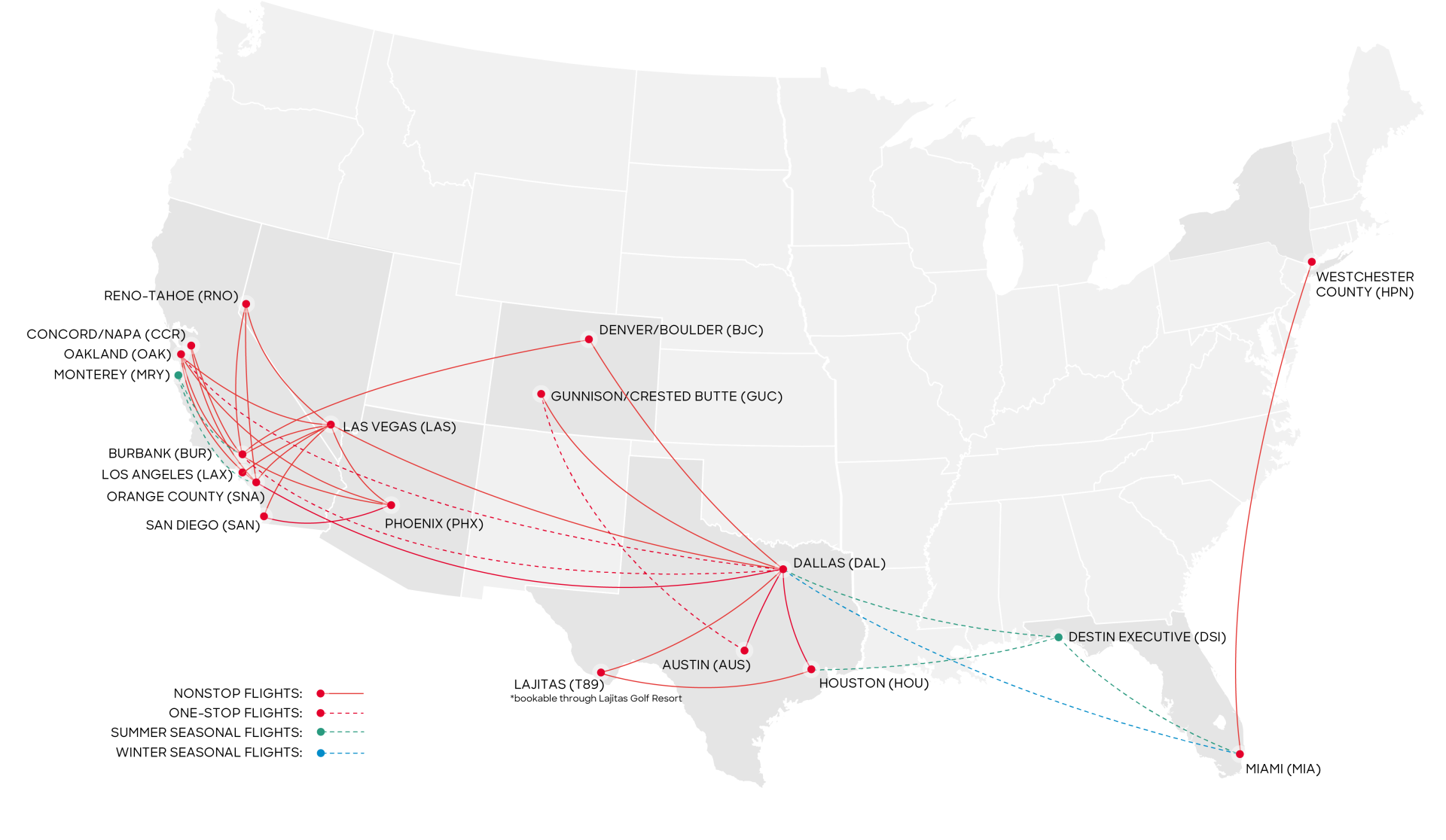
Dallas-Based JSX has announced via social media that it will be adding some new routes, and increasing some of the frequencies on a few of the routes they already operate. The airline operates a fleet of 30-seat Embraer E135s and E145s.
A JSX E-145 in Austin. The airline exclusively operates the E-145 for its intra-Texas flights. (Photo: AirlineGeeks | Mateen Kontoravdis)
New Routes
In the way of new routes, the airline has announced it will begin flights from Dallas Love Field to Miami in less than a week, on Sept. 22, 2022. These flights will operate five times a week, with flights occurring on Thursdays through Mondays, and will operate on a winter seasonal basis with services continuing until at least March of 2023. That is all in terms of new nonstop routes, but the airline is getting more into the one-stop and connecting game as the remaining two new routes are one-stop services.
The first new one-stop route they announced was Austin, Texas to Gunnison/Crested Butte in Colorado. These one-stop flights will begin on Nov. 18, 2022, and will operate between twice and four times a week depending on the week. The flight stop will be at Dallas Love Field, a route the airline operates daily from Austin. The total time from Austin to Colorado is scheduled at three hours and 55-minutes; a one-hour flight from Austin to Dallas, a 45-minute layover, and a two-hour and ten-minute flight from Dallas to Gunnison.
The second new one-stop route will be from Dallas Love Field to Oakland, Calif., and will operate daily starting Nov. 1, 2022. Flights will operate with the stop occurring in Las Vegas and the total travel time will be four hours and 50-minutes from takeoff at Dallas Love Field until landing in Oakland, which includes a 30-minute stop in the previously mentioned layover city.
Increased frequencies
The first frequency increase will be on Dallas Love Field to Gunnison/Crested Butte, Colo., and will increase to 2-to-4 flights per week. This service increase starts on Nov. 18, 2022, the same day as the new one-stop Austin to Gunnison flights, meaning this frequency increase is most likely included to help the extra inflow of passengers from Austin. The Dallas to Gunnison flights does have a hiatus of service between the summer and winter season with the last summer flights scheduled to occur on Sept. 25, 2022, and not resuming until the frequency increase in November.
The second route to see an increase in flights is Miami to Westchester County, N.Y. which will go up to five times a week on Sept. 22, 2022. Flights will operate on Thursdays through Mondays, currently, the flights only operate twice a week. This is an exciting development as less than two weeks ago American Airlines announced they would start this exact route in Jan. 2023, meaning this increase can contribute to friendly competition on this route.
JSX has been growing significantly and adding more routes recently, Dallas to Las Vegas increases to daily on Oct. 1, 2022, and they also start daily flights between Dallas and Orange County, Calif. on Sept. 29. Their route map is becoming more populated especially around their headquarters in Dallas, a place they didn’t even fly to a couple of years ago.
Joey has always been interested in planes for as long as he can remember. He grew up in Central New York during the early 2000s when US Airways Express turboprops ruled the skies. Being from a non-aviation family made it harder for him to be around planes and would only spend about three hours a month at the airport. He was so excited when he could drive by himself, the first thing he did with his driver's license was get ice cream and go plane spotting for the entire day. He graduated from Western Michigan University in 2022 with a B.S. in Aviation Management & Operations and a Minor in Business, and currently works for a major airline in his hometown.
ES-30 Aircraft in Air Canada Livery (Photo: Heart Aerospace)
Air Canada announced the signing of an agreement with Heart Aerospace of Sweden for the purchase of 30 ES-30 electric-hybrid aircraft. The battery-powered aircraft is currently under development and is expected to enter into service in 2028. With zero emissions and an expected charging time of 30 to 50 minutes, the ES-30 would be deployed on the Canadian airline’s regional network giving operational cost savings and benefits.
In a press release announcing the agreement Michael Rousseau, President and Chief Executive Officer of Air Canada said, “Air Canada has taken a leadership position in the industry to address climate change. The introduction into our fleet of the ES-30 electric regional aircraft from Heart Aerospace will be a step forward to our goal of net zero emissions by 2050.”
“Already, Air Canada is supporting the development of new technologies, such as sustainable aviation fuels and carbon capture, to address climate change,” Mr. Rousseau added. “We are now reinforcing our commitment by investing in revolutionary electric aircraft technology, both as a customer for the ES-30 and as an equity partner in Heart Aerospace.” As part of the agreement, Air Canada will acquire a $5 million equity stake in Heart Aerospace.
Anders Forslund, founder and CEO of Heart Aerospace said, “Air Canada is a strategically important partner for Heart Aerospace. The company has one of the world’s largest networks operated by regional turboprops, and it is also a progressive, future-leaning company, especially in green transmission. With the ES-30 we can start cutting emissions from air travel well before the end of this decade.”
The ES-30 is expected to have a capacity of 30 passengers with ‘an all-electric, zero-emission range of 200 km.’ The layout of the aircraft will be 2 by 1 in a 3-across configuration with the inclusion of a lavatory and a galley. With the supplementation of reserve-hybrid generators, the aircraft range of the lithium-ion battery power could be extended to 400 km and with a reduced capacity of 25 passengers a distance of 800 km may be achieved.
Heart Aerospace’s main offices and hangar facility is based at Säve Airport in Gothenburg, Sweden, and the company cites United Airlines Ventures as one of a number of investors. The company had initially been developing the ES-19 aircraft with a number of agreements and letters of intent in place with airlines. With the announcement of the development of the ES-30 the company has advised that orders from ‘United Airlines and Mesa Air Group for a total of 200 electric aircraft with an option for an additional 100 planes are reconfirmed for the updated ES-30 design.’
Scott Kirby, CEO of United Airlines said, “From the beginning Heart and United have been on the same page – with an acute focus on safety, reliability, and sustainability. Heart’s exciting new design – which includes expanded passenger capacity from 19 to 30 seats, and a state-of-the-art reserve-hybrid engine – is the type of revolutionary thinking that will bring true innovation to aviation.”
John has always had a passion for aviation and through a career with Air New Zealand has gained a strong understanding of aviation operations and the strategic nature of the industry. During his career with the airline, John held multiple leadership roles and was involved in projects such as the introduction of both the 777-200 and -300 type aircraft and the development of the IFE for the 777-300. He was also part of a small team who created and published the internal communications magazines for Air New Zealand’s pilots, cabin crew and ground staff balancing a mix of corporate and social content.
John is educated to postgraduate level achieving a masters degree with Distinction in Airline and Airport Management. John has held the positions of course director of an undergraduate commercial pilot training programme at a leading London university. In addition he is contracted as an external instructor for IATA (International Air Transport Association) and has been a member of the Heathrow Community Fund’s ‘Communities for Tomorrow’ panel.
When traveling from one end of Europe to the other, you might want to consider traveling by train. (Photo: Pixabay)
The world is expansive, and Europe is a continent that many people are drawn to. It’s home to some of the most exciting cities, diverse cultures, beautiful landscapes, and rich histories. If you’re also someone who has been exploring the idea of traveling to Europe in the near future, this blog post will offer helpful tips to get started on your next European adventure.
Use Budget Airlines Within Europe
If you’re traveling within Europe, you can save a lot of money using budget airlines. These low-cost airlines are very common in Europe and can be a great way to get around. Some European budget airlines include Ryanair, EasyJet, Wizz Air, and Norwegian. Remember that these airlines charge for everything other than the seat you’re sitting in (and sometimes that too), so travel light and be sure to read what’s included in your ticket on the website.
Also, book your flight well in advance, especially during peak seasons. This is when many people travel, so flights are more expensive and might be harder to come by.
Travel By Train
If you’re traveling from one end of Europe to the other, you might want to consider traveling by train. Trains are very common in Europe and are usually a very efficient and affordable mode of transportation. Some popular train routes include Paris to Rome, Paris to Berlin, London to Paris, and Madrid to Barcelona.
You can purchase your tickets online before arriving in Europe. Another bonus is that most trains have wifi, so you won’t be disconnected while on the trip. Again, remember that trains are often more expensive during peak season, so if possible, try to plan your trip during a less busy time.
Stay Longer In One Place
If you have a specific city you want to visit, consider staying longer in that city instead of just passing through. This will allow you to dig into the culture and see what the town offers beyond typical touristy sights. You can find home-sharing websites like Airbnb, which will enable you to stay in a local’s home for a reasonable price.
This can be a great way to experience the city like a local, and it can also be a great way to connect with other people while on your trip. During your day trips, look out for local amenities such as Barcelona bag storage to help you unload your luggage and not have to carry it with you when out and about.
Book Day Trips In Advance
If you’re visiting a specific city or area in Europe, it may be worth your while to book a day trip or two beforehand. This can be a great way to see the sights without planning a whole vacation around these excursions. Some popular day trips include visiting the Eiffel Tower in Paris, touring the Colosseum in Rome, visiting the Christmas markets in Germany, and more. Keep in mind that there are certain times of the year when certain attractions are closed. For example, the Eiffel Tower may be closed during winter due to weather conditions.
Learn Key Phrases
No matter where you’re traveling, it’s always a good idea to learn the basics of the language spoken in the area. Many free online resources are available to help you learn a new language. Some popular websites include DuoLingo, Babbel and Busuu. You can also purchase language-learning apps on your phone. This can be a great way to connect with locals, learn more about the culture, and save money while on your trip.
Final Words
If you’re someone who loves to travel and is looking for a new European adventure, hopefully, this blog post was helpful! There is so much to see and do in Europe; you should start planning your trip as soon as possible. Europe is perfect for all types of travelers, so be sure to make it a part of your next itinerary!
AirlineGeeks.com was founded in February 2013 as a one-person blog in Washington D.C. Since then, we’ve grown to have 25+ active team members scattered across the globe. We are all here for the same reason: we love deep-diving into the fascinating realm of the airline industry.
A United 777 at Dulles International Airport. (Photo: AirlineGeeks | Craig Fischer)
On Wednesday United Airlines and Emirates officially announced their new codeshare agreement at an event hosted in United’s hangar at the Washington Dulles International Airport. The agreement will connect United customers to over 100 plus destinations through Dubai and nearly 200 locations within the U.S. for Emirates customers.
The partnership between the two was initially teased on Twitter when United tweeted two “wide-eye” emojis and tagged Emirates. Emirates was quick to reply to the tweet with a “waving-hand” emoji, which quickly sparked rumors of the codeshare agreement. Additionally, United had sent a “special event” invitation to reporters titled “Come Fly With Us” with Chief Executive Scott Kirby and Emirates President Tim Clark in Washington.
“Two of the biggest, and best-known airlines in the world are joining hands to fly people better to more places, at a time when travel demand is rebounding with a vengeance. It’s a significant partnership that will unlock tremendous consumer benefit and bring the United Arab Emirates and the United States even closer,” stated Emirates President Sir Tim Clark at today’s event. “We welcome United’s return to Dubai next year, where our hub Dubai Essentially becomes a gateway for United to reach Asia, Africa and the Middle East via the combined network of Emirates and flydubai. We look forward to developing our partnership with United for the long term.”
United Airlines will launch nonstop service between its New York hub at Newark Liberty International Airport and Dubai. For the 6,852-mile journey, the carrier will utilize its 276-seat Boeing 777-200ER aircraft configured with 50 Polaris class seats (business), 24 Premium Plus seats, 46 Economy Plus seats and 156 Economy seats.
Beginning on March 27, 2023, United will offer once-daily flights between the city pairs. Traveling east, the flight is blocked at 13 hours and 25 minutes and 14 hours and 50 minutes heading west. UA164 will depart Newark at 10:15 p.m. arriving the following day at 7:40 a.m. UA163 is set to depart Dubai at 2:15 a.m. with arrival in Newark at 9:05 a.m.
The aircraft will be stationary in Dubai for a long period of time, but the schedules into, and in particular out of Dubai are intended to mesh with banks of incoming and outgoing flights operated by Emirates, proving connectivity to the airline’s network.
Once in Dubai, United customers will have the option to travel to upwards of 100 destinations served by Emirates itself or its sister company, flydubai.
“United’s new flight to Dubai and our complementary networks will make global travel easier for millions of our customers, helping boost local economies and strengthen cultural ties,” stated United Airlines CEO Scott Kirby. “This is a proud moment for both United and Emirates employees, and I look forward to our journey together.”
Emirates customers will have much more ease connecting through a few of its currently served cities of San Francisco, Chicago and Houston. The agreement will allow customers to connect to nearly 200 cities on a single ticket, allowing for a simpler and quicker check-in and luggage transfer process.
Additionally, the two carriers will also have interline agreements on the remaining eight destinations served by Emirates – New York, Boston, Orlando, LA, Miami, Dallas, Seattle and Washington D.C.
Chase Hagl grew up in Twin Falls, Idaho. His love and passion for Aviation landed him in Orem, Utah where he obtained a B.S. in Aviation Management with a minor in Business Management from Utah Valley University. Chase currently works as a flight attendant in Charleston, SC and is also the primary Inflight ASAP ERC representative for startup airline, Breeze Airways. His experience in the aviation industry spans back four years, working in areas including agriculture application, customer service, maintenance, and flight ops. In his free time, Chase enjoys road biking, astronomy, and flying.
Sign-up for newsletters & special offers!
Get the latest stories & special offers delivered directly to your inbox