An Air India Boeing 777-300ER in Washington D.C. (Photo: AirlineGeeks | Ben Suskind)
Air India failed a recent safety audit at Delhi Airport, prompting the Directorate General of Civil Aviation (DGCA), Indian aviation’s regulatory body, to make the decision to prohibit the airline from transporting any goods deemed “dangerous” to the city for 15 days. The airline failed to pass an audit measuring its compliance with ICAO guidelines, prompting the decision. The prohibition will be in effect from April 7 to April 23.
Hazardous Terrain
Following a DGCA examination of its handling facilities at Delhi Airport, Air India’s authorization to handle hazardous items has been suspended for 15 days, according to the Times of India. Certain things, ranging from combustible commodities to radioactive materials, need authorisation to be transported in airline cargo holds.
According to sources, Air India’s hub lacked storage room to segregate hazardous and radioactive commodities, as well as skilled people to handle non-risk goods and an emergency management system. These are only a few of the problems that resulted in the carrier’s license being revoked. To continue transporting sensitive products in and out of Indian airports, all Indian airlines must pass inspections.
An AI representative stated in a statement, “A normal DGCA audit was conducted in Delhi for multiple departments. Regarding our domestic freight facility in Delhi, the regulator has made certain remarks. This is being followed as well.”
ICAO Regulations
Aviation authorities, such as the DGCA, follow International Civil Aviation Organization requirements for flying hazardous materials. When it comes to managing these potentially delicate or hazardous items, this assures that airlines, sending and receiving airports are all on the same page.
When cabin workers make statements about lithium-ion batteries aboard airplanes, passengers may have had a glimpse of these laws in operation. Power banks and other batteries must be transported in handbags to avoid creating a cargo hold fire. Flights are equipped with lockable bags to enclose the batteries and put out any fire or smoldering in the event of a mishap aboard.
Air India’s Turnaround Strategy
Air India now has 15 days to remedy the errors discovered during the audit and request to have its suspension removed. Given the potential effect of such a suspension on the airline’s profitable cargo operations, the company is likely to resolve its concerns. The airline is also in the midst of a 100-day turnaround effort that started in January, after its purchase by the Tata Group.
The loss-making airline has long struggled to invest in world-class infrastructure, something the Tatas intend to rectify in the near future. Fixing serious problems like this one will take precedence till then.
Putu Deny Wijaya was always an aviation enthusiast by heart, growing up in Indonesia where air transport is very vital. His first love is The Queen of The Skies, serving the trunk routes between Jakarta and Denpasar. He brought along this passion with him throughout college by conducting his bachelor study abroad in the Netherlands for the purpose of experiencing a nonstop 14-hour long-haul flight. For Putu the sky's the limit when talking about aviation. He hopes that he would be able to combine his passion for aviation and knowledge of finance at the same time.
A LATAM Boeing 777 on approach to Amsterdam.
(Photo: AirlineGeeks | Fabian Behr)
LATAM will begin training and certifying their employees in dealing and assisting families who fly with autistic travelers. The airline is working alongside the U.S. organization Autism Double-Checked to make sure that airline personnel meet the requirements of handling and understanding autistic passengers on LATAM flights.
The airline says that the point of this mission is to continue to foster an environment of inclusivity, respectfulness and appreciation for LATAM employees. LATAM employees will work towards the notion of creating empathetic assistance towards autistic passengers and in doing so will become the first airline in the region to get the Autism Double-Checked green light for its clients in the future.
When asked to talk about the achievement, LATAM CEO Roberto Alvo said, “At LATAM, we dream of a world that does not discriminate, but rather includes; where all people have the same opportunities and are respected and accepted in any environment. Our relationships are based on respect, welcome and empathy for all people, without exception. This vision has led us to begin this process that will allow us to move towards a more inclusive group. We hope to become an even more diverse LATAM from within, supporting the inclusion of people with disabilities in the workplace in the future.”
The LATAM training will take part in three separate core focuses, being Autism Aware, Autism Ready and Autism Double-Checked. Autism Aware will focus on understanding sensitivity tools and traits that can be seen in autistic travelers. Autism Ready provides job-specific training and reading situations that may unfold and necessary steps to help the passenger in these events. Finally, Autism Double-Checked will public information about LATAM’s autism understanding and the help they can provide when marketing the airline to those passengers with needs.
A LATAM 767-300 arrives in São Paulo/Guarulhos. (Photo: AirlineGeeks | João Machado)
A New Horizon
Formed by Alan Day and David M. Tait, OBE, the Autism Double-Checked program focuses on creating travel experiences for families with autistic family members and creating vacations that allow those traveling to enjoy the experience without hassle. The program allows families to be in an environment where staff understand the autistic person’s issue and can assist with any problems without causing issues for the family in the process. The Autism Double-Checked program plans to release a searchable directory in the future of data collected about brands that are autism aware in the leisure and travel industry.
“We are very pleased and impressed with LATAM’s understanding of travel for people with special needs, and the role that they are playing in creating a better onboard environment for autistic passengers. Families with autistic people are eager to travel, and LATAM is opening up new opportunities to this community. With this, LATAM is also demonstrating how much they value their employees by empowering them with professional training. Their leadership in the airline industry is admirable,” noted Autism Double-Checked co-founder Alan Day.
Although Ian McMurtry was never originally an avgeek, he did enjoy watching US Airways aircraft across western Pennsylvania in the early 2000s. He lived along the Pennsylvania Railroad and took a liking to trains but a change of scenery in the mid-2000s saw him shift more of an interest into aviation. He would eventually express this passion by taking flying lessons in mid-Missouri and joining AirlineGeeks in 2013. Now living in Wichita, Kansas, Ian is in college majoring in aerospace engineering and minoring in business administration at Wichita State University.
AirAsia Malaysia is planning a comeback to Indian airports. In the next months, the airline has big ambitions for India.
AirAsia Malaysia recently welcomed the restart of flights to India, with the airline’s executives declaring ambitious future plans. The airline has already resumed flights to certain South Indian towns, with others slated to begin in the coming weeks. AirAsia hopes to develop a stable network between Malaysia and India by the end of this year, buoyed by an increase in international travel.
India has resurfaced on the world map.
AirAsia Malaysia has resumed flights between Kuala Lumpur and a number of Indian cities, boosting direct connection between the two countries. The airline has reopened flights to India following a two-year break because of the COVID-19 epidemic, as previously reported.
On April 13th, Bo Lingam, Group CEO of AirAsia Aviation Group Limited (AAAGL), and Riad Asmat, CEO of AirAsia Malaysia, met with Ms. C. Sushma, Chargé d’Affaires of the High Commission of India in Kuala Lumpur, Malaysia, to celebrate the restart of services between the two nations. Ms. C. Sushma expressed her thoughts as follows:
“With the opening of both countries’ borders, we are confident that two-way traffic will resume smoothly and grow progressively. This is an important step in reconnecting India and Malaysia as people-to-people connectivity lie at the foundation of this important partnership.”
On April 1st, AirAsia Malaysia began flying between Kuala Lumpur and Bengaluru (2x weekly) and Chennai (4x weekly), as well as Tiruchirappalli (4x weekly). On April 18th, April 22nd, and May 1st, respectively, flights to Kochi (1x weekly), Kolkata (1x weekly), and Hyderabad (4x weekly) will begin.
From next month, AirAsia will begin five new flights between India and Thailand. On May 1st, flights from Jaipur and Kochi to Bangkok will begin, followed by flights from Kolkata on May 2nd. On May 4th, additional services from Chennai and Bengaluru to Bangkok will begin.
The Future Is Being Conceived
In the following months, Asmat intends to develop a stable network between India and Kuala Lumpur. Noting the carrier’s significance in the Indian market, he said that AirAsia will continue to assess and extend its network to meet the growing demand for air travel, which would include the introduction of 30 total weekly flights from Malaysia to India by the end of May.
He also said that AirAsia Malaysia will soon return to pre-Covid capacity, operating more than 140 weekly flights to and from India, with a total of 71 weekly flights planned by the end of 2022.
Carriers Benefit from Open Skies
Both India and Malaysia have eased entrance rules, allowing airlines to resume lucrative routes that had previously been halted. While India’s government reopened its international borders to tourists in October 2021 and its commercial airspace to scheduled foreign flights on March 27, 2022, Malaysia’s border reopened to international passengers on April 1st.
The India-Malaysia route sees a lot of passenger traffic, and AirAsia would want to take advantage of it once again. The group’s long-haul budget carrier AirAsia X will begin flights to New Delhi on April 20th, so it’s not only South India that’s getting the love.
Putu Deny Wijaya was always an aviation enthusiast by heart, growing up in Indonesia where air transport is very vital. His first love is The Queen of The Skies, serving the trunk routes between Jakarta and Denpasar. He brought along this passion with him throughout college by conducting his bachelor study abroad in the Netherlands for the purpose of experiencing a nonstop 14-hour long-haul flight. For Putu the sky's the limit when talking about aviation. He hopes that he would be able to combine his passion for aviation and knowledge of finance at the same time.
Qantas Will Begin Flying to Seoul and Bengaluru in The Near Future.
A Boeing 787 departing London Heathrow [Photo:AirlineGeeks | James Dinsdale]
Qantas said on Friday that flights between Sydney and Bengaluru would begin in September, while flights between Sydney and Seoul will begin in December, marking a return after a 14-year hiatus. Since resuming international flights, Qantas has added six additional international routes or is planning to do so.
In December, Qantas will begin flying to Seoul
Qantas stated on Friday morning Sydney time that it will begin flying its A330s to Seoul on December 10. A search of the Qantas booking system indicates A330-300 flights departing Sydney (SYD) on Tuesdays, Thursdays, Saturdays, and Sundays. That aircraft, QF87, will depart at 09:35 for a journey of 10 hours and 45 minutes to Seoul (ICN), arriving at 18:20. The A330 returns to Sydney after 90 minutes on the ground to execute QF88. The Airbus departs ICN at 19:50 for an overnight journey to Sydney, arriving at 08:15 the next morning. Jetstar’s low-cost affiliate has added additional Seoul flights to complement Qantas’ offerings. Jetstar’s Boeing 787-8 Dreamliner will fly three times a week between Sydney and Seoul starting November 2. Qantas last flew to Seoul on a regular basis in 2008, but CEO Alan Joyce claims that South Korea is Australia’s fourth-largest business partner and that Koreans consider Sydney to be one of the best tourist destinations in the world.
“With expected strong business, premium leisure, and low-cost travel demand on the route, we see an opportunity for both Qantas and Jetstar to fly on the route,”, the Qantas CEO, Alan Joyce, commented.
From September, Qantas will provide flights between Sydney and Bengaluru.
Meanwhile, after the debut of flights to Delhi (DEL) late last year, Qantas is establishing another another route to India. This time, Qantas is partnering with IndiGo, and flights between Sydney and Bengaluru (BLR) will begin on September 14. QF67, which will be operated by an Airbus A330-200, will leave Sydney four times a week at 09:30 on Wednesdays, Fridays, Saturdays, and Sundays. At 16:55, the Airbus will arrive at BLR after 11 hours and 55 minutes in the air.
The return flight, QF68, leaves Bengaluru on the same days. The plane will depart at 18:35 and travel southeast through the night, arriving in Sydney at 10:30 the next day. Bengaluru is home to 13 million people, according to Qantas, and the burgeoning technology and financial services centre has significant ties to Australia, but no direct flights.
“As economic and investment linkages between Australia and India’s population of over one billion people increase, the signing of the Australia-India free trade agreement is a driver of travel demand,” says Alan Joyce.
“Our new direct flights to Bengaluru, together with our planned codeshare with IndiGo, have the potential to completely transform how many people travel between Australia and India.”
All three new routes are supported by the NSW Aviation Attraction Fund, which is co-funded by the State Government and Sydney Airport. Qantas’ Sydney-Bengaluru flights have also been backed by Bengaluru’s Kempegowda International Airport.
Qantas is reorganizing its worldwide network.
Qantas is taking advantage of the relaunch of its international flights to reorganize its network. Since resuming international service late last year, the airline has launched or plans to launch six new international routes, including Darwin-Dili, Melbourne-Dallas-Fort Worth, Sydney-Bengaluru, Perth-Rome, Sydney-Seoul, and Melbourne-Delhi.
Meanwhile, Qantas said on Friday that in April, its international capacity (including Jetstar) would exceed 40% of its pre-COVID capacity. Since Australia’s borders reopened last November, headed by New South Wales, the Qantas Group has transported almost 500,000 passengers on 27 foreign itineraries, with another six routes resuming next week, according to the airline.
Mr. Joyce said, “It’s apparent that Australia is back on the map for foreign tourists.” “Since the borders reopened, demand for our foreign flights has recovered, giving us the confidence to establish these additional routes.”
Putu Deny Wijaya was always an aviation enthusiast by heart, growing up in Indonesia where air transport is very vital. His first love is The Queen of The Skies, serving the trunk routes between Jakarta and Denpasar. He brought along this passion with him throughout college by conducting his bachelor study abroad in the Netherlands for the purpose of experiencing a nonstop 14-hour long-haul flight. For Putu the sky's the limit when talking about aviation. He hopes that he would be able to combine his passion for aviation and knowledge of finance at the same time.
Interview: Oneworld CEO on Pandemic Response and Environmental Sustainability
Royal Air Maroc Boeing 737-800 in oneworld livery at Murtala Muhammed International Airport, Lagos, Nigeria.
(Photo: AirlineGeeks.com | John Flett)
The Oneworld alliance currently has fourteen member airlines serving a network of over 1000 destinations in more than 170 territories. Following an event in Nigeria to celebrate Royal Air Maroc’s second anniversary of membership in the alliance, Airline Geeks asked Oneworld chief executive officer Rob Gurney for comments on the response to the coronavirus pandemic by the alliance and the overall airline industry. Mr. Gurney was also asked to comment on what he saw as the main learnings that indicate things must change significantly for the benefit of Oneworld and the wider aviation industry.
AirlineGeeks [AG]: What do you feel the Oneworld alliance did well and is doing well in response to the pandemic?
Rob Gurney [RG]: In 2020, our immediate priority amid the onset of the pandemic was to support our member airlines and establish the groundwork for the enablers to support strategic recovery from the pandemic. We also took a fiscally prudent approach to conserve cash but maintain all critical operations.
We partnered closely with our member airlines on strategic recovery initiatives to enable the restart of travel. For example, we launched a COVID-19 testing trial with American Airlines and British Airways to demonstrate the role that testing can play to safely reopening travel. In 2021, we partnered with member airlines to develop a solution that will facilitate the exchange of health credential solutions on connecting journeys, eliminating duplicative checks of customers’ health credentials at the transit point.
As global travel resumes, we are progressing a number of strategic initiatives that will deliver further value to member airlines and customers, details for which we will share in due course.
AG: In broad terms what do you feel the airline industry did well?
RG: At the beginning of the pandemic, the industry took quick action to right-size its capacity and protect its liquidity when faced with a difficult operating environment marked by rapidly changing government travel restrictions that impacted consumer travel demand. This further underlines the agility and resilience of the airline industry, following several challenges in the past two decades. The industry also quickly implemented health and well-being measures to ensure the safety of customers, including the wearing of masks and increased/enhanced cleaning, and actively communicated them.
As an industry, we continued to demonstrate how partnerships make us stronger. Airlines actively partnered across the industry in advocating for the safe restart of travel, speaking as one voice. Within Oneworld, partnerships among member airlines grew significantly notwithstanding the pandemic, for example, the partnership between American Airlines and Qatar Airways and the West Coast alliance between Alaska Airlines and America.
As a global alliance, we worked closely with our counterparts at SkyTeam and Star Alliance in advocacy efforts and raising customer awareness of what our member airlines were doing to keep customers safe onboard. As global travel gradually resumes, we firmly believe that partnerships will occupy an even more important position in airlines’ strategic plans, particularly as they emerge with smaller networks and fleets.
AG: What do you see as the main learnings that indicate things must change significantly for the benefit of Oneworld and the wider aviation industry?
RG: Environmental sustainability and the role played by the aviation industry came into greater focus during the pandemic, despite a significant reduction in flight activity. There is an immense opportunity for the airline industry to take a leadership role in this space, beyond the efforts that are already in progress.
As an alliance, we are strongly committed to advancing sustainability and that is why we made a commitment to net zero emissions by 2050, about six months after the start of the pandemic. We have continued to build upon this commitment with a sustainable aviation fuel target (10% by 2030) and joint SAF sourcing and procurement with our member airlines. In the future, we intend to announce additional initiatives to further demonstrate the strength of our commitment to sustainability.
The author’s trip to Morocco and Nigeria was provided by Royal Air Maroc.
John has always had a passion for aviation and through a career with Air New Zealand has gained a strong understanding of aviation operations and the strategic nature of the industry. During his career with the airline, John held multiple leadership roles and was involved in projects such as the introduction of both the 777-200 and -300 type aircraft and the development of the IFE for the 777-300. He was also part of a small team who created and published the internal communications magazines for Air New Zealand’s pilots, cabin crew and ground staff balancing a mix of corporate and social content.
John is educated to postgraduate level achieving a masters degree with Distinction in Airline and Airport Management. John has held the positions of course director of an undergraduate commercial pilot training programme at a leading London university. In addition he is contracted as an external instructor for IATA (International Air Transport Association) and has been a member of the Heathrow Community Fund’s ‘Communities for Tomorrow’ panel.
BOC Aviation Limited orders A320neo | Photo: Airbus
Bank of China Aviation (BOC Aviation) recently announced it will add 80 Airbus A320neos to its fleet. BOC Aviation is one of the largest aircraft leasing companies worldwide, managing 530 Boeing and Airbus aircraft operating across the globe. This brand new order will be the largest order ever placed by BOC Aviation.
The order consists of 20 A320neo, 50 A321neo, and 10 A321XLR. Those jets are highly acclaimed by carriers, and they are in high demand in the market now.
Continued Partnership
“We are proud to continue our long-standing relationship with Airbus, with whom we have partnered for more than 26 years,” said Robert Martin, Managing Director and Chief Executive Officer of BOC Aviation in the joint news release with Airbus.
Headquartered in Singapore, BOC Aviation already holds 125 Airbus A320neos, 33 of which are yet to be delivered. A320neo series jets are extremely popular among carriers, and the family already received over 7,900 orders worldwide. Boeing has its 737MAX to compete with Airbus A320. However, fatal crashes caused by its Maneuver Characteristics Augmentation System (MCAS) followed by the prolonged grounding of 737MAX made Boeing finds itself in second place in a two-person race.
High Demand Jet
BOC Aviation did not specify the end customer for those jets. BOC Aviation has customers around the world, and its main customers are carriers in Asia. The three state-owned carriers of China, Air China, China Southern, and China Eastern announced their ambitious fleet expansion plan, despite the record-high loss they made in 2021.
Air China, in its year-end report, laid out a plan to add 17 Airbus A320neo series jets in 2022. Additionally, the carrier will also introduce 9 Airbus A350s. Albeit the disappointing results of over a billion dollars loss, the airline is still maintaining a high rate of fleet expansion.
China southern planned 12 deliveries of the Airbus A320neo series in 2022. It also plans to receive 39 new Boeing 737MAX. Recently, China southern announced that it will retire all its Airbus A380 fleet due to high operating costs. The carrier is optimizing its fleet with more flexible and economical types of aircraft.
As the international oil price continues to fluctuate at a high position, airlines are motivated to upgrade their fleets to reduce fuel costs. Airbus A320neo reduced 20% of fuel consumption as well as CO2 emissions compared to the previous generation of Airbus A320ceo. With this advantage, Airbus developed A321LR and A321XLR, using the saved fuel to extend the range of aircraft. A321XLR is capable of flying 8,300km, which is 40% further than the previous generation of A321.
As the world continues to recover from the Covid-19 pandemic, the traveling demand is bouncing back dramatically. The market is no longer the same as we see before the pandemic. With the help of aircrafts such as Airbus A321XLR, international or even intercontinental flights are not only the privilege of mega-metropolis anymore. More and more cities will be connected with mid-level, long-range aircraft, and the dynamic will continue to fuel the future growth of the global aviation market.
Lei is from Inner Mongolia, China, and now lives in Guangzhou. He grew up in an aviation family, where his passion began. During his time at Penn State University, he studied Industrial Engineering specializing in operations research, and he graduated with an honor’s thesis on airport gate assignment optimization. Now, he is a Purchasing Manager with Procter & Gamble. In his free time, he enjoys flying, reading, and wandering around the city.
Behind-the-Scenes at “Hawai’i’s Hometown Airline” in Honolulu
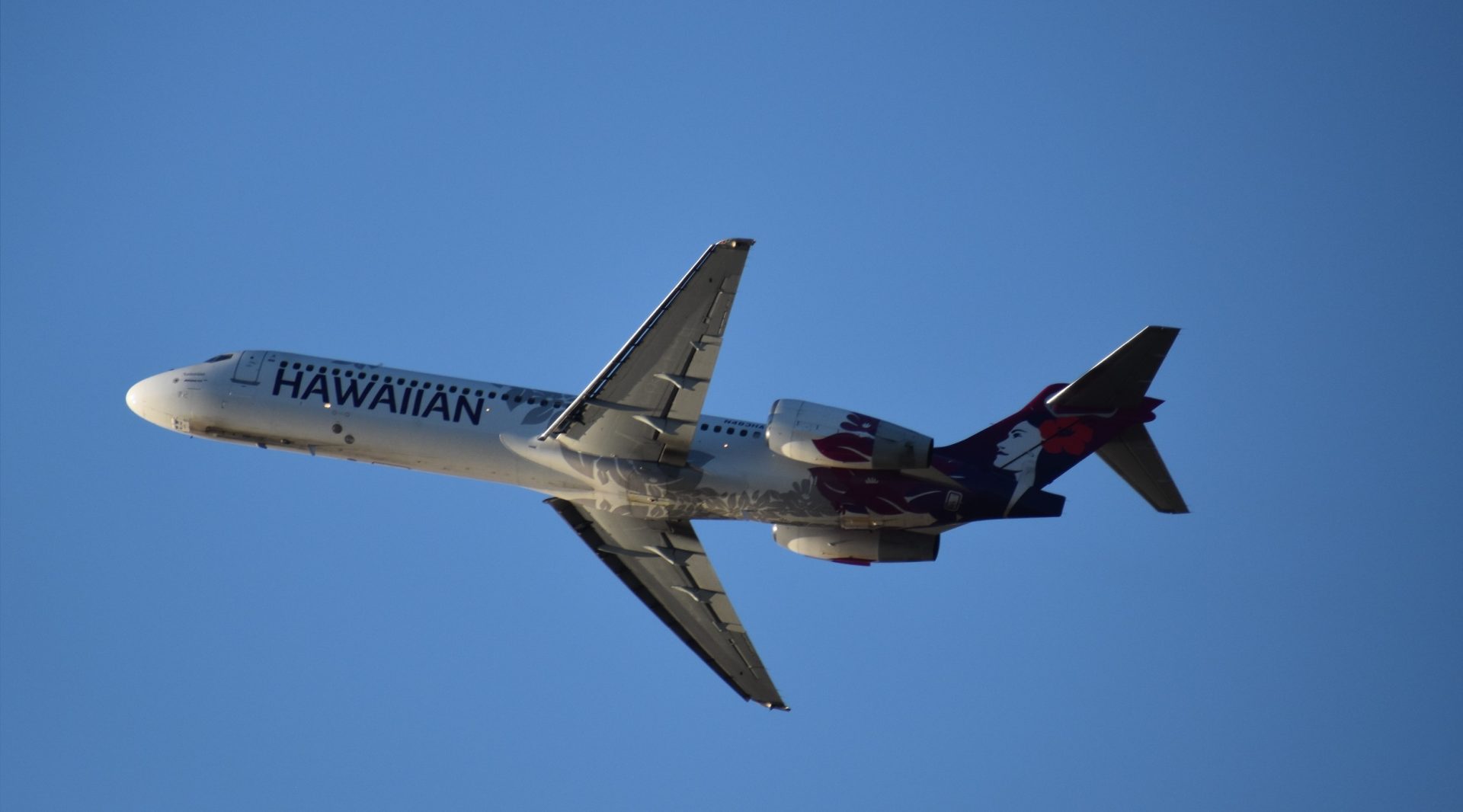
A Hawaiian Airline Boeing 717 inside the hangar at Honolulu Intl. (Photo: AirlineGeeks | Joey Gerardi)
An AvGeek couldn’t visit the Hawaiian Islands without thinking about the airline that carries the namesake of them, Hawaiian Airlines. Based in Honolulu on the island of O’ahu, the airline spans across the Pacific Ocean in all directions and now with the global pandemic finally calming down, the airline has begun to expand once again.
We had a chance to have an in-person interview with Alex Da Silva, the Director of Communications with Hawaiian Airlines, and ask him some burning questions regarding their operation.
AirlineGeeks (AG): Pilot shortages are hitting many airlines hard. Has Hawaiian Airlines felt this shortage, and if so, how are you dealing with it?
Alex Da Silva (ADS): We are targeting to hire 80-100 pilots in 2022. Despite the competitive landscape in hiring pilots, we are still seeing, for every pilot we hire, 7 times the number of applicants. Our location, fleet type, safety record, and company culture continue to allow us to attract pilots and we don’t anticipate any issues in meeting our staffing plan.
(AG): The Boeing 717 aircraft are getting up there in years. What are the airlines’ plans with these aircraft, is a replacement in order, or will you fly them as long as possible and refurbish them?
(ADS): We expect our 717s to be with us at least through the middle of this decade. Any 717 fleet replacement aircraft will depend on several factors including capabilities, performance, seat count, and operating and ownership costs. Our 717 provides us reliability, durability, and high density at 128 seats and remains a perfect aircraft for the Neighbor Island mission.
A Hawaiian Airlines Boeing 717 departing Honolulu Intl. (Photo: AirlineGeeks | Joey Gerardi)
(AG): What aircraft are you looking into replacing them with?
(ADS): We are currently evaluating similarly sized narrowbody and regional aircraft but don’t have any frontrunners currently.
Hawaiian Airlines has shown that it can take care of its older aircraft and keep them running for many MANY years. Hawaiian’s first-ever aircraft, a 1929 Bellanca CH-300 Pacemaker is still airworthy and resides with the airline at the Honolulu Intl. Airport and will occasionally fly around the island of O’ahu
A 1929 Bellanca, Hawaiian Airlines’ first aircraft (Photo: AirlineGeeks | Joey Gerardi)
(AG): When will the Boeing 787 be introduced into the Hawaiian fleet?
(ADS): We have pushed the delivery of our first two 787s from the end of 2022 to the first half of 2023. We have not finalized this timing with Boeing, but this is our planning assumption. We do not anticipate any changes to the aircraft deliveries for the rest of the orders with 3 in 2024, 3 in 2025, and 2 in 2026.
(AG): What routes will the Boeing 787 be introduced onto first?
(ADS): It will be flying to high-density and long-haul markets – routes where we can maximize its fuel efficiency, range, and seating capacity. We will also be rotating the aircraft through our U.S. mainland maintenance bases.
A visual mock-up image of Hawaiian’s first 787-9 (Photo: Hawaiian Air)
(AG): Is Europe a possibility with the 787?
(ADS): While the aircraft has the range, Europe is not part of our current 787-9 plans and we believe the aircraft will allow us to continue to grow within our existing Asia-Pacific and U.S. mainland footprint.
(AG): You stopped Ohana by Hawaiian during the pandemic, will you eventually look back into this once air travel recovers?
(ADS): While we continue to explore opportunities to return to Lāna‘i and Moloka‘i, and to reconnect all islands as Hawai‘i’s carrier, we don’t have any plans to resume service in the near future.
‘Ohana by Hawaiian’s ATR-42 (Photo: Hawaiian Airlines)
(AG): Does Hawaiian plan on partnering with Mokulele/Southern to access passengers in smaller inter-island destinations you don’t serve?
(ADS): When we ceased operations, we supported Mokulele Airlines by lending it some of our ground support equipment. We also considered possible partnerships but could not formulate a feasible arrangement.
(AG): Are there any other domestic or international destinations Hawaiian is looking into for the near future?
(ADS): We are excited by the response we’ve received in Austin, Orlando, and Ontario, California – three U.S. mainland markets nearing their one-year anniversaries. We are focused on maturing these new domestic markets and staying ready to resume more service in Japan and South Korea as border restrictions relax, and eventually returning to New Zealand.
We would like to note, that since this interview was conducted the airline has announced the date it plans on resuming service to Auckland, New Zealand. Flights to New Zealand will resume on July 2, 2022, and operate on a three times weekly basis using the Airbus A330.
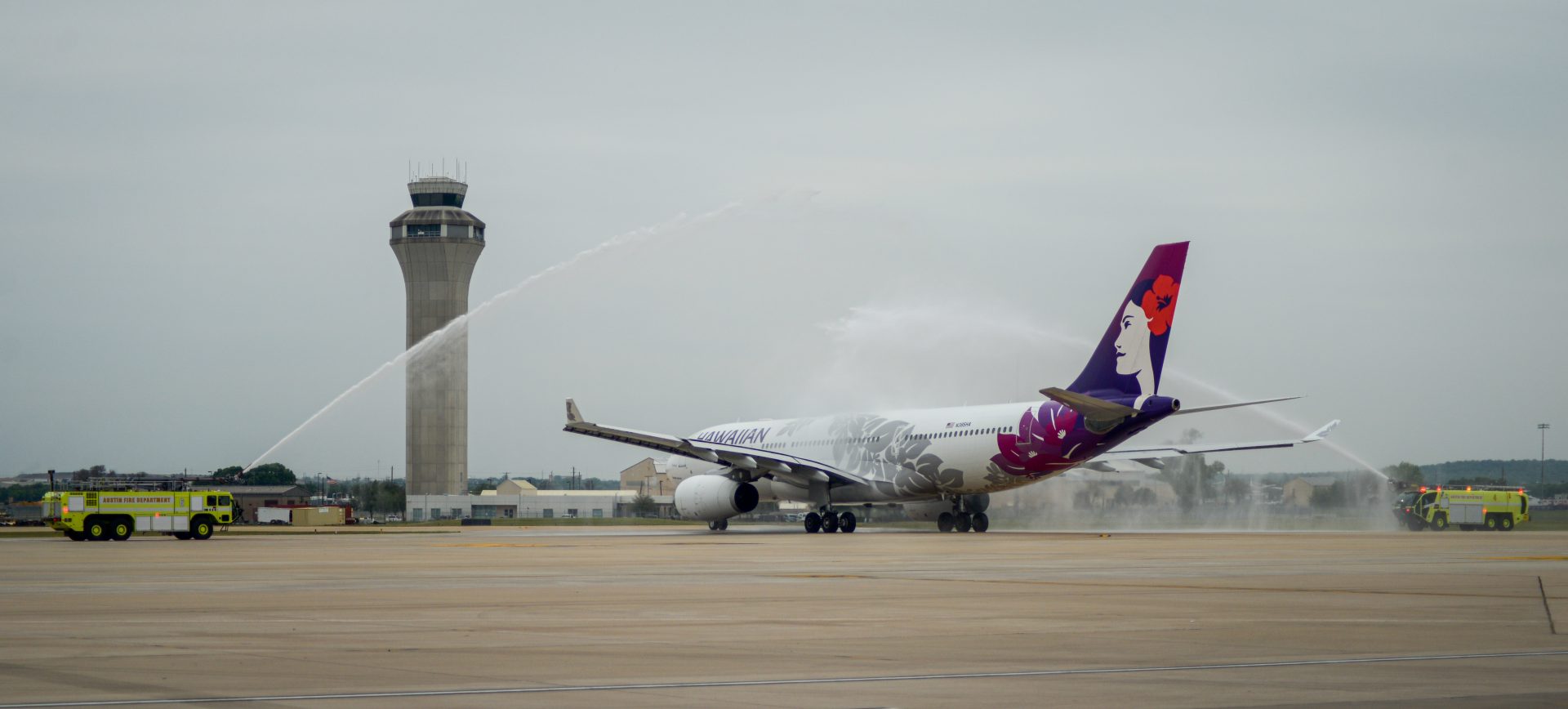
The inaugural Hawaiian Airlines flight from Austin departed on April 22 and received a celebratory water cannon salute. (Photo: Austin Airport)
(AG): What is your busiest route?
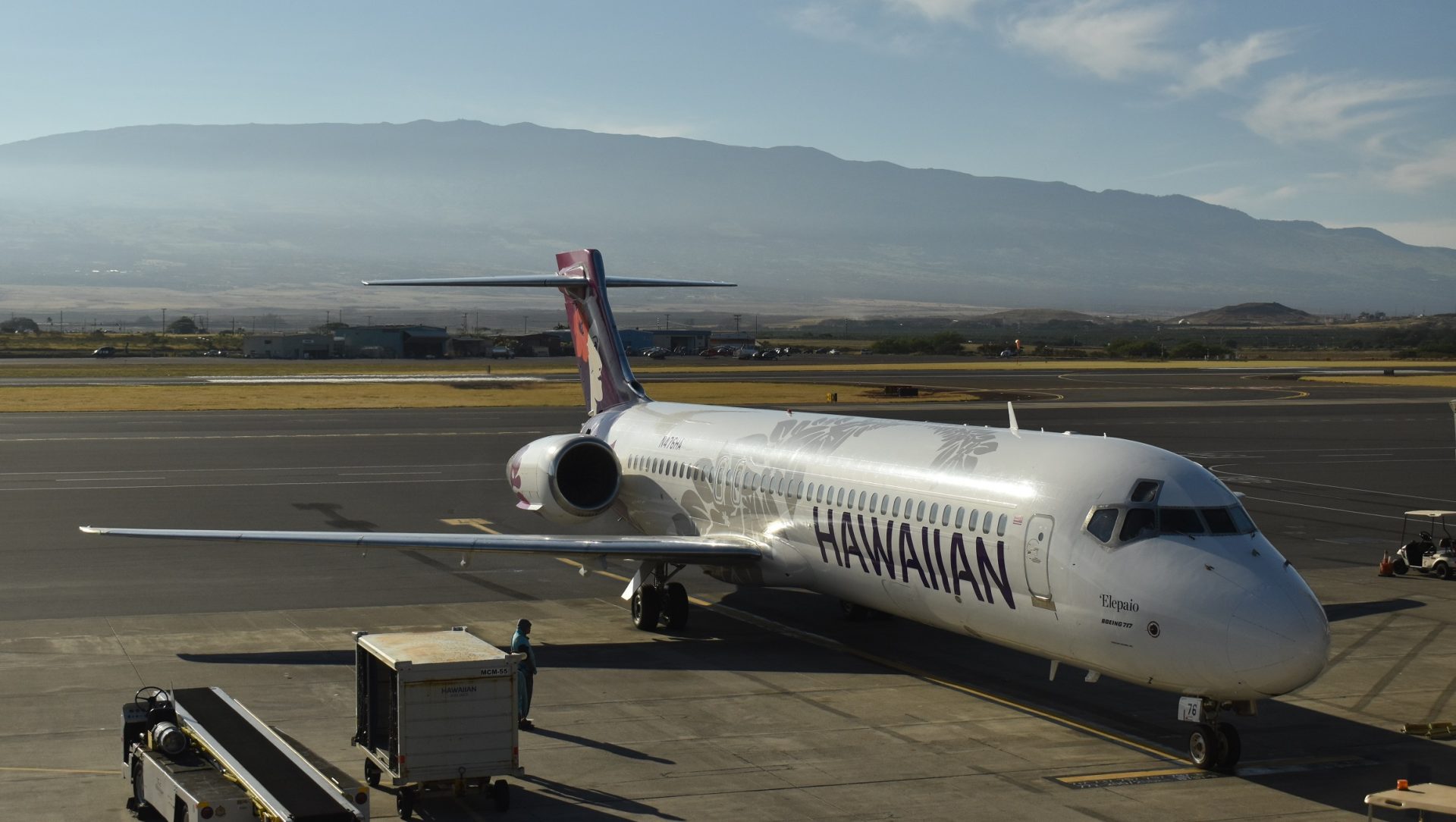
(ADS): By far, that would be Honolulu to Kahului. The route operates over 20-daily flights in each direction and is served by every aircraft in our fleet, Boeing 717, Airbus A321, and occasionally our Longhaul Airbus A330. Although all aircraft do fly the route, 98% of the time it’s on our inter-island workhorse, the Boeing 717.
A Hawaiian Airlines Boeing 717 in Kahului (Photo: AirlineGeeks | Joey Gerardi)
(AG): Would you say that more tourists or locals fly inter-island on Hawaiian?
(ADS): I would say it’s a healthy mix. In the early mornings and late evenings, it tends to lean slightly more towards the locals that use us to commute between the islands for jobs, and through the middle part of the day, we do see slightly more tourists.
(AG): Hawai’i is known for its Aloha spirit and hospitality. How does Hawaiian Airlines incorporate this into not only your brand but for your onboard experience?
(ADS): As Hawai‘i’s hometown carrier, we are proud to connect people with aloha by welcoming our guests onboard our aircraft with our distinct and warm Hawaiian hospitality. Guests boarding our aircraft are surrounded by the sights, sounds, and tastes of the islands, from the soothing Hawaiian music we play during boarding and deplaning, to our complimentary, island-inspired meals, as well as exclusive Hawai‘i-made products and cabin designs that pay homage to our archipelago. Our employees, most of whom were born or raised in Hawai‘i, innately deliver our service with genuine aloha and excitement to introduce travelers to our islands.
Economy Class cabin onboard Hawaiian’s new A321neo aircraft. (Photo: Hawaiian Airlines)
While in Honolulu, AirlineGeeks also had the pleasure of touring the carrier’s maintenance base, led by the director of base maintenance Brian Kirkpatrick. We got to see some of the unique aspects of the Hawaiian maintenance operation. The airline does most of its maintenance, inspections, and cabin refurbishments in-house right in Honolulu.
Entrance to the maintenance base (Photo: AirlineGeeks | Joey Gerardi)
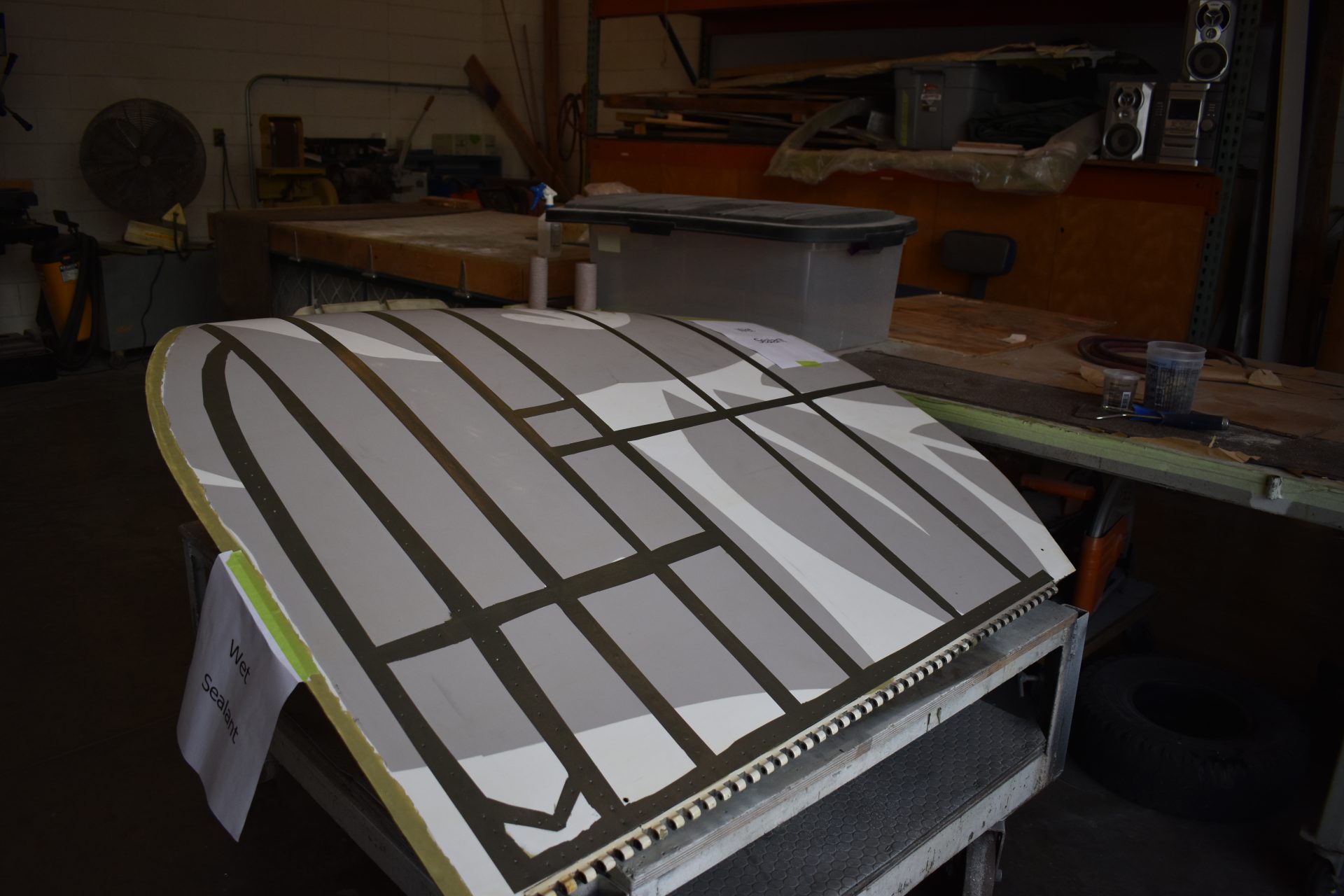
Due to the climate and the Pacific Ocean, each aircraft has a special sealant over seams, bolts, and screws to add an extra layer of protection against the ocean spray and salty ocean air. This also keeps the maintenance costs down as they don’t have to replace items more often due to corrosion.
Baggage door of a Boeing 717 getting sealant put on (Photo: AirlineGeeks | Joey Gerardi)
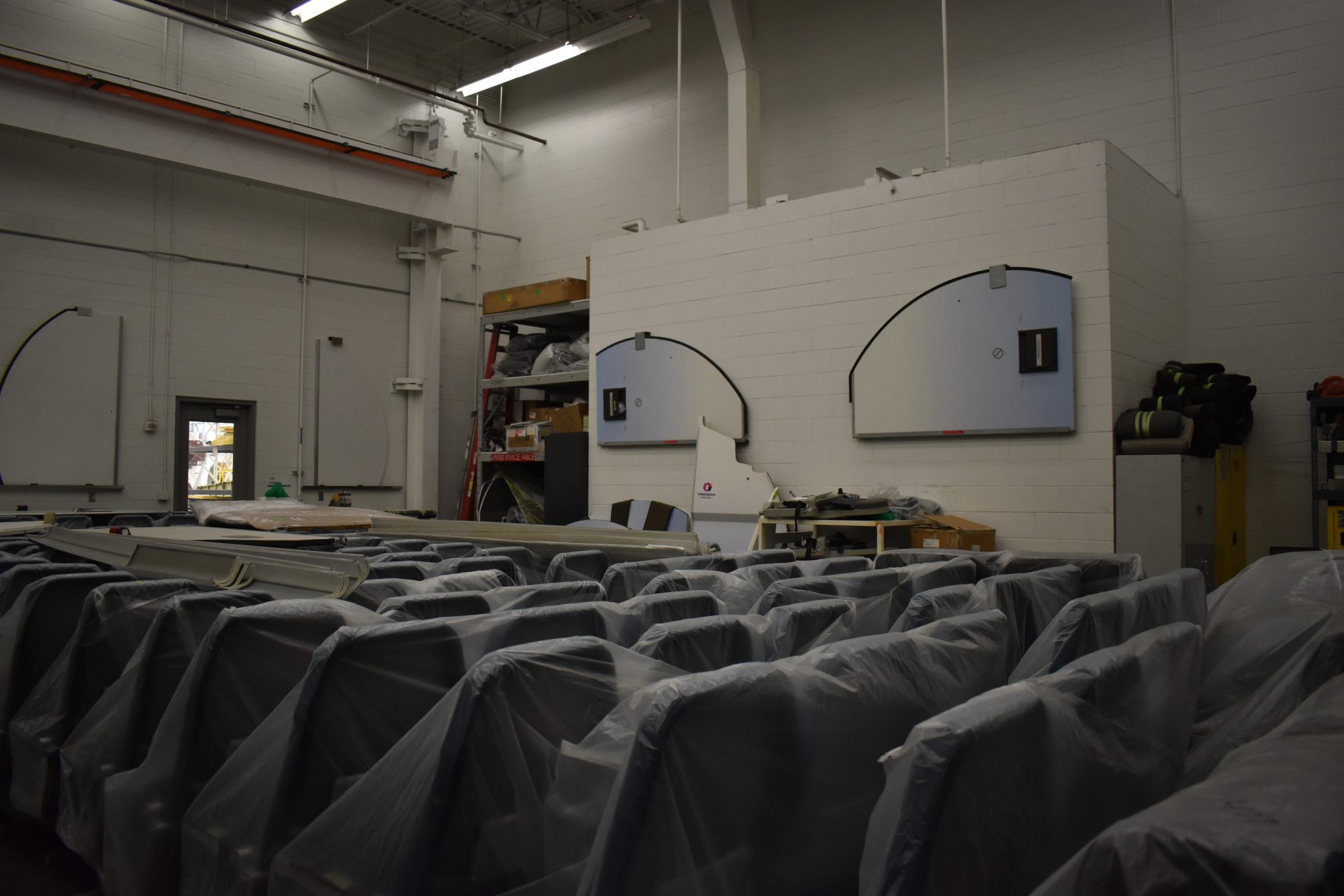
In addition to the cabin refurbishment, they also reupholster all the passenger seats at the base.
Seats waiting to be reupholstered (Photo: AirlineGeeks | Joey Gerardi)
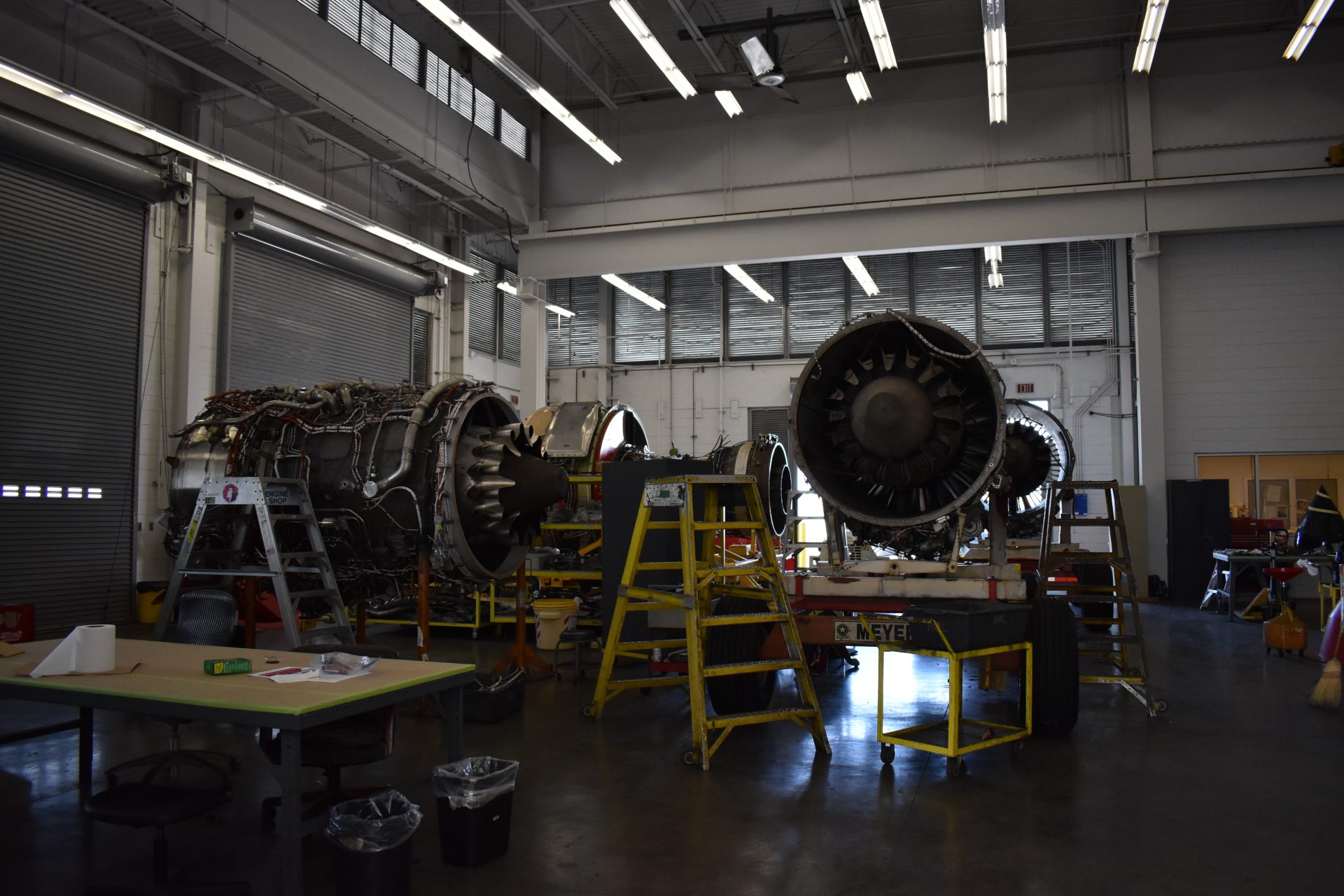
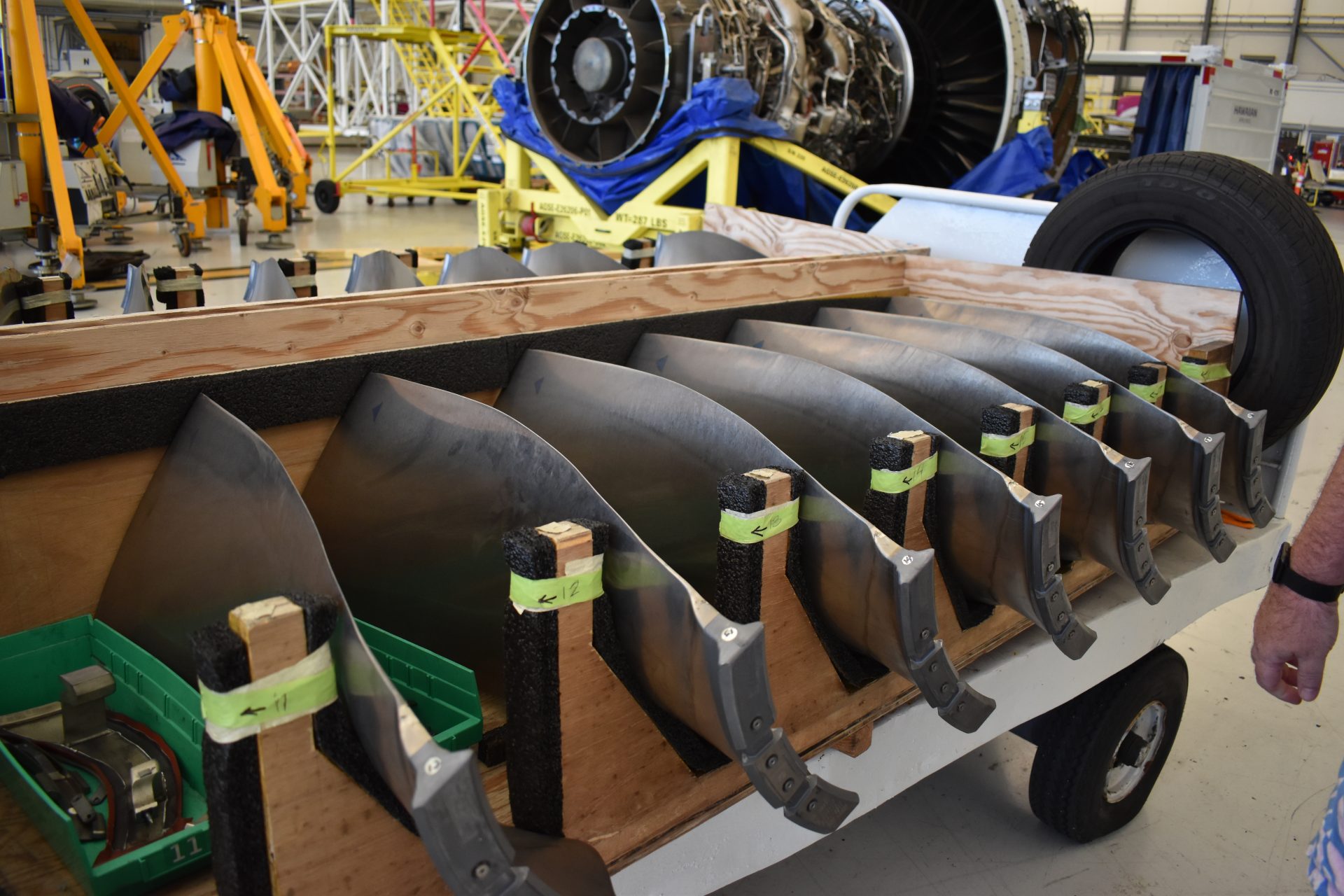
They check every part of the engine from top to bottom, including inspecting each individual engine blade for cracks and warps.
Inspecting the engines, in this photo of the Boeing 717 and Airbus A330 (Photo: AirlineGeeks | Joey Gerardi)
Inspecting each individual engine blade for defects such as cracks or warps (Photo: AirlineGeeks | Joey Gerardi)
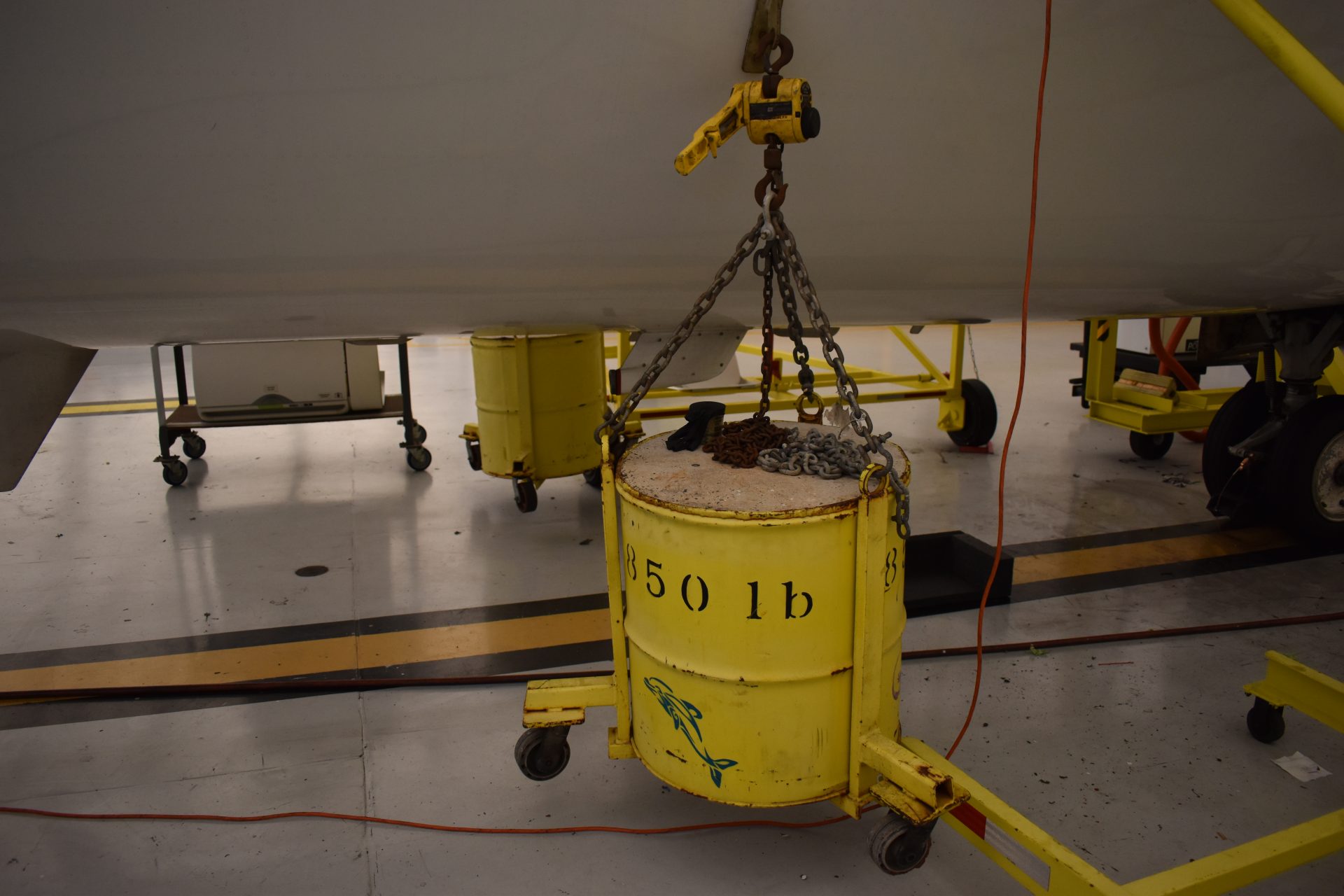
They also have a very unique aspect which I found interesting. When aircraft have the interiors taken out, the aircraft becomes very tail heavy meaning most of the weight is on the tail end of the aircraft. In order to get the now empty aircraft to not tip backward due to the weight of the engines and vertical stabilizer, they place two 850lbs cans on the front end of the aircraft which old the nose to the ground.
Weight holding down the aircraft (Photo: AirlineGeeks | Joey Gerardi)
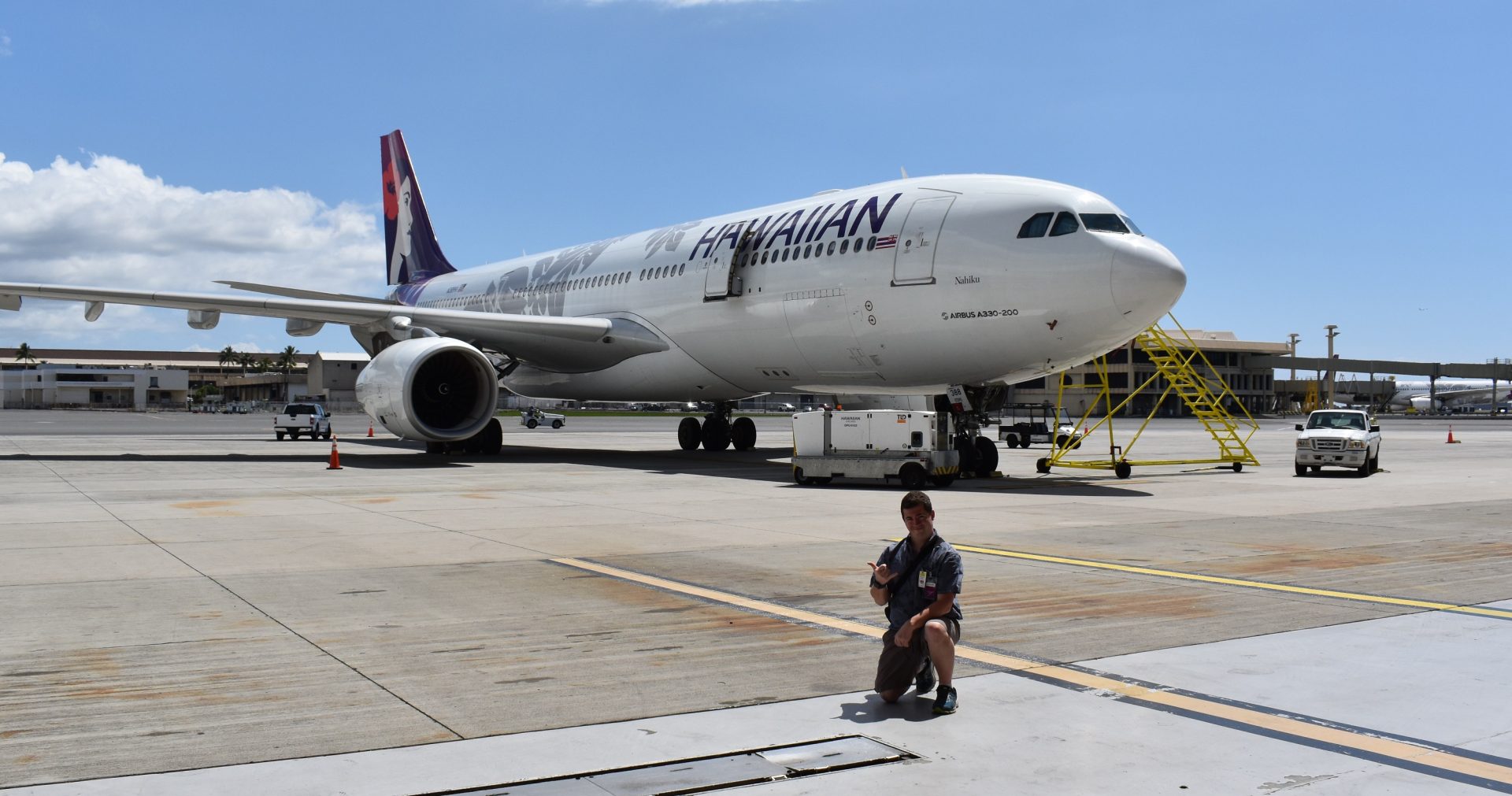
Being in the Hawaiian Islands, I had to take the obligatory photo with a Hawaiian Airlines plane showing the “peace out” or “Shaka” gesture which is commonly used in the islands.
Posing in front of a Hawaiian Airlines Airbus A330 (Photo: AirlineGeeks | Joey Gerardi)
Joey has always been interested in planes for as long as he can remember. He grew up in Central New York during the early 2000s when US Airways Express turboprops ruled the skies. Being from a non-aviation family made it harder for him to be around planes and would only spend about three hours a month at the airport. He was so excited when he could drive by himself, the first thing he did with his driver's license was get ice cream and go plane spotting for the entire day. He graduated from Western Michigan University in 2022 with a B.S. in Aviation Management & Operations and a Minor in Business, and currently works for a major airline in his hometown.
Boeing 727 XC-MPF. (Photo: AirlineGeeks | Mark Evans)
The Boeing 727 has a long history in Mexico, and the iconic Trijet can still be seen after more than 55 years of operations. With less than 50 of the 1832 B727s built still in service, Mexico is one of the few places where you can still see one fly.
The first Boeing 727 in Mexico belonged to Mexicana. It took delivery of its first aircraft back in 1966, only a couple of years after the type first entered service in 1964. Mexico’s oldest airline operated almost 70 of the type in total before phasing them out by 2003. This was the largest B727 fleet outside of the USA. Unfortunately, the Mexican carrier ceased operations in 2010.
The Mexican Government also made good use of the type. A 727 was used as the presidential aircraft for several years from 1979 before being replaced by a Boeing 757. A further six were utilized by the Mexican Air Force until 2019 and the Mexican Police are still operating them with three based out of Mexico City.
In December 2021 they could still be seen operating regular flights in their distinctive grey color schemes. All three of them just turned 40 years old having originally been delivered to Mexicana in 1981 and are registered XC-MPF, XC-NPF, XC-OPF.
Other airlines that operated the Boeing 727 in Mexico include Taesa, Allegro Air, Aerolineas Internacionales, Aeroejecutivo, Aeroexo and Aviacsa.
Two Boeing 727s sitting on the ground in Mexico City. (Photo: AirlineGeeks | Mark Evans)
Not Inflight, But Still In Use
In addition to the three still in service, at least a further 19 Boeing 727s can be seen parked around the country. Many of them have been left derelict for years but fortunately a few have been preserved including two former Air Force aircraft.
3503 is parked at Town Center Shopping Mall in Zumpango, not far from its former home of Santa Lucia Air Base which is now being converted into Mexico City’s new international airport.
3504 has been converted into an amusement park called Tematico Tizatlan park in Tlaxcala on the outskirts of Mexico City.
The view of 3504, a former Mexican Air Force Boeing 727, that has since been used as part of an amusement park. (Photo: AirlineGeeks | Mark Evans)
XC-FPA, a former Mexican Police aircraft now resides in Parque Tangamanga 1, San Luis Potosi.
XA-HOV is used as a training aircraft at IPN-ESIME Ticoman Aeronautica Engineering University in Mexico City.
XA-AAD is also used as a training aircraft at CONALEP Aeronáutico near Queretaro airport.
XA-MEE is now a paintball target at El Portal Gotcha near Monterrey North airport.
XA-SKC is preserved just outside the airport perimeter at Cuernavaca. It sits inside a small compound painted in Aeromexico colors and fake registration XA-LSV.
XA-RRA is preserved at Parque Metropolitano de Leon. It has been painted in its former Mexicana colors with fake registration XA-SEM.
The rest of them can all be seen derelict at the various airports.
Mark has been interested in aviation since the age of eight when he first went plane spotting at Manchester Airport, England. Trips around various European airports in the following years and then to the USA as a teenager furthered his desire.
This led to Mark wanting to work in the industry and at the age of twenty one was accepted to train as an Air Traffic Controller. After training and working for several years in England, Mark moved to Bahrain in the Middle East where he worked for six years. He then moved to Sydney, Australia where he resides today after twenty years in the profession.
Mark's pursuit to see planes has seen him visit over 140 countries and territories, including places, like North Korea, Sudan and Iran. He has flown over 1,100 times, visited over 700 airports and can always be found researching his next trip.
President Biden Renews Sustainable Aviation Fuel Tax Credits
United 787 Dreamliner is field with Sustainable Aviation Biofuel at San Francisco International Airport (Photo: San Francisco International Airport)
On Tuesday, U.S. President Joe Biden made remarks supporting a renewed push for tax credits for Sustainable Aviation Fuel (SAF), which is an integral piece for reducing carbon emissions from air travel — an industry known for its high CO2 output.
The tax credits were first introduced last year as part of the Build Back Better Agenda. Biden called for tax incentives that would ultimately help coordinate leadership and innovation across the federal government, aircraft manufacturers, airlines, fuel producers, airports, and non-governmental organizations to advance the use of cleaner and more sustainable fuels in American aviation. By 2030, the White House aims to have a 20 percent decrease in aviation emissions by increasing the production of sustainable aviation fuels to at least 3 billion gallons. The incentives will play a critical part in achieving this goal.
Today, the aviation industry accounts for 11 percent of United States transportation-related emissions. The push for more sustainable options will help keep both the industry and economy in the United States on track to achieving the much larger goal of net-zero greenhouse gas emissions by 2050.
“In recent weeks, global fuel shortages have underscored the growing need for Sustainable Aviation Fuels. To protect the environment and meet the needs of the public, elected officials must reimagine how we travel and prioritize measures to make Sustainable Aviation Fuels a reality,” U.S. Travel Association Executive Vice President of Public Affairs and Policy Tori Emerson Barnes said in a statement, according to TravelPulse. “U.S. Travel applauds President Biden for identifying the critical need to advance policies and long-term solutions that make travel more sustainable, and for recognizing the opportunity to not just recover from the pandemic, but to rebuild to be stronger than we were before. We do not have to choose between traveling and saving the planet—both are possible if policymakers continue to work with the travel industry to accelerate sustainability.”
Since the initial introduction of the proposed tax credits, Congress has been reluctant to approve them, as they are a part of that larger spending bill, hence the reason behind President Biden’s additional remarks at a biofuel processing plant in Menlo, Iowa on Tuesday.
“It’s going to require billions of gallons of Sustainable Aviation Fuel,” Biden said. “You simply can’t get to net-zero by 2050 without biofuels.”
This comes at a time when airlines in the United States are put under the microscope by environmental groups to lower their carbon footprint and have pledged to use more Sustainable Aviation Fuels (SAF).
Currently, the fuel is made in very small quantities from feedstocks such as cooking oil and can be two to three times more expensive than standard jet fuel, making it difficult for carriers to reduce their carbon footprint in an affordable way.
Additionally, the administration is committed to transforming the aviation sector in a way that creates good-paying union jobs in manufacturing, improves the environmental quality for airport and airline workers and unlocks rural economic opportunities for sustainable fuels from many different pathways.
Chase Hagl grew up in Twin Falls, Idaho. His love and passion for Aviation landed him in Orem, Utah where he obtained a B.S. in Aviation Management with a minor in Business Management from Utah Valley University. Chase currently works as a flight attendant in Charleston, SC and is also the primary Inflight ASAP ERC representative for startup airline, Breeze Airways. His experience in the aviation industry spans back four years, working in areas including agriculture application, customer service, maintenance, and flight ops. In his free time, Chase enjoys road biking, astronomy, and flying.
Rolls-Royce SAF flying testbed. | (Photo: Rolls-Royce)
Rolls-Royce has recently signed a sustainable aviation fuel agreement with AirBP as part of its goals to meet reduced carbon emissions. In a recent press release, according to the aerospace and defense company that designs and manufactures power systems for aircraft, the agreement will reduce lifecycle carbon emissions for its testing plants at Derby, U.K.; Bristol, U.K. and Dahlewitz, Germany.
The sustainable aviation fuel (SAF) is a blend of 10% sustainably-sourced waste-based substances, such as used cooking oils, and will be blended with traditional aviation fuels. The fuel will be in use by 2023 and reduce carbon emissions during the testing and development of Rolls-Royce engines. The agreement is part of a bigger push by Rolls-Royce to make sustainable fuel use more economical.
New Engine’s Commercial Sustainability
Rolls-Royce’s UltraFan demonstrator engine, the largest and most efficient commercial turbine engine, will demonstrate the efficiency and economical potential of Sustainable Aviation Fuel (SAF). The new engine will run on 100% SAF and is designed to lead the way for decarbonization in the aviation industry.
The UltraFan turbine engine — designed to be scalable for both narrowbody and widebody aircraft — will improve the affordability of more expensive sustainable fuels by increasing fuel efficiency by up to 25% in comparison to first-generation Trent and Business engines. Rolls-Royce believes this is an important step in promoting sustainable fuel use since such fuels are predicted to be more expensive than current fuels in the short-term future.
The power gearbox — which Rolls-Royce says can manage the power “of an entire grid of Formula 1 cars” —increases the bypass ratio to 15:1, a huge improvement to the Trent 700 used on earlier A330 aircraft with a ratio of only 5:1. The benefits of lower fuel consumption and reduced noise will be able to lower fuel use and thus lower expenses associated with SAF.
The process for testing the 140-inch diameter fan engine has already commenced and has operated for 650 hours. The engine will continue to be tested for all phases of flight, including take-off, climbs, descents and banks.
Company’s Strategic Collaboration
On Thursday, April 7, Rolls-Royce announced a new collaboration with digital services and consultation company called Infosys. Infosys — based in Bangalore, India — will work with Rolls-Royce “to explore opportunities for driving digital and engineering innovation and associated cost optimization strategies.”
According to the press release, the joint “Aerospace Engineering and Digital Innovation Centre” in Bengaluru, India, will engage in high-end research and development over the next seven years.
Kishore Jayaraman, President of India and South Asia Rolls-Royce, said, “Given the aerospace sector is poised for revival and growth in India and across the world, this joint innovation centre will strengthen Rolls-Royce’s global engineering ecosystem and position us well for the future.”
Rolls-Royce aims to play a fundamental role in helping aviation achieve net-zero carbon emissions by 2050.
Mike’s love affair with flight and mechanical objects in the sky began at an early age, fascinated by space documentaries and the vintage Flight Simulator ’95. He currently works as an instructor for UAVs and is training to receive his Private Pilot Licence with the goal of working in manned flight instruction. An avid reader of all things aviation and manned space flight, Mike stays close to developments in aerospace while reminiscing and sharing the rich history of flight with others. He loves writing, engineering and science.