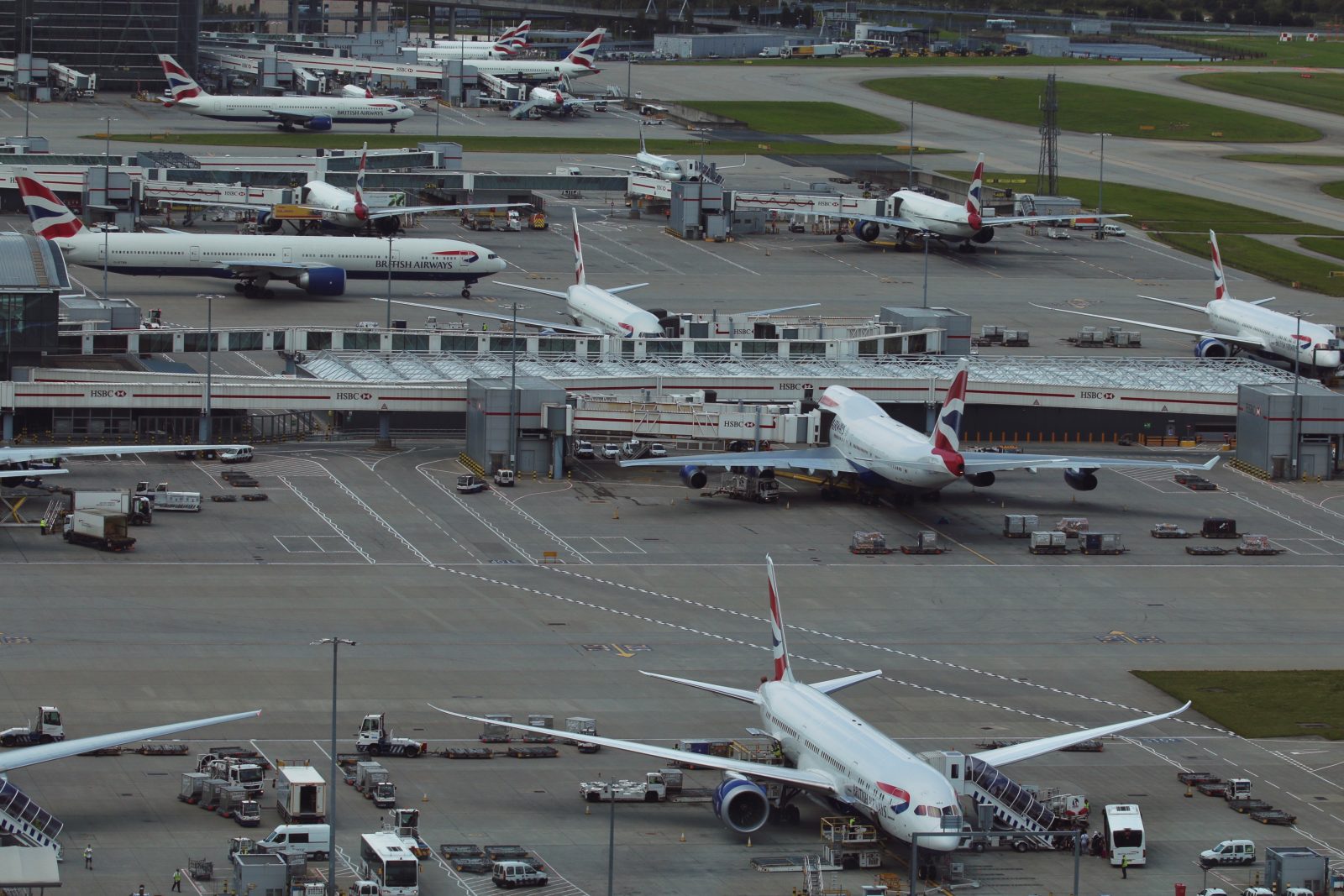
An Emirates Boeing 777F departing Los Angeles. (Photo: AirlineGeeks | William Derrickson)
News of Covid-19 vaccines available for distribution around the world buoyed industry practitioners both above and below deck with cargo carriers with climate-controlled facilities suddenly having a business opportunity in the worldwide distribution of billions of doses of vaccines.
Among the carriers that benefited immensely from the supply chain of Covid-19 vaccines is Emirates SkyCargo — Emirates airline cargo and airfreight division — which announced it transported more than one billion Covid-19 vaccines doses worldwide, in the 18 months after its first trial shipment of doses in October 2020.
More than 4,200 metric tons of Covid-19 vaccines — equivalent to over 1 billion doses — were moved to over 80 destinations on over 2,000 Emirates flights and close to two-thirds of the 1 billion doses were transported to developing countries, the UAE-based carrier announced earlier this week.
Nabil Sultan, Emirates divisional Senior Vice President, cargo, said, “From the start of the COVID-19 pandemic, Emirates SkyCargo has been focused on supporting global communities in their recovery from the devastating effects of the virus and we have prioritized assistance to developing countries. The strategic location of our Dubai hub combined with the strengths of our modern fleet of widebody aircraft, our purpose-built facilities, and capabilities in moving temperature-sensitive pharmaceuticals allowed us to transport COVID-19 vaccines securely, reliably and rapidly from one corner of the globe to another. Ahead of World Health Day, we’re incredibly proud of our global Emirates SkyCargo team who have pulled out all stops during the pandemic to keep supply chains for essential goods like vaccines up and running. ”
Transportation of Humanitarian Supplies
In addition to Covid-19 vaccines, the airline transported other critical medicines and treatments on its flights across its route network.
This is in addition to the carrier being one of the first global air cargo carriers — as early as August 2020 — to begin mapping the global logistics for the movement of potential Covid-19 vaccines.
In October 2020, Emirates announced it would be setting aside a dedicated GDP-certified airside hub for the transport of Covid-19 vaccines, working with its logistics partners, the cargo division of Emirates, which transported trial shipments of Covid-19 vaccines through Dubai.
“In January 2021, Emirates SkyCargo teamed up with leading Dubai-based companies to form the Dubai Vaccine Logistics Alliance to speed up distribution of vaccines through Dubai to developing countries,” the airline said in a statement. “In February 2021, the carrier signed an MoU with UNICEF to prioritize the transport and delivery of Covid-19 vaccines in support of the COVAX initiative. By early April 2021, Emirates SkyCargo had already transported more than 50 million doses of vaccines.”
The SkyCargo expanded its pharma cool chain infrastructure at Dubai International Airport in June 2021, allowing it to store an estimated 60-90 million doses of Covid-19 vaccines at any point in time.
The global scaling up of vaccine distribution enabled the Emirates’ cargo division to facilitate the transportation of larger volumes of vaccines from manufacturing origins to destinations, reaching 250 million doses by September 2021 and 600 million doses by December 2021.
Boosting Cargo Shipment
While it is easy to see why fortunes for transporting cargo could be viewed favorably by observers searching for a silver lining, from an economic standpoint, it is safe to say airports and airlines with cargo-diversified revenue streams have largely managed to avoid the worst of the pandemic’s ravages.
Last month, Emirates SkyCargo announced that it will be reactivating its cargo hub at Emirates SkyCentral DWC — Dubai World Central Airport — for dedicated freighter aircraft operations beginning March 26.
The move marks the return to dual-hub cargo operations in Dubai for the air cargo carrier after a period of nearly two years. The DWC facility has been utilized as a vaccine hub during the pandemic.
Victor Shalton's love for aviation can be traced to when he was 11-years-old. As a seasoned aviation writer, he takes pride in providing the best aviation coverage around the globe and is passionate about advancing his skills in the aviation space. In addition, he loves travelling, writing, arts and while his speaking engagements have taken him around the world, he is proud to call Nairobi home.
On Tuesday, news leaked that JetBlue had made a $3.6 billion takeover offer for Spirit Airlines, the Miramar, Fla.-based ultra-low-cost carrier that in February agreed to terms for a merger with close competitor Frontier Airlines.
The early announcement — in addition to a formal release from the airline after the market closed — led to a flurry of speculation as to what the airline saw in Spirit that led it to top Frontier’s offer. Frontier and Spirit have remarkably similar business models that rely on bare-bones base offerings augmented with fees for just about any auxiliary service, while JetBlue has touted its free WiFi, onboard entertainment and food and beverage offerings as hallmarks of its differentiated, though still low cost, product.
In addition, questions abounded as to whether JetBlue would be able to overcome scrutiny from the Department of Justice, which is already suing the airline and Fort Worth, Texas-based competitor American Airlines over renewed cooperation out of New York City and Boston that the carriers have taken to calling the Northeast Alliance.
One New Strategy
JetBlue has sought in recent years to continue to differentiate itself from the big four U.S. legacy carriers by offering lower cost tickets while still providing some complimentary perks to passengers. On routes it has entered to compete directly with its larger competitors, it has largely found a foothold by undercutting those carriers and looking to capture more price-sensitive travelers. It offers its cheapest tickets through its Blue Basic fare, its few-frills option that the carrier said comprises a “significant” portion of sales.
That strategy is not entirely different from ultra-low-cost carriers like Spirit and Frontier, and on a call Wednesday morning with analysts and members of the media, JetBlue CEO Robin Hayes looked to underline those similarities but stressed the proposed merger would benefit current Spirit customers when they took a flight on the combined airline.
The airline said in on the call that it would retrofit Spirit’s aircraft to resemble JetBlue’s, a move that would decrease the number of seats on the airline’s aircraft by 10-15%, according to JetBlue executives. As such, the airline would move away from Spirit’s ultra-dense configuration — from 180-182 seats on the Airbus A320 according to SeatGuru — to JetBlue’s, which is markedly less so. (The carrier features 162 seats on its most crowded version of the same aircraft.)
This transition would mean the airline would more likely shift entirely toward the JetBlue model, in many ways eschewing the ultra-low-cost structure that has brought Spirit both success and notoriety. This, of course, is in direct competition with Frontier’s plan, which would see a combined carrier devoted entirely to the future of the ultra-low-cost model.
Creating a New Competitor
JetBlue continues to put outsized focus on making clear its offer would create a more competitive marketplace for the routes on which it would operate. Similar to Frontier and Spirit’s previously agreed-upon merger, the combination of JetBlue and Spirit would create the U.S.’s fifth largest airline as measured by total seats.
A JetBlue/Spirit combination would see the merged carrier become the fifth largest in the U.S. as measured by total seats. (Photo: JetBlue)
In addition, and perhaps most crucial to JetBlue given its current hopes for growth, the combined airline would boast a substantially larger fleet and order book moving forward.
According to projections from the airline, it expects to have 346 aircraft — 100 Airbus A220s in addition 246 from the Airbus A320 family — by 2027. That includes a current order book of 156 aircraft and a desire to retire 60 Embraer E190 regional jets currently in the fleet. Those aircraft currently operate many of the airline’s high frequency routes in the Northeast, but JetBlue currently plans to phase them out between 2023 and 2026, replacing them with the A220.
Spirit brings to the table an order book that also includes 156 aircraft across the Airbus A320 family, which would help the projected fleet for a combined airline jump to 675 aircraft by 2027, 48% more than their combined operating fleets at the end of 2021. That growth dwarfs the 22% jump JetBlue is expecting on its own over the next six years and is at the front of the airline’s mind in its $3.6 billion offer. Airline executives noted multiple times on Wednesday’s call the difficulty in securing narrowbody aircraft in the short-term given high demand for the types worldwide.
A combined airline would also serve over 130 destinations, combining JetBlue’s current network of 98 destinations with Spirit’s 84.
JetBlue and Spirit’s combined route network. (Photo: JetBlue)
JetBlue thinks the new airline’s size will be a critical piece of its mission to compete at a large scale with the four largest U.S. carriers. But as it faces a somewhat hostile Department of Justice, it is also looking at price competition as a likely sticking point for regulators to approve the deal.
Hayes said the airline would not be willing to give up its Northeast Alliance with American Airlines to appease the DOJ to help push the merger through. Hayes stressed that the airline’s entry into new markets has lowered ticket prices across the board, while the same is not true for ultra-low-cost carriers like Frontier and Spirit. The airline has not made data supporting that claim publicly available though said it would continue to work with regulators to illustrate that point should its proposal be accepted.
Frontier released a statement yesterday claiming just the opposite, likely hoping those concerns will prove to be a sticking point in Spirit’s board as it considers what is, purely in terms of valuation, a significantly better offer.
“Unlike the compelling Spirit-Frontier combination, an acquisition of Spirit by JetBlue, a high-fare carrier, would lead to more expensive travel for consumers,” a Frontier spokesperson said in a statement. “In particular, the significant East Coast overlap between JetBlue and Spirit would reduce competition and limit options for consumers. It is surprising that JetBlue would consider such a merger at this time given that the Department of Justice is currently suing to block their pending alliance with American Airlines.”
Hayes also said the airline is looking to growth at legacy airline hubs such as Dallas and Atlanta — two markets among many where Spirit has pushed its expansion in years past — as a key source of increased competition.
The airline also said the proposal includes a breakup fee JetBlue would pay to Spirit in the event antitrust regulators disallow the deal.
The Financial Question
JetBlue is already offering approximately 40% more than Frontier was slated to pay in its agreement with Spirit. But the airline has said this price is justified by the potential synergies — both lower costs and higher revenues — it sees in a combined carrier. JetBlue said today it projects these at $600-$700 million per year, approximately 4.5% of combined annual revenues. That would make it the third most-successful recent major U.S. airline merger with regard to synergies, behind only the America West-U.S. Airways and Delta-Northwest Airlines combinations.
Importantly, however, JetBlue CFO Ursula Hurley said on the airline’s call today that approximately $650 million figure is expected to materialize with all of Spirit’s aircraft operating in the JetBlue configuration, a process that could take years to complete.
Hurley said the airline expects to achieve 33% of those synergies in the first year of combination, a stark comparison to Frontier’s model, which actually accounted for negative synergies in the first year on account of increased integration costs. Because of those synergies, however, JetBlue was able to say it expects a merger with Spirit to be accretive in the first year after closing, meaning earnings per share would be higher than adding the two airline’s independent projections.
Even as the integration is ongoing, the airline will have to contend with higher costs. For the fiscal year ending December 2021, Spirit’s cost per available seat mile (CASM) totaled 6.74 cents excluding fuel and special items — those are often excluded to give a picture of what the airline’s base operations cost given fuel’s price variability and the unpredictable nature of one-time charges. JetBlue’s, however, sat at 10.11 cents, meaning the combined carrier may have to stomach a 50% jump in costs over time as it brings Spirit’s old aircraft into its fleet. (Frontier’s CASM excluding fuel was 5.96 cents for the same period.)
The airline said it expects debt to be approximately three times earnings before interest, taxes, depreciation and amortization — a common measure of operational profitability — upon closing, with that figure decreasing in the years to follow. It also said it would evaluate the cheapest financing path should the proposal be accepted and did not rule out raising equity to help raise cash for the deal.
Parker joined AirlineGeeks as a writer and photographer in 2016, combining his longtime love for aviation with a newfound passion for journalism. Since then, he’s worked as a Senior Writer before becoming Editor-in-Chief of the site in 2020. Originally from Dallas and an American frequent flyer, he left behind the city’s rich aviation history to attend college in North Carolina, where he’s studying economics.
Aeromexico Announces Third Destination From Mexico City‘s New Airport, Reverses Initial Decision
An Aeromexico B737 MAX 9 jet prepares for a flight to Mexico City at Tijuana International Airport. (Photo: AirlineGeeks | Albert Kuan)
Aeromexico recently announced a new destination out of Mexico City’s Felipe Ángeles Airport this past Friday — less than two weeks since the airport’s inauguration. Beginning May 1, the airline will fly to Puerto Vallarta, Mexico four times weekly from the new international airport.
The new Puerto Vallarta, Mexico service, AM 880, leaves Felipe Ángeles Airport at 12:35 p.m. and arrives in Puerto Vallarta at 2:07 p.m. The return flight, AM 881, departs the city at 2:50 p.m., arriving back in Mexico City at 4:13 p.m. Flights to Puerto Vallarta will be operated on Aeromexico Connect’s Embraer 190.
Aeromexico is the first airline to add flights from the new airport since its opening day on March 21.
With this announcement, the Mexican flag carrier will now serve a total of three destinations and will be all domestic. Flights from Felipe Ángeles Airport to Mérida, Mexico will operate once a week, while flights to Villahermosa, Mexico will operate three times a week. The new flights to Puerto Vallarta, Mexico will be the carrier’s third destination.
Aeromexico confirmed it would continue to operate flights to these three destinations from its hub at Mexico City’s Benito Juárez Airport, more commonly referred to as Mexico City International Airport. The addition of complementary services out of AIFA helps the airline increase capacity to popular beach destinations in Mexico in time for the peak summer travel season.
At Mexico City’s Benito Juárez Airport, flights to the three destinations will operate daily. In May, the frequencies for Benito Juárez Airport are as follows: Mérida, Mexico with 67 weekly flights, Puerto Vallarta, Mexico with 42 weekly flights and Villahermosa, Mexico with 40 weekly flights. According to Aeromexico, offering these complementary services out of both Felipe Ángeles Airport and Benito Juárez Airport allows the airline to offer up to 223,000 seats each month between Mexico City and these three destinations.
Benito Juárez Airport — the airline’s current, main hub — is within the limits of Mexico City, which makes it far more convenient for many residents of the capital than Felipe Ángeles Airport, which is located about 25 miles away from the city center, in the State of Mexico. Travelers coming from the city center have reported travel times of up to two hours to reach the new airport.
As there is no crew base for Felipe Ángeles Airport, Aeromexico’s pilots and flight attendants operating early morning flights out of the new airport spend the night at the new Holiday Inn on the airport’s grounds, as it is very difficult for them to be at the airport in time to operate a flight.
Benito Juárez Airport still remains the carrier’s main operations center where the airline currently operates more than 80 routes — both domestic and international. Delta — its Skyteam partner and major shareholder — is said to be proposing plans to offer flights between the United States and Felipe Ángeles Airport.
The Airline’s Revised Decision
Back in November 2021, several months before the airport’s opening, Aeromexico confirmed it would not operate out of Felipe Ángeles Airport providing the reason that there were no passengers to fly out of the airport when it opens. The airline even said its decision was firm.
Less than two months before the airport’s opening, the airline changed its position at Felipe Ángeles Airport and announced two preliminary destinations out of the new airport, Mérida and Villahermosa.
“We decided to start with these two destinations because we have in Club Premier, which is our loyalty program, information from our customers,” Andrés Conesa, Aeromexico’s Chief Executive Officer, said. “We know where they travel to, where they leave from. We saw that from the area of influence of (Felipe Ángeles Airport), 20 kilometers to the round, these two routes were the most used.”
Conesa even advised his airline is open to the opening of further new routes out of Felipe Ángeles Airport. He explained it depends on the demand that there is in the future.
Most people hate long flights or overnight layovers, but Albert loves them. The airport and flying parts of traveling are the biggest highlights of any trip for him – as this avgeek always gets a thrill from sampling different airline cabin products and checking out regional developments happening at local U.S. airports. He’s flown on almost every major carrier in the U.S. and Asia Pacific, and he hopes to try out the new A350s soon.
Albert recently completed his undergraduate studies in Business Accounting at USC in Los Angeles and he is currently recruiting for a corporate analyst position at one of the U.S. legacy carriers. During his college years, he interned at LAX for Los Angeles World Airports working behind-the-scenes (and on the ramp) in public relations and accounting. Outside of writing for AirlineGeeks, he enjoys trekking the Hollywood hills, visiting new hotspots throughout SoCal, and doing the occasional weekender on Spirit Airlines.
A United Express CRJ-200 (Photo: AirlineGeeks | Joey Gerardi)
Plattsburgh and Ogdensburg, two airports in northern New York state, have been in aviation news a substantial amount in the past three months. Both are Essential Air Service cities, and in mid-January 2022, SkyWest announced it would be terminating service to these communities in 90 days, a proposal that was swiftly rejected by the DOT until a replacement carrier could be found.It wasn’t known at the time, but it was just the start, as SkyWest would go on to announce the requested termination of 29 additional EAS communities just two months later.
The two communities weren’t the only cities that would face the wrath of air service cuts, but they were the first two in the EAS community. Both airports had weekly round-trip flights reduced from 12 to just seven apiece, amounting to only a single daily flight from each community to Washington D.C.’s Dulles International Airport. Now, in a very peculiar turn of events, Skywest has announced it will increase flights to both cities and add a new destination, but for only for two months.
The terminal building in Ogdensburg, N.Y. (Photo: AirlineGeeks | Joey Gerardi)
First announced by the local online news platform, NNY360, this new increased service will start on May 2 and run until June 27, and will include twice-per-week flights operating on Mondays and Fridays. On those two weekdays, the aircraft used on the route will begin its day in Chicago, flying nonstop from O’Hare International Airport to Ogdensburg. From there, the aircraft will fly nonstop between Ogdensburg and Plattsburgh and again in reverse, before finally returning to Chicago from Ogdensburg in the late afternoon.
The nonstop flights from both airports to Dulles will remain unchanged at seven per week. This will bring Ogdensburg’s weekly flights up to 11 — seven to Dulles, two to Chicago O’Hare, and two to Plattsburgh. On the other side of the state, Plattsburgh will have nine weekly flights — seven to Washington Dulles, and two to Ogdensburg. While the Chicago link is new for Plattsburgh, it isn’t for Ogdensburg, as that city had nonstop flights to Chicago up until August 2021.
A map of the flights to Plattsburgh and Ogdensburg (Screenshot: GreatCircleMapper)
The flight between Plattsburgh and Ogdensburg would cut a nearly 2-hour 30-minute drive down to a near 50-minute flight. The Ogdensburg Bridge and Port Authority did not respond to a request for comment.
The flight between Plattsburgh and Ogdensburg (Screenshot: United.com)
Joey has always been interested in planes for as long as he can remember. He grew up in Central New York during the early 2000s when US Airways Express turboprops ruled the skies. Being from a non-aviation family made it harder for him to be around planes and would only spend about three hours a month at the airport. He was so excited when he could drive by himself, the first thing he did with his driver's license was get ice cream and go plane spotting for the entire day. He graduated from Western Michigan University in 2022 with a B.S. in Aviation Management & Operations and a Minor in Business, and currently works for a major airline in his hometown.
JetBlue Announces $3.6 Billion Offer for Spirit, Topping Previously Announced Frontier Deal
A JetBlue Airbus A320 on the ground in Boston.
(Photo: AirlineGeeks | William Derrickson)
Following reports by the New York Times earlier Tuesday, JetBlue announced this afternoon that it had submitted a $3.6 billion all-cash offer for Miramar, Fla.-based Spirit Airlines, putting the New York-headquartered carrier in direct competition with Frontier Airlines — the ultra-low-cost carrier with which Spirit had agreed to merge earlier this year.
Spirit’s shares jumped over 20% in trading though fell well short of the implied value of $33 per share, as investors weighed the likelihood of success for the new offer. The deal Frontier and Spirit agreed to in February valued Spirit at $25.83 per share at the time — a total equity value of $2.9 billion.
However, that deal included a small cash payment plus nearly two shares of Frontier stock, but as Frontier’s stock price has faltered slightly since the time of the offer, the total value entering Tuesday was only around $24, almost 30% less than JetBlue’s new proposal.
Frontier may seek to counter the offer in the days and weeks ahead, particularly if it feels it can find more value in Spirit than its Long Island City, N.Y.-based competitor.
Any deal would likely be put under the antitrust lens before it could be given the final sign-off. JetBlue has already been under scrutiny from government regulators, with the Department of Justice having sued the carrier and Fort Worth, Texas-based American Airlines for the companies’ cooperation through what they call the Northeast Alliance. The DOJ argued that the agreement, which has already led to codesharing across the airlines’ networks, hurts cooperation at hubs like Boston Logan International Airport and at other New York airports.
Whether a Frontier-Spirit combination would be subjected to less intense probing is unclear or how the DOJ would react to a potential JetBlue-Spirit combination. When the two airlines announced their combination of February, they stressed that a combined ultra-low-cost carrier would be a stronger competitor against American, Delta Air Lines, United Airlines and Southwest Airlines than the two of them separately, messaging JetBlue has pushed today in both its own releases and executive interviews.
“When we grow and introduce our unique value proposition onto new routes, legacy carriers lower their fares and customers win with more choice,” JetBlue CEO Robin Hayes said in a prepared statement. “The combination of JetBlue and Spirit – coupled with the incredible benefits of our Northeast Alliance with American Airlines – would be a game changer in our ability to deliver superior value on a national scale to customers, crewmembers, communities and shareholders.”
Two Different Visions
Frontier and Spirit’s merger announcement was a blockbuster in the relatively stagnant world of U.S. aviation industry giants, but the logic behind the deal took few in the industry by surprise. Both airlines are commonly placed in the “ultra-low-cost carrier” bucket — a set of carriers set apart by their relentless unbundling of the air travel experience. Notably, not just checked bags, but seat assignments, carry-ons, snacks and even water could cost extra.
Thus, Frontier and Spirit would both be coming to the table as a combined company with a similar philosophy on how to turn a profit, already catering to a similar type of passenger on all the routes they operated.
In regards to those routes, the airlines seemingly complemented each other well. Spirit is the East Coast’s ultra-low-cost powerhouse, a prospective outcome that fits given its headquarters sits in Florida. Its network expands across the U.S. and has a substantial presence in Latin America, but its past focus is clear in its operations. Denver-based Frontier is similar in that it does cover almost the entire country with its route network. But out of its Denver International Airport hub, it maintains a stronger presence in the western U.S.
JetBlue, however, on face value fails to fit either of those two criteria. As it has expanded in recent years, it has invested heavily in capturing the premium business traveler that has historically been a customer of large legacy carriers rather than those like Spirit and Frontier. Its premium Mint product — introduced for its transcontinental routes in 2013 — has been a particularly visible piece of that shift. Furthermore, the shift has continued as a cornerstone of the airline’s expansion into premium markets like New York City to London — and, as the airline announced Tuesday, Boston to London.
JetBlue’s A321LR is premium-heavy with 24 Mint seats (Photo: AirlineGeeks | Taylor Rains)
In addition, JetBlue prides itself on its New York presence. While the airline expanded substantially across the U.S. over the past decade, its East Coast presence is a significant share of its network. The airline maintained in its announcement on Tuesday that this made it a better bidder for Spirit, stressing that the airline’s substantial presence in both its and Spirits’ headquarters states would allow it to best compete with the four largest U.S. carriers.
“The combined airline would offer more than 170 daily flights at [Fort Lauderdale-Hollywood International Airport], building JetBlue’s relevance as a stronger low-fare competitor in South Florida. At Orlando International Airport, JetBlue would grow to more than 130 daily flights,” the airline said in a statement.
“Our Northeast Alliance with American Airlines has supercharged our growth in New York and Boston, unlocking opportunities for us to grow where we could not have before,” Hayes said in the release. “We view a combination with Spirit as perfectly complementing the NEA. These strategic moves aim to increase our relevance and bring the JetBlue competitive effect to more places while deepening our roots in the communities we call home.”
Parker joined AirlineGeeks as a writer and photographer in 2016, combining his longtime love for aviation with a newfound passion for journalism. Since then, he’s worked as a Senior Writer before becoming Editor-in-Chief of the site in 2020. Originally from Dallas and an American frequent flyer, he left behind the city’s rich aviation history to attend college in North Carolina, where he’s studying economics.
An exterior view of Terminal 5 at Heathrow Airport (Photo: AirlineGeeks | James Dinsdale)
The impact of the COVID-19 pandemic was monumental for the aviation industry across the globe.
It only took a matter of a few weeks for a proclamation to be accurate with airlines across the globe shredding their operational flying programs. While most aircraft were mothballed in anticipation, airline executive boards attempted to mothball their own finances for the sake of preservation, expecting not only their aircraft but also their company to be in hibernation for quite some time.
It did not take long for airlines to look to shore up their finances by cutting down on their biggest expense – their workforce. In China, the airlines began making crew redundant as early as February 2020 when the levels of traffic fell off a cliff once the virus brought about significant lockdowns. In response to the rapid reduction in flying across the world, airlines globally followed suit by announcing their own redundancy programs to reduce headcount and outgoing expenses.
Impacts on Carriers Across the U.K.
Over in the United Kingdom, the same can be said regarding the cost-saving measure of cutting crew. The process itself naturally takes longer than in other parts of the world due to employment law requiring consultations to be held between labor representatives and employers prior to any jobs being cut, but the effort by airlines was there.
In a brief summary, British Airways cut a third of its workforce including approximately 250 pilots, after initially threatening the union with a figure north of 1,000 if crew working conditions were not made inferior. Low-cost carrier easyJet closed down three hubs and was due to remove 700 pilots before an agreement of using part-time was accepted by both parties to “save” pilot jobs. Its cabin crew who were on the line were effectively ushered into taking voluntary redundancy in the end, both moves that so far seem to have bitten easyJet hard going into this summer season.
Norwegian Air Shuttle — which had a large presence in the U.K. — effectively closed down both its short and long-haul operations. The airline was already fighting its own financial demons prior to the pandemic with MAX groundings and Boeing 787 engine issues. In total, approximately 1,100 aircrews lost their jobs without compensation. Jet2 — a U.K. holiday carrier — laid off 100 pilots.
Meanwhile, Virgin Atlantic — another airline that went into the pandemic, not in the best financial state — laid off around 320 pilots and hundreds of crew. Furthermore, Ryanair accepted a number of cuts to workers’ terms and conditions across its subsidiary airlines in return for no redundancies. TUI also went against the grain after managing to evade any aircraft job losses in the U.K. — thanks to using the government furlough scheme effectively.
The shutdown of Norwegian Air Shuttle led to over 1,100 crew losing their jobs during the pandemic. (Photo: AirlineGeeks | William Derrickson)
Looking back two years later, it is clear where the two safest havens for pilots were during the global shutdown. The first was cargo — which has seen a significant rise in demand — mostly thanks to the lack of passenger aircraft belly freight being available owing to a large drop in capacity. Secondly, the U.S. initially would have hosted a bloodbath of redundancies, but the federal government intervened and spent at least $25 billion on an aviation bailout package intended to keep jobs across the industry. This was a move that U.S. carriers can now look back on with relief, as they all clamor over pilots in the largest hiring spree ever seen.
By the end of 2020, the aviation industries on each side of the Atlantic painted a very contrasting picture. Jobs in the U.S. were saved, and a large domestic flying program still continued. Across Europe, thousands of pilots and crew lost their jobs — on top of the hundreds that already returned home from Asia and the Middle East.
For summer 2022, the rebound of air travel has well and truly gone away. Most, if not all, countries have lifted most restrictions previously seen during the last two years, enabling more of society to freely travel. And to meet the demand, airlines have rapidly returned destinations to their flying programs.
Looking at the United Kingdom’s aviation sector specifically, the same can be said. You no longer need to take any pre-departure or post-arrival Covid-19 test – vaccinated or not – and no locator form needs to be submitted. Meaning the British public is welcome to arrive back to their homeland hassle-free. But how prepared is the infrastructure of the industry to cope with this expected rise in passenger numbers?
Years of Uncertainty
We start by looking at the nation’s flag carrier, British Airways, which has continued its two-year streak of bad publicity. The pandemic was tough on its employees — either accept new terms and conditions of working contracts, or you were effectively out. Cabin crew who were specifically long-haul only, a legacy contract with could pay up to 80,000 Pounds Sterling ($104,000), were made to transfer to the mixed-fleet contract paying initially 16,000 Pounds Sterling, operating both long and short-haul flights or accept voluntary redundancy. Just over one year later, British Airways announced its plan to recruit 3,000 cabin crew for summer 2022.
The carrier’s pilot situation follows a similar pattern, with 250 made redundant. Another 300 pilots were put into a “non-operational” CRS pool of employed pilots, who were mostly pilots that were left “fleet-less” after the airline’s decision to instantly remove its Boeing 747 fleet from operations. So far, most of the 300 have been returned to one of the remaining fleets, except a handful who may have asked for a specific fleet and are still waiting.
A British Airways 747 in Las Vegas (Photo: AirlineGeeks | William Derrickson)
Additionally, British Airways replaced its base at London’s Gatwick Airport with a new company, known as EuroFlyer, with an inferior contract — in an effort to conserve costs. Those in the CRS and redundancy pools were offered a chance to accept a spot at the new subsidiary or hold out of a position on the mainline. Much back-and-forth has happened since the original decision was made, but the airline is now on a positive trajectory to recall those pilots who were made redundant and not yet offered or taken the first option to go to EuroFlyer.
Some things never seem to change, and whenever British Airways and I.T. are enclosed in the same sentence, it is never for good reasons. The airline has already suffered three I.T. failures of some kind, causing a detrimental impact on the flying program. At the end of March, a three-hour outage created a situation where hundreds of BA flights were either canceled or delayed, with the knock-on effect lasting for almost a week.
Sean Doyle returned to British Airways as CEO to take over from Alex Cruz, who immediately left the airline last year following years of negativity both from within and outside the airline. It was Cruz’s decision one year into his tenure in 2016 to sack 700 BA I.T. employees before subsequently outsourcing the department to India’s TATA Consultancy services. A move that has since then been labeled as to why the airline has since suffered dozens of outages.
Asiana Airlines took delivery of its first A350-900XWB on Monday (Photo: Airbus)
South Korea’s aviation industry has gradually started recovering from the pandemic. Asiana Airlines — the second-largest carrier in the nation— has resumed its services to Hawaii on Sunday. The resumption comes after the easing of the travel restrictions in South Korea. The airline will operate three times a week services to the tourist hotspot. The flight services between South Korea and Hawaii were suspended for 25 months.
Earlier, the South Korean government has announced that fully vaccinated travelers can avoid quarantining after arriving in South Korea from most countries. The travelers who have not been vaccinated still need to quarantine for seven days. The new policy has resulted in surging international travel demand in the country. According to an online travel agency, they sold 5,200 Hawaii tour packages within 70 minutes.
The aviation sector in South Korea has seen an increase in demand for Europe, Southeast Asia and islands across the Pacific Ocean. In response to quarantine rules being lifted, Korean Air — the flag carrier of the nation — has added its frequencies to Japan and Singapore this week.
In the meantime, Asiana Airlines expanded its operations to Japan and resumed its flight operations between Seoul, South Korea to Nagoya, Japan. The airline operates one weekly flight between the two cities at the moment. Recently, Japan has relaxed its travel restrictions, and Korean travelers who have taken a booster shot need to quarantine for three days, instead of seven days
International Travel Demand Surge
Seoul, South Korea’s Incheon International Airport expected the daily traffic figure would exceed 20,000 after the border reopened. Before the pandemic, the airport handled 200,000 passengers a day, but the passenger capacity has plummeted to 3,000 daily due to the pandemic.
Ironically, Asiana Airlines recorded a profit of 456.5 billion Won ($374 million) in 2021 due to the high demand for cargo business — the first profit in four years.
Asiana Airlines has experienced severe turbulence during the pandemic. The government has allowed Korean Air to acquire Asiana Airlines, but the acquisition needed approval from six other countries and parties, which were the U.S, the European Union, the United Kingdom, Japan, Australia and China. If the acquisition is confirmed, Korean Air will become the tenth biggest airline.
The aviation sector is recovering as the Transport Ministry of South Korea anticipates that international flights could reach 50% of pre-pandemic levels by the end of the year. The government has recorded 406 international flights in March — around 8.8% of 2019.
The Korean carriers have been urging the government to speed up the resumption of international travel and guarantee that the carriers’ slots at overseas airports are kept — especially in the U.S and Europe.
Construction of the Nancy-Bird Walton International Airport runway, Western Sydney. (Photo: Western Sydney Airport)
Sydney’s newest airport is beginning to take shape with runway construction of the Western Sydney International (Nancy-Bird Walton) Airport officially commencing last week, according to its official website. The new international airport, slated for operations by late 2026, has transformed the once rural landscape of Western Sydney to a major civil construction site that is beginning to resemble an actual airport.
The 3,700 meter (12,100ft) runway has been “efficiently designed”, utilizing new technologies and rapid-exit taxiways to achieve a far more seamless and reliable for both passengers and airlines than Sydney’s only other international airport, Kingsford Smith. A major capability will be Western Sydney’s use of CAT III-B instrument landing systems — commonly known by its abbreviation, ILS — allowing precision landing in deteriorated runway visual range (RVR) that would otherwise pause flights at Kingsford Smith, which uses CAT II.
Additionally, the airport will utilise sustainable approaches to operation, including recycled LED where possible, movement plans to minimise fuel burn in aircraft, as well as plans to support a future of electric commercial aircraft. Construction of the site’s foundation is also made from crushed sandstone, reused from Sydney’s current tunnel projects.
The airport aims to be the main gateway to Australia, however with only one runway planned for opening and a second planned for as late as 2050, it will need to demonstrate its state-of-the-art and future proofed technology is up to that task.
Western Sydney Booming
The new airport is situated in what is considered the third largest economical area in Australia, with construction and operations to employ many in that area. With a rate of one in 10 Australians living in Western Sydney, employment will naturally be a major selling point for the airport.
Construction of homes is rapidly growing in Sydney as it expands westward, with Western Sydney International Airport just one of multiple major infrastructure projects underway in order to handle the ever-growing population, projected to reach 3 million in Sydney’s west by 2026.
At this point, memoranda of understanding have been entered between the airport and Qantas and Virgin Australia, the two largest carriers in Australia.
A Salute to Aviation Pioneers
In keeping with Sydney’s Kingsford Smith International Airport, the new Western Sydney Airport will be named after Australian aviation pioneer Nancy Bird Walton. Walton, the founder of the Australian Womens’ Pilots Association, was the youngest Australian woman to gain her pilot licence at 19 years of age, earning the name “Angel of the Outback”.
Having already been recognised by Qantas, naming their first A380 “Nancy-Bird”, Walton was pivotal in the operation of rural flying health service Royal Far West Children’s Health Scheme, where she used her own De Havilland Gypsy Moth.
Mike’s love affair with flight and mechanical objects in the sky began at an early age, fascinated by space documentaries and the vintage Flight Simulator ’95. He currently works as an instructor for UAVs and is training to receive his Private Pilot Licence with the goal of working in manned flight instruction. An avid reader of all things aviation and manned space flight, Mike stays close to developments in aerospace while reminiscing and sharing the rich history of flight with others. He loves writing, engineering and science.
A rendering of what a Nigeria Air aircraft could look like. (Photo: Nigeria Air)
Nigeria’s much anticipated Nigeria Air will finally launch in 2023, according to the West African country’s Infrastructure Concession Regulatory Commission (ICRC). The office of the country’s president officially agreed to the extended deadline, according to ICRC Director General Michael Ohiani.
“I want to assure the Nigerian public that we are working round the clock to get it operational. We are working with the Ministry of Aviation and we have just gotten a presidential approval,” Ohiani said in a statement. He believes that Nigeria Air will begin operations before the current presidential administration ends. To launch, the Nigerian government has begun talks with Airbus and Boeing to purchase the first three narrow-body planes for Nigeria Air.
Since the project’s inception, Nigeria has frequently postponed the debut of the national airline. The airline was a campaign pledge for President Muhammadu Buhari years ago, and Nigerians have been waiting for its opening since 2018. Hadi Sirika, the nation’s Minister of Aviation, stated in November 2021 that the airline would be operational in April 2022. It may not come as a surprise to many people if the new date eventually gets pushed back as well.
Since 2003, when Nigeria Airways, the country’s defunct national carrier, ceased operations, the West African country has been without a national carrier. The country is now the only major economy in sub-Saharan Africa without a national airline. In contrast, Ethiopia, Kenya and South Africa have national airlines that are among the best in Africa.
As a result, it’s critical for Nigeria’s airline to get up and operating as quickly as possible in order to keep up with the competition.
Emirates’ & Qatar’s Entrances
Emirates Airlines, the national carrier of the United Arab Emirates, and Qatar Airways, its Qatari counterpart, have rallied behind Nigeria’s new national carrier initiative, which is set to start off next quarter. While Qatar Airways is one of the legacy carriers asking for a technical collaboration, Emirates has only agreed to help Nigeria if invited by the government.
The Ministry of Aviation has also requested an air operator’s certificate and an air transport licence from the Nigerian Civil Aviation Authority, in addition to forming an interim staff to supervise the incubation phase.
When asked if Emirates would get involved in Nigeria Air, during a panel discussion at the World Government Summit 2022 in Dubai on March 28, CEO of Emirates Airlines, Tim Clark said, “If the Nigerian government and the Minister need some assistance in how they go about – perhaps a blueprint – we are very happy to help them, but I would say that they have the wherewithal. They are clearly understanding what needs to be done and they are doing it; and probably within the next year, they will have a very good carrier flying.”
Clark stated he believed there was a viable business case for Nigeria Air as Nigeria was “the powerhouse of Africa.”
“There is an enormously compelling business case for it, and quite honestly, we’re all very interested in flying there, as it’s a very rich nation in terms of demand for services and the Nigerians are seeking to travel all over the world,” he. He also said he like to see Air Nigeria offer service to Dubai due to the high demand it offers. While not addressed by Clark, any investment by Emirates would likely lead to a formal partnership between the two carriers to provide services to travelers connecting beyond their respective hubs.
An Emirates Boeing 777-300ER. (Photo: AirlineGeeks | Greg Linton)
Nigeria’s Aviation Environment
Nigeria Air invited interested private businesses to make ideas for the takeover and development of the new carrier last month. At the ongoing World Development Summit in Dubai, Sirika said that the process to establish the new airline was in full effect and that it would be delivered before the conclusion of this administration. (Nigeria’s next election is in February 2023.) According to Sirika, Nigeria’s potential is too big for the country to be without a national carrier.
“Nigeria is situated at the centre of Africa; equidistant from all locations in Africa of about 30.4 million square kilometres miles, 1.5 billion people and very green land,” he said at the time. “If Central and Eastern Africa are the belt of the continent, then Nigeria is the buckle. We have 200 million people and a rising middle-class with a high propensity to fly. So, Nigeria is a candidate for a national carrier.”
The minister emphasized that the government will only have a 5% investment in the private sector enterprise, with no government control or board involvement. He told the world that Nigeria had recovered from the devastation of the Covid-19 outbreak to become a stronger aviation center that benefits everyone.
“What we said we would do, as a government, has happened since 2015,” Sirika said. “That is why Tim Clark’s Emirates, Qatar Airways and all of them are looking to go into Nigeria at multiple frequencies and multiple landing points because Nigeria is the right place for airline business.”
A Private Ownership Structure
Luis Felipe de Oliveira, Director-General of Airports Council International, has said a new airline has a lot of promise.
“The potential is huge not only in Nigeria but in Africa,” he said. “But we need to find a way to reduce the restriction inside and outside of Africa, to have more passengers flying.”
Nigeria Airways, which discontinued operations in 2003, will be replaced by Nigeria Air. The replacement was conceived as a public-private partnership project, with the federal government holding only a 5% interest. Nigerian financial and institutional investors would hold 46% of the company, with international partner airlines and technical partners owning the remaining 49%.
John Ojikutu, Secretary-General of the Aviation Safety Round Table Initiative, encouraged the federal and state governments not to take more than a 10% interest in the airline to make it a flag-carrier rather than a national airline. By extension, Ojikutu stated that 40% should go to international technical/investor partners, while 20% and 30%, respectively, should go to “respectable” Nigerian investors and the general public. He, on the other hand, was wary of working with airlines that currently compete with Nigeria on its Bilateral Air Service Agreement routes.
“Using Qatar, Turkish or any Middle East country, E.U. and U.S. airlines that are on our BASA routes, in any partnership, cannot profit the airline. Get technical partners from Australia, New Zealand, Canada and so on,” Ojikutu said at a press conference.
Kalai has always wanted to work in the aviation industry, having been fascinated by its inner workings since he was a child. In pursuit of his dream, he obtained a diploma in aviation management and is currently interning with a low-cost airline, under in-flight policies. In his free time, he loves to engage in recreational activities, and watch sports. In the upcoming years, Kalai intends to pursue his degree at a business school before working as an executive for a global airline around the world.
A Qantas Boeing 787 departing LAX. (AirlineGeeks | James Dinsdale)
Qantas has been making headlines again this week with its expanding domestic and international routes, notably a direct Melbourne to Dallas Fort Worth – the first of its kind – and Darwin to Dili, Timor-Leste. It comes as post-lockdown aviation momentum picks up, with travelers headed to Australia no longer needing a negative covid-19 test result before departure after April 17, 2022.
The new routes, plus increased Melbourne-LAX flights, mean Qantas Airbus A380s will be making a return to Melbourne, Australia’s second-largest city, which has been subject to the heaviest lockdowns in Australia throughout the pandemic. Additionally, the carrier will be flying up to five weekly Darwin-Dili return flights from July this year, with its network partner Alliance Airlines, making the route Qantas’ first international Embraer E190 flight.
Qantas will increase its weekly Melbourne-LAX return flights from four to eight, utilizing its fleet of 787 Dreamliners, aiming for the A380’s return in December for the route, while four weekly return Melbourne-DFW flights will also use the Dreamliner. The new route to DFW will begin in December 2022.
Upgraded First Class and Cabin Refurbishment
During the downtime of Australia’s COVID lockdown, Qantas has been upgrading its A380 cabins, with Qantas Chief Customer Officer Stephanie Tully stating “we know that our customers have missed the Qantas A380 travel experience as much as our team has missed being able to provide it for them.”
The upgrades include increased premium economy seating – from 35 to 60 – with modernized seating and galleys, booth-style seating and a new signature Australian menu for the upper deck, including a selection of Australian fine wine.
Australia’s Post-COVID Aviation Recovery
Qantas has long been vocal for Australia to open its international borders, an opposing view to state and federal governments during the peak of the pandemic. As such, Australia’s tourism industry took a massive hit, with a reduction of 67.7% of commercial flights in Australia between 2019 and 2020. The negative impact resulted in government ‘Job Keeper’ funding in an attempt to keep tourism workers financially afloat, including airline staff.
In a Senate Committee report on the future of Australia’s aviation sector, the committee recommended the Australian Government “leverages its procurement processes and spending within the aviation sector to protect and lift standards, promote fair wages, conditions and job security, and ensure the effective operation of an aviation industry in the national interest.” The recommendation comes with specific mention of disputes between Qantas and aviation unions, the latter being criticized for using the inquiry to promote certain agendas, which “wasted” the time of inquiry.
The road ahead is turbulent, with allegations of Qantas withholding refunds from customers for extended periods of time after huge losses during the pandemic, and multiple airlines reducing agent commissions in an attempt to reduce costs and gain business,
The news of increased Qantas activity is welcome, however, further bringing back on board much staff who were unable to work during the peak of the Australian COVID lockdowns, with Melbourne itself being described as ‘the most locked-down city’ with 263 total days in lockdown.
Mike’s love affair with flight and mechanical objects in the sky began at an early age, fascinated by space documentaries and the vintage Flight Simulator ’95. He currently works as an instructor for UAVs and is training to receive his Private Pilot Licence with the goal of working in manned flight instruction. An avid reader of all things aviation and manned space flight, Mike stays close to developments in aerospace while reminiscing and sharing the rich history of flight with others. He loves writing, engineering and science.