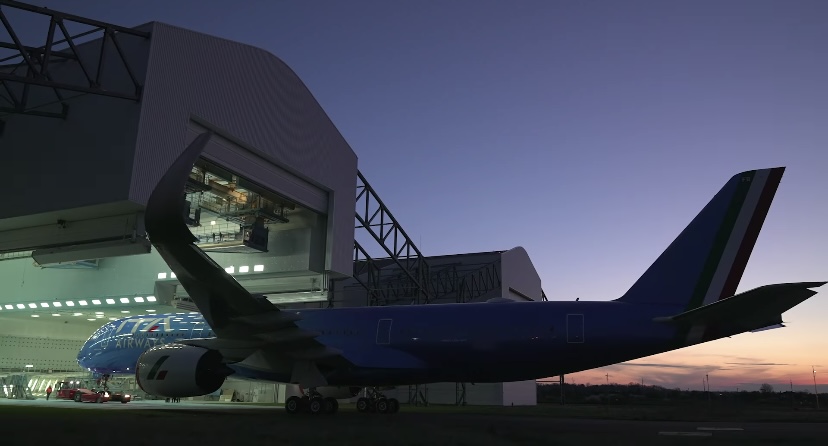
ITA Airways' first Airbus A350. (Photo: ITA Airways)
ITA Airways, Italy’s national airline, has painted the first Airbus A350 in its fleet. As it was already confirmed in January 2022 that the Airbus A350s that will join the ITA Airways fleet starting from June 2022 are the ones that previously belonged to the Chinese carrier Hainan Airlines.
The planes were never delivered to the Chinese airline due to financial problems. The Italian airline chose to lease six Airbus A350s for the long-haul, to complete the modernization of the fleet and thus pursue the green goal of reducing fuel consumption and CO2 emissions by 25%.
The aircraft is an Airbus A350 900 that was built in 2018 and has never been in service, so it is practically new. This will be the flagship aircraft as well as the largest in ITA Airways’ current fleet and will be used for intercontinental routes especially to North America.
The aircraft has been named after the coach who led the Italian national soccer team to victory in the 2006 World Cup, Marcello Lippi. The Airbus A350 is usually available in 2 versions, and the one chosen by ITA Airways is the 900, with 315 seats in a 3-class configuration. Although not much is known about the interiors yet, their fittings had already been completed for Hainan Airlines and therefore do not match those of ITA Airways. We will see in the coming days how this situation will be handled.
Another goal of the Italian national airline is therefore completed. The Airbus A350 was one of the airline’s main targets, being a key aircraft for the long-haul focus. From the beginning of May 2022, ITA Airways will introduce more routes to North America, Boston, Miami and Los Angeles, to South America with Buenos Aires and San Paulo and finally to Tokyo Haneda.
ITA Airways’ fleet continues to expand and it is anticipated that by the end of 2025, the fleet will consist of 17 owned aircraft and 88 leased aircraft. In 2028, 11 Airbus A320neo aircraft are expected to be added, so ITA Airways will own 28 aircraft.
From the promotional video presenting the new aircraft during the paint job, you can see the logo of SkyTeam, the alliance of which ITA Airways is currently a member. However, various rumors have brought the Italian flag carrier closer to Star Alliance, also considering the choice of being linked to SkyTeam for only one year. This opens up the possibility of new scenarios upon expiry of the contract term, i.e. at the end of 2022, given that if an agreement is reached for the purchase of ITA Airways by the Lufthansa group, this could mean an automatic switch to Star Alliance.
Vincenzo graduated in 2019 in Mechanical Engineering with an aeronautical curriculum, focusing his thesis on Human Factors in aircraft maintenance. In 2022 he pursued his master's degree in Aerospace Engineering at the University of Palermo, Italy. He combines his journalistic activities with his work as a Reliability Engineer at Zetalab.
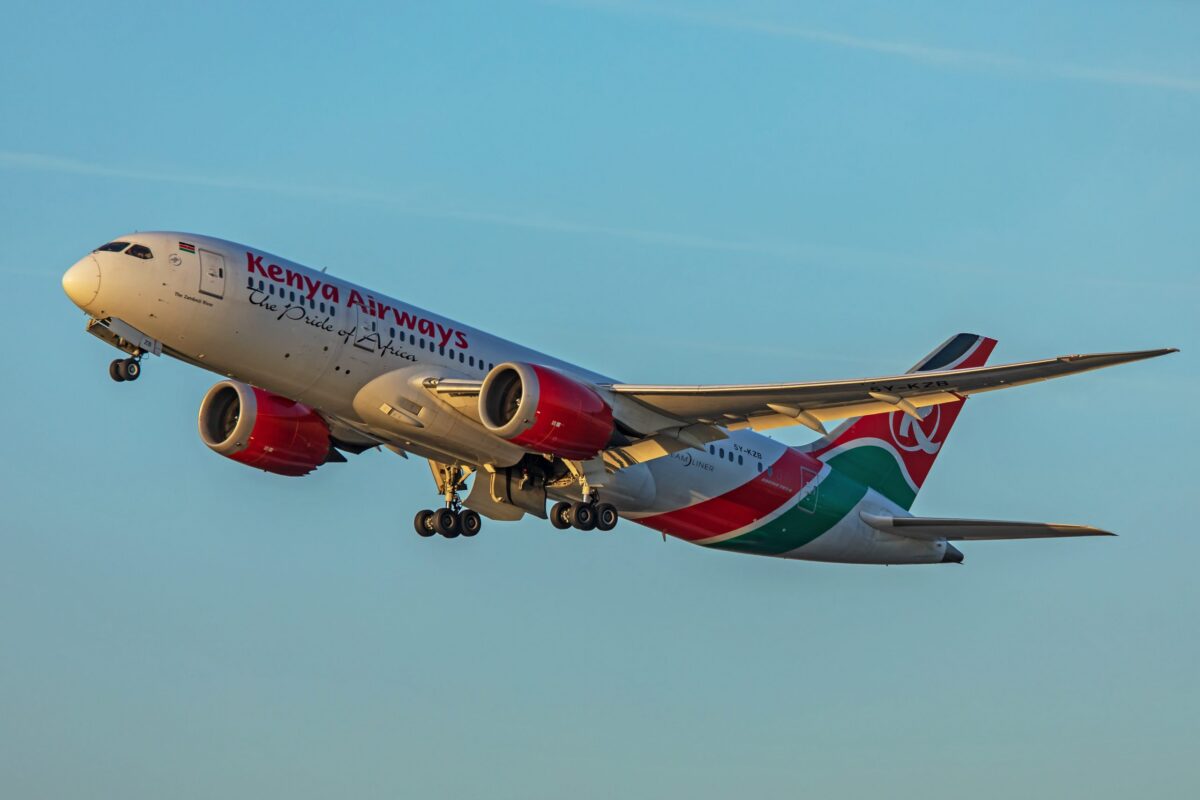
A Kenya Airways Boeing 787 Dreamliner
(Photo: AirlineGeeks | William Derrickson)
Kenya Airways has appointed Seabury Consulting, part of Accenture, to advise its board on the restructuring process being undertaken by the airline in restructuring its debt as well as advising the board on growing revenues on a long-term business plan.
Confirming the deal, KQ Board Chairman Michael Joseph said, “They [Seabury Consulting] will assist with the restructuring as part of the financial support from the National Treasury.”
According to the IMF, the retention of an international aviation consultant to prepare an in-depth financial assessment of Kenya Airways was highlighted as essential for the country’s state-owned enterprises (SOE) strategy as reported by the multinational agency in June 2021.
“Given the special circumstances and uncertainty facing the global airline industry, Kenya Airways has retained an international aviation expert to assist in defining a set of strategies for its future. Kenya Airways has experienced losses in recent years and faces significant future challenges. Sector-specific expertise will contribute to a better understanding of major trends in the regional and local aviation market, the formulation of a viable business model for Kenya Airways and ensure the consideration of all least cost alternatives for the Exchequer,” the IMF said.
While Seabury works on its report, the Kenyan legacy carrier is set to begin another painful restructuring that could see a significant number of employees getting fired as the airline seeks to remain airborne.
Meanwhile, the Kenyan government also plans to inject another 26.56 billion Kenyan shillings ($233.7 million) into the cash-strapped airline according to a supplementary budget estimates by the National Treasury presented to Parliament recently.
This is on top of 53.4 billion shillings in direct budget support already allocated to the airline for the fiscal year ending June 2022, with the government having promised to absorb 92.5 billion shillings of its debts accumulated by the end of 2020.
The extra allocation to the airline and other parastatals constitutes the highest of the National Treasury’s extra spending of 108.5 billion shillings in the fiscal year ending June 2022, aimed at alleviating unforeseen expenditure due to a drought in parts of the country, security, a petrol subsidy, payments for Covid-19 vaccines, and a general election in August, Treasury Cabinet Secretary Ukur Yattani told the Kenyan Parliament. It also represents a 3.3% increase in the national budget presented in April 2021, thus raising the country’s fiscal deficit from 7.5% of gross domestic product to 8.1%, reported Business Daily.
Kenya’s Business Daily reported the airline needs funds for the maintenance of grounded aircraft, payment of salaries, and the settling of utility bills, and to ease the effects of the Covid-19 pandemic on travel demand. Kenya Airways is at risk of running out of funds amid reluctance by commercial banks to extend further liquidity.
The government last year decided to reverse earlier plans to nationalize the national carrier and will instead look at other ways to safeguard money it has loaned the carrier, according to the International Monetary Fund.
Victor Shalton's love for aviation can be traced to when he was 11-years-old. As a seasoned aviation writer, he takes pride in providing the best aviation coverage around the globe and is passionate about advancing his skills in the aviation space. In addition, he loves travelling, writing, arts and while his speaking engagements have taken him around the world, he is proud to call Nairobi home.
Regional Express Boeing 737-800 flight over Sydney. Photo: Regional Express, 2021
Australian regional airline Regional Express (Rex) is set to continue its domestic expansion, adding new routes formerly operated by Virgin Australia, entering new Air Ambulance contracts, and even contributing 1 million Australian dollars to areas affected by the recent floods in both Queensland and New South Wales – this in addition to its acquirement of a second aviation academy in 2019.
The regional airline, which grew to prominence after the collapse of Ansett Australia in 2002, has slowly been growing in significance and operations, taking over several major inter-state routes in 2020 after Virgin Australia was unable to sustain its operations in the fallout of the Covid-19 pandemic. This expansion saw Rex increase the size and scope of its fleet, adding six Boeing 737-800 NG aircraft to its existing array of turboprop aircraft with the goal of further fleet expansion.
Domestic Routes Expanding
In early 2020, Rex obtained six Boeing 737-800NG aircraft as it commenced major inter-city domestic route operations, having recently expanded to include all major eastern Australian cities. This so-called ‘Golden Triangle’, which connects the cities of Sydney, Melbourne and Brisbane, are considered Australia’s busiest routes. Together with flight routes including Canberra and the Gold Coast, Rex has expanded its network to 62 routes around Australia.
Rex continues to reinforce its expanded operations, flying three daily flights between Sydney and Brisbane during the five-day working week and doubling this on weekends. It’s a positive outcome despite resistance from Australian flagship airline Qantas, which is accused of engaging in anti-competitive behavior against Rex. These actions from Qantas have been viewed as typical by Rex, having commenced legal remedies for Qantas’ behavior in 2021. Qantas was found guilty in 2007, 2008 and 2011 of price-fixing in the US, Australia and New Zealand respectively.
Rex Enters Air Ambulance Operations
Rex, under its subsidiary company Pel-Air’s subcontractor Total Aerospace Solutions, commenced its New South Wales air ambulance operations earlier this year on January 1, having received five new aeromedical Beechcraft King Air 350 aircraft between December 2020 and June 2021. In future-proofing the contract, two Pilatus PC-24 will enter service in 2023, replacing two of the five King Air 350s.
The 10-year contract has been complemented by Ambulance Victoria’s 12-year aeromedical contract, set to begin in 2024, worth a total of 300 million Australian dollars, requiring another four King Air 350s to be delivered later this year.
The aircraft will be used for patient transport as well as complex life-support operations across a vast range of areas in both states, each being described as a “hospital in the sky” by the NSW State Government.
Rex Disaster Relief Fund
The Rex Disaster Relief Fund will be providing up to AU$1 million to areas affected by the recent catastrophic floods. The months of February and March brought massive flooding to the eastern coast of Australia, resulting in enormous damage to many homes and at one point shutting access to Sydney’s CBD.
Rex says it is staying true to its tagline ‘Our Heart is in the Country,’ offering applications for free passenger and freight transport for those affected by the major flooding, particularly for towns it has long service. The support comes on the back of the deadly 2019-2020 bushfires and floods that followed.
Mike’s love affair with flight and mechanical objects in the sky began at an early age, fascinated by space documentaries and the vintage Flight Simulator ’95. He currently works as an instructor for UAVs and is training to receive his Private Pilot Licence with the goal of working in manned flight instruction. An avid reader of all things aviation and manned space flight, Mike stays close to developments in aerospace while reminiscing and sharing the rich history of flight with others. He loves writing, engineering and science.
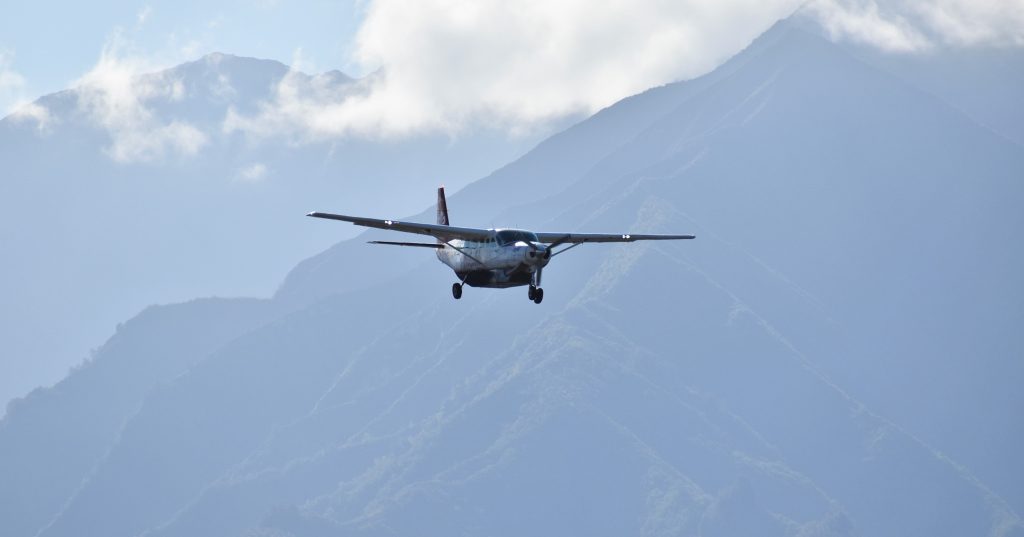
A Mokulele Airlines' Cessna 208B in Waimea (Photo: AirlineGeeks | Joey Gerardi)
Those that have read my stories and interviews know that I love out of the way or unique airlines, especially the smaller ones that still fly the propeller-driven aircraft. So, I was overjoyed to hear that I would be heading out to the Hawaiian Islands to do something that has been on my bucket list for a long time; Island hopping on Mokulele Airlines Cessna 208s.
Although this is not a trip report, those will be coming soon. While in the islands I once again had the pleasure of talking with Keith Sisson, the Chief Marketing Officer of Southern Airways Express the company that owns Mokulele Airlines, about this very unique operation in the Hawaiian Islands.
AirlineGeeks (AG): Mokulele is a unique brand from its parent company Southern Airways Express. Other than the livery, will passengers find anything else different from these flights in Hawai’i and Southern Airways Express flights on the mainland?
Keith Sisson (KS): Very few things are different. We work hard to make sure our customer service, our airplanes, and our on-time performance are standard across all five U.S. time zones we serve. You might see a bit more casual vibe among our staff in Hawaii reflecting the realities of island life, but the professional way they do their job is no different.
Mokulele Cessna 208’s in Honolulu (Photo: AirlineGeeks | Joey Gerardi)
(AG): I have heard that Hawai’i is all about the “Aloha spirit”, how does the airline try to incorporate this into their brand/livery?
(KS): The “Aloha Spirit” can mean so many things. For us, it means community engagement with our brand. We sponsor countless events and charitable fundraisers. Recently, we were the title sponsor for a food drive on Big Island that raised over 50,000 pounds of food for local food banks. We are also actively involved with the Native Hawaiian Legal Corporation, a non-profit that provides legal assistance to families who are engaged in conflicts that involve protecting the culture and traditions of Hawaii’s indigenous people. As to the livery, you’ll certainly notice that the Magnolia leaf on Southern’s blue tails has been replaced with a local hibiscus on Mokulele’s red tails!
(AG): You mentioned Southern’s blue tails, I know you have said the Mokulele name will stay alive here in the islands, but what about the Mokulele livery, what will happen to that?
(KS): A very good question. We have begun a slow process of transforming the red and orange of the Mokulele brand to conform to the navy blue and powder blue that we have at Southern. There is not a time frame set to complete the transition. As planes get repainted or signs get updated, the blues will be used.
N31SA, the first Mokulele aircraft wearing the post-merger livery in Moloka’i (Photo: AirlineGeeks | Joey Gerardi)
(AG): Every AvGeek loves a special livery, does Mokulele have any?
(KS): Actually, yes! N2150, this was the Big Island Air Tour Plane. That ceased operations as a result of COVID. We entered into an agreement to take the aircraft at that time. They used this aircraft for tours of Hawaii Island. The imagery on the aircraft is a combination of local folklore and popular attractions.
Mokulele Airlines’ special livery in Waimea (Photo: AirlineGeeks | Joey Gerardi)
(AG): Kaua’i is the only major Hawaiian island you don’t currently fly to, presumably due to the distance and restrictions of single-engine aircraft over water. Do you see the airline adding flights to this island with your new Saab340 aircraft?
(KS): We fully intend on serving that island, though not with the Saab. Instead of the main city of Lihue, we are hoping to provide scheduled flights to an unserved airport on the other side of the island, Princeville. For this, we have looked at a few different options, including the King Air Super 200. We have also taken a close look at the Tecnam Traveler and even took a demo flight near our Palm Beach, Florida headquarters. The Traveler may be a good solution for this service. No decision is made, but hopefully, we may be able to make an announcement this fall.
(AG): How has the pandemic affected your inter-island operations?
(KS): One could write a book on this subject. Two airlines did not survive the travel restrictions imposed by the State. Mokulele operated flights to five of the six islands, even in the most restrictive time of inter-island air travel. We felt an obligation to keep the islands connected as we were moving state officials, health workers, and PPE throughout the state. It was a difficult time for all. We have rebounded and have been able to provide the inter-island community with the flights they need over the last several months.
Onboard a Mokulele Cessna 208 (Photo: AirlineGeeks | Joey Gerardi)
(AG): Did any of the smaller islands/communities have their own set of health travel restrictions? How was this dealt with from a passenger’s perspective?
(KS): It was highly confusing for us as the airline, so I can’t even imagine how confusing it was for our passengers. There wasn’t a unified state-wide policy. Every county had its own set of rules, and they changed rather frequently. So, you could fly to a neighbor island and have one set of restrictions, then return to your home island and have a totally different set of rules. We did our best to adapt and to help our passengers adapt, I would never want to have to go through that again!
(AG): Inter-Island travel restrictions have finally begun to lift over the past month or so, have you seen this affect your bookings recently?
(KS): Inter-Island travel rebounded in late summer when the restrictions first lifted. We saw an overnight increase in bookings, but local traffic is still not back to 2019 levels. We believe this can be related to multiple factors, including more work-from-home jobs that do not require as much travel as in the past. Also, some of the older residents are still not comfortable returning to a pre-pandemic mindset.
(AG): Once the travel restrictions are fully lifted, do you see the airline expanding within the islands?
(KS): The only place we can expand to is Kauai—we already serve 10 commercial airports in the state! We hope we can make this happen this year, especially if the Asian countries lift the restrictions on returning residents who travel abroad. Many European countries have already done so. In Hawaii, Asian traffic is still down over 90% from 2019. So, we could be in for quite a boom when normalcy finally returns.
A Mokulele Cessna 208 seconds away from touching down at Kahului Intl. (Photo: AirlineGeeks | Joey Gerardi)
(AG): Many airlines have faced pilot shortages which have led to flight cancelations, has Mokulele faced any pilot shortages?
(KS): Absolutely not! At Southern Airways and Mokulele, we create pilots. We train the first officers and help them build hours until they are qualified to become captains for us. Then, we pass them along to SkyWest, our regional airline partner. When a young pilot starts with us, they have a fast pathway to the major airlines, so we have hundreds of pilots applying every month to join our team. Southern and Mokulele are uniquely positioned to survive and thrive during the worldwide pilot shortage—our passengers can book with confidence that they will have a plane and crew ready to go when they are!
(AG): What is Mokulele’s busiest route?
(KS): It is hard to say. Kapalua has become very popular as the resorts have reopened. Hilo to Kahului was underserved as a result of COVID and has been a very nice surprise. Molokai to Honolulu is quite popular during certain peak times of the week.
A Mokulele Cessna 208 on approach to Kahului Intl. (Photo: AirlineGeeks | Joey Gerardi)
(AG): Would you say you transport more locals or tourists on Mokulele?
(KS): Now that we have our interline agreements in place with United, Alaska, and American we are starting to see a better balance, but Mokulele was founded on the idea of serving the locals, which in Hawaiian is ‘Kamaaina’, and that is something we take great pride in.
Joey has always been interested in planes for as long as he can remember. He grew up in Central New York during the early 2000s when US Airways Express turboprops ruled the skies. Being from a non-aviation family made it harder for him to be around planes and would only spend about three hours a month at the airport. He was so excited when he could drive by himself, the first thing he did with his driver's license was get ice cream and go plane spotting for the entire day. He graduated from Western Michigan University in 2022 with a B.S. in Aviation Management & Operations and a Minor in Business, and currently works for a major airline in his hometown.
Photo provided by Aero Icarus from Zürich, Switzerland [CC BY-SA 2.0 (http://creativecommons.org/licenses/by-sa/2.0)], via Wikimedia Commons
Ocean Infinity, a reputable technology company specializing in the collection of high-resolution seabed data, has committed to another search for MH370, just under four years after their first search came to a hapless end.
The announcement comes eight years after Malaysia Airlines Flight 370 took off from the Kuala Lumpur International Airport in Malaysia, bound for the Chinese capital, Beijing. The reinstated search for the aircraft could begin as early as next year.
The Boeing 777-200ER with 227 passengers and 12 crew took off at 12:40 a.m. without incident. At 1:19 a.m., just 39 minutes after takeoff, Captain Ahmad Zahari Shah, a pilot with over 33 years of experience, radioed Malaysian air traffic control with a brief message: “Good night, Malaysia Three-Seven-Oh”, and disappeared over the Indian Ocean.
Following the aircraft’s disappearance, the Malaysian government began their attempt to locate the missing aircraft and occupants onboard. For years, local government and private companies have all attempted to locate the airliner, utilizing ships and aircraft from Australia, China, India, Japan, Malaysia, New Zealand, South Korea, the United Kingdom, and the United States, all to no avail.
With the exception of a few pieces from the aircraft washed ashore on different coastlines including debris from the flaperon, engine cowling, flap fairing, horizontal stabilizer, vertical stabilizer, cabin divider bulkhead, etc., there is still no conclusion to the final resting location of the aircraft. Experts theorize that the 777 continued its flight south for a few hours — off course to the north-eastern route towards Beijing — and now rests somewhere on the bottom of the Indian Ocean.
There is a wide range of theories on the cause of the disappearance of flight 370. These range from lack of fuel to suicide by a pilot. The only thing investigators are fairly certain of is that the aircraft manually changed course after the last radio message and that the aircraft fuselage broke apart – either in the air or on impact.
After many years and upwards of $145 million spent trying to locate the aircraft with no results, the official search came to an end in 2018.
Ocean Infinity’s first search covered an area a little under 70,000 square miles of the Indian Ocean seabed utilizing a deep-sea survey vessel named the Seabed Constructor. The total area covered by the company was in far excess of the initial 16,000 square mile target and almost the same area as the previous search achieved in 2.5 years.
Ocean Infinity has plans to send its state-of-the-art autonomous vessels back into the Indian Ocean, however this time, they’ll be complemented by new, remotely operated ships that are currently in the process of being built.
“They’re probably the most modern, cutting edge ships in the world. And one of the things we’re working on is the regulatory framework for a ship that can be driven with no person on board,” stated Ocean Infinity CEO, Oliver Plunkett.
Newfound Hope
Recently on 60 Minutes, respected British aerospace engineer and physicist Richard Godfrey made the bold statement that he knows the precise location of MH370. He claims that he accomplished this through the use of ham radio, analyzing distinct disturbances in radio waves from takeoff to the end.
He is the first and only one to investigate the signals of the ham radio operators on the night the plane went missing.
Ocean Infinity’s search will hopefully provide insight into whether Godfrey’s claims are true. Until then, the families of the 239 passengers and crew on board continue to hang onto the hope that the company can bring their losts ones home — providing the long-awaited closure they’ve been looking for.
However, before Ocean Infinity can embark on its multimillion-dollar investigation, they still need to gain approval from the owners of the airline — the Malaysian authorities.
Chase Hagl grew up in Twin Falls, Idaho. His love and passion for Aviation landed him in Orem, Utah where he obtained a B.S. in Aviation Management with a minor in Business Management from Utah Valley University. Chase currently works as a flight attendant in Charleston, SC and is also the primary Inflight ASAP ERC representative for startup airline, Breeze Airways. His experience in the aviation industry spans back four years, working in areas including agriculture application, customer service, maintenance, and flight ops. In his free time, Chase enjoys road biking, astronomy, and flying.
Delta Airlines on Wednesday took delivery of its first Airbus A321neo aircraft, delivered from Airbus’ European A321 Final Assembly Line location in Hamburg, Germany.
Following some additional modifications and technical work in Atlanta, the aircraft is set to enter service in May.
The delivery is the first of 26 A321neo’s — the neo is short for new engine option — that are set to be delivered to Delta’s fleet this year. Following the addition of 30 more neo’s in August, Delta’s book now totals 155 purchase commitments through 2027.
Following delivery of Delta’s current A321neo orders, the airline’s A321 fleet will grow to 282 planes. The aircraft will be manufactured at the same facilities in Mobile, Ala., and Hamburg, Germany.
“The delivery of our first A321neo helps to usher in the next era of premium domestic service at Delta,” said Mahendra Nair, Delta’s S.V.P. of Fleet and Tech Ops Supply Chain. “Not only do these aircraft offer the best customer experience in the industry, but these fuel-efficient airplanes further demonstrate our commitment to a more sustainable future.”
Replacing a Workhorse of Ages Past
The neo looks to replace Delta’s aging narrowbody fleet utilized for domestic operations, with the primary focus on its Boeing 757-200 aircraft, which has an average age of 24 years. In addition, the A321neo intends to replace the airline’s older A320 aircraft, with an average age of 25.
By replacing older aircraft, the neo will not only add much greater operational efficiency to Delta’s fleet, but it will also greatly assist in the company’s aim to become carbon neutral.
“Adding these aircraft strengthens Delta’s commitment to replacing older fleets with more sustainable, fuel-efficient jets, and offers the best customer experience in the industry,” Delta Senior Vice President for Fleet and TechOps Supply Chain Mahendra Nair said in a statement last year. “Delta appreciates the extensive partnership with the Airbus team in support of our strategic growth plans, and we look forward to continuing to work together throughout the recovery and in the years ahead.”
Assisting in the aircraft’s great operational efficiency is the aircraft’s Pratt & Whitney PW1100G powerplants, which, according to Delta, achieve 20% better fuel efficiency over Delta’s current A321ceo counterpart.
“The GTF-powered A321neo joins more than 200 Pratt & Whitney-powered aircraft in Delta’s fleet today” stated Rick Deurloo, Pratt & Whitney Chief Commercial Officer.
As well as improvements in efficiency, the aircraft will offer a much greater customer experience as a result of Delta’s effort to incorporate personalization and seamlessness. The 194-seat configuration will include 20 domestic First Class seats, 42 Delta Comfort+ seats and 132 Main Cabin seats, all with memory-foam cushioning. Additionally, the new domestic First Class seat features more privacy, workspace and storage. Each passenger will have access to Delta’s wireless in-flight entertainment system and powerports located at each seat, as well as their fast streaming Wi-Fi throughout the cabin.
On top of that, the aircraft includes spacious overhead bins, winged headrests, thoughtful finishes and more.
Chase Hagl grew up in Twin Falls, Idaho. His love and passion for Aviation landed him in Orem, Utah where he obtained a B.S. in Aviation Management with a minor in Business Management from Utah Valley University. Chase currently works as a flight attendant in Charleston, SC and is also the primary Inflight ASAP ERC representative for startup airline, Breeze Airways. His experience in the aviation industry spans back four years, working in areas including agriculture application, customer service, maintenance, and flight ops. In his free time, Chase enjoys road biking, astronomy, and flying.
Dubai Airport Closes Northern Runway for Refurbishment
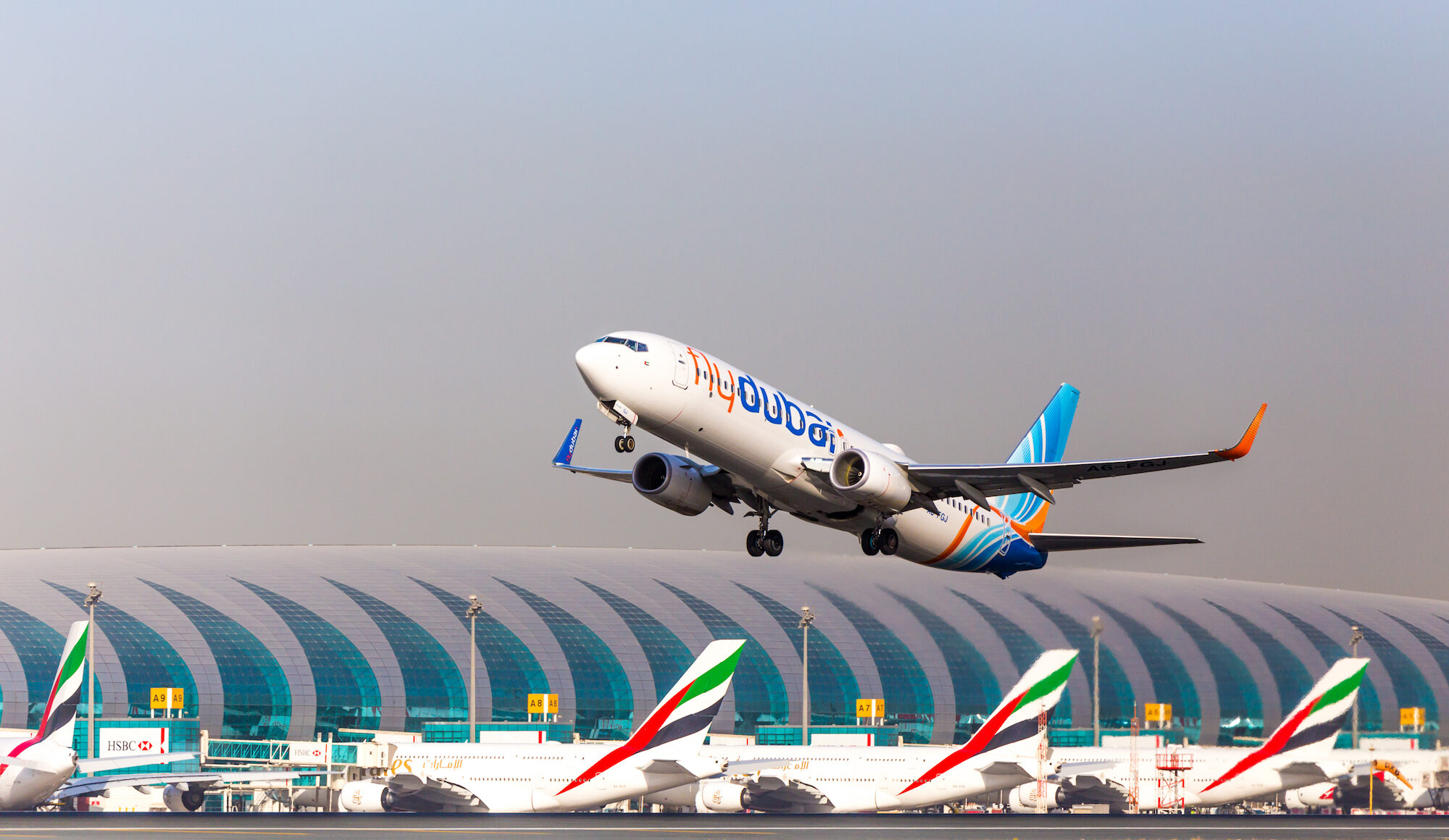
A flydubai Boeing 737 departs from Dubai International. (Photo: AirlineGeeks | Hisham Qadri)
Dubai Airports has confirmed plans to close Dubai, The United Emirates’ International Airport northern runway for a 45-day period between May 9 and June 22, 2022, to carry out refurbishment that will ensure continued safety and efficient operations.
While regular runway maintenance at the airport is scheduled on a weekly basis, more extensive upgrades such as the one planned require a complete closure of the runway.
Since Dubai International Airport is a dual runway operation, the hub will continue to welcome guests throughout this period. However, a number of flights will be redirected to Dubai World Central (DWC) — Dubai’s second airport — to limit the impact on service during the closure period.
Dubai Airports has advised passengers who are due to travel into or out of Dubai during the closure period to check with their respective airlines the airport and/or terminal of arrival/departure ahead of their journeys.
The last time this level of work was carried out on the northern runway was in 2014 — while the southern runway underwent similar improvements in 2019.
FlyDubai to Operate from Dubai World Central
Meanwhile, Flydubai will operate flights to select destinations from Dubai World Central (DWC) in order to provide more travel options to passengers during the northern runway refurbishment project announced by Dubai Airports.
The carrier will operate flights to 34 destinations from DWC during the period of the refurbishment project to ensure minimum disruption to passengers’ travel plans.
During this period flights to five of these destinations will also be available from Dubai Airport.
Flights to all other flydubai destinations will continue to operate from Terminal 2 and Terminal 3 at Dubai International Airport.
Flydubai’s chief executive officer, Ghaith Al Ghaith said, “As we saw in 2019, runway enhancement programs continue to support the long-term vision for Dubai as it reinforces its position as one of the world’s leading aviation hubs. We look forward to the completion of the northern runway refurbishment program and the efficiencies it will bring to our home at Dubai International (DXB). With flydubai flights operating to select destinations from DWC, we aim to provide our passengers with as much choice as possible to travel across our network with minimum disruption as more countries open up for travel.”
Flights to 34 destinations from flydubai’s network of more than 90 destinations will operate from DWC during the runway refurbishment project including flights to Kuwait City, New Delhi, Jeddah, Saudi Arabia; Mumbai, India; Muscat, Oman; Riyadh, Saudi Arabia and Bahrain.
Following the completion of the runway refurbishment project on 22 June 2022, flydubai will resume its flights to all destinations from Dubai International (DXB).
Passengers traveling from DWC will enjoy complimentary parking at the airport. In addition, the Roads and Transport Authority (RTA) will provide complimentary bus service between all terminals at Dubai and DWC every 30 minutes.
Victor Shalton's love for aviation can be traced to when he was 11-years-old. As a seasoned aviation writer, he takes pride in providing the best aviation coverage around the globe and is passionate about advancing his skills in the aviation space. In addition, he loves travelling, writing, arts and while his speaking engagements have taken him around the world, he is proud to call Nairobi home.
A LATAM Boeing 777 on approach to Amsterdam.
(Photo: AirlineGeeks | Fabian Behr)
From April 1, LATAM Ecuador will start a new route between Quito, Ecuador and Bogotá, Colombia with a frequency of 5 weekly flights. This new route that will link the 2 South American capitals will operate on Mondays, Tuesdays, Wednesdays, Fridays and Sundays.
LATAM Ecuador’s CEO, Mónica Fistrovic, guaranteed that this new route will stimulate tourism between Colombia and Ecuador, as well as trade, production and other different objectives where connectivity is key.
The new route announcement is evidence that the LATAM Airlines Group is committed to continuing to connect Ecuadorians and promote Ecuador in other international destinations. For his part, the Ecuadorian Tourism Minister, Niels Olsen, pointed out that the Ecuadorian government is working to improve national and international connectivity.
Airlines — as strategic allies — for growing tourism and demand help the return to frequencies and routes that existed before the pandemic.
According to El Universo, this new route will be operated according to the following schedule:
ROUTE
FLIGHT
DAY
DEPARTURE TIME
ARRIVAL TIME
BOG-UIO
LA 1443
Tuesdays and Sundays
20:07
21:45
UIO-BOG
LA 1442
Tuesdays and Sundays
17:15
18:45
BOG-UIO
LA 1441
Monday, Wednesdays and Fridays
09:37
11:15
UIO-BOG
LA 1440
Monday, Wednesdays and Fridays
07:00
08:30
In this way, LATAM Ecuador strengthens its international network, making Ecuador more visible as a tourist and commercial destination.
LATAM Airlines Group’s Reorganization Plan
LATAM Airlines Group obtained the approval of the Disclosure Statement by the Court in the United States.
Bankruptcy Judge from the Bankruptcy Court for the Southern District of New York, James Garrity, ruled that creditors may begin voting on the Reorganization Plan submitted to the Court on November 26, 2021.
This represents a fundamental step for LATAM’s exit from Chapter 11. At the hearing, the judge heard arguments about a dispute between the airline and a group of creditors.
On March 10, some LATAM Airlines Group’s creditors said that one airline’s unit should be blocked from collecting $1.3 billion from another airline subsidiary because the claim was never a valid loan.
It should be remembered that this resolution occurred after the Court approved the modification and the new consolidated DIP credit agreement text between LATAM and its financiers on March 15.
The Court also set the Confirmation Hearing for May 17 and 18, in which the Court will evaluate the definitive Reorganization Plan. According to a statement issued by LATAM, the airline expects to successfully emerge from the Chapter 11 Procedure during the second half of 2022.
As a result, the group will be able to access $3.7 billion in liquidity and refinance its existing DIP credit agreement.
Last week, the Court approved the commitment and support agreements in provision for the reorganization and financing plan proposed by LATAM. These settlements represent approximately $5.4 billion in committed funds.
The three things Juan Pedro loves most about aviation are aircraft, airports, and traveling thousands of miles in just a few hours. What he enjoys the most about aviation is that it is easier and cheaper to travel around the world and this gives you the opportunity to visit places you thought were too far away. He has traveled to different destinations in North, Central, South America and Asia. Born, raised and still living in Perú, Juan is a lawyer, soccer lover, foodie, passionate traveler, dog lover, millennial and curious by nature.
The first look at the Greater Bay Airlines 737.
(Photo: Oriental Daily)
Greater Bay Airlines — a brand-new airline in Hong Kong — received its second Boeing 737-800 aircraft, after being granted the Air Transport License in February. The new aircraft has registered with registration B-KJB and leased from China’s ICBC Leasing. According to local media, the aircraft was owned by Norwegian Air International beforehand.
“This is encouraging and exciting news to us and the recent granting of the ATLA license represents another big step forward for the airline,” Algernon Yau, CEO of the airline said in a statement.
Greater Bay Airlines has leased three Boeing 737-800 and expecting the delivery of the third aircraft by 2022. According to its website, the airline has planned to own a fleet of seven Boeing 737-800 by 2022 and more than 30 aircraft by 2026.
Despite the second aircraft having been delivered, the airline hasn’t unveiled the schedule of its maiden flight. Hong Kong is facing the fifth wave of coronavirus and carrying out the most restrictive travel rules. Yau believed the quarantine rules need to be lifted before the airline launched. The airline has expected to start operating last October but failed to receive the Air Transport License last year.
“I think we would need around three months in advance,” Yau added.
Greater Bay Airlines criticized the Hong Kong carriers for neglecting the Chinese market. Earlier, the airline said that it will “committed to contributing the continual aviation development of Hong Kong and the Greater Bay Area.” Greater Bay is the area adjacent to Hong Kong — a market that has a population of 85 million. The airline has applied to operate 104 destinations across Asia.
Airlines around the globe have started recovering after the pandemic, but Hong Kong’s travel restrictions have left the aviation industry behind. After two years of the pandemic, Cathay Pacific, Greater Bay Airline’s potential major competitor, is still battling against a strong headwind, revealing that it carried 31,253 passengers in February, a 98.9% decrease compare to the pre-pandemic in February 2019.
According to Cathay Pacific, it operated below 2% of pre-covid levels in February and the environment remains “very challenging”.
Lifting Travel Restrictions
In the meantime, Hong Kong International Airport has revealed that it handled 86,000 passengers in February, significantly lower than the pre-pandemic levels. The airport recorded 5.89 million passengers in February 2019.
However, Hong Kong Government has shown a sign of lifting its restrictions, allowing the flights from nine countries, including Australia, Canada, France, India, Nepal, Pakistan, Philippines, the U.K. and the U.S. to fly to Hong Kong again from Apr.1. Earlier, flights from nine countries have been banned from entering the city based on “place-specific and flight suspension mechanism”, due to Omicron variant concerns.
In addition, the Hong Kong government has relaxed its quarantine rules, and Hong Kong residents coming from foreign countries need to take seven days quarantine instead of 14 days hotel quarantine.
A Delta CRJ-200 (Photo: AirlineGeeks | Joey Gerardi)
If you have read my articles in the past, then you know I love out-of-the-way airports, airlines and aircraft and would do almost anything to adventure to a new city or fly on a unique, rare aircraft type. So in continuation of this series, which I call my “Unique Connection Series”, I will go over a unique flight between two cities using a small, unusual airport as a stopover. The uniqueness of the connection might be referring to the small size of an airport, a unique aircraft type or both.
Overview
For this unique connection, I will be starting at Detroit’s Metropolitan Wayne County Airport and flying to Minneapolis’ St. Paul Airport — using the small Essential Air Service (EAS) community of Iron Mountain, Mich. as my connection point. I will be flying on Delta Air Lines operated by SkyWest on a 50-seat regional Bombardier CRJ-200, neither of which are rare or unique in the United States, but the fact this trip will bring me through an EAS community definitely qualifies it as “unique”.
SkyWest operates flights to many EAS airports under the Delta Connection banner, none of which were announced to be terminated in SkyWest’s massive 31 destination cessation last week —which consisted of only United Express branded destinations. At the time of writing this trip report, this particular unique connection along with the other Delta Connection branded EAS destinations are safe for the time being.
Although Delta and SkyWest do operate in many EAS cities, only two are timed correctly for connections between the airline’s hubs in a single day; Escanaba and Iron Mountain, both of which are in Michigan’s Upper Peninsula and are actually 50-miles apart from each other. Another EAS city in the Upper Peninsula does connect to both of Delta’s Midwest hubs, Sault Ste. Marie, but at the time of writing this, the timing of the flights requires you to stay overnight for it to work.
In Escanaba, you can only connect there in the evenings going westbound from Detroit to Minneapolis. For Iron Mountain, you can connect here in either direction between the hubs, westbound in the mornings, and eastbound in the afternoon and evenings. In this article, I will be going westbound from Detroit to Minneapolis, using Iron Mountain as my connection point as explained above.
Day of the Flight
On the morning of the flight, I arrived in Detroit on another Delta flight, so there was no need to re-clear security and my connection was just about two hours. I relaxed and had a good breakfast in the terminal before heading through Detroit’s famous humming hallway to the B and C gates where all the Bombardier CRJ-200 flights depart.
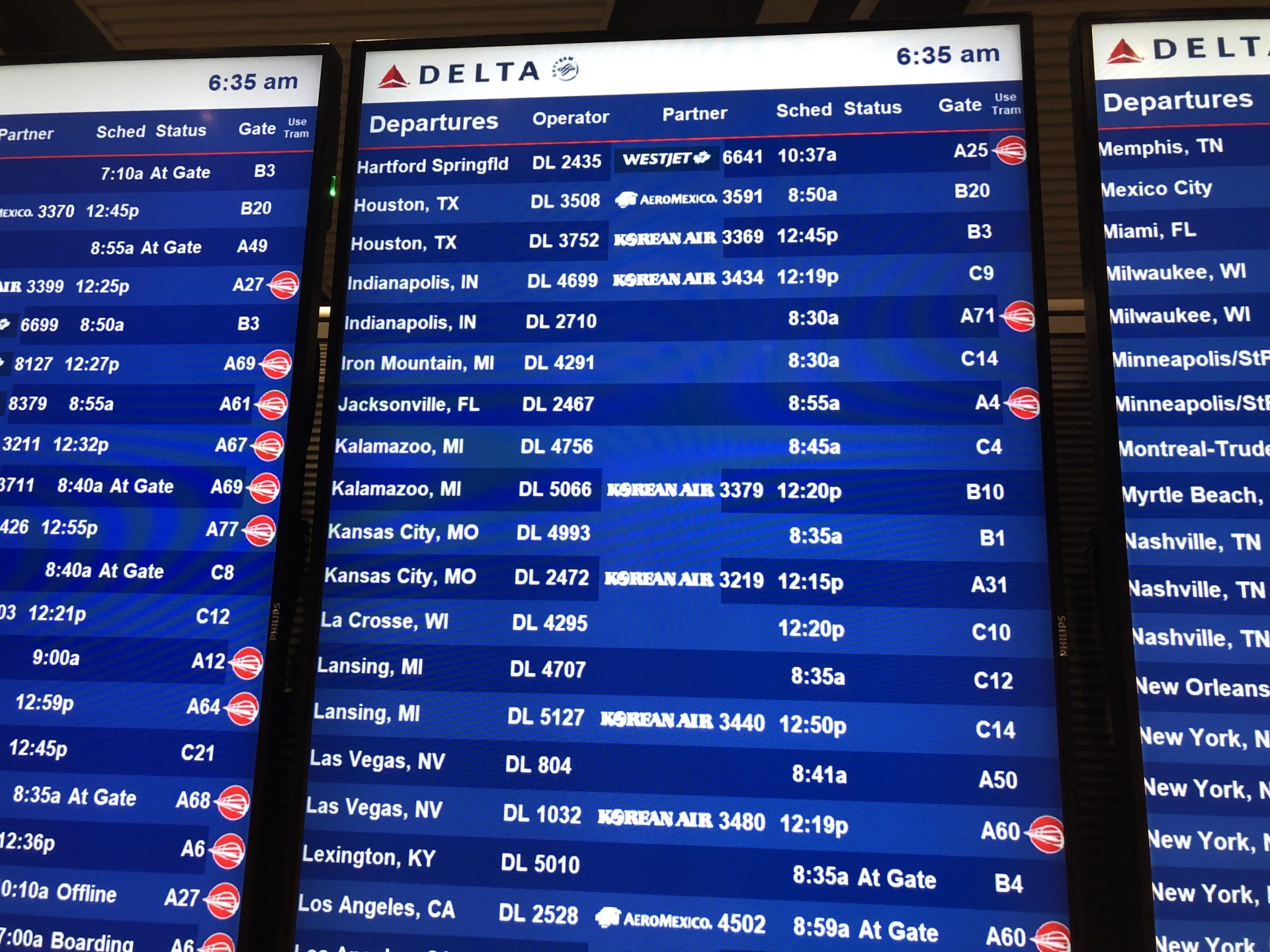
The departure board for the morning flights (Photo: AirlineGeeks | Joey Gerardi)
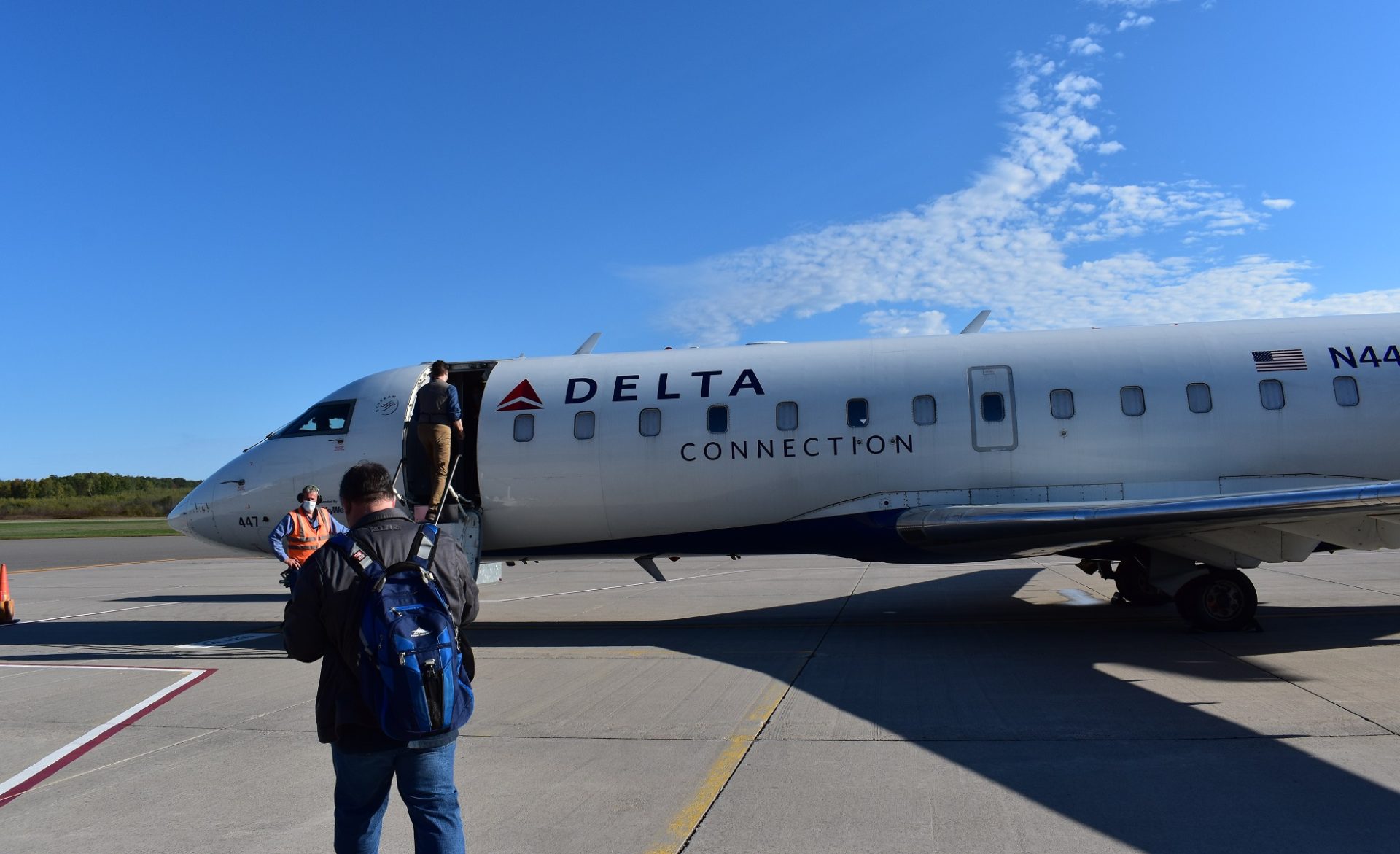
Once I arrived at the gate I saw my chariot for today’s flights; N447SW, a CRJ-200 that was delivered directly to SkyWest back in September 2002. The only time it spent away from the airline was a brief seven months during the pandemic when it was parked in Tucson, Ariz.
My aircraft for today (Photo: AirlineGeeks | Joey Gerardi)
The good news for this flight is you have no risk of missing a flight and getting stranded in the middle of nowhere. Just like in my previous Unique Connection Series articles, this aircraft will take me all the way from the starting point to my final destination — which in this case is Minneapolis/St. Paul.
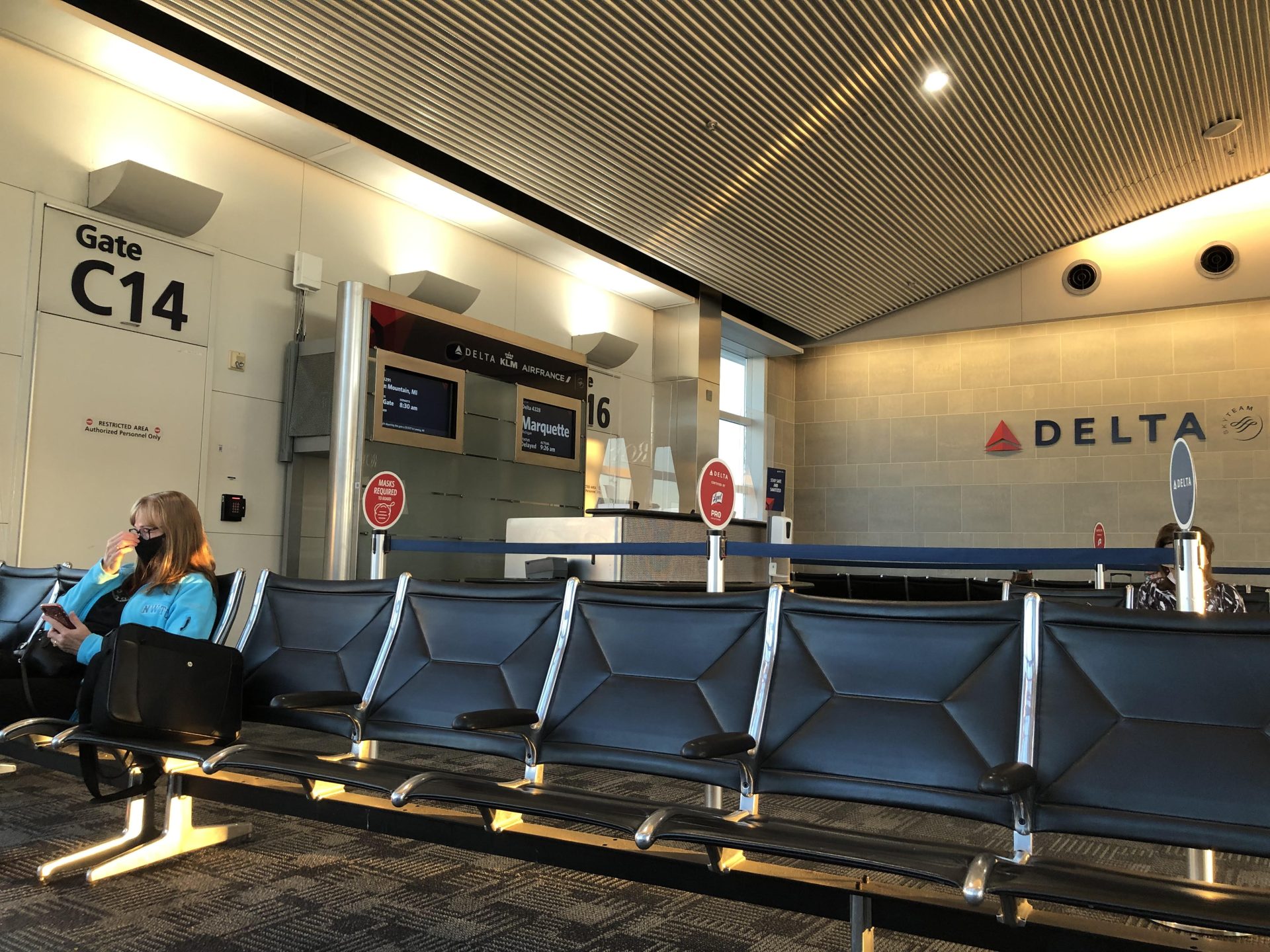
The empty gate area for my flight to Iron Mountain (Photo: AirlineGeeks | Joey Gerardi)
Boarding started, nothing special just like every other Delta flight, and I took my place for the first flight in seat 10D. This trip was taken at the end of September, so I opted for a right-side window seat in order to get some wonderful views of Lake Michigan as we flew over, as well as the fall colors I hoped to catch upon landing. There were only 11 passengers on this flight up to Iron Mountain on a 50-seat jet, which is the reason the EAS program exists. Without the program and its subsidies, no airlines would fly a 50-seat jet nearly 350-miles with only 11-people on it, the program is a lifeline to communities all over the country.
Before boarding, I made sure to switch to a window seat towards the rear of the aircraft. I’m sure it’s not often you hear people wanting to move further back, but I prefer it on the CRJ-200s as it gives you a nice view of the wing, flaps and even the engine if your far back enough.
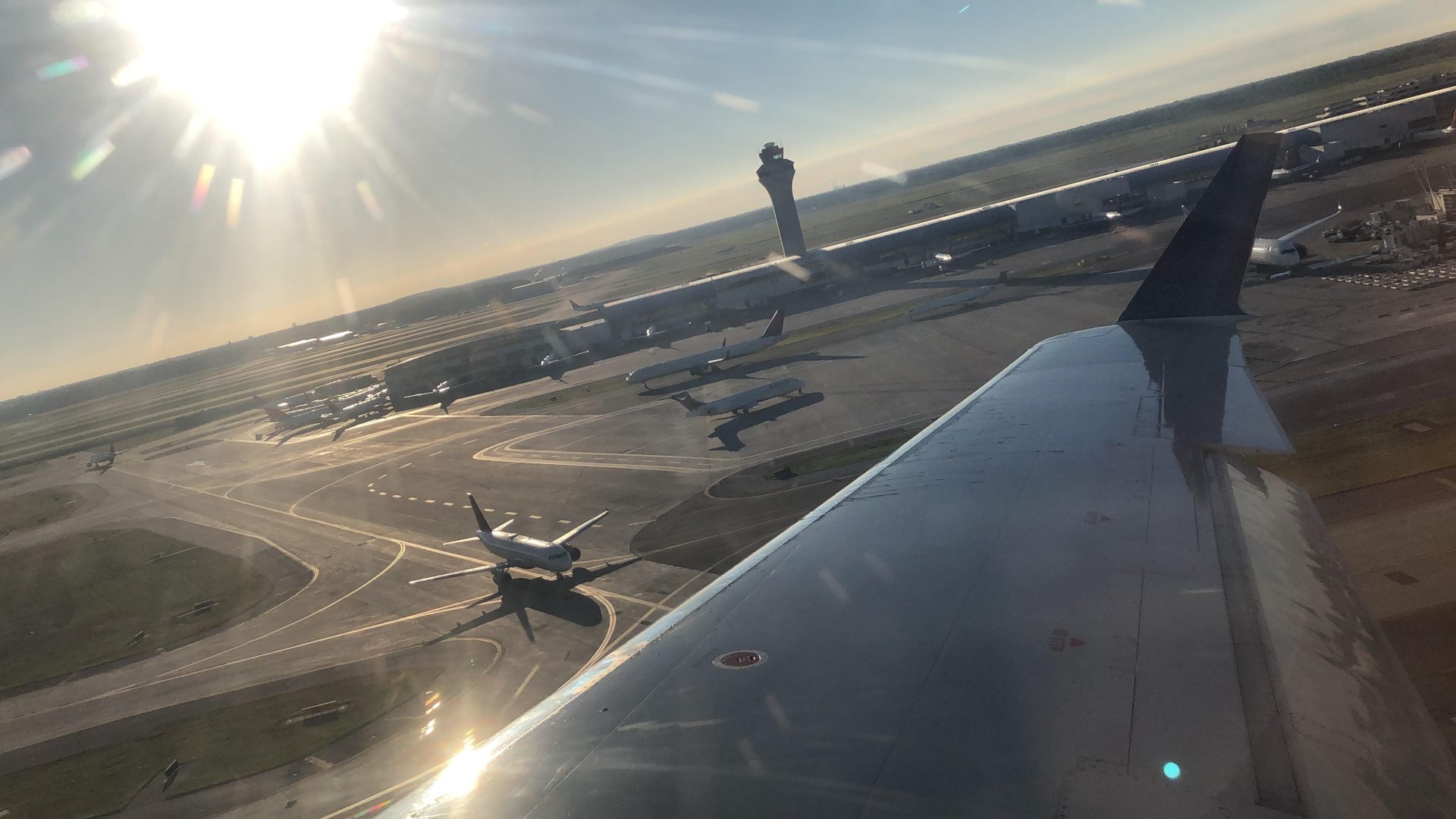
My view from seat 10D on the CRJ-200 (Photo: AirlineGeeks | Joey Gerardi)
Pushback, engine start-up and a taxi to the runway for my flight to Iron Mountain. Before I knew it we had rocketed off the runway in Detroit towards the northwest bound for the Upper Peninsula.
On takeoff from Detroit-Metro (Photo: AirlineGeeks | Joey Gerardi)
It was a pretty average flight, up to cruising altitude of 28,000-feet and made our way across Michigan and upper Lake Michigan. Service consisted of Goldfish crackers or biscoff cookies and a mini water bottle, pretty good for an aircraft this size, as I’ve had a lot less service on longer flights using bigger aircraft. We then were above Traverse City, Mich. and Grand Traverse Bay including Mission Point.
Flying passed Mission Point (Photo: AirlineGeeks | Joey Gerardi)
At the tip of that point of land, in the picture above is Mission Point, which is located along the 45th Parallel, meaning I was halfway between the Equator and the North Pole. The CRJ-200 doesn’t have WiFi or inflight entertainment to speak of, but with a view like that, I really didn’t need it and spent most of the flight looking out the window. Before long the coastline of the Upper Peninsula was coming into view and we had begun our descent.
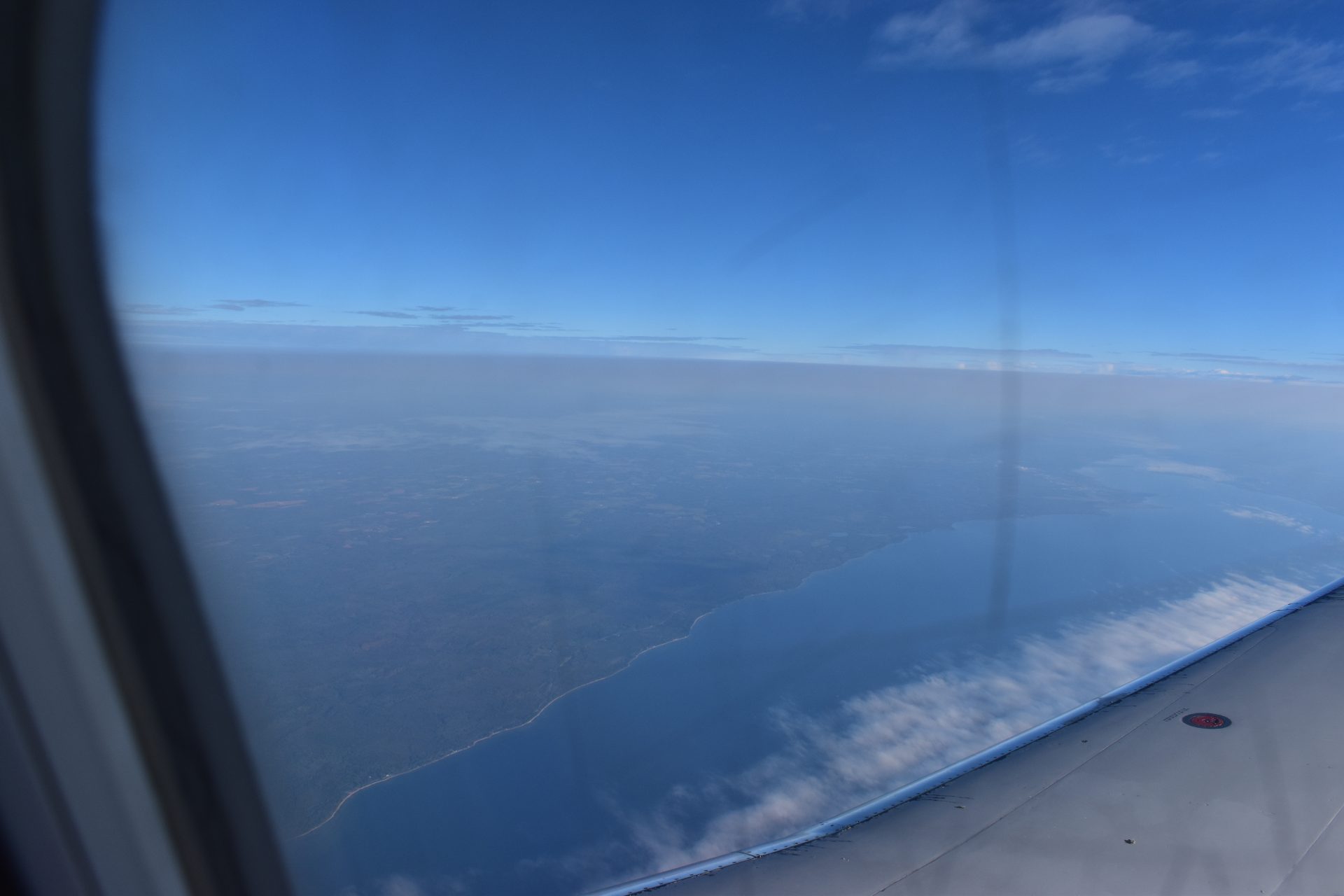
The coastline of Michigan’s Upper Peninsula (Photo: AirlineGeeks | Joey Gerardi)
As we got closer to the ground, I started to see exactly what I was hoping for, which was fall foliage. The brown, yellow and red leaves slowly became more clear the closer we come to the ground.
The fall colors of the Upper Peninsula (Photo: AirlineGeeks | Joey Gerardi)
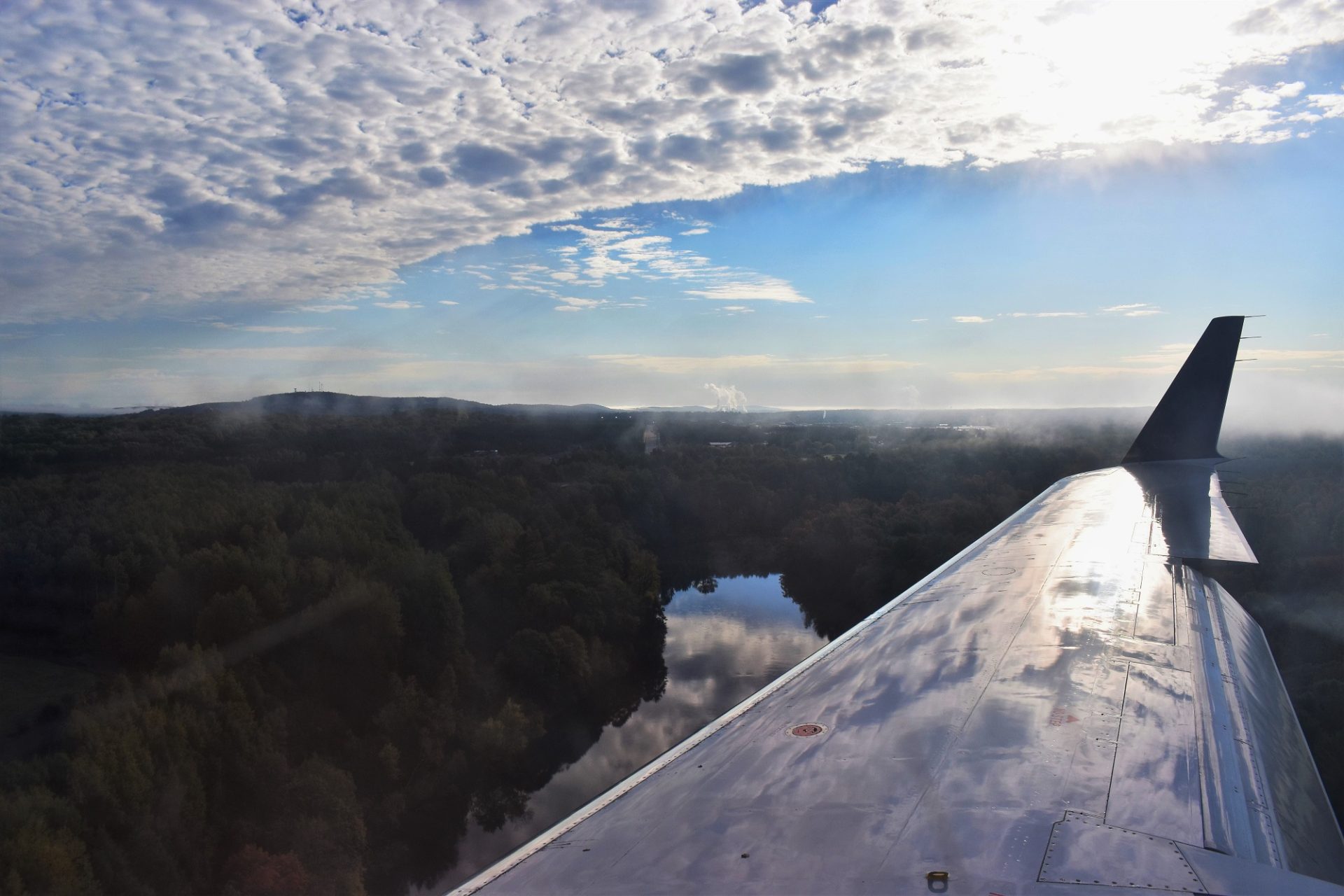
Just before touching down in Iron Mountain, we flew over the Menominee River — which surrounds the airport and the community on Iron Mountain on three sides. This river also represents the border between Michigan and Wisconsin, which means Iron Mountain is on a peninsula, within a peninsula.
Flying over the Menominee River (Photo: AirlineGeeks | Joey Gerardi)
We touched down at the Ford Airport in Iron Mountain at 8:44 A.M. local time, making the flight time from takeoff to touchdown one hour and seven minutes. It was a brief five-minute taxi to the parking gate where I was happy to see no jetway — meaning we would deplane out onto the ramp.
Pulling into the gate at Iron Mountain (Photo: AirlineGeeks | Joey Gerardi)
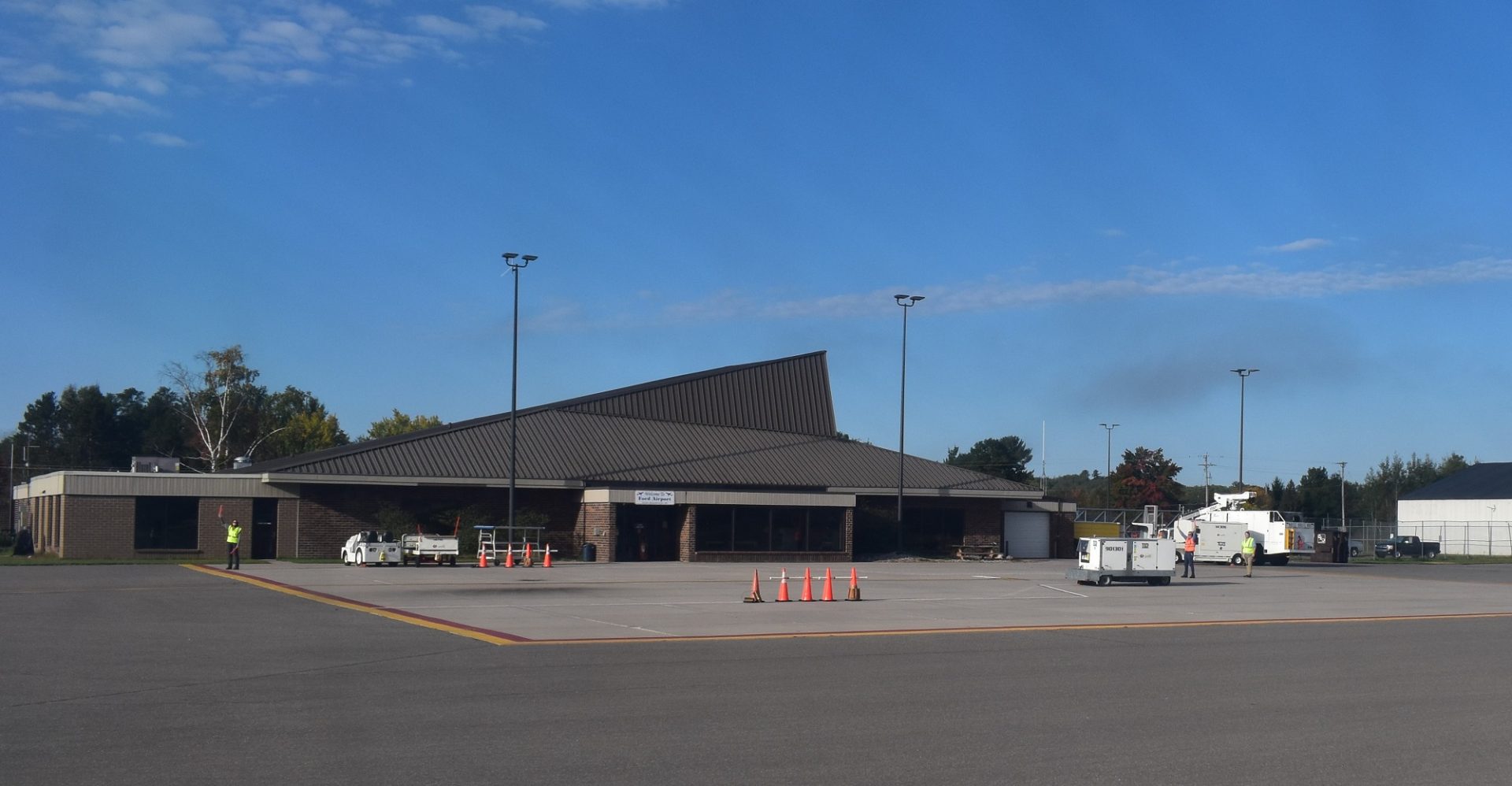
This would be the 35th EAS Airport that I have visited, and the third in the state of Michigan I have seen. The others in Michigan that I have visited include Muskegon and Manistee, the latter of the two on Cape Air’s inaugural flight. Every EAS airport terminal I have been to has its own flair or unique design to it. At Iron Mountain, the architecture of the roof is what stands out the most.
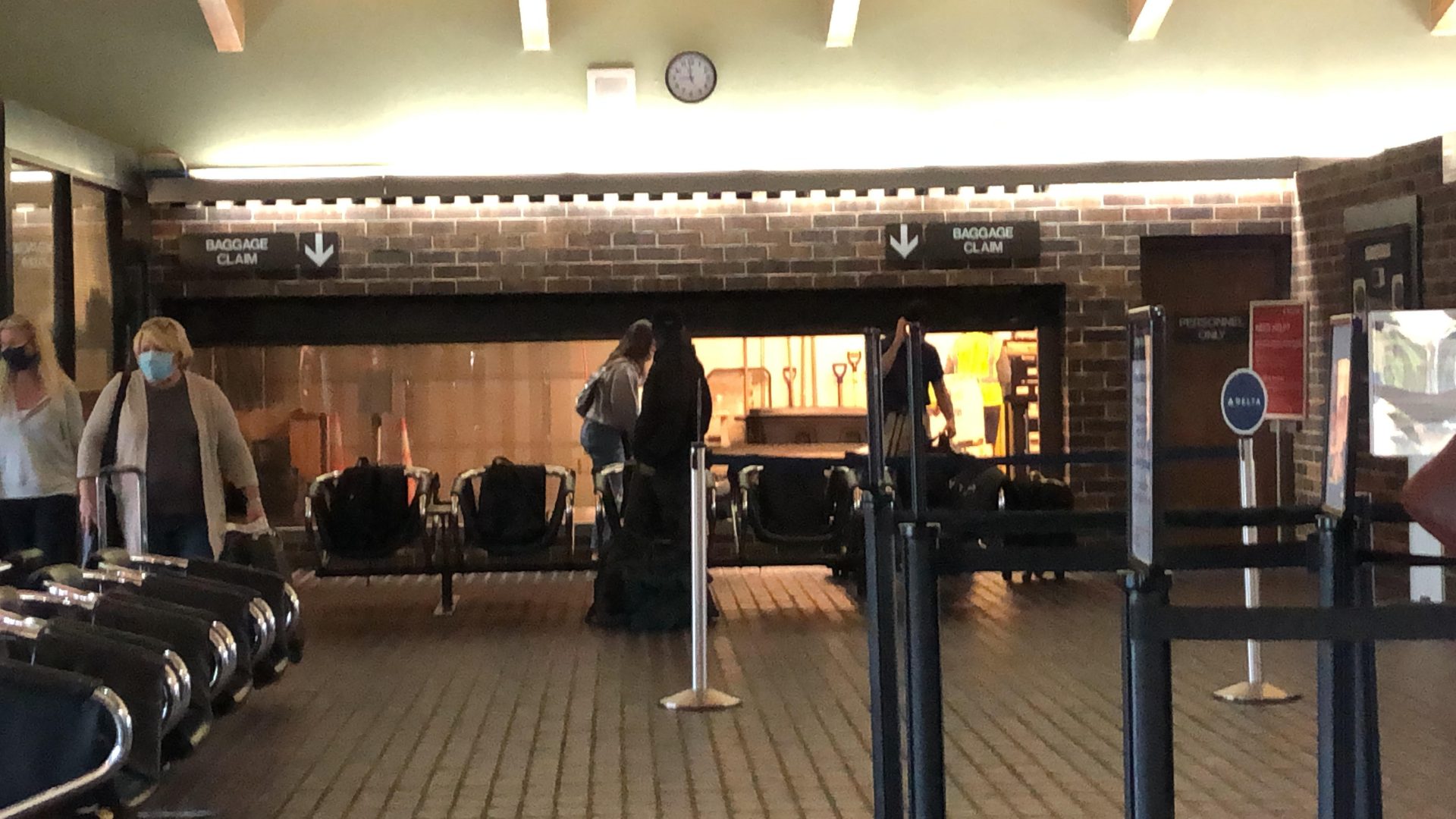
The inside of the terminal was nothing fancy, but it was unique. There was a glass wall separating the sterile and non-sterile areas of the airport, the only way to get access between the two was through the TSA checkpoint or an alarmed door that the airline employees opened for arriving passengers to exit out of. Through the glass wall, I could see the baggage claim, which here was essentially a window they open where you can grab your bags. I do apologize for the quality of that baggage claim picture, the photo got a bug as I was transferring it from my camera.
The ‘Baggage Claim’ area in Iron Mountain (Photo: AirlineGeeks | Joey Gerardi)
I saw a few passengers talking to loved ones over the phone in the gate area, while the other person stood just on the opposite side of the glass in the airport lobby. This was fun seeing that and is certainly a unique aspect of this airport.
There was no restroom in the gate area once you went through security, so they only sent people through as they got closer to the departure time. The gate area was simple, with no permanent desk foundation or counter. The gate consisted of a simple single computer and a boarding pass scanner on a rolling table, which was wheeled out as the flight was ready to board.
The gate area in Iron Mountain (Photo: AirlineGeeks | Joey Gerardi)
No Public Address (PA) system in the gate area either, just someone talking as loud as they can, and yet despite this it didn’t feel unprofessional and actually added a bit of class doing things the really old-fashioned way. Before I knew it, the Delta agent began the boarding process, and I headed out for my flight to Minneapolis on board the same aircraft that brought me here.
Walking out to my aircraft in Iron Mountain (Photo: AirlineGeeks | Joey Gerardi)
I find that the smaller the airport it is, the nicer and more friendly people working there are, and that was certainly the case here. Everyone was so accommodating, and the gate agent even helped me with my seat assignment so I would have a better view on takeoff from Iron Mountain, I took my seat in 10A and buckled in for the short flight to Minneapolis.
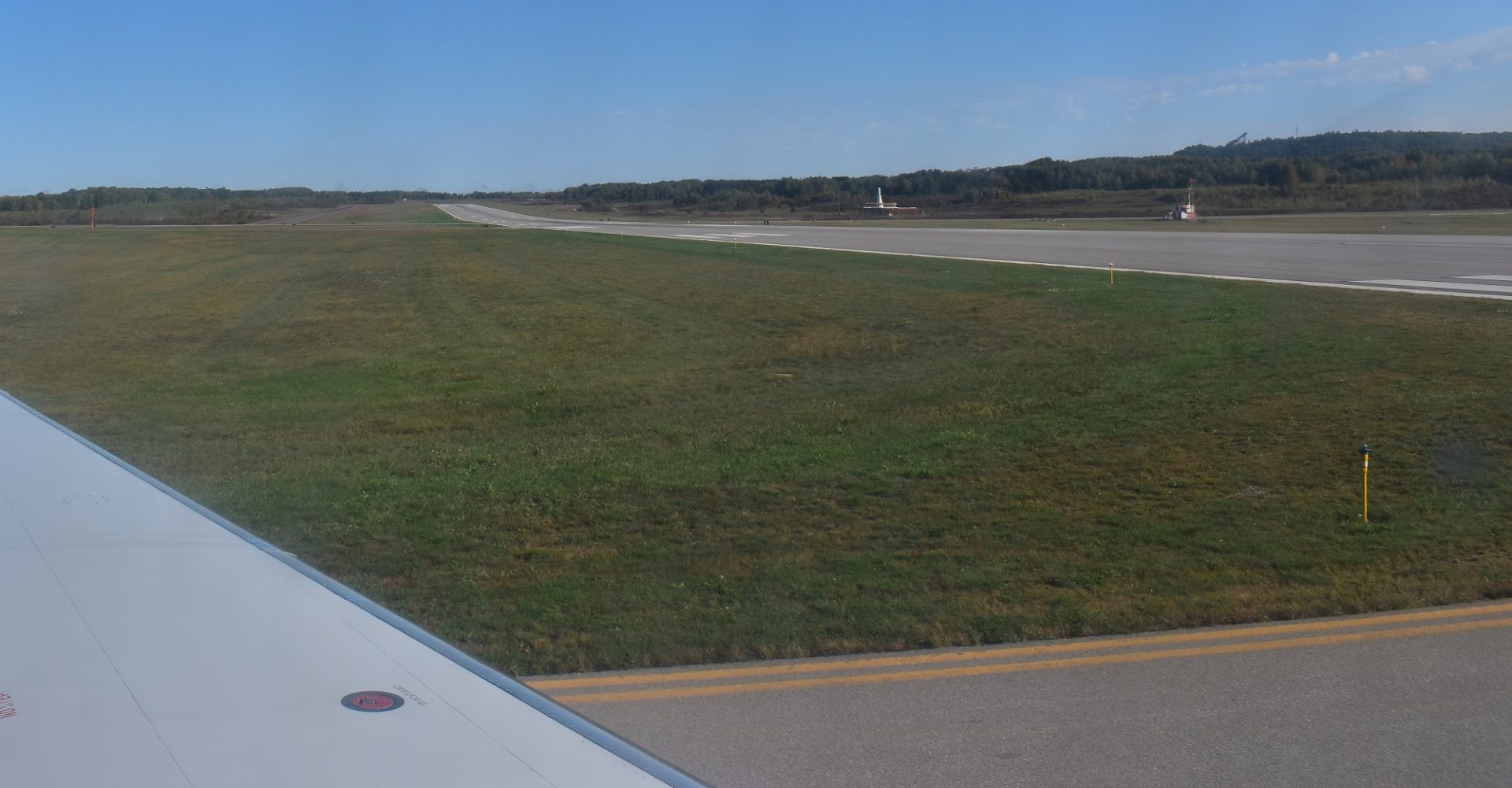
The startup, and a short taxi over to the runway for takeoff. I could see the curvature of the runway in Iron Mountain from my seat as we turned onto the runway which was nothing alarming, most runways have dips and hills in them all of which are regulation. They are usually hard to see unless you are looking at them from the right angle, which I was this time.
Looking down the runway as we taxi for takeoff (Photo: AirlineGeeks | Joey Gerardi)
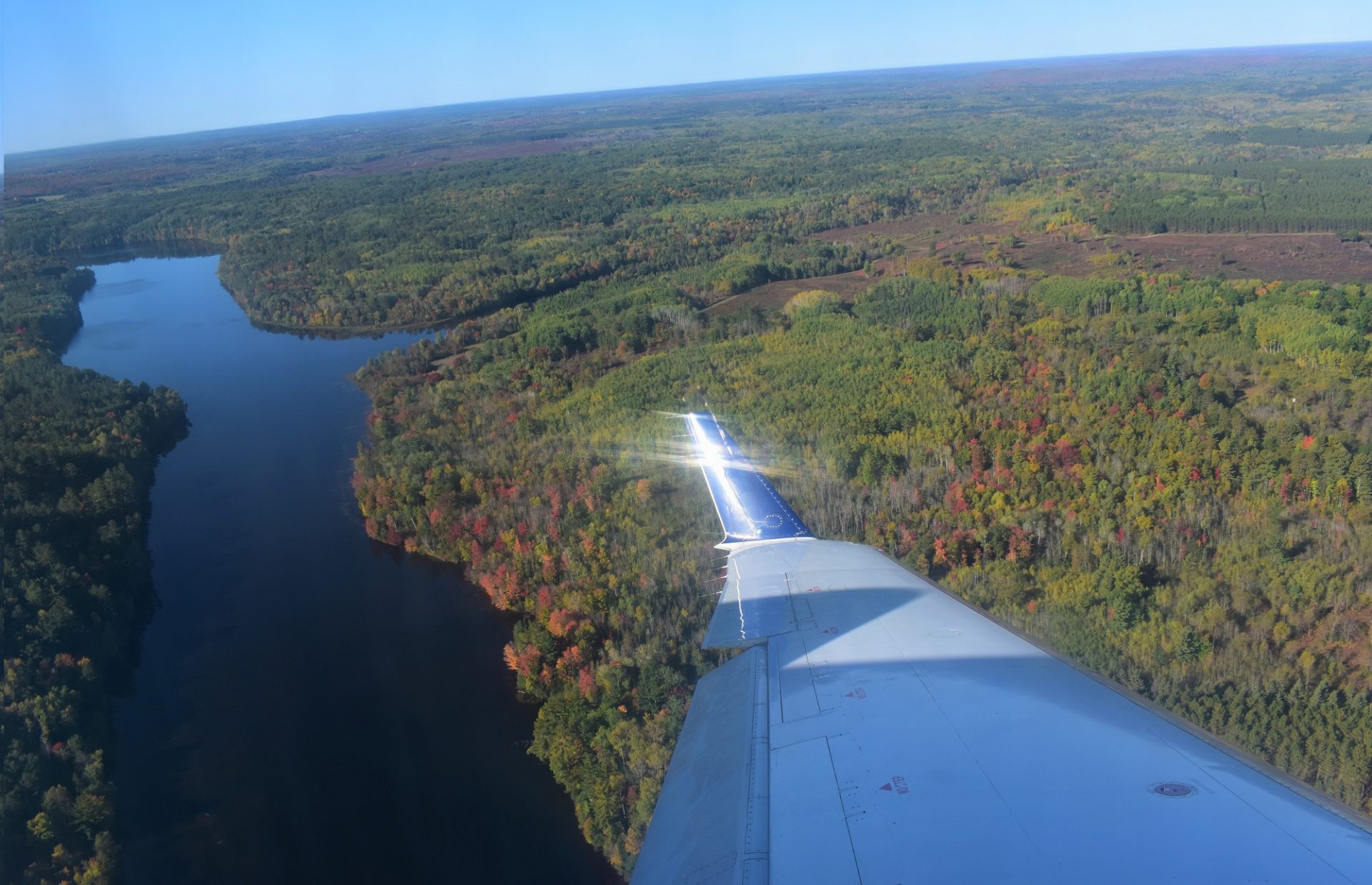
We proceeded to take off from Iron Mountain not even an hour after landing, and I saw why the gate agent recommended a seat on the left side; a view of the river. In regards to the picture below, to the left of the river is Michigan and to the right is Wisconsin.
The Menominee River (Photo: AirlineGeeks | Joey Gerardi)
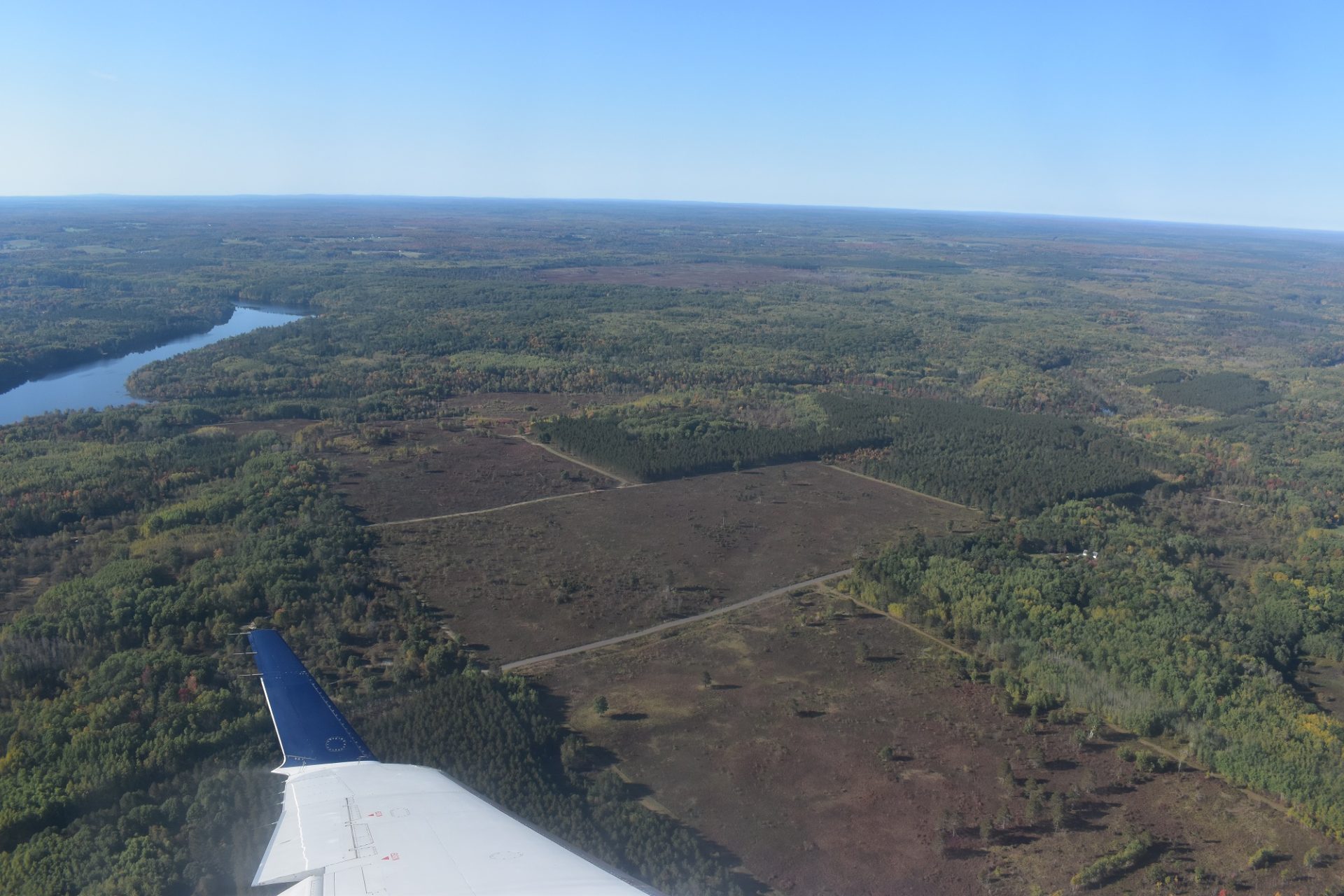
On this flight over to Minneapolis, there are 26 total passengers which is more than double that of the first flight, but still not a lot considering the aircraft can hold 50. We quickly climbed up to our cruising altitude of 24,000-feet for this short flight over to Minneapolis.
Leaving behind Iron Mountain as we head to cruise (Photo: AirlineGeeks | Joey Gerardi)
For this flight, the service was again a small water bottle and biscoff cookies, but instead of goldfish, there was a bag of pretzels. Still impressed by the service on a flight this short hop, the single flight attendant did a good job attending to passengers’ needs.
Before I knew it we had begun to descend and I could see downtown Minneapolis off the left side of the wing.
Downtown Minneapolis off the left side of the aircraft (Photo: AirlineGeeks | Joey Gerardi)
We touched down on the runway in Minneapolis/St. Paul at 10:23 A.M., which was 48-minutes after leaving Iron Mountain and 2-hours and 46-minutes after taking off from Detroit. By no means is this faster than the nonstop flight between the cities which can sometimes be under 90-minutes.
With spring break coming up for many schools across the country and pilot shortages looming, a unique connection could be your saving grace. If your hub-to-hub flight gets canceled or you miss a flight, this unique connection may just be the way of saving your vacation once the nonstop flights are completely full. On the other hand, you could just stop to see a place you’ve never been and probably have never heard of until now.
So, the next time your travel try connecting somewhere new and unique, you may just like where you end up.
A video trip report of this article can be found below. Some information and facts have been changed since the video’s creation in January 2022, this article has the most up-to-date information regarding this specific flight and was fact-checked on March 20, 2022.
Joey has always been interested in planes for as long as he can remember. He grew up in Central New York during the early 2000s when US Airways Express turboprops ruled the skies. Being from a non-aviation family made it harder for him to be around planes and would only spend about three hours a month at the airport. He was so excited when he could drive by himself, the first thing he did with his driver's license was get ice cream and go plane spotting for the entire day. He graduated from Western Michigan University in 2022 with a B.S. in Aviation Management & Operations and a Minor in Business, and currently works for a major airline in his hometown.
Sign-up for newsletters & special offers!
Get the latest stories & special offers delivered directly to your inbox