A mock-up of how a potential hydrogen-powered engine testbed could look on the Airbus A380. (Photo: Airbus)
Airbus on Wednesday announced that it will be teaming up with the world’s largest jet engine manufacturer, CFM International, to collaborate on a program to produce and test a hydrogen-powered jet engine. CFM International is a 50/50 joint venture between GE Aviation and Safran Aircraft Engines.
The collaboration will conduct both ground and flight tests of the hydrogen combustion engine, with the goal of entry into service of zero-emission aircraft by 2035, ultimately accomplishing Airbus’s ambition of developing the world’s first zero-emission aircraft.
Selected Aircraft
Demonstration of the engine will be done by utilizing a modified Airbus A380 aircraft equipped with liquid hydrogen tanks. The engine will be mounted along the rear fuselage of the aircraft to allow engine emissions, including contrails, to be monitored separately from the A380’s four wing-mounted engines.
The decision to utilize the A380 was a strategic one, as the world’s largest passenger-carrying aircraft has the capacity to carry the liquid hydrogen tanks and other equipment required for flight tests.
Airbus will oversee the project by defining propulsion system requirements, supervising flight testing, providing aircraft, etc., and says flight testing could begin as early as 2026 following the completion of an extensive ground testing program.
The announcement comes 18 months after the European aircraft manufacturer launched its ZEROe program to develop a hydrogen-powered aircraft.
“This is the most significant step undertaken at Airbus to usher in a new era of hydrogen-powered flight since the unveiling of our ZEROe concepts back in September 2020,” said Airbus Chief Technical Officer, Sabine Klauke, in a statement. “By leveraging the expertise of American and European engine manufacturers to make progress on hydrogen combustion technology, this international partnership sends a clear message that our industry is committed to making zero-emission flight a reality.”
The engine, a General Electric Passport turbofan, was selected for the program for its physical size, advanced turbomachinery and fuel flow capability and will have a modified combustor, fuel system and control system in order to handle the higher temperatures and speed at which hydrogen burns as opposed to the regular jet fuel.
“Hydrogen combustion capability is one of the foundational technologies we are developing and maturing as part of the CFM RISE Program,” stated Gaël Méheust, President & CEO of CFM. “Bringing together the collective capabilities and experience of CFM, our parent companies, and Airbus, we really do have the dream team in place to successfully demonstrate a hydrogen propulsion system.”
Tuesday’s announcement comes at a time where aircraft manufacturers and air carriers are continuously looking for ways to slash their emission output and reduce their carbon footprint in an industry that accounts for more than 2% of the world’s total emissions. Ultimately, the push to become more sustainable will lead to a much brighter and long-lasting future for aviation and companies involved, regardless of if the focus is placed more on sustainable aviation fuels as main competitor Boeing, or on an alternate form of fuel to power aircraft such as hydrogen.
Chase Hagl grew up in Twin Falls, Idaho. His love and passion for Aviation landed him in Orem, Utah where he obtained a B.S. in Aviation Management with a minor in Business Management from Utah Valley University. Chase currently works as a flight attendant in Charleston, SC and is also the primary Inflight ASAP ERC representative for startup airline, Breeze Airways. His experience in the aviation industry spans back four years, working in areas including agriculture application, customer service, maintenance, and flight ops. In his free time, Chase enjoys road biking, astronomy, and flying.
Kenya Airways Downsizes Fleet, Cuts its Operational Costs
Kenya Airways Boeing 787-8 On Final Approach To Heathrow Airport. (AirlineGeeks | James Dinsdale)
During the last few years, Kenya Airways struggled financially. One would argue that many airlines globally have found a tough going but for Kenya Airways, the fate of the airline hangs in the balance. The government — who has been writing checks to keep the airline afloat — is now demanding the carrier to restructure.
Part of this is an impressive fleet disposition, according to Kenya’s The Star Newspaper. The airline has a fleet of 36 aircraft, including 15 Embraer E190ARs, nine Boeing 787 Dreamliners, eight Boeing 737-800s, two Boeing 737-700s who are inactive and two Boeing 737-300s. Kenya Airways may be forced to reduce its fleet to 30 aircraft and may have to streamline its workforce further as the national carrier looks to cut costs, as reported by Kenya’s The Star newspaper.
So far, no decision has yet been made, according to the carrier’s chairman Michael Joseph but winding down of some of the carrier’s Boeing 787 Dreamliners and a number of its E190s looks to be the likely choice for the SkyTeam Alliance carrier. However, reports indicate that the carrier is expected to maintain its fleet of 737s.
According to sources, this is in line with a recovery and turnaround plan completed late last year for Kenya Airways by London-based consultants Steer Group.
The Airline’s Recovery Plan
Kenya Airways is fortunate to have strong government support to ensure its survival and emerge a much different airline group post-pandemic. In the last few months, the focus has been on bolstering liquidity and maintaining a skeleton schedule.
According to the International Monetary Fund (IMF), the Kenyan government agreed to assume $827.4 million of the airline’s debt and provide financial support in the 2022-2023 financial year.
The international lender revealed that the Kenyan government would provide $473 million to handle the airline’s payment obligations and restructuring costs as part of the assistance package.
Early this month, Allan Kilavuka, the airline’s CEO, welcomed the government’s conditional bailout saying it will help the airline strengthen its cash flow and speed up much-needed reforms including its network, fleet and operations
“The financial support will help the airline strengthen its cash flow and speed up much-needed reforms including its network, fleet and operations. Other areas focus on cost restructuring, productivity and efficiency,” Kilavuka said, according to local media.
Kenya Airways is now conducting a major review of its fleet and network, with the appointment of Seabury Consulting to advise on its long-term business plan as well as improving its revenue. Reducing the group’s headcount may be a viable otion for the airline as it works aggressively to cut other costs but most of which are fixed costs.
Meanwhile, the Kenya Airline Pilots Association (KALPA) and the Kenya Aviation Workers Union (KAWU) warned further lay-offs were not an option. “KQ must address corruption and system losses if it wants to remain competitive. Downsizing is not a solution to financial issues and growth,” a KAWU spokesperson said.
A recovery plan dubbed the “Kenya Aviation Recovery Road Map ” prepared by the lobby group last year calls for the diversification of Kenya Airways’ business model through the establishment of secondary hubs, rapid expansion of profitable routes, replacing some of the E190s with larger aircraft such as B737-800s or Airbus A320 Family aircraft and combination passenger/cargo options.
Kenya Airways ended 2020 with a workforce of 3,652 — a loss of about 1,123 employees — mostly through resignations or voluntary early retirements.
Victor Shalton's love for aviation can be traced to when he was 11-years-old. As a seasoned aviation writer, he takes pride in providing the best aviation coverage around the globe and is passionate about advancing his skills in the aviation space. In addition, he loves travelling, writing, arts and while his speaking engagements have taken him around the world, he is proud to call Nairobi home.
An Air Canada Boeing 737 MAX taxies to its gate. (Photo: AirlineGeeks | James Dinsdale)
After a relatively challenging and slightly positive year, Air Canada saw encouraging numbers in its latest financial results. In fact, the numbers were encouraging enough for the Canadian flag carrier to reverse its previous decision to cancel 12 ordered Airbus A220s — a decision that was made in November 2020 when the crunch of the pandemic was still relatively strong.
“We plan to add 12 more A220s to the fleet,” Air Canada Chief Financial Officer Amos Kazzaz said, in a press release. “These are the 12 aircraft that we had previously determined that we would not be purchasing.”
Currently, the airline already has 27 A220-300s in its fleet and has plans to eventually operate 45 of the aircraft type, as six of the 12 A220s are expected to be delivered in 2024, and the remaining half in 2025. Additionally, Air Canada will also be receiving its pending Boeing 737 MAX orders within the first half of this year, allowing for the airline’s fleet replacement to continue.
Transatlantic & Transpacific Operations
The fleet development will definitely come in handy for the Canadian flag carrier, as it announced an expansion of its North American network for Summer this year, another positive tell-tale sign that its recovery from the pandemic is only just accelerating. The expansion includes new services on both transborder and domestic routes, as well as the relaunching of past routes.
Starting from as early as this March, Air Canada will resume nonstop services from Toronto to Copenhagen, Denmark; Manchester, U.K.; Paris, Amsterdam and Tokyo. From Montreal, flights to Tokyo, Rome, Algiers, Algeria; Casablanca, Morocco; Nice, France and Tel Aviv, Israel will be resuming as well. From Vancouver, Canada, the Star Alliance member will be flying to Frankfurt, Germany; Dublin and Zurich. The carrier will also be relaunching services to tourist hotspots such as Barcelona, Spain; Budapest, Hungary; Copenhagen, Denmark; Venice, Italy; Madrid and Milan, which were unfortunately suspended since March 2020.
The prominent Star Alliance carrier will be the to Baltimore, Cincinnati, San Diego and Nashville, Tenn. are just a few of the 41 North American routes that will be restored, including 13 from Toronto, nine from Montreal, five from Ottawa, five from Vancouver, four from Calgary, three from Halifax and two from Edmonton.
These will be in complement with new services launching to the U.S from Montreal to Atlanta and Detroit, Toronto to Salt Lake City, and Vancouver to Austin. Within Canada, three new services will be launched between Montreal and Gander, Calgary and Fort St. John, and Vancouver and Halifax. All the routes are timed to connect with Air Canada’s domestic, U.S. and international network at the airline’s global hubs in Toronto, Vancouver and Montreal.
Transborder Flights
In light of this brand-new expansion, Air Canada will operate to a grand sum of 51 Canadian and 46 U.S airports this summer, allowing it to offer customers the largest network and most travel options than any other Canadian carrier.
“These changes will also grow and cement our position as the leading carrier of choice in the transborder market, with the most non-stop flying between Canada and the U.S. and as the foreign carrier with the most service to the U.S. Moreover, our revitalized North American network, designed to connect easily with our global network, gives customers by far the widest choice of routes and destinations of any Canadian carrier this summer,” Mark Galardo, Senior Vice President, Network Planning and Revenue Management at Air Canada, said.
Air Canada’s customer service will be complementing the network expansion, as it plans to open all 23 of its Maple Leaf Lounges with brand-new features to further enhance safety without compromising on passenger comfort, such as touchless airport services and ordering food and beverages from their seats.
Fascinated by aircraft from a very young age, Charlotte’s dream was to work alongside the big birds one day. Pursuing her dream, she went on to achieve her diploma in Aviation Management and is currently working on her degree in Aviation Business in Administration with a minor in Air Traffic Management. When she’s not busy with school assignments, you can find her aircraft spotting for long hours at the airport. In Charlotte’s heart, the Queen of the Skies will always be her favorite aircraft.
A Scoot 787 Dreamliner departs Paine Field in Washington.
(Photo: AirlineGeeks | Katie Bailey)
For two years, Hong Kong’s strict travel restrictions have made flying into the city challenging and costly. The city instituted a zero-covid policy — banning flights from several countries and subjecting arrivals to compulsory hotel quarantines of two weeks. As thousands of new infections are now being reported daily in the city, the government responded with even tougher curbs on residents and bans on airlines for bringing in infected travelers.
Due to four travelers testing positive upon arrival between Feb. 13 to Feb. 19 after flying Scoot, who is the low-cost subsidiary of Singapore Airlines, Hong Kong has banned all Scoot flights from flying to the city for two weeks. Scoot’s once-daily service was one of the last few remaining flights operating between the two cities.
A Scoot representative confirmed its once-daily flight to and from Hong Kong has been suspended until further notice.
In addition to flights from Singapore being paralyzed, KLM Royal Dutch Airlines has also been banned from flying to Hong Kong from Feb. 21 to March 6. The ban was imposed after a traveler on a KLM flight tested positive on arrival in Hong Kong on Feb. 18. Two other travelers flying KLM also failed to comply with travel requirements.
Impacts for Important Route
Before Covid-19, the Hong Kong to Singapore route was one of the busiest in the world with multiple different carriers zipping back and forth between the two financial hubs each day. Hong Kong’s Cathay Pacific Airways alone operated more than 250 scheduled flights a month in 2019.
Singapore Airlines also stopped accepting bookings to Hong Kong last week when the Hong Kong government blocked their flights on Feb. 16. The carrier has also been blocked for two weeks from flying to Hong Kong for the same reason.
The only remaining flight that will operate between Hong Kong and Singapore this month is an HK Express flight operating on Feb. 22. Cathay Pacific only operated one flight to and from Singapore in February. The next scheduled flight after that is a Cathay Pacific flight scheduled to depart next month on March 19.
Air travel in and out of Hong Kong has been nearly non-existent as the city becomes increasingly cut off. Hong Kong has banned flights from nine countries including the U.K. and U.S. as well as transit travel from everywhere except Taiwan and China. More than 7,500 new cases were reported this Monday and the government is now seeking support from China and considering tighter lockdown measures.
Most people hate long flights or overnight layovers, but Albert loves them. The airport and flying parts of traveling are the biggest highlights of any trip for him – as this avgeek always gets a thrill from sampling different airline cabin products and checking out regional developments happening at local U.S. airports. He’s flown on almost every major carrier in the U.S. and Asia Pacific, and he hopes to try out the new A350s soon.
Albert recently completed his undergraduate studies in Business Accounting at USC in Los Angeles and he is currently recruiting for a corporate analyst position at one of the U.S. legacy carriers. During his college years, he interned at LAX for Los Angeles World Airports working behind-the-scenes (and on the ramp) in public relations and accounting. Outside of writing for AirlineGeeks, he enjoys trekking the Hollywood hills, visiting new hotspots throughout SoCal, and doing the occasional weekender on Spirit Airlines.
Breeze Airways Continues Rapid Expansion and Focus on Core Mission
After launching at the tail end of the worst crisis in the history of commercial aviation and becoming the fastest-growing carrier in the U.S., Breeze Airways shows no signs of slowing down. During the past weekend, the Salt Lake City, Utah-based start-up airline launched two more routes adding two more airports to its network of destinations.
Northeast Presence
On Feb. 18, Breeze officially arrived in the New York area commencing a new three-weekly service that will eventually become four-weekly between MacArthur Airport in Islip/Long Island, N.Y. and its focus city of Charleston, S.C. On the same day, Islip saw also the launch of a four-weekly service to Norfolk, V.A.
“Long Island MacArthur Airport is helping lead this region into a time of greater economic prosperity. As part of the 2021 bipartisan infrastructure package, I secured over $21.5 million for MacArthur Airport,” U.S. Senator Chuck Schumer said, who was instrumental over 20 years ago to the birth of another low-cost airline, JetBlue, and was also present at the inauguration. “Breeze Airways will increase convenient travel options for Long Islanders, and I congratulate Supervisor Angie Carpenter, Airport Commissioner Shelley LaRose-Arken and her team, County Executive Steve Bellone, Breeze Airways, and my friend David Neeleman, for bringing new service to and from MacArthur. This is an important development for Islip, Suffolk County, and all of Long Island.”
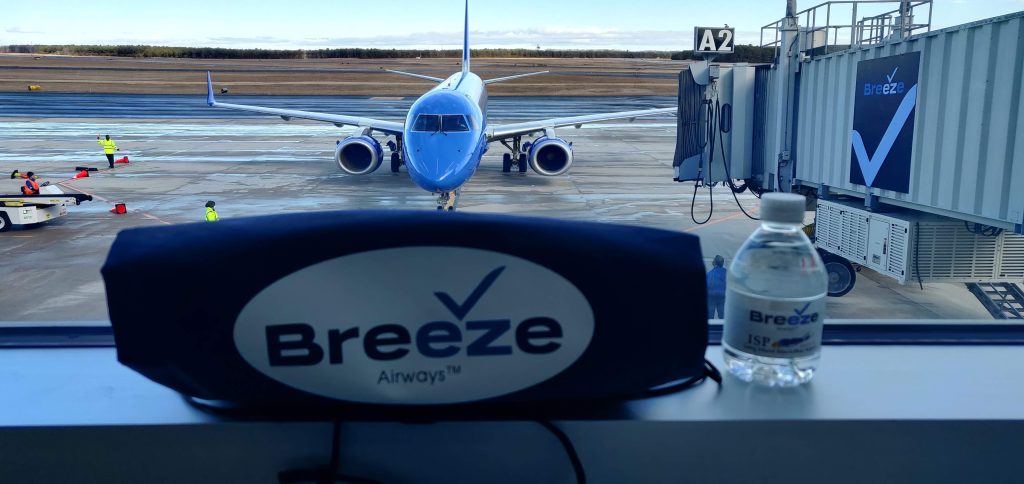
Breeze Airways Embraer 190 at Islip MacArthur International Airport (ISP) (Photo: AirlineGeeks | Vanni Gibertini)
Airlinegeeks had the opportunity to try the Breeze Airways product on this inaugural service, which was duly celebrated by the MacArthur Airport Fire Squad with the traditional water cannon salute, and to visit the town of Charleston, S.C. that now sees Breeze fly non-stop to 14 destinations unserved by other carriers.
Waiting for the Airbus A220
The flight was operated by an Embraer 190 configured with 96 economy seats, one of the 10 aircraft of this type Breeze operates while it is waiting to introduce the first of the 80 Airbus A220-300 on order will feature a 36-seat premium cabin and 90 economy seats. The new aircraft will also bring a significant upgrade in terms of in-flight experience, as they will be equipped with ViaSat internet connection.
The 13 Embraer aircraft that form Breeze’s present fleet offer passengers the BYOD or Bring Your Own Device in-flight entertainment system provided by Anuvu with a good choice of complimentary movies, TV shows and games. “We have not decided yet what we are going to do with our onboard internet connectivity – Breeze Airways’ CEO David Neeleman said, who made himself available to answer some of our questions in Charleston – the main purpose to have internet onboard for us is to improve customer experience. There are a couple of options, with the air-to-ground gogo inflight option [used by United and American] that are worse and more expensive than the Viasat option chosen by Delta, which charges $5 per flight, and JetBlue which provides it for free. We’ll see what we are going to do”.
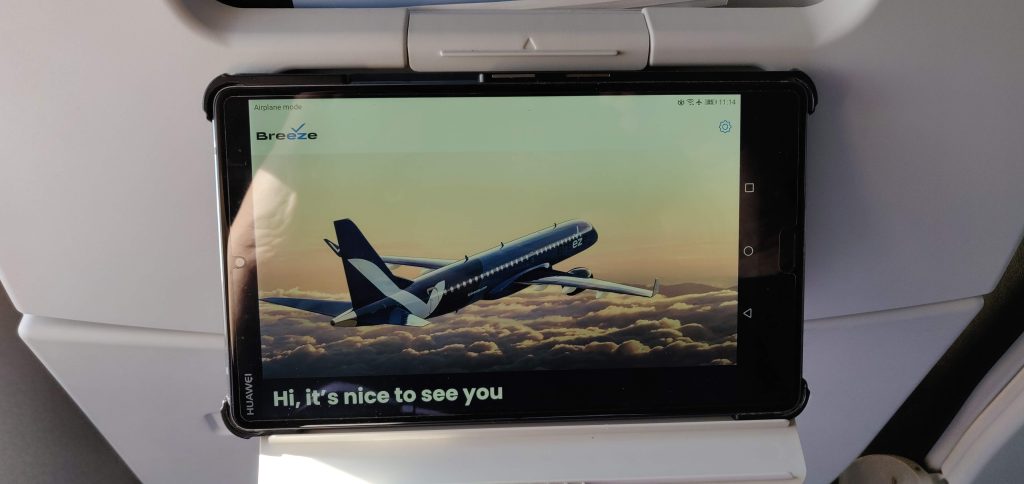
Entertainment device stand aboard Breeze Airways E190 (Photo: AirlineGeeks | Vanni Gibertini)
The 2-2 configuration on the Embraer eliminates the hated middle seats that will return on the A220-300, but the leather upholstery and the comfortable seat pitch even for tall passengers are making the flight experience quite pleasant. Breeze puts a lot of emphasis on the word “nice” that is also used to define its fare classes: nice, nicer and eventually nicest when a premium cabin is introduced. Crewmembers are key to delivering a “nice” experience to all guests, as passengers are called on Breeze flights, just like it happens on WestJet, another of the airlines founded by serial entrepreneur David Neeleman.
It’s Nice To Be Nice
The focus on superior customer service is a bit more than a differentiation feature for Breeze: in fact, their business model is geared towards providing direct flights on city pairs that do not have non-stop services, so there would be no need to provide a superior service to a theoretically captive market. “At the end of the day we want to be nice because it’s the right thing to do – Neeleman said – I don’t think we are going to compete with other carriers for some time, we have room to grow on unserved routes and stimulate demand to generate enough traffic. Obviously, we may face competition at some point, and if that is going to happen, we will be able to defend ourselves. But if we can create a nice enough experience for our guests, I believe there is a big potential to stimulate demand”.
Breeze mainly targets leisure customers providing a convenient way to fly between destinations that would otherwise require tortuous itineraries and long layover at hub airports. “We are targeting people with second homes, those who live in one place but work out of another, parents wanting to visit their kids at college, grandparents visiting their grandchildren – continued Neeleman – we don’t anticipate getting a lot of business traffic. In order to do that you need to fly consistently on Tuesdays and Wednesdays, and that’s not something we are willing to do. Also, it remains to be seen what business travel will be like after the profound changes introduced in the way business is conducted by the COVID pandemic. We’ll see if it is going to come back the way it was before”.
In-flight service on Breeze follows the mantra of the Ultra Low-Cost Carriers: every item is for purchase, including soft drinks, with the possibility to purchase some value bundles at discounted prices. The absence of seat-back monitors is balanced by a very useful device that allows to the position of personal devices on a dedicated mini-tray to make the fruition of contents more comfortable. There is a full power source every two seats, allowing for both USB charging and U.S./U.K. plugs to recharge laptops. When internet connectivity is introduced, working throughout the flight with a laptop will be possible given the comfortable seat pitch and the availability of power at the seat.
The flight from Islip to Charleston lasted approximately two hours, and a small celebration was prepared on arrival by the city of Charleston as well as by the Airport that saw the addition of two new destinations within less than 24 hours.
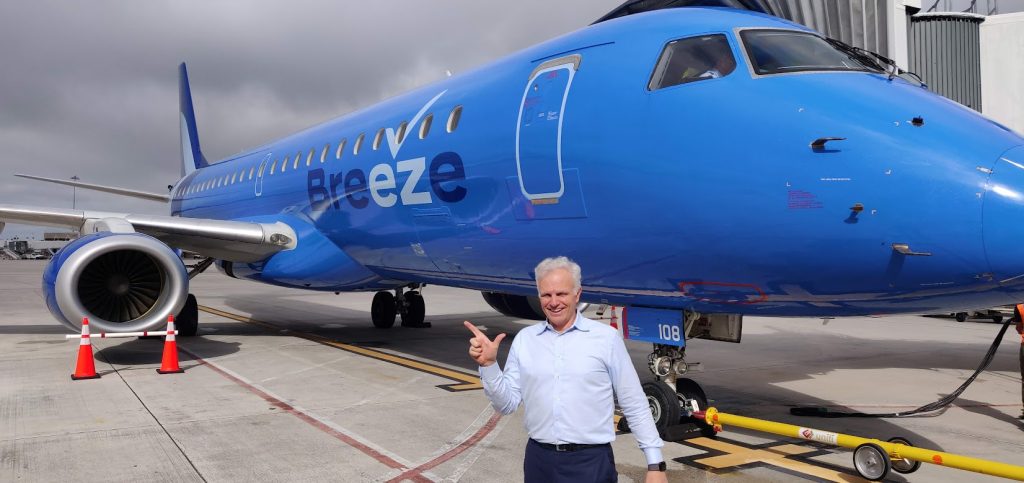
Breeze Airways CEO David Neeleman at West Palm Beach International Airport (PBI) (Photo: AirlineGeeks | Vanni Gibertini)
In fact, on Feb. 19, Breeze launched a new weekly service from Charleston, S.C. to West Palm Beach, Fla. At the end of the one-hour flight, CEO David Neeleman addressed the passengers while en route and CFO Trent Porter helped the crew collect the service items before landing. In addition, the Breeze Embraer 190 was saluted by the Fire Department water cannon and was christened with champagne by Neeleman and the dignitaries from both the city of Palm Beach, Fla. and the West Palm Beach International Airport. Charleston, S.C. is now the sixth destination served by Breeze from West Palm Beach, Fla.
Vanni fell in love with commercial aviation during his undergraduate studies in Statistics at the University of Bologna, when he prepared his thesis on the effects of deregulation on the U.S. and European aviation markets. Then he pursued his passion further by obtaining a Master’s Degree in Air Transport Management at Cranfield University in the U.K. followed by holding several management positions at various start-up carriers in Europe (Jet2, SkyEurope, Silverjet). After moving to Canada, he was Business Development Manager for IATA for nine years before turning to his other passion: sports writing.
Australia’s New Budget Airline Reveals Future Plans
Artist Impression of a Bonza Boeing B737-800. (Photo: Bonza)
Bonza — Australia’s newest budget start-up airline — is stepping up its operations and presenting its first routes across the country. The low-cost carrier has unveiled its launch route network with flights set to begin in the middle of 2022.
Last year in October, the independent low-cost airline revealed its plan to launch Down Under — expanding travel options for citizens across the country looking to take a break. Tim Jordan, the airline’s CEO, stated that the airline’s goal was about “bringing more choice to Aussies from a leisure perspective”. The airline has announced the launch of 25 new flight routes this year which will connect travelers to 16 different destinations.
Airline’s Routes
The low-cost start-up carrier will initially offer 25 trips to 16 destinations, 20 of which will operate from two hubs at Melbourne, Australia and Sunshine Coast airports. Sunshine Coast will have 12 routes to places in the Australian states of New South Wales, Victoria and Queensland including Albury, Avalon, Cairns, Coffs Harbour, Mackay, Melbourne, Mildura, Newcastle, Port Macquarie, Rockhampton, Townsville and the Whitsunday Coast.
A further eight will operate from Melbourne, Australia to Bundaberg, Gladstone, Mackay, Mildura, Port Macquarie, Rockhampton, Toowoomba Wellcamp and the Sunshine Coast, with additional routes featuring cities across Australia, connecting the Whitsunday Coast to Newcastle and Toowoomba Wellcamp, Rockhampton to Cairns and Townsville, and Mackay to Cairns.
Unfortunately, Sydney did not make it onto Bonza’s launch list, with the Sunshine Coast and Melbourne taking the spots. According to Bonza, 80 percent of its planned routes are now unserviced, and its network would expand the number of low-cost carrier routes in Australia by 40%.
Fleet and Specifics
Bonza advertises itself as a low-cost airline that serves cities and rural areas around Australia that have been underserved by regular, large-scale flights. According to Jordan, Bonza’s rates would be comparable to Jetstar’s. It will also be clear that the airline will not participate in stunt fairs since it is not a good way to treat consumers.
Bonza will initially operate a fleet of five B737 Max aircraft in an all-economy configuration, with flights expected to go on sale within the next two months, subject to regulatory permission. Depending on approval, the airline hopes to begin flying in the middle of this year, with its first Boeing arriving in Australia at the end of May. Bonza plans to increase its fleet to eight planes within its first year.
Bonza is now creating its own app — claiming that the company’s dedication to technology is driven by consumer experience and sustainability. When all functions are introduced to the app in the following weeks, it will be the place for customers to plan, book and manage their active reservations. They would also be able to access boarding cards and in-flight retail. With this app, Bonza aims to provide a paperless experience for the passengers.
Bonza’s Domestic Influence
Sydney — which is a fantastic market to enter — is losing out because other airports have provided better conditions and access to landing slots, but this could be a temporary problem. Jordan has stated that they “believe there are opportunities in Sydney to do something different,’ and’ ‘want the 20 percent of the population who call Sydney home to benefit from Bonza fares in the future.”
Rex Airline — the regional carrier that launched capital city services last year — had difficulty getting permanent slots at Sydney Airport, so this could be a wise move for the new low-cost carrier.
Bonza is funded by 777 Partners who is a major private investment group situated in North America with over $US6 billion in assets under management. Aviation is one of the company’s pillars, and 777 Partners has already successfully launched Flair Airlines, a Canadian low-cost carrier.
“[777 Partners] saw the opportunity in Australia and Bonza is coming and here to stay for the long term,” Jordan added.
Bonza will be Australia’s first new low-cost carrier since Tigerair Australia entered voluntary administration in March 2020 as a result of Covid-19. It will compete with Jetstar — Qantas’ low-cost affiliate — in the domestic market.
Kalai has always wanted to work in the aviation industry, having been fascinated by its inner workings since he was a child. In pursuit of his dream, he obtained a diploma in aviation management and is currently interning with a low-cost airline, under in-flight policies. In his free time, he loves to engage in recreational activities, and watch sports. In the upcoming years, Kalai intends to pursue his degree at a business school before working as an executive for a global airline around the world.
Qantas, Perth Airport Resolve Fees Dispute in Court
A Qantas 787 Dreamliner lifting out of Paine Field in Washington.
(Photo: AirlineGeeks | Katie Zera)
Qantas and Perth, Australia’s Airport aeronautical fee saga have come to an end. The Supreme Court of Western Australia has ordered Qantas to pay aeronautical fees. Perth Airport initially sued Qantas for outstanding bills of sixteen million Australian dollars ($11.49 million), but the flag carrier believed that it pays through the nose for the services.
Perth Airport — the gateway to Western Australia — charged Qantas 39 million Australian dollars for the aeronautical fee over a six-month period in 2018. Qantas believed the airport has monopoly power and thus only paid 22.89 million Australian dollars.
Qantas demanded the Weighted Average Cost of Capital (WACC) for the airport to calculate returns on investment for Perth Airport should be between 6.3 percent to 7.3 percent, but the judge has ruled that the WACC should be 9.6 percent.
Also, the judge has revealed that Perth Airport should charge Qantas for the period in dispute, including fees per passenger for domestic and international airfield services, for international passenger services and for domestic passenger services. Both Qantas and Perth Airport have welcomed the decision from the judge.
“Three years in court to determine five months of pricing shows why the industry needs an expert umpire to resolve stalemates quickly when they occur,” Vanessa Hudson, CFO of the airline, said.
However, the flag carrier said the 9.6 percent of WACC is still higher than “comparable rates used by airports overseas and well above most rates set by regulators for other Australian monopolies.” Kelvin Brown, CEO of Perth Airport, welcomed the decision and looks forward to working with Qantas. Meanwhile, Brown has unveiled more details.
“We began that consultation process with a WACC of 9.7%. Qantas has countered with a significantly lower figure, almost half of what Perth Airport proposed and short-paid Perth Airport on that basis, Brown said.
The Country’s Border Reopens
However, Qantas has decided that its Kangaroo Route will be rerouted via Darwin, Australia — in the Northern Territory — instead of Perth, Australia until June. The decision came before the Supreme Court’s rule. Despite the country’s international border having reopened, the state of Western Australia remains closed until March 3 due to the omicron variant. According to the airline, Qantas currently operates daily flights from Melbourne, Australia and Sydney to London’s Heathrow Airport on its Boeing 787 Dreamliner.
In addition, after nearly two years of closing its border, Australia has welcomed international travelers. International travelers who have been fully vaccinated can avoid quarantine, but unvaccinated travelers need to take a 14-day quarantine.
“The thousands of international tourists arriving this week and many more over the coming months will help kickstart the tourism industry which has done it tough for the past couple of years.” Alan Joyce, CEO of Qantas said.
A Flydubai 737 MAX 8 performs a test flight at Paine Field in Everett, Wash. (Photo: AirlineGeeks | Katie Bailey)
Under a contract with Air Lease Corporation (ALC), Malaysia Airlines will get 25 new Boeing 737 MAX 8s from its order book. The purchase, which comes from Malaysia Airlines’ order book with Boeing, will enable the carrier to take possession of new aircraft and continue to pursue its strategic objectives of domestic and medium-haul domination.
The planes will begin arriving at the airline in 2023 and continue until early 2026.
“We are happy to have in ALC, a partner who is committed to be part of our future endeavors as outlined in our Long-Term Business Plan 2.0 (‘LTBP2.0’),” Izham Ismail, Chief Executive Officer of Malaysia Aviation Group, which is the parent company of Malaysia Airlines, said about the deal. “The 737-8 is key to LTBP2.0 with its superior product offerings and better fleet performance which includes amongst others, improved fuel efficiencies of up to 15%. This aligns well with our sustainability journey, whilst also enabling MAB with greater flexibility and agility to implement our future network strategies.”
In 2016, Malaysia Airlines placed a definite order for 25 MAX 8 aircraft. Due to the grounding of the MAX and the worldwide health crisis, deliveries of the plane have been delayed.
Planning for the Future
Malaysia Airlines is in the process of putting its long-term business strategy into action. As the airline works to recover from the crisis, it is developing measures to cut expenses and become a stronger carrier in the future. This has included retiring its fleet of Airbus A380s and replacing them with more fuel-efficient planes.
Malaysia Airlines’ duty as the country’s flag carrier is to assist link communities throughout Malaysia and to the rest of the globe. Moving forward, the airline is focused on securing its position as a major airline linking Europe and Asia, as well as expanding its offering of connecting flights.
The Boeing 737 MAX 8 is one such possibility. As a fuel-efficient aircraft, the type has been employed for local and medium-haul connections across the globe, while others are trying to expand the capabilities to operate long-haul routes. Because the airline does not presently operate any MAX aircraft, it is unclear how these jets will be deployed within their route.
ALC’s Comeback
ALC is a significant aircraft lessor with customers all over the globe, though it is headquartered in the U.S. ALC also holds six Airbus A350-900 XWBs on long-term lease with Malaysia Airlines, in addition to these 25 aircraft. Airlines may occasionally place orders without obtaining finance for such items and will make judgments about leasing versus financing or paying in full closer to delivery.
Air Lease Corporation has been busy forging agreements with numerous airlines as the airline industry has recovered. Spirit Airlines and Alaska Airlines are among them. ALC reported in November that narrowbody demand was rebounding strongly. Finally, shortly before the end of the year, the airline placed an order with Airbus for 116 aircraft.
As both Malaysia Airlines and ALC look to the future, this leasing arrangement will benefit both airlines and help Malaysia Airlines achieve its long-term goals.
Putu Deny Wijaya was always an aviation enthusiast by heart, growing up in Indonesia where air transport is very vital. His first love is The Queen of The Skies, serving the trunk routes between Jakarta and Denpasar. He brought along this passion with him throughout college by conducting his bachelor study abroad in the Netherlands for the purpose of experiencing a nonstop 14-hour long-haul flight. For Putu the sky's the limit when talking about aviation. He hopes that he would be able to combine his passion for aviation and knowledge of finance at the same time.
Each Boeing 787 Dreamliner Produced Will Have to Be Individually Certified By FAA
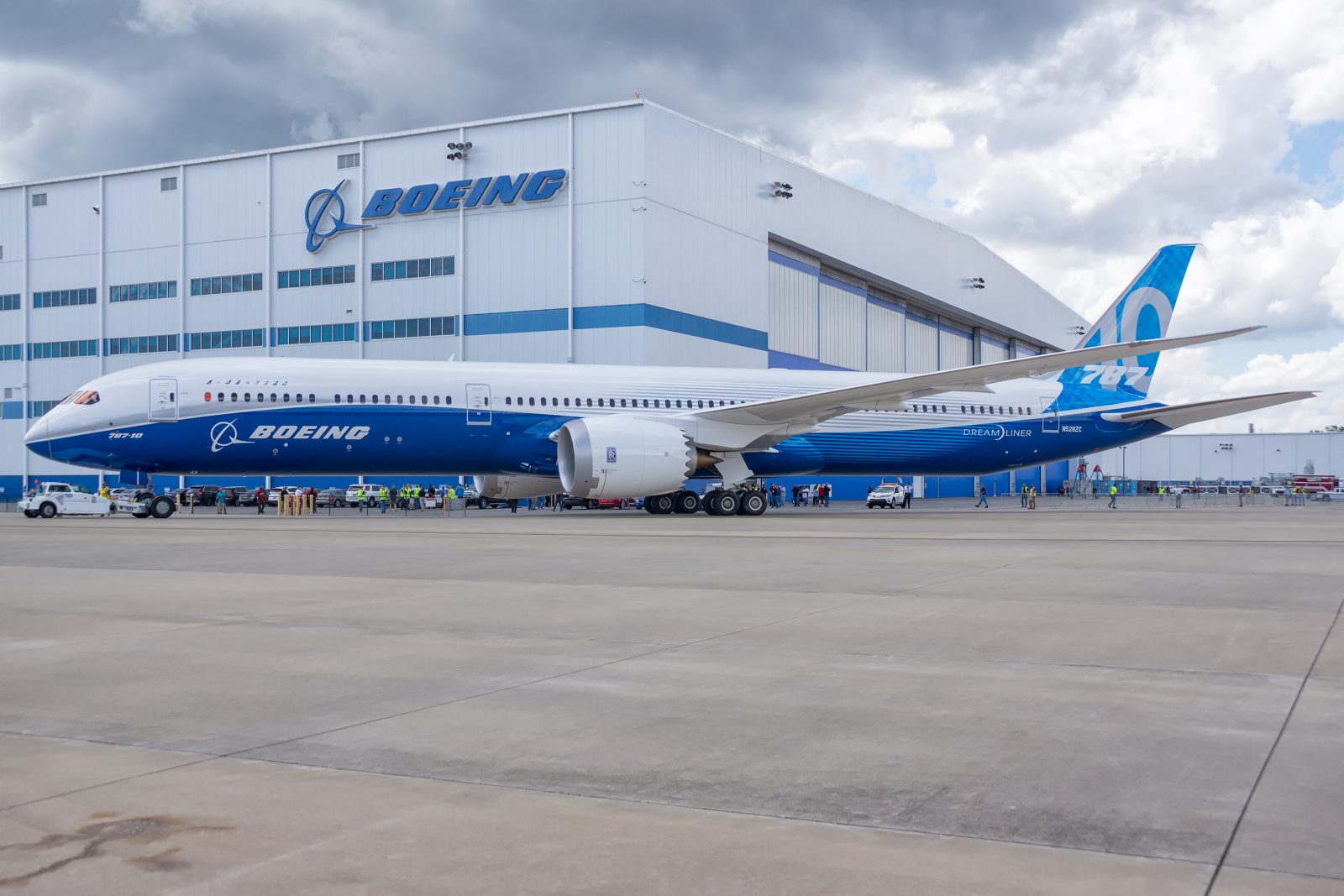
A Boeing 787-10 Dreamliner testbed in North Charleston, S.C. (Photo: AirlineGeeks | Chuyi Chuang)
Usually, the issue of an airworthiness certificate for a specific aircraft is a task delegated to the manufacturer, which the certifying body — the Federal Aviation Administration (FAA) in the U.S. or European Aviation Safety Agency (EASA) in the European Union — then approves. However, Boeing will no longer be able to do this for its 787 Dreamliner which confirms to be a very “unfortunate” aircraft.
The company and the FAA confirmed that each aircraft that Boeing produces will have to undergo scrutiny by inspectors from the government body, eliminating the freedom the Chicago-based company once had as the trust it shared with regulators and the growing public continue to erode.
Originally, the Boeing 787 was scheduled to enter service in May 2008, but due to many delays, the maiden flight took place on Dec. 15, 2009, and flight tests were completed only in mid-2011. The first Boeing 787-8 Dreamliner was delivered in September 2011 and entered service on Oct. 26, 2011, with All Nippon Airways.
The aircraft, though, also suffered from several problems during service. In 2013, some fires aboard lithium-ion batteries forced the FAA and other national civil aviation authorities in other countries to ground all Boeing 787 Dreamliners.
Unmet Expectations
Certainly, the Boeing 787 is a revolutionary aircraft. It is the first commercial aircraft mass-produced with massive use of composite materials — over 50% — it has an incredible operating range of almost 15,000 kilometers and its final assembly can take just three days. thanks to a supply chain of suppliers around the world.
However, all these design “challenges” require a lot of commitment and further investment, and even the slightest error can cause delays in deliveries. The first problems related to the production process of the Boeing 787 were first identified in 2020 with the discovery of manufacturing defects, with gaps in the structural joints.
Since then, the aircraft has been under the FAA spotlight for problems that have emerged in the quality of some of its components, such as some parts supplied by the Italian Leonardo group, with lower percentages of titanium than required.
Several components from foreign suppliers have been found not to comply with the customer’s requirements. For this reason, the Federal Aviation Administration intervened again, stating that this time the decision was taken so that Boeing could improve the quality of the manufacturing process of the aircraft.
Therefore, as already happened almost three years ago with the Boeing 737 MAX, the American manufacturer is struggling since, due to the inspection requirement for each aircraft before each delivery, there will be further delays in deliveries, which could trigger lengthy legal disputes or losses of billions of dollars.
To rub it in is the documentary “Downfall: The Case Against Boeing” published a few days ago on Netflix, in which in an hour and a half producers highlight all the mistakes made by the U.S. manufacturer during the design and certification process of the Boeing 737 MAX. The greed of Boeing to obtain a higher revenue omitted some features of the aircraft during the certification process, betraying the main objective of the aviation industry: safety. This omission caused two accidents in Indonesia and Ethiopia in which 346 people lost their lives.
For decades, Boeing has been an icon of safety and reliability, to the point that people have been known to say, “If it is not Boeing, I’m not going.” However, resulting from poor choices, profit-driven strategies and pressure from investors, Boeing now finds itself no longer held in the same esteem as before, and the latest FAA decisions prove it.
Vincenzo graduated in 2019 in Mechanical Engineering with an aeronautical curriculum, focusing his thesis on Human Factors in aircraft maintenance. In 2022 he pursued his master's degree in Aerospace Engineering at the University of Palermo, Italy. He combines his journalistic activities with his work as a Reliability Engineer at Zetalab.
United Airlines CRJ-200 operated by SkyWest at Muskegon-County Airport (Photo: AirlineGeeks | Joey Gerardi)
Essential Air Service (EAS) is a group of government-funded airports around the country that airlines bid for and then are respectively won. Contracts are by law required to be followed out until completion unless they want to face heavy fines under federal law. In mid-January 2022, SkyWest announced its intentions to terminate service to two EAS cities in Northern New York — Ogdensburg and Plattsburgh — in 90-days. This intention was denied by the Department of Transportation (DOT) unless the cities could find another carrier to start a contract.
Since that announcement, Plattsburgh and Ogdensburg have both begun the long and tedious EAS bidding process, and each of the cities has had only one bidder — Plattsburgh had Cape Air, and Ogdensburg’s only eligible bidder was Boutique Air. The two cities are now awaiting the final word from the DOT as to which airline will take over services in both cities at which point SkyWest is allowed to leave once both airlines have successfully begun services to each respective city.
Reduced Frequencies
Although it has not requested to leave, SkyWest has announced the intent to reduce service frequencies in 18 EAS contracts. In the following cities, the airline will reduce the number of weekly flights from 12 to 10:
• Alamosa, Colo.
• Scottsbluff, Neb.
• Dodge City, Kan.
• Fort Dodge, Iowa
• Hays, Kan.
• Laramie, Wyo.
• North Platte, Neb.
• Liberal, Kan.
• Pueblo, Colo.
• Vernal, Utah
• Cape Girardeau, Mos.
• Decatur, Ill.
• Mason City, Iowa
• Muskegon, Mich.
• Fort Leonard Wood, Mo.
• International Falls, Minn.
All of the above are cities that SkyWest fly’s to under the United Express brand, except for International Falls, which is flown under the Delta Connection brand.
Plattsburgh and Ogdensburg flights will be — and have already been — reduced from 12 to seven weekly flights, essentially giving the two New York cities only one flight per day.
The airline is citing all of the scheduling changes to “a staffing imbalance caused by the COVID-19 pandemic”.
A New Tag
In addition to all of the previously mentioned frequency reductions, SkyWest/United has also loaded a tag flight into its system with the cities of Lewisburg, West Vir. and Shenandoah, Vir. Both cities currently receive nonstop flights to both Washington D.C.’s Dulles International Airport and Chicago’s O’Hare International Airport under the EAS program. But come March 4, they will be combining the services to a tag flight.
The flights will operate Washington Dulles to Shenandoah, then onto Lewisburg, and finally to Chicago O’Hare. This same routing will be operated, but in reverse, in the evenings. With the new tag flights, Shenandoah will be losing its nonstop service to Chicago, and Lewisburg will be losing its nonstop to Washington D.C., but will both still operate it with the connection in the other EAS city.
How the flights will operate to Lewisburg and Shenandoah (Photo: Great Circle Mapper)
This new tag flight will last for less than a month, reverting back to the old way at the beginning of April 2022, but could be extended further if the situation calls for it.
If you are looking for a fun or unique way of getting between Chicago and Wahington D.C., this may be the way to go, and the United website even gives you the possibility of flying between Lewisburg and Shenandoah if you are so inclined to.
With staffing shortages becoming more common as the pandemic drags on, this trend of schedule reductions could become a normal thing and we could see even more tag flights added before this is over. All flights and routes mentioned in this article are flown on the 50-seat CRJ-200.
Joey has always been interested in planes for as long as he can remember. He grew up in Central New York during the early 2000s when US Airways Express turboprops ruled the skies. Being from a non-aviation family made it harder for him to be around planes and would only spend about three hours a month at the airport. He was so excited when he could drive by himself, the first thing he did with his driver's license was get ice cream and go plane spotting for the entire day. He graduated from Western Michigan University in 2022 with a B.S. in Aviation Management & Operations and a Minor in Business, and currently works for a major airline in his hometown.
Sign-up for newsletters & special offers!
Get the latest stories & special offers delivered directly to your inbox