








Stories

Air Canada Reports Positive Recovery Signs in Final Quarter of 2021

An Air Canada A330-300 (Photo: Air Canada)

Air Canada has posted its 2021 financial year results that indicate a strong final quarter finish to the year with an unexpected positive EBITDA — a common proxy for operational profitability that stands for earnings before interest, taxes, depreciation and amortization — for the first time in seven quarters.

By comparison, 2020’s final quarter EBITDA was negative 728 million Canadian dolloars ($571 million) compared to 2021’s Q4 figure of 22 million Canadian dollars. In addition, the airline posted a full year 2021 operating loss of 3.049 billion Canadian dollars compared to an operating loss of 3.776 billion Canadian dollars in 2020.

“The unpredictable course of COVID-19 made 2021 extremely challenging for Air Canada and the global airline industry. But the sequential and year-over-year improvement in Air Canada’s fourth-quarter results shows the underlying recovery remains intact despite the Omicron variant,” Michael Rousseau, President and Chief Executive Officer of Air Canada, said in a statement. “Our progress rebuilding our airline is due to the hard work, resourcefulness, and commitment of our people. I warmly thank our employees for their dedication and professionalism, which have been unwavering through nearly two years of a global pandemic. I also thank our customers, including shippers, for their steadfast loyalty in continuing to choose Air Canada.”

Air Canada reported an increase in capacity for Q4 2021 of 134% over Q4 2020 though down 47% from Q4 2019 levels. The airline’s overall capacity measured in available seat miles (ASM) for 2021 was down 11 percent over 2020 and 70 percent from 2019 levels indicating the challenges ahead for Canada’s aviation industry. However the airline plans “to increase its first-quarter 2022 ASM capacity by 243% from the same quarter in 2021. When compared to the same period in 2019, first quarter ASM capacity is expected to decrease by about 44%.”

Positive signs for the carrier came with record cargo revenues in 2021 of 1.495 billion Canadian dollars compared to 2020 cargo revenues of 920 million Canadian dollars. In 2021, the airline operated a total of 10,217 cargo-only flights compared to 4,235 cargo-only flights in 2020.

“Prior to Omicron’s onset, ticket sales reached 65 percent of pre-pandemic levels in October and November,” Rosseau said. “These are all encouraging indicators.”

Air Canada’s results come at the end of a week in which the Canadian government announced the relaxing of some testing requirements for inbound arrivals to Canada. Fully vaccinated travelers will be able to opt for a less expensive antigen test prior to departing for the country though the option of a PCR test 72 hours prior to departure remains.

Vaccinated passengers who may be selected for a random test upon arrival will now no longer have to self-isolate until receiving the results. In addition, international passenger flights will be permitted to land at all remaining Canadian airports that are designated by the Canada Border Services Agency to receive international passenger flights.

John Flett

John has always had a passion for aviation and through a career with Air New Zealand has gained a strong understanding of aviation operations and the strategic nature of the industry. During his career with the airline, John held multiple leadership roles and was involved in projects such as the introduction of both the 777-200 and -300 type aircraft and the development of the IFE for the 777-300. He was also part of a small team who created and published the internal communications magazines for Air New Zealand’s pilots, cabin crew and ground staff balancing a mix of corporate and social content. John is educated to postgraduate level achieving a masters degree with Distinction in Airline and Airport Management. John has held the positions of course director of an undergraduate commercial pilot training programme at a leading London university. In addition he is contracted as an external instructor for IATA (International Air Transport Association) and has been a member of the Heathrow Community Fund’s ‘Communities for Tomorrow’ panel.

Cargo Belly Space Aboard AirAsia X is for Sale

The first A330neo for Air Asia X (Photo: Airbus)

Over the next year, AirAsia X will dedicate a third of the cargo capacity in its Airbus A330 cargo holds to transport freight on behalf of Teleport.

AirAsia X has reached an agreement with another Capital A (previously the AirAsia Group) company to make greater use of the cargo capacity in its planes’ cargo holds. Over the following 12 months, Capital A’s logistics company, Teleport, will utilize up to one-third of the cargo capacity aboard AirAsia X’s Airbus A330-300 planes. Teleport’s goal is to meet the need for more freight capacity. When intra-Asian passenger demand is low, AirAsia X’s goal is to maximize revenue.

Continuing Diversification

AirAsia X is seeking to considerably increase its regional footprint and become a viable long-term partner for some of the world’s leading freight forwarders as Capital A continues to diversify its business strategy. The airline has secured a long-term agreement with global logistics company GEODIS to operate several dedicated weekly cargo flights throughout the Asia-Pacific region.

Last year, AirAsia X and its sister airline Thai AirAsia X successfully reorganized and are now relaunching as a United freight and passenger airline. The agreement with Teleport is a continuation of that approach. AirAsia X claims to be well-positioned to compete successfully in the areas where it operates, with the lowest operational cost structure of any airline of its kind in the world.

“We’re also in talks with a number of other major worldwide clients with air freight requirements, particularly in areas where we have established facilities and flying rights. We have a great need to increase our cargo business just two months following our restructure ” AirAsia X CEO Benyamin Ismail said in a statement. “This will perfectly match with one of our combined carrier strategy’s main cornerstones. For the foreseeable future, cargo income will be the core of our route plan, while passenger revenue will be supplementary for the first time.”

Expanding Teleport’s Services

Six of AirAsia X’s 18 Airbus A330-300 planes are currently in operation. Thai AirAsia X operates nine of the same aircraft, five of which are operational. Teleport’s ambition to become a major freight forwarder is limited by the fact that it only has one aircraft, a Boeing 737-800. Teleport will be able to handle expanding client demand while also becoming one of Southeast Asia’s most efficient freight forwarders as a result of the agreement with AirAsia X. Malaysia, Thailand, Indonesia, the Philippines, India, Singapore and China are among Teleport’s current service regions.

“We’re excited to be collaborating more closely with AAX on their A330 cargo fleet. AirAsia X’s acquisition of the A330, in addition to our dedicated 737-800 freighter, provides us to deliver extra capacity to fulfill demand in the area while flying from our primary hubs in Kuala Lumpur and Bangkok “Adrian Loretz, Teleport’s Chief Operating Officer, added in a statement. “In 2022, we want to expand our fleet as well as our planned route network. Adding additional essential destinations to cover South East Asia and beyond, in addition to our current AirAsia passenger flights’ vast coverage and high frequency. This is particularly crucial since we want to devote the majority of our efforts to the supply chain, which will continue to develop dramatically in the coming years.”

Putu Deny Wijaya

Putu Deny Wijaya was always an aviation enthusiast by heart, growing up in Indonesia where air transport is very vital. His first love is The Queen of The Skies, serving the trunk routes between Jakarta and Denpasar. He brought along this passion with him throughout college by conducting his bachelor study abroad in the Netherlands for the purpose of experiencing a nonstop 14-hour long-haul flight. For Putu the sky's the limit when talking about aviation. He hopes that he would be able to combine his passion for aviation and knowledge of finance at the same time.

Etihad Airways Becomes Newest Airbus A350F Customer at Singapore Airshow

The Airbus A350F. (Photo: Airbus)

Held as a biennial event where aviation’s finest meet at Asia’s largest and most influential aerospace and defence exhibition, the Singapore Airshow is the event for both the leaders of the aerospace industry, as well as the eager newcomers to make their mark and settle in some new partnerships.

After a full two days — with another two to go — the Singapore Airshow 2022 has shown some remarkable highlights such as Singapore Airlines’ signing of a $2.8 billion order for 22 GE9X engines to power its future fleet of Boeing 777X aircraft, as well as the national carrier finalizing its purchase agreement with Airbus for seven A350F freighters.

Success for Airbus

Besides the ongoing successful partnership with Singapore Airlines, manufacturing giant Airbus has been having a grand repeat of the success it had during the Dubai Airshow late last year as the likes of Cebu Pacific selecting the Airbus Flight Hour Services for its fleet of 16 A330neos, and also including Jetblue having ordered an additional 30 A220-300s.

The success does not stop for just the commercially for Airbus, as its significance in the air cargo freighter market continues to grow bigger – especially since Etihad Airways has just become the latest airline customer intending to add the A350F freighter to its fleet.

“We are pleased to sign this agreement with our long-standing partner Etihad, shortly before this most discerning airline also introduces A350 passenger service. Thank you Etihad for endorsing the game-changing nature of the new A350F” said Christian Scherer, Chief Commercial Officer and Head of International.

Interestingly, the Gulf carrier is actually yet to confirm when its passenger fleet of the Airbus A350 will enter flying service or even the planned routes, yet Etihad Airways proved eager for the A350F freighter as it signed a Letter of Intent for seven aircraft, all of which will be added to its existing fleet of five A350-1000 passenger fleet. And just like Cebu Pacific, the airline has also chosen Airbus’ Flight Hour Services to support its entire A350 fleet.

“Etihad is delighted to extend our relationship with Airbus to include this remarkable aircraft as part of our freighter fleet for the future,” said Tony Douglas, Group Chief Executive Officer, Etihad Aviation Group. “As our cargo operations continue to overperform and we work towards a more sustainable future built upon the world’s youngest and most fuel-efficient fleet, the addition of the A350F will play a key role in driving our long-term cargo strategy and achieving our 2035 target to reduce CO ₂ emissions by 50%.”

Not Going with Boeing

Etihad Airways interest in the Airbus A350F freighter is quite the curious move, and would make it the first of the three major Gulf carriers to sign a Letter of Intent for it, as Qatar Airways worsening relationship with Airbus has made it sign for the Boeing 777X freighter instead.

Oddly enough, Qatar Airways’ flagship passenger aircraft is the Airbus A350, whereas it’s the Boeing 787 Dreamliner for Etihad Airways. And cargo fleet wise, both Gulf carriers operate a more Boeing-centered fleet of freighters — which is why it does come as quite a surprise for Etihad Airways to intent towards the A350F instead of the 777X freighter.

With the intent from Etihad Airways, the order logbook for the Airbus A350F and the Boeing 777X freighter seems to be rather on par with each other right now. It would be quite the turn of events for either manufacturer when the third and final prominent Gulf carrier – Emirates, whose cargo fleet is mainly Boeing-centered as well – makes an order for either freighter, or when another airline comes along to sign for either as well.

Charlotte Seet

Fascinated by aircraft from a very young age, Charlotte’s dream was to work alongside the big birds one day. Pursuing her dream, she went on to achieve her diploma in Aviation Management and is currently working on her degree in Aviation Business in Administration with a minor in Air Traffic Management. When she’s not busy with school assignments, you can find her aircraft spotting for long hours at the airport. In Charlotte’s heart, the Queen of the Skies will always be her favorite aircraft.

Air China Fined $300K for Extensive Tarmac Delay

An Air China 777 sits on the ramp at Houston Intercontinental Airport (Photo: AirlineGeeks | Mateen Kontoravdis)

On Feb. 10, the US Department of Transportation (DOT) issued a fine of $300,000 to Air China due to the carrier’s extensive delay violation in 2018. Air China argued that the situation was caused by the chaotic management of New York’s JFK Airport under extreme weather conditions. The Port Authority of New York and New Jersey did not make any comments regarding this particular punishment.

According to other media outlets, Air China reached an agreement with DOT to pay a $143,000 fine, and $14,000 will be used to compensate passengers involved in those incidents. Should Air China commit this violation again in the following year, the remaining $143,000 fine will need to be paid to DOT immediately from Air China.

Fines are made based on the extensive delay of Air China flight CA981 from Beijing to New York on Jan. 4, 2018. At the time, New York City was suffering from a historic blizzard. New York’s John F. Kennedy Airport was forced to shut down for almost four days.

Frustrating Delays

CA981 on Jan. 4, 2018, took off from Beijing six hours later than the scheduled time, however, when approaching JFK, the weather condition was not permitting the jet to land, so it diverted to Chicago’s O’Hare International Airport. Passengers were forced to remain in the cabin for four hours due to O’Hare Airport’s limited capacity to process a massive wave of international flights diverted from New York and other east coast hubs.

Air China’s 777-300ER taxis at Dulles (Photo: AirlineGeeks | Craig Fischer)

Over 24 hours after the CA981 arrived at O’Hare Airport, it finally took off for New York. After arriving at JFK, the airport was overwhelmed by the massive amount of flights, and the plane was left on the tarmac for six hours before passengers were able to get off.

At the same time, another flight that took off from Beijing to New York, CA989, was also deplaning after waiting for a gate on the taxiway of JFK for seven hours. The CA989 took off on Jan. 6, 2018, two days after the Jan 4 CA981 started its convoluted journey. However, the extensive tarmac delay of CA989 on Jan. 6 was not mentioned in the fine.

Another incident mentioned in the fine document was the CA982 flight from New York’s JFK Airport to Beijing on Nov 15, 2018. At the time, New York City was also facing a significant weather condition and was delayed for over five hours until the plane was able to de-ice and take off.

An Air China 747-8i at San Francisco International Airport (Photo: AirlineGeeks | William Derrickson)

Never Ideal

For those two incidents, Air China blamed the poor management of JFK Airport under significant weather conditions and reassured the carrier’s respect towards the regulation of DOT. As Air China is only operating four regular passenger flights weekly out of the U.s. at the time of writing, and there are no signals of China releasing the international travel restrictions, the carrier will likely dodge the rest of the $143,000 fine.

Air China recently reported a huge loss of up to $2.5 billion during 2021, even worse than the loss during 2020. The fine will put another red line on Air China’s balance sheet, even as the airline struggles to break even.

Lei Yan

Lei is from Inner Mongolia, China, and now lives in Guangzhou. He grew up in an aviation family, where his passion began. During his time at Penn State University, he studied Industrial Engineering specializing in operations research, and he graduated with an honor’s thesis on airport gate assignment optimization. Now, he is a Purchasing Manager with Procter & Gamble. In his free time, he enjoys flying, reading, and wandering around the city.

Iberia Firms Up U.S. Expansion Plans, Adds Dallas and Washington D.C.

An Iberia A330 in Madrid
An Iberia A330 in Madrid. (Photo: AirlineGeeks | Fabian Behr)

This summer, Iberia will offer more than 120 flight frequencies to the United States, firming its plans to add flights to Dallas/Ft. Worth, Texas and Washington-Dulles. In addition, the Madrid-based carrier intends to resume flights to San Francisco, servicing a total of nine U.S. destinations this summer. This announcement builds upon an initial statement in November 2021, which announced intentions to launch these destinations without any filed schedules.

The Details

From American Airlines hub in Dallas/Ft. Worth, Texas; Iberia intends to launch four-weekly frequencies from June 1, 2022, on Mondays, Wednesdays, Fridays and Saturdays. Primarily, the oneworld member carrier touts its ability to connect Dallas to 100 Iberian destinations across Europe. In addition, travelers can connect from Madrid to American Airlines’ extensive Dallas domestic network.

In addition, Iberia will add services from Madrid to Washington-Dulles, a route that was scheduled to launch in 2020 but delayed due to the pandemic. Its’ flights will commence on June 1, 2022, and operate four times a week on Mondays, Wednesdays, Thursdays and Saturdays. Previously, Iberia served Washington-Dulles in 2010 during the summer.

Finally, Iberia will resume thrice-weekly services from Madrid to San Francisco on Mondays, Wednesdays and Fridays. This connection complements Iberia’s long-haul low-cost partner, LEVEL, and its thrice-weekly services from Barcelona to San Francisco. On the San Francisco end, Iberia passengers can connect onto a plethora of oneworld member’s Alaska Airlines flights, in part due to a recent codeshare expansion.

On flights to Washington-Dulles, Iberia faces competition from United Airlines via its daily Boeing 757-200 during the summer season. Meanwhile, on flights from Madrid to Dallas/Ft. Worth, Iberia complements American Airlines’ daily afternoon frequency on its Boeing 787-9 with an evening frequency.

In total, Iberia will increase its footprint to the United States with around 120 frequencies. This summer, Iberia will offer up to 14-weekly flights to New York-JFK, in addition to a daily LEVEL flight from Barcelona to New York-JFK. In addition, Iberia will offer up to 14-weekly flights to Miami. The flag carrier of Spain will connect Chicago and Boston to Madrid up to seven times a week, while connecting Los Angeles to Madrid up to five times a week.

All of these flights will operate on Iberia’s fleet of Airbus A330s. Specifically, the Madrid-based carrier operates 12 Airbus A330-200s, seating 288 passengers, including 19 business class seats and 269 economy class seats.

In addition, Iberia operates eight Airbus A330-300, seating 292 passengers, including 29 business class seats, 21 premium economy class seats and 242 economy class seats. On flights to Dallas/Ft. Worth and San Francisco, Iberia will utilize the Airbus A330-200, while on flights to Washington-Dulles, it will utilize a mix of Airbus A330-200s and Airbus A330s.

Iberia is one of three Spanish carriers to increase its offering to the United States. New Spanish startup World2Fly partnered with its travel partner Newblue to offer charter flights via tour packages to select U.S. destinations, including Boston, Washington-Dulles, Orlando, San Francisco and Las Vegas on select dates throughout the summer.

In addition, the International Airlines Group’s low-cost long-haul subsidiary LEVEL unveiled its latest offering for the summer from its hub in Barcelona last year. Specifically, the airline will operate a daily flight from Barcelona to New York City and four-weekly flights from Barcelona to Boston, Los Angeles and San Francisco. Originally, flights to Boston, San Francisco and New York City were scheduled three times a week, while flights to Los Angeles are new, representing ten new weekly frequencies. 

These flights arrive amid a growing belief that transatlantic demand is due for a rebound this summer, potentially matching or surpassing pre-COVID-19 levels. Earlier this week, German airline Condor announced three new routes linking Frankfurt to Boston, Los Angeles and San Francisco, as part of a bold summer offering totaling 16 routes.

Last year, multiple carriers revealed transatlantic city additions like fellow oneworld joint venture partner Finnair, which unveiled flights from Helsinki to Dallas/Ft. Worth and Seattle for the summer season. 

Origin Destination Arrival (local time) Destination (local time)
Madrid Dallas/Ft. Worth 3:55 P.M. 7:50 P.M.
Dallas/Ft. Worth Madrid 9:25 P.M. 2:20 P.M.
Madrid Washington-Dulles 12:10 P.M. 3:15 P.M.
Washington-Dulles Madrid 4:45 P.M. 6:30 A.M.
Madrid San Francisco 12:20 P.M. 4:15 P.M.
San Francisco Madrid 5:50 P.M. 2:10 P.M.


Winston Shek

Ever since Winston was a toddler, he has always had a fascination for airplanes. From watching widebodies land at Washington Dulles to traveling the world, Winston has always had his eyes towards the skies. Winston began aviation photography in 2018 and now posts his photos occasionally on his Instagram account. He previously wrote for a blog. In his free time, Winston loves to play chess, do recreational activities, and watch sports. Looking into the future, Winston plans to service the aviation industry.

Astral Aviation to Become Global Launch Operator of Airbus A320 P2F

Astral Aviation's Boeing 767-200F taxies at the carrier's hub in Nairobi, Kenya. (Photo: Astral Aviation)

Ahead of the Singapore Air Show, Kenya’s fastest-growing cargo airline, Astral Aviation, has announced that it will operate the first-ever Airbus A320 passenger to freighter (P2F) converted aircraft. ST Engineering announced it will be carrying out the conversion and expects to place the first A320 P2F jet on lease in the second quarter of 2022.

The company will be leasing a total of five Airbus A320 P2F aircraft to Vaayu Group, an aviation solutions provider based in the United Arab Emirates.

Astral Aviation, based at Nairobi’s Jomo Kenyatta Airport, will subsequently be the launch operator for the first two of the five A320P2F aircraft by sub-leasing them from Vaayu.

Yip Heng Meng, Executive Vice President of Aviation Asset Management at ST Engineering, said, “We are excited to welcome Vaayu as our first A320P2F lessee customer, and for Astral Aviation to be the first airline in the world to operate such a platform. As an aviation asset solution provider that is backed by other integrated lifecycle capabilities including freighter conversion and MRO, we are able to provide comprehensive solutions not offered by other service providers, and help operators gain a competitive edge.”

Emad Al Monayea, Chairman and President, Vaayu Group, said, “The upside of the pandemic was an increase of sales in e-commerce space. For freighters and cargo handlers worldwide, this was unexpected. We saw this coming. We simply fast-tracked the process; from conception to a reality in this A320P2F programme.”

The A320P2F is one of the two variants – the other being the A321P2F – in the Airbus narrowbody P2F programme by ST Engineering, Airbus and their joint venture Elbe Flugzeugwerke.

Sanjeev Gadhia, CEO at Astral Aviation, said, “We are truly honored to be the launch operator for the A320P2F which is also the first Airbus in Astral’s fleet of 14 freighter aircraft. The Airbus range of freighter aircraft are impressive and will add immense value to Astral’s fleet and network expansion, which will result in Astral considering future freighter aircraft acquisitions of the A320, A321, A330-300 and A350.”

The two A320 freighters Astral Aviation will be welcoming to its fleet will top up the carrier’s existing fleet of two Boeing 727-200s, one Boeing 767-200, one DC-9-30, one Fokker 27 and two Boeing 747-400s wet-leased from Air Atlanta Icelandic. The carrier is also due to receive three Boeing 757-200s from U.S.-based Aquila Air Capital, part of its fleet expansion drive

The A320P2F can handle 10 unit load device (ULD) containers as well as one pallet position on the main deck, and seven ULD containers on the lower deck. It can haul a payload of 17 tonnes up to 4,700 kilometres and 21 tonnes over 3,300 kilometres making it ideal for established general freight and express markets. As such, the A320/321P2F’s fly-by-wire cockpit commonality with the A330 widebody family of passenger and freighter aircraft have led Astral to consider other Airbus offerings.

Victor Shalton

Victor Shalton's love for aviation can be traced to when he was 11-years-old. As a seasoned aviation writer, he takes pride in providing the best aviation coverage around the globe and is passionate about advancing his skills in the aviation space. In addition, he loves travelling, writing, arts and while his speaking engagements have taken him around the world, he is proud to call Nairobi home.

Aeroméxico Plans Return to London

An Aeromexico 787-8 landing at London Heathrow. (Photo: AirlineGeeks | William Derrickson)

On April 1, Aeroméxico will restart operations to London with 5 weekly flights using its Boeing 787 Dreamliners. The flight resumptions represent a monthly offer of more than 9 thousand seats.

In a statement, Aeroméxico stated that with this resumption, the carrier will be operating six direct routes to Europe, such as Mexico City to Amsterdam, London, Madrid and Paris. Flights will also operate from Guadalajara, Mexico and Monterrey, Mexico to Madrid.

The company adds more than 330 monthly flights to Europe with an offer of nearly 90,000 seats. Aeroméxico has been operating to London since 2012, but the COVID-19 pandemic and the restrictions ordered by the governments forced this route to be suspended.

Almost half of the cargo and freight between the U.K. and Mexico — which represents more than $2 billion —  traveled to London’s Heathrow Airport in 2019. Thus, the return of Aeroméxico is a great platform to start rebuilding the great trade between the two regions.

Passengers will now have more options and companies can re-develop stronger business links. Leisure passengers and business travelers regularly use this route.

Flights from Mexico City’s New Airport

On April 25, Aeroméxico will begin operations at Mexico City’s new airport Felipe Ángeles International Airport. Meanwhile, Volaris and Viva Aerobus will start operating from this new airport in March. Aeroméxico decided to wait one month after its resumption to start operations at the new airport.

Aeroméxico announced that it will start operations at the Felipe Ángeles International Airport with daily flights to Mérida, Mexico and Villahermosa, Mexico. This decision is the result of network analysis, location, customer needs and services of the airport’s infrastructure, which opens as a new air connectivity option to and from Mexico City.

With these new routes, Aeroméxico will connect Mexico City’s metropolitan area with 43 domestic destinations.

Although Aeroméxico had previously indicated that it was not planning to operate at the new Felipe Ángeles International Airport, and that it wanted to strengthen its presence at the Benito Juárez International Airport, this change of plans could be due to a strategy related to the Chapter 11 restructuring process that the Mexican carrier is currently facing.

Domestically, Aeroméxico transported 841 thousand passengers, which represented a decrease of 1.5 percent compared to the same month in 2021. In terms of international operations, the Mexican flag carrier transported 429 thousand passengers, representing an 79.2 percent increase compared to Jan. 2021. In total, Aeroméxico transported more than 1.2 million passengers, which represented an increase of 16.3 percent compared to the same month in 2021.

Juan Pedro Sanchez Zamudio

The three things Juan Pedro loves most about aviation are aircraft, airports, and traveling thousands of miles in just a few hours. What he enjoys the most about aviation is that it is easier and cheaper to travel around the world and this gives you the opportunity to visit places you thought were too far away. He has traveled to different destinations in North, Central, South America and Asia. Born, raised and still living in Perú, Juan is a lawyer, soccer lover, foodie, passionate traveler, dog lover, millennial and curious by nature.

Joby Aviation, ANA Form Partnership to Launch Air Taxi Service

Aerial Vehicle of Joby Aviation
Joby's aerial vehicle (Photo: Joby Aviation)

On Feb. 14, ANA and Joby Aviation announced an agreement that will see Japan’s largest airline unite with the aerospace company to offer aerial ridesharing services to Japan. Toyota Motor Corporation has also joined the agreement — with plans to study potential topics such as ground-based mobility.

Joby’s intention to establish operations in Japan comes just a week after the business revealed intentions to launch an air taxi service in South Korea in collaboration with SK Telecom. It will collaborate with the T Map Mobility platform — a subsidiary of SK Telecom — to integrate air taxis into T Map’s subscription-based mobility-as-a-service platform.

The Aircraft’s Capabilities

Joby is building an all-electric, five-seat aircraft capable of vertical takeoff and landing (eVTOL). Joby’s piloted aircraft is meant to make comfortable, emissions-free air travel an everyday reality, with a maximum range of 150 miles or 241 kilometers, a top speed of 200 mph or 321 km/h and a low noise profile that allows it to approach densely-populated areas. For example, the 31-mile or 50-kilometer flight from Osaka Station to Kansai International Airport may take less than 15 minutes instead of an hour by car.

The aerospace company’s electric vehicles can only carry four passengers, so commercial services will most likely be limited in the beginning. We’re definitely a few years away from air taxi services becoming mainstream until Joby begins mass-producing its existing models or builds considerably larger eVTOLs. This is due not just to the time and money required to create eVTOLs, but also to potential regulatory roadblocks.

Joby still needs to acquire certification in every area it wants to enter, but it did hit a milestone last week when it signed a G-1 or stage four Certification Basis for its aircraft with the Federal Aviation Administration (FAA) under the United States Department of Transportation (DOT). This authorizes Joby to undertake conformity testing and enter the “implementation phase” within the U.S., which essentially means that it can begin designing and manufacturing composite parts for its aircraft.

Joby’s latest move reflects the company’s strategy of partnering with local businesses to launch its service in regions outside the United States, according to the company. The airline and the startup will collaborate on infrastructure development, pilot training, flight operations and air traffic management. The partners will also have cooperative conversations with key commercial enterprises besides local and national governments such as Japan’s Ministry of Transport, in order to speed the country’s adoption of aerial ridesharing.

JoeBen Bevirt, Founder and CEO of Joby, said, “Joby exists to help people save time while reducing their carbon footprint. Japan offers us a spectacular opportunity to do just that with 92%¹ of the population living in urban areas and Tokyo registering as one of the top 20 most congested cities in the world,” in regards to the partnership and the opportunity presented by the Japanese market.

Future of Air Travel

Electric air taxis are becoming a reality as the initial wave of concepts matures and developers seek funding from the market. A flurry of negotiations with airlines and lessors in the sector during the last year indicates that competition to seal agreements is heating up. With Japan set to host the World Expo in Osaka in 2025, the proposal gained traction in the country. Similar agreements have taken place in other countries, with Gol Linhas Aereas Inteligentes  — one of Brazil’s low-cost airlines  ordering flying taxis from the British company Vertical Aerospace Group.

ANA Holdings Director and Executive Vice President Koji Shibata, said, “Our customers value efficiency very highly, so being able to provide them with the option to travel rapidly and sustainably from an international airport to a downtown location is very appealing.”

While Joby’s aerial ridesharing service will be operated directly by the company and available to passengers in core U.S. markets via the Joby app or Uber app, this announcement reflects Joby’s strategy to partner with local companies committed to delivering exceptional customer service and operational excellence to launch its service in select markets outside the U.S. The company also plans to collaborate with local ground mobility partners to provide clients with smooth, end-to-end journeys.

Kalai Raajan

Kalai has always wanted to work in the aviation industry, having been fascinated by its inner workings since he was a child. In pursuit of his dream, he obtained a diploma in aviation management and is currently interning with a low-cost airline, under in-flight policies. In his free time, he loves to engage in recreational activities, and watch sports. In the upcoming years, Kalai intends to pursue his degree at a business school before working as an executive for a global airline around the world.

Avelo Airlines Adds Four East Coast Routes

Boarding Avelo's first ever commercial flight in Burbank. (Photo: AirlineGeeks | Taylor Rains)

Just a few weeks after the celebration of its first 100 days of operations in New Haven, Conn., Avelo Airlines, a new low-cost airline in the U.S., is ready to announce another significant expansion from the Northeast.

Starting on May 5, Avelo Airlines will launch four new non-stop routes from Tweed-New Haven Airport (HVN) in Connecticut to destinations in the Southeast of the United States.

The first two destinations to be launched will be Myrtle Beach (MYR) and Charleston (CHS) in South Carolina which will be served six times and four times per week respectively. On the following day, May 6, two more exciting destinations will be added to the Avelo network from New Haven: Savannah/Hilton Head, Georgia (SAV) and Nashville, Tennessee (BNA), both initially to be served four times per week.

Avelo Airlines Chairman and CEO Andrew Levy said in a press release, “The significant service expansion we announced today builds on the excitement for Avelo we are seeing across Connecticut. Our Customers are telling us they would love for Avelo to fly to more places beyond Florida. These four new routes show we’re listening. Now with 10 popular Southeastern U.S. destinations to choose from, Avelo is Connecticut’s most convenient, reliable and affordable choice for your next vacation, weekend getaway, or reconnecting with family and friends.”

This will expand the number of destinations that Avelo Airlines connects non-stop to New Haven Airport to 10 as services are already operational to six airports in Florida: Fort Lauderdale, Fort Myers, Orlando, Sarasota/Bradenton, Tampa and West Palm Beach.

The Easy Alternative

Plagued by low traffic numbers and usually served only by small regional jets, Tweed-New Haven Airport is now boasting non-stop narrow-body connections to new destinations in the Southeast of the United States that can be reached avoiding connections at congested hubs or a stressful experience at one of the major airports in the tri-state area.

Fares on the new flights will start from a low introductory fare of $49 one-way.

Avelo Airlines operates three 147-seat Boeing 737-700 aircraft all based at Tweed-New Haven Airport, and it also runs flights out of another base on the West Coast at Hollywood Burbank Airport, Calif., where the fleet is joined by three 189-seat Boeing 737-800 aircraft.

Vanni Gibertini

Vanni fell in love with commercial aviation during his undergraduate studies in Statistics at the University of Bologna, when he prepared his thesis on the effects of deregulation on the U.S. and European aviation markets. Then he pursued his passion further by obtaining a Master’s Degree in Air Transport Management at Cranfield University in the U.K. followed by holding several management positions at various start-up carriers in Europe (Jet2, SkyEurope, Silverjet). After moving to Canada, he was Business Development Manager for IATA for nine years before turning to his other passion: sports writing.

JetBlue Set to Become Largest A220 Operator with New Order

JetBlue's A220 at the hangar in New York (Photo: AirlineGeeks | William Derrickson)

JetBlue on Tuesday announced an agreement allowing the airline to exercise options to add an additional 30 Airbus A220 aircraft to its order book. The order brings the airline’s total to 100 A220s making it the largest operator of the type.

The New York-based carrier announced its initial order for the A220 in July of 2018. The original order was for 60 firm orders of the aircraft with the option for an additional 60. In 2019, JetBlue converted 10 of those 60 options to firm orders, leading to today, converting 30 of the remaining 50 to firm orders.

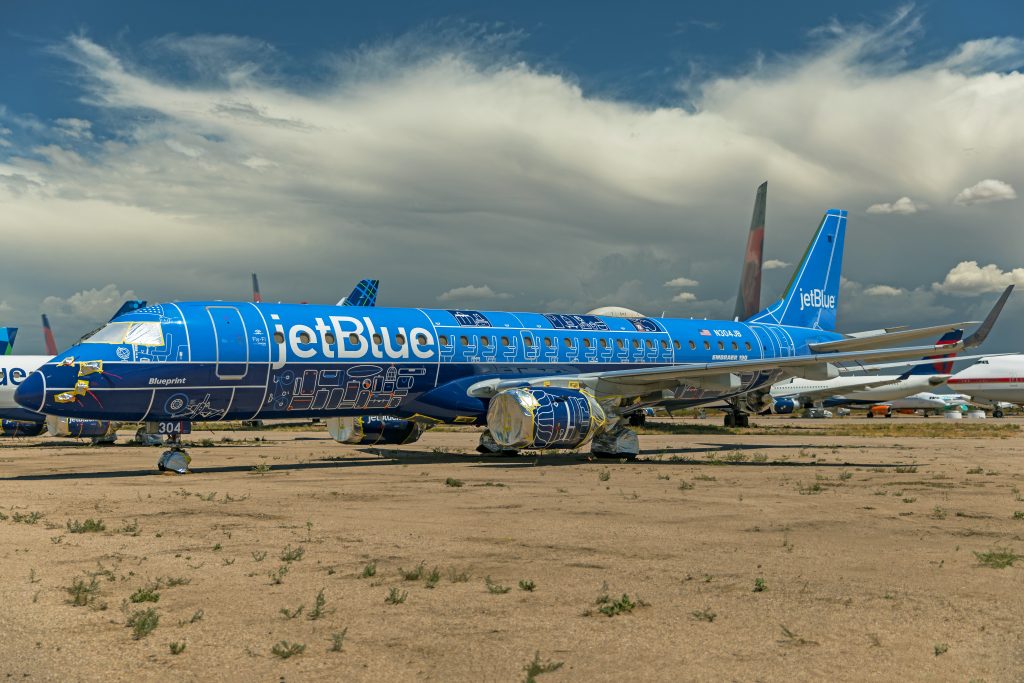
The announcement will accelerate the airline’s transition from Embraer E190 aircraft to Airbus A220s, moving closer to the retirement of the E190 fleet as a whole, with the last one scheduled to exit in 2026.

JetBlue’s ‘Blueprint’ special livery sits idle in the desert (Photo: AirlineGeeks | William Derrickson)

Currently, Airbus has delivered eight A220s to the carrier to date, with the ninth scheduled to be delivered later this month. The carrier has plans to take delivery of nine more within 2022, followed by another 21 in 2023.

“It is very rewarding to see a happy customer coming back for more aircraft not even a year after entry into service of its first A220. We salute our friends at JetBlue on this landmark deal,” said Christian Scherer, Airbus Chief Commercial Officer and Head of Airbus International in a press release. “Over 700 A220 orders to date underscore the strong market appetite for this all-new single aisle aircraft.”

Efficiency and Economics

For an aircraft of its size, when it comes to fuel efficiency and economics, it is hard to compete with the A220. When compared to the E190 fleet it will be replacing, the A220 offers 30 percent lower direct operating costs per seat, giving the airline a huge advantage over its competitors utilizing older aircraft.

On top of this, the aircraft can be utilized on a much wider range of networks, tapping into a much broader range of markets compared to that of the E190. The A220 will allow the airline to target growth in its focus cities, as well as give it the option of longer, transcontinental flying.

In line with their sustainability strategy, JetBlue’s initiative to meet net-zero emissions by 2040 will be greatly aided by fuel-efficient aircraft. The A220’s Pratt and Whitney GTF engines, which deliver double-digit improvements in fuel and carbon emissions, will be an important step in moving closer to that goal.

Configuration

Currently, Jetblue utilizes a configuration that consists of 140 Collins Meridian seats in a two-by-three arrangement. The airline continues to pride itself in offering the most legroom in coach. On top of that, passengers will have access to USB-C, USB-A and AC power at every seat, high-speed Fly-Fi, inflight entertainment on high-definition screens, LED mood lighting, enhanced bigger windows for better views, and much more.

Chase Hagl

Chase Hagl grew up in Twin Falls, Idaho. His love and passion for Aviation landed him in Orem, Utah where he obtained a B.S. in Aviation Management with a minor in Business Management from Utah Valley University. Chase currently works as a flight attendant in Charleston, SC and is also the primary Inflight ASAP ERC representative for startup airline, Breeze Airways. His experience in the aviation industry spans back four years, working in areas including agriculture application, customer service, maintenance, and flight ops. In his free time, Chase enjoys road biking, astronomy, and flying.
Sign-up for newsletters & special offers!

Get the latest stories & special offers delivered directly to your inbox

SUBSCRIBE

Uh-oh! It looks like you're using an ad blocker.

Our website relies on ads to provide free content and sustain our operations. By turning off your ad blocker, you help support us and ensure we can continue offering valuable content without any cost to you.

We truly appreciate your understanding and support. Thank you for considering disabling your ad blocker for this website