








Stories

Cathay Pacific Struggles Amid Government Travel Restrictions

A Cathay Pacific 777 lifts off from Dusseldorf, Germany. (Photo: AirlineGeeks | Fabian Behr)

Cathay Pacific revealed that it is not out of the woods, while the global aviation industry is experiencing a gradual recovery.

Hong Kong’s flag carrier has unveiled the traffic figures for December, carrying 92,916 passengers — an increase of 130.6 %, compared to the same time last year. However, it was nearly a 97% decrease to the pre-Covid levels in 2019. The passenger load factor was 36.6%.

In addition, the carrier has reported that it only carried 717,059 passengers in 2021 — as a result of the travel restrictions and strict quarantine measures. The carrier carried 4.6 million passengers in 2020 and 35.2 million in 2019 respectively.

The airline announced that it carried 1.3 million tonnes of cargo in 2021, similar to last year’s figure. The airline has carried 2 million tonnes in 2019.

According to the struggling airline, it has reduced operating cash burn from an amount within the range of HK$2.5 – 3 billion ($321 million – $385 million) in the first half of 2020 down to marginally cash generative in the second half of 2021.

In the meantime, Hong Kong is facing the fifth wave of the Coronavirus — recording over a hundred cases every day recently. Earlier, the Hong Kong government tightened its quarantine requirements and travel restrictions.

The restrictions will make a significant impact on the airline. In January, Cathay Pacific Cargo only provided 20% of its pre-Covid capacity, and passenger flights have reduced to around 2% of their pre-Covid levels. The airline expected that it results in an operating cash burn of HK$ one billion – to 1.5 billion per month from February.

Cathay Pacific expected that the flights to China will remain largely unaffected, but the capacity to the rest of the network will be reduced in response to the measures. However, Hong Kong Express — its low-cost carrier — maintains connectivity with some regional destinations.

The carrier will operate cargo services to China and a daily freighter operation to North America. Meanwhile, the airline operates passenger aircraft to carry cargo to Europe and Southwest Pacific. Cathay Pacific is trying to maximize its capacity to operate an additional 5% more cargo flights.

Hong Kong has no sign of lifting the travel restrictions, most travelers coming from overseas need to take 21-day quarantine. The government is implementing a zero-Covid policy, insisting “living with Covid” is not an option.

Domestic Policy

Hong Kong is implementing the “place-specific and flight suspension mechanism”. Under the restriction, if a total of five or more passengers among all flights from the same place, regardless of airlines were confirmed positive through testing or relevant virus mutation within one week, then the airline will be banned from entering Hong Kong for two weeks.

Earlier, Akbar Al Baker, CEO of Qatar Airways, believed the policy is “killing” Cathay Pacific. Qatar Airways owns almost 10% of Cathay Pacific.

“You can’t just shut the aviation industry because somebody got infected coming on someone’s airplane,” Baker said, in regards to the policy.

In the meantime, despite the aviation industry in Hong Kong is still facing severe turbulence, the stakeholders never stop developing its business and infrastructure. Earlier, Hong Kong International Airport has revealed that the construction of third runway is underway and expected to be completed in 2024. Also, Greater Bay Airlines — the brand-new airline in Hong Kong — is expecting an Air Transport License to be granted by the government in early 2022.

How Mexican LCCs Volaris, Viva Aerobus Stand Out for Their Sustainability

Viva Aerobus A320 LAS William Derrickson
A Viva Aerobus A320 in Las Vegas. (Photo: AirlineGeeks | William Derrickson)

Volaris and Viva Aerobus are Mexican low-cost airlines that have been standing out in the domestic and international market in recent months. The airlines have the two youngest fleets in the country and among the newest in North America.

In recent years, the airlines have been working on their plans to modernize their fleets, not only for the better comfort of their passengers, but also to stand out as environmentally responsible companies. As a result, both carriers were recognized recently for their commitment to maintaining young and efficient fleets for environmental benefit.

These recognitions were granted by Ch-Aviation, a Swiss company founded in 1998 specializing in intelligence and information in civil aeronautics. The Ch-Aviation Youngest Aircraft Fleet Award recognizes airlines from across the globe that keep a young, modern, and efficient fleet.

Having modern aircraft contributes significantly to the reduction of carbon dioxide within the aviation industry due to the efficiencies the engines bring when it comes to fuel use, thus directing the sector towards a sustainable operation.

The Mexican ultra-low-cost airline Viva Aerobus was recognized for having the third-youngest fleet in North America. Right behind Viva Aerobus, Volaris was distinguished for having the fourth-youngest fleet in North America.

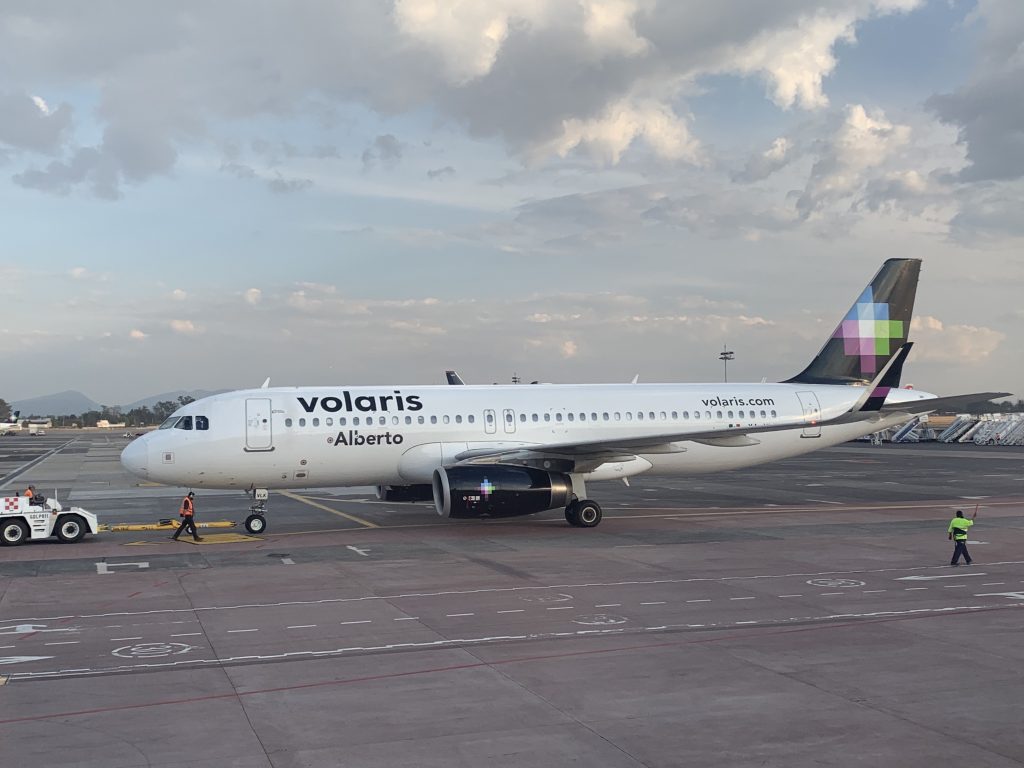
A Volaris Airbus A320 sitting at the carrier’s hub at Guadalajara International Airport in Mexico. (Photo: AirlineGeeks | Albert Kuan)

This award was given to Viva Aerobus due to its modern fleet, which is comprised of 55 Airbus aircraft, including 40 Airbus A320s and 15 Airbus A321s, with an average age of five years.

Currently, Viva Aerobus is the airline with the lowest amount of carbon dioxide emissions per passenger in Mexico. Among Viva Aerobus’s environmental commitments stands outs its objective to reduce its carbon dioxide emissions by more than 15% by 2025.

This goal is supported by the carrier’s efficient operation: its high load factor and the technology of its aircraft and engines.

In addition, Viva Aerobus can maintain one of the lowest cost structures due to its fuel savings.

Fleet Additions

The Mexican ultra-low-cost carrier is also showing its firm growth and modernization plan for its fleet, having closed 2021 with 12 more aircraft than at the end of 2020.

During 2021, Volaris received 15 new aircraft, bringing its average fleet age down to 5.4 years, and recently announced a new purchase order for 39 A321neo aircraft, as well as the conversion of 20 A320neo aircraft from its current order to A321neo.

The Airbus neo engines reduce a flight’s impact on the environment by reducing fuel consumption and carbon dioxide emissions by 16%, nitrogen oxide emissions by 50% and the sound footprint by up to 75%.

The airlines with the youngest fleets in North America are American low-cost carrier Frontier Airlines and Canadian budget airline Flair Airlines, which were awarded first and second place, respectively.

Worldwide, the airline with the youngest fleet is Uganda Airlines, and Sky Airlines the second. Third is SalamAir with Viva Air in fourth and Flydeal the fifth.

Juan Pedro Sanchez Zamudio

The three things Juan Pedro loves most about aviation are aircraft, airports, and traveling thousands of miles in just a few hours. What he enjoys the most about aviation is that it is easier and cheaper to travel around the world and this gives you the opportunity to visit places you thought were too far away. He has traveled to different destinations in North, Central, South America and Asia. Born, raised and still living in Perú, Juan is a lawyer, soccer lover, foodie, passionate traveler, dog lover, millennial and curious by nature.

Emirates Resumes U.S. Flights Despite 5G Interruptions

An Emirates 777-300ER departs from Sydney Airport. (Photo: AirlineGeeks | Hisham Qadri)

Emirates has announced it will restore its full scheduled operations to all its U.S. destinations that were suspended last week based on Federal Aviation Administration (FAA) and Boeing recommendations on possible interference between the 5G antennas and aircraft systems.

The services resumption is also a result of telecommunication operators delaying the rollout of 5G networks around US airports, with FAA and Boeing issuing formal notifications that lift the previous restriction on aircraft operations.

From January 21, the airline reinstated its Boeing 777 operations to Chicago, Dallas Fort Worth, Miami, Newark, Orlando and Seattle.

Emirates services to Los Angeles, New York JFK, and Washington D.C. remain unimpacted while flights to Boston, Houston and San Francisco, on which the airline had temporarily deployed its larger A380 aircraft last week, returned to Boeing 777 operations on Saturday.

The airline also operates Boeing 777 freighter aircraft to Chicago, Houston, Los Angeles, Columbus and Aguadilla, carrying exports and essential cargo such as food and life-saving medicines and pharmaceuticals.

Sir Tim Clark, President of Emirates Airline said in a statement, “We apologise for the inconvenience caused to our customers by the temporary suspension of flights to some of our US destinations. Safety will always be our top priority, and we will never gamble on this front. We welcome the latest development which enables us to resume essential transport links to the US to serve travellers and cargo shippers. However, we are also very aware that this is a temporary reprieve, and a long-term resolution would be required. Emirates will continue to work closely with the aircraft manufacturers and relevant regulators to ensure the safety and continuity of our services.”

Why is 5G rollout a problem?

The United States auctioned mid-range 5G bandwidth to mobile phone companies in early 2021 in the 3.7-3.98 GHz range on the spectrum known as C band, for around $80 billion.

Last week, chief executives of major U.S. passenger and cargo airlines warned of a “catastrophic” aviation crisis as telecommunications firms AT&T and Verizon planned to deploy new 5G services.

They said the new C band 5G service that was set to be rolled out on Wednesday of last week could render a significant number of aircraft unusable, causing chaos for U.S. flights and potentially stranding passengers.

The FAA had warned that the new 5G technology could interfere with instruments such as altimeters, which measure how far above the ground an airplane is travelling among other utilities.

While the altimeters operate in the 4.2-4.4 GHz range, the concern is that the auctioned frequencies sit too close to this range. Additionally, the altimeter readouts are also used to facilitate automated landings and to help detect dangerous currents called wind shear per Reuters.

According to the Washington Post, the FAA announced on Thursday it had cleared more than three-quarters of the U.S.’ commercial fleet to land at airports where interference from 5G signals could pose a danger in bad weather, with the agency having reviewed the radar altimeters to determine whether they can still provide reliable measurements of altitude in areas with 5G tower.

The agency also indicated that some planes might never secure approvals.

Victor Shalton

Victor Shalton's love for aviation can be traced to when he was 11-years-old. As a seasoned aviation writer, he takes pride in providing the best aviation coverage around the globe and is passionate about advancing his skills in the aviation space. In addition, he loves travelling, writing, arts and while his speaking engagements have taken him around the world, he is proud to call Nairobi home.

Alitalia Could Return as a Subsidiary of ITA Airways

An Alitalia A330 at MIA. (Photo: AirlineGeeks | William Derrickson)

In the hearing at the Italian Transport Committee of the Chamber of Deputies a few days ago, ITA Airways President Alfredo Altavilla stated that the brand of old national airline Alitalia could be reused. The statement, however, comes after much pressure put on the “waste” of 90 million euros ($102 million) of public money for the purchase of the Alitalia brand, which might not otherwise be used. The original reason for the purchase aimed at removing the brand from the market is no longer true.

This announcement clashes with the European Commission’s demand for discontinuity with Alitalia’s nefarious past. The latest statements by the management of ITA Airways seem to be very much at odds with what has been said so far. President Altavilla and airline CEO Fabio Lazzerini have always been very clear in reiterating that the Alitalia brand represented “the past” and not a path that the airline would pursue again. Is their initial project of a single airline focused mainly on long-haul to North America and placed within an international alliance, perhaps giving way to other projects?

At the moment the plan to bring back Alitalia as a subsidiary of ITA Airways, as a low-cost airline is only speculation. This news has not been confirmed by the management of ITA Airways, but it could be very good news for all Italian passengers who, to make a domestic flight, have always been “forced” to choose non-Italian airlines (see Ryanair, Easyjet or Wizzair). The choice has always been “forced” by the prices, generally much more advantageous than those of the past and current Italian national airlines. This is why the “new adventure” of Alitalia, offering reduced prices for domestic flights, could bring many Italians to start traveling with the national carrier again.

On the other hand, this business model is already used by many other airlines, such as Lufthansa (Eurowings), IAG (Vueling) and Air France–KLM (Transavia), just to name a few.

Bringing In New Amenities

On Jan. 19, ITA Airways introduced two Lounge Areas, one at Rome Fiumicino Airport and one at Milan Linate Airport. Access is granted to all passengers with a Business Class ticket, Premium and Executive members of the “Volare” loyalty program and Elite Plus SkyTeam members departing to destinations served by ITA Airways.

Besides, ITA Airways presented its new digital newsstand service, created thanks to the partnership with ‘PressReader’. The service is offered free of charge to passengers and will allow them to access directly from their device to more than 7,000 titles, including newspapers and magazines from 120 countries in more than 60 languages, without any limit.

Vincenzo Claudio Piscopo

Vincenzo graduated in 2019 in Mechanical Engineering with an aeronautical curriculum, focusing his thesis on Human Factors in aircraft maintenance. In 2022 he pursued his master's degree in Aerospace Engineering at the University of Palermo, Italy. He combines his journalistic activities with his work as a Reliability Engineer at Zetalab.

Canada’s Lynx Air Begins Selling Tickets for April Launch

A mock up of Lynx Air's livery (Photo: Lynx Air)

Lynx Air, Canada’s newest ultra-low-cost carrier, will begin commercial flights in April, with tickets on sale now for seven domestic routes throughout the country. The Canadian airline has seven destinations in all, covering five locations and offering 39 weekly flights during the peak summer season. Lynx will compete with three to five airlines each route, using its own Boeing 737 MAX 8 aircraft.

Merren McArthur, former CEO of Tigerair Australia, will lead the airline, which will initially operate three Boeing 737 MAX aircraft from Calgary International Airport. The airline wants to service Kelowna, Toronto, Vancouver and Winnipeg from its Alberta headquarters. It will also operate flights from Vancouver to Kelowna, Toronto and Winnipeg.

Lynx was earlier called Enerjet, a Calgary-based charter airline that specialized in transporting oil-sands workers to job sites in Alberta, as well as contract work for tour operators. However, in late 2018, it announced ambitions to turn into an ultra-low-cost carrier, supported by Canadian investors and private equity firm Indigo Partners, which is behind success stories such as Frontier Airlines and Wizz Air.

Its Network

It will be one of four airlines on the airport-pair this summer, alongside Air Canada, WestJet and Flair. Indeed, all of the initial routes, which are detailed below, will compete with Flair.

  1. Calgary to Kelowna: starts April 15th, 3x weekly in August; competing with WestJet, Air Canada, Flair
  2. Calgary to Toronto Pearson: April 14th, 1x daily; Air Canada, WestJet, Flair, Air Transat
  3. Calgary to Vancouver: April 8th, 2x daily; Air Canada, WestJet, Flair
  4. Calgary to Winnipeg: April 19th, 4x weekly; WestJet, Air Canada, Flair
  5. Kelowna to Vancouver: April 15th, 2x weekly; Air Canada, WestJet, Air North, Central Mountain Air, Flair
  6. Toronto to Vancouver: April 28th, 1x daily; Air Canada, WestJet, Air Transat, Flair
  7. Vancouver to Winnipeg: April 19th, 2x weekly; WestJet, Air Canada, Flair

Lynx’s network approach stands in stark contrast to the majority of startup airlines, which deliberately seek out underserved markets. Breeze, for example, will avoid well-served major airport pairs in the U.S. Instead, it will primarily focus on developing new non-stops in leisure areas, with the remainder in seriously underserved destinations.

Despite competing with Flair on every route, ultra-low-cost carriers – which use their lower seat-mile costs to provide stronger price-based competition – will still have only a small proportion of flights in most markets. It’s especially low compared with most other major countries, which wasn’t lost on Lynx. When the startup is included, about 10% of Vancouver-Winnipeg flights and Calgary-Toronto, only about 8% will be about by ultra-low-cost carriers, Cirium data shows.

A New Vision

Lynx sees a need for more price-based competition in order to increase markets.

McArthur told an aviation publication that Lynx’s business approach will aim to boost demand and cut fares rather than to capture market share.

“ULCCs represent just 12% of the Canadian market right now, and in some regions, it’s only 3%,” she said. “If you look at Europe, the representation is around 42%. There are huge opportunities to stimulate demand here.” Over the next seven years, Lynx has firm orders and lease arrangements in place for 46 Boeing 737 MAX family aircraft. McArthur stated that the ULCC plans to have six ships in its fleet by the end of 2022.

According to the OAG Schedules Analyzer, Lynx will face competition from both Air Canada and WestJet on all seven itineraries. Furthermore, Flair Airlines, a fellow ULCC, presently operates four of the seven routes but plans to fly all seven by May. Lynx aims to operate 76 flights per week by May, and McArthur stated that more destinations will be added during the summer 2022 season. She told Routes that there is “an opportunity in eastern Canada that is potentially underserved” but all domestic markets that are unserved or underserved by an LCC are under evaluation.

McArthur noted that transborder links to the U.S. would be added later.

Kalai Raajan

Kalai has always wanted to work in the aviation industry, having been fascinated by its inner workings since he was a child. In pursuit of his dream, he obtained a diploma in aviation management and is currently interning with a low-cost airline, under in-flight policies. In his free time, he loves to engage in recreational activities, and watch sports. In the upcoming years, Kalai intends to pursue his degree at a business school before working as an executive for a global airline around the world.

Wichita Lands Amazon Flights Via Silver Airways

An Amazon Air ATR 72 (Credit: Wichita Airport Authority)

Amazon Air continues to grow as the airline has once again called on one of its operators to begin service to Wichita’s Dwight D. Eisenhower National Airport. The airport saw the first Silver Airways ATR 72-500F make an arrival into the quiet Midwest airport on Thursday, with the airline touching down at 1:03 am and departing back to its origin at 5:15 am.

Amazon Air is utilizing a focus city in Fort Worth Alliance to link the cities, relying on Silver’s fleet of 5 ATRs to connect the Kansan and Texan cities. Silver has been performing services for Amazon since November 12th, utilizing an ATR fleet that mirrors that of its commercial operations based out of Florida. The newest aircraft type to the airline comes from picking up used aircraft, with the previous operators ranging from Air Corsica to Aurigny Air Services with aircraft ages spanning 12 to 18 years.

Amazon Air’s fleet now rests at 95 aircraft operating at nine different operators. The two-day delivery marketed firm has 26 Boeing 737-800BCFs spread across Atlas Air, Sun Country Airlines and ASL Airlines Ireland, 12 Boeing 767-200s spread evenly with Air Transport International and ABX Air, and 54 Boeing 767-300ER(BCF)s with 33 at Air Transport International, 19 with Atlas Air and 2 with Canadian carrier Cargojet. Silver is the lone ATR operator.

“This is an exciting expansion for Amazon Air that will provide greater capacity for shipping packages to our valued customers throughout the Wichita area and Central Kansas. We are thrilled with Amazon’s continued investment in Kansas and look forward to continued growth to meet our customer demands,” noted Amazon Air Gateway Operations Director Chris Preston.

Amazon Air will rely on Trego-Dugan Aviation to do the loading and unloading of the cargo planes for the express-delivery company in Wichita. The aviation company leased 10,691 square feet of space in the airport’s air cargo building to perform operations. Amazon Air will share the cargo ramp with fellow package haulers FedEx, UPS and DHL, who all operate a mix of aircraft ranging from the Airbus A300 to the Cessna 208 Grand Caravan. An icing pad has also been made available for Amazon Air, with the Silver-operated planes using 1,470 square feet of room to PrimeFlight Aviation for deicing services.

The Wichita-Ft. Worth route is not new for either city, as FedEx Feeder carrier Empire Airlines has its own ATR 72F that operates between the two cities for the airline. From Ft. Worth, Amazon packages will have access to flights to 11 additional Amazon Air destinations by air as well as access to the eCommerce company’s expansive ground transportation network.

But that’s not saying that the company doesn’t have access to the said network already, Amazon has been rapidly expanding in the “Aviation Capital of the World.” The company has already invested $4 billion in the region over the last decade and created 8,000 jobs for workers for local Kansans. As a result, Amazon has constructed two buildings in the area, a 140,000 square foot delivery station in northeast Wichita as well as a one million square foot fulfillment center in the suburban town of Park City. The city notes that Amazon’s investments have created $3 billion to the GDP for Kansas and this growth is continuously beneficial for more than just Wichita but all of rural Kansas.

Wichita Airport Authority’s Director of Airports Jesse Romo welcomed the additional cargo service, saying, “we are proud to welcome Amazon Air to Wichita Eisenhower Airport. This location is uniquely positioned with convenient access to Highway 54/400 and Interstate 235 to support Amazon’s deliveries to customers in Kansas and surrounding areas.”

Ian McMurtry

Although Ian McMurtry was never originally an avgeek, he did enjoy watching US Airways aircraft across western Pennsylvania in the early 2000s. He lived along the Pennsylvania Railroad and took a liking to trains but a change of scenery in the mid-2000s saw him shift more of an interest into aviation. He would eventually express this passion by taking flying lessons in mid-Missouri and joining AirlineGeeks in 2013. Now living in Wichita, Kansas, Ian is in college majoring in aerospace engineering and minoring in business administration at Wichita State University.

Scoot Resumes Flights to Gold Coast

A Scoot Boeing 787-8 Dreamliner on final in Singapore. Benny Zheng [CC BY-SA 4.0 (https://creativecommons.org/licenses/by-sa/4.0)]

The first half of every year tends to be a slower period for travel as, and now even more so as the Covid-19 Omicron variant surges through the globe and continues to stall the aviation industry’s recovery.

And even though the Vaccinated Travel Lanes were successful in boosting recovery, a slight halt on ticket sales and flight quotes have once again delayed the recovery process of the Singapore Airlines Group – which managed to ferry almost 600,000 passengers between national carrier Singapore Airlines and low-cost carrier Scoot in December 2020.

To navigate through the storms that Omicron threatens to keep bringing – particularly in Asia whereby the virus seems to have a more acute and prolonging effect as compared to other regions – the airline group would have to keep adjusting its network according to the ever-changing market conditions, wherever an opportunity arises.

A Date At The Beach

And this strategy is exactly what Scoot is practicing as following the announcement of quarantine-free international travel into Queensland, the low-cost arm of the Singapore Airlines Group has decided to take the opportunity to become the first airline to resume flight services between Singapore and Gold Coast.

Scoot Chief Executive Officer, Campbell Wilson, said, “Scoot is delighted to be the first airline to resume international flights to and from Gold Coast. Having flown more than 65 million customers with over close to a decade of flights, Australia remains a much-loved travel destination. Scoot served close to 130,000 travelers between Singapore and Gold Coast alone in 2019, just before the onset of the COVID-19 pandemic. With our current network of 70 destinations, Scoot is looking forward to providing customers with opportunities to once again reignite their wanderlust, reunite with loved ones, and reconnect with concordant business counterparts.”

With effect from Valentine’s Day, the three-times-weekly flight service will operate as TR6 towards Gold Coast. The addition of the beachy destination marks the fourth Australian city that Scoot is providing flight services to – alongside Melbourne, Perth and Sydney.

Even though Scoot has been continuously operating flights into and out of Australia, the resumption of flights between Singapore and Gold Coast allows for the low-cost carrier to better support a myriad of business and leisure travel needs.

Queensland Airports Limited CEO, Chris Mills, welcomed news of Scoot returning to the Gold Coast. “We can’t wait to see Scoot again, and welcome visitors from Singapore back to the Gold Coast,” he said. “It is fantastic to have a date for Scoot recommencing services, so soon after the Queensland border was reopened to international travelers. Many locals will be keen to book their trip, whether it’s to catch up with family and friends or experience everything Singapore has to offer. And the Gold Coast will be a very attractive destination for international visitors.”

Uncertainty in Australia

Although the news of resumption is certainly welcoming for Scoot, the same still can’t yet be said for Singapore Airlines as the national carrier had to delay the quarantine-free flights from Singapore to Perth, which was planned to commence on February 5.

Whilst Singapore Airlines continues to operate quarantine-free flights under the Vaccinated Travel Lane scheme from Perth to Singapore, the lack of the other direction is still a key hindrance in the airline’s recovery as Australia remains an immensely popular market for all types of travelers.

Unfortunately, the uncertainty in Australia keeps growing as the reopening of certain borders still remains exceptionally delayed with the rising number of infections within the country, even forcing the hands of the Qantas Group had to cut down on both its domestic and international capacity through end-March.

Charlotte Seet

Fascinated by aircraft from a very young age, Charlotte’s dream was to work alongside the big birds one day. Pursuing her dream, she went on to achieve her diploma in Aviation Management and is currently working on her degree in Aviation Business in Administration with a minor in Air Traffic Management. When she’s not busy with school assignments, you can find her aircraft spotting for long hours at the airport. In Charlotte’s heart, the Queen of the Skies will always be her favorite aircraft.

Trip Report: Traveling between Beijing and Guangzhou During COVID-19 and Olympics

Air China 777 Taxing to the runway from Beijing Capital Airport Terminal 3

I traveled between Beijing and Guangzhou during this week, and the trip was unique since now is approaching the opening of the 2022 Beijing Winter Olympic Games, and Covid-19 was reappearing in China. Overall, the experience was still efficient, and airports and airlines did everything they can to ensure a smooth travel experience.

Domestic travel in China is still vibrant, unlike international travel in and out of China. However, the situation is highly dependent on the Covid-19 development around the country. Recently, China saw Covid-19 reappearing in multiple cities around the country, adding nearly 1,000 cases. Luckily, no new death is reported due to the pandemic.

New Policies

The State Department of China will issue travel advisories for each city and county, based on their current Covid-19 situation. However, each city has its epidemic prevention policies. For Beijing, the city requires negative nucleic test results within 48 hours before departure; for Guangzhou, it is not mandatory to have a nucleic test before boarding. However, for passengers departing from a mid or high-risk region for Guangzhou, it is mandatory to take a nucleic test upon arrival. You may leave the airport after finishing the test.

First Leg

The first leg of my travel is from Guangzhou’s Baiyun International Airport to Beijing’s Capital International Airport onboard Air China’s CA1352. The aircraft was a Boeing 777-300ER, Air China’s intercontinental flagship. Because of the strict requirement to travel to Beijing, all check-ins have to be done at a counter before departure. The check-in process is still very simple, only added the part for you to show the nucleic test results. The whole check-in took less than one minute to complete.

Air China Lounge at Guangzhou (Photo: Lei Yan)

At security, Guangzhou’s Baiyun airport opened a lane specifically for passengers bound for Beijing’s Capital Airport and Daxing airport. At the front of the lane, passengers’ nucleic test results were checked again. Travelers are very familiar with the policies in place, and no one at the scene was stopped due to a lack of a nucleic test result.

At the boarding gate, each passenger’s temperature will be checked. Everyone is required to wear face coverings throughout the entire flight, except during the time of drinking and eating. The flight experience was routine, not seemed to be disturbed by the changing policies.

Beijing’s Daxing Airport from above (Photo: Lei Yan)

The aircraft was parked at an apron stand after we arrived, and passengers need to take a shuttle bus to get to the terminal. Seven PM at Beijing’s Capital Airport looks a bit lonely at the time, considering this was once the second largest airport in the world. No additional checks for nucleic test results after arrival, as the airports are all coordinated to minimize passenger’s efforts.

Empty Arrival hall at Beijing Capital International Airport (Photo: Lei Yan)

Departing Again

After I finish my business in Beijing, I hopped on my second flight back to Guangzhou. Terminal 3 of Beijing’s Capital Airport has a portion of the building blocked as the close loop to serve for Beijing’s Winter Olympic Games. People in the close loop will not be required to quarantine after arriving in China. Checking in and getting through security was very easy, just like the normal operation. The process did not take long.

Close Loop Area at Beijing Capital International Airport (Photo: Lei Yan)

I am taking a red-eye flight, Air China’s CA1329, operated by a 10+ years old Airbus A330-200. The carrier will retire 12 Airbus A330 series from its fleet in 2022, and the one I flew would be one of the 12.

The occupancy rate of this flight is around 30%. As it was a late-night flight, only snacks and dim sum were served on board. Air China was innovating on its in-flight meals and recently rolled out this “fly with me” goodie bag for passengers on short flights and night flights. This new product was highly acclaimed by travelers.

Air China’s “fly with me” Goodie Bag (Photo: Lei Yan)

Covid-19 Tests Situation

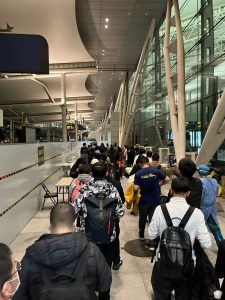
Because of the recent Covid-19 cases found in Beijing, Guangzhou now requires all Beijing-originated passengers to take a nucleic test before leaving Guangzhou’s Baiyun Airport. All passengers are transported to concourse 3 west after disembarking the aircraft, where we will go through a mandatory nucleic test. The scene was very ordered, with a very short line. I got off the plane at 12:35 a.m., and got in a taxi at 12:52 a.m., after completing my test.

COVID-19 Testing Line at Guangzhou Airport (Photo: Lei Yan)

Peak Season

At this moment, China is in the peak season of traveling before the Chinese New Year. The State Department issued several policies to make sure the travelers are not interrupted by the arbitrary policies posted by local governments. Guangzhou and Beijing have set good examples for cities to learn how to strictly carry out the pandemic prevention policy, while still giving passengers the agility to get through airports efficiently.

Lei Yan

Lei is from Inner Mongolia, China, and now lives in Guangzhou. He grew up in an aviation family, where his passion began. During his time at Penn State University, he studied Industrial Engineering specializing in operations research, and he graduated with an honor’s thesis on airport gate assignment optimization. Now, he is a Purchasing Manager with Procter & Gamble. In his free time, he enjoys flying, reading, and wandering around the city.

‘Pilots Hire Pilots Here:’ Avelo COO Discusses New Hire Pay Hikes, Pilot Shortage Challenges

Boarding Avelo's first ever commercial flight in Burbank. (Photo: AirlineGeeks | Taylor Rains)

The U.S. airline industry is currently bracing for the ongoing shortage of pilots, as several carriers race to find their own solutions and incentives to prevent the issue from disrupting daily flight operations and route networks.

On Thursday, in its attempt to attract new crewmembers and expand its team,  Avelo Airlines announced a substantial salary raise for its pilots and expects to welcome 120 new pilots this year.

Posturing Future Growth

As part of this pay hike announcement, AirlineGeeks spoke with Avelo Chief Operating Officer Captain Greg Baden who shared, “With the right qualifications, you could become a direct entry 737 captain.” The ultra-low-cost carrier is looking to hire 120 pilots in 2022.

“We probably lead the industry in upgrade times because we’re actually hiring captains off the street in certain numbers right now. But what I wanted to make sure in the background was that’s only because we are expanding and I will say that this year we’re going to more than double the amount of crew members we have currently,” added Baden.

An Avelo Airlines Boeing 737-800. (Photo: Joe Scarnici/Getty Images for Avelo Air)

Hiring direct entry captains is not a widely common industry practice, certainly not before the COVID-19 pandemic. But Baden notes that as the airline grows, it will become more traditional in its pilot hiring processes.

Competitive Benefits

In a similar move to some other ultra-low-cost carriers like Allegiant, Avelo has designed its route network so that crew members start and end their day at base. Certainly a competitive benefit for prospective new hires, this approach also helps the airline save on lodging and transportation costs over time.

Referring to the added benefit of less time on the road at Avelo, Capt. Baden said, “That brings a lot of simplicity to our business and it’s a real advantage for raising a family…that’s an added benefit to the quality of life is just being able to be home every night, be a part of your family unit and sleep in your own bed.”

Approaching Burbank on Avelo (Photo: AirlineGeeks | Ryan Ewing)

Avelo has bases at Tweed-New Haven Airport and Hollywood Burbank Airport, operating a fleet of six Boeing 737 aircraft.

The carrier plans to raise the first-year starting hourly pay rate by about 50 percent for captains, while new first officers will receive a roughly 30 percent raise for their first year. In addition, in its pitch to persuade prospective pilots to join, Avelo intends to provide a $20,000 sign-on bonus to its new pilots who join before June 1.

Furthermore, the ultra-low-cost carrier’s approach for more effectively and successfully combating the scarcity for pilots includes comprehensive training, uniform allowance, a virtual base stipend for both commuting pilots and those who live in base, and an assurance that each pilot will be able to work at least 70 block hours a month.

Attracting Pilots in a Diverse Market

According to Baden, Avelo’s hiring minimums for pilots are “pretty much industry standard.” Most of its pilots come into the airline with turbine time, some even with actual jet experience.

Airlines such as Frontier and smaller regional operators have partnered with FAA part 141 flight schools to attract first officers with lower flight times in hopes that they will stay longer moving up the pay scale. Avelo is considering this, according to Baden, who says, “We do have several plans in the future…more to come on that.” These types of flight schools are more structured and regulated by the FAA, making them widely attractive to airlines with lower time qualifications.

“So I think as an industry in general, you’ll see younger and lower time qualified crew members entering into the civilian arena. But you know, we’re not there yet,” he adds.

The U.S. labor market remains in a crunch for workers, and as the airline industry seeks to capitalize on suppressed demand with greater capacity, adding more crew members is key. Generous new hire bonuses, lower time qualifications, and competitive upgrade times will ultimately shape airline – especially ultra-low-cost carriers – operational structures in the future.

“Pilots hire pilots here, and we have a lot of respect for what they do and what they contribute to our success,” noted Capt. Baden.

AirlineGeeks’ Ryan Ewing and Benjamin Pham contributed to this story. 

Ryan Ewing

Ryan founded AirlineGeeks.com in February 2013 and has spent more than a decade covering the airline business. His work has been featured by CNN, WJLA, CNET, and Business Insider. His aviation experience spans airport operations, Part 135 regulatory compliance, and airline crew workforce planning, along with time behind the yoke of a Cessna 172 and interviews with airline executives. Ryan now serves as Group President of Firecrown Media’s Aviation Group. He holds a B.S. in Air Transportation Management and an MBA from Arizona State University and teaches Airline Management at Embry-Riddle Aeronautical University.

U.S. Start-Up Northern Pacific Airways Talks Future at Sumptuous California Unveiling

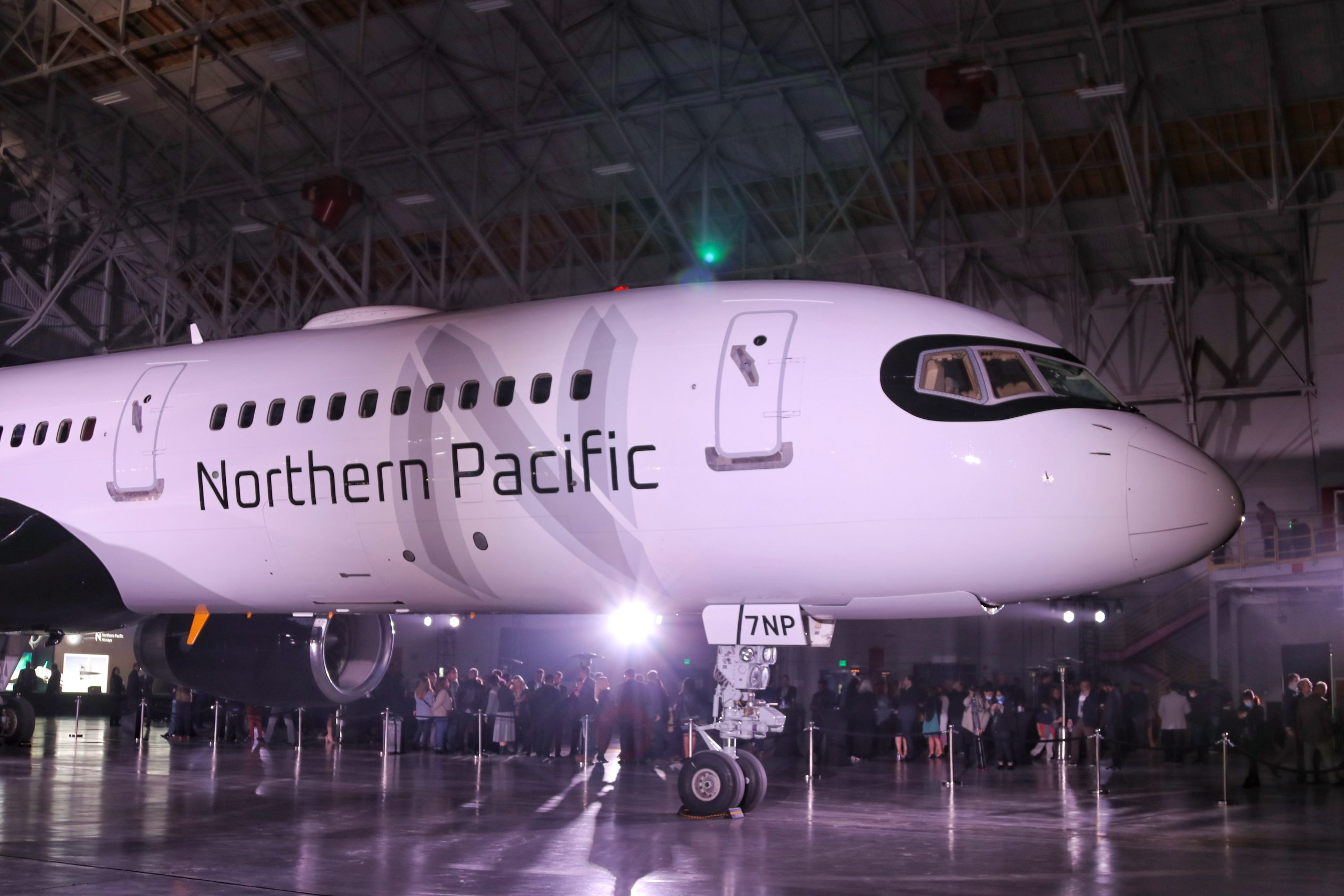
New Pacific's first Boeing 757-200 at an unveiling event in Southern California (Photo: AirlineGeeks | Katie Zera)

Northern Pacific Airways introduced the livery design of its first aircraft at an event in San Bernadino, Calif. on Tuesday. The 26-year-old Boeing 757 aircraft previously operated for U.S. Airways and American Airlines and will be one of 12 757s initially planned for the commencement of services by the Anchorage, Alaska-based carrier. The airline’s parent company also operates commuter airline RAVN Alaska.

Commenting on the livery Northern Pacific Chief Executive Officer Rob McKinney stated: “The livery design captures the Northern Pacific brand and our affection for our Alaskan home. The design echoes our airline’s values – elevated customer service, an esteemed point of view, and an innovative route strategy designed to connect passengers from east to west.”

Mr. McKinney told those at the livery reveal that Northern Pacific currently has six of the planned 12 Boeing 757s. The aircraft was selected as they were readily available, though the Boeing 737 MAX 9 or Airbus A321XLR are on the radar for future fleet enhancement. The choice of which will be determined by what is likely to be available sooner.

In an interview with Airline Geeks at the reveal event, Mr. McKinney discussed the start-up’s strategy and route network aspirations.

“We are looking heavily on the Asia side: Tokyo, Nagoya, Osaka and Seoul,” said Mr. McKinney. “On the U.S. side at L.A., San Francisco, Las Vegas, New York and Orlando.” However, details of routes and airports to be used were unable to be divulged by Mr. McKinney at this time because the airline “does not have the authorities from the US DOT (Department of Transportation) yet.”

Eyeing an Icelandair-esque Strategy

Northern Pacific will be using Anchorage’s strategic location on the great circle routing between Asia and the U.S. to influence network strategy. This compares much in the same way that Icelandair has leveraged Reykjavik’s geolocation for trans-Atlantic stopovers linking North America and Europe.

Anchorage’s existing tourism draw and RAVN Alaska’s existing operations would be leveraged to facilitate this. Anchorage airport’s empty North terminal will also be providing the base of operations for Northern Pacific “Where else in the world can you find an empty terminal where you can create an airline?” said Mr. McKinney.

Northern Pacific’s first 757-200 (Photo: AirlineGeeks | Katie Bailey)

When discussing the initial focus on Japanese routes rather than those in China, Mr. McKinney cited pent-up demand as a result of the travel restrictions imposed by the pandemic. Prior to the pandemic outbound, Japanese tourism had seen minimal growth compared to other Asian markets and inbound tourism from the U.S. to Japan had declined over the last decade.

“We are definitely optimists,” added Mr. McKinney. “Because of the retraction of the industry and the tapering off of travel that provides the opportunity for us even to enter these markets. If we were to have tried to have done this in 2019 it would have been nearly impossible for us to get slots and gates and the infrastructure needed for an airline of this magnitude.”

With regard to the selection of U.S. destinations from Anchorage, Mr. McKinney cited consideration for routes already well served by existing operators. With the example of Anchorage – Seattle, he said that this was already well served by Alaska Airlines and Delta.

Looking Towards a Crypto Future

“There is so much open space out there to serve so to go on top of two big competitors didn’t seem the wisest.” In addition to a ‘really good’ partnership with Alaska, Northern Pacific will be seeking to leverage the existing alliances in place with RAVN Alaska. Mr. McKinney stated that “we expect that those will stay in place.”

The target demographic for Northern Pacific’s customer market for the airline was “going to skew younger than the typical trans-Pacific traveller and cost-conscious people that are looking for better options,” said Mr. McKinney.

“People that like the convenience of clearing customs in Anchorage versus an LAX. Cryptocurrency as a loyalty program is going to skewer to a younger crowd.” The use of cryptocurrency instead of miles or points is seen by Mr. McKinney as the way of the future.

With this target demographic the 757 will be configured in three classes, shared Mr. McKinney. In a broader discussion at the event, he said that the three classes of travel would be Economy, Economy Plus and Business.

In his discussion with AirlineGeeks, Mr. McKinney said, “We are still working on the exact LOPA and about 180 as the total density. As the airline is not seeking to target the typical premium class traveler.” He said that service in the top class of travel “will be fairly minimal with amenities and food and possibly enhanced internet but not lie-flat seats, touch screens or any of those types of things.”

Seating configurations on Northern Pacific Airways (Photo: AirlineGeeks | Katie Bailey)

Northern Pacific is seeking to commence inaugural operations in Q3 of 2022 though it may be likely that this target date drifts into Q4.

Reporting by AirlineGeeks’ Katie Bailey and John Flett

John Flett

John has always had a passion for aviation and through a career with Air New Zealand has gained a strong understanding of aviation operations and the strategic nature of the industry. During his career with the airline, John held multiple leadership roles and was involved in projects such as the introduction of both the 777-200 and -300 type aircraft and the development of the IFE for the 777-300. He was also part of a small team who created and published the internal communications magazines for Air New Zealand’s pilots, cabin crew and ground staff balancing a mix of corporate and social content. John is educated to postgraduate level achieving a masters degree with Distinction in Airline and Airport Management. John has held the positions of course director of an undergraduate commercial pilot training programme at a leading London university. In addition he is contracted as an external instructor for IATA (International Air Transport Association) and has been a member of the Heathrow Community Fund’s ‘Communities for Tomorrow’ panel.
Sign-up for newsletters & special offers!

Get the latest stories & special offers delivered directly to your inbox

SUBSCRIBE