An Air Canada Airbus A321 painted in the Star Alliance livery in Los Angeles.
(Photo: AirlineGeeks | William Derrickson)
The question of when to safely reopen Canada’s borders for certain international travelers remains a constant conversation amongst many world leaders during the ongoing Covid-19 ordeal. Many major airlines continue to monitor travel restrictions and must adjust their flight schedules and route network to adhere to the imposed entry restrictions. Domestic travel has been at the center of attention due to the reduction of international flights, and Air Canada is quickly resuming domestic operations at its hubs. However, with the prospect of borders reopening on the horizon, the carrier is rebuilding its long-haul route network.
Canada’s federal government recently lifted its lengthy travel ban on international flights to/from India and is instead opting to implement more enhanced COVID-19 screening procedures such as testing and vaccination documentation. In response to the termination of the ban, the prominent Star Alliance carrier announced flight resumptions from its hubs in Canada to its route network in India.
“People are eager to reunite with family and friends and we are very pleased to resume service immediately from India to our Toronto and Vancouver hubs following the lifting of restrictions by the Government of Canada,” Mark Galardo, Senior Vice President for Network Planning and Revenue Management at Air Canada, said.“We continue to be focused on the growing visiting friends and relatives market, and together with the long-standing cultural and business ties between Canada and India which are expected to grow over the coming years, Air Canada remains strongly committed to this important Asia-Pacific market.”
The Montreal, QC-based carrier resumed flights from Toronto and Vancouver to New Delhi and plans to eventually inaugurate service from Montreal this fall. Flights to Mumbai are expected to be scheduled soon for the upcoming, seasonal holiday travel time frame.
In light of Canada’s federal government lifting restrictions, the airline plans to require its passengers to have proof of a negative COVID-19 test. The test must be completed at an approved laboratory, within 18 hours of departing India.
Canada’s International Flight Recommencements
Air Canada is not the sole carrier to recently recommence flights to India, as Air India – one of Air Canada’s partners in the Star Alliance – plans to resume its daily flights from Toronto to New Delhi on Sept. 30, while flights from Vancouver to the Indian capital will recommence on Oct.1, operating three times a week.
Both carriers, who have simultaneously restarted flights, play a significant role in strengthening the partnership between them and the cultural relations between the two nations. In addition, both airlines have the opportunity to attract as much of the remaining passenger demand for the market in Asia.
Clearly, Air Canada is contributing to the country’s efforts to reopen its borders to a larger number of countries through its long-haul flight operations. The return of the airline’s operations in India is in stark contrast to its domestic flight recommencements from its hubs. It is undeniable that long-haul travel was significantly impacted due to the effects of COVID-19. However, the Canadian flag carrier is en route to returning long-haul operations to Asia, featuring India.
Benjamin has had a love for aviation since a young age, growing up in Tampa with a strong interest in airplane models and playing with them. When he moved to the Washington, D.C. area, Benjamin took part in aviation photography for a couple of years at Gravelly Point and Dulles Airport, before dedicating planespotting to only when he traveled to the other airports. He is an avid, world traveler, having been able to reach 32 countries, yearning to explore and understand more cultures soon. Currently, Benjamin is an Air Transporation Management student at Arizona State University. He hopes to enter the airline industry to improve the passenger experience and loyalty programs while keeping up to how technology is being integrated into airports.
South African Airways, Kenya Airways Seize Partnership Opportunity
A South African Airways A340 pushing back at Washington Dulles International Airport. (Photo: AirlineGeeks | Ben Suskind)
Rhetoric on the need for cooperation between airlines in Africa has never been in short supply, but action has been less forthcoming.
In the current aviation landscape, filled by the emergence of new markets, South African Airways and Kenya Airways are looking to redouble their efforts to remain competitive.
The two loss-making airlines have signed a memorandum of understanding with a longer-term view to co-start a Pan-African Airline Group that will enhance mutual growth potential by taking advantage of strengths of the two airlines’ busy hubs.
SAA’s Interim CEO, Thomas Kgokolo, said, “As well as being a strong local carrier, part of our broader growth strategy is to become a major player in regional travel and this joint memorandum with Kenya Airways, one of the continent’s strongest and most respected carriers, will do just that.
“Part of SAA’s core remit is to be a significant enabler of business and trade in Africa and it’s through a strategic understanding like this that real progress will be made in advancing South Africa and the continent’s growth,” Kgokolo continued.
The memorandum will help improve customer experience by offering a wider range of choices and destinations. The cooperation will also help in the standardization of product and service offering that is in line with current global aviation trends.
Mr. Allan Kilavuka, Kenya Airways’ CEO, highlighted the partnership’s significance in turning around the fortunes of both KQ and SAA: “The future of aviation and its long-term sustenance is hinged on partnership and collaboration. Kenya Airways and South African Airways collaboration will enhance customer benefits by availing a larger combined passenger and Cargo network, fostering the exchange of expertise, innovation, best practices, and adopting home-grown organic solutions to technical and operational challenges’’.
A Kenya Airways Boeing 787-8 at Schiphol Airport. (Photo: AirlineGeeks | James Dinsdale)
“It is not a merger but a partnership that seeks to re-organize KQ and SAA assets into an ecosystem that will make the South African and Kenyan aviation sector more competitive,” Kenya Airways said in a statement.
The Airlines’ Rivalry
In a context of intense rivalry, the two legacy carrier are facing multiple challenges that include, but are not limited to, high fleet renewal and maintenance costs, advent of new business models and regulatory changes. Since internal growth or competitors’ takeover may be hard, choosing to cooperate with each other makes more sense.
This form of partnership has indeed also attracted many airlines in recent years and now covers a major part of global air traffic. Indeed the trans-Atlantic joint venture of Air France – KLM alone accounted for more than 20% of the overall trans-Atlantic capacity in 2017 with 250 trans-Atlantic flights per day.
These partnerships exist in more or less complex forms and constitute crucial levers for airlines to enter a new market or strengthen their position in fast growing areas like Africa.
Kgokolo believes that working with Kenya Airways will harness internal resources and capacities leading to sustainable and cost-effective growth. This includes shared services in the areas of route networks, fleet, and capacity deployment and exploring economic, technical as well as maintenance, repair, and overhaul opportunities to achieve economies of scale.
A Market With Great Potential
The African market offers strong growth potential for airlines. According to the International Air Transport Association (IATA), provided that governments do not harden the barriers to entry, Africa is set to become one of the fastest-growing regions for aviation in the next 20 years with an annual expansion of nearly 5%.
Airlines inside and outside Africa are upbeat about the growing opportunities and huge potential in the continent’s aviation industry.
Driving this growth are the international and African carriers adding more routes on the continent and scaling up their operations by acquiring or forging partnerships with other airlines operating in Africa.
A South African A340 on approach. (Photo: AirlineGeeks | Fabian Behr)
In 2018, the continent’s largest airline by revenue and profit, Ethiopian Airlines, signed a deal to acquire a 45% stake in Zambia Air, resurrecting the Zambian flag-carrier more than two decades after its shut-down.
Moreover, another sign that Africa’s aviation industry is witnessing an upturn is that low-cost carriers have begun serving second-tier cities on the continent, a trend that industry experts expect to continue.
South Africa’s Kulula.com became the continent’s first budget airline in 2001. Since then, others have jumped in, connecting cities that bigger carriers deem unprofitable to serve at prices the growing middle-class can afford.
Victor Shalton's love for aviation can be traced to when he was 11-years-old. As a seasoned aviation writer, he takes pride in providing the best aviation coverage around the globe and is passionate about advancing his skills in the aviation space. In addition, he loves travelling, writing, arts and while his speaking engagements have taken him around the world, he is proud to call Nairobi home.
Editor’s Note: Tickets were provided by DAT Volidisicilia to AirlineGeeks.
Beautiful Sicilia, not-so-beautiful Catania Airport during Summer season. The terminal is big and modern as well, but it really gets crowded during this time of the year, and it showed.
At least the airport management showed some commitment to avoid crowding as much as possible, as only passengers with a ticket (or a reason to get in) were admitted inside the terminal. I’ve waited some 10 minutes in line before I could get in.
Waiting to get inside Catania Airport. (Photo: AirlineGeeks | João Machado)
As I said, the terminal is actually very nice – it’s just that there is so many flights coming and going during Summer that it’s tough for the terminal to handle capacity properly. I guess during winter it’s way better.
The departures screen divided its space with a distancing reminder. (Photo: AirlineGeeks | João Machado)
Anyway, I had arrived from Pisa by Ryanair with hours to spare, so there was no rush. Nevertheless, I accessed the airside to see the flights arriving and departing. Check-in would only start two hours before the flight, and there was plenty of time.
Airside in Catania. (Photo: AirlineGeeks | João Machado)
Though I didn’t have any luggage to dispatch, I like to keep the boarding passes for my collection. So, two hours before my flight, I went to the line. In some 10 minutes, I had the boarding pass.
Waiting in line for my boarding pass. (Photo: AirlineGeeks | João Machado)
During Summer season, Catania sees an unmatched number of flights from all parts of Europe and with all sorts of airlines, from the oldest network carriers to newest low-cost airlines.
DAT Volidisicilia, however, is a special case: it was granted the continuità territoriale (territorial continuity) contract by the Sicily regional government in 2018 – with the service extended until 2022. This way, it connects Lampedusa and Pantelleria, two insular cities south of Sicily which are part of the region, to major cities in the region itself.
The operation, according to Travel Quotidiano, involves four aircraft based in Italy by the Danish airline and more than six thousand flights a year.
While the airline is contractually obligated to operate these flights, it can use its assets as it wants as long as it operates the contracted flights. As such, during summer, the airline adventures itself into connections to the mainland – this Summer it flew to Brindisi and Napoli – and even into the other insular Region of Italy, Sardinia, with flights to Olbia competing toe-to-toe with much larger low-cost carrier Volotea.
Flights from Catania. (Photo: AirlineGeeks | João Machado)
Anyway: soon the gate for my flight was announced. I expected us to board in the lower levels of the terminal since DAT Volidisicilia only operates ATRs, which don’t use jet bridges.
Instead, we didn’t.
Line for boarding DAT Volidisicilia to Olbia. (Photo: AirlineGeeks | João Machado)
Well, we got in the jetway, but got downstairs instead, where a bus awaited us.
Boarding an ATR with a jetbridge? Obviously we had to take the stairs to get in the bus. (Photo: AirlineGeeks | João Machado)
Thankfully the flight was quite empty, so we all fit in a single bus, which was not packed in the end.
The bus serves as the ATR’s jetway in large airports; in Catania it was no different. (Photo: AirlineGeeks | João Machado)
I was really looking forward for this flight; I’m a fan of the ATR because of the connectivity it provided back in my country, but I had never flown the old -200 version. This is exactly the one DAT uses in its Sicily operations, so I had a shot at comparing it to the -500 and -600 versions, which is the one I had flown multiple times in Brazil.
There were two DAT flights leaving at the same time, so it was only arriving at the plane that I discovered which bird I’d fly that day. The answer: OY-LHB.
According to Planespotters.net, Hotel-Bravo was originally delivered to KLM’s botched “KLM uk” project in June 1998, being returned to the lessor in June 2003 and then being incorporated by Denmark’s Cimber Air (later renamed to Cimber Sterling) in November 2004 until the airline went bust in May 2012. DAT then incorporated the frame in March 2013, to which it has been flying ever since. The earliest picture of the airline with the “Volidisicilia” titles on JetPhotos is from January 2019.
Boarding OY-LHB in a cruel Summer afternoon; no wonder why everyone rushed to inside the airplane. (Photo: AirlineGeeks | João Machado)
The inclement sun prompted everyone to rush to inside the aircraft. I’d been allocated in row 12 and asked the flight attendant to move forward. They said row 1 was blocked for “balancing reasons” but that I could take row 2, which I did.
The fact OY-LHB was more than 20 years old didn’t mean it had to be in an awful state. DAT really took care of this ATR, and it showed. In fact, the leather seats were way more comfortable than the ones I was used to see in Azul’s ATR 72-600s.
DAT’s interior in this ATR 72-200 was really well maintained. (Photo: AirlineGeeks | João Machado)
Of course the frame did show its age, though, as the lighting was not as modern as the -600s, but there was nothing that could harm the flight experience.
DAT’s ATR 72-200 cabin. (Photo: AirlineGeeks | João Machado)
Seat pitch was quite good, too, in the standard 68-seat configuration of the ATR 72.
Seat pitch in DAT’s ATR 72-200. (Photo: AirlineGeeks | João Machado)
In fact, load factor was quite poor, with only 34 passengers, making for a 50% load factor. This, though, meant that boarding was finished as soon as everyone was seated.
However, we had to wait on the ramp; we were the fourth aircraft waiting to take-off, and others were landing. Engines started at 14h37, and at 14h46 we started taxi to the nearby runway 08.
It was only at 14h59, 34 minutes after schedule, when we took-off from Sicily, the pair of turboprop Pratt & Whitney engines making some loud noise, naturally way louder than the modernized ones in the -600 version of the aircraft.
https://youtu.be/CKnaZpmhRD8?t=255
We had lost time to make up for – even because the flight had a quick turnaround to return to Catania after arrival in Olbia.
The two-hour flight would be quite boring, though, as naturally DAT does not offer any entertainment options in the ATR. And soon we were informed by the PA system that, because of COVID, there would be no (active) catering service either.
But the nature of the flight, a high season connection between two highly touristic destinations, entertained most of the passengers, who were mostly not alone and could chat about their vacations.
The uneventfulness was such that later I discovered what was the “balancing problem” that got me out of row 1: the flight attendant sat there and started to read a book. Well, fair enough.
Soon she returned to the back of the plane and I went there to talk to both of them and learn more about their gig, which sounds fun: operating for a Danish airline in Italy-based operations. I thought they would be native Italians, but I was wrong.
The chief FA, Luciano, was Romanian (but a fluent Italian speaker, which was clear from his PA speeches) and had worked for Wizz Air and Primera Air before getting hired by DAT. The second FA, Gintare, was from Lithuania and had previously worked for Corendon.
Apparently, they are from DAT’s “normal” people of flight crews, the airline paying for their stay in Sicily in what they called “mission” – DAT’s nature as a typical wet-lease operator showed. They’d work for about three weeks in Italy, return home and be replaced, both being quite pleased with this system that’s different from most airlines.
We spent most of the flights talking about aviation, so the time passed like a breeze. While DAT didn’t actively offer catering in the flight, they did bring water and coffee for the passengers who asked. I did benefit from that, for that day was long, so I really needed some coffee.
All in all, OY-LHB did show its age (like in the panel the flight attendants operate, for instance); apart from that, the 20-odd years that ATR was operating passed unnoticed. DAT took such great care of that plane.
OY-LHB’s lighting and sound panel. (Photo: AirlineGeeks | João Machado)
The lavatory was quite small and looked like a cave such was the lighting, but it was clean nevertheless.
OY-LHB’s single bathroom. (Photo: AirlineGeeks | João Machado)
What I like about the ATR, and about all regional planes, is the 2-2 configuration versus the 3-3 I’d see, for instance, traveling with Volotea in the same segment. The speed difference with respect to flight time really gets higher in these longer segments though, and the ATR -200 was quite loud, which got annoying after some time.
OY-LHB had 17 rows in a 2-2, standard ATR configuration. (Photo: AirlineGeeks | João Machado)
About 45 minutes before landing, I returned to my seat, just in time for the descent, which started at 16h26. The flight was an incredibly smooth sail over the Mediterranean Sea, with no turbulence at all. However, despite the crew trying to minimize the delay by picking up the pace, we would most definitely arrive with some delay, as we were nine minutes before the scheduled arrival.
At 16h43, though, we made a smooth landing in Olbia’s Costa Smeralda Airport runway 23, with a delay of only eight minutes – versus the take-off half an hour after schedule.
https://www.youtube.com/watch?v=YFR9V5kVfQo
OY-LHB stopped in a remote position and the crew rapidly posed for a photo – as the bus was waiting for me to go back to the terminal.
DAT’s crew in the Catania-Olbia segment. (Photo: AirlineGeeks | João Machado)
Well, wasn’t this a cool experience! It’s one of the things only Europe can provide: a Danish airline flying domestically in Italy with a French-made aircraft and a multinational crew. All in all I think DAT delivered a cool experience for what it promised.
The aircraft, albeit not the most modern, was impeccably clean with comfortable seats; entertainment, as I said, was not really needed by most passengers who were out on vacations, and catering lacked – keep in mind other airlines are already offering full onboard service, with most passengers at this point vaccinated against COVID-19. The crew was also very professional and treated all passengers very well, with attention and always a smile in the face.
So, would I fly again with DAT Volidisicilia? In the public service obligation flights, definitely, since they are the single operator there anyway. In the routes where they compete with someone, like Catania-Olbia, where they went toe to toe with Volotea this Summer, I definitely would, though they would have to win me by price. I guess that’s the case for most passengers these days.
João has loved aviation since he was six-years-old when he started visiting his home airport in Porto Alegre, southern Brazil. As he always loved writing, in 2011, at age 10 he started his very own aviation blog. Many things have happened since then, and now he is putting all his efforts into being an airline executive in the future. João currently lives in Siena, Italy, where he studies Economics and Management at Unisi.
A British Airways A320neo landing. (Photo: AirlineGeeks | William Derrickson)
There had been some hints throughout the past several months, but this time there is an official communication by the carrier itself: following a failed negotiation with the pilots’ union BALPA (British Air Line Pilots Association), British Airways had decided to cancel almost all its short-haul flights from London Gatwick and maintain only a small number of domestic routes to feed its long-haul services.
“After many years of losing money on European flights from the airport, we were clear that coming out of the pandemic, we needed a plan to make Gatwick profitable and competitive”, a spokesman for the airline said, as reported by Airways Magazine. “With regret we will now suspend our short-haul operations at Gatwick, with the exception of a small number of domestic services connecting to our long-haul operations, and will pursue alternative uses for the London Gatwick short-haul slots”.
British Airways had announced that its intention was to set up a new low-cost airline based at Gatwick, but it could not agree with BALPA on the employment conditions for the personnel at the new carrier. British Airways’ parent company, IAG, already has two low-cost airlines in its portfolio: Spanish-based short-haul airline Vueling and Level Airlines, also based in Spain, that focuses on leisure long-haul routes. However, none of these carriers was considered suitable for the Gatwick operations, hence the attempt to set up a new one.
Before the pandemic, London Gatwick airport used to be the busiest single-runway airport in the world and the main leisure airport in the United Kingdom. It is the largest base for low-cost airline easyJet and has significant operations also by other leisure carriers like Wizz Air and Jet2.
According to British newspaper The Telegraph, British Airways was planning to offer the captains at its new low-cost unit a salary package almost 30% lower than what is offered to pilots at rival easyJet. This would have made the new Gatwick-based carrier’s cost base competitive with other airlines serving the same leisure markets in Europe and on the Mediterranean Sea.
The British flag carrier has been famous for driving a very hard bargain in negotiations with its staff, and it is not possible to exclude that the drastic decision to axe its short-haul network out of Gatwick is only a negotiating move to obtain more concession from the trade unions.
British Airways still maintains ownership of the majority of slots at Gatwick, which are going to be extremely valuable once traffic recovers, since the airport used to operate at full capacity before the pandemic, and it serves a very sought-after catchment area including the Southern part of London.
Vanni fell in love with commercial aviation during his undergraduate studies in Statistics at the University of Bologna, when he prepared his thesis on the effects of deregulation on the U.S. and European aviation markets. Then he pursued his passion further by obtaining a Master’s Degree in Air Transport Management at Cranfield University in the U.K. followed by holding several management positions at various start-up carriers in Europe (Jet2, SkyEurope, Silverjet). After moving to Canada, he was Business Development Manager for IATA for nine years before turning to his other passion: sports writing.
Ethiopian Airlines has signed an eight-year operating lease agreement with specialist regional aircraft lessor TrueNoord for a De Havilland Canada Dash 8-400 (MSN 4621).
This is TrueNoord’s first lease program in Africa and, according to the lessor, funding for the aircraft was provided by TrueNoord’s revolving warehouse facility, underwritten by Citibank, Société Générale and Royal Bank of Canada.
Pillsbury acted as legal counsel for TrueNoord on the acquisition with Milbank advising on the financing and Clifford Chance advising the lenders.
Manufactured by De Havilland Aircraft of Canada Limited (De Havilland Canada), the new Dash 8-400 will be integrated into Ethiopian’s fleet for immediate operation.
Sibert van Leeuwen, TrueNoord’s sales manager for Africa, Middle East, India, Russia and CIS said, “Ethiopian Airlines has a growing portfolio and a strong reputation for service and innovation. TrueNoord is pleased to be chosen to support their regional connectivity with the versatile and economical Dash 8-400.”
“Based in Addis Ababa Bole International Airport, the aircraft is enabling them to boost services domestically, and broaden the choice of routes across neighbouring East African countries. We are proud to be joining the ranks of lessors supporting an airline that is a driving force behind much needed airline consolidation in Africa and liberalisation of the air transport market in the region,” van Leeuwen added
Tewolde GebreMariam, Group CEO of Ethiopian Airlines, said: “We are expanding with an important remit to explore new technologies alongside environmental matters and economic solutions. Ethiopian is committed to a sustainable future for regional aviation and meet new demands through collaboration with partners in the industry such as TrueNoord. We are growing our domestic and regional network and the addition of the new aircraft will enhance our operations.”
Philippe Poutissou, vice president, sales and marketing at De Havilland Canada commented, “We are extremely pleased to see our Dash 8-400 aircraft join TrueNoord’s growing portfolio and are confident that it will be a valuable asset in the rapidly expanding regional aircraft sector of the leasing marketplace.”
“We also congratulate TrueNoord on its lease agreement with Ethiopian Airlines. As a leading operator of the type, Ethiopian Airlines continues to demonstrate that the Dash 8-400 aircraft provides the operational flexibility, exceptional performance capability, capacity and passenger comfort to support its operations and we wish the airline and its strategic airline partners much continued success,” Poutissou said.
Anne-Bart Tieleman, TrueNoord’s chief executive, while acknowledging the potential throughout Africa for leased regional aircraft, also noted, “Air transport remains one of the key components to the development of this huge continent and we are enthusiastic about Africa’s untapped air travel potential. The lack of services between even highly populated African countries means travellers often take long and arduous road journeys, or fly via other continents, just to reach a neighbouring African country.”
“Pre-COVID-19 there were only 500 scheduled routes between domestic African destinations versus around 800 between African airports and the rest of the world. As we try to find ways to emerge from the crisis and support our lessors globally it is clear that if we can work with esteemed operators, like Ethiopian Airlines, to help them offer commercially viable direct flights between domestic African destinations via increased load factors – then it’s a powerful move in the right direction,” Tieleman said
Ethiopian’s Dash 8-400 aircraft have transported more than 12 million passengers since introduction to the fleet in 2010, and the airline‘s network is enhanced by its strategic partnerships with ASKY Airlines, Malawi Airlines, Ethiopian Moçambique Airlines and Tchadia Airlines.
The East African carrier also plays a leading role in supporting other Dash 8 aircraft operators in the region through its operation of Dash 8 flight simulators and as an Authorized Service Facility.
Victor Shalton's love for aviation can be traced to when he was 11-years-old. As a seasoned aviation writer, he takes pride in providing the best aviation coverage around the globe and is passionate about advancing his skills in the aviation space. In addition, he loves travelling, writing, arts and while his speaking engagements have taken him around the world, he is proud to call Nairobi home.
Starlux Airlines' first Airbus A321neo at Airbus' facility. The airline has placed an order for the A330neo. (Photo: Starlux Airlines)
Singapore’s Changi Airport this week welcomed the inaugural flight of StarLux Airlines operating from Taipei’s Taoyuan International Airport. StarLux is not the only new airline to land Changi in September, with Japan Airlines’ low-cost subsidiary Zipair launching service to the nation early in the month.
Changi told The Straits Times that new airlines such as Zipair and StarLux starting service to the airport are “a part of various measures to protect Changi’s position as a major hub.” Officials said this was especially important given the turmoil in the industry during the past 18 months and the recovery that is expected over the next couple of years.
“Despite the dire air situation, Changi Airport Group [CAG] kept our airline partners updated on the latest border policies and encouraged them to reinstate flights to carry transfer traffic through Changi Airport or bring passengers to Singapore via the various SafeTravel lanes,” Ching Kiat Lim, managing director for air hub development, said in a statement.
According to local media, StarLux Airline flew only 12 passengers to Singapore, but the maiden flight was full of cargo and other goods that the airline agreed to transport between the two cities. StarLux is currently operating two flights per week to Singapore in the early phases of its launch but will increase its services to three fights per week in October.
StarLux Airlines launched during the onset of the pandemic, but the drastic drop in air travel hasn’t prevented the young airline from expanding its route map — Singapore became the airline’s tenth destination when it launched this week. In recent months, StarLux has launched the services to Tokyo, Osaka, Macau, Kuala Lumpur and Penang, Malaysia. According to StarLux, the airline is planning to expand its route map to North America as soon as 2022.
A Year to Forget
Over the summer, the Singaporean government implemented “Safe Travel Lanes,” allowing foreigners to enter Singapore without quarantining.
Singapore is reeling from the effects brought on by the coronavirus throughout much of 2020 and 2021, despite the fact that the country has rolled out a successful program and vaccinated more than 80% of its permanent residents. New cases have been skyrocketing since September, with the tourism and commerce hub recording upwards of 1,000 daily cases in some recent weeks.
As a result of a lack of domestic air travel market in Singapore, Changi was hard hit by the pandemic. Earlier this month, the airport revealed its financial report for the fiscal year spanning 2020 and 2021, announcing that it recorded a 98% drop in passenger traffic from the previous fiscal year. The total number of aircraft movements at the airport dropped by 80% during the same period. CAG said the financial year had been the most difficult year in Changi’s history.
In the wake of the coronavirus, Terminal Two and Four have ceased operations since last May, and the airport has converted terminal four to a vaccination center, the biggest in the country. However, the airport has seen a silver lining in strong cargo demand. Cargo throughput in March nearly rebounded to the levels before the pandemic.
In addition, Changi believed the travel will resume “in a matter of time,” following global vaccination programs and the latest testing technology rollout.
An Emirates A380 at LAX (Photo: AirlineGeeks | William Derrickson)
The ongoing Covid-19 pandemic has made travelling for passengers a lot more troublesome than it used to be, with additional documentation and safety measures required before entry and exit is allowed in dozens of countries throughout the world.
This then paved the way for various innovative solutions developed by numerous companies, such as the IATA Travel Pass, which effectively acts as a digital passport for passengers, storing important documentation such as Covid-19 test results, vaccination certifications and any other information that would be required in a single application.
Such an innovation is aimed at not only improving efficiency and reliability when it comes to cross-border travel but also at bringing about environmental benefits through the digitization of what would otherwise be a paper-heavy solution.
Emirates Takes The Lead
Several airlines worldwide have piloted successful trials but had yet to actually implement the technology into their operations until Emirates announced this week it had signed a contract with IATA to fully implement the digital innovation across its network worldwide, making the Gulf carrier to be the first airline to do so.
This initiative follows the well-resulted trials that Emirates piloted in April using selected routes from its hub in Dubai, which were then expanded to its customers as well in June.
With full implementation, the IATA Travel Pass will be made available to Emirates passengers travelling from 50 cities initially, before it gradually extends to all of the airline’s 120 over destinations by October.
“We are pleased to partner with IATA on the IATA Travel Pass solution from early pilot trials to full implementation and we will continue to work closely with IATA on enhancements to facilitate even more secure and smoother journeys for travellers,” Emirates Chief Operating Officer Adel Al Redha said in a statement.
With regard to how the full implementation will be a big help to passengers, IATA Senior Vice President of Operations, Safety and Security Nick Careen said in a statement that it would be similar to a “one-stop-shop” that provides and stores everything “through a secure automated process.”
Investing in Innovation
Even prior to the pandemic, Emirates was known to be one of the more creative airlines in the industry, having consistently invested in various technologies for the benefit of its passengers.
The likes of biometric technology in the boarding gates, lounges and even check-in counters are just some of the investments that the Gulf carrier carried out. The airline said the investments paid off as Covid-19 continued to ravage the industry, as the touch-free experience proved useful throughout the airline’s process amid heightened concerns of health and safety.
Having seen a positive trend in the use of biometric technology since the pandemic hit, Emirates have made plans with Dubai International Airport to further expand the implementation of biometric technology.
Fascinated by aircraft from a very young age, Charlotte’s dream was to work alongside the big birds one day. Pursuing her dream, she went on to achieve her diploma in Aviation Management and is currently working on her degree in Aviation Business in Administration with a minor in Air Traffic Management. When she’s not busy with school assignments, you can find her aircraft spotting for long hours at the airport. In Charlotte’s heart, the Queen of the Skies will always be her favorite aircraft.
Representatives from Turkish Airlines and DFW Airport celebrate Turkish's inaugural flight to the airport on Sept. 24. (Photo: AirlineGeeks | Luke Weigel)
Turkish Airlines began its 11th long-haul service to the U.S. on Sept. 24 as it began flying from Istanbul to Dallas/Fort Worth International Airport on Sept. 24. The airline is offering a four times weekly service to Istanbul on Monday, Wednesday, Friday and Sunday using its fleet of new Boeing 787-9’s.
Turkish flight 191 is blocked for 12hrs 45 mins, leaving Turkey at 2:10 p.m. and arriving in Dallas at 6:55 p.m. The return flight, Turkish flight 192 departs Dallas/Fort Worth International Airport at 8:25 p.m. and arrives at 3:50 p.m. the following day back at Istanbul Airport. These flights offer both business and economy class options.
With the start of Turkish Airlines service, Dallas/Fort Worth International Airport now has 15 international carriers servicing the Dallas/Fort Worth Metroplex.
Representatives from Turkish Airlines and DFW Airport celebrate Turkish’s inaugural flight to the airport on Sept. 24. (Photo: AirlineGeeks | Luke Weigel)
“For us, it’s going to open up Africa more to our customers which we think is phenomenal. It also opens Central and Eastern Europe,” said John Ackerman, Executive Vice President of Global Strategy and Development for DFW Airport. “With Turkish, they fly to more countries than any other airline in the world out of Istanbul, basically from here you can go to the world. It really expands our network and adds points of strength we didn’t have before.”
Representatives from Turkish Airlines and DFW Airport celebrate Turkish’s inaugural flight to the airport on Sept. 24. (Photo: AirlineGeeks | Luke Weigel)
Turkish Airlines currently holds the crown as the airline that operates to the greatest number of countries of any passenger carrier in the world, currently operating to over 120 nations on five continents.
AirlineGeeks.com was founded in February 2013 as a one-person blog in Washington D.C. Since then, we’ve grown to have 25+ active team members scattered across the globe. We are all here for the same reason: we love deep-diving into the fascinating realm of the airline industry.
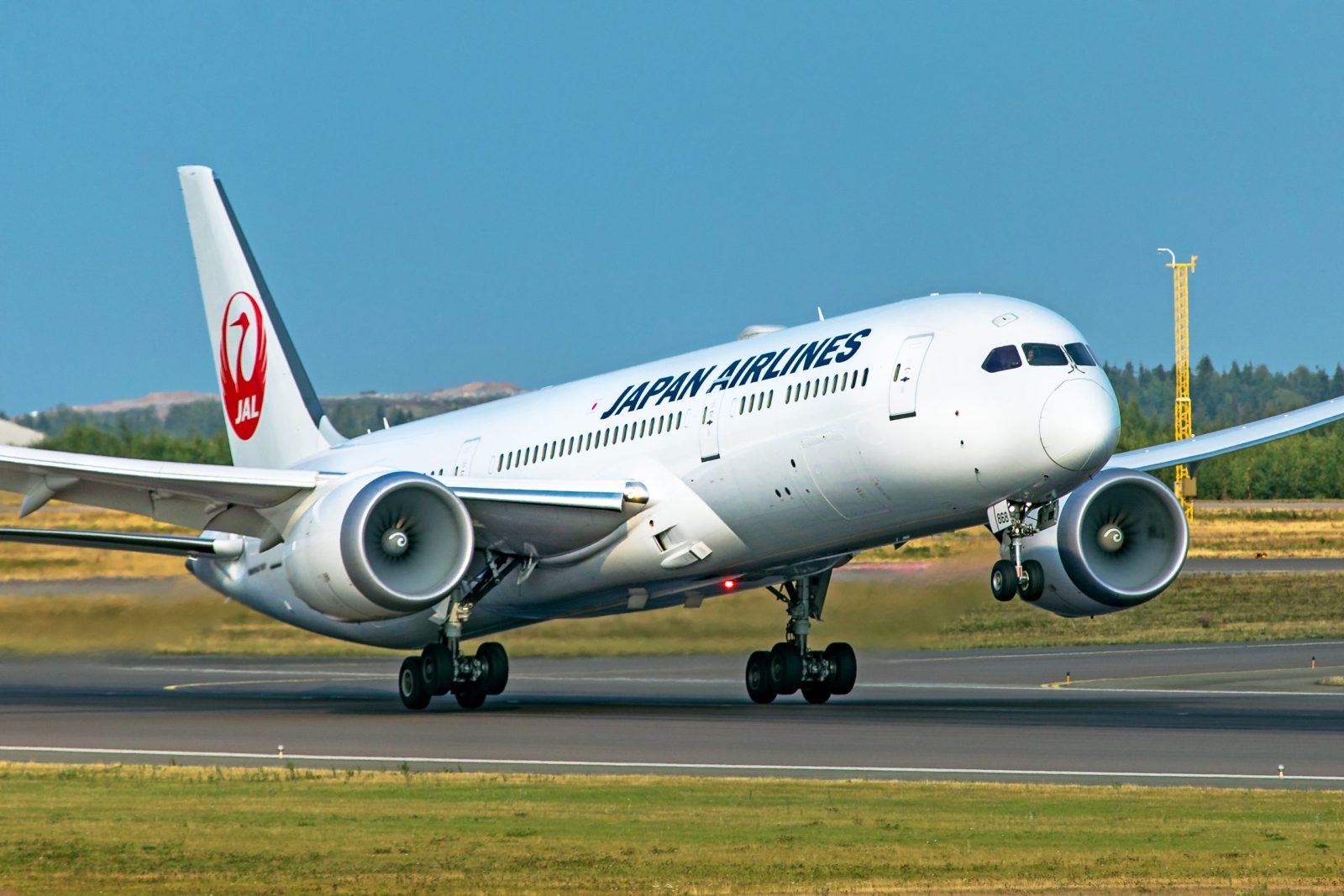
A Japan Airlines 787-9 departing. (Photo: AirlineGeeks | William Derrickson)
As September winds down, Japan Airlines is making small network changes that will begin as soon as October while will strengthen the carrier’s position in the current climate. October changes are planned to target destinations south of the carrier’s homeland, while changes after October are strategic for North American operations.
On Japan Airlines’ schedule between the dates of Oct. 10 and Oct. 30, JL707’s Friday and Sunday service between Bangkok and Tokyo-Narita will now be supplemented with the return leg JL708 over those three weeks. JL708 already parallels the schedule with JL707 on all other days besides Wednesday, which will be the only day that JL707 operates. All Bangkok flights operate on Boeing 787-8 Dreamliners.
Similarly, JL759 to Ho Chi Minh from Tokyo-Narita will share a similar schedule between October 15 and October 30 with outbound leg JL759 operating daily and JL750 getting an additional Friday return. The route will fly both outbound and return on all days except Wednesday and Sunday on the amended schedule. JAL operates the route on a Boeing 787-9 Dreamliner.
Finally, passengers will have access to an additional Saturday flight between Narita and Taipei. Outside of the additional flight, Japan operates outbound JL809 to Taipei and returns leg JL802 on Tuesdays and Thursdays. Those Boeing 767-300 flights will be flown between Oct. 1 and 30.
Cargo flights to Melbourne will take place in October Mondays and Thursdays, with JL8773 replacing JL773 and JL774 following the increased restrictions between Victoria and visitors.
After October, international flights out of Nagoya-Chubu will be given a boost on specific dates. Flights to Dallas will be given an additional flight on December 11th and 18th, while Los Angeles will be on Dec. 19th. Osaka-Kansai will also share in some of the increased love, with additional flights being offered between the southern Japanese city and the long-haul destinations of Los Angeles and London-Heathrow.
JAL’s network of changes comes as the airline also stretches its Corona Cover program in 2022. The original plan, which sees the airline cover passengers’ medical testing and quarantine expenses, was expected to conclude at the end of September. The new termination date for the program is January 10, 2022, with future expansions still possible as the world recovers from the lingering effects of the pandemic.
Statistically, the airline is currently seeing a 73% overall reduced rate on international flights through October and November. The number of flights has fallen from over 4,700 each month to roughly 3,500 now on the schedule. Alternatively, the winter travel months of December and January will see the reductions fall to 51%. The number of flights has dropped from the original 2,418 each month to roughly 1,200 currently planned.
Although Ian McMurtry was never originally an avgeek, he did enjoy watching US Airways aircraft across western Pennsylvania in the early 2000s. He lived along the Pennsylvania Railroad and took a liking to trains but a change of scenery in the mid-2000s saw him shift more of an interest into aviation. He would eventually express this passion by taking flying lessons in mid-Missouri and joining AirlineGeeks in 2013. Now living in Wichita, Kansas, Ian is in college majoring in aerospace engineering and minoring in business administration at Wichita State University.
A Bamboo Airways 787 departs from Hanoi for its inaugural flight to the U.S. (Photo: Bamboo Airways)
Bamboo Airways operated its first flight to the United States on September 23, 2021, from Hanoi, Vietnam to San Francisco, marking an important milestone in its international operations. In total, the Hanoi-based carrier will operate twelve demonstration/charter flights from Hanoi and Da Nang to Los Angeles, San Francisco and Seattle through November.
Bamboo Airways’ first flight to the United States, QH9149, departed the Vietnamese capital at 8:15 P.M. and touched down in San Francisco at 7:51 P.M, per FlightRadar24, for a total flight time of 13 hours and 36 minutes. On the way back, the flight is scheduled to depart the Bay Area at 2:55 P.M. and arrive in Hanoi at 8:25 P.M.
Bamboo Airways will use its Boeing 787-9 Dreamliner on the demonstration flights. Its long-haul aircraft utilizes two different seating configurations, one featuring 294 seats with 26 business class seats, 21 premium economy seats and 247 economy seats, and another featuring 292 seats with 30 business class seats, 36 premium economy seats and 226 economy seats.
Per Vnexpress, Bamboo Airways Deputy General Director Nguyen Ngoc Trong is excited for the new route, believing that it is an opportunity to excel amid the pandemic, stating: “In the last two years, we’ve managed to see opportunities in developing flights not just within Vietnam, but also in Southeast Asian and Northeast Asian regions like Japan, Taiwan, and even reaching towards Europe, Australia. And now, to the U.S.”
He adds, “By introducing direct flights to the U.S. at this moment in time, we’re ready to perform commercial flights once the pandemic dies down to meet customers’ demands in both countries.”
In April 2021, Bamboo Airways Chairman Trinh Van Quyet teased the start of permanent flights to the United States, stating: “We will start conducting chartered flights to the U.S in July and target the launch of nonstop commercial flights between Ho Chi Minh City and San Francisco in September, with an initial frequency of three flights per week.”
The start of these flights was delayed, as Bamboo Airways is currently aiming for the launch of permanent flights in early 2022, pending government approval for their foreign carrier air permit. The Vietnamese carrier states it plans to start at three flights per week, increasing to five times a week and even daily service at some point.
To support the service in the future and help long-range operations to the U.S., Bamboo Airways inked a $2 billion deal with General Electric for their GEnx engines. In a statement from Bamboo Airways’ spokesman per Reuters, “This new signing agreement will be an important milestone for the airline to expand its transcontinental flight network, connecting Vietnam with medium and long-range markets.”
Earlier this week, Bamboo Airways met with Boeing officials in New York to discuss talks centering around the “cooperation and delivery schedule of the Boeing 787,” as part of a string of activities in the United States. For example, Bamboo Airways opened a representative office in San Francisco this week, marking a commitment towards U.S. service. Also, the airline plans to sign memorandums of understanding with Los Angeles International Airport and San Francisco International Airport for service to Vietnam.
Earlier this year, Bamboo Airways finalized a preliminary schedule for the flights to San Francisco and Los Angeles, after receiving approval for its proposed flight timings at the two slot-facilitated airports. Its preliminary schedule at San Francisco is arrival at 10 A.M. and a departure at 1 P.M, allowing a departure from Ho Chi Minh City in the morning and an arrival into Ho Chi Minh City in the evening. Meanwhile, its preliminary schedule to Los Angeles is arrival at 9:30 A.M. and departure at 12:30 P.M, allowing for similar departure and arrival times from and to Ho Chi Minh City.
Competition
Similarly, Vietnam Airlines is planning international flights to the U.S. in late October, per Bloomberg. According to its CEO Le Hong Ha, the airline would utilize a Boeing 787-9 or Airbus A350-900 aircraft to fly from Ho Chi Minh City to San Francisco, with a stop in-between. The Vietnamese flag carrier is planning to rely on cargo demand to counter low passenger demand.
During the summer, Vietnam Airlines reinitiated repatriation efforts to the United States, operating flights to Washington Dulles, San Francisco and Dallas. Similarly to Bamboo Airways, the airline utilized its Boeing 787-9 Dreamliner for these flights, pivoting from the usage of the Boeing 787-10 Dreamliner and Airbus A350-900 in 2020.
According to RoutesOnline, Sabre data indicates that the O&D – Origin and Destination- traffic between the United States and Vietnam totaled 1.77 million passengers in 2019, with the highest number of passengers flying the 300,300 passengers on the Ho Chi Minh to Los Angeles route and 198,000 passengers on the Ho Chi Minh to San Francisco route.
Even with the high demand between the two countries pre-pandemic, concerns over profitability have arisen due to the cost of the long length of the flight and the low-yielding nature of the market. In a 2019 filing, Vietnam Airlines posted that it anticipates first-year losses of $54 million on a hypothetical Ho Chi Minh City to Los Angeles route. Similarly, in 2018, Vietnam Airlines CEO Doung Tri Thanh expressed that “Vietnam Airlines could face an average annual loss of $30 million in the first five years of operation if we open a direct route to the U.S.”
International Ambitions
As Bamboo Airways is eyeing new U.S. operations, it plans to resume regular international commercial operations in November. By November 5, Bamboo Airways will resume three key international connections from Hanoi, including flights to Seoul, Taipei and Tokyo. In addition, the Vietnamese carrier is eyeing an ambitious expansion, with more flights to Australia and new flights to the United Kingdom and Germany.
Ever since Winston was a toddler, he has always had a fascination for airplanes. From watching widebodies land at Washington Dulles to traveling the world, Winston has always had his eyes towards the skies. Winston began aviation photography in 2018 and now posts his photos occasionally on his Instagram account. He previously wrote for a blog. In his free time, Winston loves to play chess, do recreational activities, and watch sports. Looking into the future, Winston plans to service the aviation industry.
Sign-up for newsletters & special offers!
Get the latest stories & special offers delivered directly to your inbox