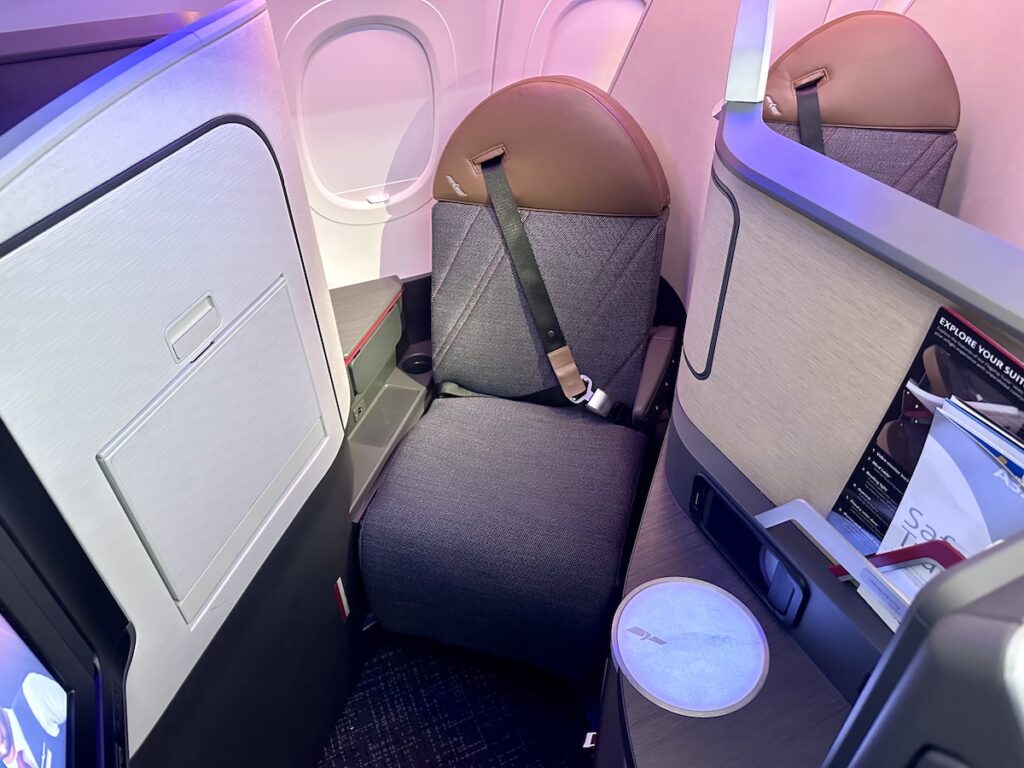











JSX's first ATR aircraft arrives at Dallas Love Field. (Photo: Adam Baker)
JSX said this week that it plans to have four ATR 42-600 aircraft in service early this year as it looks to connect more small and underserved airports.
The public charter operator took delivery of its first -600 aircraft late last year and in December began using it on flights between Santa Monica, California, and Las Vegas. The aircraft was put on display Monday at a joint ceremony involving both JSX and ATR at Santa Monica Airport.
“JSX is proud to partner with ATR to relaunch this highly capable aircraft in the United States passenger market,” JSX CEO Alex Wilcox said in a news release. “The ATR 42-600 is a game-changer for JSX, enabling us to expand our award-winning hop on service to thousands more airports across the U.S. while maintaining the premium experience our customers expect.”
The carrier said it will operate four ATR 42-600s in early 2026, each with a 30-seat configuration.
ATR recently secured FAA approval for a modification that allows operations at high-altitude airports. The authorization “ensures JSX can expand its network to challenging airports,” the two companies said.
ATR leaders said they see “strong potential in the U.S. market” as aging 50-seat regional aircraft are retired.
JSX expects to take delivery of four ATR 42-600 aircraft, with options for up to 25 more. The turboprop airplanes allow access to smaller airports with shorter runways that JSX’s main fleet, consisting of Embraer E135s and E145s, cannot use.
Zach Vasile is a writer and editor covering news in all aspects of commercial aviation. He has reported for and contributed to the Manchester Journal Inquirer, the Hartford Business Journal, the Charlotte Observer, and the Washington Examiner, with his area of focus being the intersection of business and government policy.
Delta Employees to Get Over Four Weeks of Extra Pay
The carrier is set to distribute $1.3 billion next month through its profit-sharing program.
A Delta A220 at Paine Field. (Photo: AirlineGeeks | Katie Zera)
Delta employees are in line to receive an average of over four weeks of extra pay as part of the airline’s profit-sharing program.
The carrier announced Tuesday that about $1.3 billion will be distributed to workers on Feb. 13, Delta’s “Profit Sharing Day.”
“The passion and dedication of Delta people carried us through 2025 and will continue to propel us forward,” Allison Ausband, Delta’s chief people officer, said in a news release. “Their unwavering focus on safety and care is what builds trust and a deep loyalty for customers, and continued success for Delta.”
This year’s bonus is among the largest payouts in the company’s history, officials said.
Under the airline’s profit-sharing model, employees receive 10% of the first $2.5 billion the airline earns and 20% above $2.5 billion.
Last year, Delta’s payouts from profit-sharing averaged about five weeks’ salary.
Zach Vasile is a writer and editor covering news in all aspects of commercial aviation. He has reported for and contributed to the Manchester Journal Inquirer, the Hartford Business Journal, the Charlotte Observer, and the Washington Examiner, with his area of focus being the intersection of business and government policy.
Delta Adds 787 Dreamliner to Its Fleet
The carrier ordered 30 787s, with options for 30 more.
The airline said Tuesday that it ordered 30 787-10s, the largest Dreamliner variant. Separately, Boeing stated that Delta’s order includes options for up to 30 more 787s, which if exercised, would bring the total order to 60 jets.
Delta officials said the new airplanes will help strengthen and grow international operations, specifically in transatlantic and South American markets.
“Delta is building the fleet for the future, enhancing the customer experience, driving operational improvements, and providing steady replacements for less efficient, older aircraft in the decade to come,” Delta CEO Ed Bastian said in a news release. “Most importantly, these aircraft will be operated by the best aviation professionals in the industry, providing Delta’s welcoming, elevated, and caring service to travelers worldwide.”
The airline selected GEnx engines to power the 787s.
A Boeing 787-10 Dreamliner testbed in North Charleston, S.C. (Photo: AirlineGeeks | Chuyi Chuang)
The widebody aircraft will feature Delta One Suites and more Delta Premium Select and Delta Comfort seats, officials said. Delta Sync wireless internet will also be available.
“The 787 Dreamliner’s unmatched efficiency, range, and passenger comfort make it a perfect fit for Delta’s international expansion and fleet modernization,” Stephanie Pope, president and CEO of Boeing Commercial Airplanes, said in a statement. “Our team looks forward to delivering new Dreamliners to Delta and supporting their commitments to provide an exceptional passenger experience and advance sustainability in aviation.”
Delta famously eschewed the 787 for years even as competitors embraced the type. In 2016, it canceled an order for 18 Dreamliners it inherited from its acquisition of Northwest Airlines, citing production delays and quality control problems at Boeing. At the time, Delta was pivoting toward Airbus for its long-haul needs and placing orders for the A330 and A350.
Delta’s order book with Boeing now stands at 130 aircraft. That figure includes commitments for 100 737 MAX jets, finalized in 2022.
Zach Vasile is a writer and editor covering news in all aspects of commercial aviation. He has reported for and contributed to the Manchester Journal Inquirer, the Hartford Business Journal, the Charlotte Observer, and the Washington Examiner, with his area of focus being the intersection of business and government policy.
PSA Completes Move to North Carolina
The airline opened its new headquarters in Charlotte on Monday.
An American CRJ-900. (Photo: AirlineGeeks | William Derrickson)
American Airlines subsidiary PSA officially opened its new headquarters in Charlotte, North Carolina, on Monday.
The carrier moved its corporate office from Dayton, Ohio, and plans to have over 450 employees at its Charlotte campus. The headquarters is situated about two miles from American Airlines’ Charlotte Flight Training Center and five miles from Charlotte Douglas International Airport, where many PSA staff are based.
PSA is now the only Part 121 passenger carrier based in North Carolina, company leaders said.
“Because of what Charlotte offers, PSA has a stronger foundation for continued growth,” PSA President and CEO Dion Flannery said in a statement. “And we believe the benefit will be mutual, as the region will continue having reliable aviation partners, a top employer, and a responsible corporate citizen headquartered in its backyard.”
Of the 450 employees expected to be based in Charlotte, about 150 have relocated from Dayton and another 50 were already in Charlotte at other facilities. The other 250 positions are being filled by new hires.
PSA operates flights under the American Eagle brand. It directly supports four American Airlines hubs – Charlotte, Dallas/Fort Worth, Philadelphia, and Washington National.
A grand opening event at the headquarters in Charlotte will take place in March.
PSA will maintain a significant presence in Dayton, with hundreds of employees, including pilots, flight attendants, and technicians, based at the airline’s crew base and maintenance hangar at Dayton International Airport.
Zach Vasile is a writer and editor covering news in all aspects of commercial aviation. He has reported for and contributed to the Manchester Journal Inquirer, the Hartford Business Journal, the Charlotte Observer, and the Washington Examiner, with his area of focus being the intersection of business and government policy.
An EVA Air Boeing 787-9 Dreamliner (Photo: Shutterstock | eric1207cvb)
Taiwan’s EVA Air will launch a new nonstop route to the U.S. East Coast this summer.
The airline’s general manager said service between Taipei and Washington Dulles will start in July. EVA will operate the route four times a week using a Boeing 787-9 aircraft.
The executive’s comments were first reported by Chinese-language news website ETToday. As of Monday morning, the new route had not been announced on the carrier’s website.
No airline in the world currently connects Taipei and Washington, D.C.
The service will be among EVA’s longest, at around 7,600 miles.
EVA officials said they selected Washington Dulles because of the relatively large Asian diaspora population in the Washington, D.C., area, and because Dulles is a hub of fellow Star Alliance member United.
EVA currently serves nine destinations in North America, including Los Angeles, Chicago O’Hare, Toronto, and New York-JFK. Flights between Taipei and Dallas/Fort Worth began in October.
Zach Vasile is a writer and editor covering news in all aspects of commercial aviation. He has reported for and contributed to the Manchester Journal Inquirer, the Hartford Business Journal, the Charlotte Observer, and the Washington Examiner, with his area of focus being the intersection of business and government policy.
Construction of Continent’s Largest Airport Now Underway
The airport will be located near the city of Bishoftu in central Ethiopia. It will serve as the nation’s main international gateway, while Addis Ababa Bole International Airport – currently the country’s largest – will prioritize domestic flights.
State-owned Ethiopian is managing the development and operation of the airport, which is intended to relieve congestion at Addis Ababa. The project will cost an estimated $12.5 billion, according to Reuters.
Phase one of construction at Bishoftu is expected to be completed by 2030, Ethiopian Airlines officials said. At that stage, the facility will be able to accommodate 60 million passengers annually, surpassing Cairo International Airport in Egypt and O. R. Tambo International Airport in South Africa, currently Africa’s busiest airports.
When fully completed, Bishoftu’s capacity will grow to 110 million.
“As we celebrate 80 years of service, this project stands as yet another milestone, underscoring our commitment to shaping the future of the African air transport industry, while supporting the growing demand for our passenger and cargo services,” Ethiopian Airlines Group CEO Mesfin Tasew said in a news release.
Ethiopian Airlines is the largest airline in Africa by passenger volume.
Zach Vasile is a writer and editor covering news in all aspects of commercial aviation. He has reported for and contributed to the Manchester Journal Inquirer, the Hartford Business Journal, the Charlotte Observer, and the Washington Examiner, with his area of focus being the intersection of business and government policy.
Air Canada, PAL Move Toward Expanded Agreement
The carriers signaled they will extend their partnership to 2032.
An Air Canada Express De Havilland Dash 8-400 aircraft. (Photo: Air Canada)
Air Canada and Newfoundland-based regional carrier PAL Airlines are moving toward an agreement that would extend their nearly three-year-old commercial partnership and grow service in eastern Canada.
The two carriers said they have signed a letter of intent to extend their current provider contract to 2032. As part of the deal, five additional PAL Dash 8-400 aircraft would be operated on behalf of Air Canada on regional routes in eastern Canada and Quebec.
The tentative agreement is subject to final negotiations.
PAL began operating Air Canada Express flights in 2023.
“Our proposed agreement with PAL Airlines will enable us to protect existing services from Montreal to destinations in Quebec and New Brunswick and support the overall growth of our regional network,” Mark Galardo, Air Canada’s executive vice president, COO, and president of cargo, said in a statement.
PAL is one of two regional operators that provide service under the Air Canada Express brand, the other being Nova Scotia-based Jazz Aviation.
Zach Vasile is a writer and editor covering news in all aspects of commercial aviation. He has reported for and contributed to the Manchester Journal Inquirer, the Hartford Business Journal, the Charlotte Observer, and the Washington Examiner, with his area of focus being the intersection of business and government policy.
Allegiant, Sun Country to Merge
Deal values Sun Country at about $1.5 billion as carriers move to combine operations.
Sun Country and Allegiant aircraft. (Photo: AirlineGeeks | Katie Zera)
Allegiant and Sun Country announced a merger agreement on Sunday under which Allegiant will acquire Sun Country in a cash-and-stock transaction. The deal implies a value of $18.89 per Sun Country share.
Under the terms, Sun Country shareholders will receive 0.1557 shares of Allegiant common stock and $4.10 in cash for each share they hold. Allegiant and Sun Country shareholders are expected to own approximately 67% and 33%, respectively, of the combined company on a fully diluted basis.
The transaction values Sun Country at approximately $1.5 billion, including about $400 million of net debt.
The combined airline will serve approximately 22 million customers annually, operate in nearly 175 cities with more than 650 routes, and have a combined fleet of 195 aircraft, along with additional orders and options.
An Allegiant Airbus A320 (Photo: Shutterstock | Joe A. Kunzler)
According to the companies, the merger is expected to generate approximately $140 million in annual synergies by the third year after closing and be accretive to earnings per share in the first year following the completion of the transaction.
The two airlines said the combined operation will bring together their route networks, fleets, and third-party travel businesses under the Allegiant brand. The companies also plan to offer an expanded loyalty program.
Both carriers said the combined airline will maintain a significant operational presence in Minneapolis–St. Paul.
The transaction was unanimously approved by the boards of both Allegiant and Sun Country and is expected to close in the second half of 2026, subject to regulatory approvals, shareholder approvals, and other customary closing conditions, the carriers said.
Ryan founded AirlineGeeks.com back in February 2013 and has amassed considerable experience in the aviation sector. His work has been featured in several publications and news outlets, including CNN, WJLA, CNET, and Business Insider. During his time in the industry, he's worked in roles pertaining to airport/airline operations while holding a B.S. in Air Transportation Management from Arizona State University along with an MBA. Ryan has experience in several facets of the industry from behind the yoke of a Cessna 172 to interviewing airline industry executives. Ryan works for AirlineGeeks' owner FLYING Media, spearheading coverage in the commercial aviation space.
Royal Air Maroc Boeing 787 Dreamliner. (Photo: AirlineGeeks | William Derrickson)
With 2025 in the history books, the African aviation sector stands at a pivotal juncture, marked by ambitious infrastructure projects, regulatory reforms, technological innovations, and persistent challenges amid ongoing geopolitical tensions and economic pressures. This year-in-review compiles the most impactful stories, drawing on key events across the months, and highlights how African nations are navigating global trends while addressing local realities.
Morocco Unveils $4.17 Billion Airport Expansion Plan On Jan. 21, Morocco’s minister of transport and logistics, Abdessamad Kayouh, announced a 42 billion dirhams (approximately $4.17 billion) investment to modernize and expand the nation’s airports by 2030. This plan targets key hubs, such as Casablanca’s Mohammed V International Airport and Marrakech-Menara, aiming to double capacity to handle surging tourism and position Morocco as Africa’s premier transcontinental gateway.
FlySafair Faces Potential Shutdown Over Ownership Compliance South Africa’s low-cost carrier, FlySafair, entered turbulent waters when the Air Services Licensing Council (ASLC) ruled on Jan. 6 that its ownership structure violated domestic licensing laws, which require at least 75% South African control of voting rights. Allegations centered on indirect foreign influence through trusts and holdings linked to Ireland-based ASL Aviation. The carrier, holding over 60% of the domestic market, risked license suspension, threatening widespread disruptions in affordable travel. Ultimately, FlySafair received a 12-month compliance grace period in February.
São Tomé and Príncipe Advances Airport Modernization Amid Geopolitical Financing Dynamics The island nation progressed on upgrading Nuno Xavier International Airport, navigating a complex landscape involving a 49-year concession to Turkey’s FB Group and renewed talks for Chinese support — potentially including elements of a longstanding $100 million pledge.
Libya’s MedSky Airways Re-enters European Skies via Malta MedAir Partnership In a symbolic breakthrough, MedSky Airways launched direct Benghazi-Malta flights on Jan. 16 in collaboration with Malta MedAir, marking the first Libyan-operated route to Europe in years. Overcoming EU bans through this partnership, the weekly service facilitates medical, business, and tourism travel, amid Libya’s gradual aviation normalization post-conflict.
February: Partnerships and Persistent Safety Challenges
South Africa Overhauls ATNS to Avert Airspace Crisis Transport Minister Barbara Creecy approved a comprehensive reform of Air Traffic and Navigation Services (ATNS) on Jan. 30, following a diagnostic report from an expert committee established in December 2024. The overhaul addressed critical issues, including staffing shortages, unreliable systems, and lapsed instrument flight procedures that had caused widespread delays and safety concerns. Immediate implementation focused on hiring new controllers, system upgrades, and governance improvements, stabilizing southern Africa’s airspace, and preventing broader disruptions in a key regional hub.
Emirates and Air Peace Forge Interline Partnership Amid Nigeria-UAE BASA Amendments On Feb. 11, during the ICAO Global Implementation Support Symposium in Abu Dhabi, Emirates signed an interline agreement with Air Peace, enabling seamless connections from Dubai-Lagos flights to 13 domestic Nigerian destinations, including Asaba, Benin City, Enugu, and Port Harcourt. Coinciding with amendments to the Nigeria-UAE Bilateral Air Services Agreement signed by ministers Festus Keyamo and Abdulla Bin Touq Al Marri, the deals expanded reciprocal rights, promoted codeshares, and included technical cooperation on safety and security. This diplomatic breakthrough enhanced trade, tourism, and connectivity, resolving prior tensions and boosting passenger options.
RwandAir Reroutes Network After DRC Airspace Ban Escalating geopolitical tensions led the Democratic Republic of Congo to ban Rwandan-registered aircraft from its airspace in mid-February, forcing RwandAir to suspend or modify routes to West and Central Africa. Key changes included suspending Kigali-Abuja-Accra and rerouting flights via alternative paths, increasing fuel costs, and flight times. The ban, tied to conflicts in eastern DRC, highlighted aviation’s vulnerability to regional politics while underscoring the need for diversified routing in volatile areas.
IATA’s 2024 Safety Report Underscores Africa’s Challenges Released on Feb. 26, IATA’s Annual Safety Report revealed Africa’s all-accident rate rose to 10.59 per million sectors in 2024 — over nine times the global average of 1.13 — despite zero fatalities for the second year. Common incidents involved runway excursions and gear issues, often on turboprops. While celebrating no fatal accidents, the report renewed urgency for initiatives like IATA’s Focus Africa and CASIP to address training, oversight, and infrastructure gaps.
March: Ethiopia’s Hub Dominance Solidified
Ethiopian Airlines and AfDB Partner for $7.8 Billion Bishoftu International Airport March’s defining moment came on March 14 when Ethiopian Airlines Group CEO Mesfin Tasew and AfDB Vice President Nnenna Nwabufo signed a Letter of Intent for the Bishoftu International Airport project, estimated at $7.8 billion. Held in the presence of AfDB President Dr. Akinwumi Adesina and Ethiopia’s Finance Minister Ahmed Shide, the agreement transforms a longstanding vision into a bankable reality backed by multilateral financing. Designed to relieve pressure on Addis Ababa’s Bole International (currently at 17 million passengers annually, nearing its 25 million limit), Bishoftu aims to catapult Ethiopia’s capacity to over 60 million passengers by 2040.
Uganda Airlines Launches Direct Entebbe–London Gatwick Service Uganda Airlines achieved a major milestone by announcing four-weekly direct flights to London Gatwick starting May 18. For a young flag carrier born from the ashes of its predecessor, securing slots and regulatory approval for a premium European route represents not just commercial expansion but a validation of credibility and sovereignty.
South African Airways Manages Pilot Work-to-Rule with Contingency Measures On March 19, SAA pilots initiated a work-to-rule action after rejecting the airline’s final wage offer amid protracted negotiations. Group CEO John Lamola responded with robust contingency plans, emphasizing minimal disruptions, real-time updates, and unwavering safety standards despite challenges like high fuel costs and currency weakness. The episode tested SAA’s post-privatization resilience but showcased mature crisis management, reassuring investors and partners watching labor stability as a key risk factor for Africa’s iconic legacy carrier.
Ethiopian Airlines Pioneers eVTOL Deployment with Archer Aviation On March 27, Ethiopian signed a deal worth up to $30 million for Archer’s Midnight eVTOL aircraft under the “Launch Edition” program. Including training and regulatory collaboration with Ethiopia’s Civil Aviation Authority, the partnership positions Ethiopia—and Africa—as an early adopter of urban air mobility.
An Ethiopian Airlines 737 MAX (Photo: AirlineGeeks | Katie Zera)
April: Governance Scandals and Quiet Maturation
Air Mauritius Reveals $394 Million Cumulative Losses Amid Theft Allegations Prime Minister Navin Ramgoolam stunned parliament on April 15 by disclosing that Air Mauritius had accumulated MUR 17.72 billion ($394 million) in losses from 2015 to 2024, a stark reversal from prior profitability. Declaring “someone stole this money,” Ramgoolam pointed to an ongoing KPMG forensic audit probing misappropriation and mismanagement.
U.S. Terminates $3.4 Million Kenya Aviation Advisory Contract On April 3, the newly established U.S. Department of Government Efficiency (DOGE) canceled a $3.4 million contract for aviation advisors in Kenya, part of 47 terminations saving $30.2 million.
Green Africa Airways Takes Delivery of First Owned Aircraft Nigeria’s Green Africa marked a maturation milestone on April 1 with the arrival of its first owned ATR 72-500 (5N-GAB) in Lagos, financed partly through a Naira facility from Access Bank. Moving beyond leasing dependency, this acquisition bolsters balance-sheet strength, reduces forex risks, and enhances long-term planning in a volatile domestic market — offering a blueprint for other young African airlines.
Ghana Revives National Airline Ambitions with World Aviation Group On April 4, Transport Minister Joseph Bukari Nikpe met World Aviation Group representatives to advance plans for a new flag carrier under President John Dramani Mahama’s administration. Framing it as essential for economic growth and connectivity, the talks revive a decades-long saga of failed attempts, testing political will against historical pitfalls.
Air Algérie Eliminates French from Customer Platforms On April 14, Air Algérie announced the removal of French from all tickets, bookings, and documents, adopting only Arabic and English. Director Abdelkader Salmi cited alignment with Arab and international norms, but the timing amid strained Algeria-France relations lent symbolic weight — a quiet assertion of cultural identity and geopolitical realignment.
May: Regulatory Reform Amid Conflict
Nigeria Launches Revised Insurance Regulations for Leased Aircraft On May 12, the National Insurance Commission (NAICOM), in collaboration with the Ministry of Aviation and Aerospace Development, unveiled revised regulations for insuring leased and financed aircraft. Launched in Abuja by Minister Festus Keyamo, the policy addresses longstanding barriers: high costs from foreign insurance mandates, limited local insurer participation, and repossession uncertainties. By aligning with the Cape Town Convention — where Nigeria now boasts Africa’s highest compliance score (70.5) — and strengthening IDERA mechanisms, the reforms empower local insurers, slash premiums, and enhance lessor confidence.
Renewed Tripoli Clashes Trigger Widespread Flight Cancellations and Evacuations Violence erupted on May 12 in Tripoli suburbs like Ain Zara and Bin Ashur, shattering relative calm and forcing major disruptions at Mitiga International Airport. Carriers including EgyptAir, Turkish Airlines, ITA Airways (which had just resumed after a decade), and Royal Jordanian canceled services, while others evacuated aircraft.
Drone Attacks Target Port Sudan Airport Amid Escalating Sudanese Civil War Between May 4 and 6, Rapid Support Forces (RSF) drones struck Port Sudan New International — Sudan’s de facto main gateway since Khartoum’s 2023 closure — hitting military bases, warehouses, and fuel depots. Flights halted temporarily, UNHAS suspended aid operations, and cancellations rippled outward.
Algeria Advances New Domestic Carrier Using Tassili Airlines Assets A May 27 coordination meeting chaired by Transport Minister Al-Saeed Sayed Saoud accelerated President Tebboune’s March vision for a dedicated domestic airline. Leveraging Tassili’s fleet and staff to create an Air Algérie subsidiary, a joint task force was formed for rapid transfer. The move aims to free Air Algérie for international growth while improving internal connectivity across Algeria’s vast territory.
June: Sustainability and Cargo Take Center Stage
Xinjiang Launches Africa’s First Direct Air Cargo Route via Ethiopian Airlines On June 27, a Boeing 777 freighter from Addis Ababa touched down in Urumqi, inaugurating Xinjiang’s first direct cargo link to Africa with two to three weekly round-trips operated by Ethiopian Airlines. Loaded with 104.8 tons from Guangzhou on its return, the route facilitates exports like electronics and imports of African beef, lamb, coffee, and horticulture.
Safarilink Signs for AURA AERO Hybrid-Electric ERA Aircraft At the Paris Air Show on June 17, Kenya’s Safarilink inked a Letter of Intent for four (plus options for two) 19-seater ERA hybrid-electric aircraft from France’s AURA AERO. Boasting up to 80% CO₂ reductions via eight Safran electric motors and turbogenerators, a 900 nm range, and SAF compatibility, the ERA targets entry into service by 2030. Amid over 650 global pre-orders, Safarilink’s commitment positions Kenya as a leader in sustainable regional aviation, aligning short-haul safari routes with net-zero goals.
Kenya Airways Advances Local SAF Production Plans During the June 24 launch of its 2024 Sustainability Report in Nairobi, Kenya Airways announced plans for domestic Sustainable Aviation Fuel production by 2030, partnering with a local producer to cultivate feedstock trees on degraded Kwale County land. Attended by government officials, the initiative ties decarbonization to land restoration, job creation, and potential exports, supporting KQ’s net-zero 2050 ambition and Africa’s broader sustainability push.
Court Blocks Mango Airlines Revival, Ruling Business Rescue Plan Unlawful On June 17, Johannesburg’s Gauteng High Court invalidated Mango’s Business Rescue Plan, siding with creditor Aviation Co-Ordination Services (owed R23.3 million) against a compulsory debt cession for nominal value. Judge Denise Fisher deemed the provision unconstitutional “confiscation,” unenforceable under common law, and misaligned with the Companies Act’s rescue intent. The ruling derails a proposed December 2025 relaunch backed by Ubuntu Air Services.
July: National Pride and Regional Expansion
Somali Airlines Acquires Airbus A320s for Historic Comeback On July 28, Somalia’s Ministry of Transport and Civil Aviation signed for two Airbus A320s from Lima Holding Group, announced by Minister Mohamed Farah Nuuh in Prime Minister Hamza Abdi Barre’s office. Announced to operate within two months under the revived Somali Airlines banner, the efficient narrowbodies signal domestic revival and international ambitions after a 34-year hiatus amid civil war. Minister Nuuh called it a restoration of “national dignity,” reducing foreign carrier reliance, cutting costs, creating jobs, and linking diaspora communities — part of plans for fleet expansion, including widebodies.
Air Algérie Places Africa’s Largest ATR Order for Domestic Subsidiary On July 4, Air Algérie ordered 16 ATR 72-600s powered by Pratt & Whitney PW127XT engines, with deliveries from 2026-2028, for its new domestic-focused subsidiary. Including Africa’s first ATR 72-600 full-flight simulator, the deal enhances southern connectivity, pilot training, fuel efficiency, and sustainability — building on Air Algérie’s existing 15 ATRs operated since 2003.
South African Airways Posts $19.5 Million Loss but Shows Revenue Growth SAA reported a R354 million ($19.5 million) net loss for 2023/24 at its July 17 AGM, reversing prior profits due to rand volatility (R415 million forex loss), 46% jet fuel surge amid global instability, and >30% leasing hikes from aircraft shortages. Yet 23% revenue growth to R7 billion continued post-rescue momentum, highlighting resilience and macroeconomic headwinds while signaling recovery potential.
A South African Airways A340-300. (Photo: Shutterstock)
Ghana Explores TAP Air Portugal Partnership for National Airline President John Dramani Mahama, meeting Portugal’s ambassador on July 10, invited TAP for partnership in reviving Ghana’s flag carrier — absent since 2010 — citing direct Accra flights and shared ties. Supported by a May-inaugurated task force, this advances Mahama’s connectivity vision.
Air Zimbabwe Clears $1 Million Debt for GDS Reintegration CEO Edmund Makona announced on July 1 debt settlements enabling Global Distribution System return within three months, boosting visibility, code-shares, and tourism under the turnaround plan.
August: Building Technical Sovereignty
Uganda Airlines Completes First In-House Engine Change Coinciding with its sixth anniversary on Aug. 28, Uganda Airlines achieved a landmark by performing its first in-house engine swap on a CRJ900 (5X-KNP) at Entebbe’s Eagle Air Hangar 7, finalized around Aug. 23. The UCAA-certified AMO replaced a $7 million GE CF34-8C5 engine sourced from the U.S., extending the procedure to four to five days for training 18 graduates. Previously costing over $100,000 per outsourced operation (plus fees), in-house capability — post-ending SAMCO contract in 2023 — slashes monthly expenses by hundreds of millions of UGX, building technical sovereignty and expertise for the young flag carrier.
Air Peace Breaks Ground on Lagos MRO Facility On Aug. 27, Chairman Allen Onyema confirmed groundbreaking for Nigeria’s largest maintenance, repair, and overhaul center in Lagos, set for Sept. 17 with construction lasting 12 to 15 months. Partnering with Embraer for technical support and Nigerian training, the facility will reduce overseas downtime, lower costs for local operators, and attract West/Central African business — easing bureaucratic hurdles and fostering regional self-reliance.
UAE Bans Sudanese Airlines Amid Diplomatic Crisis On Aug. 6, the UAE barred Sudanese carriers from its airports, grounding one in Abu Dhabi without prior notice, per Sudan’s CAA. Affecting Badr and Tarco’s routes, the move escalates tensions after Sudan’s May accusations of UAE arming RSF (denied by Abu Dhabi) and diplomatic severance.
September: Innovation Accelerates
Rwanda Unveils Africa’s First Autonomous Electric Air Taxi At the 9th Aviation Africa Summit in Kigali on Sept. 4-5, Rwanda launched the continent’s first self-flying eVTOL demonstration with the EHang EH216-S, witnessed by President Paul Kagame. Partnering with China Road and Bridge Corporation (CRBC) and EHang Holdings, the two-passenger, 35 km-range, 130 km/h vehicle heralds Advanced Air Mobility for congestion relief, tourism, and logistics.
Juba International Airport Achieves First Nighttime Operations On Sept. 5 at 10:15 p.m., an Air Congo Boeing 737 departed Juba, marking South Sudan’s first-ever nighttime takeoff after runway lighting upgrades. The SSCAA hailed it as transforming JIA into a 24/7 international hub connecting to 10 destinations in 9 countries.
flyCAA Inducts Africa’s First A321P2F Freighter Kinshasa-based flyCAA took delivery on Sept. 28 of a converted Airbus A321-200P2F (9S-PEB, ex-Air Moldova), owned by ATSG’s Cargo Aircraft Management after PEMCO conversion. Joining its 767-200F, the fuel-efficient narrowbody diversifies flyCAA’s cargo strategy, challenging rivals like Serve Air.
Airlink Secures SACAA Approval for Embraer E2 Jets On Sept. 3, SACAA certified the E190-E2 and E195-E2, paving the way for Airlink’s 10 leased E195-E2s (from Azorra) starting late 2025. Offering superior fuel efficiency (up to 29% better) and passenger comfort in 2×2 configuration, the approval bolsters Airlink’s sub-Saharan expansion and Embraer’s regional dominance.
GNU Allocates $10.6 Million Debt Relief to Afriqiyah Airways Amid Political Controversy On Aug. 11 (formalized September), Libya’s GNU approved 58 million dinars ($10.6 million) via resolutions to settle Presidential Council debts to Afriqiyah, drawing from miscellaneous budgets. Amid accusations of overreach and transparency issues (the Presidential Council received $80 million in 2025), the relief aids the conflict-battered carrier (which lost seven aircraft since 2011) but exposes governance fractures.
AFCAC Validates Study on Harmonizing Aviation Taxes On Sept. 10, AFCAC’s virtual workshop, backed by AUC and EASA, endorsed a study on high taxes’ adverse effects, advancing a continental framework and advocacy paper. Secretary General Adefunke Adeyemi stressed alignment with SAATM, AfCFTA, and Agenda 2063 to cut fares and boost connectivity, echoing IATA critiques of “milking aviation.”
October–November: Industrial and Institutional Gains
Morocco Secures Safran’s First Non-French LEAP Engine Assembly and MRO Facilities On Oct. 13, presided over by King Mohammed VI, Safran signed agreements for a €200 million LEAP-1A assembly line (350 engines/year by 2027, 300 jobs) and €120 million MRO shop (150 overhauls/year, 600 jobs) near Casablanca. Sharing a test bench, these 38,000 sqm facilities integrate Morocco into the global supply chain for A320neo/737 MAX engines.
Niger Launches Niger Air International, Appoints CEO Approved Sept. 4 via Decree 2025-275, Niger established mixed-economy Niger Air International to reclaim flag carrier status after over 20 years. A public-private model prioritizes state stakes, with CEO recruitment (open to AES citizens, deadline November 5, appointment Nov. 15) tasked with operations, routes, and compliance. Amid underserved airspace reliant on private/humanitarian flights (e.g., Niger Airlines’ recent Beechcraft resumption), it asserts economic sovereignty for the landlocked Sahel nation.
LAM Rejoins IATA Clearing House After Debt Clearance Effective Oct. 2, Mozambique’s LAM regained full ICH membership post-repaying obligations, enabling secure global transactions after suspensions in 2023/2024. Amid restructuring and withheld revenues, this restores partnerships and credibility for the flag carrier.
Botswana Advances Air Botswana Restructuring with Fleet Sales As part of reforms, Botswana sold grounded aircraft to streamline the struggling national carrier toward sustainability.
December: Challenges and Bold Reforms
EnComm Aviation Faces Shutdown Over BAE ATP Support Withdrawal Kenyan humanitarian cargo operator EnComm issued a dire warning of potential loan default after BAE Systems withdrew technical support for its BAe ATP fleet — the last of its type in service. Having delivered nearly 19,000 tonnes of aid to conflict zones since 2023, the grounding disrupts vital humanitarian operations and exposes vulnerabilities in supporting legacy aircraft types.
ECOWAS Abolishes Key Aviation Taxes In a landmark move, ECOWAS adopted reforms abolishing ticket, tourism, solidarity, and foreign travel taxes while slashing passenger service and security charges by 25%, effective January 2026. This policy, backed by a regional oversight mechanism, targets West Africa’s exorbitant airfares — often higher than long-haul routes to Europe — and aligns with ICAO standards to foster affordability, competition, and integration.
2025 was not without setbacks — conflict disruptions in Libya and Sudan, governance scandals, legacy aircraft challenges, and lingering safety gaps reminded the industry of its fragility. Yet the year’s defining theme was forward momentum: record infrastructure financing, pioneering sustainability efforts, technological firsts, a wave of national carrier revivals, and decisive regional tax reforms. As African nations increasingly assert technical and industrial sovereignty — from MROs to SAF production to aerospace manufacturing — the continent is transitioning from a late adopter to an active shaper of global aviation trends.
Victor Shalton's love for aviation can be traced to when he was 11-years-old. As a seasoned aviation writer, he takes pride in providing the best aviation coverage around the globe and is passionate about advancing his skills in the aviation space. In addition, he loves travelling, writing, arts and while his speaking engagements have taken him around the world, he is proud to call Nairobi home.
“Upstate airports connect New Yorkers to destinations across America and around the globe,” Hochul said in a statement. “I am pleased that Delta has identified available aircraft in order to resume daily service at BGM in the spring. Preserving this flight is a win for the entire Southern Tier, ensuring that this newly modernized airport serves travelers for years to come and that is why I fought so hard to protect this lifeline for workers and businesses in the Binghamton area.”
Delta did not immediately respond to a request for comment. It appears from Hochul’s statement that the carrier will still halt flights in February but restart them at a later date.
Delta currently connects Binghamton with Detroit.
Officials at Greater Binghamton Airport said last week that they were working with state and federal officials to reestablish commercial air service “as soon as possible.” They said they were in talks with several airlines, but did not mention the possibility of Delta retaining its operations there.
Zach Vasile is a writer and editor covering news in all aspects of commercial aviation. He has reported for and contributed to the Manchester Journal Inquirer, the Hartford Business Journal, the Charlotte Observer, and the Washington Examiner, with his area of focus being the intersection of business and government policy.
Sign-up for newsletters & special offers!
Get the latest stories & special offers delivered directly to your inbox