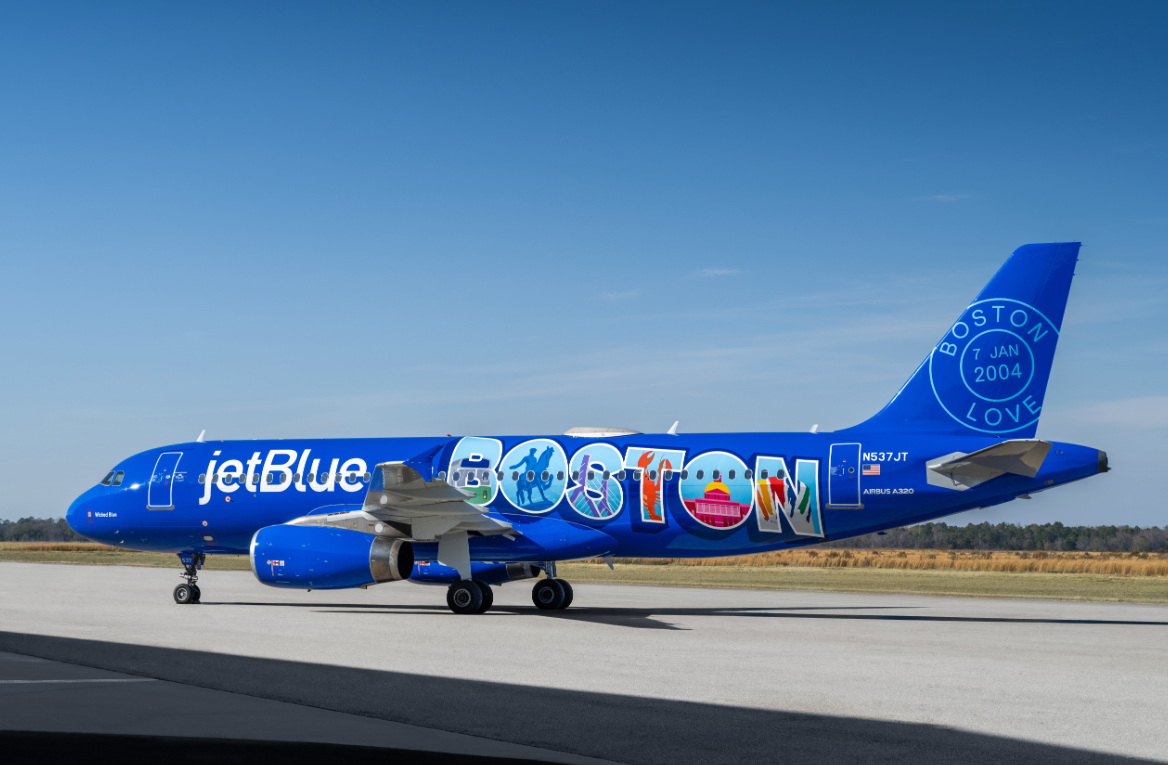
JetBlue on Friday unveiled its new Boston-themed aircraft livery, nicknamed “Wicked Blue.”
The design, which was applied to an Airbus A320, features postcard-style illustrations of Boston landmarks and motifs, including the city’s Paul Revere statue, the Zakim Bridge, a lobster, and the Massachusetts State House. Painted on the aircraft’s tail is a stamp with the date of JetBlue’s first-ever revenue flight from Boston – Jan. 7, 2004.
“Wicked Blue embodies our pride in the Boston community, crewmembers, and customers who have helped build JetBlue into the airline we are today,” JetBlue President Marty St. George said in a news release. “Boston is one of our most important markets with a huge loyalty base, and it’s a key driver of our JetForward strategy to offer the best East Coast leisure network.”
JetBlue’s newest livery was commissioned in part to mark an expansion of operations at Boston Logan. The carrier will start long-haul service from Boston to Barcelona in April and Milan in May.
The airline is also set to open its second BlueHouse lounge in Logan’s Terminal C in 2026.
JetBlue has several other Boston-specific liveries, including ones for the Red Sox, the Celtics, the Bruins, and Dunkin’ Donuts.
Zach Vasile is a writer and editor covering news in all aspects of commercial aviation. He has reported for and contributed to the Manchester Journal Inquirer, the Hartford Business Journal, the Charlotte Observer, and the Washington Examiner, with his area of focus being the intersection of business and government policy.
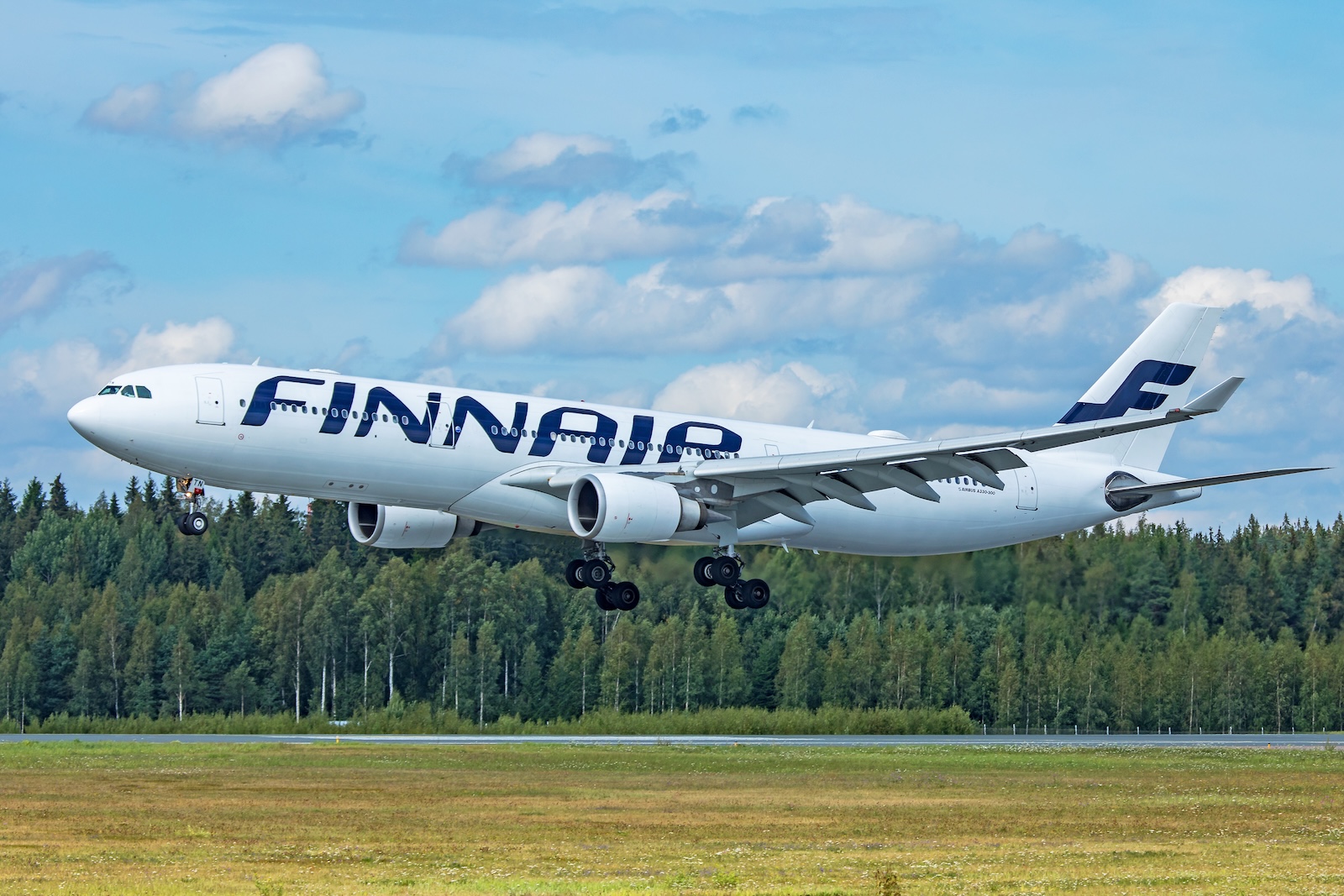
A Finnair Airbus A330. (Photo: AirlineGeeks | William Derrickson)
Finnair will commence flights between Helsinki and Melbourne, Australia, next year.
The service will operate daily, via Bangkok, starting Oct. 25, 2026. Flights will use an Airbus A350 aircraft.
This connection will become Finnair’s first route to Australia.
In a statement, Finnair Area Vice President Pasi Kuusisto said the service will provide an attractive new option for both business and leisure travelers.
First Australia Route
Finnair will be one of only a few airlines from Europe operating service to Australia with its own aircraft.
Currently, only British Airways and Turkish Airlines fly from their respective bases to Melbourne.
A number of airlines have added Melbourne as their first Australian destination, including Turkish Airlines, Emirates, and Qatar Airways.
Lorne is a South Africa-based aviation journalist. He was captivated and fascinated by flying from the day he took his first airline flight. With a passion for aviation in his blood, he has flown to destinations in all corners of the globe. Lorne has traveled extensively and lived in various countries. Drawing on his travels and passion for aviation, Lorne enjoys writing about airlines, routes, networks, and new developments.
Understanding Airline Metrics
A brief introduction to the most common airline metrics.
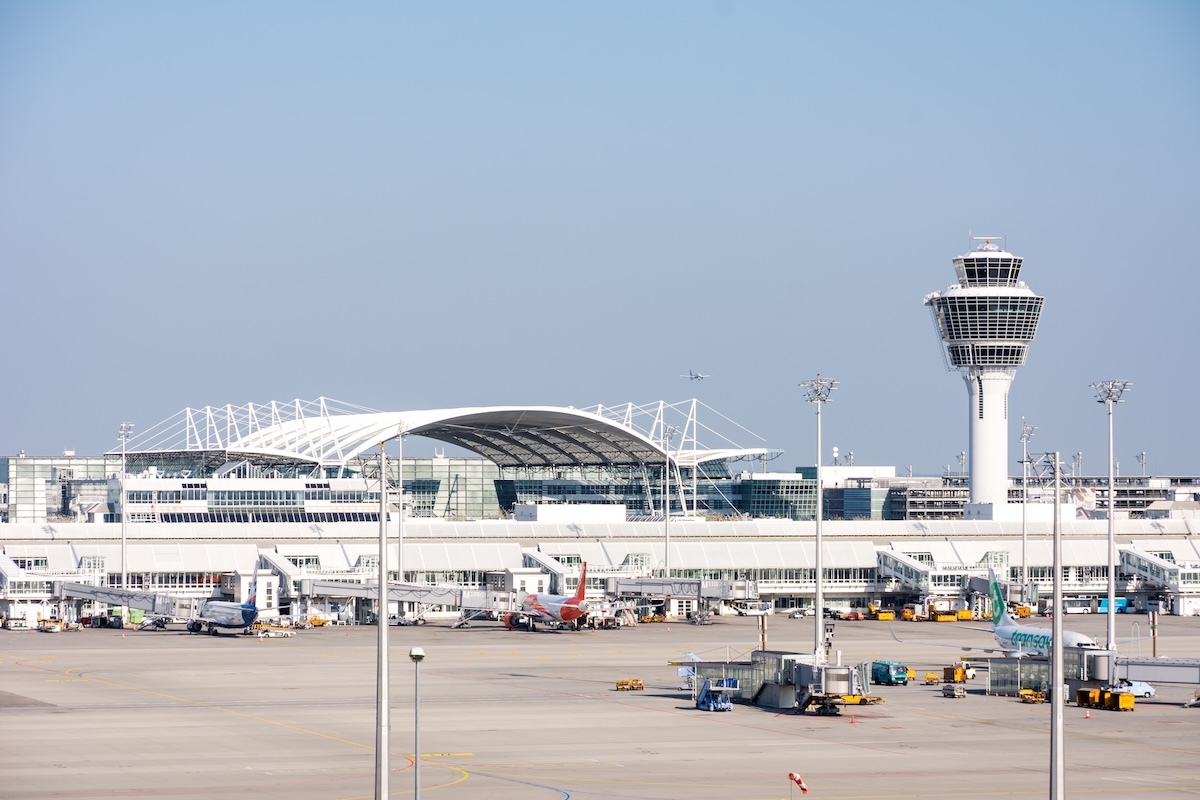
Munich Airport in Germany. (Photo: Shutterstock | manfredxy)
One of the most important aspects in every industry is to establish appropriate metrics to accurately measure performance and make sure that all the fundamentals are kept under control.
Measuring Output – Available Seat Miles (ASM)
While in the manufacturing sector it is relatively easy to measure the output of a company by simply counting the units of the specific good that are produced, the airline industry had to create a specific metric that quantifies the output of an airline and standardizes to allow comparisons among various companies.
The most commonly used metric to measure the output of an airline is ASM, which stands for “Available Seat Miles.” One ASM is one seat flown for a distance of one mile.
Airlines in the U.S. generally use miles as a measurement for distance; however, in the rest of the world, it is usually preferred to use the SI system (the International System of Units), and therefore, they will measure distances in kilometers. Their corresponding metric for output would be the ASK, i.e., one seat flown for a distance of one kilometer.
For example, if an airline flies an Airbus A321 with 190 seats from New York-JFK to Los Angeles, considering that the great circle distance between the two airports is 2,475 miles, that flight will generate:
2,475 x 190 = 470,250 ASMs
If we used the SI system, the distance between the two airports would be
2,475 x 1.609 = 3,983 kilometers
Therefore, the output generated by that flight will be:
3,983 x 190 = 756,770 ASKs
For simplicity, from now on, the metrics described in this article will use miles as a measure for distance, but it is possible to generate similar metrics using kilometers.
Total Output – Available Tonne Miles (ATM)
The ASM metrics only take into account passengers carried, but if an airline has a significant cargo operation, it is possible to create a metric that combines passengers and cargo traffic, converting passengers into a standard weight (usually including their baggage allowance).
In the example above, if we convert every seat into 100 kg, the passenger component of the output for that flight would be
190 x 100 = 19,000 kg = 19 tonnes
If we assume that the aircraft can carry an extra five tonnes of cargo, the output generated for that flight would be:
(19 + 5) tonnes x 2,475 miles = 59,400 ATM
From now on, we will focus only on passenger metrics.
Measuring Revenue Generation – RPM and Load Factor
The ASM metric measures all the units of output produced by the airline that, at some point, have been available for sale. However, it is quite common for flights to have at least some empty seats, and once a flight has departed, those seats cannot be sold any longer. This is called “spoilage.”
In order to account for how many of the seats produced have been able to generate some revenue for the airline, another metric has been created. This metric is called Revenue Passenger Miles (RPM). One RPM is one revenue passenger being flown for one mile.
The concept of “revenue passenger” excludes those seats that have been occupied by passengers who provide little or no revenue for the airline, such as airline employees flying on concessionary fares, free tickets provided for promotional activities, etc.
In the example above, if we assume that the A321 performed the flight from JFK to Los Angeles with 10 empty seats. Then the RPM generated by that flight would be:
2,475 x (190-10) = 2,475 x 180 = 445,500 RPM
If we divide the number of seats on the flights generating revenue by the total number of seats, we obtain the seat factor (SF). Sometimes this metric is referred to as “load factor” (LF), however, formally, the load factor is calculated by dividing the RPM by the number of ASM.
Of course, on a single flight basis, the SF and the LF coincide. However, since these metrics can be calculated by aggregating a large number of different flights, in that case, the two metrics will differ since longer flights will have a higher weight in the calculation of the load factor.
In the case of the flight above, the seat factor and the load factor of the flight will be:
Measuring Cost Per Unit – CASM
So far, we have been constructing metrics that may be perceived as rather abstract because they have been created to evaluate the somewhat elusive concept of the output of an airline. Now it’s time to see how all of this is converted into revenue and profits, which is the ultimate goal of every business.
Once we have established the total output for an airline by adding all the ASM generated by every flight in a given timespan (a month, a quarter, or a year), it is possible to calculate how much it costs the airline to produce one single unit of output simply by dividing the Total Operating Costs by the total number of ASM. This metric is called Cost per Available Seat Mile (CASM):
Generally speaking, this amount is measured in U.S. cents. The airlines with the lowest CASM are low-cost airlines (that’s where the name comes from). The “champions” in this category are the two largest European low-cost carriers, Ryanair and Wizzair, which have a CASM of just below eight cents per ASM (or five cents per ASK). Pan-Asian carrier AirAsia, IndiGo from India, and Pegasus Airlines from Turkey have similar CASM.
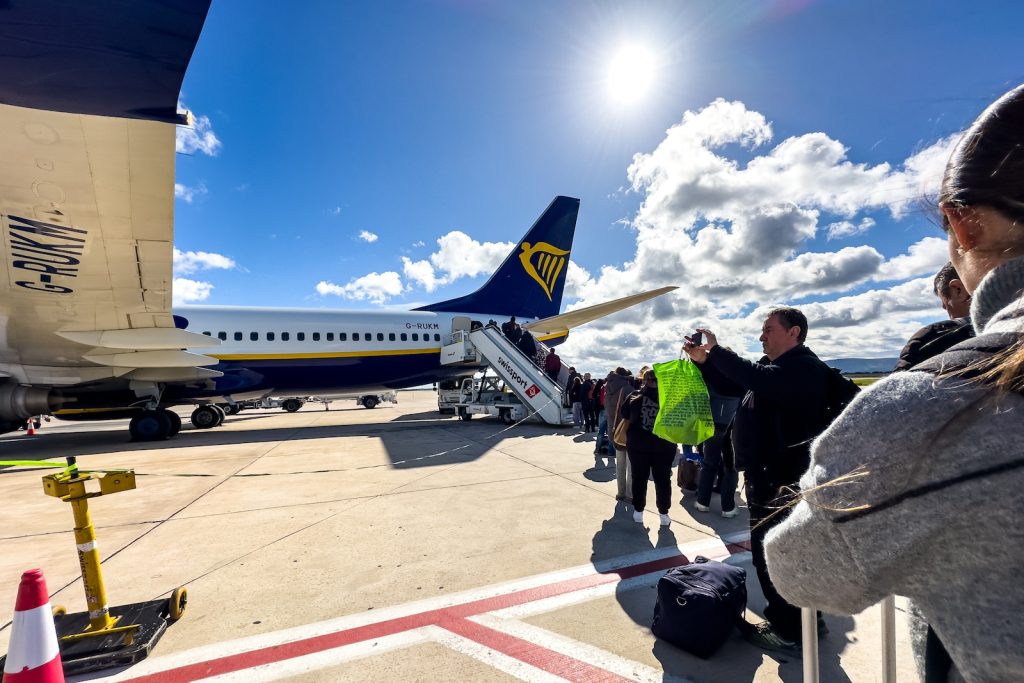
People queuing while boarding a Ryanair aircraft (Photo: Shutterstock)
While U.S. low-cost airlines Spirit (before bankruptcy) and Frontier manage to remain below 10 cents per ASM, the majority of network carriers in North America and Europe (Delta, American, United, Air France-KLM, Lufthansa, British Airways) have a cost ranging between 16 and 20 cents.
Measuring Revenue Per Unit – RASM and Yield
After measuring output and costs, it is important to understand how much revenue can be generated with the output produced.
The revenue correspondent of the CASM is the Revenue per Available Seat Mile, or RASM:
If we focus only on passenger revenue, it is interesting to calculate the PRASM, Passenger Revenue per Available Seat Mile, which only takes into account the revenue generated by passengers.
However, while it is quite easy to split the revenues generated by passengers from those generated by cargo, the same cannot be said for costs; therefore, if we want to calculate this metric to evaluate how revenues are performing compared to costs, it is more appropriate to use RASM instead of PRASM.
Finally, if we want to focus more on the airline’s revenue-generating efficiency, it is interesting to calculate the Yield for the carrier:
This metric focuses on how much revenue is being produced only from those units of output that have been effectively sold, without considering spoilage. It is a metric that is usually evaluated together with the LF: if yield is relatively high but LF is low, the airline might evaluate the opportunity to reduce capacity, if that doesn’t affect its CASM, or to increase its sales effort to sell the capacity being spoiled.
The airline may also decide to adopt different pricing strategies, which may decrease the yield, but may also increase the LF so that the overall total revenue is increased.
Vanni fell in love with commercial aviation during his undergraduate studies in Statistics at the University of Bologna, when he prepared his thesis on the effects of deregulation on the U.S. and European aviation markets. Then he pursued his passion further by obtaining a Master’s Degree in Air Transport Management at Cranfield University in the U.K. followed by holding several management positions at various start-up carriers in Europe (Jet2, SkyEurope, Silverjet). After moving to Canada, he was Business Development Manager for IATA for nine years before turning to his other passion: sports writing.
Southwest Adds New Hawaii Route
Service will start in August 2026 after the island lost all mainland flights.
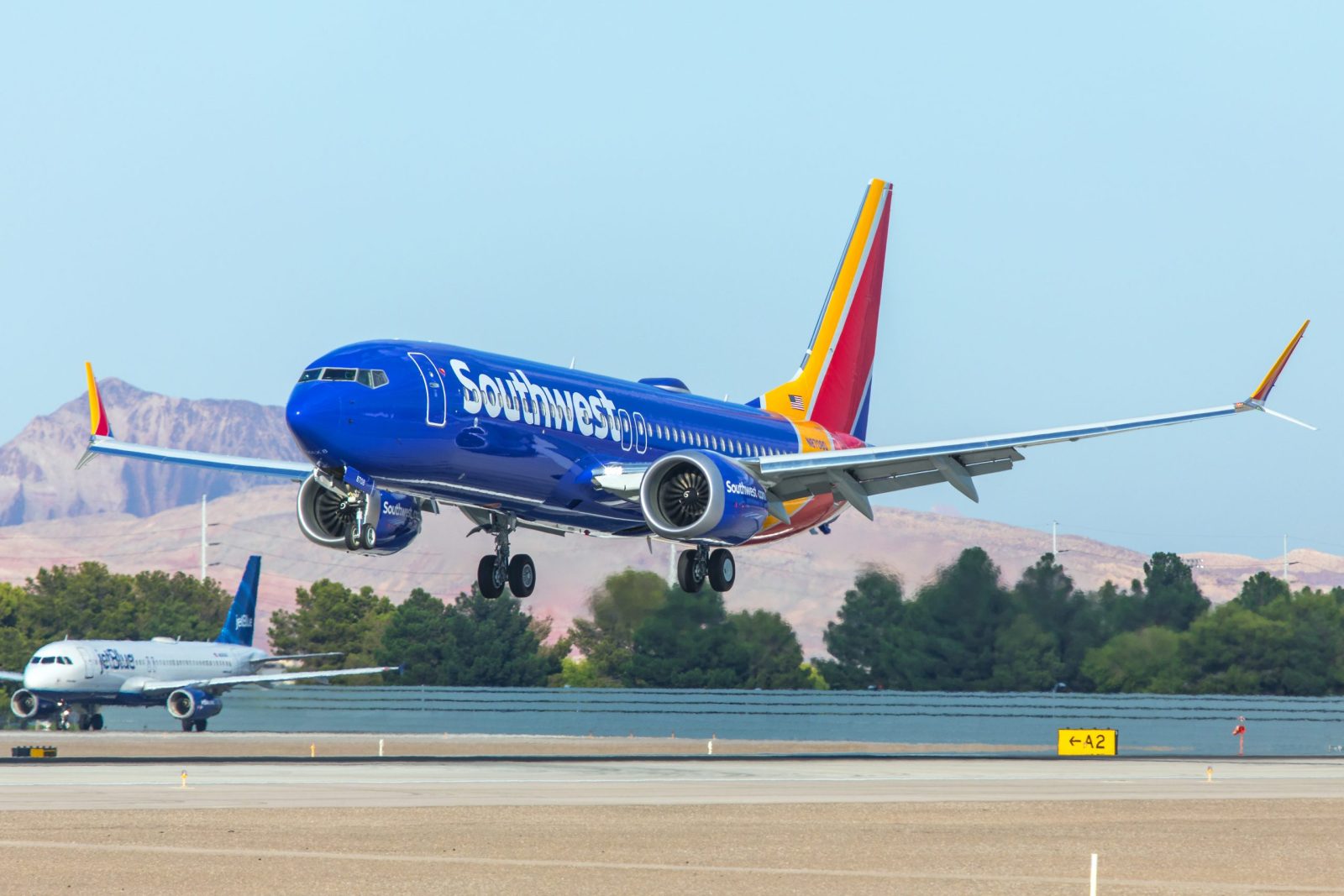
A Southwest 737 MAX 8 in Las Vegas. (Photo: AirlineGeeks | William Derrickson)
Southwest is preparing to launch a new route from the mainland U.S. to Hawaii next summer.
Starting Aug. 6, 2026, the carrier will connect Las Vegas and Hilo. Hilo is the largest population center on the Island of Hawaii, often referred to as the “Big Island.”
Flights will operate three times per week, on Mondays, Thursdays, and Fridays.
Tickets are now on sale.
Southwest currently offers interisland flights from Hilo to Honolulu but does not link Hilo to the mainland.
Airline officials noted the large Hawaiian population in Las Vegas and said the new route will help families visit each other and stay connected, while also supporting leisure travel.
Southwest also plans to operate special one-off flights for Hawaii’s Merrie Monarch Festival in April 2026. The carrier will fly from Las Vegas to Hilo on April 9 and from Hilo back to Las Vegas on April 12.
Zach Vasile is a writer and editor covering news in all aspects of commercial aviation. He has reported for and contributed to the Manchester Journal Inquirer, the Hartford Business Journal, the Charlotte Observer, and the Washington Examiner, with his area of focus being the intersection of business and government policy.
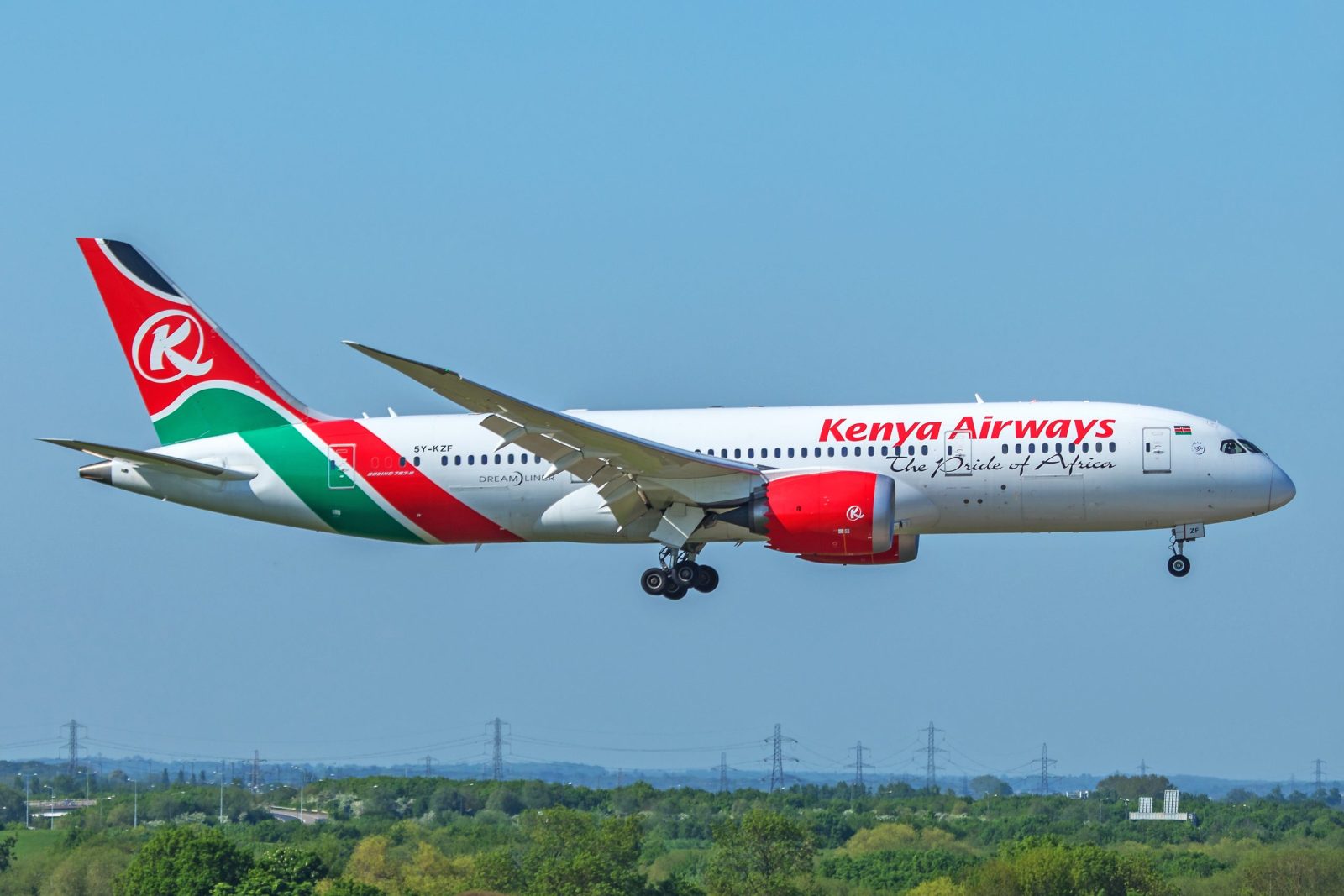
Kenya Airways CEO Steps Down
Allan Kilavuka led the airline for the last six years.
Kilavuka will remain on leave until his contract officially ends in March 2026.
In the interim, the airline’s board has elected COO George Kamal as acting group MD and CEO.
Kamal previously served with Air Arabia and Iraqi Airways.
Leading Through Tough Times
Kilavuka has led Kenya Airways for the past six years, including during the COVID-19 pandemic.
He was responsible for rolling out the airline’s Project Kifaru turnaround plan, which translated to increased passenger numbers, revenues, and the carrier’s first net profit in 11 years.
“Allan served with commitment, dedication, honor, and diligence,” Kenya Airways company secretary Habil Waswani said in a statement.
Kilavuka was also the mastermind behind the establishment of a pan-African airline group with South African Airways in 2021. However, South African pulled out of the agreement in September of this year.
Lorne is a South Africa-based aviation journalist. He was captivated and fascinated by flying from the day he took his first airline flight. With a passion for aviation in his blood, he has flown to destinations in all corners of the globe. Lorne has traveled extensively and lived in various countries. Drawing on his travels and passion for aviation, Lorne enjoys writing about airlines, routes, networks, and new developments.
Fiji Airways Announces Seventh Australian Destination
Fiji Airways is the first South Pacific airline to take delivery of a MAX aircraft. (Photo: Boeing)
Fiji Airways has announced its seventh destination in the country of Australia via its LinkedIn page: Gold Coast.
This will not only bring passengers from Fiji to the Gold Coast, but it will also bring convenient one-stop options for passengers coming from the airline’s other cities it operates to, especially its longer flights from North America, such as Vancouver, Los Angeles, Honolulu, San Francisco, and the longest route in its network: Dallas/Fort Worth.
The flight will begin on June 11, 2026, and will operate three times a week, with departures from its home airport in Nadi on Mondays, Thursdays, and Saturdays. Flights to the Gold Coast will be operated by a Boeing 737 MAX 8.
Other destinations the airline currently serves in Australia include: Cairns, Brisbane, Sydney, Canberra, Melbourne, and Adelaide.
These new flights to Gold Coast, Australia, from Nadi, will add 53,000 seats a year to the Fiji Airways network, and are now on sale via the carrier’s website.
Joey has always been interested in planes for as long as he can remember. He grew up in Central New York during the early 2000s when US Airways Express turboprops ruled the skies. Being from a non-aviation family made it harder for him to be around planes and would only spend about three hours a month at the airport. He was so excited when he could drive by himself, the first thing he did with his driver's license was get ice cream and go plane spotting for the entire day. He graduated from Western Michigan University in 2022 with a B.S. in Aviation Management & Operations and a Minor in Business, and currently works for a major airline in his hometown.
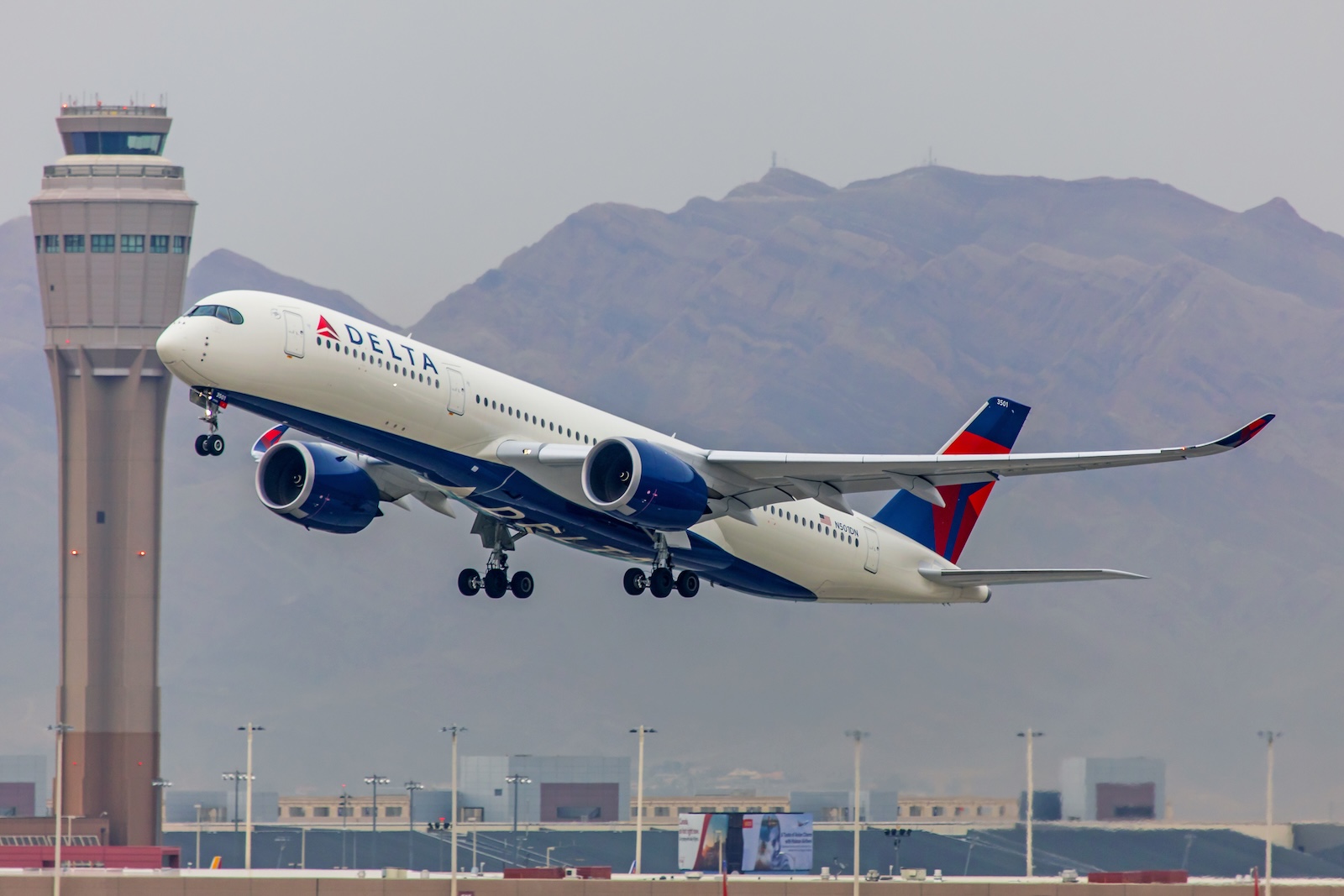
A Delta A350-900 aircraft. (Photo: AirlineGeeks | William Derrickson)
Delta this week confirmed the start date for its upcoming nonstop service to Saudi Arabia.
Flights between Atlanta and Riyadh will launch Oct. 23, 2026, airline officials said. The carrier will fly the over 7,000-mile route – one of Delta’s longest – with an Airbus A350-900 aircraft.
Tickets will go on sale Saturday.
Delta plans to operate the Atlanta-Riyadh route daily between Oct. 23 and 30, then switch to three times weekly.
Delta leaders said the route dovetails with the Saudi government’s Vision 2030 project, which aims to develop tourist destinations in the country, expand its entertainment sector, and diversify its economy.
Riyadh is the capital and largest city in Saudi Arabia. It is also the country’s main financial hub and contains the regional headquarters of numerous foreign companies, including Google and Samsung.
Zach Vasile is a writer and editor covering news in all aspects of commercial aviation. He has reported for and contributed to the Manchester Journal Inquirer, the Hartford Business Journal, the Charlotte Observer, and the Washington Examiner, with his area of focus being the intersection of business and government policy.
United Takes Aim at American With New Routes
Carrier unveils new service, going head-to-head with American.
A United CRJ aircraft in Chicago (Photo: Shutterstock | John McAdorey)
United is escalating competition with American Airlines in Chicago, announcing new service to two markets, just days after American disclosed plans to serve the same routes from the airport.
Beginning June 1, 2026, United will resume service between Chicago O’Hare and Erie, Pennsylvania, a route it last operated in May 2023. On June 8, the airline will launch new service to Tri-Cities, marking the first time United has served the eastern Tennessee market.
Both routes will operate three times daily during the summer season. United will also add an additional daily frequency to Lincoln, Nebraska, bringing that market to five daily departures from O’Hare. Tickets for all flights are now on sale.
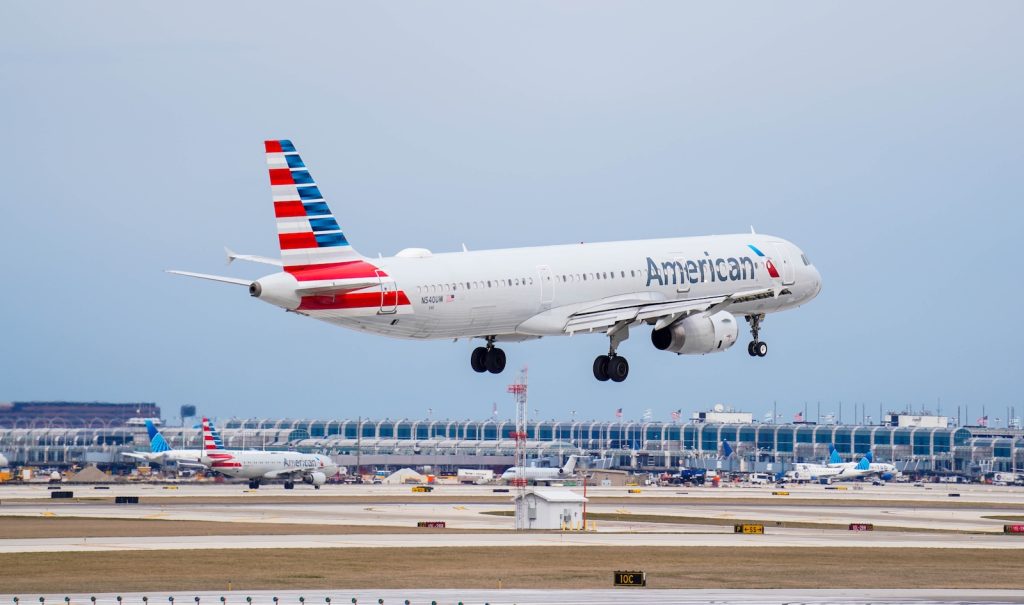
An American A321 in Chicago. (Photo: Shutterstock | MKPhoto12)
Intensifying Competition
United’s move reinforces its long-stated strategy of expanding aggressively at O’Hare, where it expects to operate nearly 650 daily departures during peak summer travel next year.
“As we continue our steady growth at O’Hare, reaching nearly 650 daily departures during peak summer travel, we’re building on the strength of a global network that’s simply unmatched in Chicago,” said Mark Weithofer, United’s managing director of domestic network planning, in a news release. “Every new route we add expands the connection opportunities available to our customers and reinforces O’Hare’s role as one of the most important gateways in our system.”
With the additions of Erie and Tri-Cities, United said it has now announced 13 new destinations from Chicago O’Hare this year, following the recent unveiling of service to Clarksburg, West Virginia.
United has also expanded its local workforce alongside the network growth, hiring more than 2,000 employees in the Chicago area and bringing its total local headcount to more than 18,000. The airline expects to add another 5,400 employees in the region by 2027.
United recently received five more gates from the City of Chicago, which was contested by American in court. Earlier this month, American acquired two additional gates at O’Hare from Spirit.
Ryan founded AirlineGeeks.com in February 2013 and has spent more than a decade covering the airline business. His work has been featured by CNN, WJLA, CNET, and Business Insider. His aviation experience spans airport operations, Part 135 regulatory compliance, and airline crew workforce planning, along with time behind the yoke of a Cessna 172 and interviews with airline executives. Ryan now serves as Group President of Firecrown Media’s Aviation Group. He holds a B.S. in Air Transportation Management and an MBA from Arizona State University and teaches Airline Management at Embry-Riddle Aeronautical University.
Editor’s Note: AirlineGeeks is proud to present our ‘Livery of the Week’ series. Every Friday, a team member will share an airline livery, which can be from the past, present, or even a special scheme. Some airline liveries are works of art. The complexity associated with painting around critical flight components and the added weight requires outside-the-box thinking from designers. The average airliner can cost upwards of $200,000 to repaint, creating a separate aircraft repainting industry as a result.
Have an idea for a livery that we should highlight? Drop us a line.
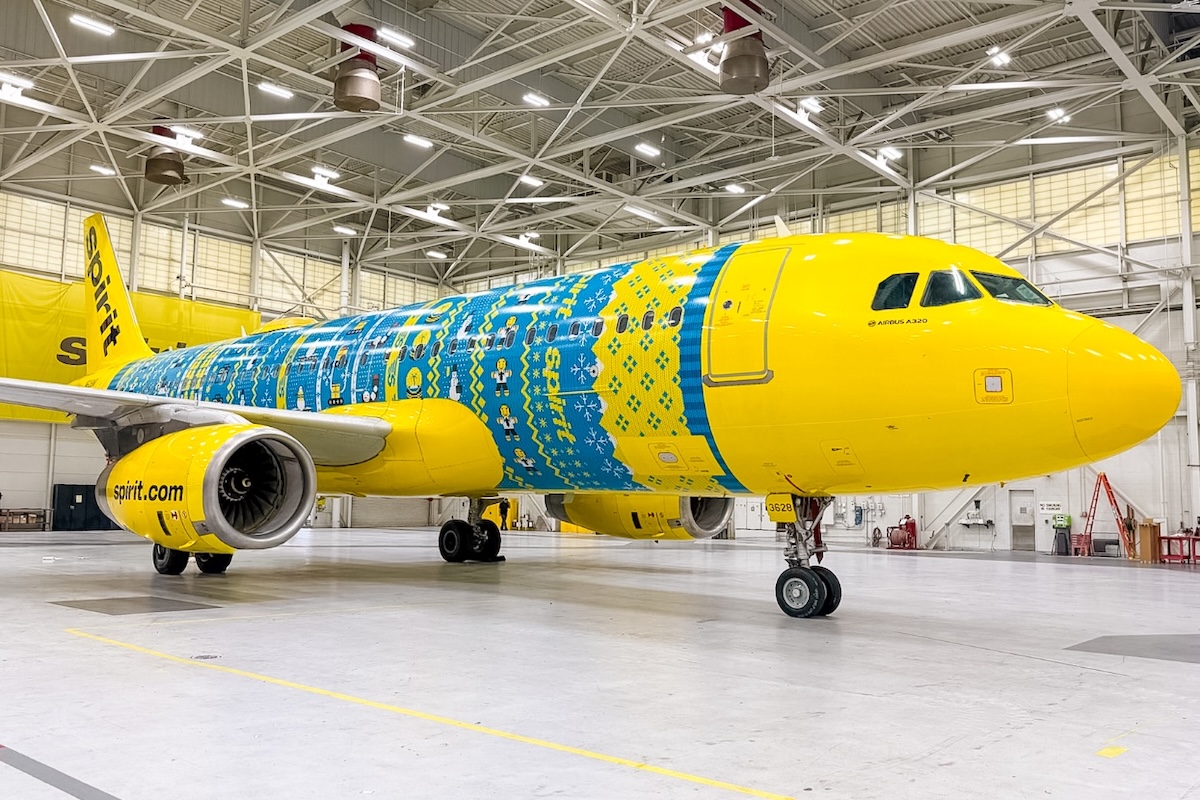
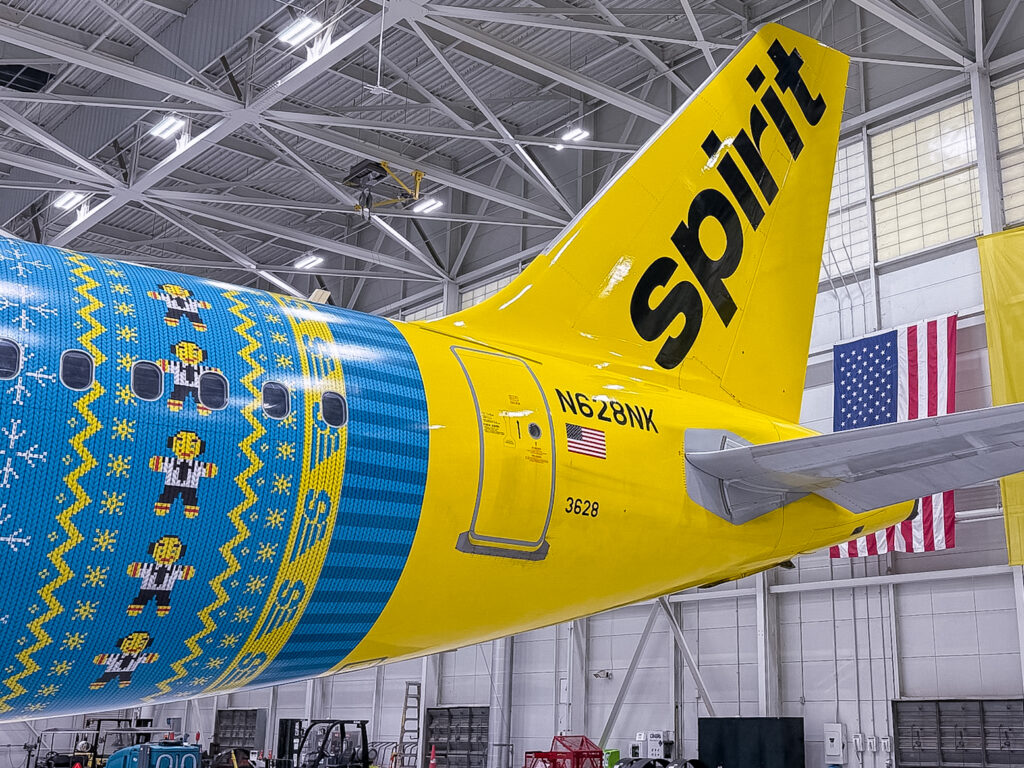
Spirit has unveiled its first-ever holiday-themed special edition livery, introducing a festive exterior design for the winter travel season. The limited-time scheme has been applied to one of the carrier’s Airbus aircraft, registered as N628NK, transforming it with a holiday “sweater” motif featuring seasonal graphics such as snowmen and gingerbread men.
The airline rolled out the special livery as part of its peak holiday travel operations, a period that represents one of the busiest times of the year for Spirit. The festive aircraft will operate regularly scheduled flights across the carrier’s network, giving travelers the chance to spot the design on routes throughout the United States, Latin America, and the Caribbean.
While the underlying aircraft layout remains unchanged, the seasonal graphics provide a temporary visual contrast to the standard scheme.
Spirit’s special holiday-themed livery (Photo: Spirit)
Spirit has positioned the special edition livery as a seasonal feature tied to its broader holiday initiatives, which include expanded schedules and festive touches during the winter travel period. The design is intended to remain in service through the end of the holiday season, after which the aircraft will return to the carrier’s standard livery.
Looking for a new airplane model? Head over to our friends at the Midwest Model Store for a wide selection of airlines and liveries.
Ryan founded AirlineGeeks.com in February 2013 and has spent more than a decade covering the airline business. His work has been featured by CNN, WJLA, CNET, and Business Insider. His aviation experience spans airport operations, Part 135 regulatory compliance, and airline crew workforce planning, along with time behind the yoke of a Cessna 172 and interviews with airline executives. Ryan now serves as Group President of Firecrown Media’s Aviation Group. He holds a B.S. in Air Transportation Management and an MBA from Arizona State University and teaches Airline Management at Embry-Riddle Aeronautical University.
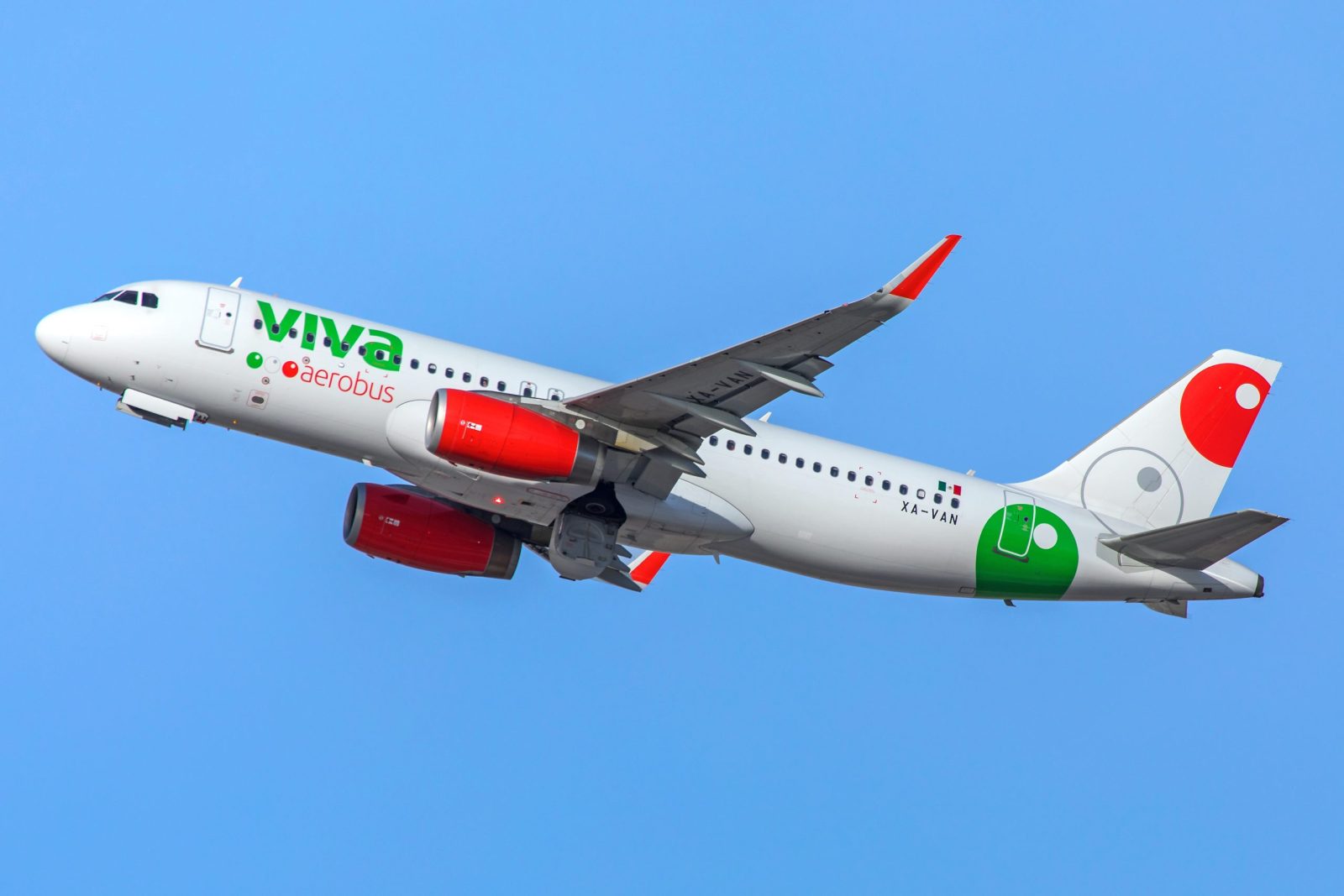
A Viva Aerobus Airbus A320. (Photo: AirlineGeeks | William Derrickson)
Two of Mexico’s largest airlines, Viva and Volaris, have agreed to merge, officials with both companies confirmed on Thursday.
The low-cost carriers will come together under a new, as yet unnamed airline group. Through economies of scale, the deal is expected to lower aircraft ownership costs while also helping drive down ticket prices for customers, executives said.
The airlines plan to retain their separate operations, operating certificates, and brand identities.
“We expect the formation of the new airline group will allow us to realize significant growth opportunities for air travel in Mexico, in line with the low fare and point-to-point approach that revolutionized the industry over the last two decades,” Volaris President and CEO Enrique Beltranena said in a statement.
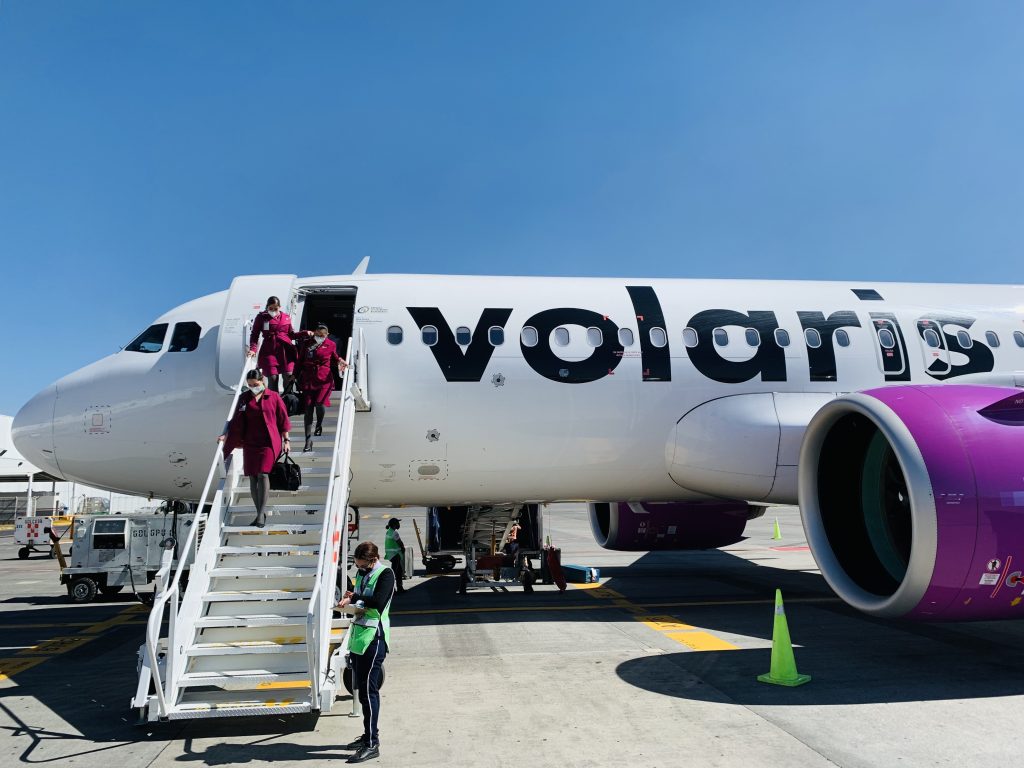
Volaris flight crew deplane an A320neo jet at Guadalajara International Airport. (Photo: AirlineGeeks | Albert Kuan)
If completed, the merger of Viva and Volaris could radically reshape the Mexican airline industry. The carriers are among the largest in Mexico by passenger volume, and have more extensive domestic networks than flag carrier Aeroméxico.
Both Viva and Volaris fly primarily within Mexico, though they also offer service to the U.S. and Central and South America.
In a message to investors, airline leaders said the planned linkup will not only lower costs but also improve institutional resilience to supply chain disruptions and product quality issues at original equipment manufacturers. Uniting Viva and Volaris, they said, will facilitate fleet optimization and ultimately strengthen operations and returns.
The merger is expected to close in 2026. It remains subject to regulatory approvals.
Shares of the new joint holding company will be listed in Mexico and on the New York Stock Exchange.
Zach Vasile is a writer and editor covering news in all aspects of commercial aviation. He has reported for and contributed to the Manchester Journal Inquirer, the Hartford Business Journal, the Charlotte Observer, and the Washington Examiner, with his area of focus being the intersection of business and government policy.
Sign-up for newsletters & special offers!
Get the latest stories & special offers delivered directly to your inbox