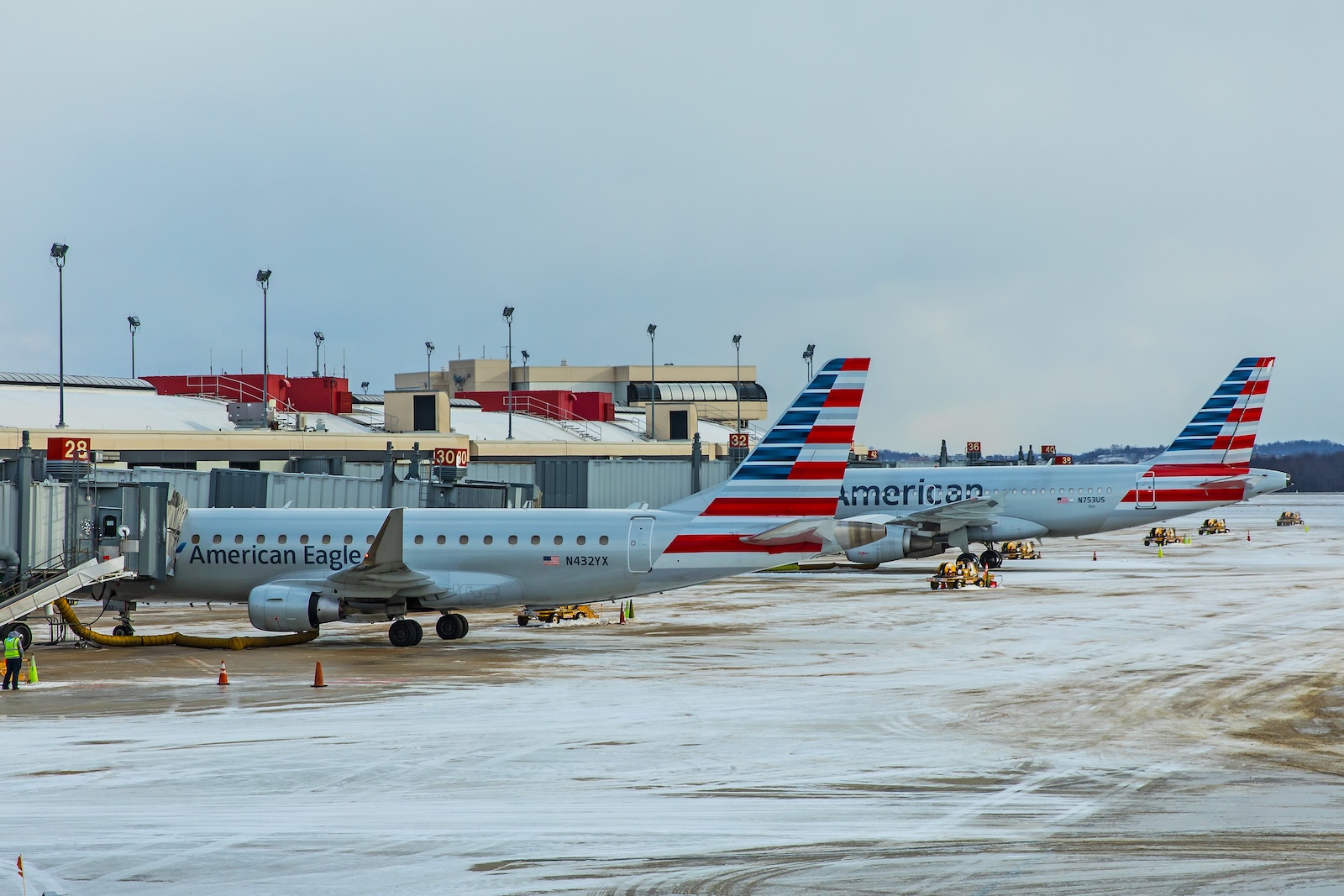
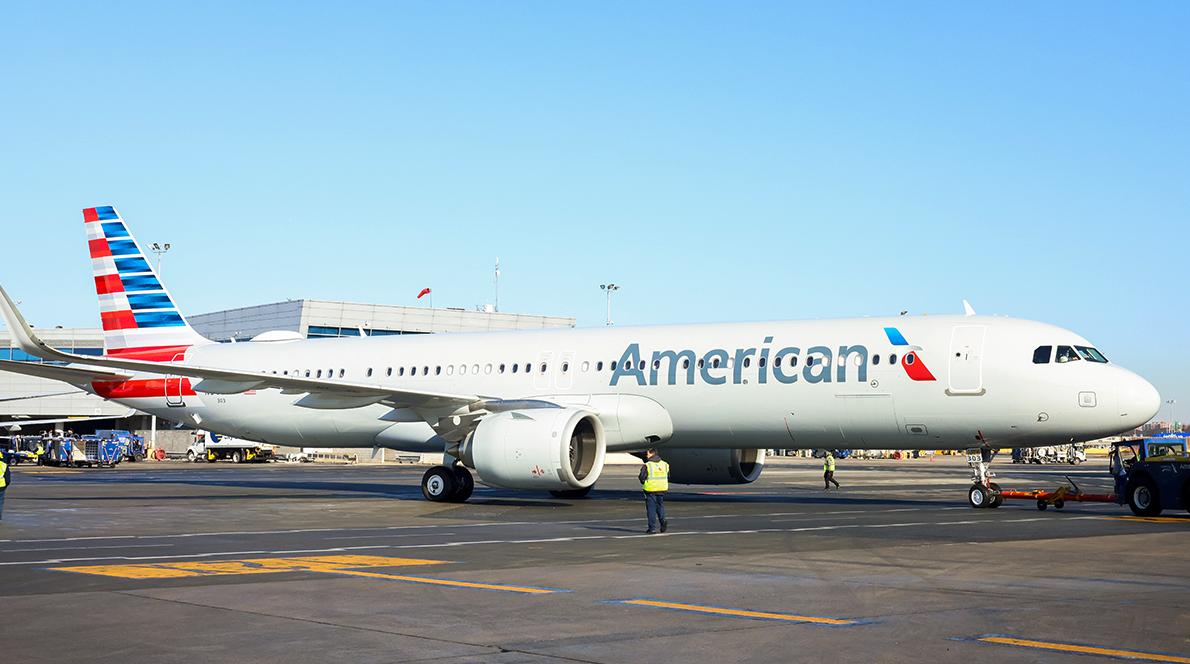
American Airlines aircraft in Pittsburgh. (Photo: AirlineGeeks | William Derrickson)
A major winter storm is complicating air travel across the Upper Midwest and Northeast.
Parts of Michigan, Pennsylvania, and western New York are currently seeing a mix of snow, ice, and freezing rain, and as the system moves east, heavy snow is expected in the Hudson Valley and the New York metro area, as well as in New Jersey, western Maryland, and southern New England.
The National Weather Service predicts four to eight inches of snow, though certain areas, particularly in the tri-state region, could see more.
In response, airlines are canceling and delaying flights during one of the busiest travel periods of the year. As of midday Friday, over 1,000 flights to, from, and within the U.S. had been canceled, according to FlightAware, and over 3,100 had been delayed. The three main New York-area airports – JFK, LaGuardia, and Newark, New Jersey – saw the highest number of cancellations, followed by Philadelphia and Detroit.
CNBC reported Friday that several large carriers, including United, Delta, American, and Southwest, are allowing passengers in the region to change their flights without any additional charges.
The storm, which developed quickly this week, could hardly have come at a worse time. Industry trade groups and government agencies are predicting one of the busiest holiday travel seasons on record, and according to the Transportation Security Administration, three of the busiest days – Dec. 27-29 – will come right after the storm hits the Northeast.
Zach Vasile is a writer and editor covering news in all aspects of commercial aviation. He has reported for and contributed to the Manchester Journal Inquirer, the Hartford Business Journal, the Charlotte Observer, and the Washington Examiner, with his area of focus being the intersection of business and government policy.
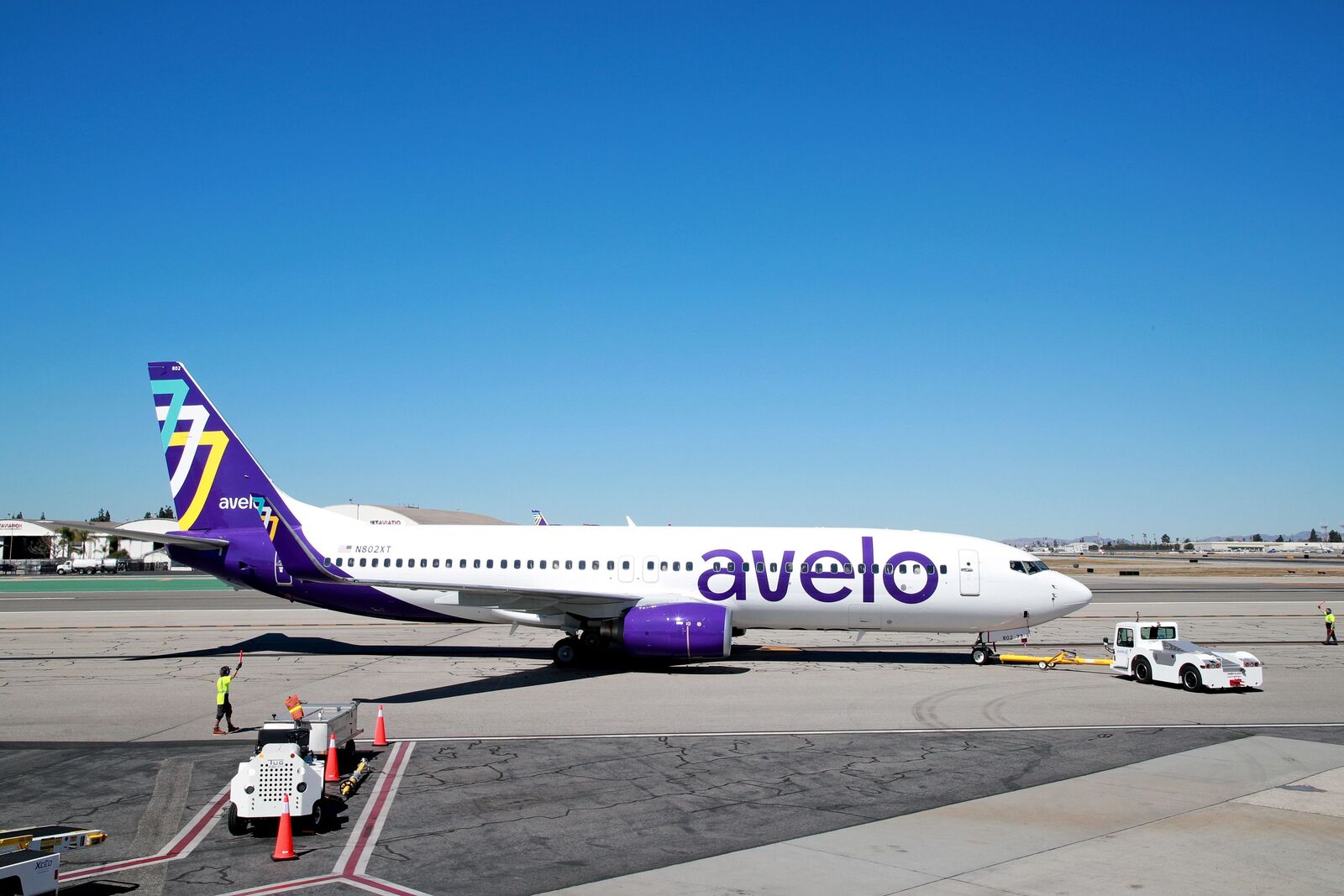
Avelo Launches Caribbean Route
The carrier now offers the only international flights from Wilmington, North Carolina.
The route will operate twice a week on Wednesdays and Saturdays using Boeing 737NG aircraft. It is the only international route currently operating from Wilmington, which mainly connects to markets in the Northeast, the Midwest, and Florida.
Punta Cana is one of Avelo’s three destinations outside the U.S., the others being Cancun and Montego Bay, Jamaica. It also serves the city from Raleigh-Durham, North Carolina, and Hartford, Connecticut.
Avelo has a crewmember and operations base in Wilmington and has been growing its footprint in the area since 2022. The airline now serves 15 destinations from Wilmington, including Washington Dulles, Baltimore, Detroit, Nashville, Tennessee, and Orlando, Florida.
Zach Vasile is a writer and editor covering news in all aspects of commercial aviation. He has reported for and contributed to the Manchester Journal Inquirer, the Hartford Business Journal, the Charlotte Observer, and the Washington Examiner, with his area of focus being the intersection of business and government policy.
Delta Flies ‘Miracle on Ice’ Hockey Team to D.C. For Honors
The former players received the Congressional Gold Medal, the highest civilian award given by the U.S. Congress.
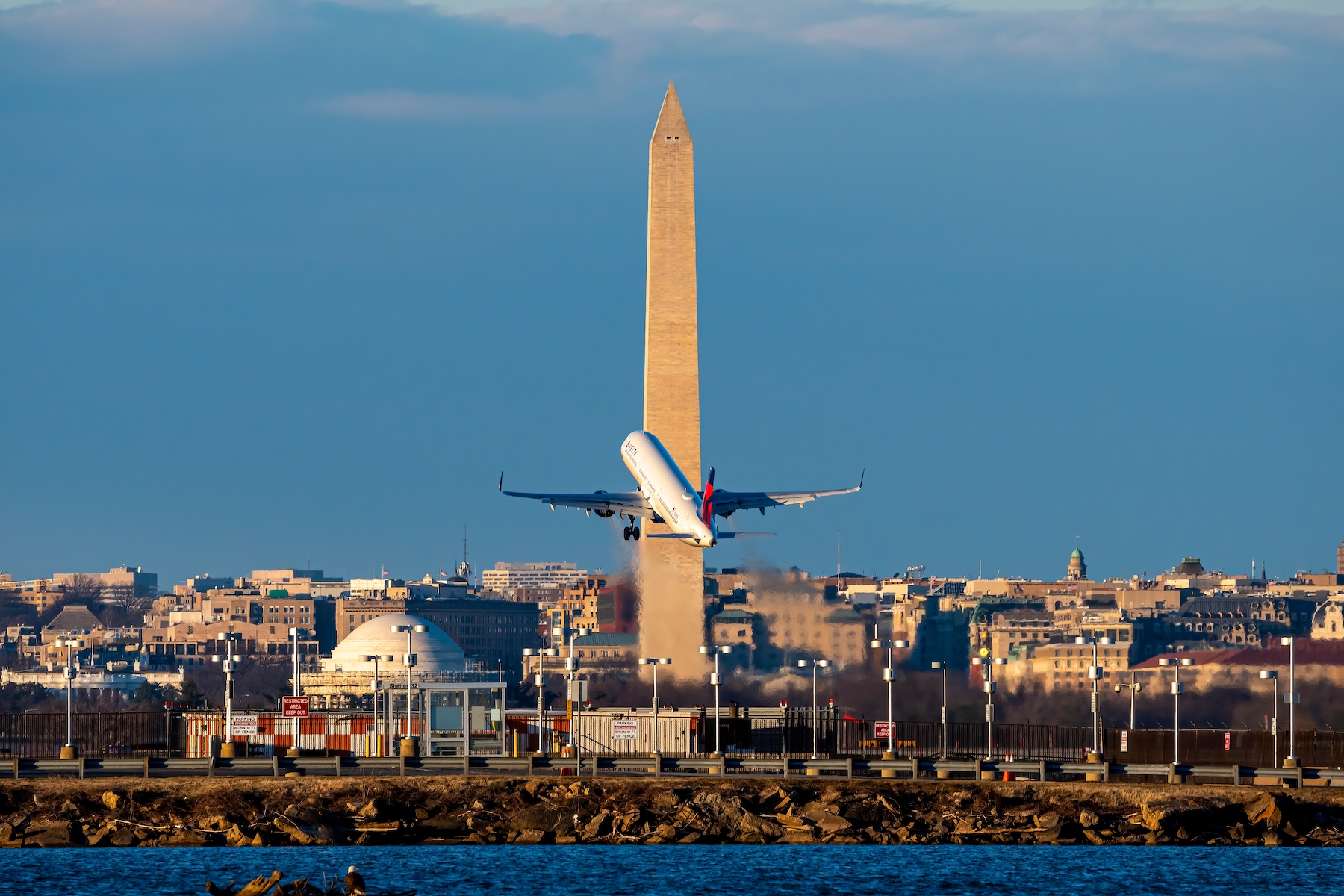
A Delta aircraft takes off from Washington DCA. (Photo: Shutterstock | Andrew Mauro)
Members of the 1980 U.S. men’s Olympic hockey team – celebrated across the country for their surprise win over the Soviet Union – caught a ride with Delta earlier this month en route to the U.S. Capitol and the White House, where they received one of the nation’s highest honors.
The men wore white cowboy hats during the ceremony, just as they did during the opening ceremony of the 1980 Winter Olympics in Lake Placid, New York, and gave one to the president.
According to CBS News, captain Mike Eruzione, goaltender Jim Craig, forward Buzz Schneider, and the family of deceased coach Herb Brooks were in attendance.
Members of the 1980 U.S. men’s Olympic hockey team in Washington. (Photo: Delta)
The bill recognizing the team’s achievement passed the Senate and House in April. This year marks the 45th anniversary of the “Miracle on Ice” match, which stunned the sports world and boosted national pride at a time of deep anxiety over the country’s direction.
“The Miracle on Ice is a defining moment in sports history that continues to inspire generations,” Alicia Tillman, Delta’s chief marketing officer, said in a news release. “At Delta, we’re honored to play a role in celebrating the team’s legacy as they receive the Congressional Gold Medal. Their story reflects the same perseverance and passion that fuel our commitment to Team USA and to connecting people and cultures around the world.”
The 1980 team, composed mainly of young amateur players, bested the Soviets 4-3 in the first game of the Olympic medal round. Their victory was immortalized by sportscaster Al Michael’s famous declaration at the match’s end – “Do you believe in miracles? Yes!”
The Soviet Union had not lost an Olympic hockey game since 1968.
Two days after the “Miracle on Ice,” Team USA defeated Finland and secured the gold medal.
Zach Vasile is a writer and editor covering news in all aspects of commercial aviation. He has reported for and contributed to the Manchester Journal Inquirer, the Hartford Business Journal, the Charlotte Observer, and the Washington Examiner, with his area of focus being the intersection of business and government policy.
InterCaribbean will offer seven flights per week between Tortola and Barbados. Four will operate nonstop, while the other three will land at Princess Juliana International Airport in St. Maarten before continuing on.
“Expanding nonstop options from Tortola has been a priority for us,” interCaribbean Chairman Lyndon Gardiner said in a statement. “Adding Barbados and St. Maarten as nonstop destinations gives BVI travelers access to our wider Caribbean network in both directions. For the British Virgin Islands, it reinforces our long-term commitment to the territory.”
Both Terrance B. Lettsome International Airport near Tortola and Grantley Adams International Airport in Barbados are hub locations for interCaribbean.
The carrier’s current network includes destinations in Puerto Rico, Cuba, The Bahamas, the Dominican Republic, Jamaica, Antigua, Dominica, and Grenada, among other island locations.
Zach Vasile is a writer and editor covering news in all aspects of commercial aviation. He has reported for and contributed to the Manchester Journal Inquirer, the Hartford Business Journal, the Charlotte Observer, and the Washington Examiner, with his area of focus being the intersection of business and government policy.
TSA: Holiday Travel Could Break Records
The agency expects to screen about 44.3 million people through Jan. 4, 2026.
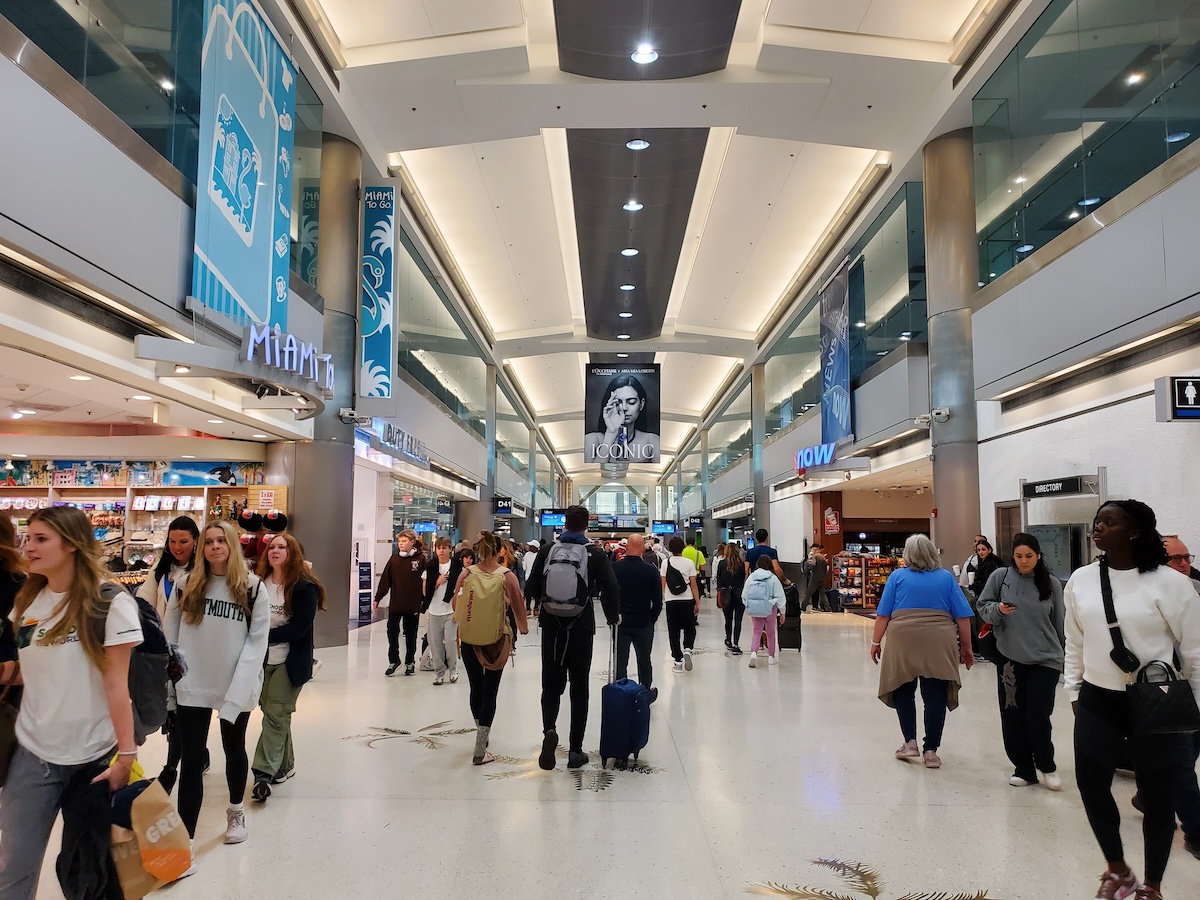
A terminal in Miami. (Photo: Shutterstock | Khairil Azhar Junos)
The Transportation Security Administration expects to screen about 44.3 million passengers through early January, a figure that if realized would make this year’s holiday travel season one of the busiest on record.
The agency’s projections cover the weeks between Dec. 19 and Jan. 4, 2026. The single busiest day in that span will be Sunday, Dec. 28, TSA said, when about 2.86 million people in the U.S. will board an airplane. Saturday, Dec. 27, and Monday, Dec. 29, will be close behind in terms of passenger volume, according to the agency’s forecast.
The single busiest travel day last year was Dec. 28, when TSA screened around 2.85 million passengers.
TSA officials said Monday that the agency is well prepared for the surge in traffic. They also noted recent changes in airport policies – including Real ID requirements and the end of mandatory shoe removal at security checkpoints – that they said will make the flying experience safer and more convenient.
Industry trade group Airlines For America has estimated that about 52.6 million people will fly with a U.S. carrier between Dec. 19 and Jan. 5, 2026. If reached, that number would set a record for the holiday travel period.
Zach Vasile is a writer and editor covering news in all aspects of commercial aviation. He has reported for and contributed to the Manchester Journal Inquirer, the Hartford Business Journal, the Charlotte Observer, and the Washington Examiner, with his area of focus being the intersection of business and government policy.
Delta Expands Premium Check-In Across Hub Airports
The perk is now available to Delta One passengers in eight U.S. cities.
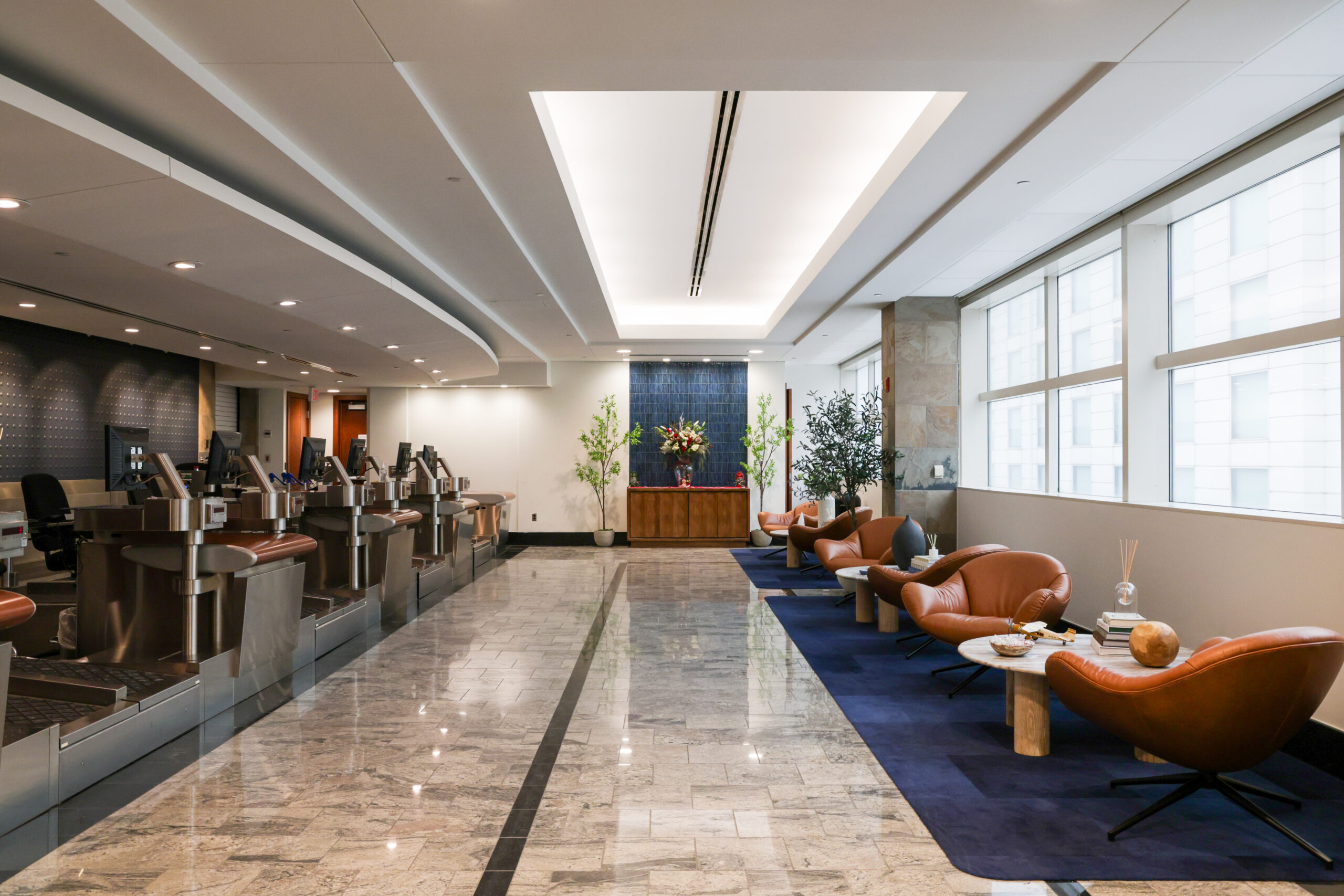
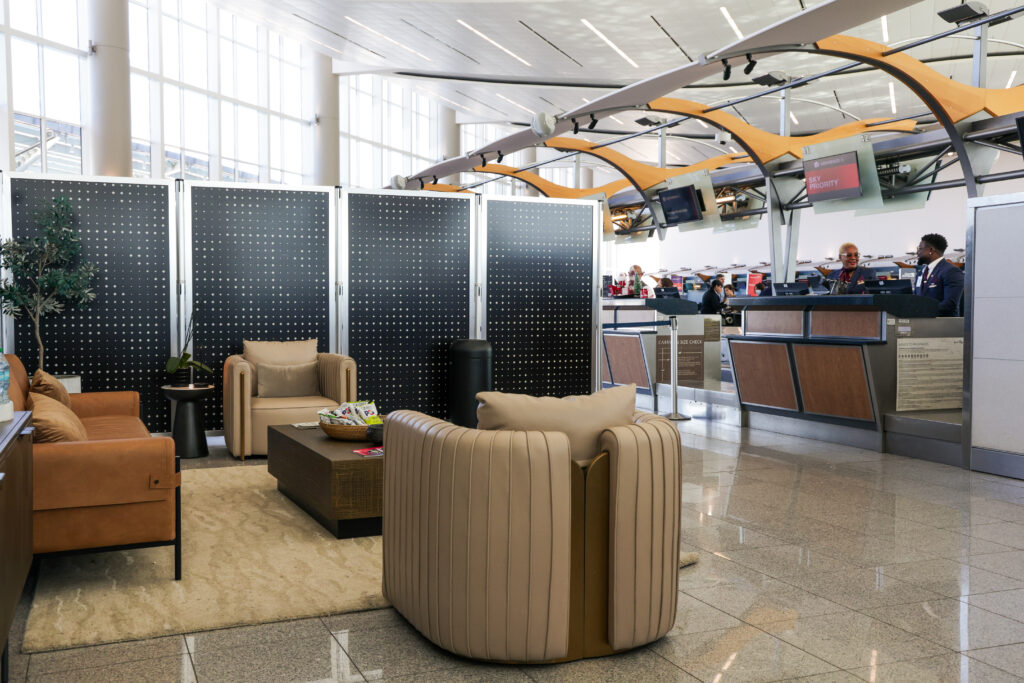
The airline started rolling out dedicated check-in spaces for passengers in Delta One, its most premium cabin, last year. According to Delta, the service makes it easier for travelers to check in and drop off their bags, and gives them a quiet environment with seating, drinks, and small bites to relax.
Delta One Check-In areas are now open at Atlanta, Los Angeles, New York-JFK, Seattle, Boston, Salt Lake City, Detroit, and Minneapolis-Saint Paul.
The Delta One Check-In in the International Terminal at Hartsfield-Jackson Atlanta International Airport. (Photo: Delta)
At New York-JFK and Los Angeles, the airline also offers private security that leads directly to a Delta One lounge. Boston and Seattle also have Delta One lounges.
“Delta One Check-In sets the tone for each one of our Delta One customers to begin experiencing their elevated journey from the moment they arrive at the airport,” Greg Forbes, Delta’s managing director of airport experience, said in a news release. “It builds on the efficiency and consistency with a welcoming, calm environment that reflects Delta’s signature care and hospitality.”
The airline plans to open Delta One lounges at its remaining hub locations in the coming years.
Zach Vasile is a writer and editor covering news in all aspects of commercial aviation. He has reported for and contributed to the Manchester Journal Inquirer, the Hartford Business Journal, the Charlotte Observer, and the Washington Examiner, with his area of focus being the intersection of business and government policy.
Trip Report: Fiji Airways’ Longest Route
We had the pleasure of experiencing Fiji Airways' business class product on a nonstop flight from Nadi to Dallas.
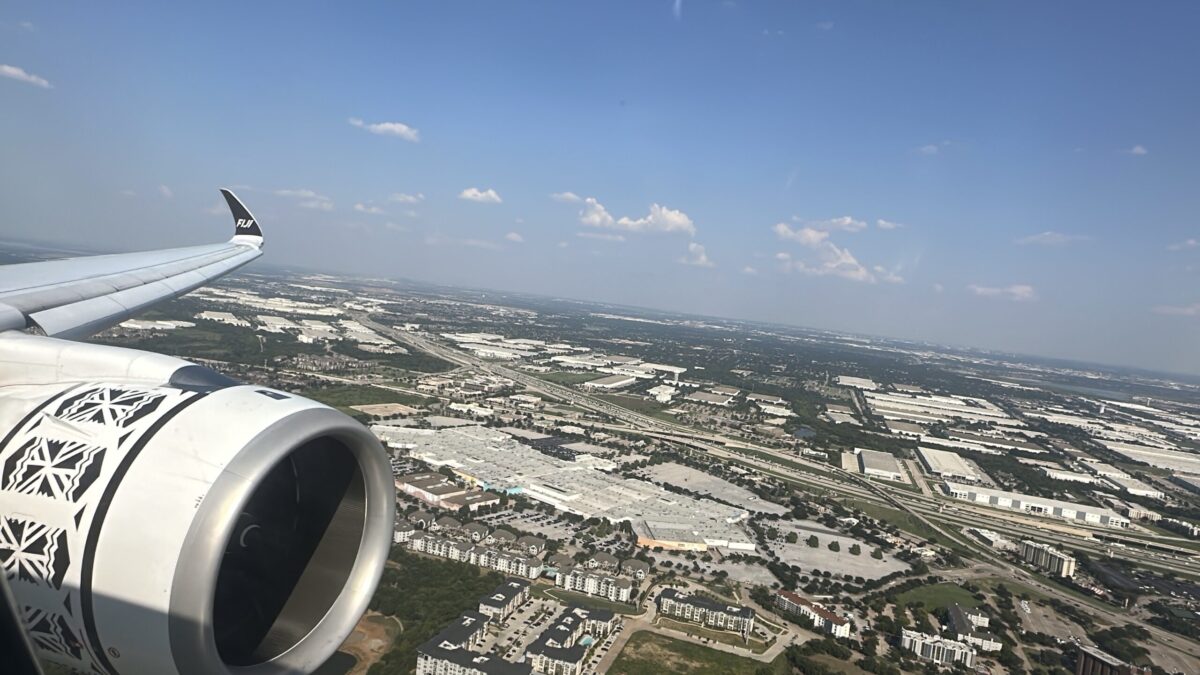
Our flight on final approach to Dallas/Fort Worth. (Photo: AirlineGeeks | Joey Gerardi)
In this trip report, we’re joining Fiji Airways on its longest route — Nadi, Fiji, to Dallas/Fort Worth — to experience what it’s like flying at the front of the cabin in the airline’s award-winning business class.
Fiji Airways has been expanding its network steadily but moderately. It recently entered the oneworld network, and was coming off an APEX World Class award just days before I took this flight.
The Day of the Flight
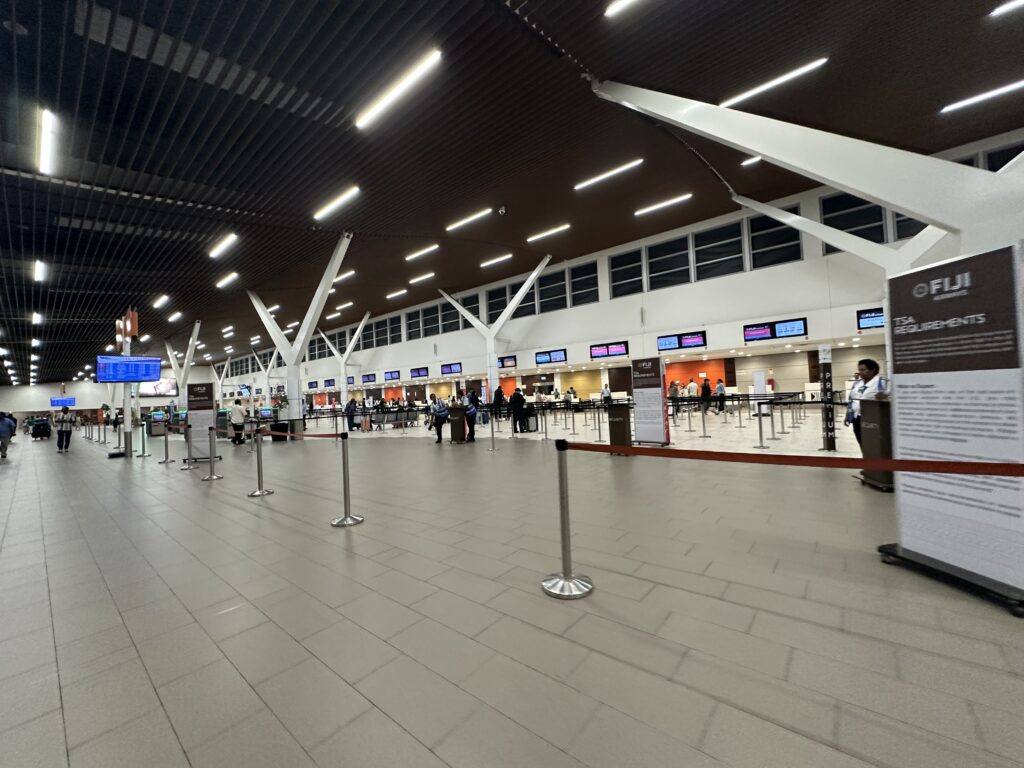
I started my journey at Nadi International Airport. Check-in was super easy despite there being tons of international flights leaving around the same time. Because I was headed to the U.S., I couldn’t check in online and needed to see an agent. The agents were friendly, greeting passengers with the signature “Bula!” that instantly reminds you you’re in Fiji.
The Fiji Airways check-in area at Nadi International Airport. (Photo: AirlineGeeks | Joey Gerardi)
Security and customs were surprisingly quick, considering multiple flights to the U.S. were leaving around the same time. It also helped that I could use the business class customs line.
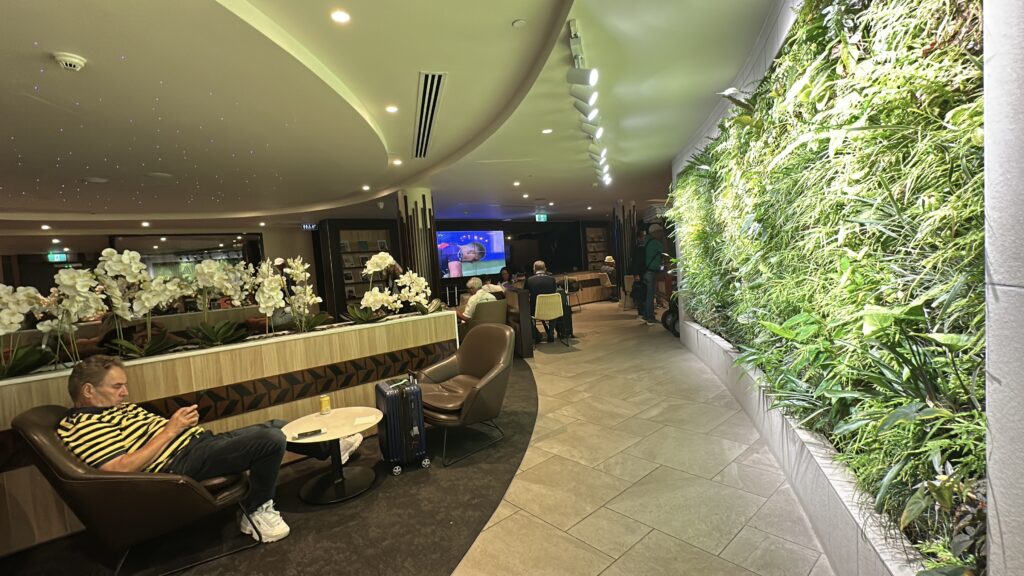
Being a business class passenger, I was given access to the airline’s Bula lounge, which was wonderfully set up and had tons of food and plenty of seating for everyone, along with an open bar with attendants. Since I was about to get on an international flight and did not want to spoil my dining experience, I decided to go lighter on food at the lounge.
Fiji Airways’ Bula Lounge at Nadi International Airport. (Photo: AirlineGeeks | Joey Gerardi)
Before I even realized what time it was, the announcement came over the speakers in the lounge that it was time to board the flight bound for Dallas. The gate area was quite busy with multiple flights departing around the same time, but I was able to make out the announcements for my specific flight.
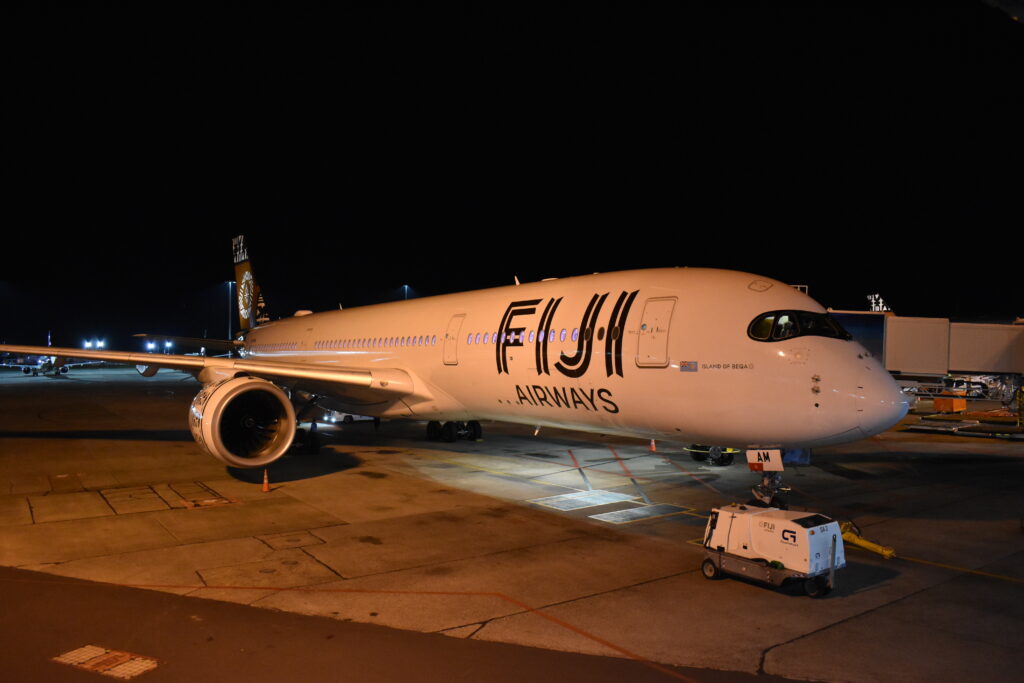
Another bonus of this airport was the open-air building, similar to a lot of tropical locations, meaning you got unobstructed windowless views of the aircraft sitting out on the gates. The aircraft operating the flight up to Dallas was an Airbus A350-900 with the registration DQ-FAM. It was originally supposed to be delivered to Hong Kong Airlines and Hainan Airlines, but didn’t end up going to either of them, and came to Fiji Airways in August 2023.
My aircraft for the flight up to Dallas with Fiji Airways. (Photo: AirlineGeeks | Joey Gerardi)
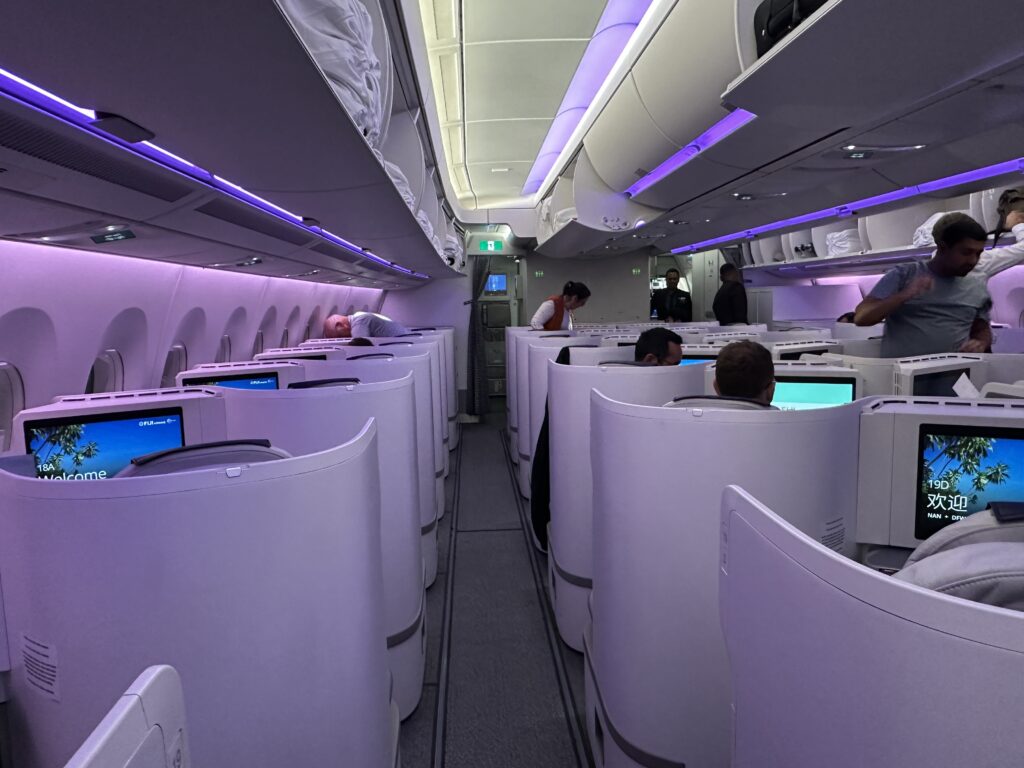
Stepping on board, the first things to make an impression were the warm atmosphere, purple and pink mood lighting, and Fijian music in the background. Fiji Airways uses a 1-2-1 configuration in its business class cabins on the A350, ensuring every passenger has aisle access, a big plus for long-haul comfort.
Walking into the business cabin on Fiji Airways. (Photo: AirlineGeeks | Joey Gerardi)
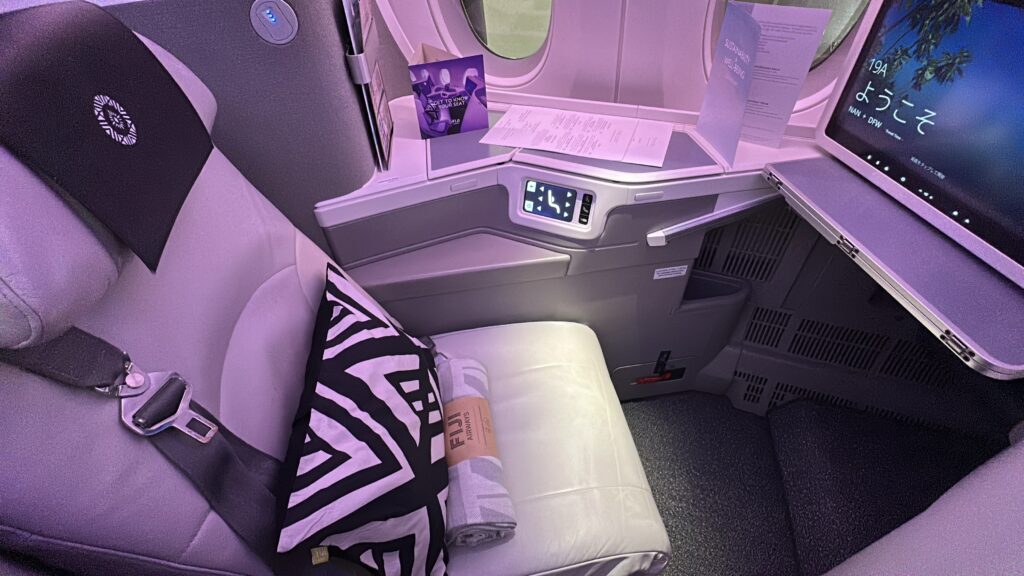
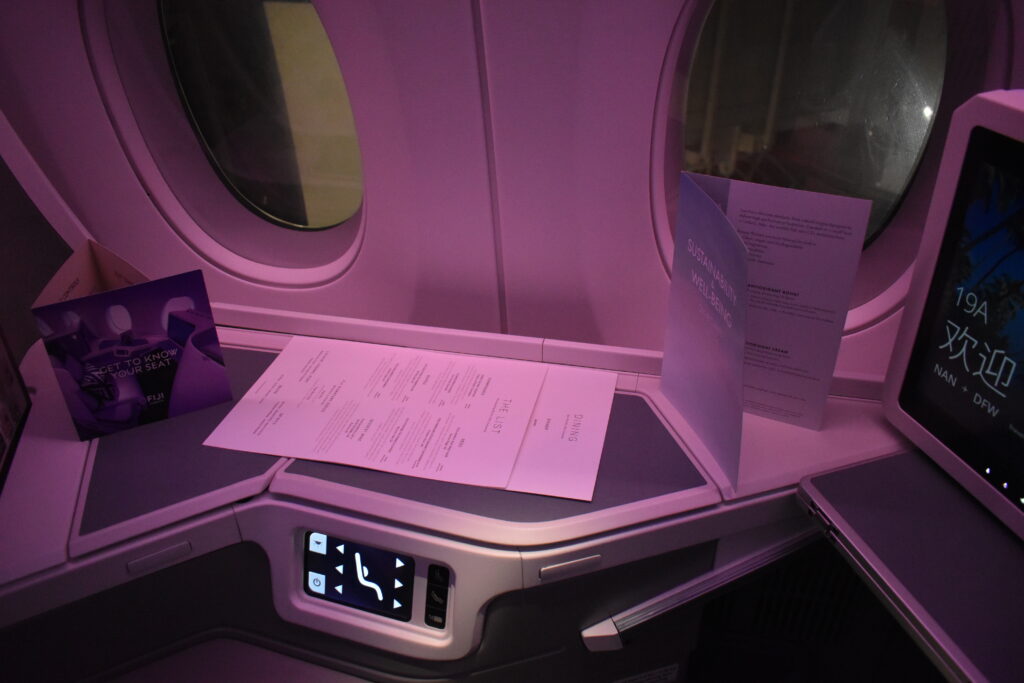
My seat for the journey would be 19A, a window seat on the left side of the plane. Waiting for me at my seat was a pillow, a blanket, noise-canceling headphones, a water bottle, the menu, a pamphlet on how to use the seat and its many features, and information on how to be sustainable and improve your well-being on long flights.
My seat, 19A. (Photo: AirlineGeeks | Joey Gerardi)
Before pushing back, the flight attendants came around with a lavender hot towel as well as either fruit juice or champagne for everybody in business class. Despite starting the boarding process late, we were able to make up some time with a quick and efficient boarding process. We pushed back from the gate on time and took off into the night skies.
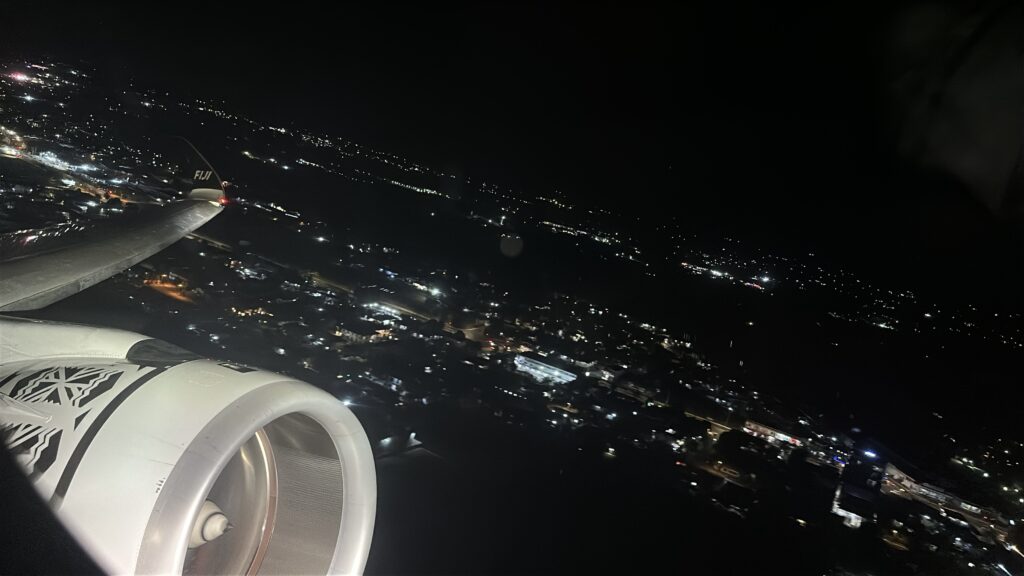
Takeoff was smooth with very little turbulence, and since we were taking off from an island nation after dark, it didn’t take long for the lights beneath us to disappear, signaling that we were over the ocean for the long journey up to Texas.
Taking off from Fiji. (Photo: AirlineGeeks | Joey Gerardi)
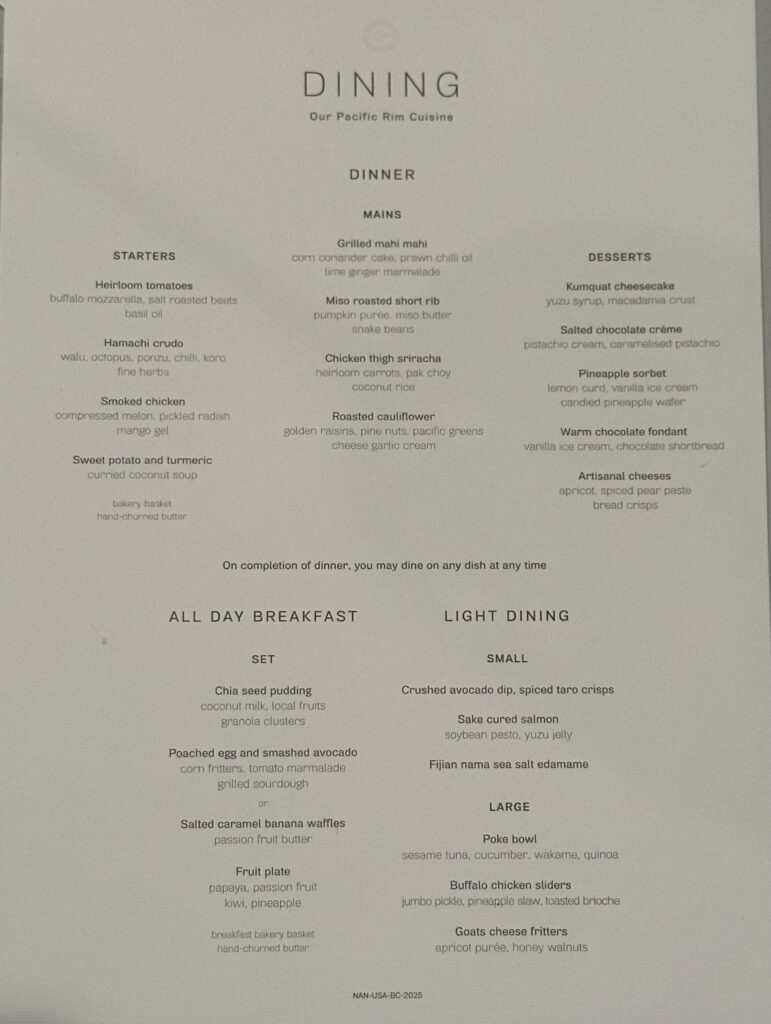
About 20 minutes or so after takeoff, the flight attendants came around and took our food and drink orders.
The business class dining menu for my Fiji Airways flight to Dallas. (Photo: AirlineGeeks | Joey Gerardi)
Fiji, as a country, is trying to be as sustainable as possible, and in an effort to help the country reach its goal of net zero, Fiji Airways plants a mangrove tree somewhere in the country for every takeoff it has.
Another part of that effort is how the carrier handles its amenity kits.
Most airlines hand out hundreds of amenity kits every flight, most of which go to waste and are thrown out. Fiji Airways does it differently by having deconstructed amenity kits. You tell the flight attendants which parts of the kit you want, and they bring them to you.
One of the things from the kits you can ask for is hand lotion and moisturizer from Umbria, which is made in Italy. The products are handed out in zip-lock bags, which you can bring with you and on your next flight, since they are all travel-sized.
The lotion and moisturizer kit Fiji Airways hands out to business class passengers. (Photo: AirlineGeeks | Joey Gerardi)
It’s a good thing that the seat came with a brochure about how to use the different features and buttons, since there were a lot of things that I didn’t even notice at first without reading it. There were also a lot of storage spaces to put things like the comforter, my camera, and other smaller items.
The side of my seat, closer to the window, where the compartments are located. (Photo: AirlineGeeks | Joey Gerardi)
Also at the seat were two USB-A ports, along with a power outlet, and what looks like a smartphone. The device is actually a remote for the IFE system in front of you, and is used kind of like the touchpad on a laptop. The remote can also turn off the lights at your seat as well as call the flight attendants.
Fiji Airways also has Wi-Fi, and while it does cost a small fee, passengers in business class are given a small card for complimentary internet.
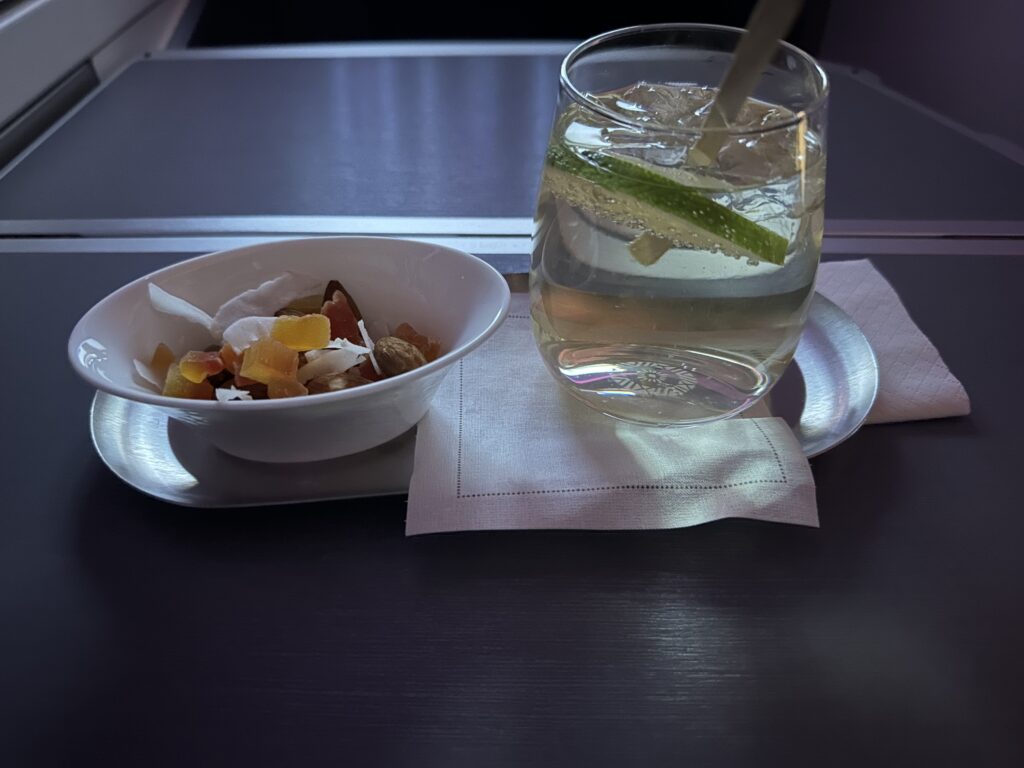
The first thing food-wise that came out was a small bowl of candied papaya, roasted almonds, and toasted coconut, along with your choice of drink, which for me was a Hugo Blue Turtle, a Fiji signature cocktail.
The candied papaya, toasted almonds, and coconut. (Photo: AirlineGeeks | Joey Gerardi)
Not long after I had finished, the flight attendants cleaned that up and brought around a tablecloth, a flower, and a candle, both of which are obviously fake for safety reasons, and prepared for the main courses to come.
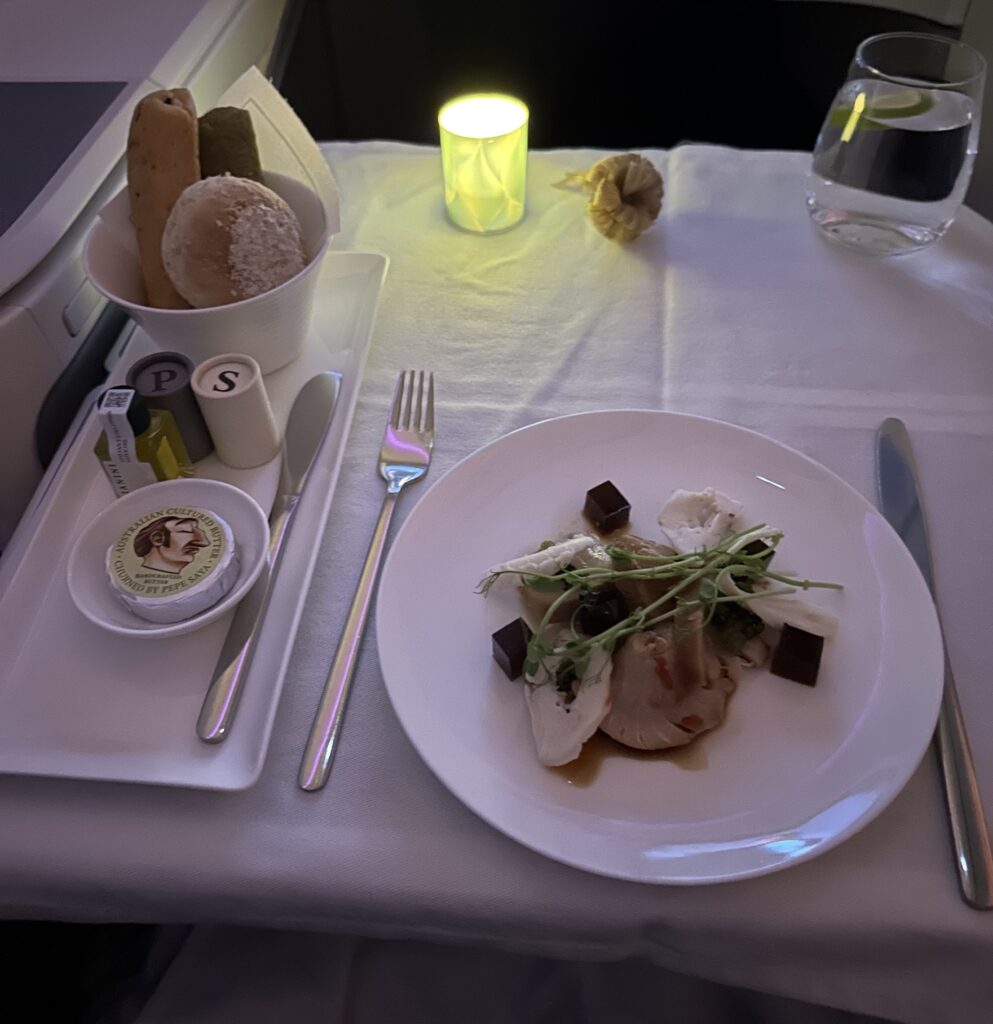
The starter came out next, which was smoked chicken with compressed melon, pickled radish, and mango gel, along with a bowl of assorted bread and artisanal butter, and your choice of drink.
The starter meal for my flight. (Photo: AirlineGeeks | Joey Gerardi)
One thing I like about Fiji Airways is that, unlike other airlines where they roll the big cart through the aisle and everyone gets served at the same time, Fiji Airways has the personal touch where they bring out trays individually, and everyone gets served the next course only when they are done. It’s a pleasant experience, because with the standard way of serving, passengers who eat slowly are rushed to finish, and they sometimes have dessert delivered when they are midway through their dinner.
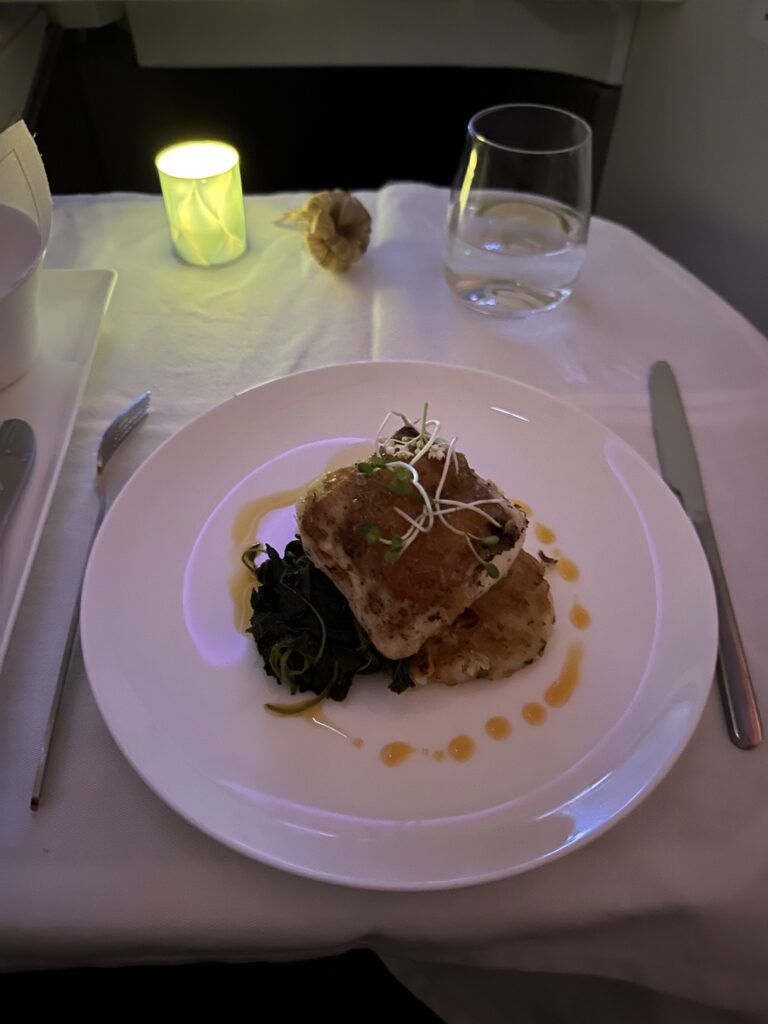
Once I was done with the starter, the flight attendants cleaned up the tray and brought around my main course, which was grilled Mahi Mahi, with corn coriander cake, prawn chili oil, and lime ginger marmalade, all of which was presented very nicely and gave it the feel of a five-star restaurant instead of food served on an airplane.
My main course. (Photo: AirlineGeeks | Joey Gerardi)
After an amazing meal, I was greatly satisfied and starting to get in the mood for sleeping, but there was still one more course to come: dessert! The option I chose was pineapple sorbet with lemon curd, vanilla ice cream, with a candied pineapple wafer on it.
The dessert. (Photo: AirlineGeeks | Joey Gerardi)
About two and a half hours since departing from Nadi, I decided to put my seat into lie-flat mode and get ready for sleeping.
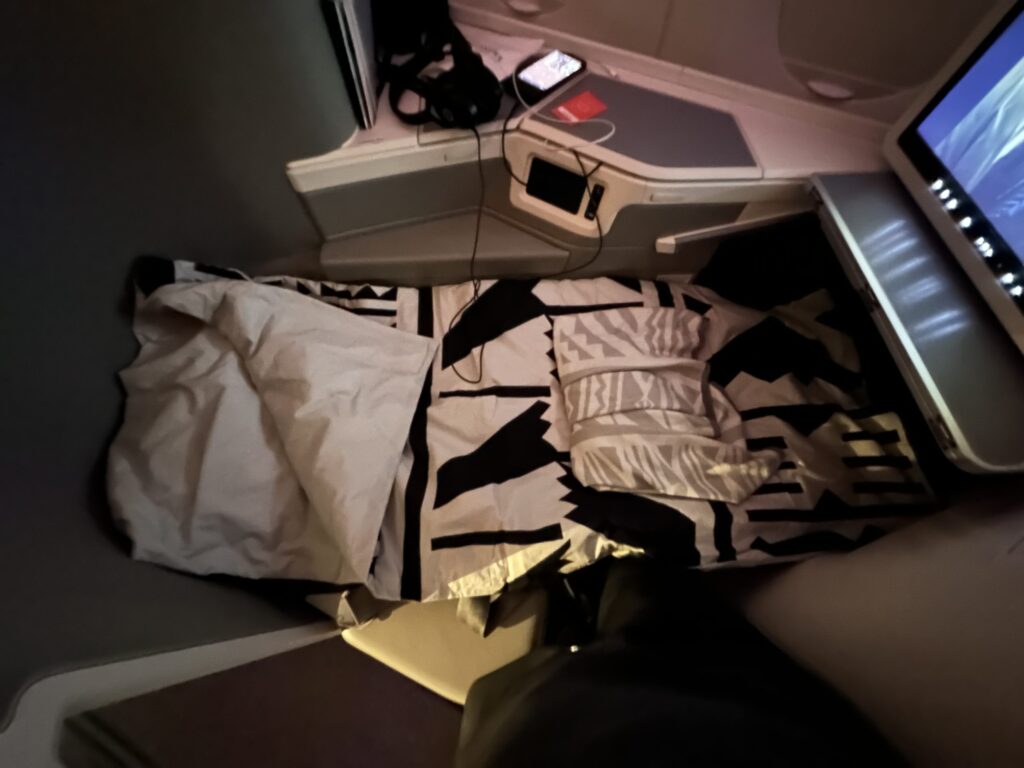
Another personal touch from the airline: while I was up using the restroom getting ready for bed, I came back to see that my seat/bed had been made up for sleeping by the flight attendants with the comforter that we were given before leaving the gate, in addition to another thicker comforter.
My seat was made up by the flight attendants for the overnight to Dallas. (Photo: AirlineGeeks | Joey Gerardi)
This move helps show that the little things add up to make a great experience. It didn’t cost the flight attendants any extra to do this, but it is a nice touch and gives the passengers the feeling that they do truly care about them.
After a little bit over six hours of sleeping, I decided it was a good time to get up, especially since it was 2 p.m. in Dallas and I needed to start getting used to the time zone changes back home. By this point in the flight, there was a little less than three hours left, and we had climbed to a new cruising altitude of 41,000 feet. We had burned a lot of fuel in our journey across the Pacific, and we were much lighter than when we took off.
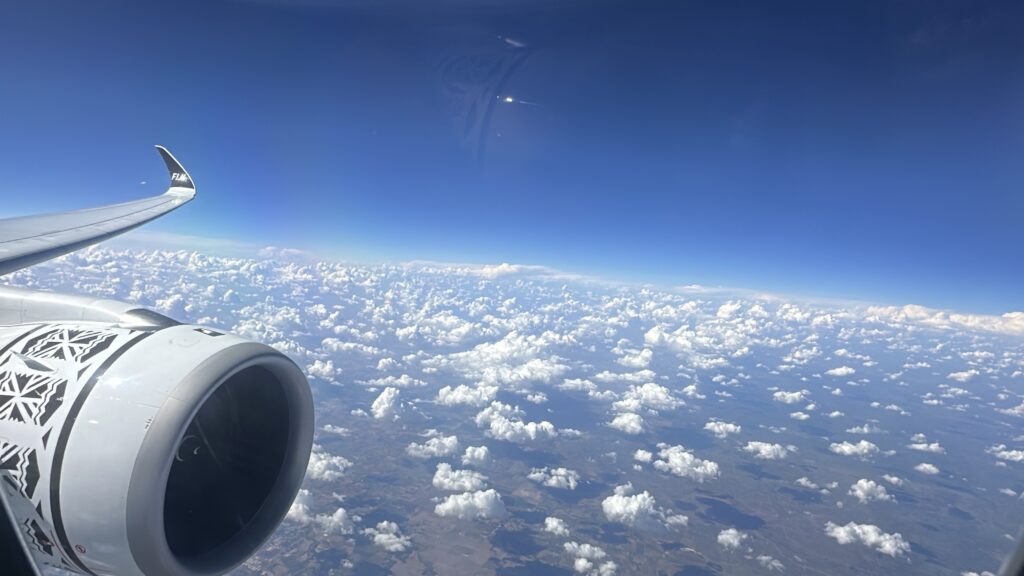
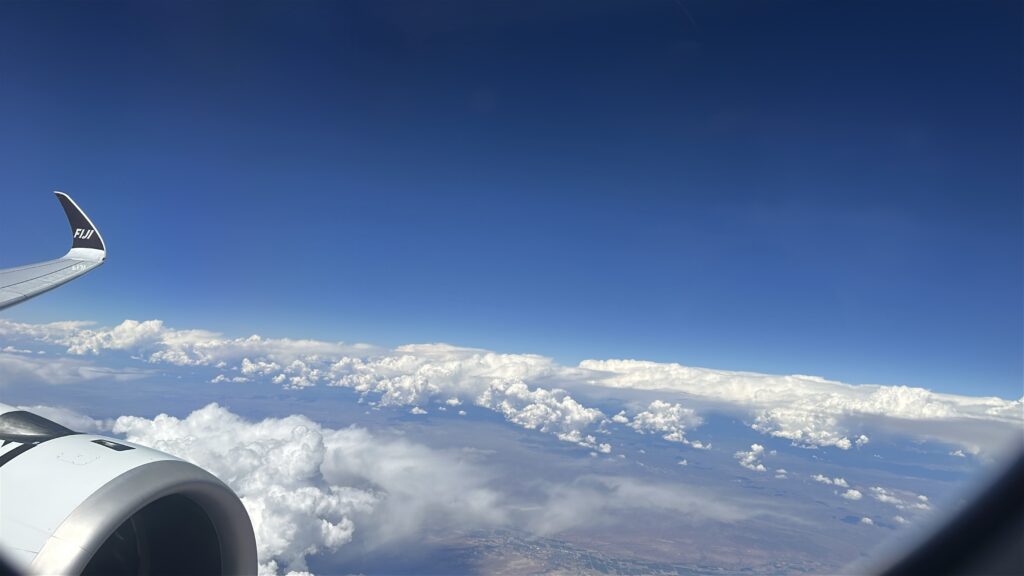
Up at our cruising altitude of 41,000 feet. (Photo: AirlineGeeks | Joey Gerardi)
Another thing I didn’t get to explore the night before that I decided to look into was the IFE system onboard. It has many cool features, including movies, TV, the live moving map, games, and even the tail and nose cameras that the A350 is known for.
There is also a section of short videos on how to say common words and phrases in Fijian, videos on the history of Fiji Airways, and clips on how the airline is being sustainable. There was also a tab that had the airline’s route map, including some partner destinations from a handful of oneworld partners.
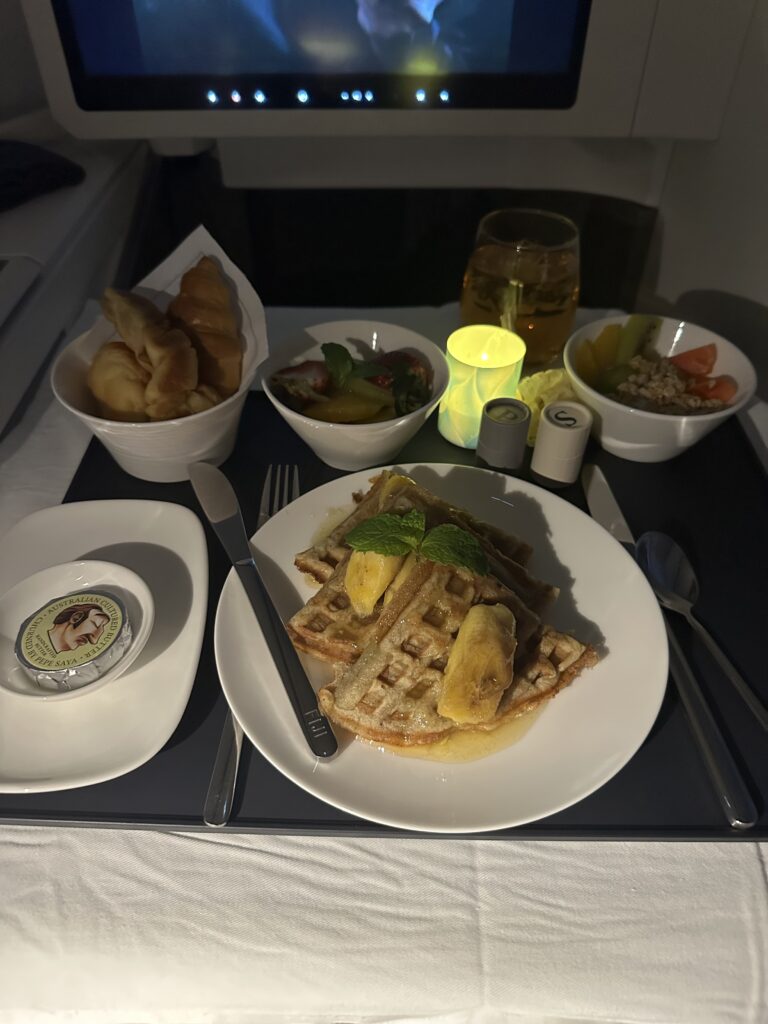
With about two hours left in the flight, the flight attendants came around with a tablecloth and asked what we wanted from the menu for breakfast. The breakfast was chia seed pudding, with coconut milk, fruit, and granola in it, and another small side of fruit that included papaya, passion fruit, kiwi, and pineapple. There was also a small basket of breakfast bakery items with hand-churned butter. The main breakfast option that I chose was salted caramel banana waffles with passion fruit butter.
My breakfast option. (Photo: AirlineGeeks | Joey Gerardi)
Just like the night before, the breakfast was wonderfully presented not only with the tablecloth but the flowers and candle.
The rest of the flight flew by, no pun intended, and we began our descent into Dallas/Fort Worth. A duty-free cart came through the cabin, and I, of course, had to indulge in a 1:200 model of the Fiji Airways A350, which now sits on my model shelf.
Descending into Dallas after a long flight from Fiji. (Photo: AirlineGeeks | Joey Gerardi)
Before landing, the flight attendants came around and gave everyone a Fiji water for the road, but because I had a connecting flight and needed to go through security again after customs, I opted out, since I would need to throw it out or dump it, and I didn’t want to waste it.
We had a smooth approach to Dallas/Fort Worth and landed just after 4:30 p.m. local time, a little over 12 hours in flight time from Fiji.
Conclusion
This flight offered a clear look at why Fiji Airways has earned its World Class distinction and continues to collect industry awards. Even on the airline’s longest route, the service remained steady and well-paced, and the crew handled the ultra-long-haul sector with the kind of professionalism you’d expect from a much larger carrier.
We had the chance to interview the airline’s CEO at the time, Andre Viljoen, and ask him some questions about the company and the APEX World Class award, which it had just won.
A video account of this trip report can be found below.
Editor’s Note: Fiji Airways provided AirlineGeeks with a seat on this flight, but this trip report is an objective portrayal of events and is in no way swayed.
Joey has always been interested in planes for as long as he can remember. He grew up in Central New York during the early 2000s when US Airways Express turboprops ruled the skies. Being from a non-aviation family made it harder for him to be around planes and would only spend about three hours a month at the airport. He was so excited when he could drive by himself, the first thing he did with his driver's license was get ice cream and go plane spotting for the entire day. He graduated from Western Michigan University in 2022 with a B.S. in Aviation Management & Operations and a Minor in Business, and currently works for a major airline in his hometown.
SkyWest to Open New Aircraft Maintenance Facility
The center is expected to be operational by early spring 2026.
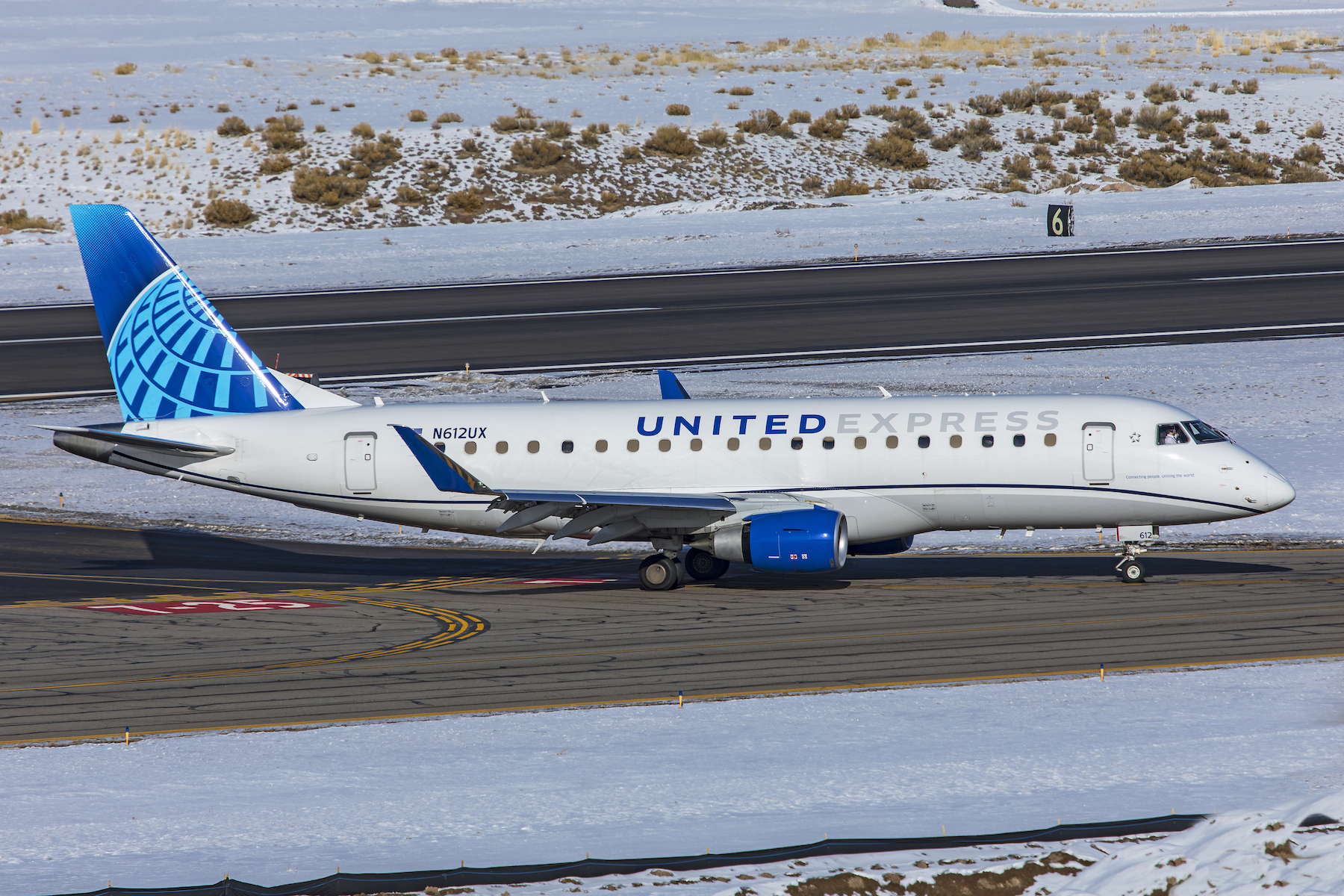
Airport officials said Monday that the center will service a portion of SkyWest’s fleet, including the aircraft currently operating United Express flights in and out of Salina.
The facility is expected to be operational by the early spring of 2026.
The airline is now hiring technicians for the Salina base but did not say how many positions it is looking to fill.
Support for the new facility came from the Kansas Department of Commerce, the City of Salina, Saline County, the Salina Airport Authority, and the Salina Community Economic Development Organization.
“SkyWest’s decision to establish a maintenance base in Salina reflects Kansas’ ability to compete and deliver for world-class aviation partners,” Kansas Department of Commerce Deputy Secretary Joshua Jefferson said in a news release. “We’ve made deliberate investments in workforce, infrastructure, and airport readiness, and this announcement shows that those efforts are paying off. Salina is positioned to support SkyWest’s growth today and well into the future.”
SkyWest operates multiple daily flights as United Express between Salina and Denver, Chicago O’Hare, and Houston.
Zach Vasile is a writer and editor covering news in all aspects of commercial aviation. He has reported for and contributed to the Manchester Journal Inquirer, the Hartford Business Journal, the Charlotte Observer, and the Washington Examiner, with his area of focus being the intersection of business and government policy.
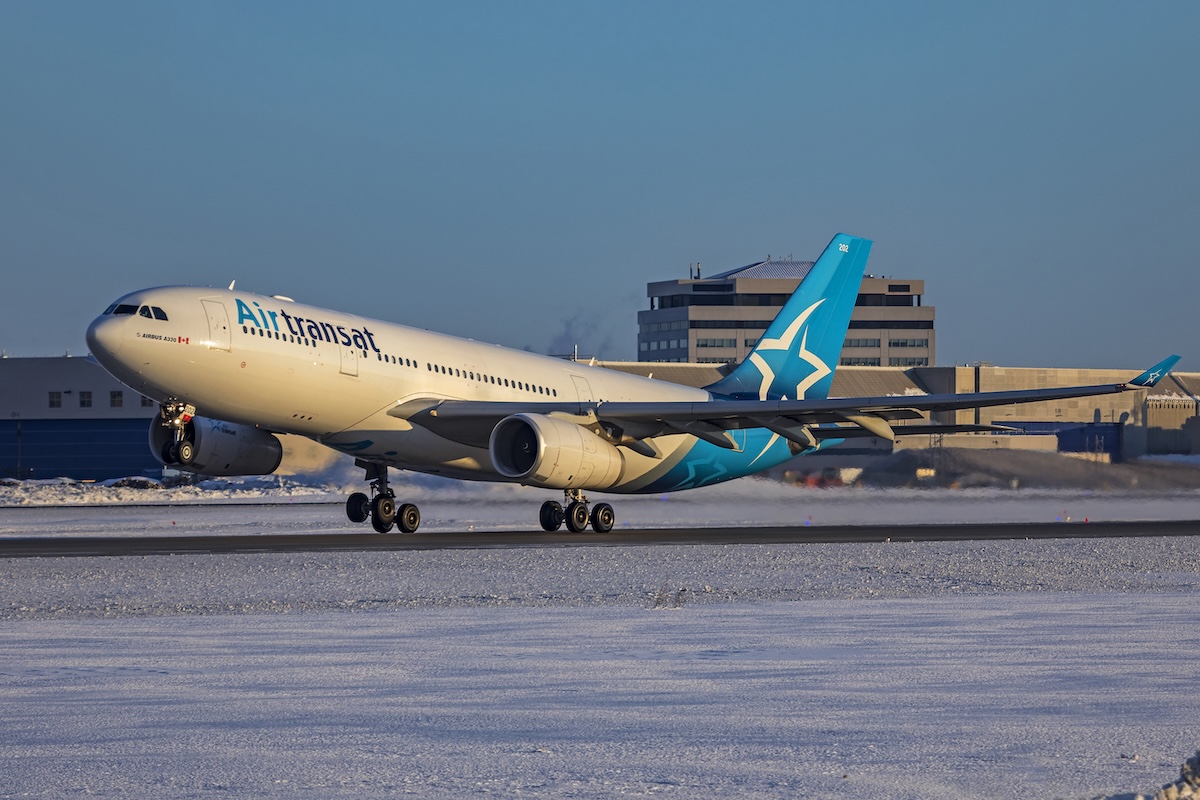
Starting June 18, 2026, the carrier will connect Toronto and Tirana, Albania. The service will operate once weekly using an Airbus A330 aircraft.
“Albania is fast becoming a standout destination on the European travel map, and we are proud to be the first airline to serve it directly from North America,” Sebastian Ponce, Air Transat’s chief revenue officer, said in a statement.
Tirana is the capital and largest city in Albania.
Quebec City-Nantes
Air Transat will also launch nonstop service to Nantes, France, next summer. Flights will operate once weekly, on Tuesdays, from Quebec City Jean Lesage International Airport between June 2 and Oct. 20. The carrier will use an Airbus A321LR on the transatlantic route.
Zach Vasile is a writer and editor covering news in all aspects of commercial aviation. He has reported for and contributed to the Manchester Journal Inquirer, the Hartford Business Journal, the Charlotte Observer, and the Washington Examiner, with his area of focus being the intersection of business and government policy.
American Debuts A321XLR
The aircraft officially entered service on Thursday.
The long-range jet departed New York around 11 a.m. Thursday, carrying more than 150 passengers, and arrived in Los Angeles that afternoon, airline officials said.
American is currently the only U.S.-based airline operating the type.
The carrier plans to schedule the A321XLR on additional routes as more of the aircraft are delivered over the coming months. The jet will launch service between New York-JFK and Edinburgh, Scotland, on March 8, 2026, then take over existing routes between New York-JFK and San Francisco in May and between Boston and Los Angeles in July.
Americans’ A321XLRs come with Flagship Suite, premium economy, and main cabin seats.
In an interview with AirlineGeeks last week, American’s senior vice president of network planning, Brian Znotins, said he envisions growing the carrier’s premium transcontinental and transatlantic networks in parallel as more A321XLRs are delivered.
Zach Vasile is a writer and editor covering news in all aspects of commercial aviation. He has reported for and contributed to the Manchester Journal Inquirer, the Hartford Business Journal, the Charlotte Observer, and the Washington Examiner, with his area of focus being the intersection of business and government policy.
Sign-up for newsletters & special offers!
Get the latest stories & special offers delivered directly to your inbox