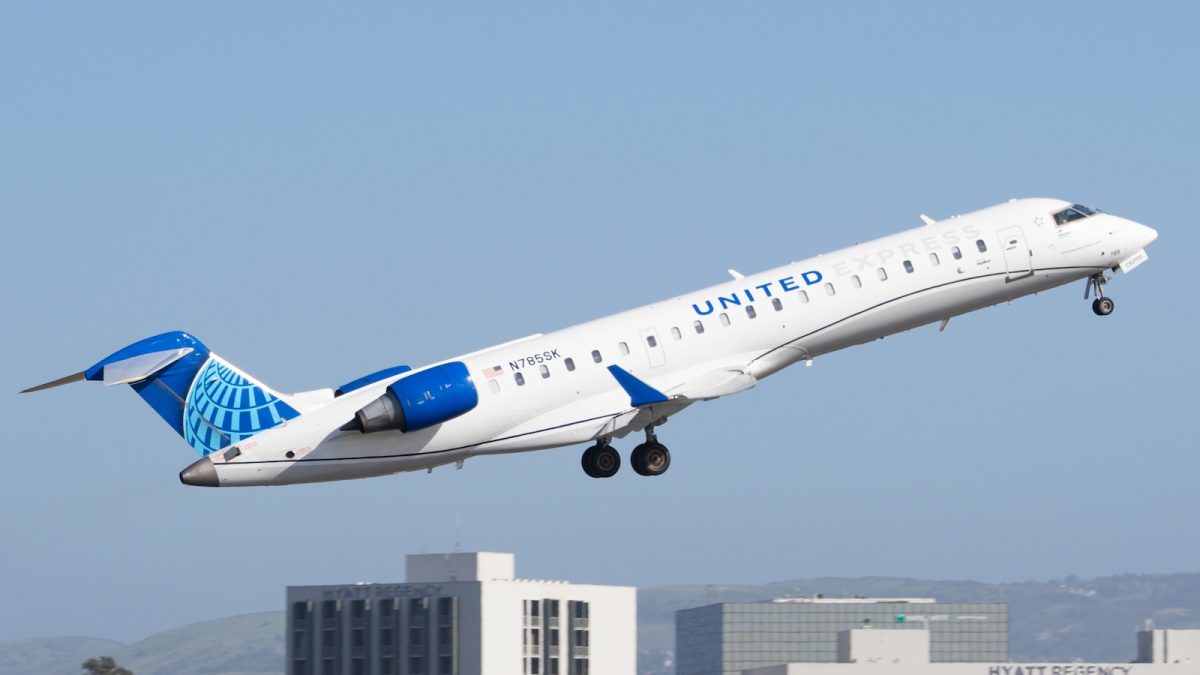
Columbia Mayor Barbara Buffaloe announced Thursday that the airline will operate two daily nonstop flights to and from Chicago O’Hare and one daily nonstop flight to and from Denver. The new routes will launch Sept. 25, she said.
“We are proud to work with United Airlines to expand routes for passengers,” said Columbia City Manager De’Carlon Seewood. “Bringing new destinations has always been a priority for COU, and this partnership will make business and leisure travel even more convenient for passengers.”
City officials said both flights will have first-class seating available. The Columbia-Chicago route will operate with a Bombardier CRJ-550.They did not specify the aircraft to be used on the Denver route.
Service to Denver is being made possible through a Small Community Air Service Development Program Grant from the U.S. Department of Transportation. The grant provides funding for communities that have insufficient air carrier service or “unreasonably” high air fares, according to the DOT.
United’s return to Columbia means it will be competing against American, which currently provides service to Chicago.
United suspended flights between Columbia and Denver in 2020 during the COVID-19 pandemic. It suspended all operations at Columbia, including twice-daily flights to Chicago, in 2022.
Zach Vasile is a writer and editor covering news in all aspects of commercial aviation. He has reported for and contributed to the Manchester Journal Inquirer, the Hartford Business Journal, the Charlotte Observer, and the Washington Examiner, with his area of focus being the intersection of business and government policy.
Uganda Airlines Launches Services Between Entebbe and London
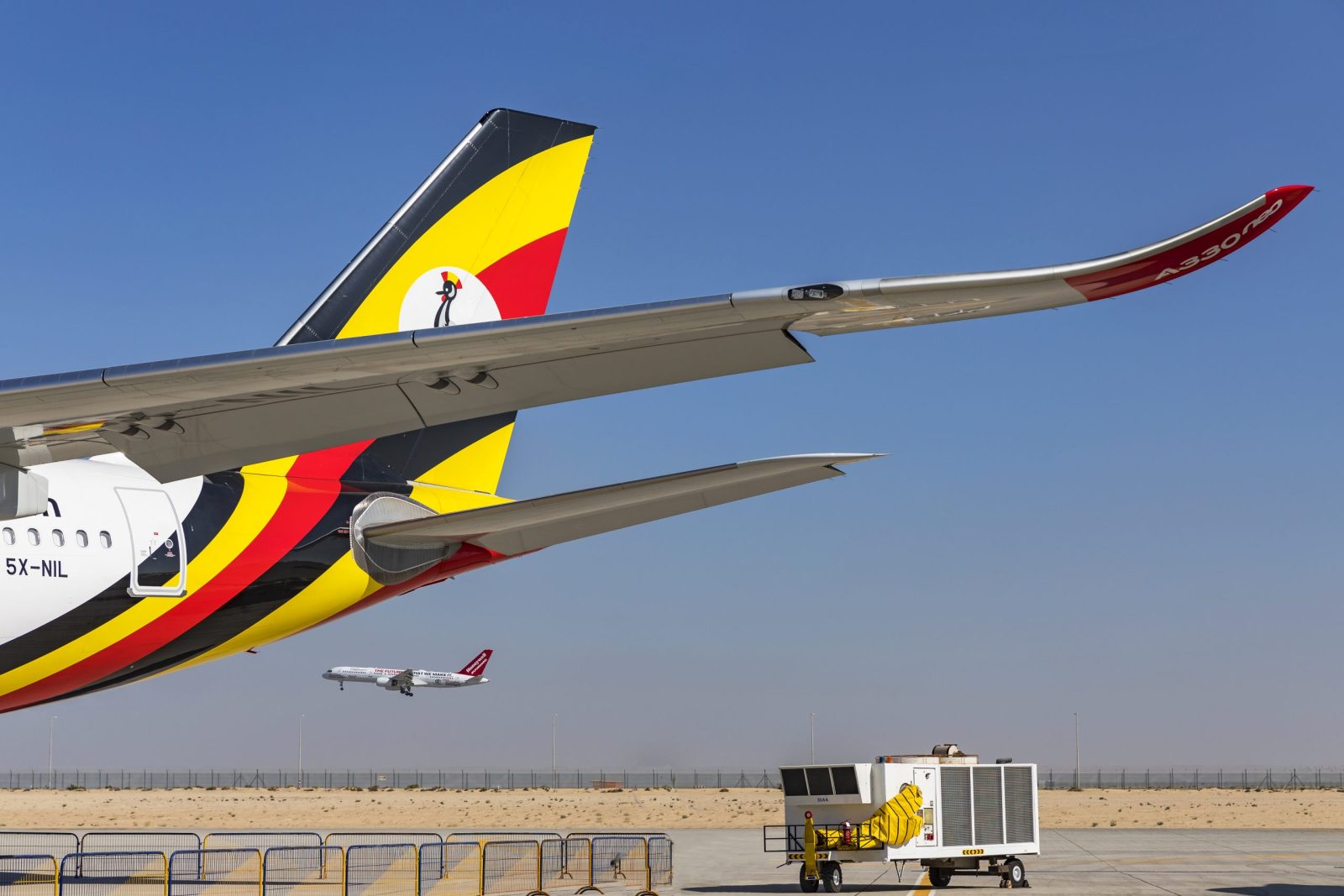
Uganda Airlines inaugurated non-stop flights between Entebbe International Airport and London Gatwick Airport on May 18.
A Uganda Airlines Airbus A330neo.
(Photo: AirlineGeeks | William Derrickson)
Uganda Airlines inaugurated non-stop flights between Entebbe International Airport and London Gatwick Airport on May 18, marking a major milestone as its first European route. This launch also restores a direct air link between Uganda and the United Kingdom after nearly a decade.
The service operates four times a week — on Sundays, Tuesdays, Wednesdays, and Fridays — using the Airbus A330-800neo, configured with 20 business, 28 premium economy, and 210 economy seats.
The inaugural flight departed Entebbe at 10:16 a.m. local time and arrived at London Gatwick at 4:53 p.m., according to flight data from Flightradar24. This service is expected to enhance trade, tourism, and investment between the U.K. and Uganda.
In 2024, the total trade between the two nations was valued at £606 million, with U.K. exports accounting for £483 million. The flight is also set to meet rising demand from the over 200,000 Ugandans residing in the country, making travel more convenient and fostering stronger ties between the two countries.
Jonathan Pollard, chief commercial officer at London Gatwick, welcomed the new service, saying: “We are delighted to welcome Uganda Airlines to London Gatwick. This new route not only strengthens our position as a key gateway to Africa but also supports our vision of fostering economic growth and connectivity, particularly among new markets across Africa, Asia, and the Middle East. As the airport continues to grow, we are excited about the opportunities this new connection will bring, further supporting the regional economy alongside leisure travellers across the South East.”
Flights between Entebbe and London were previously operated by British Airways, which ended its service in 2015. Since then, travellers have had to rely on connecting flights through other hubs like Nairobi or Doha. Initial attempts to secure landing slots at London Heathrow began in 2020, but challenges with certification from the U.K. Civil Aviation Authority and slot availability led the airline to shift its focus to Gatwick by 2024. In June 2024, a Ugandan delegation led by Bamuturaki travelled to London to finalize agreements with U.K. aviation authorities and engage key stakeholders, paving the way for the successful launch.
The new London Gatwick route becomes Uganda Airlines’ third intercontinental destination after Dubai and Mumbai. The airline currently operates a fleet of six aircraft, including two Airbus A330-800neos and four Bombardier CRJ-900s. It recently added a leased nine-year-old Airbus A320through a short-term ACMI agreement with Danish Air Transport, which arrived in Entebbe on Nov. 24.
London Gatwick Airport is increasingly becoming a hub for African connectivity. This summer, the airport is directly connected to 16 African destinations. A new Kenya Airways service to Nairobi is also expected to begin in July.
Victor Shalton's love for aviation can be traced to when he was 11-years-old. As a seasoned aviation writer, he takes pride in providing the best aviation coverage around the globe and is passionate about advancing his skills in the aviation space. In addition, he loves travelling, writing, arts and while his speaking engagements have taken him around the world, he is proud to call Nairobi home.
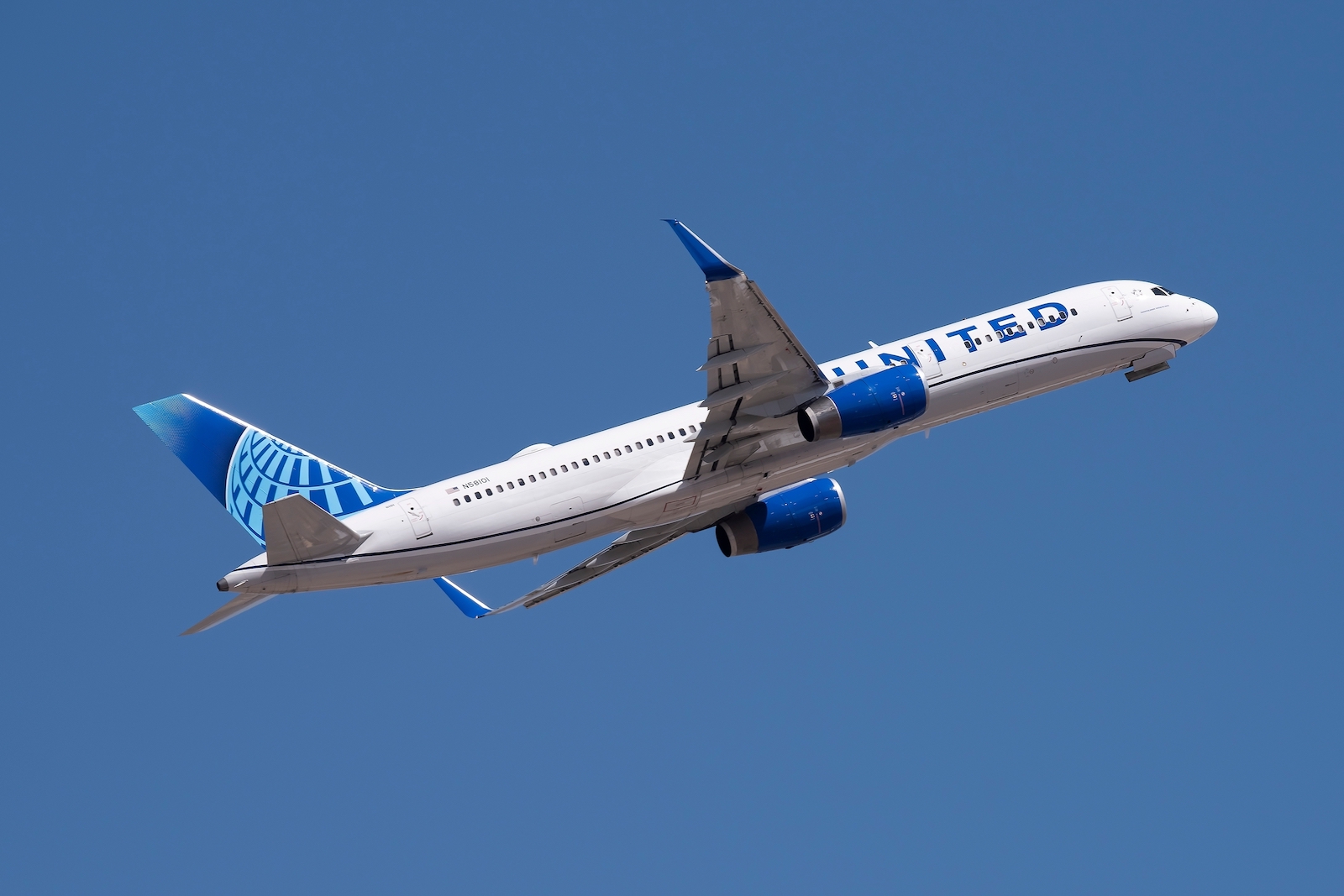
A United Boeing 757-200 aircraft (Photo: Shutterstock | Robin Guess)
United and the Association of Flight Attendants-CWA (AFA) have announced a tentative agreement that includes “industry-leading” wages and other improvements for the airline’s 28,000 flight attendants, according to a joint statement released Friday.
The agreement, if ratified, would also include a signing bonus and enhancements related to scheduling and quality of life. The new contract would remain in effect for five years before becoming amendable.
Final language for the contract is expected to be completed in the coming days. Following this, the agreement will be presented to the AFA’s Master Executive Council for approval on May 29-30. If approved, the tentative agreement will then be submitted to flight attendants for ratification.
The airline’s CEO, Scott Kirby, expressed support for the agreement, saying in a news release: “Our flight attendants are the best in the industry and have earned an industry-leading contract. I often say they are the face of our operation and the role they play every day – to keep people safe and deliver great service – helps make United the biggest and best airline in aviation history.”
Ryan founded AirlineGeeks.com in February 2013 and has spent more than a decade covering the airline business. His work has been featured by CNN, WJLA, CNET, and Business Insider. His aviation experience spans airport operations, Part 135 regulatory compliance, and airline crew workforce planning, along with time behind the yoke of a Cessna 172 and interviews with airline executives. Ryan now serves as Group President of Firecrown Media’s Aviation Group. He holds a B.S. in Air Transportation Management and an MBA from Arizona State University and teaches Airline Management at Embry-Riddle Aeronautical University.
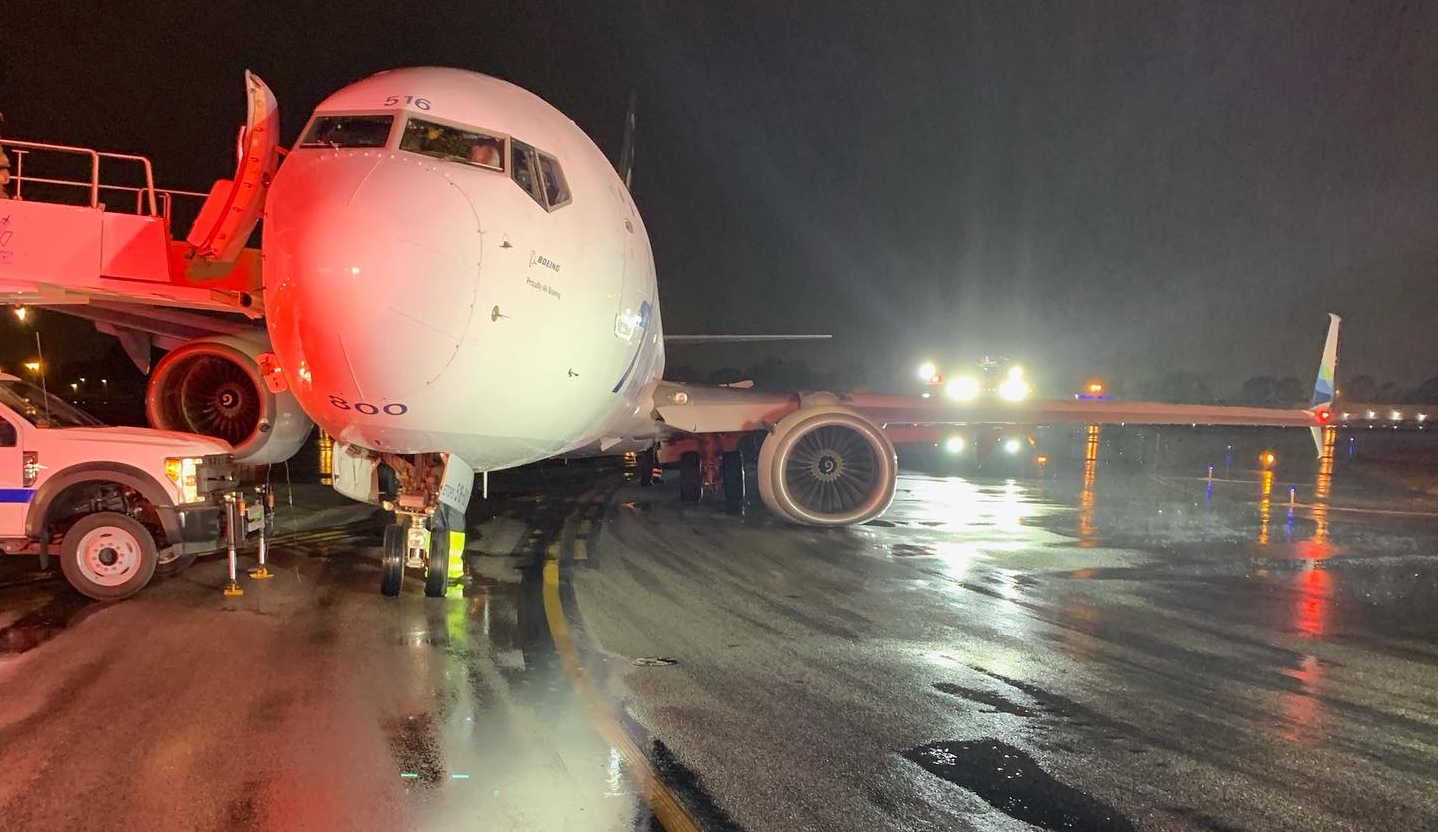
Damaged Alaska 737-800 in Santa Ana (Photo: Orange County Fire Authority)
The National Transportation Safety Board has determined that excessive grinding during maintenance led to the collapse of a Boeing 737-800’s left main landing gear during landing at John Wayne/Orange County Airport in Santa Ana, California.
Alaska Airlines flight 1288 experienced “substantial” damage on Aug. 20, 2023, when its left main landing gear failed upon touchdown. None of the 112 passengers and crew members aboard were injured.
“The National Transportation Safety Board determines the probable cause of this accident to be maintenance personnel’s excessive grinding of the left main landing gear’s aft trunnion pin during machining, which imparted heat damage to the base metal and led to the fatigue cracking that caused the pin to fracture during landing,” the agency stated in its final report published Thursday.
The Accident
According to the NTSB report, the flight from Seattle encountered moderate rain, shifting winds, and light turbulence during its approach to Santa Ana.
The flight crew reported that the aircraft was fully configured for landing and on a stabilized approach before the final approach fix. After visually acquiring the runway at about 800 feet above ground level, the captain, who was the pilot flying, disengaged the autopilot and autothrottle.
Flight data recorder information showed that the main landing gear touched down at 11:14:57 p.m., with the nose gear following about one second later. The maximum vertical acceleration recorded at touchdown was approximately 1.71 G.
The captain reported feeling a “firm jolt” and noted the aircraft was “pulling reasonably hard” to the left, which he initially attributed to a flat tire. After bringing the aircraft to taxi speed and exiting the runway, the crew noticed the airplane leaning to the left.
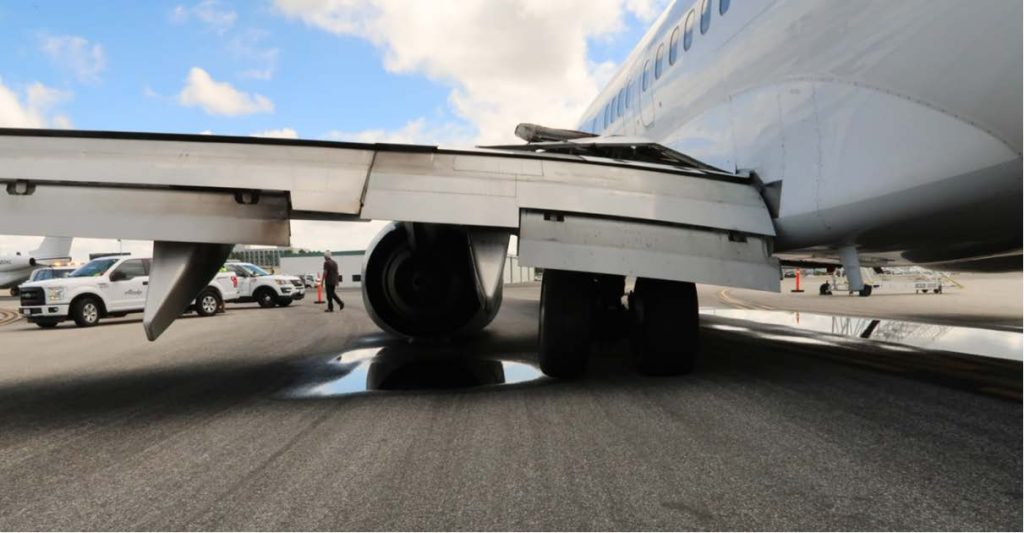
Upon inspection, they discovered the aircraft was resting on its left engine cowling. Photos show the landing gear strut piercing through the top of the wing.
NTSB investigators found that the aft trunnion pin in the left main landing gear had fractured during landing due to a fatigue crack that had grown to a depth of 0.144 inches. The crack was large enough to cause the remaining material to fracture during landing, resulting in the collapse of the gear.
Further examination revealed the fatigue crack had initiated from a small intergranular region below the external chromium-electroplated layer of the pin. This region showed an elevated reading from a Barkhausen noise inspection and displayed darker visual contrast following temper etch and metallographic inspections.
“The elevated readings and area of visual contrast were consistent with the area being exposed to higher temperatures becoming softer than the surrounding material,” the report stated. “The heat exposure most likely occurred as part of the excessive grinding of the surface, performed during the maintenance overhaul of the pin that occurred on July 5, 2018.”
The investigation determined that the overtempered region and surrounding material created an area of intergranular fracture within the material where grinding had occurred. The grinding burn likely happened during machining after the new chromium layer electroplating process was applied.
Technical Analysis
A fatigue crack analysis performed on the aft trunnion pin fracture surface indicated the crack had been present for at least 797 landing cycles. The maintenance records showed that the left main landing gear assembly, including the aft trunnion pin, had been overhauled approximately 4,710 landing cycles before the accident.
“The crack was not present when the pin was overhauled in July 2018 but had likely developed later as a result of the grinding performed during the overhaul,” the report stated.
The NTSB noted that most nondestructive inspection techniques used to detect damage to plated trunnion pins rely on identifying cracks, making them ineffective before crack initiation. However, the investigation found that “even relatively mild heat exposure from grinding and/or machining during overhaul can lead to cracking, which can lead to fatigue crack growth and failed landing gear components.”
Damage to the 737 (Photo: NTSB)
At the time of the left main landing gear assembly overhaul in 2018, the landing gear had accumulated 11,116 landing cycles. The overhauled assembly was installed on the accident airplane on July 17, 2018, and accumulated an additional 4,710 landing cycles before the failure.
The aircraft – registered as N516AS – remained out of service until December 2023.
Ryan founded AirlineGeeks.com in February 2013 and has spent more than a decade covering the airline business. His work has been featured by CNN, WJLA, CNET, and Business Insider. His aviation experience spans airport operations, Part 135 regulatory compliance, and airline crew workforce planning, along with time behind the yoke of a Cessna 172 and interviews with airline executives. Ryan now serves as Group President of Firecrown Media’s Aviation Group. He holds a B.S. in Air Transportation Management and an MBA from Arizona State University and teaches Airline Management at Embry-Riddle Aeronautical University.
United VP Jon Gooda put out a statement advising customers that the airline will continue operating on a reduced schedule at Newark before gradually rebuilding.
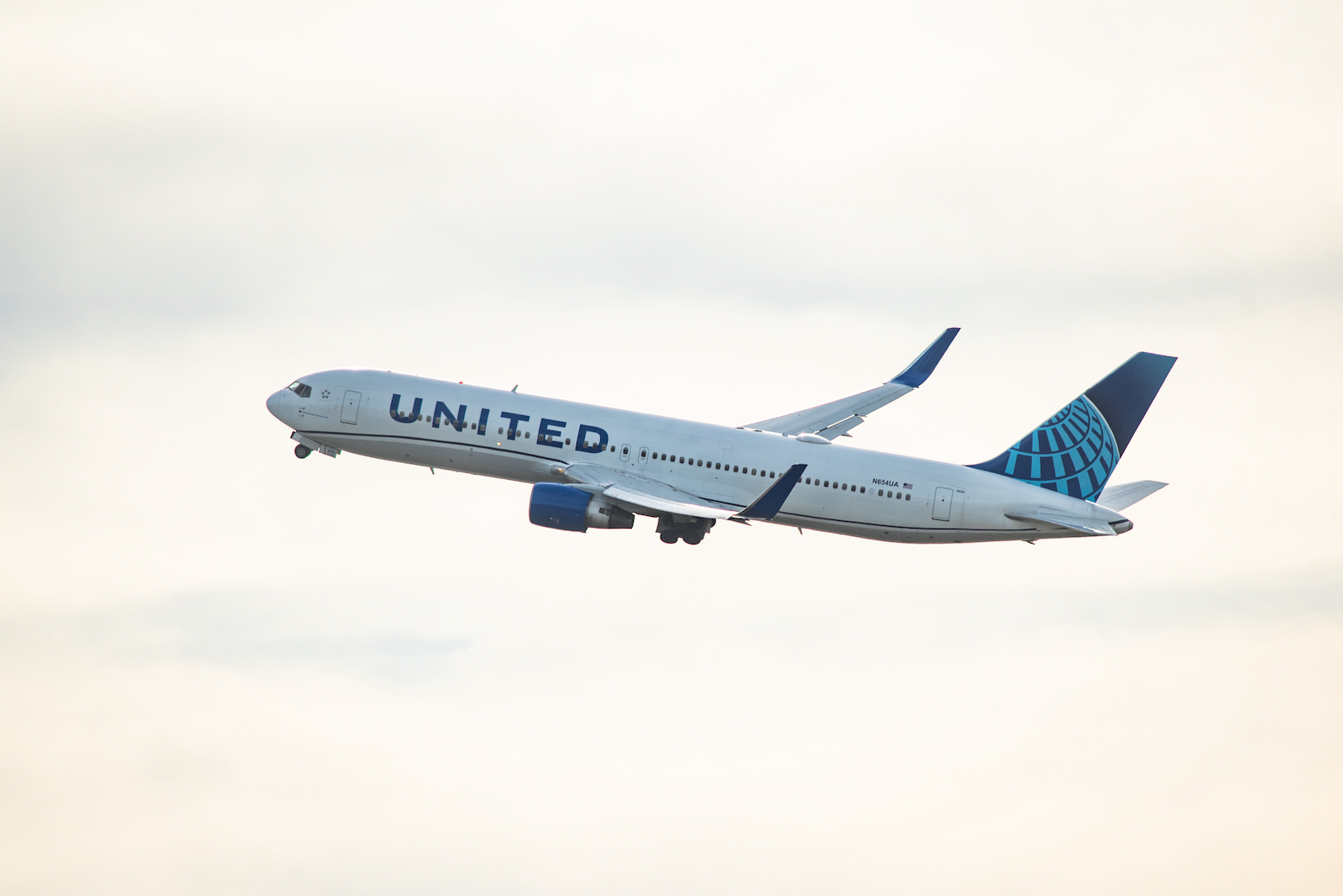
A United Boeing 767-300 departs from Newark (Photo: Shutterstock | KMarsh)
United is advising customers that it will maintain its reduced schedule at Newark Liberty International Airport but plans to “slowly and safely” rebuild after the completion of runway construction there next month.
United Vice President Jon Gooda, who oversees the airline’s hub at Newark, laid out a plan for “getting back on track” in a statement released for MileagePlus members on Thursday. He said the carrier will continue to operate on a reduced schedule in compliance with an order from the FAA aimed at easing congestion at the airport, which is grappling with equipment failures and a shortage of air traffic controllers.
Gooda noted that United proactively cut 35 flights at Newark when troubles first surfaced weeks ago and said the move “got our operation back on the right path.” The airline hopes to add back flights when Newark finishes construction on one of the three runways it uses for commercial jets, another factor in the airport’s wave of delays and cancellations.
“We expect EWR’s runway construction to be completed in mid-June,” Gooda said. “Our plan is to slowly and safely build our schedule over the summer. However, because of the recent FAA decision, every airline’s schedule at EWR will be smaller than planned and smaller than last year, including ours. We’ll operate fewer daily flights this summer compared to last year, which gives us even more confidence that our EWR operation will continue to run reliably.”
Looking Ahead
Gooda also emphasized that, even with the logistical challenges at Newark, United has cancelled comparatively few flights. On eight of the past 11 days, he said, the airline canceled less than 1% of its departures out of Newark, while the airport is once again beating LaGuardia in on-time arrivals.
Newark is United’s largest hub and a critical node in its East Coast and transatlantic network, so disruptions there can have a substantial impact on operations. The airline has a smaller presence at LaGuardia and no presence at New York-JFK.
Newark has faced rounds of flight delays and cancellations since late April, when air traffic controllers first lost contact with pilots at and around the airport. Several more outages have struck since then, and the problem has been worsened by the number of air traffic controllers now out on trauma leave. The FAA has acknowledged that, due to chronic understaffing, there is no quick way to rebuild the ATC team needed to oversee Newark.
Zach Vasile is a writer and editor covering news in all aspects of commercial aviation. He has reported for and contributed to the Manchester Journal Inquirer, the Hartford Business Journal, the Charlotte Observer, and the Washington Examiner, with his area of focus being the intersection of business and government policy.
United Aviate Academy Faces Another Lawsuit
A former student at United Aviate Academy has filed a lawsuit against the flight school, alleging fraud and significant delays in training.
A United Aviate Academy aircraft (Photo: AirlineGeeks | Ryan Ewing)
A former student at United Aviate Academy has filed a lawsuit against the flight school, alleging fraud and significant delays in training that prevented program completion within the advertised time frame.
United Airlines purchased Westwind School of Aeronautics in Phoenix in February 2020, rebranding it as United Aviate Academy (UAA) to support the carrier’s goal of hiring more than 10,000 pilots within the next decade. The academy marketed itself as an expedited flight school program designed to provide all necessary certifications to become a commercial pilot within one year.
According to court documents, the program was structured to deliver seven training components within specific time frames: private pilot training (two months), instrument rating (two months), commercial single-engine initial (three months), commercial multiengine add-on (one month), certified flight instructor (two months), certified flight instructor-instrument (one month), and multiengine flight instructor (one month).
Latest Lawsuit
Carrie Lynne Thompson, the plaintiff in the recently refiled case, claims she enrolled in October 2022 after receiving assurances that the UAA program could be completed in 12 months. In her complaint, Thompson alleges this timeline was promoted across multiple channels, including “marketing materials, billboards, commercials, print advertisements, online references, the leave of absence agreement, the student agreement, and press releases.”
Her initial complaint was first filed on July 15, 2024. After some back and forth in the court docket, Thompson filed an amended complaint on April 12.
Thompson’s lawsuit details how students were allegedly prohibited from working while attending the academy, forcing many to rely on student loans and savings to fund their education based on the promised accelerated timeline.
“It took me nine months to receive my private pilot license [PPL], which was, according to the marketing materials, student agreement, website for the academy, and course catalog provided by both the academy and United Airlines, supposed to take two,” Thompson stated in her amended complaint.
Thompson is seeking $500,000 in damages, aiming to recover the losses she alleges were incurred due to the academy’s mismanagement and misleading promises. Her lawsuit contends that the financial strain imposed by the extended duration of the program, combined with lost income and accrued debts, warrants this compensation.
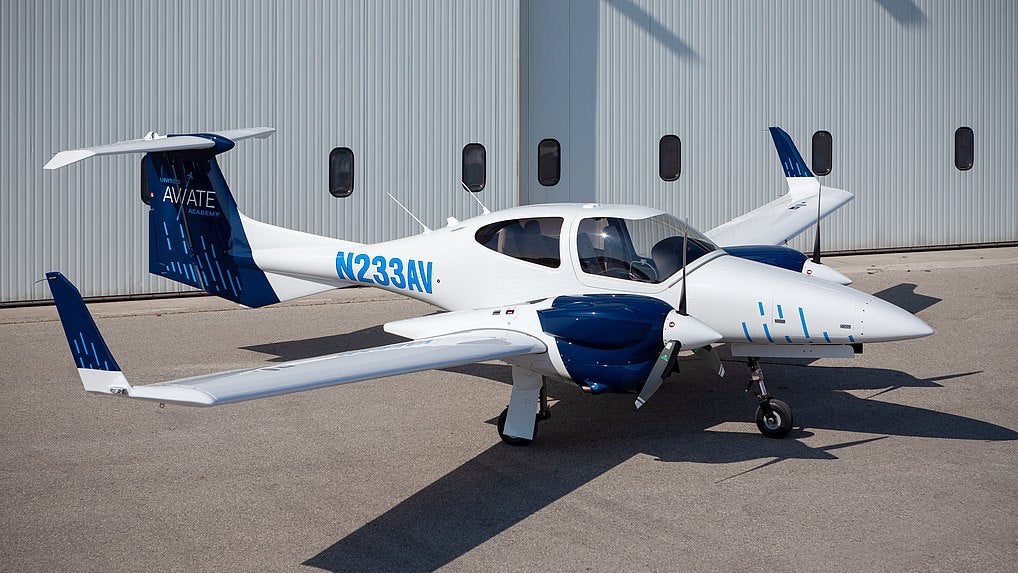
United Aviate Academy agreed to acquire five Diamond DA42-VI piston twin trainers. (Photo: Diamond Aircraft)
The complaint also requests punitive damages, reflecting the emotional and financial impact that the academy’s purported failures have had on her and potentially on other students facing similar circumstances.
Implications of Inadequate Training
The lawsuit further contends that these operational issues had severe financial consequences for students who invested tens of thousands of dollars based on allegedly misleading information. Thompson claims she lost approximately $100,000 in income during her time away from work, in addition to incurring over $49,000 in academy fees and approximately $25,000 in relocation expenses.
According to Thompson’s filing, “no student who began with [zero] flight hours from my class finished in fewer than 18 months,” despite the advertised 12-month timeline. The complaint further alleges that of the entire student body, only three students were able to complete the program within the promised time frame.
The other lawsuit—which was filed in March—includes similar allegations from multiple former students, including claims that some received only about 300 hours of flight time over two years, significantly less than expected.
Student Experiences and Complaints
Thompson’s complaint describes how students were allegedly told to “bear with us, we’re a new school and working out the kinks” when they raised concerns about delays. The lawsuit claims students who fell behind schedule—allegedly due to the academy’s operational issues—were sometimes expelled for taking too long to advance through the program.
The filing also references what Thompson describes as a “purely for show” graduation ceremony on January 25, 2023, where “only one student had actually finished all of their ratings,” despite the presence of United CEO Scott Kirby.
Thompson resigned from the academy in July 2023 “due to the lack of consistent training and inability to fund the much longer than expected time frame without work,” according to her complaint. She alleges that despite requesting to return to her previous position as a flight attendant while maintaining her place at the academy, this request was denied by its leadership.
Thompson, 46, stated that the prolonged training period severely disrupted her career trajectory, as the mandatory time commitment at UAA delayed her entry into a professional piloting career at an age when opportunities might become more limited. The mandatory retirement age for airline pilots in the U.S. is 65.
Thompson’s complaint alleges violations of the Arizona Consumer Fraud Act, promissory estoppel/detrimental reliance, and false advertisement.
Court records show that United Airlines has already filed a motion to strike the amended complaint in Thompson’s case, claiming procedural issues with the filing.
On May 1, a federal district court judge ruled in favor of the airline’s motion to strike Thompson’s second amended complaint, citing procedural discrepancies. The court noted that the amended complaint introduced new allegations and causes of action that differed from those previously approved, thereby deeming it unauthorized. Thompson could still contest the court’s order.
Per court records, she is representing herself in this matter.
United Airlines did not directly comment on the March class-action lawsuit, only stating to the Associated Press that the carrier has “the highest confidence in the rigorous curriculum and flight training program provided at United Aviate Academy and are proud of the school’s hundreds of graduates.”
Editor’s Note: This story first appeared on FlyingMag.com.
Ryan founded AirlineGeeks.com in February 2013 and has spent more than a decade covering the airline business. His work has been featured by CNN, WJLA, CNET, and Business Insider. His aviation experience spans airport operations, Part 135 regulatory compliance, and airline crew workforce planning, along with time behind the yoke of a Cessna 172 and interviews with airline executives. Ryan now serves as Group President of Firecrown Media’s Aviation Group. He holds a B.S. in Air Transportation Management and an MBA from Arizona State University and teaches Airline Management at Embry-Riddle Aeronautical University.
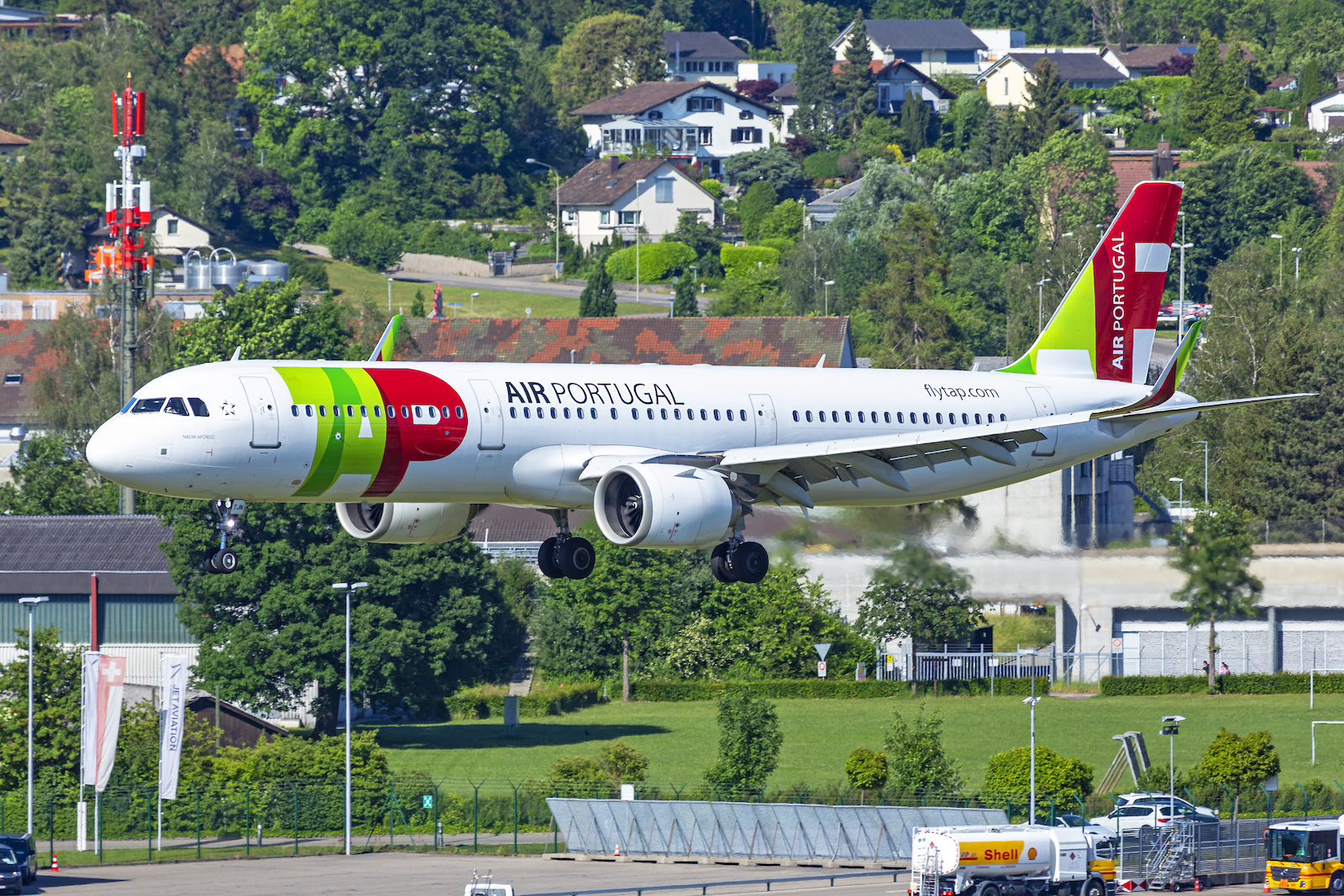
A TAP Air Portugal A321neo (Photo: AirlineGeeks | William Derrickson)
Editor’s Note: AirlineGeeks is proud to present our ‘Livery of the Week’ series. Every Friday, a team member will share an airline livery, which can be from the past, present, or even a special scheme. Some airline liveries are works of art. The complexity associated with painting around critical flight components and the added weight requires outside-the-box thinking from designers. The average airliner can cost upwards of $200,000 to repaint, creating a separate aircraft repainting industry as a result.
Have an idea for a livery that we should highlight? Drop us a line.
TAP Air Portugal, the flag carrier of Portugal, has sported a series of distinctive liveries throughout its long history, reflecting both its national identity and evolving branding strategies. The airline’s visual presentation on its aircraft has transitioned through various designs, with the current iteration emphasizing a modern look while retaining strong ties to Portuguese heritage.
The contemporary livery prominently features the name “TAP Air Portugal” in a stylized, typically sans-serif font along the forward fuselage. The airline’s logo, a key element, is displayed on the tail fin and often incorporates the colors of the Portuguese flag – green and red – alongside white.
The main body of the aircraft is predominantly white, a common choice in the aviation industry for its thermal and maintenance advantages.
Historically, TAP’s aircraft have showcased several livery changes since its inception as Transportes Aéreos Portugueses in 1945. Early designs featured simpler cheatlines and the full company name. A significant visual identity was established in the mid-20th century, characterized by a white upper fuselage, a cheatline in the airline’s colors, and prominent “Transportes Aéreos Portugueses” titles. The tail often featured a distinctive logo of the era.
In 1979, coinciding with a modernization program and a name change to TAP Air Portugal, a new livery was introduced. This era saw variations, but generally maintained a clean look with the updated branding. Later, in 2005, the airline rebranded as “TAP Portugal,” a change that was also reflected in its aircraft livery, before reverting to “TAP Air Portugal” in 2017, accompanied by the current livery design.
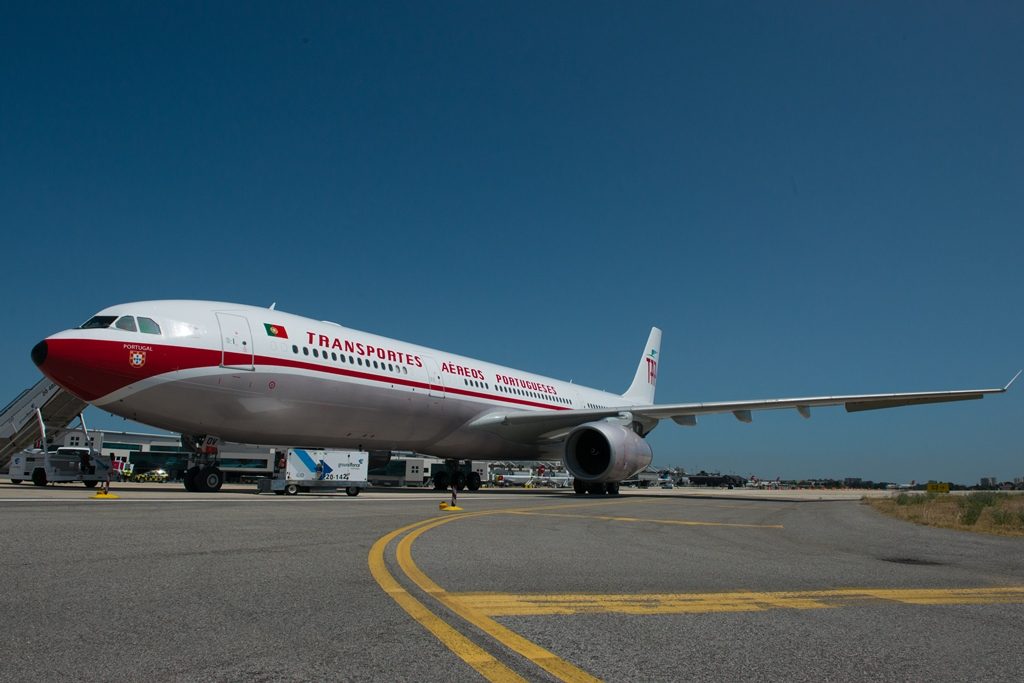
TAP’s newly minted A330 retro jet (Photo: TAP Portugal)
The airline has also embraced its heritage through the use of retro liveries on some of its modern aircraft. Notably, the airline has painted select Airbus aircraft, including an A330 and an A321neo, in a design reminiscent of its livery from the 1950s and 1960s. This popular retro scheme typically features the historic “Transportes Aéreos Portugueses” titles in a classic font along the fuselage.
Looking for a new airplane model? Head over to our friends at the Midwest Model Store for a wide selection of airlines and liveries.
Ryan founded AirlineGeeks.com in February 2013 and has spent more than a decade covering the airline business. His work has been featured by CNN, WJLA, CNET, and Business Insider. His aviation experience spans airport operations, Part 135 regulatory compliance, and airline crew workforce planning, along with time behind the yoke of a Cessna 172 and interviews with airline executives. Ryan now serves as Group President of Firecrown Media’s Aviation Group. He holds a B.S. in Air Transportation Management and an MBA from Arizona State University and teaches Airline Management at Embry-Riddle Aeronautical University.
EasyJet is set to open a new three-aircraft base at Newcastle Airport in March 2026, creating around 130 direct jobs and boosting regional connectivity.
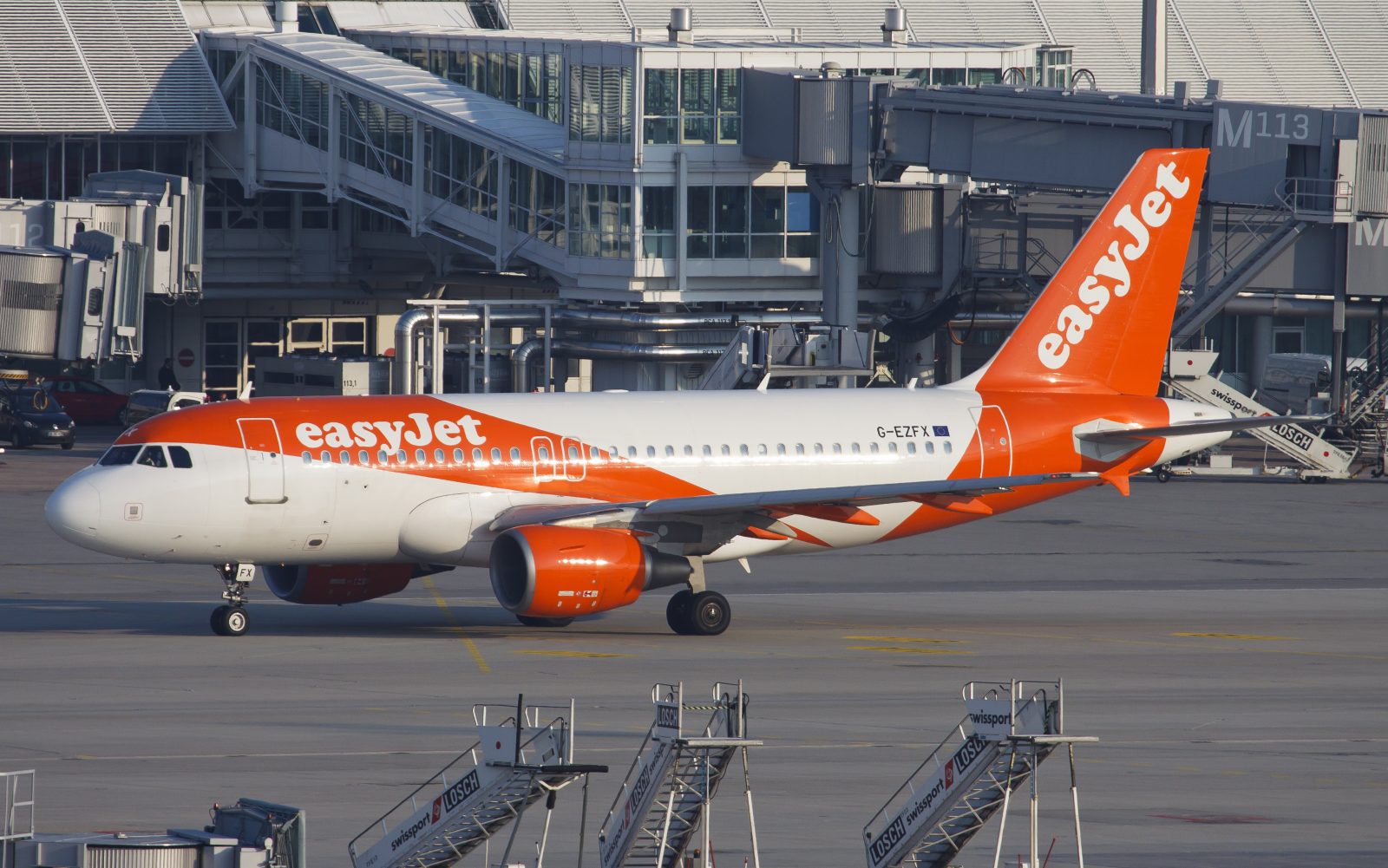
An EasyJet A319 in Munich. (Photo: AirlineGeeks | Fabian Behr)
British low-cost carrier easyJet will open a new three-aircraft base at Newcastle International Airport in March 2026, marking a strategic expansion in Northern England as the airline deepens its U.K. network. The move is expected to create around 130 direct jobs and support an estimated 1,200 positions across the wider economy.
The new base, easyJet’s 11th in the U.K., will allow the airline to increase connectivity in the North East and Southern Scotland, tapping into a catchment area traditionally underserved by London-centric operations. The company already serves eight routes from Newcastle and plans to announce new destinations and package holidays in the coming weeks.
“This new base consolidates our position as the UK’s largest leisure airline and supports our growth ambitions in the North,” said Kenton Jarvis, CEO of easyJet.
The decision underscores a growing shift in European air travel as carriers expand beyond capital hubs to reach regional markets with high outbound demand. By establishing a permanent base in Newcastle, easyJet is signaling confidence in the long-term strength of regional airports and their value to the national network. The airline is also stepping up competition with Jet2 and TUI, which have been bolstering their own schedules in the region.
The addition of three based aircraft will not only expand the route network but also allow easyJet to increase scheduling flexibility, improve turnaround times and boost aircraft utilization. Operational control is particularly important during peak summer periods when leisure travel dominates the demand curve.
“The new base is a strong vote of confidence in Newcastle Airport and our skilled workforce,” said Nick Jones, Chief Executive at Newcastle International Airport. “It strengthens our long-term partnership with easyJet and brings real economic value to the region.”
Regional Connectivity Tied to Post-Brexit Economic Goals
The announcement aligns with local and national development goals aimed at boosting the regional economy outside of London. The North East is seeking to attract international tourism and business travel in the post-Brexit economy, and stronger air links are seen as key to that ambition.
Still, success will depend on sustained passenger demand and efficient operational conditions. Regional bases have at times proven vulnerable to fluctuating fuel prices, labor availability, and airport charges.
easyJet has been on a growth streak in the U.K., launching a base at London Southend in March and expanding its presence at Birmingham last year. Seven additional aircraft were added to the U.K. fleet this summer, as the airline prepares for its largest U.K. flying program ever—offering over 33 million seats across 44 new routes.
Newcastle will be its 11th UK base, joining operations in London Gatwick, Luton, Southend, Manchester, Liverpool, Birmingham, Bristol, Glasgow, Edinburgh, and Belfast.
Founded nearly 30 years ago in the UK, easyJet now serves over 120 destinations in 30 countries. The airline carried more than 100 million passengers in 2024 and is planning to operate 100 million seats this year.
Tolga is a dedicated aviation enthusiast with years of experience in the industry. From an early age, his fascination with aviation went beyond a mere passion for travel, evolving into a deliberate exploration of the complex mechanics and engineering behind aircraft. As a writer, he aims to share insights , providing readers with a view into the complex inner workings of the aviation industry.
Midway Airport Redesignates Runways After Close Call
The Chicago Department of Aviation announced the planned airfield changes as part of ongoing safety improvements at the city’s second-busiest airport.
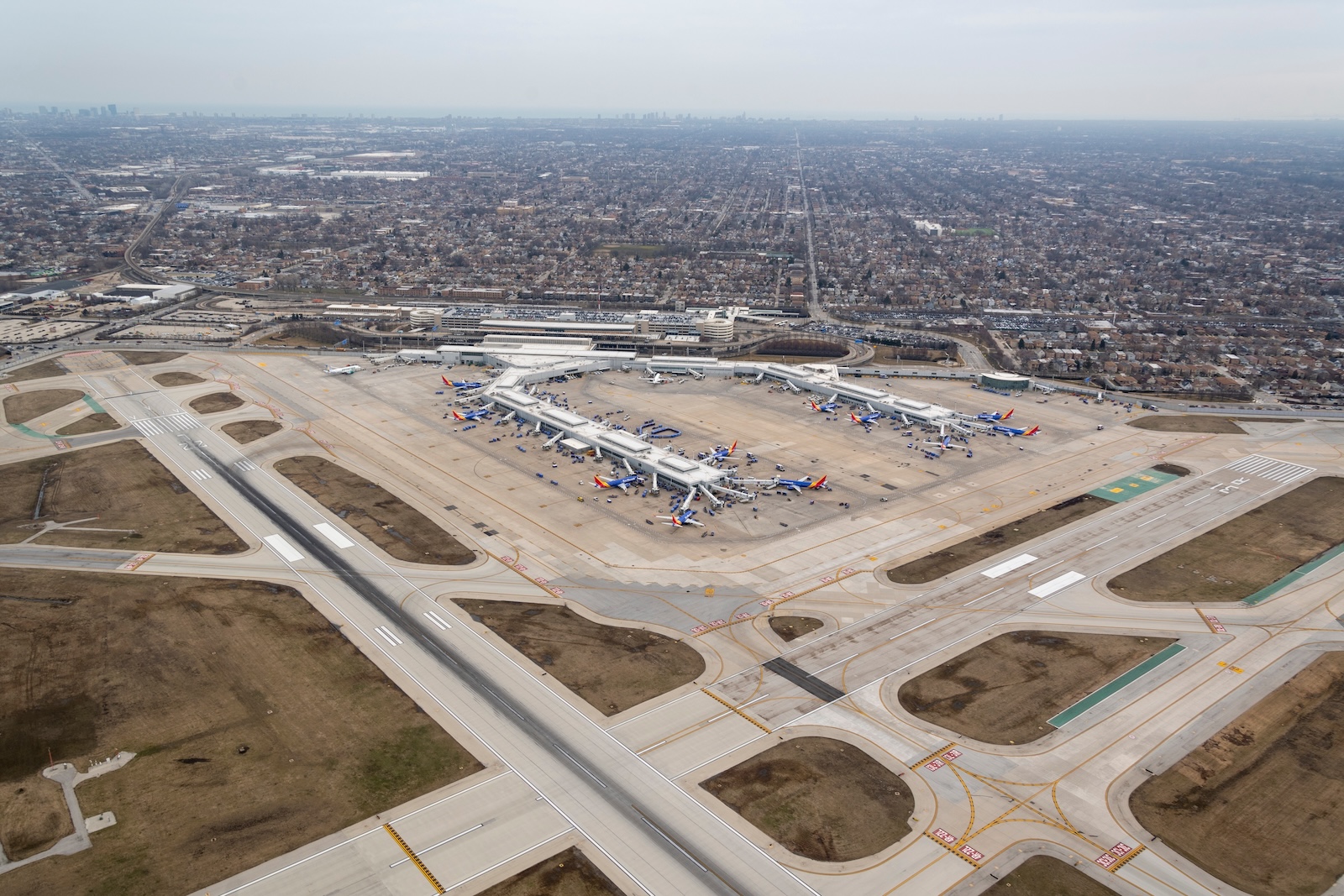
An aerial view of Chicago's Midway Airport. (Photo: Shutterstock | Henry C Jorgenson)
Chicago Midway International Airport will redesignate its runways on June 12. Runway 13C/31C will become Runway 13L/31R, while the existing Runway 13L/31R will be decommissioned.
The Chicago Department of Aviation announced the planned airfield changes as part of ongoing safety improvements at the city’s second-busiest airport.
According to an FAA Safety Team Notice (NOTC4427) issued on Wednesday, the changes are significant enough to warrant a special notification to pilots and aviation personnel. The notice is scheduled to remain active until June 19, one week after implementation.
The redesignation comes following a series of safety mishaps at the airport, including a near-miss involving Southwest flight 2504, a Boeing 737-800, and a FlexJet Challenger 350 in February. The incident occurred when the Challenger jet crossed Runway 31C while the Southwest aircraft was operating on the same runway.
According to the National Transportation Safety Board’s preliminary report, the Flexjet crew, while taxiing for departure, was instructed to turn onto Runway 4L, cross Runway 31L, and hold short of Runway 31C. However, the pilots reported confusion over the taxi instructions and misidentified Runway 31L as a taxiway due to its narrow width, similar to adjacent taxiways, and the proximity of Taxiway F and Runway 13R/31L.
This misperception led them to believe they had not yet crossed Runway 31L when they were, in fact, entering Runway 31C, which was active for the Southwest flight’s landing. Compounding the issue, the Flexjet crew stated that sun glare impeded their visibility, preventing them from seeing critical hold short lines and signage for Runway 31C.
Ryan founded AirlineGeeks.com in February 2013 and has spent more than a decade covering the airline business. His work has been featured by CNN, WJLA, CNET, and Business Insider. His aviation experience spans airport operations, Part 135 regulatory compliance, and airline crew workforce planning, along with time behind the yoke of a Cessna 172 and interviews with airline executives. Ryan now serves as Group President of Firecrown Media’s Aviation Group. He holds a B.S. in Air Transportation Management and an MBA from Arizona State University and teaches Airline Management at Embry-Riddle Aeronautical University.
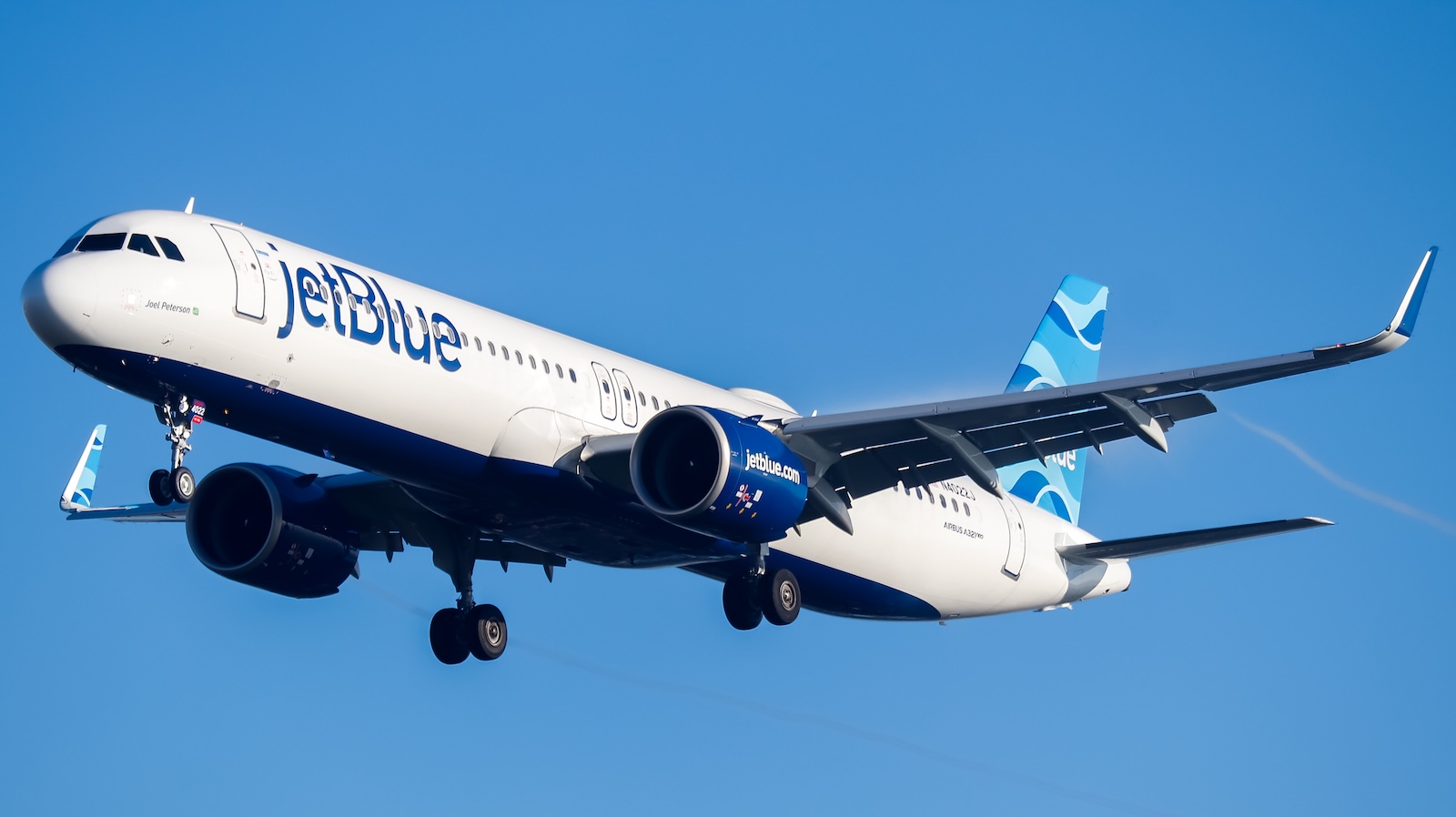
A JetBlue A321LR in London. (Photo: Shutterstock | Bradley Caslin)
JetBlue is expanding its seasonal route offerings this summer with two new nonstop flights linking Boston with Madrid and Edinburgh, Scotland.
The flights launched on Thursday and will continue on a daily basis through Oct. 25. JetBlue officials said the Boston-Madrid connection is the airline’s first-ever service to Spain.
“With our deep Boston roots, we’re excited to be putting more of Europe within reach for New England travelers with JetBlue’s low fares, great service, and the convenience of flying right from Logan,” said Daniel Shurz, JetBlue’s senior vice president of revenue, network, and enterprise planning, in a news release. “As we grow across the Atlantic from Boston, we’re also making it easier to connect to more of our network across the U.S., Latin America, and the Caribbean.”
The carrier is using Airbus A321LR aircraft to operate both routes.
Growing The Network
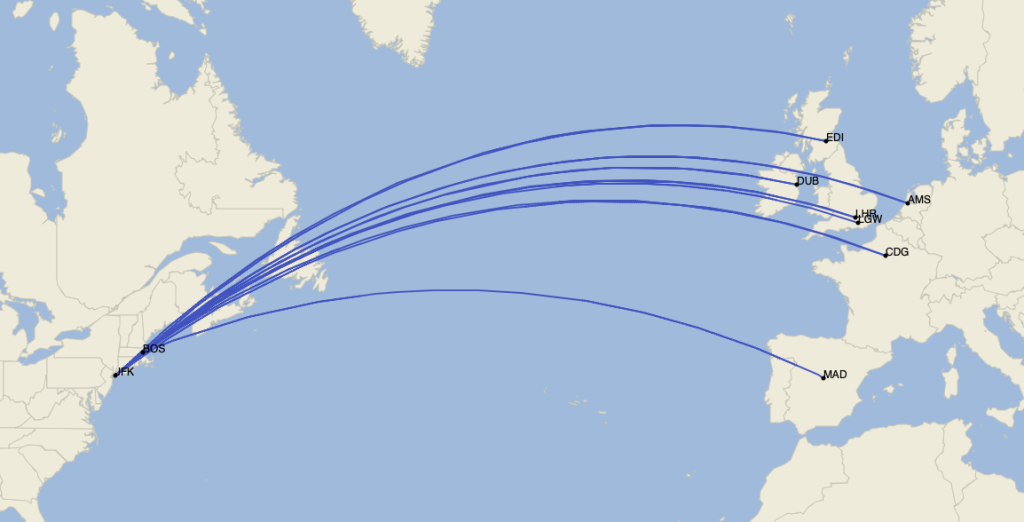
JetBlue officials said the European expansion is part of an effort to build up their East Coast “leisure network,” which already includes seasonal service from Boston to Amsterdam, Dublin, and London-Gatwick. JetBlue also flies between Boston and London-Heathrow and Paris year-round.
JetBlue’s European network in June 2025 (Photo: Cirium Diio)
The seasonal service between Boston and London-Gatwick restarted on Thursday.
JetBlue also offers summer flights from JFK in New York to Dublin and Edinburgh, plus year-round routes to Amsterdam, London-Heathrow, and Paris. The routes to Dublin and Edinburgh have been extended to the end of October this year, one month later than last year.
Zach Vasile is a writer and editor covering news in all aspects of commercial aviation. He has reported for and contributed to the Manchester Journal Inquirer, the Hartford Business Journal, the Charlotte Observer, and the Washington Examiner, with his area of focus being the intersection of business and government policy.
Sign-up for newsletters & special offers!
Get the latest stories & special offers delivered directly to your inbox