The first look at the Greater Bay Airlines 737.
(Photo: Oriental Daily)
Greater Bay Airlines, the new airline in Hong Kong, has spread its wings after the lifting of travel restrictions in Hong Kong in September. The airline launches two new routes with starting its service to Tokyo and Seoul, South Korea within six days.
“Greater Bay Airlines will create a new aviation chapter with an innovative operation mode.” Bill Wong, the chairman of the airline gave a speech in the ceremony before launching the flight services to Tokyo.
The new airline is best known for focusing on the Greater Bay Area and the Southern China near Hong Kong, which has a population of 86 million.
Traditional Airline or Low-Cost-Carrier?
Greater Bay Airlines is currently operating four routes with three 737-800s. According to Stanley Hui, the CEO of the airline, the airline lease three aircraft and paid the low rent between $39,000 to 58,000 each month as a result of the pandemic. Hui said that it could rent or acquire two or three aircraft in coming year. In the midterm, the airline targets to own a fleet of 22 by 2027.
The airline is on track to expand its route map, but the impression of the carrier has confused some passengers. Hui emphasized Greater Bay Airlines is not a no-frills airline and “better than a low-cost carrier” with more legroom. The airline considers introducing premium economy class and business class in the future, letting the passengers enjoy a better service without breaking the bank. Earlier, the airline mentioned itself between a traditional airline and a budget carrier.
Hui forecast the airline needs to train its own pilots and hire 150 front-line staff for expanding the business. The airline focuses on Asian markets and Chinese cities, such as Beijing and Shanghai.
Travel demand in Hong Kong has surged since the travel restrictions were lifted. Hong Kong International Airport has handled 1.6 million passengers in December. The airport has also revealed a total of 5.7 million travelers in 2022. Compare that to 2019, when the then vibrant airport has served more than 70 million travelers.
However, the aviation industry in Hong Kong is not out of the woods. The South Korean government has sounded the alarm and forced arriving flights from Hong Kong touch down at Seoul’s Incheon airport. The passengers couldn’t arrive in their destinations in the country directly, such as Jeju and Busan. It came after the announcement of China to reopen its border.
Hong Kong Express, the budget carrier has hit hard under the new regulations. In addition, the travelers from Hong Kong are not allowed to transit at Incheon Airport. In the meantime, the Hong Kong budget carrier has canceled a number of flights to Japan, in response to the latest travel restrictions.
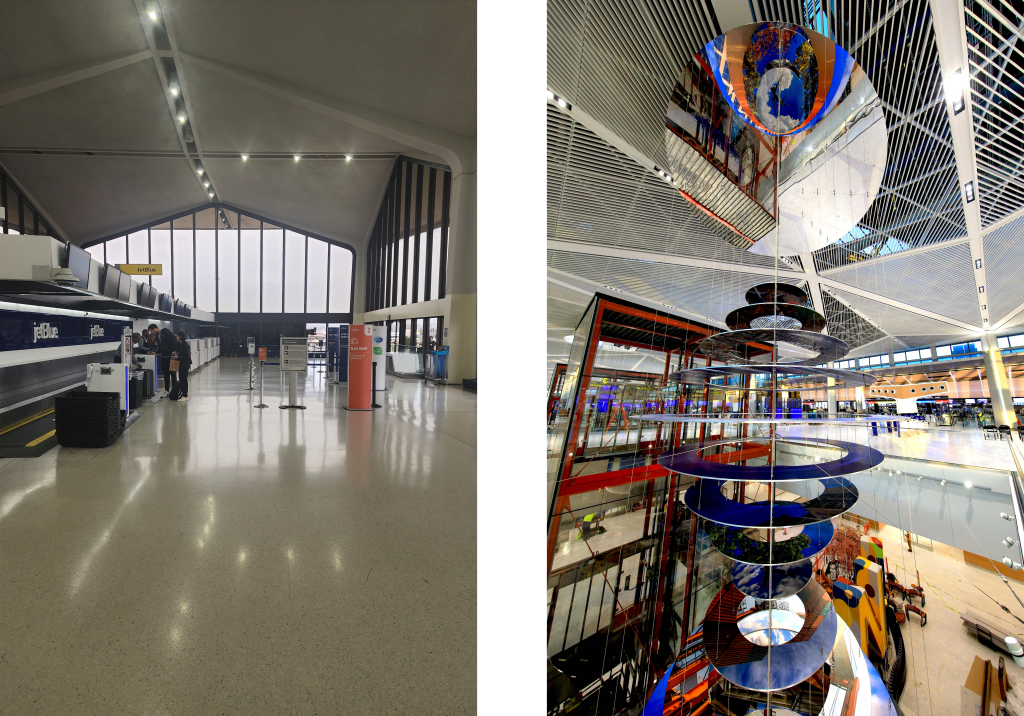
New Terminal A at Newark Liberty International Airport (Photo: Port Authority of New York and New Jersey)
After a month-long delay, Newark Liberty International Airport’s brand-new Terminal A opened for operations last week.
Passengers began using the 1 million square foot terminal on Thursday, marking a much-anticipated grand opening for the beautiful new facility. With a price tag of $2.7 billion dollars, the new terminal is the largest single investment in New Jersey in the history of the Port Authority of New York and New Jersey.
A Gorgeous New Terminal
The new terminal is replacing the old Terminal A, which sits to the north of the new facility and is set to be demolished. That building opened in 1973 and has a reputation as an outdated and uncomfortable facility with limited amenities. The airport as a whole does not have the best reputation either. In late 2022, Newark Liberty International Airport was ranked as the worst airport in the mega-airport category for passenger satisfaction in consumer research and analytics firm J.D. Power’s 2022 North America Airport Satisfaction Study.
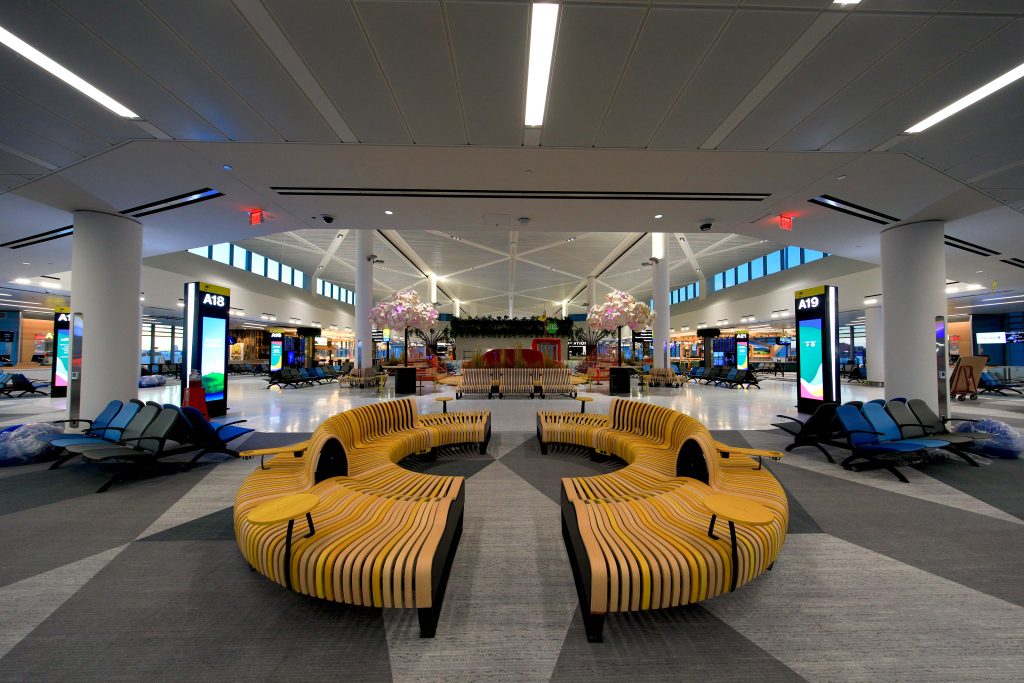
The airport’s new Terminal A is on track to change that. Compared with the poorly lit and crowded spaces in the old Terminal A, the newly opened facility is a major improvement. Departing passengers are welcomed by large modern common check-in area featuring high ceilings and natural light. A common security area features 16 lanes, a significant improvement from the old Terminal A which had individual security checkpoints for each pier of gates.
Throughout the terminal, passengers can enjoy modern art as well as food and retail outlets from 60 regional, national and global brands. While the terminal currently does not have any lounges, four are set to open in the future: an American Admirals Club, a Delta Sky Club, a United Club and an American Express Centurion Lounge. Thursday’s opening included 21 of the 33 gates, which now serve Air Canada, American Airlines, JetBlue and some United Airlines flights. Delta Air Lines will also start using the facility later in the year when the final 12 gates become operational.
Old (Left) and New (Right) Terminal A at Newark Liberty International Airport (Photos: Port Authority of New York and New Jersey)
A Rocky Opening
The opening of Newark’s newest airport terminal faced some setbacks. The first phase of the terminal was first scheduled to open in 2021 but was pushed back to the summer of 2022 due to the COVID-19 pandemic. It was then delayed to early December when it was subsequently pushed back to this month due to some last-minute operational issues with fire alarms and security systems.
The terminal also faced a number of hiccups on its opening day. An early morning power outage briefly shut down all security screening. Then, the Transportation Security Administration (TSA) identified a security breach, in which two individuals apparently managed to bypass a security checkpoint. Delays at the security checkpoint have continued to affect passengers travelling out of the new Terminal A, with the airport posting on Twitter about security delays at the terminal multiple times since its opening.
There also appeared to be some confusion among passengers about the opening of the new terminal, with the airport making a midday Tweet on opening day with directions for those parked at the old Terminal A. Despite the terminal making positive visual impressions, passengers also reported delays with flights and bags.
New Terminal A at Newark Liberty International Airport (Photo: Port Authority of New York and New Jersey)
A Redeveloped Airport
The new Terminal A is part of an overall redevelopment plan for the airport that could change its subpar reputation among passengers. The next phase of the plan involves the hiring of a planning and design firm to oversee a vision plan for the airport. The Port Authority has also committed to replacing the aging AirTrain Newark system. The train line, which carries passengers and employees between terminals, parking facilities and the Northeast Corridor Rail Link Station, is an essential part of the airport’s infrastructure but is at the end of its useful life.
Despite the long road ahead for the redevelopment plan, the Port Authority is optimistic about the facility’s future. “The first airport operations out of the world-class Terminal A mark a truly historic milestone for Newark Liberty,” said Port Authority Executive Director Rick Cotton in a press release.
“This is an important step forward in our vision to transform the airport into a state-of-the-art gateway to the world. We are committed to continue elevating the passenger experience by building modern, 21st century facilities like this terminal, delivering superior amenities and a real new Jersey sense of place.”
Andrew is a lifelong lover of aviation and travel. He has flown all over the world and is fascinated by the workings of the air travel industry. As a private pilot and glider pilot who has worked with airlines, airports and other industry stakeholders, he is always excited to share his passion for aviation with others. In addition to being a writer, he also hosts Flying Smarter, an educational travel podcast that explores the complex world of air travel to help listeners become better-informed and savvier travelers.
An American Boeing 777-200 lifts off from New York's JFK.
(Photo: AirlineGeeks | Ben Suskind)
The National Transportation Safety Board (NTSB) is investigating a close call at New York’s John F. Kennedy International Airport after a near-miss between two aircraft Friday evening.
A Near-Disastrous Incident
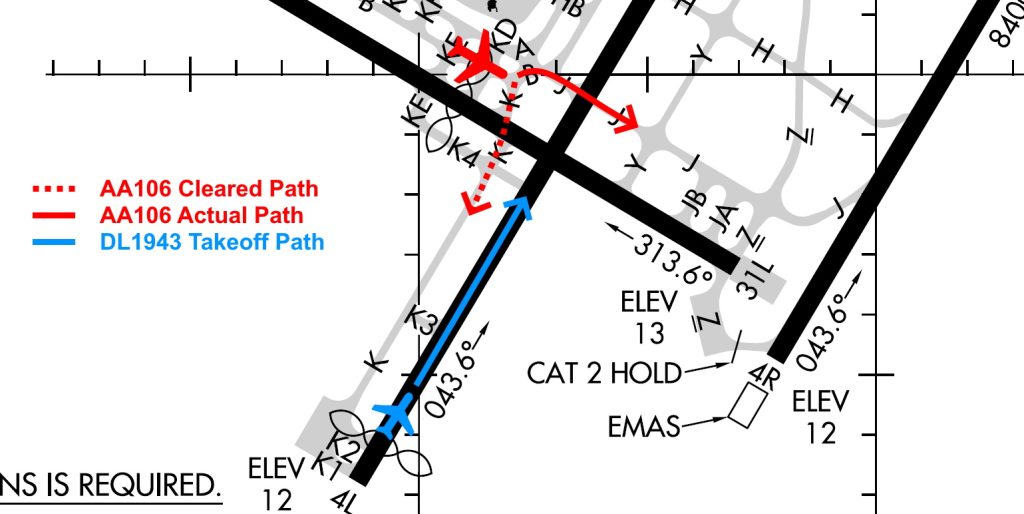
At around 8:45 p.m., Delta Air Lines Flight 1943 was taking off from Runway 4L when an American Airlines jet crossed the same runway. Initial analysis shows that the American Airlines Boeing 777-200ER bound for London Heathrow had not been cleared to cross Runway 4L and was instead cleared to cross the intersecting Runway 31L. The Delta flight was bound for Santo Domingo in the Dominican Republic and was being operated by a four-year old Boeing 737-900ER registered as N914DU.
Fortunately, an air traffic controller noticed the incident and a potential collision was avoided. The Delta aircraft rejected its takeoff run and stopped approximately 1,000 feet from where the American Airlines widebody jet had crossed.
The diagram below shows the paths of the two aircraft:
Runway incident at John F. Kennedy International Airport on January 13, 2023 (Diagram: Andrew Chen | AirlineGeeks, Original Airport Diagram: Federal Aviation Administration)
Dramatic Air Traffic Control Audio
Recordings of the air traffic control transmissions help paint a picture of what occurred. The American Airlines flight, operated by a 22-year old Boeing 777-200ER registered as N754AN, was taxiing for departure and was cleared to cross Runway 31L at Taxiway Kilo, a move that would not have put it in the path of the departing Delta jet.
The Delta flight is then cleared for takeoff from Runway 4L. Approximately 20 seconds later, the following exchange occurs:
Instead of crossing Runway 31L as cleared, the American flight crossed Runway 4L, into the takeoff path of the Delta 737.
Due to its size and traffic volume, the airport actually has two Tower frequencies. Meanwhile on the other Tower frequency, the controller instructs the American Airlines flight to stop, although it is unclear if the aircraft was on this frequency:
JFK Tower: American 106 heavy, American 106 heavy hold position
After rejecting the takeoff, the Delta pilot sounds relieved. The aircraft then taxis off the runway and asks for some time to complete checklists and make some phone calls:
Delta 1943: All right and uh…phew. Delta 1943
JFK Tower: Delta 1943, are you able to taxi or do you need a couple of minutes to run checks?
Delta 1943: Yeah we can get off the runway, Delta 1943
JFK Tower: Delta 1943, turn left Juliet…and um…just remain clear of Runway 4L.
The controller later speaks with the American Airlines flight:
JFK Tower: American 106 heavy, possible pilot deviation. I have a number for you, advise ready to copy.
The Federal Aviation Administration (FAA) website provides the following information on pilot deviations: “Ground deviations can happen while taxiing, taking off, or landing without clearance, deviating from an assigned taxi route, or failing to hold short of an assigned clearance limit.”
In this case, it appears that the American flight did not follow its assigned taxi route and instead crossed an active runway without clearance. When deviations occur, air traffic control will often give the pilots a phone number to call to discuss the matter.
After the number presumably being given, the conversation continues between the controller and the American pilots:
American 106: Tower, American 106 heavy
Tower: American 106 heavy
American 106: The last clearance we were given, we were cleared to uh cross, is that correct?
JFK Tower: American 106 heavy…we’re departing runway 4…um I guess we’ll listen to the tapes, but uh…you were supposed to depart Runway 4L. You’re currently holding short of uh 31L.
American 106: Roger American 106 heavy
See the video below for air traffic control recordings of the incident:
A Rare but Potentially Deadly Occurrence
While many runway incursions do not result in any immediate safety consequences, they have occasionally led to deadly results.
The deadliest accident in aviation history occurred when two Boeing 747 aircraft collided at Los Rodeos Airport, now known as Tenerife North Airport in Tenerife, Spain. Amidst patches of fog at the airport, a KLM Boeing 747-200 started its takeoff run while a Pan Am Boeing 747-100 was taxiing on the same runway. The collision and subsequent fire killed 583 people, with 61 survivors from the Pan Am aircraft.
Incidents similar to what occurred on Friday also happen from time to time. In July 2018, A KLM Cityhopper Embraer E190 received take-off clearance while a KLM Boeing 737-800 was also cleared to line up and take off further down on the same runway at Schiphol Airport in Amsterdam. The pilots of the Embraer E190 stopped their takeoff roll when when they heard that the Boeing 737 was also getting takeoff clearance.
Investigation Ongoing
The American flight ended up departing for London around an hour behind schedule. Meanwhile, the Delta flight was cancelled and rescheduled for the following morning.
At this point, the NTSB is conducting an investigation that will ultimately uncover the details on what happened. That being said, it appears clear that the Delta pilots were following their takeoff clearance while the American flight crossed the runway without proper clearance.
There are still questions that remained unanswered though. While this is no doubt a frightening incident, it is unclear whether the trajectories and positioning of the aircraft would actually have led to a collision had the takeoff not been aborted. It is possible that the Delta flight would have narrowly missed the American aircraft.
In addition, the airport is equipped with Airport Surface Detection Equipment, Model X (ASDE-X) equipment. ASDE-X is a system that uses using radar, multilateration and satellite technology to help air traffic controllers track the movement of aircraft and vehicles on the ground. According to the FAA, the ASDE-X system has alarms that alert controllers of possible runway incursions or incidents. It is unclear whether this system played a role in this incident.
Andrew is a lifelong lover of aviation and travel. He has flown all over the world and is fascinated by the workings of the air travel industry. As a private pilot and glider pilot who has worked with airlines, airports and other industry stakeholders, he is always excited to share his passion for aviation with others. In addition to being a writer, he also hosts Flying Smarter, an educational travel podcast that explores the complex world of air travel to help listeners become better-informed and savvier travelers.
The relationship between aircraft and film stretches back about 100 years to the early days of aviation. Film cameras initially captured aircraft performing stunts and planned crashes to excite cinema audiences and this evolved into aviation providing the backdrop for feature films. Indeed the first Best Picture Academy Award in 1927 was given to the World War I combat pilot film ‘Wings’.
Over the next century film producers utilized aircraft and aviation within their motion pictures to varying degrees of success and accuracy. This week sees the latest Hollywood endeavor hit the screens with the singularly titled ‘Plane’ starring Gerard Butler. Though first and foremost a ‘popcorn picture’ the film may give some airline geeks, particularly pilots cause for concern about how flying and aerodynamics are portrayed. Be assured this film will not be in line for next year’s Best Picture race but that is not to say it is not a good film.
Aircraft have been a central part of the plot for action thrillers such as 2005’s ‘Flight Plan’ and ‘Red Eye’ and the recent Liam Neeson film ‘Non-Stop’. A number of films that have featured aircraft and airlines may have given cause to those who have some understanding or background within aviation to exclaim “that could never happen” or “aircraft can’t do that!”. The firing of a gun inside a pressurized aircraft cabin will have more serious consequences and widebody aircraft require more than two or three flight attendants onboard.
To me, a suspension of disbelief is key when watching these films just as those who have any understanding as to how cars and trains operate must do when they watch any of the ‘Fast and Furious’ franchise or the recent Brad Pitt ‘Bullet Train’ (if the train is moving as fast as the outside shots portray why are the buildings going by so slowly in the interior shots?). Doing otherwise becomes a distraction and an annoyance to those viewing with you.
One of the more absurd scenes I recall from my youth was the opening of the flight deck window inflight to fire a flare to deflect a missile in ‘The Concorde…Airport ‘79’. Definitely worth a watch for this and other more ridiculous scenes – the epitome of an airline geek guilty pleasure – apparently filmed with the permission of Air France. In fact, the complete series of four films in the ’Airport’ franchise is worth a watch if only for the absurdities of aerodynamics on display and the stars of Hollywood’s bygone era being subjected to all manner of action set-pieces and bad dialogue.
As someone with only a vague knowledge of the industry may appreciate these and other films are somewhat removed from the actualities of flight. There are unintentional inconsistencies to match the intentional absurdities of the classic spoof comedy ‘Airplane!’. For films that have gone some way to get most aspects right – but not all – airline geeks may wish to consider Clint Eastwood’s ‘Sully’ or the under-rated Jeff Bridges film ‘Fearless’.
In my opinion, there is just as much enjoyment to be had from pilot Gerard Butler making an emergency landing in a commercial aircraft on a makeshift jungle runway in ‘Plane’ than any number of National Geographic aviation documentaries.
John has always had a passion for aviation and through a career with Air New Zealand has gained a strong understanding of aviation operations and the strategic nature of the industry. During his career with the airline, John held multiple leadership roles and was involved in projects such as the introduction of both the 777-200 and -300 type aircraft and the development of the IFE for the 777-300. He was also part of a small team who created and published the internal communications magazines for Air New Zealand’s pilots, cabin crew and ground staff balancing a mix of corporate and social content.
John is educated to postgraduate level achieving a masters degree with Distinction in Airline and Airport Management. John has held the positions of course director of an undergraduate commercial pilot training programme at a leading London university. In addition he is contracted as an external instructor for IATA (International Air Transport Association) and has been a member of the Heathrow Community Fund’s ‘Communities for Tomorrow’ panel.
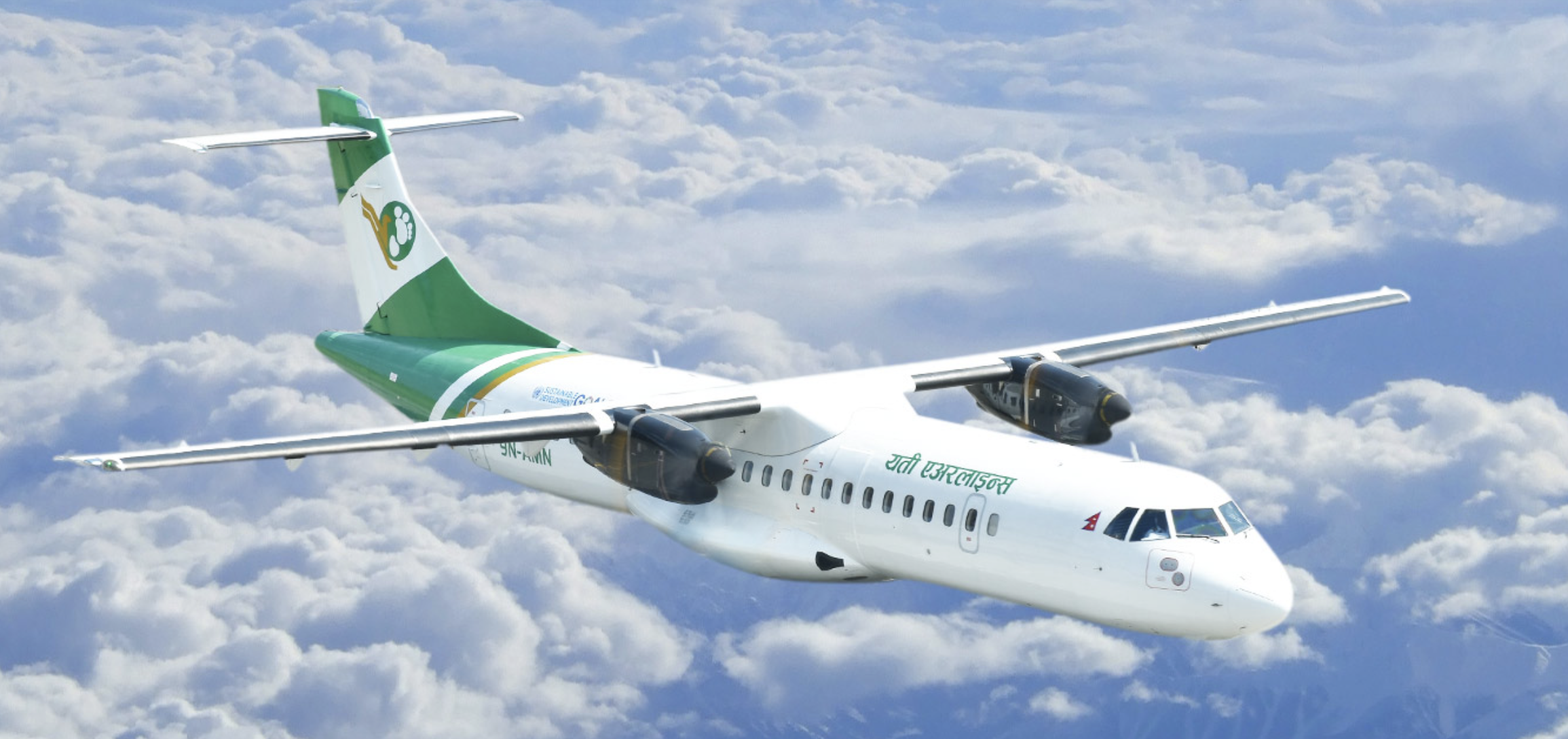
An ATR 72-500 belonging to Nepal’s Yeti Airlines with 72 people on board crashed in Nepal on Sunday, January 15. The aircraft was flying from Nepal’s capital Kathmandu to Pokhara in central Nepal. Unfortunately, of the sixty-eight passengers and four crew members, there would be no survivors.
January 15 is a national holiday in Nepal, Makar Sankranti of a Buddhist-Hindu type, with a harvest celebration and observed for three days: Bhogi Pongal, Surya Pongal and Mattu Pongal.
As shown in a video shared by Diwas Bohora on social media, the low-flying plane is seen suddenly making a turn before crashing to the ground near the Seti River. The reason for the sudden turn clearly is still unknown and will only be clarified once the investigation is completed. Meanwhile, Nepalese Prime Minister Pushpa Kamal Dahal urged security personnel and the public to help in the rescue operation.
The aircraft manufacturer, ATR, shared on its social media that it is aware of the accident in Nepal and that it involved one of its aircraft, adding that “our first thoughts are with all those affected by this accident. ATR specialists are fully committed to supporting both the investigation and the customer.”
Yeti Airlines Notice on their website.
Unfortunately, Nepali airlines do not have a good safety record, so much so that the European Union has banned Nepali planes from plying European skies since 2014, citing air safety problems. However, according to the latest reports in 2022, Nepali aviation had greatly improved aviation safety, so much so that there had been talk of removing Nepali airlines from the European air safety blacklist.
In 2022, ICAO had shown that Nepal’s aviation sector had shown that the global average flight safety rate was 67 percent and that of Asia-Pacific was 63 percent, but Nepal had performed better at 70.1 percent. However, ICAO had already removed Nepal from the Serious Security Concerns (SSC) list in July 2017.
This disaster certainly lowers the average flight safety rate in Nepal again, and unfortunately causes more aviation fatalities.
The author and the entire editorial staff of AirlineGeeks join the grief of the families of the victims involved in the tragic accident.
Vincenzo graduated in 2019 in Mechanical Engineering with an aeronautical curriculum, focusing his thesis on Human Factors in aircraft maintenance. In 2022 he pursued his master's degree in Aerospace Engineering at the University of Palermo, Italy. He combines his journalistic activities with his work as a Reliability Engineer at Zetalab.
A China Southern 737 MAX heads to storage in Everett, Wash. (Photo: AirlineGeeks | Katie Bailey)
After a lengthy period of being prevented from flight, Boeing’s 737MAX took off again with passengers in China on Jan. 13. China Southern flight CZ3960 took off from Guangzhou, China’s Baiyun International Airport for a flight to Zhengzhou, China. The flight was operated by China Southern’s first Boeing 737 MAX B-1206. On the same day, another China Southern Boeing 737 MAX, B-1127, took off for a flight to Wuhan, China.
On Jan. 13, China Southern began continuously scheduling its 737 MAX to operate domestic flights from Guangzhou to Zhengzhou and Wuhan. Passengers did not pay too much attention to the type of aircraft they are flying, and so far the response on Chinese social media regarding the 737 MAX has not expressed any resentment or fear regarding the 737 MAX.
Cautious Moves
China Southern and the Chinese aviation authority were not keen on making a scene about Boeing’s 737 MAX returning into service in China. The flight was only entered into the ticketing system 3 days before take off, and no social media efforts have been spent on 737 MAX. Previously in November 2022, the 737 MAX was briefly scheduled to operate the flight, however, the plan was canceled 2 days ahead of the schedule.
Boeing has not made any public statements or congratulatory gestures on social media. The company has been pushing for its 737 MAX to fly again in China for over a year. Due to the COVID-19 restrictions, airlines were not motivated to unseal their 737 MAXs. As China lifted its pandemic restrictions, airline transportation has experienced a major surge in demand, hence driving the airlines to finally unseal the 737 MAX.
Who’s Next?
Since the Civil Aviation Administration of China (CAAC) released the grounding order for Boeing’s 737 MAX in December 2021, several airlines have made their moves to unseal the aircraft. Air China unsealed two 737 MAXs and took them for several test flights. Hainan Airlines also took two 737 MAXs out of storage from Taiyuan, China and flew them back to the company headquarters in Haikou, China. However, no official scheduling of 737 MAX from those two carriers.
An Air China 737 MAX 8 (Photo: AirlineGeeks | Katie Bailey)
Before the grounding in 2018, 96 Boeing’ 737 MAX was delivered to Chinese carriers. Also, there are over 100 finished goods are awaiting their delivery at Boeing’s factories. Boeing expressed their concerns about those piling inventories and decided to resell them to other customers if their Chinese owners are still reluctant to receive them. So far, no action from Boeing has been taken to redirect those 737 MAXs to other customers.
Boeing 737 MAXs parked in Moses Lake. (Photo: AirlineGeeks | Katie Bailey)
In the future, as the Chinese aviation market continues to recover, the capacity shortage will drive carriers to unseal all of Boeing’s 737 MAX and reintroduce them to passengers. Boeing is also hoping the recovery of the Chinese market may bring them business in the second-largest aviation market in the world. Airbus — Boeing’s main competitor — has been taking major orders in 2022 from Chinese carriers, and the emerging COMAC made its first delivery of C919 to China Eastern in the same year. If Boeing’s long overdue victory will reclaim its dominance in China, it is still to be seen.
Lei is from Inner Mongolia, China, and now lives in Guangzhou. He grew up in an aviation family, where his passion began. During his time at Penn State University, he studied Industrial Engineering specializing in operations research, and he graduated with an honor’s thesis on airport gate assignment optimization. Now, he is a Purchasing Manager with Procter & Gamble. In his free time, he enjoys flying, reading, and wandering around the city.
Interview: Red Bull Pilot Matt Hall on Expanding into Charter Flying
Matt Hall stands proudly with his Red Bull aircraft. (Photo: Matt Hall)
There are pilots, and then there are pilots. Of the latter, Matt Hall is one. Perhaps best known as Australia’s first Red Bull Air Race pilot, winning the championship in 2019, he stands out as a crowd favorite at air shows across the world. For Hall, captivating audiences with high-G maneuvers and breath-taking aerobatics is just another chapter in a remarkable flying career, having spent many hours at the controls of the F/A-18 Hornet and F-15 Strike Eagle as a combat pilot beforehand.
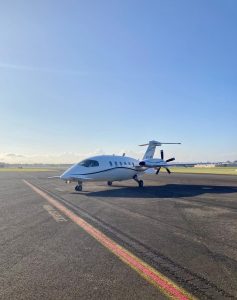
In this part one interview, AirlineGeeks was privileged to catch up with this incredible aviator. While most would love to relish in his storied past (this can be found in his book), it is another chapter – far more recent – that this writer chose to discuss, and it centers around a certain Piaggio Avanti.
Matt Hall’s Piaggio Avanti at Lake Macquarie Airport. Photo: Matt Hall
New Horizons with a New Aircraft
It should come as no surprise to the reader that an aviator seldom leaves his profession, and Matt Hall is no exception. In fact, despite his decades of flying, Hall has ventured off toward new horizons. While continuing his career in aerobatics and aerial displays, he has added a less-expected branch to his ever-growing business and career – that of charter flying – and we wanted to know more.
AG: What has led you to the charter business?
MH: It’s something that’s been developing for about six or seven years now with all of the aircraft that I own. I bought them for a personal reason – I had a number of aircraft – and I’ve got to get around Australia to do things. The busier we got, the more I realized I needed a dedicated aircraft for me to fly around in, not just using one of the race planes or the Extra or supercar or whatever. So I bought a twin-engine Piper Comanche, and when I wasn’t using it, we thought it might produce a charter there and then it became busy with this activity, so we bought another plane – a King Air – so that I could fly in and that became busy with the charter, too. So we keep buying a plane so I can use it personally and then it gets used for the charter so I get another one.
AG: Australia is far vaster than most people realize. Do you see your charter business using this to your advantage?
Yeah, definitely. I think Australia is pretty unique in the FI-FO type thing – fly in and fly out stuff – and we did dabble in that; it’s huge in Western Australia. We built demand for us to take our King Air over West Australia to do some of that, but that’s not the industry I want to get into personally. I think where charter really sells, so to speak, is in America because there are lots of 200-mile legs where you can just jump between towns really, really quickly and that’s great for charter. Anything more than about 200 to 300 miles, it starts to become a little bit cost prohibitive for most people, so it’s going up down the East Coast of Australia where there are a lot of charters because the business between towns is so great that they can do this.
So, that’s the normal thing we’ll be doing. But that said, there are still people who want us to fly them to Perth and have done that before. But those ones are few and far between because in Australia, you’re looking at a $30,000 bill to go out there and back for an aircraft that’s only carrying 7 or 8 people and has to stop along the way. So that’s where the Australian charter side of things is.
AG: Are you flying when you operate on those charters or do you have someone else?
MH: I do maybe one a month in all the different aircraft. With all the aircraft here, it’s it gets a bit challenging to be flying them all and staying current enough so I have another pilot and I just jump in when the mood strikes me.
AG: When I think charter, I’m sure a lot of people think of Caravans, King Airs, and so forth. Why the Piaggio Avanti? What made you choose that? It seems like a bit of a unicorn among other planes.
MH: It’s a different aircraft but again, I’ve always operated unique aircraft from a race plane to the P-51 that we’ve got. You know, we’ve got a counter-rotating Twin Comanche which is pretty rare, and the Cessna 303 Crusader which is very rare. I guess there’s something about looking after little orphans and keeping them flying. That said, the Piaggio is an amazing aircraft actually. They’ve probably got a bit of a bad rep for no real reason of their own. They had some maintenance support issues a number of years ago and it has had a reputation of being loud on the runway and all these things, but they’re actually none of those things. The plane’s low noise – it’s quieter than the King Air – it’s just a different noise. It’s a noise that’s not pleasant when you are used to normal aircraft propellers – this has got a completely different noise – but the actual dB is less.
They’re not a runway hog. We’ve got a runway here that’s only 880 meters, and it gets in and out with no problems at all. It’s a good aircraft for doing everything but speed is what attracts me. It’s a fast turbo-prop, more than 100 knots faster than King Air – quite impressive – and the cabin is much larger as well, which is also attractive. I’m not a short person but I can stand up straight up in a cabin, compared to a King Air where I have to bend over to walk through the cabin.
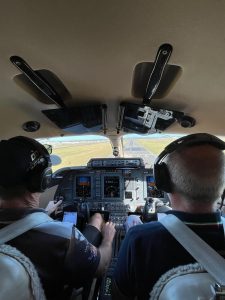
Matt Hall flies his new Piaggio Avanti. Photo: Matt Hall Racing
AG: So functionality and Italian design – can’t go wrong with that. Just a bit further on that; from a maintenance perspective, has it improved more recently than perhaps in past times?
MH: We actually paid for one of the factory pilots to come over to Australia and train us on the aircraft for a month. So we’ve actually got a reasonable relationship now with the factory, and they are good with parts and to send them out. Part of the problem was that a company in America bought a whole heap to start an aerial taxi service, so they bought a whole heap of parts. Then that company fell over and, somehow, that was blamed on Piaggio. Piaggio did actually become bankrupt through another venture, but it wasn’t because of the Avanti. They are still propped up by the Italian government and still producing parts, still making orders with the aircraft. They just had a bad reputation from the turmoil that occurred.
Next Week…
It would be easy to believe that a man who spends so much of his time in the air has little time for those on the below, but that is simply not the case. Easy to talk to, well-grounded, and ever the insightful aviator, Matt Hall was not done yet with AirlineGeeks.
How do you plan for something new? A story this writer once heard from the space shuttle teaches that you ask the operators of that new thing; a pilot’s perspective is worth their weight in gold (if it could be weighed, that is).
Next week, find out Matt Hall’s perspective on the future of aviation, and why Australia may have something to learn from the FAA.
Mike’s love affair with flight and mechanical objects in the sky began at an early age, fascinated by space documentaries and the vintage Flight Simulator ’95. He currently works as an instructor for UAVs and is training to receive his Private Pilot Licence with the goal of working in manned flight instruction. An avid reader of all things aviation and manned space flight, Mike stays close to developments in aerospace while reminiscing and sharing the rich history of flight with others. He loves writing, engineering and science.
Earlier this week, the final Boeing 747 ever produced emerged from the paint shop in Portland, Oregon to a flurry of disappointment from aviation enthusiasts and historians alike.
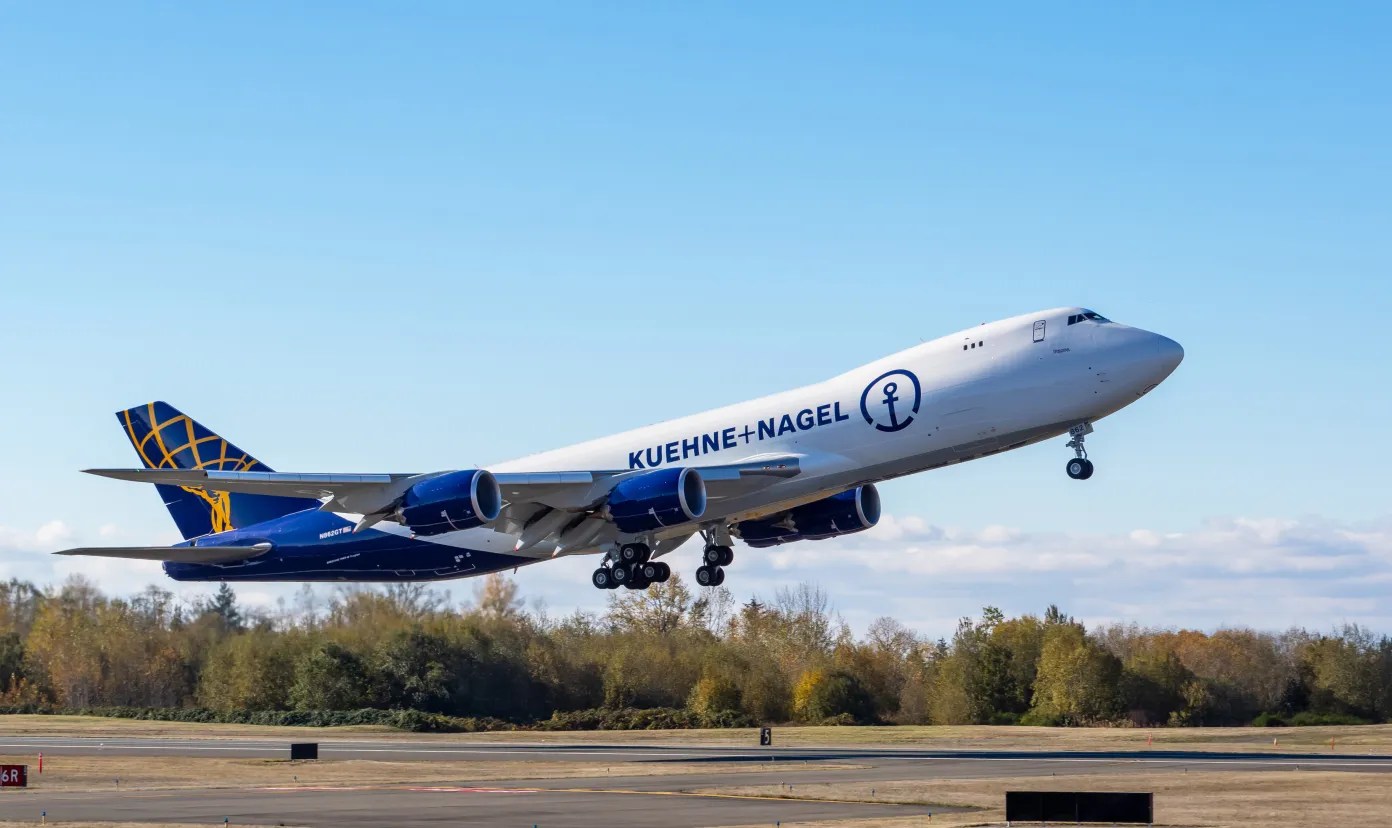
N863GT, the final Boeing 747, rolled out of the assembly line in early December of 2022 to much speculation as to whether or not the aircraft would receive any special markings from Boeing. This aircraft is a special one, as it is the last of its kind. The aviation community got its answer on Tuesday, as N863GT sported no significant lettering or decals.
There are unconfirmed reports on Twitter however saying that a Joe Sutter sticker will be applied to the 747 when the aircraft returns to Everett, Wash. before delivery. While by no means a special livery or even really much commemoration, Boeing honoring Sutter, known as the “father of the Boeing 747” is certainly a nice touch.
The aircraft has been painted in a split livery with one side featuring the aircraft’s owner, Atlas Air’s signature dark blue and yellow scheme while the other side sports Apex Logistics, marking who the aircraft is being operated for. Apex Logistics is owned by Bremen, Germany-based transport giant Kuehne + Nagel.
Additionally, the final Boeing 747’s rollout marks a sort of quiet end to an aircraft that was really the pioneer of commercial aviation, as we know it today. Being able to transport hundreds of passengers at a time between continents at incredible speeds with unparalleled comfort for its time. The first Boeing 747 was rolled out in September of 1968, to a frenzy of fanfare unseen before in commercial aviation. The plant in Everett that was constructed for the 747 productions became the largest building in the world and was expanded to accommodate the production of the Boeing 767, Boeing 777 and Boeing 787 Dreamliner.
However, the 747 could not last forever. Aviation has changed dramatically in the 50 years since its rollout. The program, which produced a variety of variants in order to keep up with the changing decades, began to be phased out with the success of newer, more efficient types like the Boeing 777, Boeing 787 Dreamliner, Airbus A330 and Airbus A350. Airlines liked these types far more, because of their versatility and better fuel efficiency.
In more recent decades, the 747 took on more roles as a cargo workhorse and will likely continue to be one for the coming decades. Production may be over, but it won’t be going anywhere anytime soon though as we saw with COVID-19, the outlook can change very quickly. Perhaps, Atlas Air will choose to honor the final 747 once it takes control of the airframe, but that is unlikely. Regardless, the end of 747 production marks a real end to an era in aviation regarded by many to be one of the most thrilling.
Ezra Gollan is a student, photographer and aviation enthusiast based in New York, New York. He has spent over half a decade around New York City’s airports as a photographer.
San Juan Airlines Cessna 172 taxiing at Anacortes Airport. (Photo: AirlineGeeks | Fangzhong Guo)
When people think about scheduled flights, Boeing 737s and Airbus A320s are likely the first planes that come to mind. However, flight operations come in different shapes and sizes when it comes to aircraft fleets. I got to fly on San Juan Airline’s Cessna 172 over the New Year’s holiday. With only three passenger seats, it’s one of the smallest airplanes providing scheduled commercial services. It’s also the most-produced aircraft in aviation history.
The company flies Cessna 172s, Cessna 206s and Cessna 207s. I was hoping to fly on the company’s 207s. Unfortunately, one plane is in heavy maintenance, while the other is still in cargo configuration for the holiday rush.
San Juan Airlines’ current destinations. (Photo: San Juan Airlines)
The Bellingham, Wash.-based airline’s history traces all the way back to 1947. It has served many destinations in the area, including Port Angeles, Wash., Paine Field Airport in Everett, Wash. and even Canada. One of its most intriguing destinations has to be Point Roberts, Wash, a pene-exclave with no road connection to the United States. However, most of its flights begin or end in the San Juan Islands in the Pacific Northwest.
Booking
Like other commuter airlines running intra-state services, San Juan Airlines does not have an automated booking system. Passengers need to either call or email the airline to request a booking. The email addition is an improvement from when I flew with them a few years ago. At that time, they would only take reservations over the phone. However, the company has undoubtedly reduced its schedule since it no longer offers scheduled service over the weekend.
Due to my schedule, I booked a roundtrip out and back from Anacortes, Wash. to Bellingham, Wash. The reservation agent was kind enough to call and double-checked that I did not make a mistake. They only allow requests at least two days out from the date of the flight, so you will want to call for last-minute bookings.
Check-In
I departed from Anacortes both times I flew with the airline. Simply put, there was no official check-in counter or process for this flight. The pilot would ask if I was the passenger and let me through the coded gate and onto the plane. There is a small office at the Anacortes Regional Airport. However, passengers generally don’t get to use that facility.
San Juan Airlines terminal at the Bellingham International Airport. (Photo: AirlineGeeks | Fangzhong Guo)
However, if you depart from any of their other destinations, such as Friday Harbor, Wash. and Bellingham, Wash., you’ll likely find yourself in a cozy sitting area waiting for your airplane. They also offered free coffee in the waiting room at Bellingham.
There were no security checks at any of the locations they serve either. Therefore, you will need to go through security if you are transferring to any other domestic flights offered at Bellingham, Wash. International Airport.
The Flight
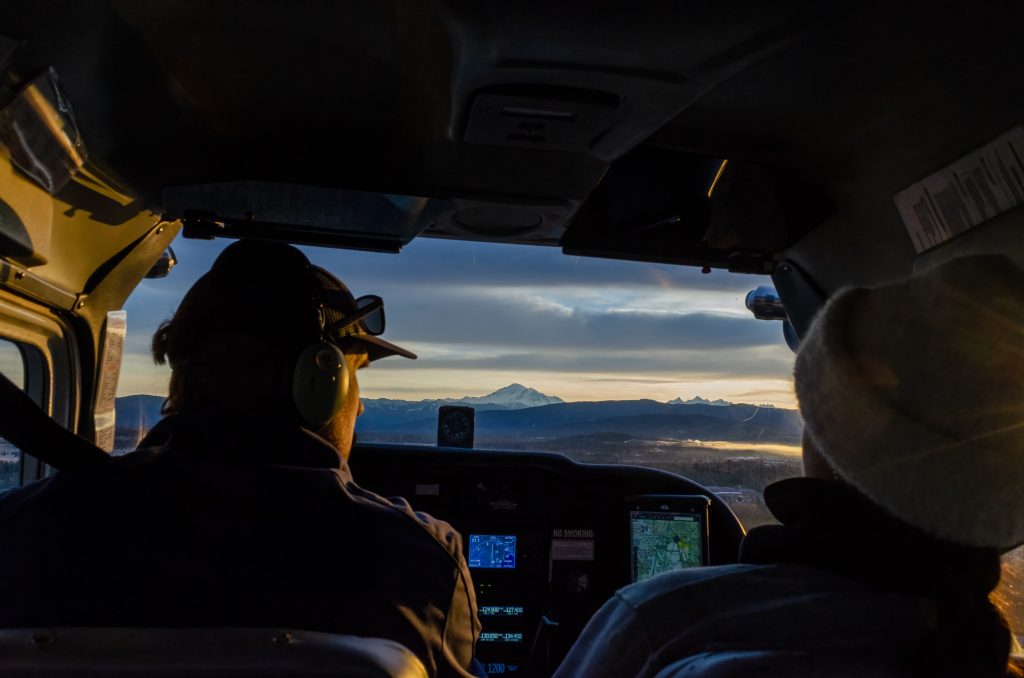
A glorious sunrise in the Cessna looking toward Mt Baker. (Photo: AirlineGeeks | Fangzhong Guo)
While the flights follow a general schedule, they follow different paths depending on the demand. On the morning of my flight, the plane picked up a passenger from Lopez Island, Wash., before returning to Bellingham from Anacortes. On the way back, since I was the only passenger, we flew directly to Anacortes.
The Cessna 172 is the most produced airplane and is popular among general aviation pilots and flight schools. However, it rarely serves as a scheduled passenger plane outside of Alaska. Therefore, flying on such a plane is a rare avgeek treat.
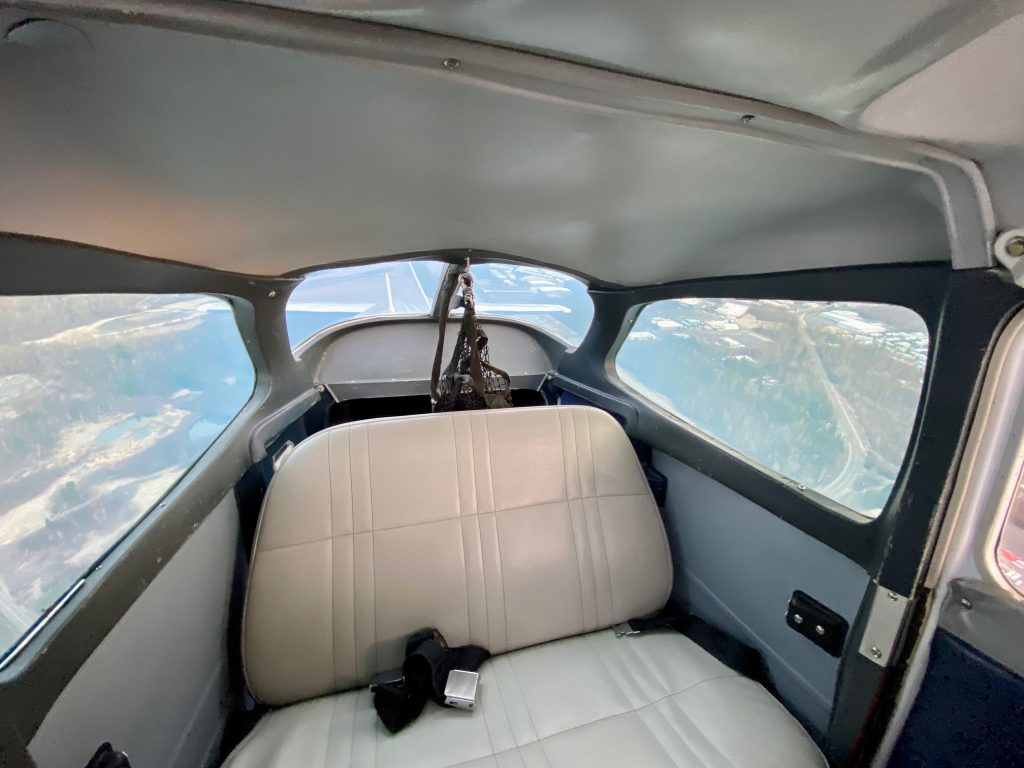
Rear seats in the Cessna was surprisingly spacious. (Photo: AirlineGeeks | Fangzhong Guo)
With a high-wing design and canopy all around, you are well-lit and have nearly unobstructed views. The rear cabin is also surprisingly spacious, with a ton of leg room and headspace, so most people won’t feel cramped sitting in it. The commuter airline also provided earplugs to mitigate the noise. However, the noise level was not very bothersome since the sole engine is mounted at the nose, so I did not need them. The pilot and the passenger sitting in front were also able to converse over the engine noise while we were in the air.
It was a gorgeous morning when the sun poked out after several days of rain. The San Juan Islands were partially covered in fog and looked very mystical. We had a bumpy descent at the end, but the flights were mainly enjoyable.
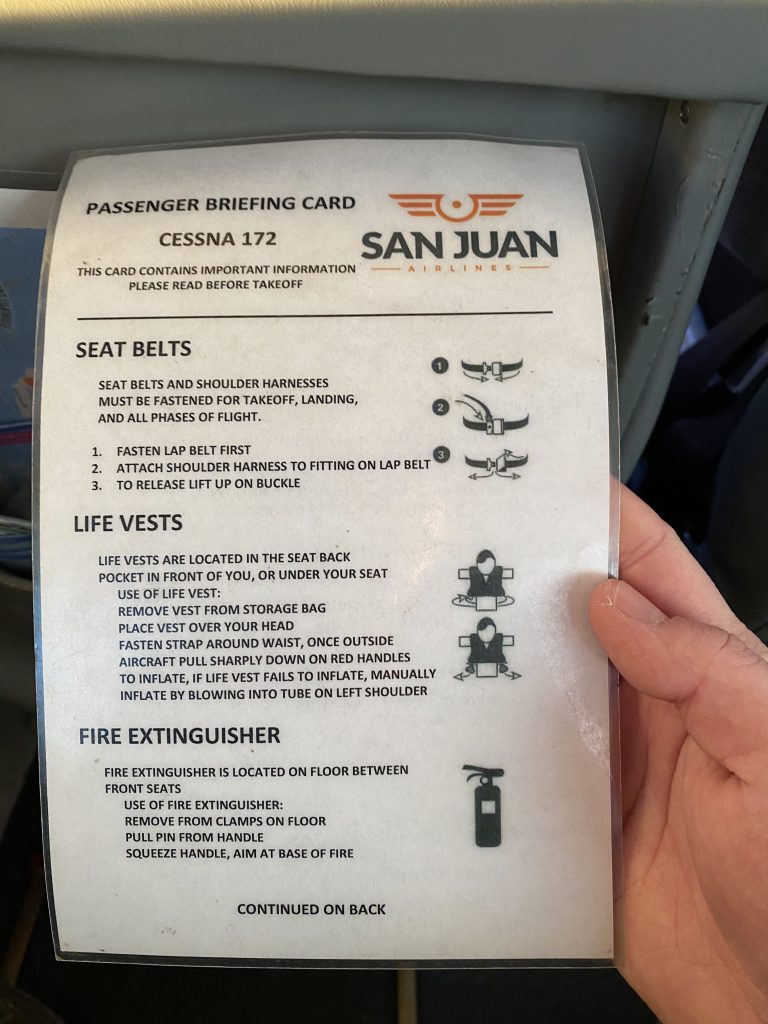
A Cessna 172 safety card with airline branding is a rare treat. (Photo: AirlineGeeks | Fangzhong Guo)
Final Thoughts
San Juan Airlines provides a fast way to transport between the islands and the mainland. Despite sitting only 20 miles apart, driving from the islands to Bellingham requires a ferry crossing and can take more than two hours. It’s service like this that made us appreciate the convenience that airplanes brought to us. I also had the opportunity to meet many people that rely on these services. They offered a perspective on why these flights exist in the first place for these communities.
Fangzhong grew up near an OEM airport in northeastern China, where he developed his enthusiasm for aviation. Taking upon his passion, he's now working as an aircraft interior design engineer. Besides working in the aerospace industry, Fangzhong enjoys trying out different types of airplanes and seeing how airplane interiors have evolved. So far, he's flown on over 80 types of aircraft. He also planespots in his spare time. His rarest catches included the 747 Shuttle Carrier Aircraft and AN-225.
NOTAM System Outage Impacts United States and Canada
Inside an FAA Air Traffic Control Tower at Washington Dulles International Airport. The federal agency is celebrating 100 years of its Flight Service program. (Photo: AirlineGeeks | Ryan Ewing)
The U.S. Federal Aviation Administration (FAA) reported that air operations in U.S. airspace were affected by the failure of the NOTAM (Notice to Air Mission) system, which informs aircrews and all operations-related personnel of key flight safety issues, are returning to a normal status as final validation checks were performed and the system was reloaded.
At 6:57 AM ET (11.57 AM GMT) the FAA updated the status update reporting that “while some functions are beginning to come back online, National Airspace System operations remain limited.”
At 7:19 AM ET (12:29 PM GMT) they confirmed the order to all airlines to suspend domestic flight departures until 9:00 AM EST (2:00 PM GMT) “to allow the agency to validate the integrity of flight and safety information.”
They also stated that “all flights currently in the sky are safe to land. Pilots check the NOTAM system before they fly”.
At 8:15 AM ET (1:15 PM GMT) the FAA reported that “is making progress in restoring its NOTAM system” and that departures are being resumed at Newark Liberty (EWR) and Atlanta (ATL) airports due to air traffic congestion in those areas. At all other airports, 9:00 AM ET remains the estimated resumption time.
At 8:50 AM ET (1:50 PM GMT) the FAA updated the status reporting that the departure suspension was lifted, and air operations are gradually resuming in the United States while they continue to investigate the cause of the initial problem.
White House Press Secretary Karine Jean-Pierre said this morning that President Joe Biden has been briefed by the Secretary of Transportation on the NOTAM system outage, clarifying that at the time there is no evidence that it was the result of a cyberattack, although the Department of Transportation was instructed to conduct a full investigation into the matter.
Data obtained through Cirium indicates that 19,621 domestic flights are scheduled for this Wednesday in the United States, representing an offer of 2,547,394 seats.
A NOTAM (Notice to Air Missions) is a notice issued by a government agency to inform pilots of potential hazards along a flight route or at a location that could affect the safety of the flight. NOTAMs are issued for a variety of reasons, such as to inform pilots of closed or changed runways, temporary flight restrictions, or the presence of hazardous conditions like severe weather.
Air traffic control or other aviation authorities typically issue NOTAMs, and they can be valid for a specific period or until canceled by another NOTAM. Pilots are responsible for checking NOTAMs before a flight to ensure they are aware of any potential hazards.
Canada: same issue, but not related
NAV CANADA, Canada’s air traffic control service provider, reported at 5:38 PM GMT that the NOTAM (Notice to Air Missions) entry system is down. The outage does not affect the consultation of those NOTAMs that were previously published, but it does affect the uploading of new notices. In any case, the agency indicated that they are not experiencing flight delays related to this downtime.
“We are assessing the impacts to our operations and will provide updates as soon as they become available,” NAV CANADA said in a statement.