On Monday, JetBlue set in motion a second attempt to merge with Spirit — the ultra-low-cost carrier — through the means of a hostile takeover. This is the carrier’s second attempt to win over Spirit’s shareholders.
The move from JetBlue comes just weeks after their initial offer was rejected by Spirit’s Board of Directors due to the “unacceptable level of closing risk” highlighted by the carrier.
The Long Island, N.Y.-based carrier’s new offer proposes $30 per share in cash, an offer equivalent to $3.2 billion, to Spirit stockholders. The most recent offering has a reduced price due to Spirit’s unwillingness to share financial information. Although lower, JetBlue said its April 5 offer of $33 per share is still available and states they are open to “negotiate in good faith a consensual transaction at $33, subject to receiving necessary diligence.”
JetBlue’s initial $3.6 billion bid was rejected by Spirit’s board on May 2, as it was unlikely that the deal was capable of clearing antitrust regulators. The merger also faces scrutiny from the ‘Northeast Alliance’ pursued by JetBlue and American Airlines. This alliance is under the microscope of the U.S. Government which has since sued to stop said deal from happening.
Spirit said its board would “carefully” review JetBlue’s offer with plans to inform shareholders of the board’s decision within 10 business days. In the meantime, Spirit has encouraged its shareholders to take no action at this time.
JetBlue remains in a bidding war with Frontier Airlines. Spirit shareholders are scheduled to vote on June 10 on the Frontier bid, which is favored unanimously by the Spirit board. Compared to JetBlue’s current $3.2 billion offer, Frontier’s cash-and-stock offer was valued at $2.9 billion when initially announced in February, however, Frontier’s shares have dropped 30 percent since, reducing the value of the deal.
Amid the hostile takeover bid for Spirit, JetBlue asked shareholders of the low-cost carrier to reject a proposed acquisition by Frontier.
In a letter to Spirit shareholders, JetBlue’s CEO Robin Hayes said, “JetBlue offers more value — a significant premium in cash — more certainty, and more benefits for all stakeholders. Frontier offers less value, more risk, no divestiture commitments, and no reverse break up fee, despite more overlap on nonstop routes and their own regulatory challenges.”
Hayes goes on to state, “Acquiring Spirit has been a strategic objective of JetBlue for many years and, as such, we were disappointed that the Spirit Board of Directors (the “Spirit Board”) elected not to have any discussions with us prior to the announcement of Spirit’s transaction with Frontier Group Holdings, Inc. (“Frontier”).”
In a rather interesting attempt to make a case to Spirit shareholders, JetBlue launched a website, giving individuals the opportunity to vote against the Frontier deal. Through overuse of the words, “Inferior” and “Superior”, the question still remains whether or not this will be effective for JetBlue’s efforts in taking over Spirit.
Chase Hagl grew up in Twin Falls, Idaho. His love and passion for Aviation landed him in Orem, Utah where he obtained a B.S. in Aviation Management with a minor in Business Management from Utah Valley University. Chase currently works as a flight attendant in Charleston, SC and is also the primary Inflight ASAP ERC representative for startup airline, Breeze Airways. His experience in the aviation industry spans back four years, working in areas including agriculture application, customer service, maintenance, and flight ops. In his free time, Chase enjoys road biking, astronomy, and flying.
Opinion: Lowering Minimums and Raising Retirement Age Won’t Solve Pilot Shortage
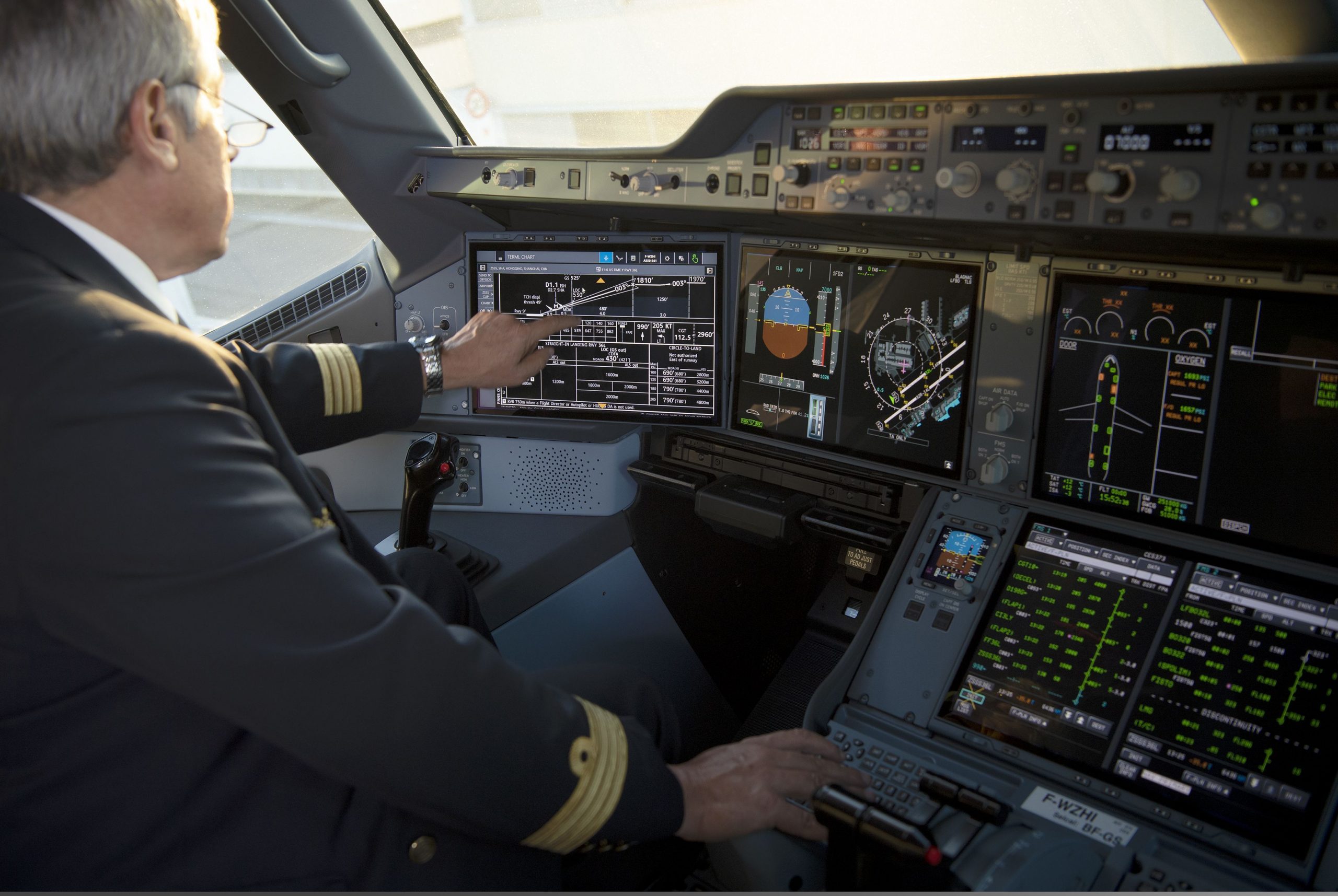
A pilot utilises one of the three new touchscreen displays in the A350. (Photo: Airbus)
As travelers return to the skies, following the suppression of demand from the Covid-19 pandemic, airlines are facing a familiar challenge, a pilot shortage. Before the pandemic, airlines were already facing a wave of pilot retirements in the coming years. More stringent requirements for certification have slowed down the number of pilots qualified to fly for commercial airlines. The pandemic provided temporary relief for airlines as demand was severely depressed, but the rapid recovery has led to exemplified problems.
Lowering Minimums For New Pilots
Recently Republic Airways, a regional partner for American Airlines, Delta Air Lines, and United Airlines, has requested an exemption for pilots at their Lift Academy to obtain their Airline Transport Pilot (ATP) certificate at 750 hours. Currently, the only pilots who can obtain an ATP certificate at 750 hours are former military pilots. Republic is arguing that their training program, through Lift, meets and exceeds the same standards that military pilots go through. Presently graduates of their Lift Academy must acquire 1,500 flight hours before they can start flying for Republic.
The 1,500-hour rule was introduced in 2013 in the wake of the fatal crash of Colgan Air flight 3407 outside of Buffalo in 2009. Although both the pilots of flight 3407 had more than 1,500 hours, the NTSB found issues in their training and development. The 1,500-hour rule was introduced as a measure designed to increase safety and provide new pilots more flight time before being placed in a commercial aircraft. Prior to 2013, new first officers in the industry were only required to have 250 hours before they could be hired by airlines.
Increased Safety and Quality of Life
The rule has had a multitude of effects. On safety, the rule seems to have achieved its goal. The Colgan Air crash has been the most recent fatal airplane crash in the U.S. For pilots, pay and benefits have continually gone up since being introduced. In 2007, the average first-year pay for first officers at regional airlines was $22.25 per flight hour. In 2022, the same average first-year pay for first officers at regional airlines is $47.50 per flight hour.
Rest requirements have also increased, giving pilots a better quality of life. Reducing flight time requirements could not only impact safety but also impact the quality of life for current and new pilots. The reduction in the flight time requirement also does not solve the true issue in the industry. The shortage of pilots is mostly on the captain’s side of the industry rather than on the first officer. A lack of qualified captains will not be solved by reducing minimums for first officers.
The lack of qualified captains is an issue that was exacerbated by the pandemic. In order to qualify as a captain, pilots must have 1,000 hours of flight time with a commercial airline. As flying was severely reduced from the pandemic, first officers at airlines were unable to flight hours at the rate they previously had. This has led to a gap in qualified captain candidates as airlines begin to run out of qualified first officers. Again lowering the minimum requirement to become a first officer for an airline does not solve this problem.
An Increase to Retirement Age
On the other end of the experience spectrum, earlier this week it was reported that legislation could soon be introduced to raise the mandatory retirement age for pilots from 65 to 67. The age has been in place since 2007 when the age was raised from 60 to 65. On paper, it seems like a good solution for solving a shortage of pilots. Retirements are predicted to hit a level of 3,000 per year in the next few years as many older pilots will hit the 65-year benchmark. However, this solution also doesn’t actually solve the problem.
Pilots are still going to have to retire. At the least, raising the retirement age will just push the problem two years down the line. The same amount of pilots who are due to retire in 2022 will be the same as in 2024. It also doesn’t account for pilots who will still choose to retire at 65. Pilots who, for most of their careers, have been planning to retire at 65 may simply choose to do so.
A Double-Edged Solution
It can also create more problems for airlines than solutions. Pilots who would continue flying to the age of 67 will most likely be at the top end of pay scales. They also typically have the most favorable schedules, with the most days off. This means the airlines will get less work from these pilots, while also seeing higher labor costs.
Senior pilots are also more likely to be flying widebody aircraft, rather than narrowbody aircraft. Widebody aircraft are typically used on long, international flights, a market that is still not recovered from the pandemic. Although airlines could use more widebody aircraft for domestic flights, currently with a stronger demand market, the higher cost and less efficient schedules would offset many of the gains, at a cost that will likely be passed onto the traveler.
Keeping pilots on passed the current retirement age may also have other knock-on effects. These senior pilots would hold onto captain positions that qualified first officers could be brought into. It could also exacerbate a growing issue at airlines, a lack of instructors. Many airline simulator instructors are former pilots who have reached their retirement age and want to teach the next generation of pilots.
A Problem with No Good Solution
The pilot shortage appears to be here to stay. Airlines, government agencies, and travelers should not accept increased risk, and potential increased cost to solve the shortage. That being said, solutions are far and few in-between. In order to encourage people to become pilots, efforts should be made to lower, or offset the cost of training, as well as providing more developed pathways for new pilots to procure their flying hours.
For helping to keep qualified pilots, airlines should be focusing on improving pay, benefits, and quality of life rather than stop-gap measures such as increasing the retirement age. By focusing on improving what they can offer pilots they are more likely to retain more pilots than having an additional two years of the highest cost pilots. Despite everyone’s effort, the pilot shortage will most likely be here to stay for the next few years, with current efforts only kicking the can down the road.
Daniel has always had aviation in his life; from moving to the United States when he was two, to family vacations across the U.S., and back to his native England. He currently resides in South Florida and attends Nova Southeastern University, studying Human Factors in Aviation. Daniel has his Commercial Certificate for both land and sea, and hopes to one day join the major airlines.
A Frontier Airlines
A320neo in Denver. (Photo: AirlineGeeks | William Derrickson)
After making the headlines for its attempt to merge with Spirit Airlines, Denver-based low-cost carrier Frontier Airlines is in the news for announcing the termination of the only commercial service in the state of Delaware. Its service between Wilmington-New Castle Airport and Orlando will terminate at the beginning of the summer due to insufficient demand.
“We are very appreciative of the support we have received from the community and our airport partner at Wilmington-New Castle. Unfortunately, sufficient demand did not materialize to support the service and the final flight between Wilmington and Orlando is scheduled on June 6, 2022 – said Frontier’s spokesperson Jennifer De La Cruz in a statement reported by the Delaware Republic – We are continually evaluating our routes and ILG will certainly remain in the consideration set for potential service in the future.”
The airline had already abandoned Wilmington-New Castle in 2015 but returned with this twice-weekly Orlando service in 2020, announcing the return just a few weeks before the COVID-19 pandemic wreaked havoc in the air transport industry. The start of those flights was postponed several times as the environment remained challenging due to the prolonged effects of the pandemic, but eventually services began in February 2021. Now the decision to once again end its services to the airport thus leaving Delaware as the only state in the U.S. without any commercial air service.
An Alternative to Philadelphia Airport
The Delaware and River Bay Authority (DRBA) has expressed its disappointment at the announcement but remains committed to restoring commercial services at Wilmington Airport. “The management and staff of the DRBA continue to believe that scheduled commercial air service can and will succeed at Wilmington Airport – ILG. The airport’s excellent location along the busy I-95 corridor, along with the lowest cost operating environment of any airport in the US, offers customers the opportunity to forego the stress and expense of a big city airport.”
Wilmington-New Castle Airport is located on a 1,250-acre area just 8 miles south of the city of Wilmington and just 25 miles south of Philadelphia International Airport, a major hub for American Airlines. In 2019 the airport recorded over 50,000 movements as a general aviation facility with over 200 aircraft based at the airport. It is equipped with three asphalt runways, two of which are over 7,000 feet long. The airport is frequently used by U.S. President Joe Biden when he returns to his state and electoral district of Delaware.
“Securing new commercial service for Wilmington – ILG will remain one of the airport’s key goals – continued the DRBA in its statement – […] We will continue to promote the many benefits of Wilmington Airport to those airlines who value both low-costs, and an uncongested air traffic and passenger operating experience.”
Vanni fell in love with commercial aviation during his undergraduate studies in Statistics at the University of Bologna, when he prepared his thesis on the effects of deregulation on the U.S. and European aviation markets. Then he pursued his passion further by obtaining a Master’s Degree in Air Transport Management at Cranfield University in the U.K. followed by holding several management positions at various start-up carriers in Europe (Jet2, SkyEurope, Silverjet). After moving to Canada, he was Business Development Manager for IATA for nine years before turning to his other passion: sports writing.
Emirates Nearly Tripled Passenger Tally, Doubled Revenue in 2021-2022 Year
An Emirates A380 in Dubai. (Photo: AirlineGeeks | Hisham Qadri)
Emirates, the Dubai-based flag carrier airline of the Arab Emirate of Dubai, part of The Emirates Group owned by the Government of Dubai, two days ago published its financial year 2021-2022 results on its official website. According to the report, Emirates’ total passenger and cargo capacity increased by 47%, restoring passenger services throughout its network after the lifting of flight and travel restrictions imposed during the previous two pandemic years.
At the beginning of the financial year, Emirates grew from 120 destinations to more than 140 as of March 31, 2022. In addition, in July, the airline launched a new route to Miami, bringing its destinations to the U.S. to 12, joining Seattle, San Francisco, Los Angeles, Dallas, Houston, Orlando, Washington, New York, Boston, Toronto and Chicago. Emirates is the airline with the highest number of Airbus A380s in its fleet (115 operational and five in delivery) and in 2021-2022 increased its network of A380-operated routes to 29 destinations.
It also phased out two older aircraft, one Boeing 777-300ER and one freighter, leaving the total fleet at 262 aircraft at the end of March. The average age of Emirates’ fleet remains 8.2 years. As for Emirates’ orders, the number remains unchanged at 197 aircraft.
Emirates has also expanded its interline and codeshare partnerships in Europe, the Americas, Africa and Asia. It has agreements with Aeromar, airBaltic, Airlink, Azul, Cemair, Garuda Indonesia, Gulf Air, Maldivian, South African Airways, Royal Air Maroc and TAP Air Portugal. Emirates this year announced a major retrofit program to equip 120 of its 777 and A380 aircraft with new Premium Economy seats and the latest cabin interiors.
In this second year of the pandemic, Emirates’ cargo section, Emirates SkyCargo, contributed 40 percent of the airline’s total cargo revenues, holding steady among the top 5 cargo airlines in the world. Emirates SkyCargo started operations in October 1985, the same year Emirates was formed and its fleet consists of 10 Boeing 777F aircraft.
Revenues and Statistics
Emirates’ total revenues for the financial year increased 91% to $16.1 billion. Total operating costs increased by 30% from last financial year due to cost of ownership (depreciation and amortization), fuel cost, and personnel cost. Fuel accounted for 23 percent of operating costs compared to 14 percent in 2020-21, doubling from the previous year to $3.8 billion, due to a higher average fuel price, which increased by 75%.
In the year spanning 2021 and 2022, Emirates carried 19.6 million passengers — up 199% — with seat capacity increased by 150%. The airline recorded a Passenger Seat Factor of 58.6%, up from 44.3% in 2020-21. The airline managed to improve all of its financial results compared to the Pre-Covid-19 period and recorded a loss of $1.1 billion. These results are much better considering that the previous year’s loss was $5.5 billion.
Vincenzo graduated in 2019 in Mechanical Engineering with an aeronautical curriculum, focusing his thesis on Human Factors in aircraft maintenance. In 2022 he pursued his master's degree in Aerospace Engineering at the University of Palermo, Italy. He combines his journalistic activities with his work as a Reliability Engineer at Zetalab.
A SpiceJet 737 (Photo: Jane Mejdahl [CC BY-SA 2.0 (https://creativecommons.org/licenses/by-sa/2.0)])
In early May, the Directorate General of Civil Aviation (DGCA) — India’s commercial aviation regulator — started overnight inspections of many aircraft across the county.
The goal of the initiative is to inspect aircraft that belong to Indian carriers with weak finances or aging fleets. When considering the state of Indian aviation, this includes a good number of airlines. Teams were sent out to look for anything that could impact safety, from the conditions of aircraft interiors to maintenance.
The inspections started with the carrier SpiceJet after complaints about cabin interiors and an incident with severe turbulence which caused multiple injuries from carry on bags falling from overhead bins. As of the second week of May, regulators had inspected approximately half of SpiceJet’s fleet.
Aircraft found deficient during these safety inspections will be grounded until the repairs have been made. Officials stated, “The message conveyed to SpiceJet was very clear. They need to spend money to ensure safe operations, it’s an absolute priority. They can defer all other expenses but cannot compromise on safety.”
Inspection Findings
As of May 11, regulators have conducted 213 inspections of aircraft totaling 149 aircraft. 113 SpiceJet aircraft, 25 for IndiGo, 21 for Vistara, 17 for Go First, 17 for Air India, 14 for AirAsia India, 3 for Alliance Air, 2 for Star Air, and 1 for Flybig. These inspections have uncovered a number of problems ranging from damaged seats and cabin interiors to missing safety signage and discrepancies with maintenance records. There we cases of issues that we previously reported to the airlines earlier in the year for repair but were never carried out. One aircraft was found to have “fasten seat belt while seated” and “life vest under the seat” signage missing in six rows.
Most notably, an Airbus A319 of an unnamed airline was undergoing maintenance in Mumbai on May 6 when inspectors appeared. The aircraft was undergoing a tire replacement of the main landing gear without the presence of a maintenance engineer. No documentation on the work being carried out was available from the technicians present conducting the maintenance. Additionally, inspectors noted that there were significant lighting issues as well, stating that the amount of light available was not enough to adequately complete the required tasks.
There is some debate on the best way to undertake this. Not everyone is sold on the idea of prioritizing inspections of aircraft that belong to airlines with weak finances. Nearly all airlines in India have precarious finances, so additional audits of books and inspections of aircraft may not uncover anything additional.
Hemal took his first flight at four years old and has been an avgeek since then. When he isn't working as an analyst he's frequently found outside watching planes fly overhead or flying in them. His favorite plane is the 747-8i which Lufthansa thankfully flies to EWR allowing for some great spotting. He firmly believes that the best way to fly between JFK and BOS is via DFW and is always willing to go for that extra elite qualifying mile. Hemal's opinions are his own and do not reflect those of his employer.
Unique Connection Series Trip Report: Kalaupapa, Hawaii
Mokulele Airlines in Kalaupapa, Hawai'i (Photo: AirlineGeeks | Joey Gerardi)
If you have read my articles in the past, then you know I love out-of-the-way airports, airlines, and aircraft and would do almost anything to adventure to a new city or fly on a unique, rare aircraft type. So in continuation of this series, which I call my “Unique Connection Series”, I will go over a unique flight between two cities using a small, unusual airport as a stopover. The uniqueness of the connection might be referring to the small size of an airport, a unique aircraft type, or both.
Overview
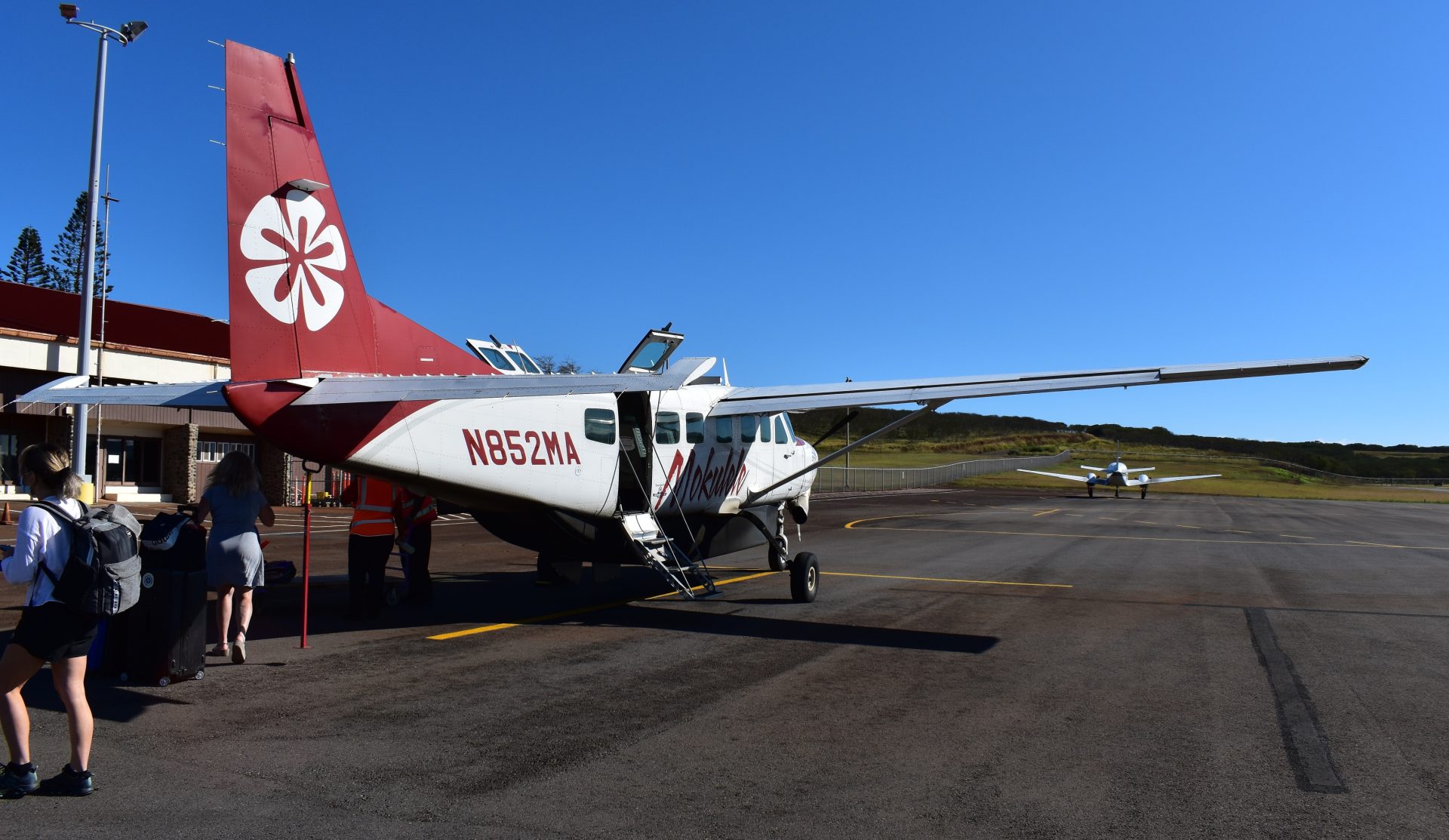
For this unique connection, I will be starting at Hawaii’s busiest airport, Honolulu International, and flying to the main airport on the Hawaiian island of Moloka’i named Hoolehua Airport, using the small Essential Air Service (EAS) community of Kalaupapa, Hawai’i as my connection point, which is also on the island of Moloka’i. I will be flying on Mokulele Airlines, which is now operated by Southern Airways Express and flying on an 8-seat Cessna 208B Grand Caravan that carries the registration of N852MA.
While Mokulele Airlines is a unique aspect for anyone that doesn’t live in Hawaii, it isn’t that unique for the people who live here as the airline has quite the presence and operates nearly 120 daily flights around the Hawaiian islands. The Cessna 208 also isn’t that unique in the Hawaiian islands as at the time writing of this article all Mokulele flights are operated using this aircraft, but they do have some Saab340s that will be coming to the islands soon. The uniqueness of this route is due to Kalaupapa, the community is one of the Hawai’i’s three Essential Air Service cities, that’s a great place for visitors to land, especially those who are in Hawai’i for their vacation, whether that is for some time in the sun or scuba diving trip or taking in the culture of the island. But that is actually not the most unique aspect of this connection.
Kalaupapa is a small peninsula on the north end of the island of Moloka’i and is cut off from the rest of the island by cliffs. But the biggest unique aspect of this community is that guests aren’t allowed under most circumstances. Kalaupapa is a former Leprosy colony and is part of the Kalaupapa National Historic Park, no visitors are allowed to visit here unless you have a sponsor, know someone that lives there, or work for the National Park Service, and even then no one under the age of 16 is allowed here even with a permit, and the government of Hawai’i has pretty much stopped giving out all permits since Covid began.
No roads in, and boats aren’t allowed within 1/4 mile of the Kalaupapa shoreline without a special permit from the government of Hawai’i, the only land way in is a donkey trail along the almost 2,000-foot cliffs, but the trail is highly dangerous for anyone to attempt without a special guide and even then you would still need a permit. No dining, shopping, medical facilities, or lodging for visitors, and even the locals must have everything they need to survive, and be flown in and out on the Cessna 208s that fly here five times a day.
The peninsula of Kalaupapa on Moloka’i (Photo: AirlineGeeks | Joey Gerardi)
But there is one exception to the special permit rule, this flight. The flight between Honolulu and Hoolehua, or the other way around, with a Kalaupapa connection, is most likely the only way outsiders will step foot in or even see Kalaupapa in person. One-way flights to this spot aren’t bookable online and the only way to book the flight to Kalaupapa is with a connection between the two previously mentioned cities, even with the connection, you aren’t allowed to leave the airport, and you’re only there for less than 20-minutes.
The flight between Kalaupapa and Hoolehua is also the shortest commercial flight in North America, and the second shortest in the world, just coming out a few miles longer than the famous flight between Westray and Papa Westray in Scotland.
Day of the flight
The airline operates one flight in each direction between Honolulu and Hoolehua with a connection in Kalaupapa. They do operate multiple flights between Hoolehua and Kalaupapa, but as non-locals, without a permit, you have to fly it between the two bigger cities as a connection. At the time of my trip, the flight operated in the morning, so I stayed overnight in Honolulu for the night. I made sure to get to the airport two hours prior to the flight as Mokulele does operate in a separate location from the other airlines, and requires a shuttle from the main terminal to their location at Terminal 3.
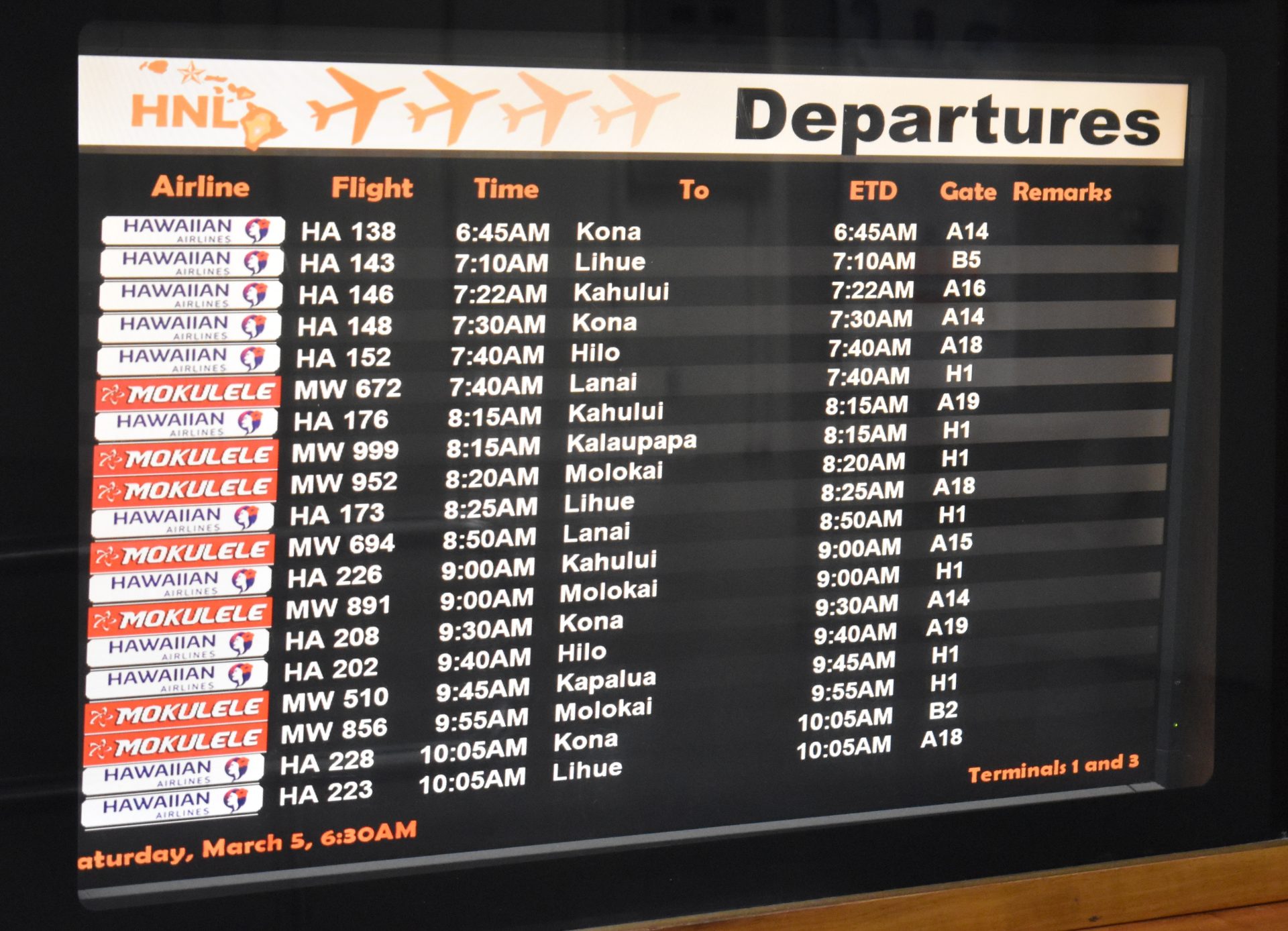
The departure monitor at the main terminal of Honolulu (Photo: AirlineGeeks | Joey Gerardi)
As most non-locals don’t know about Kalaupapa, Hoolehua Airport is displayed as ” Moloka’i ” on airport terminal monitors and even on most airline booking websites as that is the main airport on the island of Moloka’i and is the airport most visitors and vacationers search for. But, for the sake of showing the true correct name in this article, we will refer to the main airport on Moloka’i as Hoolehua.
It wasn’t hard to find the bus stop, the airport offers a free inter-terminal shuttle that does go to the terminal Mokulele operates out of. On the departure monitors, all Mokulele flights show departing from ‘H1’ and the shuttle stop sign says ‘H Gates’, super simple to find and piece together. After a short five-minute ride I made it to Mokulele’s terminal.
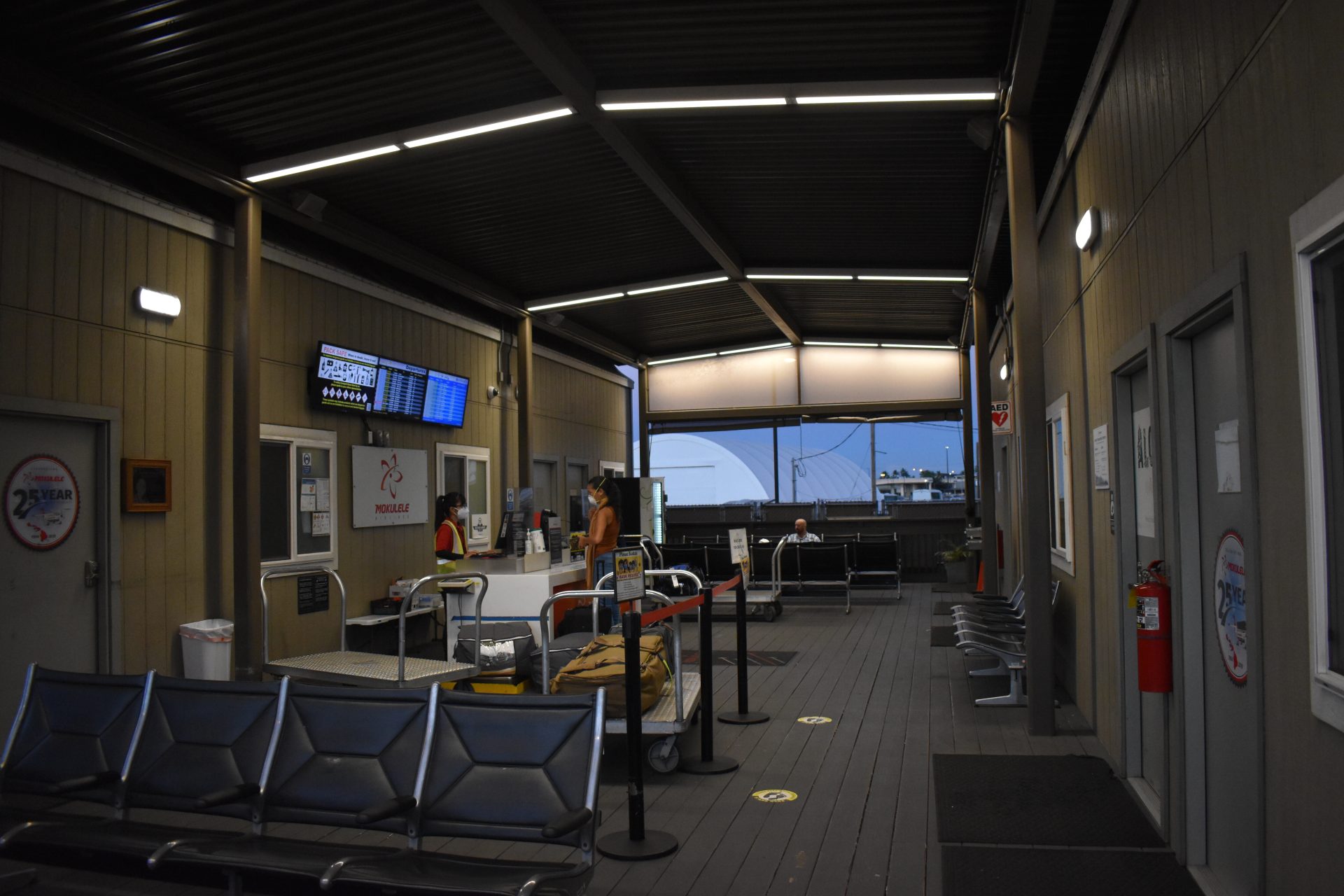
Terminal 3 at Honolulu International (Photo: AirlineGeeks | Joey Gerardi)
The terminal was very simple, an open-air terminal to let the warm Hawaiian breeze blow through. Mokulele operates all of its flights in the Hawaiian Islands non-sterile, meaning there is no TSA to go through and passengers can show up closer to their departure time than if they were departing from the main terminal. There were a few seats in the terminal for those that didn’t wish to sit in the direct sunlight, but I opted to sit at the picnic tables outside with other passengers as it was still pretty early in the day and the sun wasn’t in full force yet.
Check-in was easy, they checked my ID, weighed my carry-on, and asked my approximate body weight. They do this on these aircraft as they are on the smaller side, and they assign everyone’s seats for them based on weight and balance for safety.
The seating inside the terminal (Photo: AirlineGeeks | Joey Gerardi)
I had some time to spare so I watched next to the fence as the morning flights started to come in from the other islands. It was pretty busy and at the peak time when I was there, they had about eight-or-nine aircraft at any given time sitting out on the ramp.
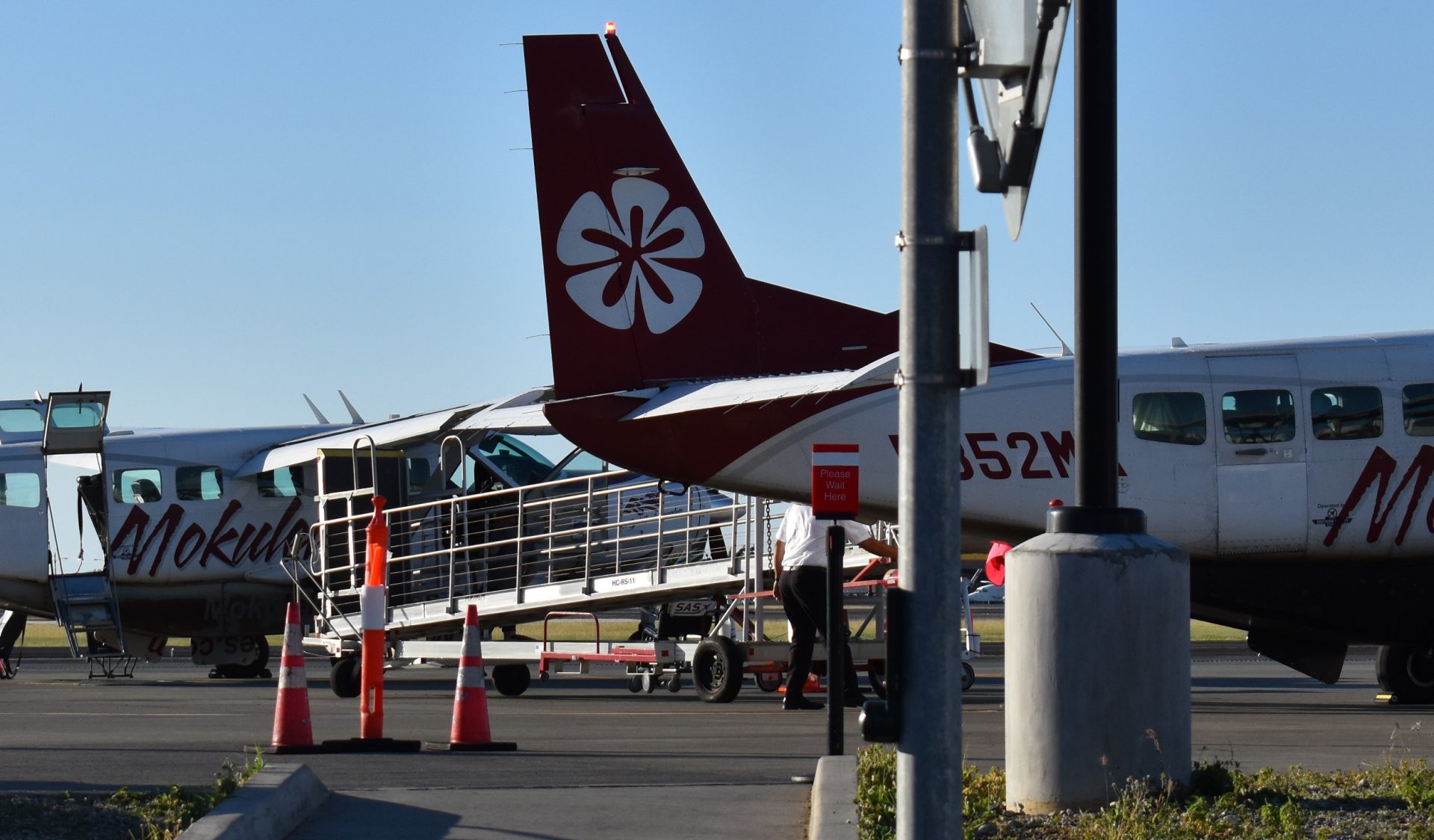
One thing I was also very impressed with was the airlines’ ability to handle wheelchairs and people with very limited mobility, usually on small aircraft like this passengers must be able to lift themselves up into the aircraft on the steps on their own power. But I did see them use an ADA ramp into the left side cargo door to help a person with low mobility out of the aircraft, a big kudos to the airline for this and I hope more airlines with small aircraft do this in the future.
A passenger ramp being positioned into the cargo door on a Mokulele aircraft (Photo: AirlineGeeks | Joey Gerardi)
It wasn’t long before we were called out to get ready for our flight, they announced the flights with the flight numbers as there are sometimes multiple aircraft headed to the same destination at similar times. There were no boarding passes so they just called out our names and lined us up according to the seating chart made by the pilots which were calculated using the weights we gave them at check-in.
Just before walking out to the aircraft, I noticed about 12-to-14 boxes of Krispy Kreme doughnuts being offloaded from inbound aircraft. Doughnuts will very frequently be flown on the Mokulele flights and is a common sight, there is only one Krispy Kreme in the entire Hawaiian Islands and it is in Kahului on the island of Maui.
Krispy Kreme doughnuts being offloaded from a Mokulele aircraft (Photo: AirlineGeeks | Joey Gerardi)
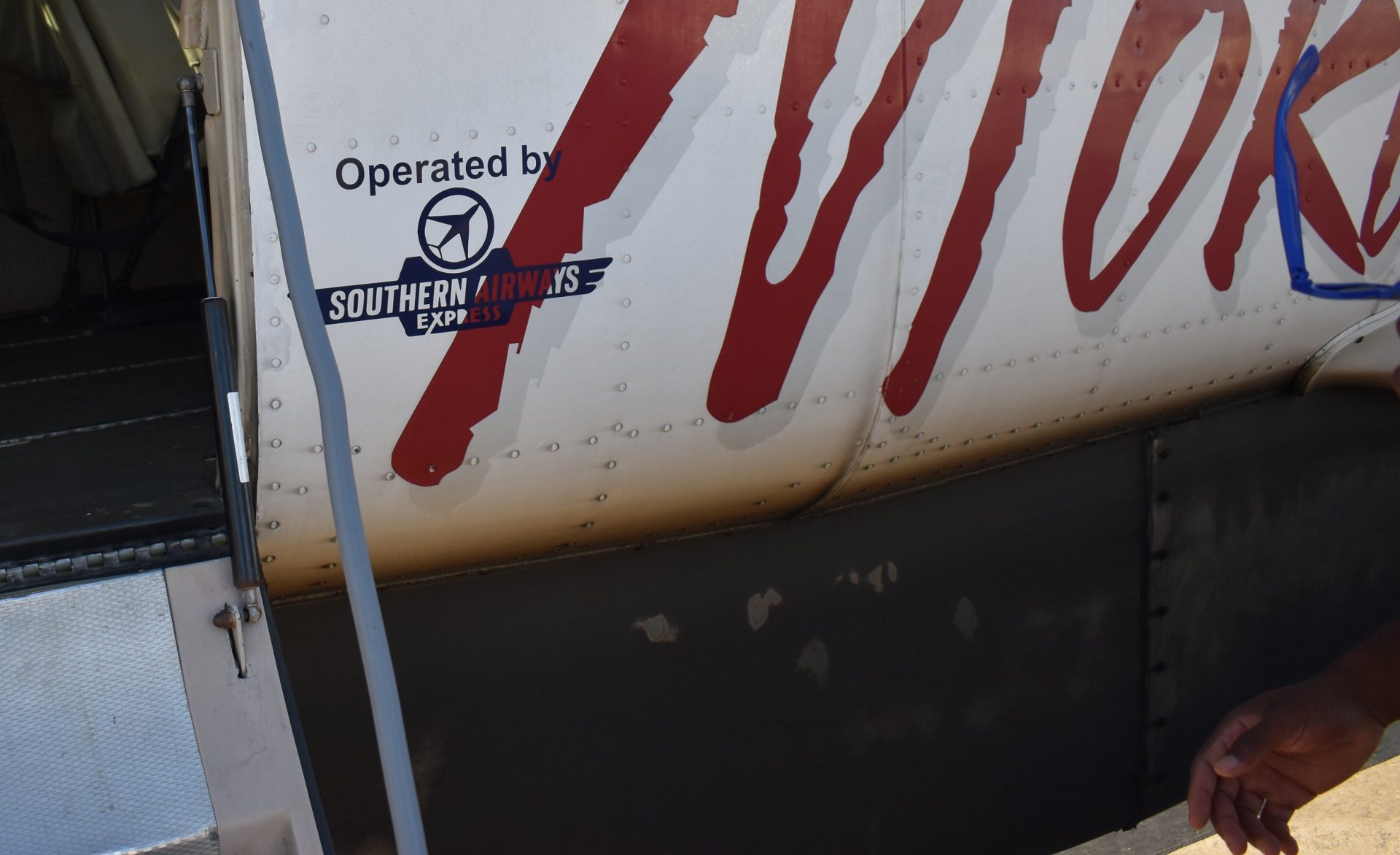
As we boarded our aircraft I saw the Southern Airways Express logo just next to the door, the carrier said that the Mokulele brand will stay alive in the Hawaiian islands, meaning this small logo will be the extension of the Southern branding seen on the Cessna’s. But all Mokulele flights are operated by Southern Airways Express and carrier the SAE flight number code of ‘9X’ and SAE’s ATC callsign which is ‘Friendly’.
The SAE logo on our Mokulele aircraft (Photo: AirlineGeeks | Joey Gerardi)
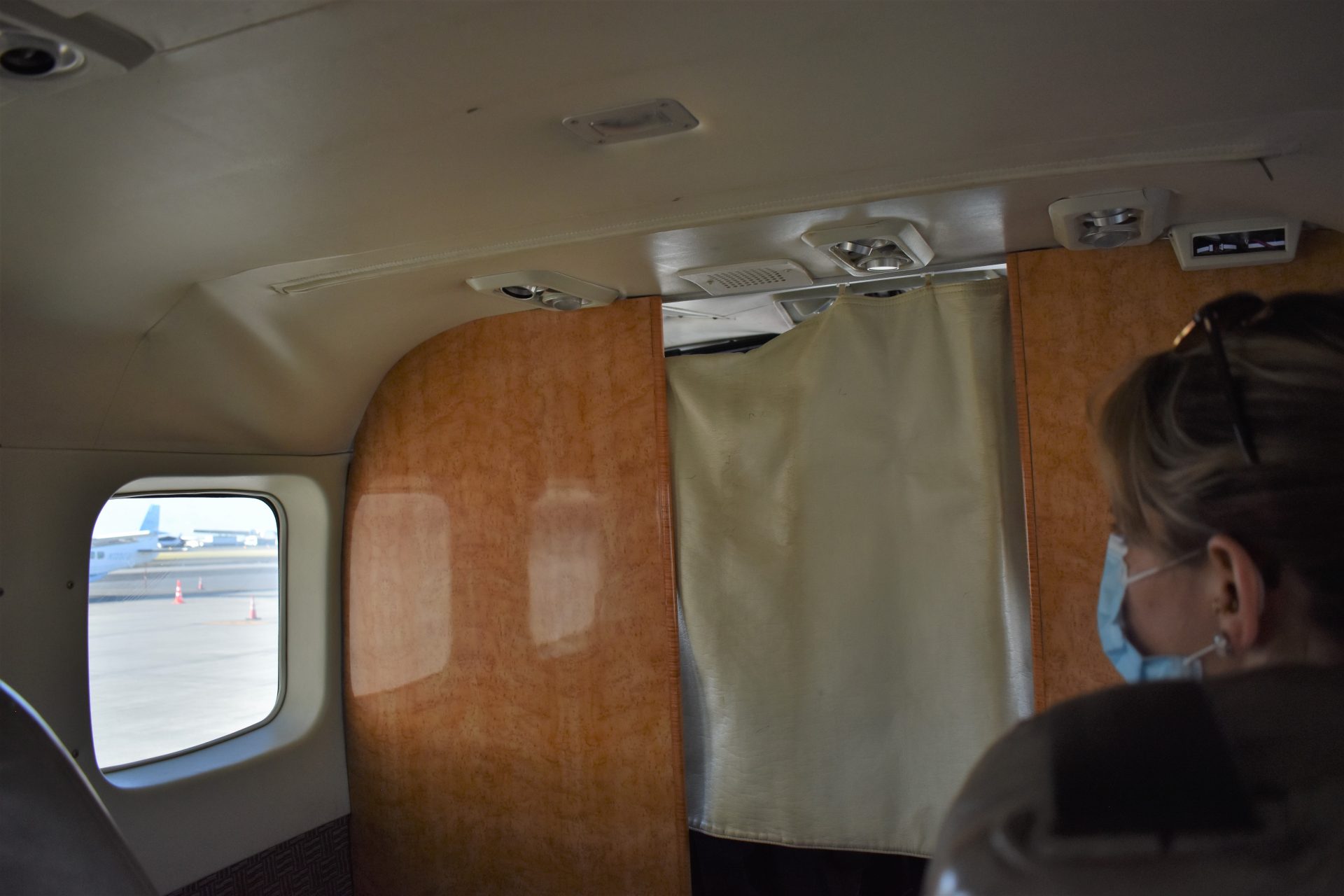
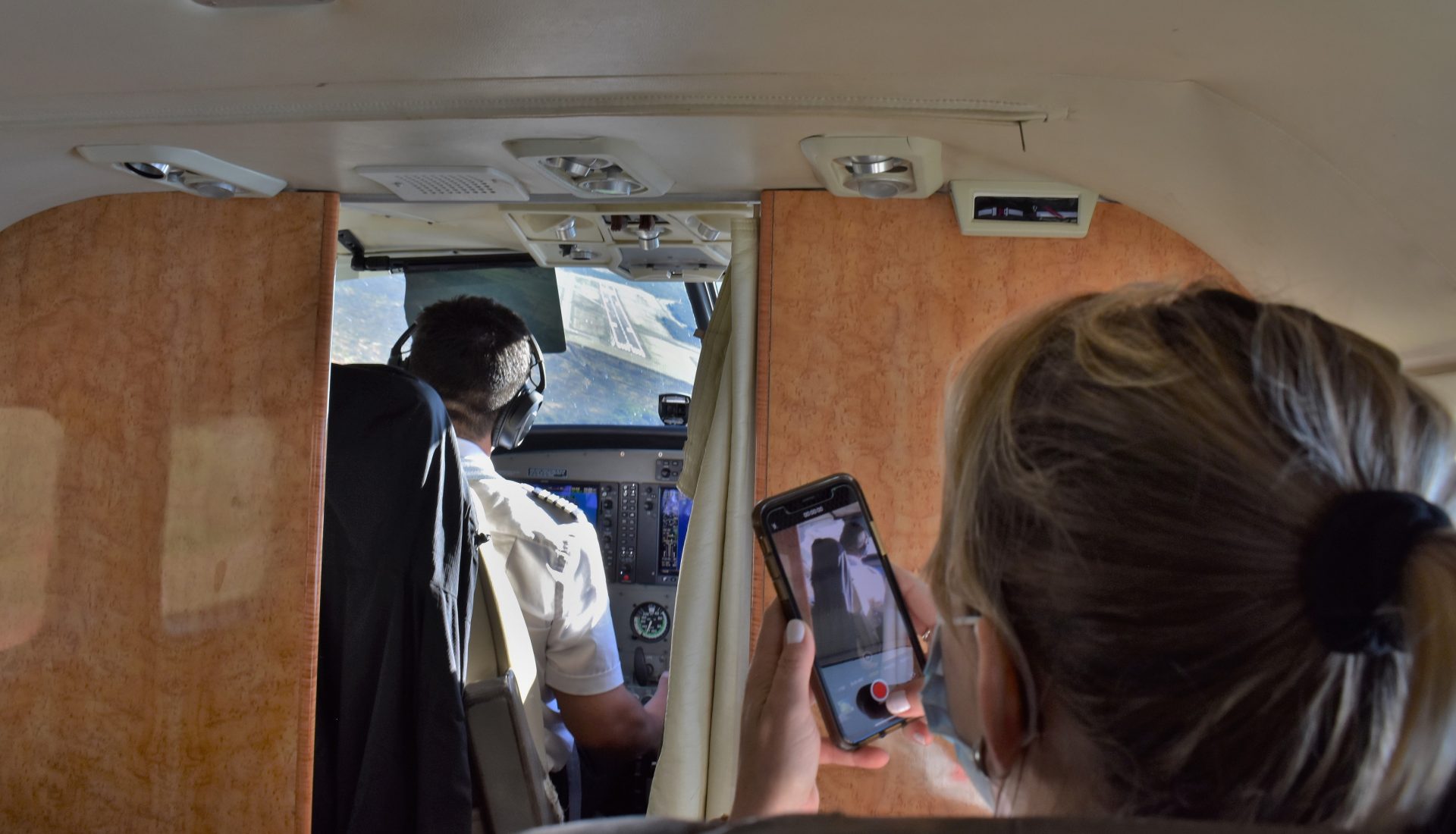
I was told to sit in row 2, but they give you the choice of which side we sit on. When flying from Honolulu to Kalaupapa you want to be on the right side to see the scenery, and you just have to make sure you get in line ahead of the other person in your row, as they might have the same idea as you do. I managed to get ahead of that person and sat on the right side of the second row. Nothing special about the inside, eight seats and a cargo net in the back, there was also a wall and a curtain in the front which separated us from the pilots during the flight.
The wall separating us from the pilots (Photo: AirlineGeeks | Joey Gerardi)
The crew did their normal safety briefing and mentioned we would be making a quick stop in Kalaupapa. Although I was aware of this stop, a few of the passengers booked the flight without realizing it had a stop somewhere despite being listed on the flight details when booking.
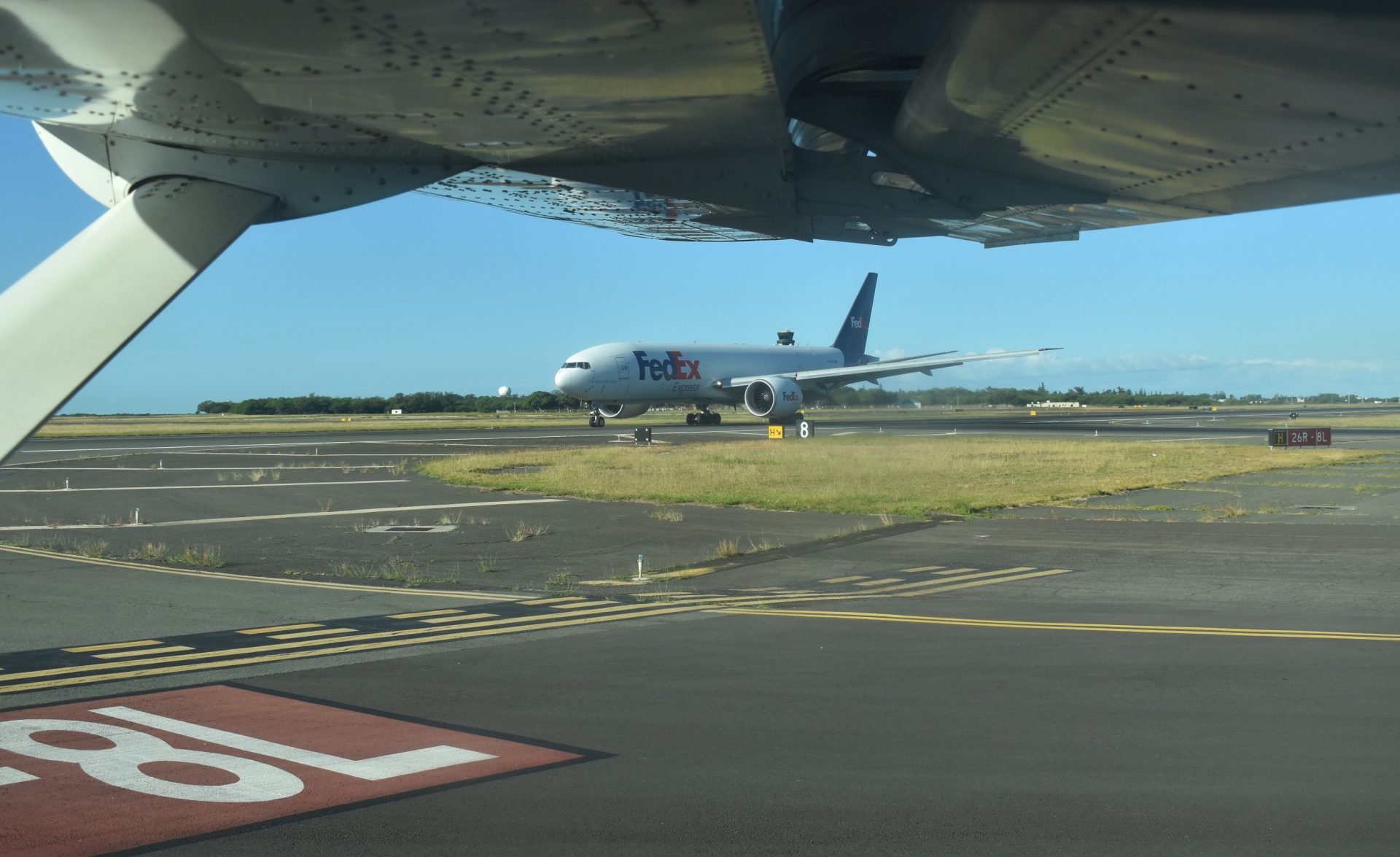
The startup was normal and we taxied out to the runway. Due to the Cessna 208 having a short takeoff distance, we entered runway 8L roughly at the 2/3 mark using Taxiway Echo, allowing us not to taxi all the way down to the very end of the 12,000-foot runway.
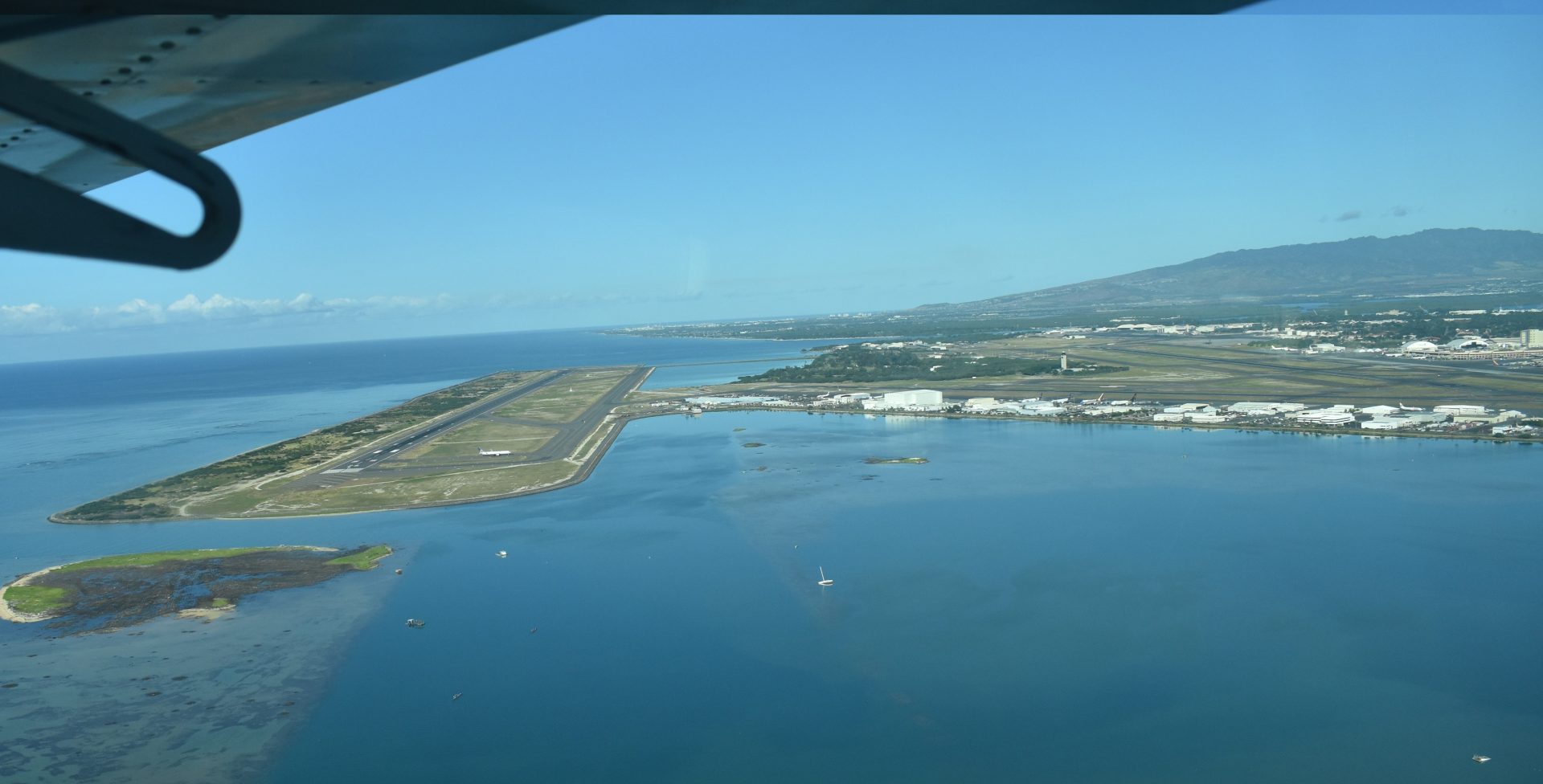
The low rate of climb relative to jet aircraft gave passengers on the right side a great panoramic view of the entire Honolulu Intl. For passengers on the left, they got to see downtown Honolulu and Waikiki Beach as well as Diamond Head.
It wasn’t long before we were gaining distance from the island of O’ahu making our way towards the island of Moloka’i. Other than here in Hawaii, it is not very often you see single-engine unpressurized aircraft flying over open water for long periods of time, as the Cessna 208 isn’t rated for or certified for extended flight time over water. This is one of the main reasons the airline doesn’t fly to the island of Kauai.
Overwater between the islands of O’ahu and Moloka’i (Photo: AirlineGeeks | Joey Gerardi)
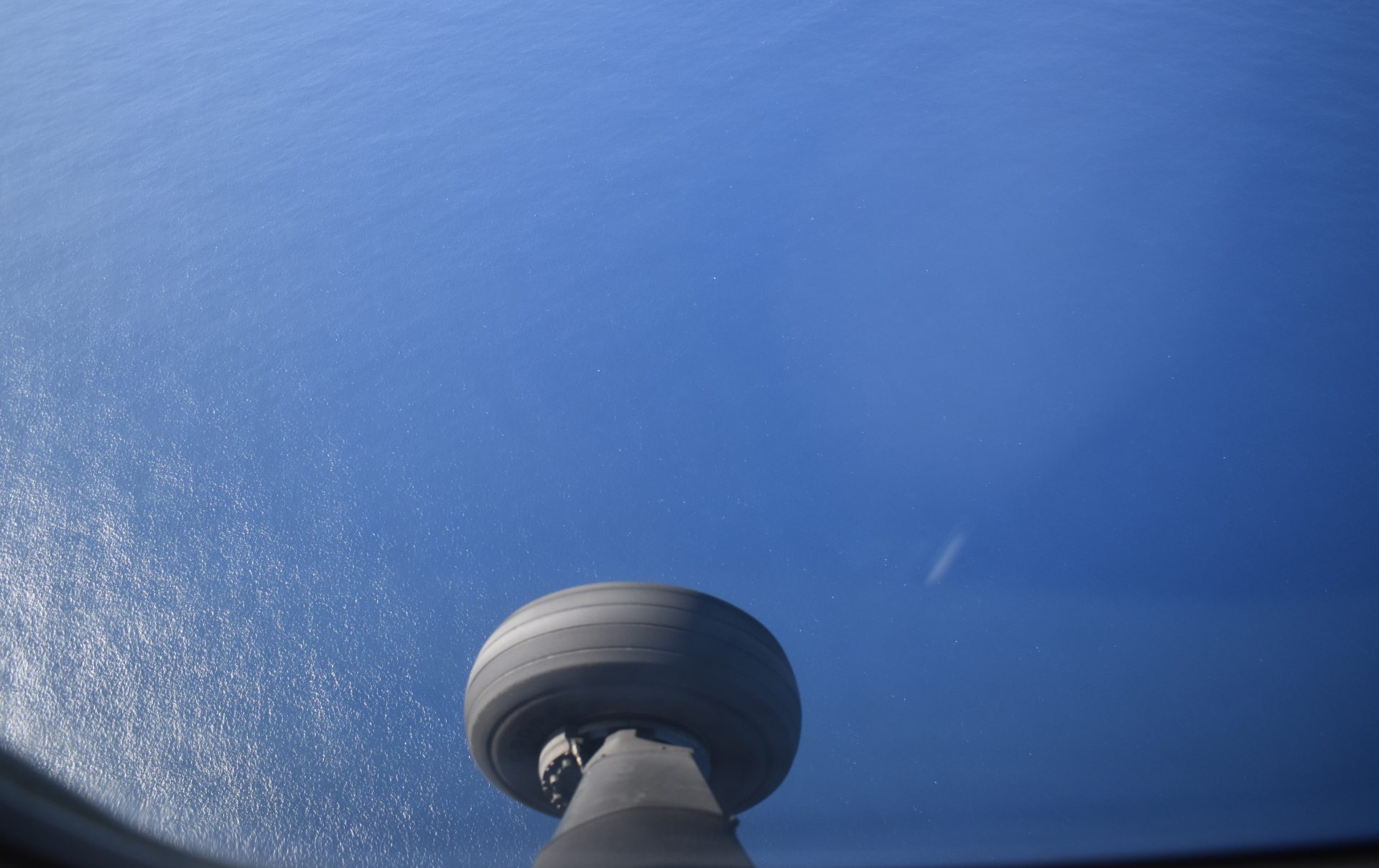
Due to this rule, there was no ‘cruising altitude’ for this flight, instead, we spend roughly half of the flight gaining altitude and the latter half descending. The highest altitude we got to for this flight was approximately 6,500-feet. Another unique aspect of the Cessna 208 was the fixed landing gear, meaning passengers could look out and down to see the main landing gear.
While many major airlines are taking stuff out of the seatback pockets, Mokulele had a lot in them. This included a magazine for the airline, two safety cars (one for Southern Airways Express, and one for Mokulele), and a brochure with popular attractions on the islands. This made for good reading material while in-flight, but the views outside were great so I didn’t spend much time looking at the stuff in the seatback pocket.
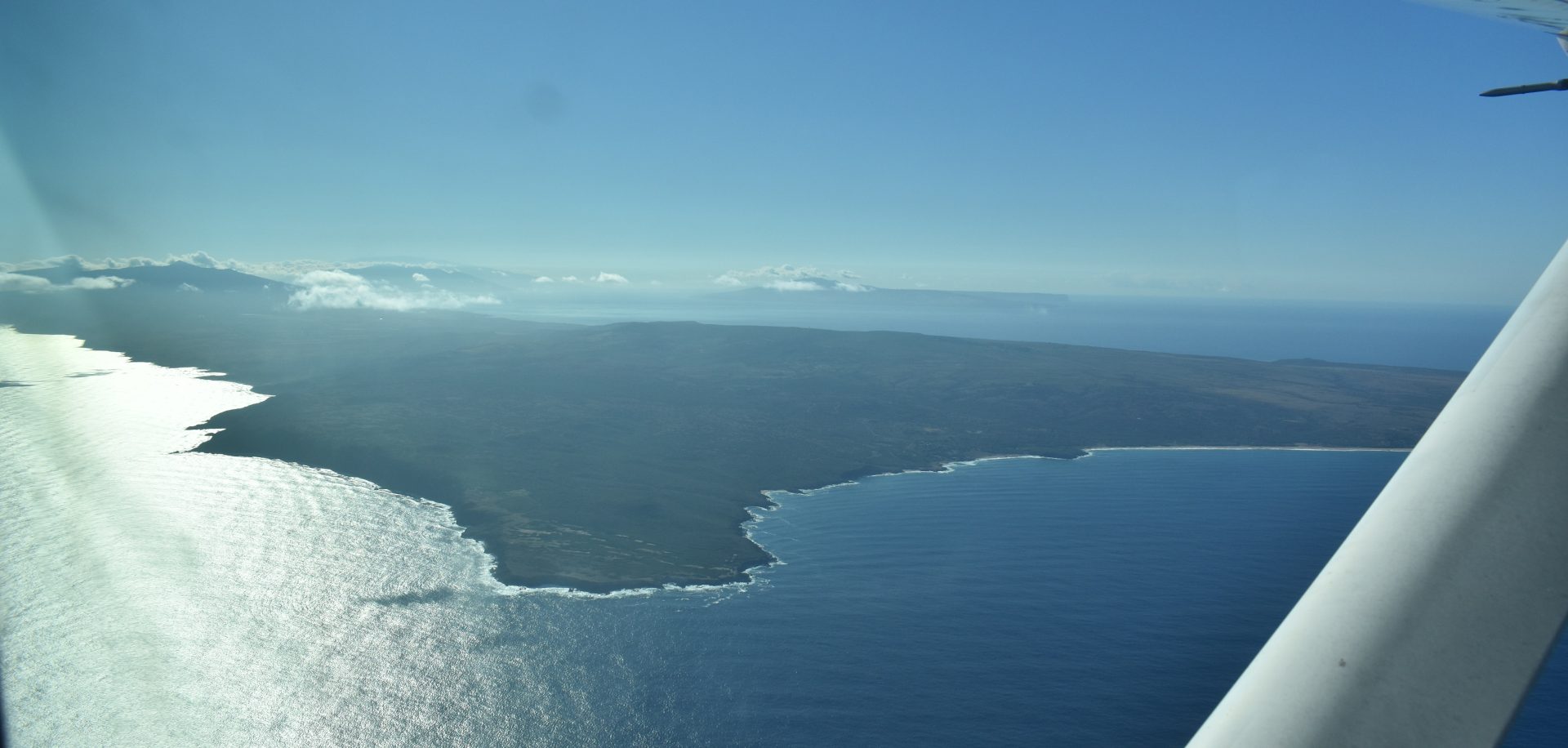
It wasn’t long before the island of Moloka’i came into view, and the island slowly became bigger as we began to descend. The island has lower terrain on the western side of the island than on the eastern side, and it was an interesting aspect watching the elevation of land slowly increase as we approached Kalaupapa.
Looking at the island of Moloka’i towards the East (Photo: AirlineGeeks | Joey Gerardi)
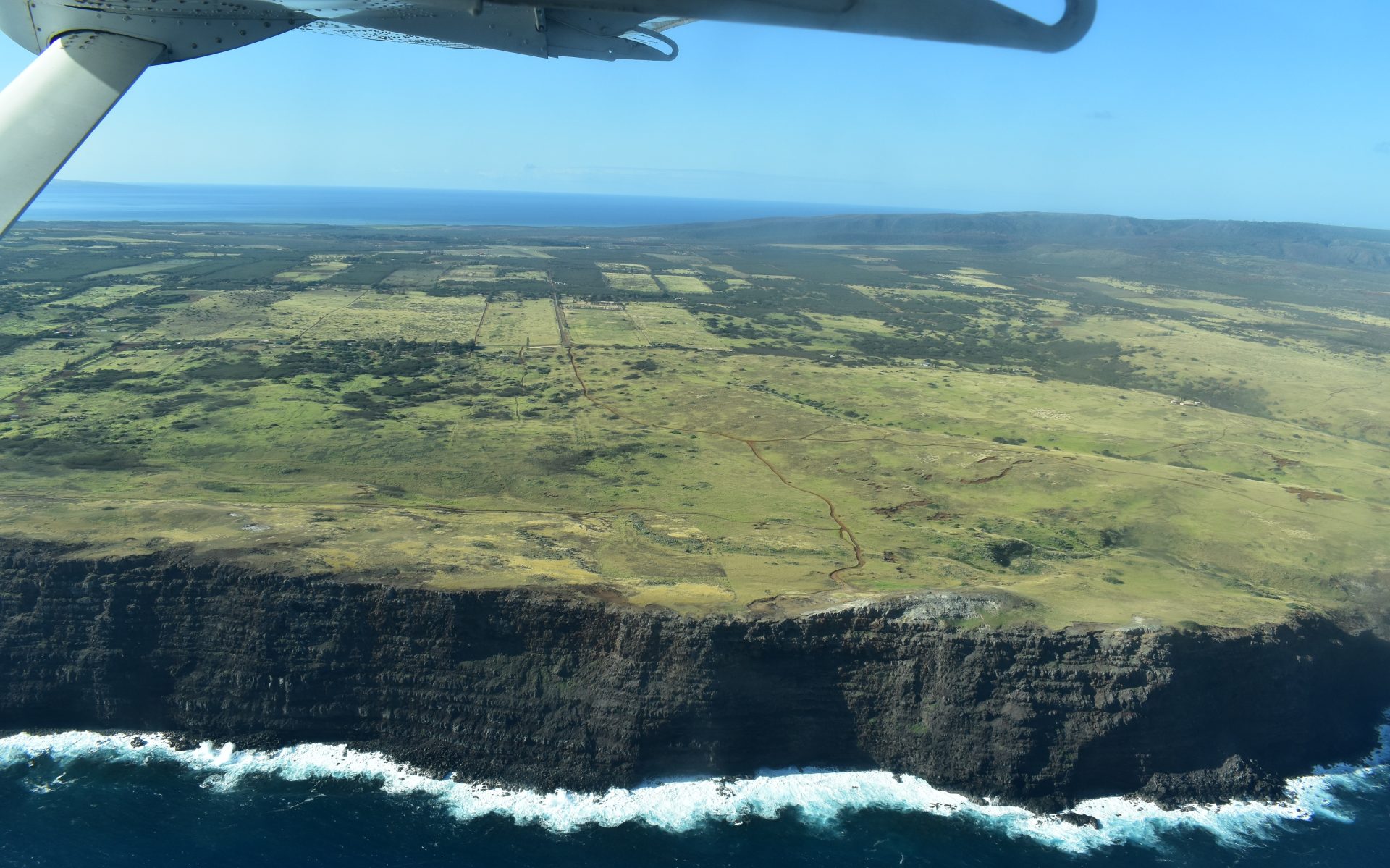
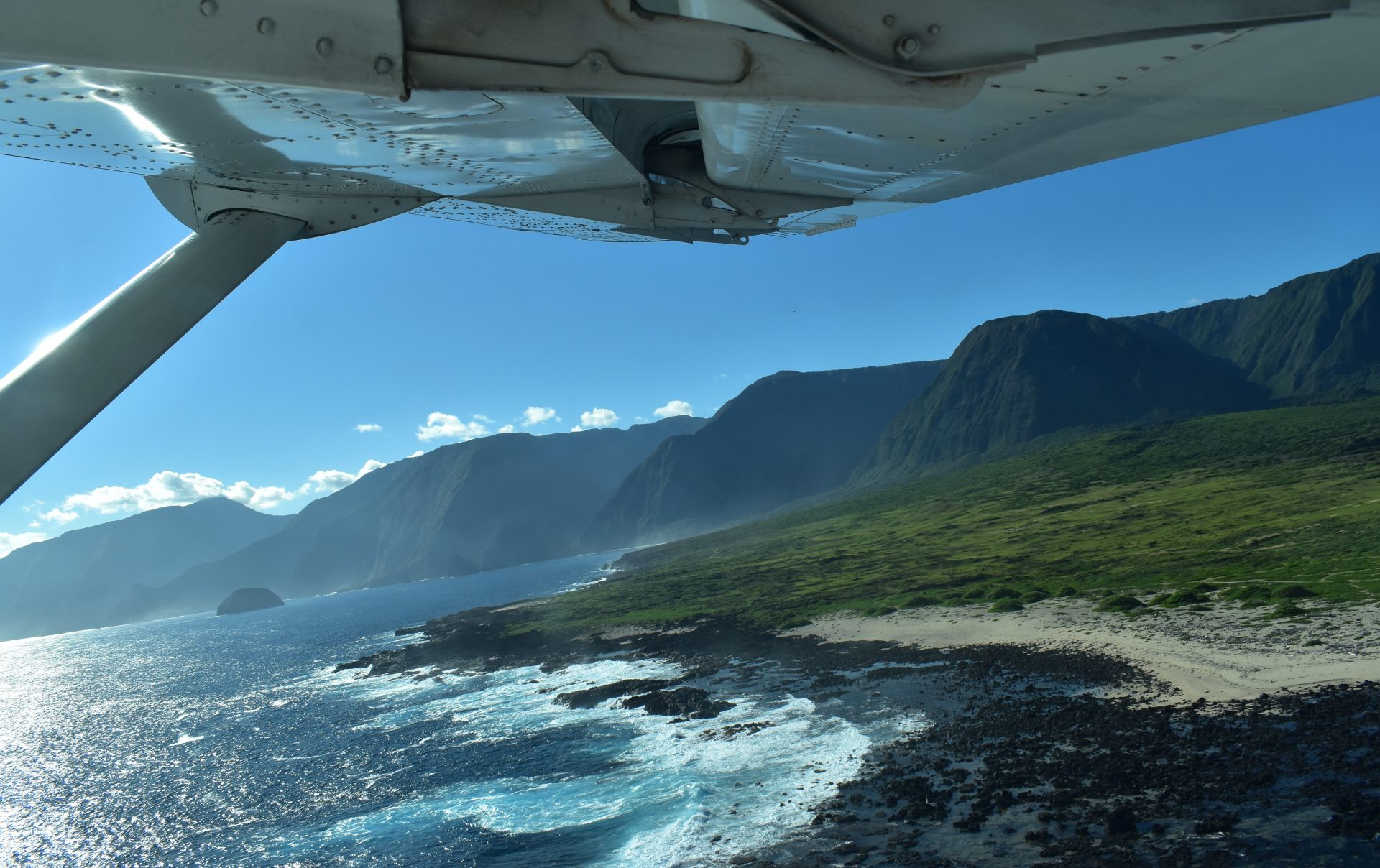
As we got closer to Kalaupapa and we descended, the cliffs along the north side of the island began to gain elevation and become more prominent. I could also see the main airport of Hoolehua, it is not often you see your destination airport while on approach to your connection airport, another unique aspect of this route.
The cliffs on the north side of the island, with the main airport in the distance (Photo: AirlineGeeks | Joey Gerardi)
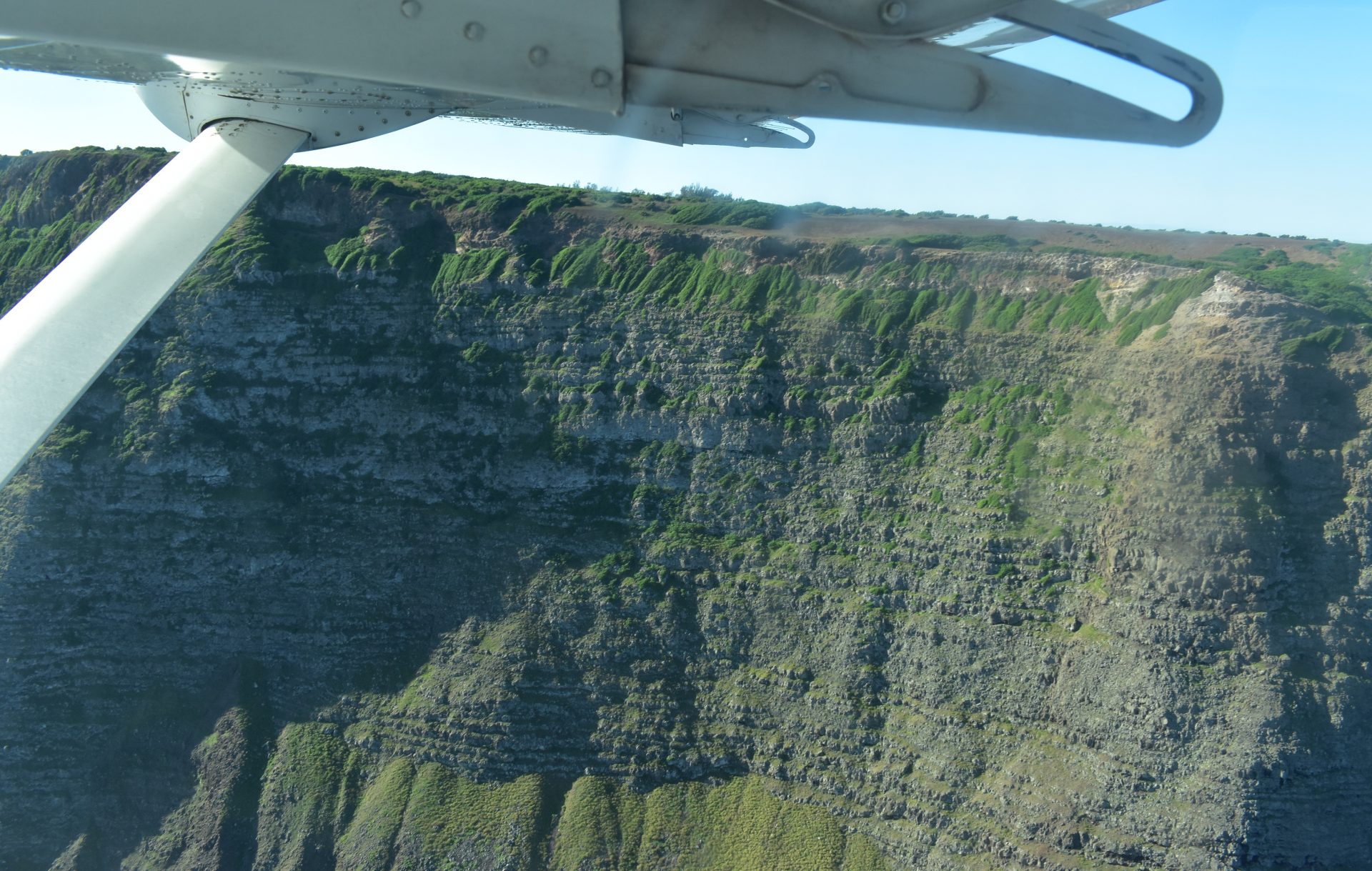
It wasn’t long before the aircraft dropped below the cliff line, it was a spectacular sight and certainly like no other I have experienced.
Flying below the cliff line on the approach to Kalaupapa (Photo: AirlineGeeks | Joey Gerardi)
It wasn’t long before we touched down on Kalaupapa’s 2,700-foot runway and taxied to the small terminal in this truly unique location. As noted before, visitors aren’t allowed to stay in Kalaupapa without written permission from the government, so nobody was allowed to get off at this shortstop and wander around. However, I was allowed to get off and take some pictures of the airport as long as I didn’t leave the eyesight of my pilots while cargo was offloaded from the aircraft.
The very mall ‘terminal’ building in Kalaupapa (Photo: AirlineGeeks | Joey Gerardi)
This was the 37th EAS Airport I have been to, and I have seen my fair share of small buildings, but this has to be the smallest I have seen. The only fence around the airport was a small white picket fence around the terminal area, but other than that the only border to speak of was a knee-high post marking the airport perimeter. With no TSA, there was no need for scanners, and they don’t even have customer service agents working in this location. They train the pilots to do that task in the event when they occasionally have passengers going out.
Sign saying no visitors (Photo: AirlineGeeks | Joey Gerardi)
Another sign on the airport fence reiterates that visitors are under no circumstances allowed to leave the airport area without an escort. So even if you do get permission from the government, at no point are you allowed to wander around by yourself on the peninsula
Being on the ground in Kalaupapa was truly amazing and you can see the clear physical boundaries of the cliffs cutting this peninsula off from the rest of the island.
Looking at the cliffs that cut off this community from inside Kalaupapa (Photo: AirlineGeeks | Joey Gerardi)
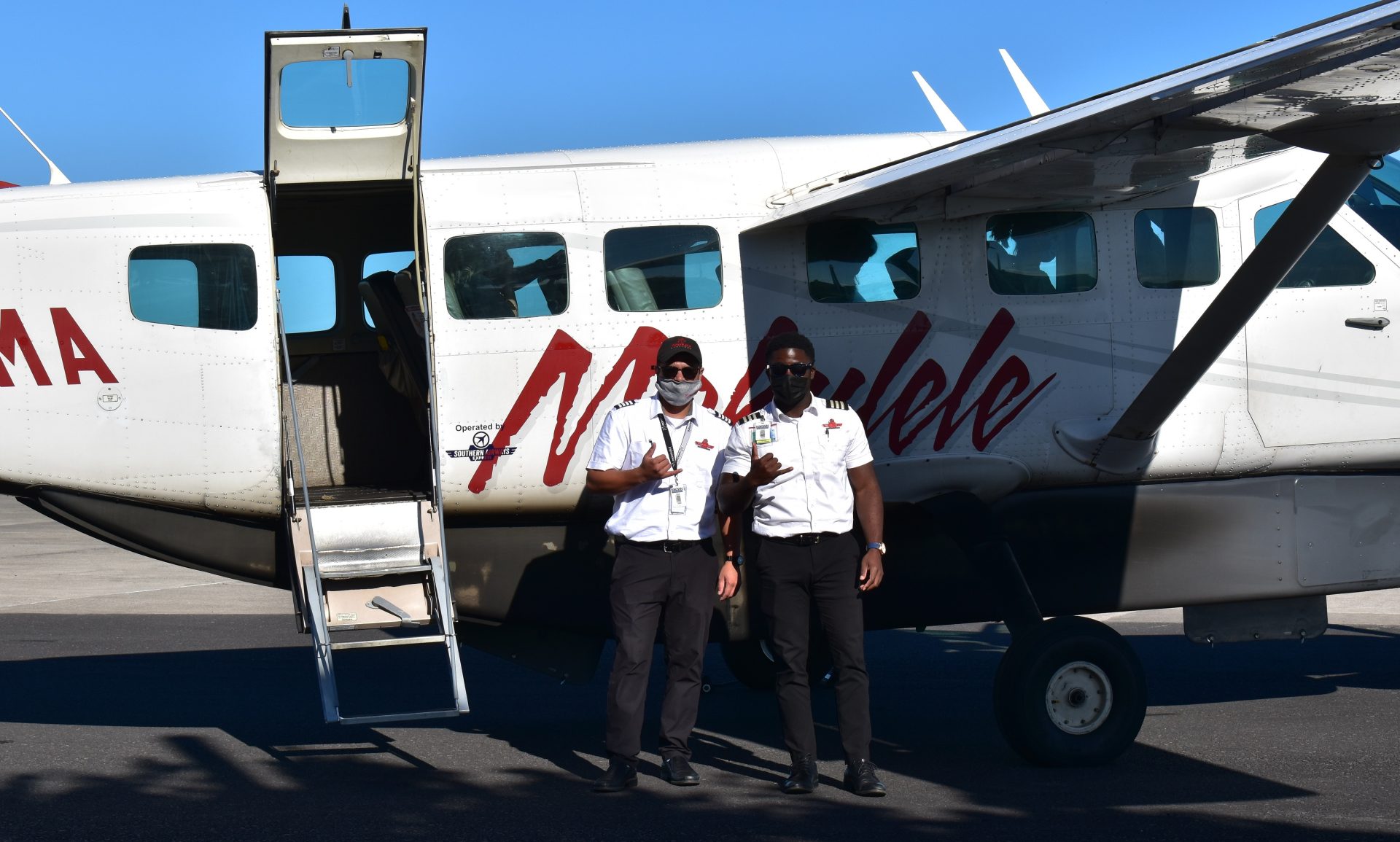
The pilots for my flight, Thaddaeus and Zach, saw my camera and instantly wanted to be included in the pictures and I wasn’t one to deny them this opportunity for a photo.
The pilots for my flight to Kalaupapa (Photo: AirlineGeeks | Joey Gerardi)
They also helped me out and took my picture in front of the terminal building, which I try to do at all my EAS stops. This next flight is the second shortest commercial flight in the world and the shortest in North America. Even with all of the picture taking, we only ended up being on the ground in Kalaupapa for just 12-minutes.
We took off from what may have been my one and only time stepping foot on this tiny peninsula and in the community of Kalaupapa. As we took off, I could see the filming location for the opening scene of Jurassic Park III in the distance, as the two pointed rocks from that scene are unmistakable.
Taking off From Kalaupapa (Photo: AirlineGeeks | Joey Gerardi)
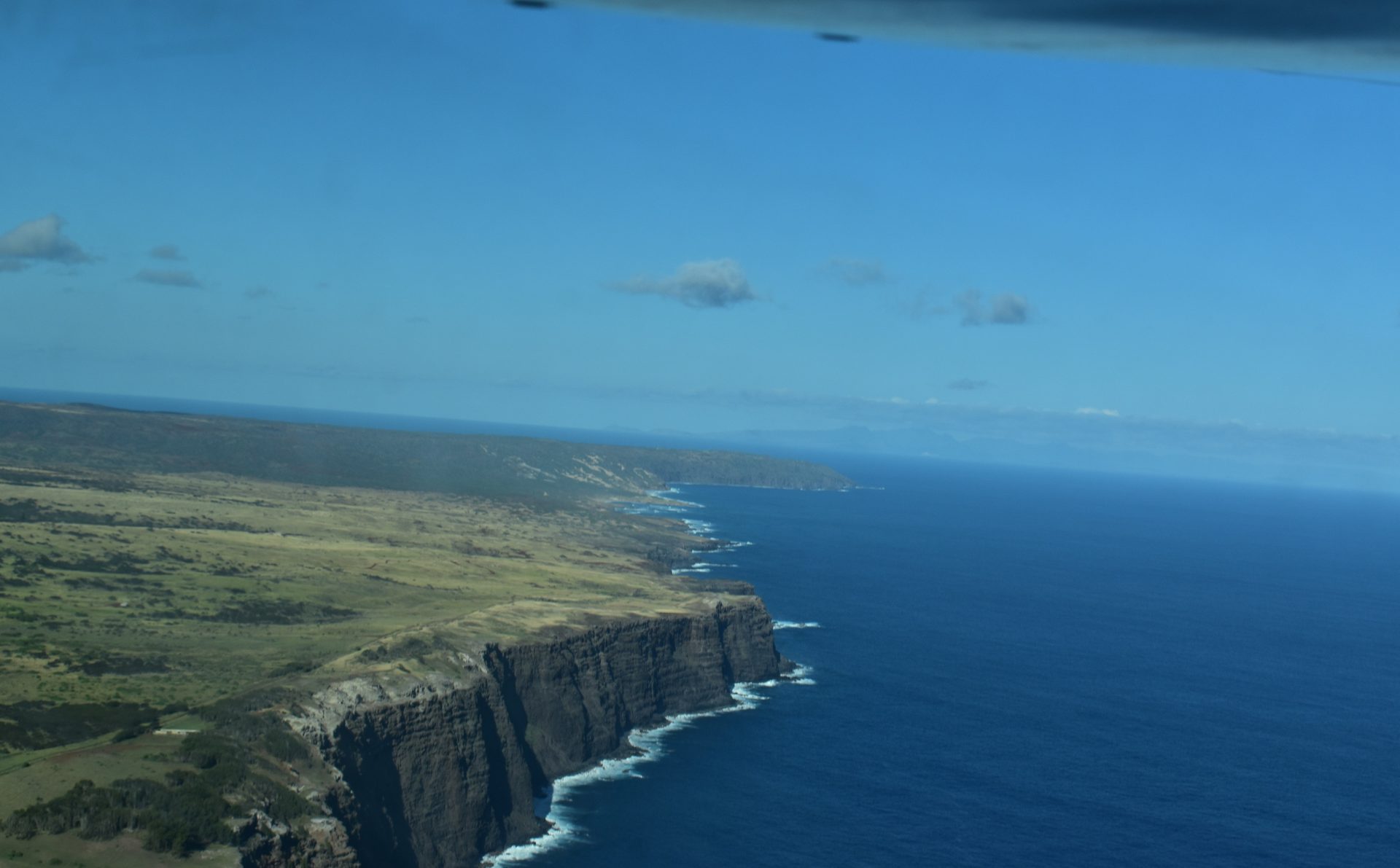
This flight was pretty uneventful, quickly up to our max altitude of 1,900-feet in order to clear the cliff line and made our way to Hoolehua Airport.
Flying over the cliff line at roughly 1,900-feet (Photo: AirlineGeeks | Joey Gerardi)
Even the non-aviation geeks enjoyed the sights and perks of a smaller aircraft, as many of the passengers were taking pictures of the runway out of the front window as we approached the airport.
We landed at Hoolehua Airport only 5-minutes after taking off from Kalaupapa. Even though the flight time was only 5-minutes, we took the long way to get here flying roughly 11-miles as we took off and made a 180-degree turn, then passed Hoolehua airport and turned 180-degrees again to land. The shorter direct route would have been 8-miles and would’ve made the flight time even shorter than that.
As an added bonus, due to our short shop in Kalaupapa, we arrived in Hoolehua at 9:07 A.M. which was our scheduled departure time from Kalaupapa. This also means that we arrived at Hoolehua 13-minutes early.
Our plane in Hoolehua (Photo: AirlineGeeks | Joey Gerardi)
This trip was a truly unique connection, and quite possibly one of the most unique stops I have ever made. There are many aspects that make this connection so unique and one of the must-take flights if you are an AvGeek in the Hawaiian Islands. From the time we took off from Honolulu to the time we landed in Hoolehua, it was 38-minutes, the nonstop flight from Honolulu to Hoolehua is only about 15 minutes shorter than connecting in Kalaupapa. So why not take an extra 15-minutes and see somewhere that you would never see in person otherwise.
Unless you fall into one of the previously mentioned permit categories, this connection is the ONLY way you will ever see Kalaupapa in person. So, the next time your travel try connecting somewhere new and unique, you may just like where you end up.
For a video account of this Unique Connection in Kalaupapa, Hawai’i, check out the link below.
Joey has always been interested in planes for as long as he can remember. He grew up in Central New York during the early 2000s when US Airways Express turboprops ruled the skies. Being from a non-aviation family made it harder for him to be around planes and would only spend about three hours a month at the airport. He was so excited when he could drive by himself, the first thing he did with his driver's license was get ice cream and go plane spotting for the entire day. He graduated from Western Michigan University in 2022 with a B.S. in Aviation Management & Operations and a Minor in Business, and currently works for a major airline in his hometown.
Garuda Indonesia Has Asked to Defer Payment of Debt Once More
On Wednesday, May 11, 2022, Garuda announced the process to defer its debt payment was filed with the Commercial Court of the Central Jakarta District. The application for a time extension takes into account the claims verification that is presently occurring. The method for the peace plan is still being discussed with the company’s creditors, according to Antara.com on Wednesday, May 11, 2022. Garuda Indonesia additionally extended the PKPU to meet and accommodate many creditors’ requirements.
Garuda Indonesia President Director Irfan Setiaputra indicated in an official statement that the extension of the PKPU would provide a better opportunity for Garuda and all creditors to achieve an agreement.
“Just as PKPU strives for a win-win solution for all parties concerned,” he stated, “We feel that this process must be carried out with caution and moderation.”
Garuda Indonesia committed to making the most of the opportunity given the 30-day timeframe. Irfan Setiaputra also claimed that the PKPU that was submitted this time will be the final extension request. “We appreciate creditors’ patience and cooperation throughout the PKPU process, which has gone successfully thus far,” he said. “This is crucial evidence that the communication process so far has revealed increasingly strong optimism about Garuda’s business prospects going forward,” he remarked once more.
Garuda is dedicated to maintaining normal passenger and cargo flight operations during the PKPU process. ” Throughout the first quarter of 2022, he asserted, the GIAA-coded issuer’s performance continued to demonstrate positive gains.
This is also assisted by the liberalization of travel mobility rules, which encourages an increase in public interest in flying. “Moreover, the operation of Umrah flight services from a number of important Indonesian cities, as well as the deployment of Hajj flights, will be a positive signal in our efforts to speed performance recovery, which we will continue to optimize,” Irfan added.
Garuda Indonesia’s Current Situation
PT Garuda Indonesia Tbk situation is still dire. In recent years, this government-owned airline has continued to lose money. Debt continues to mount, and the interest load is increasing. The decline of this flag carrier airline, which is currently dismal, is alleged to be the result of past corruption and business blunders by Garuda’s senior leaders. Rather than liquidating Garuda, the government decided to save the airline with APBN funds via the State Capital Investment (PMN) injection scheme. The House of Representatives Commission VI’s Garuda Rescue Committee has also backed the Garuda Indonesia rescue plan. Garuda will receive Rp 7.5 trillion in state funds from the 2022 State Budget. The Rp 7.5 trillion ($511 million) sum will be utilized to address very significant and urgent operational needs, such as salaries for staff who are still owed, maintenance, planes, and so on.
In a statement released on Thursday (12/5/2022), SOE Minister Erick Thohir said, “We are thankful and grateful that the cooperation of the DPR Commission VI committee is very relevant in efforts to restore Garuda.” After the approval of the APBN money disbursement, Erick Thohir stated that the Ministry of SOEs and Garuda Indonesia would implement the House of Representatives’ recommendations, beginning with fixing bad corporate governance and setting a clear timeframe and benchmarks. “The agreement between Commission VI, the Ministry of BUMN, and Garuda Indonesia in upgrading Garuda is a good teamwork and synergy,” he stated.
Putu Deny Wijaya was always an aviation enthusiast by heart, growing up in Indonesia where air transport is very vital. His first love is The Queen of The Skies, serving the trunk routes between Jakarta and Denpasar. He brought along this passion with him throughout college by conducting his bachelor study abroad in the Netherlands for the purpose of experiencing a nonstop 14-hour long-haul flight. For Putu the sky's the limit when talking about aviation. He hopes that he would be able to combine his passion for aviation and knowledge of finance at the same time.
Gatwick Airport Expands Connectivity to Canada Over Summer
An Air Transat A321 featuring a special "Kids Club" sticker on its livery. (Photo: AirlineGeeks | William Derrickson)
London’s Gatwick airport is to increase connectivity with Canada over the summer season with airlines offering 50 flights to six destinations. Services from the U.K.’s second-largest airport will be operated by WestJet and Air Transat with extra capacity being added to existing operations. Quebec City this week joined Vancouver, Calgary, Toronto, Montreal and Halifax as a new destination to those currently and previously available from the airport.
Stephanie Wear, Vice President of Aviation Development at Gatwick Airport said, “With so many people in the UK having close connections with Canada, we are delighted to be able to offer Gatwick passengers such easy and widespread access to fantastic destinations across the country.” According to the tourism entity Destination Canada, just over 900,000 tourists traveled to Canada from the U.K. in 2019. The equivalent British entity Visit Britain reported that 850,000 visitors entered the U.K. in 2018.
“Destination Canada is delighted to see the launch of so many routes to Canada from London Gatwick, including the first-ever direct connection to Quebec City with Air Transat,” said Marsha Walden, President and chief executive officer of Destination Canada.
“Re-establishing air routes into Canada is critical to rebuilding our industry and driving revenue back into tourism businesses across our vast country,” Marsha Walden added. “These flights mean Canada’s iconic experiences are even more accessible to British holidaymakers looking to take in our wide-open spaces, nature, wildlife, adventure and return feeling fully rejuvenated. What is particularly encouraging is that demand for the summer months is looking strong and our industry is ready to welcome guests back with open hearts.”
In addition to the once-weekly flight offered to Quebec City Air Transat will increase its thrice-weekly Montreal service to a daily offering in mid-June. Air Transat will also increase services to Canada’s most populous city Toronto with a double daily offering in operation by the end of June. Calgary-based carrier WestJet will also increase services to Toronto with a daily operation peaking at nine flights a week from mid-June.
WestJet will also increase flights to Halifax, Nova Scotia from four per week to a daily service from mid-July. The airline will offer U.K passengers the ability to fly to its home base in the province of Alberta .5 times a week from mid-June up from the current 3 services. The longest route on the Gatwick-Canadian network will be expanded by WestJet from mid-June with an extra flight added to Vancouver, British Columbia making for a daily service offering.
Stephanie Wear added, “From the spectacular landscapes of the Rockies and Nova Scotia to vibrant cities with an array of wonderful sights, it’s really exciting to have so many more opportunities to visit Canada from Gatwick. It’s also great news for those wishing to see family and friends, or conduct business across the Atlantic.”
John has always had a passion for aviation and through a career with Air New Zealand has gained a strong understanding of aviation operations and the strategic nature of the industry. During his career with the airline, John held multiple leadership roles and was involved in projects such as the introduction of both the 777-200 and -300 type aircraft and the development of the IFE for the 777-300. He was also part of a small team who created and published the internal communications magazines for Air New Zealand’s pilots, cabin crew and ground staff balancing a mix of corporate and social content.
John is educated to postgraduate level achieving a masters degree with Distinction in Airline and Airport Management. John has held the positions of course director of an undergraduate commercial pilot training programme at a leading London university. In addition he is contracted as an external instructor for IATA (International Air Transport Association) and has been a member of the Heathrow Community Fund’s ‘Communities for Tomorrow’ panel.
Textron Aviation Delivers FedEx’s First Cessna SkyCourier
FedEx Express takes delivery of a new 408 SkyCourier aircraft (Photo: Textron Aviation)
On Monday, Textron Aviation delivered the first Cessna SkyCourier to its launch customer, FedEx Express. The delivery of the twin-engine, high-wing turboprop marks the first of FedEx’s 50 aircraft orders for the SkyCourier. However, FedEx has options for 50 additional aircraft if they see fit. For Textron Aviation, the SkyCourier is their newest freighter, as it received its type certificate earlier this year in March.
Through improved performance at lower operating costs, the aircraft looks to play a vital role in FedEx’s feeder operation.
“For nearly 50 years, FedEx has been known for being flexible and innovative in finding solutions for our customers, and this aircraft will help us better serve small and medium markets where we aren’t able to operate our larger aircraft,” said Scot Struminger, CEO and Executive Vice President of Aviation, FedEx Express. “The SkyCourier will make us more efficient, now being able to move containerized and palletized freight for our customers.”
Textron Aviation and FedEx Express collaborated throughout the entire development process of the aircraft, from engineering to design, the teams tailored the aircraft to best suit the carrier. The two companies are no strangers to each other, however. They have been working collaboratively for many years.
“FedEx took delivery of its first Cessna in the mid-1980s and the two companies have had a collaborative relationship over the four decades since,” said Textron Aviation President and CEO, Ron Draper. “We’re thrilled to deliver this aircraft that will help FedEx serve its customers more efficiently as it is designed with the option to carry industry-standard prepacked cargo containers. We believe much other air freight, passenger, and special mission operators also will benefit from the winning combination of low operating costs and unparalleled lift capacity that the new Cessna SkyCourier brings to the market.”
The Cessna 408 SkyCourrier will play an important role in FedEx’s initiative to modernize its fleet.
The aircraft generates power through two wing-mounted Pratt & Whitney PT6A-65SC turboprop engines and utilizes a four-bladed, 110-inch aluminum McCauley Propeller C779. The full feathering, reversible pitch propeller is designed to enhance the performance of the aircraft while carrying large loads. The aircraft features Garmin G1000 NXi avionics. It has a maximum cruise speed of more than 200 knots and a 900 nautical-mile maximum range. The aircraft features a large door and a flat floor cabin. It is capable of holding three LD3 shipping containers with a 6,000 lb payload capability.
The SkyCourier isn’t just a freighter. Textron Aviation designed a 19-passenger variant of the aircraft that includes separate crew and passenger entries for smooth boarding, as well as large cabin windows for natural light and views. Both configurations offer single-point pressure refueling to enable faster turnarounds.
The SkyCourier is a much-needed refresher for the industry and looks to replace older aircraft. The average twin utility turboprop on the market today is 30 years old, indicating that a modern aircraft is due.
Much of FedEx’s smaller markets are served by the highly successful Cessna 208 Caravan. The versatile 408 SkyCourier doesn’t look to replace the Caravan, but rather works alongside it.
Chase Hagl grew up in Twin Falls, Idaho. His love and passion for Aviation landed him in Orem, Utah where he obtained a B.S. in Aviation Management with a minor in Business Management from Utah Valley University. Chase currently works as a flight attendant in Charleston, SC and is also the primary Inflight ASAP ERC representative for startup airline, Breeze Airways. His experience in the aviation industry spans back four years, working in areas including agriculture application, customer service, maintenance, and flight ops. In his free time, Chase enjoys road biking, astronomy, and flying.
Star Alliance Celebrates Its 25th Anniversary, Continues Enhancing Digital Passenger Experience
Original Star Alliance Carrier (Photo: Walter Orten/Lufthansa)
Next weekend Star Alliance, the oldest alliance in the airline industry, will celebrate its 25 anniversary. In fact, it was on May 14, 1997, that the five original founding members of the alliance announced the creation of this entity that would shape the growth of air transportation growth for the years to come. Air Canada, Lufthansa, Scandinavian Airlines, Thai and United constituted the core of what is still today the largest airline in the aviation industry with 26 active members, after reaching a peak of 28 airline members before the pandemic took away Adria Airways and Avianca Brazil.
During a press call on Friday, the CEO of Star Alliance Jeffrey Goh underlined the many achievements of Star Alliance during the past 25 years and provided an outlook of what is yet to come in the next few months and years.
The Passenger Is In Control
After the 20 anniversary of the Alliance in 2017 marked the shift of the focus toward the passenger’s digital experience, today Star Alliance is continuing down the same path with seat selection integration: soon passengers on itineraries involving multiple Star carriers would be able to select their seats throughout their journey without having to access their reservation multiple times through different apps or websites, and work is underway to allow bag tracking on multi-airline itineraries.
Technology still remains central to the strategy of Star Alliance Carriers: the introduction of biometric solutions at four trial airports allowing passengers to go through security and board their planes without having to worry about passports and boarding passes has proven to be a perfect solution in times of COVID-19.
In November 2020 there was also the launch of a trial for a Digital Connection Center at London Heathrow Airport. Possible risks of passengers in danger of missing their interline connection between two Star Alliance Carriers are being evaluated and addressed as appropriate, performing protection as necessary and helping them navigate through the airport using their smartphones and existing electromagnetic fields around the airport.
Branded Credit Card, Intermodal Partnership
Some of the initiatives in the pipeline for Star Alliance include the launch of a Star Alliance co-branded credit card before the end of the third quarter of 2022. Details about the credit institute that will be partnering with Star and the country where this industry-first endeavor will be rolled out were not disclosed.
There is also a more ambitious problem in the pipeline that would create the first intermodal partnership between Star Alliance carrier and a non-airline to integrate services and networks in order to provide passengers a seamless service. It has been revealed that the experiment will take place with a European partner and it will be launched by the end of this year.
This will be part of Star Alliance’s commitment, together with the rest of the industry, to net-zero carbon emissions by the middle of this century. “We are looking at all the possible solutions – said Goh – at the moment Sustainable Aviation Fuels are not being produced in quantities that can make a difference in aviation, but we will be ready to procure them as soon as manufacturers are able to deliver the quantities that are being needed. In the meantime, we keep looking at other possible solutions like decarbonization through the development of hydrogen aircraft and carbon-capture techniques”.
Vanni fell in love with commercial aviation during his undergraduate studies in Statistics at the University of Bologna, when he prepared his thesis on the effects of deregulation on the U.S. and European aviation markets. Then he pursued his passion further by obtaining a Master’s Degree in Air Transport Management at Cranfield University in the U.K. followed by holding several management positions at various start-up carriers in Europe (Jet2, SkyEurope, Silverjet). After moving to Canada, he was Business Development Manager for IATA for nine years before turning to his other passion: sports writing.
Sign-up for newsletters & special offers!
Get the latest stories & special offers delivered directly to your inbox