








Stories

Air Mauritius Resumes Flights To Johannesburg

An Air Mauritius Airbus A330-900 at the Paris Airshow 2019 (Photo: Airbus)

Air Mauritius recently announced the resumption of its commercial flights from Johannesburg to Mauritius.

The airline will now serve five weekly flights scheduled for January 2022, operated on Mondays, Wednesdays, Thursdays, Fridays and Sundays. Flights will be operated by both the Airbus A350-900 and the A330-900neo.

Air Mauritius flight resumption from Johannesburg comes when Mauritius reopened its border to travelers from South Africa, and eight other previously restricted countries, on Friday.

This was the latest island nation to lift its South African travel ban, three weeks ahead of schedule, as a similar move was seen taken by island destinations including Seychelles and the Maldives. The popular island destination had initially announced that the Omicron-induced travel ban would last until Jan, 31.

The ban imposed on South African travelers was after the detection of the controversial Omicron coronavirus variant in late November with African countries affected by the ban including South Africa, Botswana, Namibia, Zimbabwe, Eswatini, Lesotho, Malawi, Mozambique and Zambia.

“The high infection rates in over 50 countries means a person is as likely to catch the Omicron variant in Port Louis, Berlin, Brussels or Paris or as they are in Johannesburg or Cape Town. Travel bans have become redundant in the face of this reality,” Otto de Vries, CEO of the Association of Southern African Travel Agents (ASATA), said in reaction to Mauritius’ ban. “ASATA is profoundly frustrated and disappointed by the Mauritian Government’s decision to further extend a travel ban when it is evident there is no scientific basis to continue the ban.”

The Island country’s initial decision to extend the travel ban to Jan. 31 was met with disdain, making the popular island destination suddenly change its plans in an announcement on Thursday.

“We are very pleased that South Africans can once again travel to Mauritius,” Arvind Bundhun, Director of the Mauritius Tourism Promotion Authority (MTPA), said.

Mauritius’ Response

Mauritius reopened to international travelers in a phased approach, beginning September last year. The first phase restricted travelers to designated resorts, which gradually eased with the second and third phases of reopening.

“Covid-19 has placed significant pressure on all nations to do the right thing and we thank South Africans and the South African travel industry for their patience in this regard,” Bundhun added.

This was however distorted by the Omicron scare which was imposed on Nov. 27. With the travel ban now lifted, Mauritius joins the ranks of the Seychelles, Maldives and Zanzibar as the latest idyllic island getaway open to holiday visitors.

FlySafair and South African Airways operate flights directly to Mauritius but have not yet confirmed when these services will resume.

Fully vaccinated travelers going to Mauritius still need to present a negative PCR test taken within 72 hours before departure and arrange Covid-19 health insurance cover. Additionally, visitors will be required to undergo another free Covid-19 test upon arrival in Mauritius and a self-administered antigen test on day 5 of their holiday.

Victor Shalton

Victor Shalton's love for aviation can be traced to when he was 11-years-old. As a seasoned aviation writer, he takes pride in providing the best aviation coverage around the globe and is passionate about advancing his skills in the aviation space. In addition, he loves travelling, writing, arts and while his speaking engagements have taken him around the world, he is proud to call Nairobi home.

Singapore’s Changi Airport Observes Surge In Passengers

A Singapore Airlines A380 coming in to land in Los Angeles. (Photo: AirlineGeeks | William Derrickson)

Singapore’s Changi Airport has revealed its traffic at the end of 2021, which was about 15% of pre-pandemic levels. Compared to early 2021, the passenger capacity was only 3% of pre-pandemic levels. The international travel hub believed the passenger traffic will improve this year. However, the airport will need to take several years to recover.

According to Changi’s website, the airport handled 68.3 million in 2019, but the passenger capacity plummeted to 11.8 million in 2020.

Singapore has been seeing a surge in travelers by the end of 2021, thanks to the government’s Vaccinated Travel Lane (VTL) and Air Travel Pass (ATP) program, allowing some countries and regions’ citizens to travel to Singapore without quarantine, such as the U.S., the U.K., Canada, Germany and France.

Since the pandemic has begun, Singapore’s aviation industry has been facing a severe impact. Hong Kong, — Singapore’s main rival — has experienced the same problem, which is a lack of domestic air travel.

According to Singapore Airlines, the VTL has supported demand for air travel to Singapore. In response to the surge in demand, the flag carrier has resumed Airbus A380 operations to London and Sydney in November and December respectively.

“Our goal is to restore quarantine-free travel with more countries and regions as allowed for by the public health assessment,” S. Iswaran, Transport Minister of Singapore, said.

With the Omicron raging through the world, the Singapore government sounded the alarm as the ticket sales for all designated VTL are suspended until Jan. 20.

There is growing concern about the virus coming into the country after reopening the border. According to the government, over 220,000 travelers have entered Singapore via the VLT program, but less than 1% of travelers tested positive for Covid-19 on their arrivals.  Meanwhile, about 2,600 Omicron cases have been imported into the country thus far, making up about 60% of the total cases in the country. Additionally, 32% of cases came from the U.S. and U.K., and another 10% came from India.

Airport Competition

In addition, the vibrant hub is committed to opening the border despite the Omicron cases surging.

“As part of living with Covid-19, Singapore must shift to a new setting that will enable us to stay connected to the world,”  Isawaran said when discussing that the VLT is important to Singapore, allowing foreign travelers to enter the country without obstacles

Singapore’s Changi Airport is best known for being the world’s best airport for eight years in a row. However, Changi Airport was defeated by Doha, Qatar’s Hamad International Airport and Tokyo’s Haneda International Airport — ranking third in 2021.

Also, there is competition with airports in neighboring countries. Earlier, Indonesia revealed its ambition, going to partner with Indian and French airport operators to compete with Changi and Malaysia’s Kuala Lumpur International Airport.

“It is important that we mount a systemic response to preserve our competitiveness as an international hub,” Iswaran added, to the competition with other airports.

Viva Aerobus Sets Passenger Record

Viva Aerobus A320 LAS William Derrickson
A Viva Aerobus A320 in Las Vegas. (Photo: AirlineGeeks | William Derrickson)

In December 2021, Viva Aerobus exceeded, for the first time in its history, more than 1.6 million passengers transported. This represented a growth of 46% compared to the same month of 2019 and with a load factor of 84%.

In a press release, Viva Aerobus published these record figures that demonstrate the excellent 2021 it had and its impressive continuous growth measured by passenger totals as well as revenue passenger kilometers (RPK) and available seat kilometers (ASK), measures of passengers carried and capacity, respectively.

“Our ultra-low-cost business model allowed us to continue stimulating the demand and serve more than 15 million passengers last year, thus exceeding our pre-pandemic demand levels and with a healthy load factor despite the waves of Covid-19 during 2021,” Viva Aerobus CEO Juan Carlos Zuazua said. “Our nonstop service, low prices, new fleet and unmatched reliability have been the reason for the preference and trust that passengers have given us during this pandemic.”

Monthly Results
December 2019 December 2020 December 2021
Passengers 1,136,886 1,103,042 1,660,765
Load factor (RPK/ASK) 86.8% 76.7% 84.3%
RPK (millions) 1,285 1,270.2 1,979.2
ASK (millions) 1,480.7 1,655 2,347.7

With these figures, the Mexican ultra-low-cost carrier Viva Aerobus closed 2021 with solid numbers as it looks to cement its leadership in the Mexican aviation market.

Viva Aerobus’ 2021

Viva Aerobus celebrated in 2021 its 15th anniversary at a time of historic growth, having carried more than 80 million passengers since its founding in 2006 and showing a strong revival in demand compared to recent months.

In 2020, Viva Aerobus maintained a leadership position in the reactivation of the North American aviation industry by becoming the first carrier on the continent to resume 100% of its operational capacity after the Covid-19 pandemic affected the aviation industry, an achievement it reached in November 2020.

Viva Aerobus was positioned in March 2021 as the first Mexican carrier to exceed pre-Covid-19 passenger traffic, a trend it has maintained since then. The Mexican ultra-low-cost carrier launched 11 new routes in 2021 – five domestic and six international.

Concerning its fleet, Viva Aerobus in 2021 took delivery of its 50th Airbus A321. With this arrival, the Mexican ultra-low-cost carrier reaffirmed itself as the airline with the youngest fleet in the country and the second youngest in North America, now made up of 10 Airbus A321s and 40 Airbus A320s with an average age of only 4.6 years.

Regarding annual passenger traffic in 2021, the Mexican ultra-low-cost carrier presented a 27% increase compared to 2019, with more than 15.2 million passengers transported.

Annual Results
2019 2020 2021
Passengers 12,019,114 8,122,815 15,267,636
Load factor (RPK/ASK) 88.7% 80.5% 83.6%
RPK (millions) 13,374.8 9,393.2 17,830.9
ASK (millions) 15,080.1 11,669.5 21,330.7

After years of ups and downs, Viva Aerobus has positioned itself as one of the three main airlines in Mexico and one with the highest passenger growth rates globally.

Juan Pedro Sanchez Zamudio

The three things Juan Pedro loves most about aviation are aircraft, airports, and traveling thousands of miles in just a few hours. What he enjoys the most about aviation is that it is easier and cheaper to travel around the world and this gives you the opportunity to visit places you thought were too far away. He has traveled to different destinations in North, Central, South America and Asia. Born, raised and still living in Perú, Juan is a lawyer, soccer lover, foodie, passionate traveler, dog lover, millennial and curious by nature.

ITA Airways Eyes Likely Agreement with Lufthansa As Delta Watches On

ITA Airways
An ITA Airways Airbus A320 with the new livery at Leonardo Da Vinci International Airport. (Photo: ITA Airways)

Though its operations first started less than three months ago, ITA Airways has become an airline of great interest both in its home country and around the world. The fact that it is the Italian national airline is a strategic factor both for the company itself and for other European and non-European airlines. Several sources have reported that not only the American carrier Delta is interested in becoming a partner of ITA Airways, but recently also the German behemoth Lufthansa.

ITA Airways is undoubtedly a newborn company, economically stable and focused on its future in order not to make the same mistakes as its predecessors. President Altavilla says it would be wrong to remain independent because ITA Airways is too small compared to the three big airline groups operating in Europe. So his goal is to form an alliance with a major partner as soon as possible before the start of the summer season, which tends to be a very profitable time for airlines in Europe.

Lufthansa’s offer is not official, but it is rumored that the German group is willing to acquire a significant share of ITA’s capital – not less than 15-20% with the possibility of reaching 40%. On the other hand, Delta, already in negotiations with Alitalia during the period the carrier was under administration, would likely prefer to see the agreement with the German giant go away in favor of their own deal with ITA to develop a stable network with Italy, one with an airline which Delta already has codeshare agreements.

Negotiations, although not yet official, seem to be trending toward Lufthansa, according to sources of the Italian newspaper Il Messaggero. ITA’s president has also talked up the benefits of a European partnership over any other. 

Finding Its Alliance

Today SkyTeam posted on its social channels an updated graphic with the 19 member airlines, including of course ITA Airways. The choice of ITA Airways to become part of the SkyTeam group, led by Delta and Air France, made it seem from the outset that the partner was Delta. However, the choice to be bound for only one year in this alliance opens up the possibility of new scenarios come the expiration of the term. Therefore, at the end of 2022, should the agreement with Lufthansa materialize, ITA Airways could switch to competition and become part of the Star Alliance group, which in Europe is anchored by Lufthansa.

It has been confirmed that the Airbus A350s that will join the ITA Airways fleet as of June 2022 are those that previously belonged to beleaguered Chinese carrier Hainan Airlines. However, the planes, despite never having been delivered to the Chinese airline due to financial problems, their internal fittings have already been completed and therefore do not match those of ITA Airways. All this will therefore have an increased cost for the internal and external retrofit, but it is not yet clear whether the company or the lessor will pay for it.

Vincenzo Claudio Piscopo

Vincenzo graduated in 2019 in Mechanical Engineering with an aeronautical curriculum, focusing his thesis on Human Factors in aircraft maintenance. In 2022 he pursued his master's degree in Aerospace Engineering at the University of Palermo, Italy. He combines his journalistic activities with his work as a Reliability Engineer at Zetalab.

Interviews: Southern Airways Express Receives King Air After Delay

Southern KingAir 200 in Chadron, Nebraska. (Photo: Southern Airways Express)

Despite knowing a lot about the Essential Air Service, or EAS, program and what goes on in it there are still some things that slip past and go unnoticed. Southern Airways Express won the contract for the community of Chadron, Neb., (CDR) to operate daily flights to Denver on the King Air 200 and has been operating the route since June of 2021.

But something had gone unnoticed and was brought to the attention of AirlineGeeks by a concerned individual who wishes to remain nameless. Southern Airways Express, or SAE for short, has been operating the route on the much slower Cessna208 since the route began more than six months ago. In this article, we will go over the reasoning for this, as well as celebrate the arrival of the carrier’s first King Air 200.

The Reason and Commentary

As with anyone during the pandemic, and more so in the past couple of months, staffing shortages are plaguing companies everywhere and the Federal Aviation Administration, or FAA, is not immune to this problem.

AirlineGeeks had a brief discussion with Southern Airways Express Chief Marketing Officer, Keith Sisson, as to why the arrival of these aircraft is six months late.

AirlineGeeks (AG): So, is there any specific reason why the King Air 200 took so long to put into service?

Keith Sisson (KS): Initially we wanted to make sure we got the proper planes into the Chadron market, our predecessor [Boutique Air] flew PC-12’s which were severely lacking in luggage space. So, we specifically ordered the Super 200’s [King Air 200] with cargo pods in order to ensure plenty of room for bags. For one of the planes, we had to have the pod custom built. The larger problem came later and was related to an FAA pilot regulation put into effect in 2018. Southern operates all of our 220 daily flights with two pilots, but the new FAA regulation requires us to initially operate the King Air single Pilot. We believe this is a safety issue and have chosen to seek a variance on that nonsensical rule. Our application has been held up in Washington D.C. for weeks. We’re hoping to get approval any day now to put two pilots into our King Airs. The planes are sitting on the tarmac in Chadron just waiting on government action! Who would possibly want to fly with one pilot instead of two?

Inside Southern Airways Express new King Air 200 (Photo: Southern Airways Express)

(AG): You said planes, as in plural. How many King Air 200’s do you have?

(KS): We have three Super 200’s in our system, and two of them will be operating in Chadron.

(AG): What will the King Air 200 feature in terms of passenger comforts?

(KS): Not many airlines fly a King Air on scheduled-service routes. The aircraft has traditionally been used for private executive charters. Customers flying on the Super 200 will feel more like a corporate executive than passengers on an Essential Air Service route. The planes are outfitted with cargo pods, so the baggage capacity will be similar to the Caravan [Cessna208], but unlike the Caravan, these will cruise at 20,000 feet and 250 miles per hour.

A Southern Airways Express Cessna 208 (Photo: AirlineGeeks | Joey Gerardi)

We also had time to ask the City Manager of Chadron, John Sutherland, a question regarding the aircraft currently flying the route to his community;

(AG): So John, has there been any issue or complaints from anyone in the community in regards to the Cessna 208 currently operating the flights to Denver?

(John Sutherland): No, their customer service performance has been excellent. Their service performance has been so much better than their predecessor’s, complaints about the aircraft they have put into interim service for the route have not been an issue with the public. The King Airs that were promised have been delivered…… and will be put into service for regular flights to and from Chadron as soon as the regulatory process allows. We are all looking forward to it.

The passenger door is located at the rear of the aircraft on the King Air 200 (Photo: Southern Airways Express)

Each EAS contract has a set amount of subsidy that is given to airlines operating the respective route. Due to the Cessna 208 having a much lower operating cost-per-hour compared to the King Air, we reached out to the FAA to inquire about how this is handled as the subsidy they were given is using the King Air 200 standards, The FAA said they “have no comment at this time”.

Celebration

The aircraft in question first arrived into the community on Dec. 21, 2021, and was shown off to the residents there, who got a firsthand look at the aircraft they have been so patiently waiting for. In the below photo, you can clearly see the cargo pods under the aircraft that were added to increase baggage capacity.

SAE showing off their new plane in Chadron back in Dec. of 2021 (Photo: Southern Airways Express)

While this is an exciting time for Chadron and Southern Airways Express, it’s also exciting for AvGeeks. As Keith Sisson mentioned, other airlines do fly the King Air in the United States for scheduled passenger flights, but at this current point in time, there is only one other in the lower48 states that operate a King Air of any type on scheduled passenger flights. Hawthorne, Calif.-based Advanced Air operates the King Air 350 on its EAS routes out of Silver City, N.M., and Merced, Calif. as well as a non-EAS flight from Phoenix to Hawthorne three times a week. But Advanced operates the 350 version of the King kiAir, meaning SAE is the ONLY airline that flies the KingAir200 in the United States, and only on the one route to Chadron, Neb.

As far as when the aircraft will officially be put into scheduled passenger service in Chadron, well that is completely up to the government and the FAA. For now, they have two of them sitting in Chadron if you feel like taking a road trip to see them, or by tracking the tail number N727SA to see if they have finally taken to the skies with passengers.

A big thanks to Keith Sisson at Southern Airways Express and Chadron City Manager John Sutherland for answering my questions.

Joey Gerardi

Joey has always been interested in planes for as long as he can remember. He grew up in Central New York during the early 2000s when US Airways Express turboprops ruled the skies. Being from a non-aviation family made it harder for him to be around planes and would only spend about three hours a month at the airport. He was so excited when he could drive by himself, the first thing he did with his driver's license was get ice cream and go plane spotting for the entire day. He graduated from Western Michigan University in 2022 with a B.S. in Aviation Management & Operations and a Minor in Business, and currently works for a major airline in his hometown.

American Airlines Resumes Sydney Services

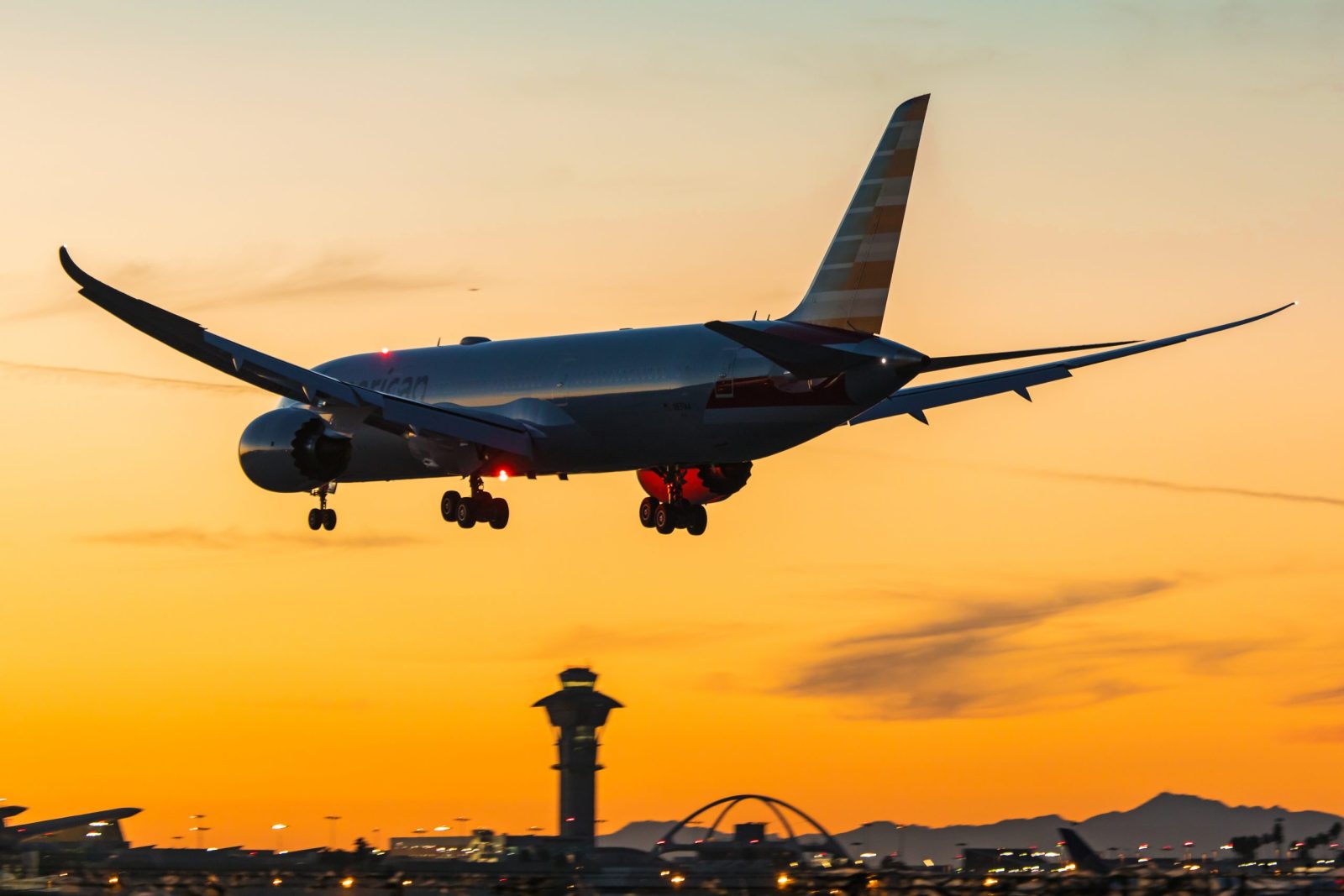
An American Airlines Boeing 787 Dreamliner on approach to Los Angeles. (Photo: AirlineGeeks | William Derrickson)

American Airlines has resumed service between Sydney and the United States. The airline joined competitors Qantas, Delta Air Lines, and United Airlines on the Los Angeles – Sydney route for the first time in several months this week. The Dallas-based airline has joined the ranks of other airlines that have recently resumed service to Australia’s largest city.

Daily American flights to Sydney is Resuming

On Thursday morning, an American Airlines Boeing 787-9 Dreamliner arrived in Sydney after flying AA73 across the Pacific. The airplane flew AA72 back to Los Angeles after a few hours on the ground.

American Airlines will finally fly to and from Sydney on a daily basis, as it did before the travel crisis. On the Sydney – Los Angeles city pair, the 787-9 accommodates 285 people and adds 3,990 weekly seats in and out of Sydney.

United’s daily Dreamliner service, Delta’s daily A350-900 flights, and Qantas’ soon-to-be Airbus A380 services will all compete on the route. It’s not quite business as usual on this city pair, but the four airlines together provide plenty of options to potential travelers

American’s return sees four airlines flying the Sydney – Los Angeles route

Except for United’s Sydney – San Francisco flights, other West Coast North American cities are still absent from the departures board at Sydney. Both Delta and American only ever flew the Sydney – Los Angeles route, but United usually also flies Sydney – Houston. Qantas typically flies to San Francisco, Vancouver, and Dallas in addition to Los Angeles. One Qantas Los Angeles flight also usually continues onto New York.

There’s plenty of business flying freight between Sydney and Los Angeles in both directions. However, passenger traffic remains subdued. While the US is welcoming fully vaccinated Australians, Australia is yet to roll out the welcome mat to fully vaccinated US citizens. That will change soon enough. But in the meantime, the restriction puts a dampener on demand for transpacific flights.

In 2019, the last year of open skies for airlines, 908,540 individuals traveled from Sydney to Los Angeles in both directions. It was the seventh busiest international airline route in and out of Australia, based on passenger counts. In that year, the route accounted for 27.5 percent of total passenger travel between the two nations.

British Airways has also confirmed that it will return to Sydney.

Meanwhile, another well-known airline will shortly begin service to Sydney. This airline is coming in from the other side. British Airways has stated that its London-Singapore-Sydney flights will resume at the end of March.

British Airways was the final remaining airline among a slew of Europe-based carriers that formerly flew into Sydney until it ceased operations in 2020. The BA Sydney service was also the last of what used to be a large British Airways presence in Australia.

There are plenty of British Airways fans who will remain with the carrier no matter what happens. However, their previous daily Boeing 777-300ER service was abysmal and simply couldn’t compete with Qantas and Singapore Airlines’ sleeker planes and superior accommodations on the London – Singapore – Sydney route.

However, when BA flies back to Sydney at the end of March, it will do so on a Boeing 787-9 Dreamliner. Qantas intends to deploy its A380s on this route by the middle of the year. On this route, Singapore Airlines uses a variety of aircraft, including A380s. Those BA Dreamliner flights may struggle to compete with the A380 offers from Qantas and Singapore Airlines.

On the Sydney – Los Angeles route, American Airlines will also have its job cut out for it, as it will be competing against some rather swanky cabin items supplied by competitors. Both airlines, however, have a sizable client base, and it will be great to see two of the world’s most well-known airline brands return to Australian skies.

Putu Deny Wijaya

Putu Deny Wijaya was always an aviation enthusiast by heart, growing up in Indonesia where air transport is very vital. His first love is The Queen of The Skies, serving the trunk routes between Jakarta and Denpasar. He brought along this passion with him throughout college by conducting his bachelor study abroad in the Netherlands for the purpose of experiencing a nonstop 14-hour long-haul flight. For Putu the sky's the limit when talking about aviation. He hopes that he would be able to combine his passion for aviation and knowledge of finance at the same time.

Air China Received Three New Airbus Aircraft at the End of 2021

First Air China A350-900 take off (Photo: Airbus)

On Dec. 31, 2021, Air China picked up an Airbus A320neo and an Airbus A321neo from Airbus headquarters in Toulouse, France. On the previous day, the flag carrier of China received a brand-new Airbus A350 from the manufacturer’s Tianjin, China facility. Air China set the ambitious goal to receive 55 jets in the year 2021, however, even with the 3 additions, the airline still fell short of the goal.

The two Airbus A320neo series jets will be based in Air China’s Chengdu, China hub. In June 2021, the city opened its second mega airport, Chengdu’s Tianfu International Airport, to support the continuously growing travel demand in-and-out of the region.

The newly delivered A350 will be based in Air China’s Beijing hub. This A350 is the third of its kind to be delivered from Airbus’s Tianjin, China facility. In July 2021, Airbus officially opened its Tianjin A350 finishing center and delivered its first A350 to China Eastern.

Missing Target

Air China fell short of its 2021 delivery target by 15 jets. In its financial reports, Air China laid out a 55 delivery plan for new aircraft in 2021. On top of the 23 jets delivered in H1 2021, Air China planned to add 32 jets to its fleet. The plan was laid out in the carrier’s mid-year report and its Q3 performance announcement, however, only 17 out of the 32 jets were received by Air China, based on initial statistics of the airline’s importation record.

Previously, in October and November of 2021, Air China received three Airbus A320neos, three Airbus A321neos, and one COMAC ARJ21-700. Boeing has long been missing from Air China’s delivery records. Tough Air China Group still holds a massive inventory of orders for Boeing 737Max. The jet has just finished its 45 months of grounding in China. Grounded 737Maxs in China are being unsealed, and hopefully to contribute to the travel rush near the spring festival.

The reason behind the missed target was largely attributed to China’s underperforming domestic markets in 2H 2021 due to Covid-19. The zero-tolerance policy against the virus limits travels from cities that had spot cases. International travel is still maintained at an extremely low level, as new variants of Covid-19 soar around the world.

Airbus also delivered two A350s to China Southern, Air China’s long-term competitor, at the end of 2021. The two new jets of China Southern will be based in Shenzhen, one of Air China’s strategic hubs.

New Hopes

In the previous reporting, Air China is planning to receive 34 jets in 2022, excluding any Boeing 737Max. With 737Max being reissued with Airworthiness certification in China, the number is expected to be much higher than 34. The additional capacity will come conveniently as China is also slowly relieving travel restrictions.

Aircraft manufacturers tend to accelerate the delivery of aircraft at year ends to boost their results. Airbus achieved its goal to deliver 600 jets in 2021. The manufacturer originally set its target at 566 jets and dialed up its target in mid of 2021 based on the optimistic outlook for the recovery of the aviation industry. Airbus is increasing the production capacity of its popular A320neo family from 60 per month to 65 per month, and possible for a further increase to 75 per month. The industry is fueling a swift rise in the coming years.

Lei Yan

Lei is from Inner Mongolia, China, and now lives in Guangzhou. He grew up in an aviation family, where his passion began. During his time at Penn State University, he studied Industrial Engineering specializing in operations research, and he graduated with an honor’s thesis on airport gate assignment optimization. Now, he is a Purchasing Manager with Procter & Gamble. In his free time, he enjoys flying, reading, and wandering around the city.

St. Louis’s Master Plan Reveals Push for Single Terminal

Terminal A at St. Louis-Lambert International Airport (Photo: AirlineGeeks | Ian McMurtry)

What once started as a single terminal resting under the domes of Minoru Yamasaki might be returning once more as St. Louis-Lambert International Airport evaluates its future needs going forward. The airport recently announced its updated Airport Master Plan during the Airport Commission Briefing on January 5th, taking into account an array of flyers requests and discomforts about the current experience at St. Louis. These polls were run in 2020 and 2021 and were compiled to focus on St. Louis’s current flaws and ways to address them.

The report was created and analyzed by the Technical Advisory Committee (TAC) and Airport/Airline Affairs Committee (AAAC). The TAC is notable for having members ranging from local and national government officials to on-site airport users like rental car companies, passenger and cargo airlines and The Boeing Company. AAAC consists of just airlines, including the recently announced new arrival of Lufthansa.

On passengers’ top priorities were roadway issues and the differences between Terminals A and B. Passengers found that food options and space were inconsistent between the two and even lacked consistency between concourses in Terminal A. Further frustration was met with Terminal A’s concourse-specific security points preventing travelers from accessing shops and restaurants in other sections of the airport.

The airport also noted that the passengers noted issues with parking and road signage. Most of which has been impacted by the airport’s narrow presentation as it fits between Interstate 70 to the south, a Department of Defense office to the west and the existing airport infrastructure to the north and east.

St. Louis’s current airport design is a two-terminal layout with the initial Terminal 1 structure and a Terminal 2 extension. Terminal 1 consists of four Concourses, marked A, B, C, and D, with B and D being shuttered over the last two decades as air service dwindled. The biggest movement came over the last two decades as the loss of Trans World/American’s hub in Concourse C and D was countered with the rise of Southwest in Terminal 2.

This has led to St. Louis’s greatest issue, where space has become a factor. In Terminal 1, the vacated concourses lead to plenty of room for airlines to find growth and have since come to welcome other low-cost airlines like Spirit and Sun Country in recent years. Meanwhile, Terminal 2 has become flooded and is well over its initially planned usage. The airport has converted some of the abandoned Terminal 1 Concourse D into Terminal 2 gates but leaves passengers with a lengthy walk if they need to make a connection. The airport also took into consideration the idea of having Southwest and the Concourse C inhabitants switch positions alongside reopening Concourse D should the demand require it but the funds never arrive.

At the time of writing, St. Louis currently has 54 being utilized by airlines, the largest of which is Southwest with 18. However, the single-sided nature of Terminal 2 makes these gates harder to connect through compared to other airports that offer gates on both sides of the walkway. The airport expects the new terminal would need to have 62 gates by 2040 as the airport expects further growth from airlines on site.

Under the selected plan, the airport would utilize a mix of existing infrastructure and new buildings, with the most notable change being airside. The Yamasaki-designed dome would remain and would serve as the check-in counter like it does today, but would now lead passengers into a consolidated single security screening point on the same level and would eventually lead into a single-linear terminal that would stretch longer than the current span of Concourses A and C today. Arriving passengers would descend down to ground level and walk under the security screening area before making their way to the baggage carousels.

St. Louis-Lambert’s Preferred Single Terminal Design (Credit: FlySTL)

The new terminal would not infringe on any existing taxiways, continuing to utilize taxiways C and D for their entire stretch. St. Louis’s new terminal would require the removal of a hangar and the repositioning of the southern fire station in the process.

For a reference to what these single terminals bring to the table, St. Louis can just look across the state where Kansas City International Airport is expected to open a single terminal in 2023. The terminal consolidates three horseshoe-shaped terminals into a single H-destined structure on top of now demolished Terminal A, saving money on operating costs and building a structure that is more welcoming to passengers in terms of both connectivity and origin/destination.

St. Louis’s previous study in 2012 had also looked into the concept of a consolidated terminal building for all airlines but would not make it a priority since the existing infrastructure was sufficient for the time. Since then, Southwest has stepped up service alongside the arrival of new faces like Spirit, Sun Country, WOW Air and soon-to-touch down Lufthansa. The Dallas-based airline has increased service to the midwestern town to the point it has named it a focus city and has been the driving force as the airport has climbed from 12.2 million flyers in 2012 to 15.2 million flyers in 2019

St. Louis also plans on addressing the other issues that passengers brought up including signage, traffic flow and the Terminal 1 parking garage. The airport is looking into new signage placements and alternative exit ramps from Interstate 70 to combat drivers seeing signage right before their turn. The airport notes how the Indianapolis International Airport has built its terminal to have signage telling passengers about lanes a least one mile before the cutoff. The airport would also like to replace Terminal A’s parking garage as the current structure is nearing the end of its useful life.

Terminal construction is still a long way off, St. Louis wants to run an additional poll this spring to get more in-depth information about travelers walking distances and food choices. The airport must also finish its own internal financial feasibility report before sending it off to the Federal Aviation Administration for approval. Only then can the airport start creating concrete plans to replace the aging infrastructure.

Airport director Rhonda Hamm-Niebruegge noted the potential, saying, “It’s a process so we will see how it will go in the coming months and the coming years but we are very optimistic….if you think about the best of all worlds, [new terminals] have happened in eight or nine years but a more realistic approach of start to finish is usually in that 10- to 11-year mark.”

Ian McMurtry

Although Ian McMurtry was never originally an avgeek, he did enjoy watching US Airways aircraft across western Pennsylvania in the early 2000s. He lived along the Pennsylvania Railroad and took a liking to trains but a change of scenery in the mid-2000s saw him shift more of an interest into aviation. He would eventually express this passion by taking flying lessons in mid-Missouri and joining AirlineGeeks in 2013. Now living in Wichita, Kansas, Ian is in college majoring in aerospace engineering and minoring in business administration at Wichita State University.

Peruvian Government Executes Airports Expansion Projects

Inside Lima's airport terminal. (Photo: VasenkaPhotography - https://www.flickr.com/photos/vasenka/8722356428/, CC BY 2.0, https://commons.wikimedia.org/w/index.php?curid=26698429)

The Peruvian government has already started the procedures and other measures for the airport’s expansion at Cajamarca, Pucallpa, and Iquitos.

These measures consist of the execution of the expropriations of the properties affected in the expansion projects of the Cajamarca, Pucallpa, and Iquitos airports.

Mayor General FAP Armando Revoredo Iglesias Airport

Mayor General FAP Armando Revoredo Iglesias Airport is located at north Cajamarca, in the Baños del Inca district, province and department of Cajamarca.

Cajamarca’s airport has one 2,500 meters long by 45 meters wide runway; a four-story Control Tower with 12.70 meters high; a single passenger terminal; 2 parking spaces on a platform 160 meters long by 80 meters wide, which is for small narrow-body aircraft.

In 2020, ADP conferred the engineering studies to carry out the runway rehabilitation works, taxiway and platform, as well as the design of the perimeter fence of the airport.

The expansion works will require an investment of $38.6 million.

At the end of 2021, the Peruvian government approved a $23,400 payment to compensate the people who will be harmed by the expropriation of land in favor of the expansion of the Cajamarca airport.

Capitán FAP David Abensur Rengifo Airport

Capitán FAP David Abensur Rengifo Airport is located in northeast Pucallpa, in the Yarinacocha district, Coronel Portillo Province, Ucayali department.

Pucallpa’s airport has one 2,800 meters long by 45 meters wide runway; a five-story Control Tower with 14 meters high; a single passenger terminal; 4 parking spaces on a platform with 270 meters long by 92.90 meters wide, which is for small narrow-body aircraft.

In 2018, the Ministry of Transportation and Communications agreed to buy/expropriate the land affected by the Pucallpa airport expansion project.

However, 3 years later, the Peruvian government announced the disbursement of $658,900 to carry out this operation.

At the beginning of this year, the Minister of Transportation and Communications promised to complete this year the approval of the technical file to rehabilitate the runway and expand the perimeter fence of this air terminal, work that will require an investment of $85 million.

Additionally, the new passenger terminal is also close to approval, with an investment of approximately $200 million.

Coronel FAP Francisco Secada Vignetta International Airport

Coronel FAP Francisco Secada Vignetta International Airport is located at northeast Iquitos, in the district of San Juan, Province of Maynas, department of Loreto.

Iquitos’ airport has one 2,500 meters long by 45 meters wide runway; a single passenger terminal; 5 parking spaces on a platform with 247.50 meters long by 220 meters wide, which is for small narrow-body aircraft.

In 2020, the Ministry of Transportation and Communications published the technical file project for the investment in the rehabilitation of the airside and the optimization of the airport’s perimeter fence, whose works will demand an investment of approximately $85 million.

In mid-2021, the MTC acquired 90.55% of the properties necessary for the works described above.

In total, 1,485 properties were acquired, leaving 155 for pending acquisition.

At the beginning of this year, the MTC approved the total value of the appraisal and the payment of the improvements found in the affected areas for the expansion works.

Juan Pedro Sanchez Zamudio

The three things Juan Pedro loves most about aviation are aircraft, airports, and traveling thousands of miles in just a few hours. What he enjoys the most about aviation is that it is easier and cheaper to travel around the world and this gives you the opportunity to visit places you thought were too far away. He has traveled to different destinations in North, Central, South America and Asia. Born, raised and still living in Perú, Juan is a lawyer, soccer lover, foodie, passionate traveler, dog lover, millennial and curious by nature.

Atlas Air to Add Four Boeing 777 Freighters

An Atlas Air 777 Freighter (Photo: Boeing)

Last year has certainly been a drier year for Chicago-based aircraft manufacturing Boeing with production issues and fewer orders as opposed to fellow rival Airbus, especially with several notable airline customers who have switched to the Toulouse-based aircraft manufacturer.

Fortunately for Boeing, the manufacturer seems to be getting a slightly better start to this year as it managed to turn the tables on Airbus after securing an agreement with Allegiant Air, and it looks like the manufacturer’s fortune may be turning towards gold as more orders from other airlines pour in.

An Order From Atlas Air

Considered as one of the leading cargo-dedicated airlines in the world that also happens to operate the largest fleet of Boeing 747 aircraft, with nearly 50 in its fleet – Atlas Air will also be receiving the final four 747s from the manufacturer as the production for the iconic jumbo jet came to an end last year.

Hence, it would only make sense that as Atlas Air continues to show its loyalty to Boeing, the cargo airline would be settling for the twin-engined workhorse it placed an order for an additional four 777-200LRFs as means to increase capacity to meet the roaring demand for e-commerce worldwide, as well as express cargo demand.

“We are honored that Atlas Air Worldwide, as a global leader in airfreight, has once again selected to grow with Boeing and our freighter family. As air cargo demand continues to grow, we’re confident that the efficiency, capability and flexibility of our freighter family will meet customer needs now and in the future,” said Ihssane Mounir, Boeing Senior Vice President of Commercial Sales and Marketing in a statement.

The first of the four new 777-200LRFs is expected to be delivered in November 2022 with the other three expected to be delivered throughout 2023. This new order will bolster the cargo airline’s 777 fleet – which currently includes 14 freighters that the company operates or provides to customers on a dry-lease basis through its Titan Aviation Leasing subsidiary.

“We are excited to expand our fleet and service offerings for our existing and prospective customers with these four new 777s. These new aircraft will advance our strategic growth plan as we continue to capitalize on strong demand for dedicated airfreight capacity,” said John W. Dietrich, Atlas Air Worldwide President and Chief Executive Officer in a press release.

Airbus vs. Boeing

Fortunately for Boeing, the Atlas order will be counted for 2021 instead of 2022 and will be aiding in making it the best year for Boeing on record for freighter sales, ensuring that the crown for domineering the freighter market still remains on its side.

Although the freighter market is booming alongside the cargo industry and even as Boeing has hinted at a possibility of a new freighter based on the 777X, but rival Airbus has already taken massive strides with its A350F.

Even with Boeing’s current line of existing freighters shining brightly for huge cargo airlines such as Atlas Air and UPS, but the uncertainty still remains with other customers such as Cargolux, FedEx Express and Emirates SkyCargo.

Charlotte Seet

Fascinated by aircraft from a very young age, Charlotte’s dream was to work alongside the big birds one day. Pursuing her dream, she went on to achieve her diploma in Aviation Management and is currently working on her degree in Aviation Business in Administration with a minor in Air Traffic Management. When she’s not busy with school assignments, you can find her aircraft spotting for long hours at the airport. In Charlotte’s heart, the Queen of the Skies will always be her favorite aircraft.
Sign-up for newsletters & special offers!

Get the latest stories & special offers delivered directly to your inbox

SUBSCRIBE