A China Airlines A350-900XWB in a special joint livery with Airbus (Photo: Airbus)
Taiwan’s government has removed Indonesia from the list of high-risk countries in response to the coronavirus curve flattening in Indonesia. China Airlines and EVA Air have announced that regular flights to Indonesia will resume in November. The resumed services are expected to meet the rising business and cargo demand. Both airlines have suspended the services to Indonesia since the end of June.
Taiwan’s aviation industry is seeing a silver lining after the impact of the coronavirus with the airlines expected to benefit from the huge cargo demand. November is the peak season of the air cargo industry in Indonesia and the cargo price to North America hit $18 per kilogram. Earlier, both airlines revealed the revenue had been surged due to the strong demand of air cargo, but the passengers’ travel demand remained weak due to the international travel restrictions. Meanwhile, Taiwan experienced a large coronavirus outbreak in May, but the cases have dropped rapidly since June after carrying out strict restrictions.
Looking Forward to Lifting Restrictions
Currently, foreign national are being suspended from entering Taiwan, and the transit services in Taiwan’s airports are halted as well. Taiwanese people have been willing to roll up their sleeves to get the vaccine since May. According to local media, 70% of Taiwan has taken their first jab and 30% of Taiwan’s citizens have been fully vaccinated. The high vaccination rate could clear the way for lifting some restrictions.
Earlier, the aviation industry expected the government to lift the restrictions on the “high-risk countries.” Compared to June, the cases in Myanmar and India have plummeted, however, cases in the U.K have not dropped recently. The airlines believed the demand for business and student travel between U.K. and Taiwan are strong.
In addition, some Asian countries, such as Malaysia and Singapore, have started reopening their borders to stimulate the travel industries. Thailand has joined its neighboring countries, trying to entice foreigners by introducing quarantine-free travel. Under the new scheme, Taiwanese travelers could go to Thailand without any restrictions. Travelers who have been fully vaccinated with designated vaccines 14 days before arriving in Thailand are eligible. Thailand is one of the favorite destinations for Taiwanese tourists.
Earlier, Singapore’s government lifted travel restrictions for Taiwanese citizens as well. As a result of the new travel arrangements, China Airlines has increased its passenger flights frequencies to the city. The airline emphasized that it would adjust its services with flexibility.
An Emirates 777-300ER. (Photo: AirlineGeeks | Katie Zera)
Just a year ago, the aviation industry was struggling through the wrath of the Covid-19 pandemic with airlines hardly able to publish schedules with most borders around the globe closed.
The flight routes that were once so regular became paused and it began to feel like a struggle just to find a flight towards any destination.
Airlines and passengers alike felt the frustration as networks became restricted and the world that was once made smaller by air travel, suddenly felt bigger.
Fast forward to end of 2021 where it’s the beginning of November and winter is coming, the scene is a lot different now as airlines around the world are able to expand their networks once again.
Bound for Algiers
After nearly 20 months out on pause, Dubai-based Emirates has announced the reintroduction of flight services to the Algerian capital, Algiers.
Beginning from Nov. 9 onwards, the flight service from Dubai to Algiers will operate twice a week, acting as a triangle service on the return trip to Dubai as it links with Tunis, Tunisia.
Scheduled as EK757 Tuesdays and Thursdays, the flight will depart Dubai at 9:30 a.m. and arrive in Algiers at 2:00 p.m.
The return flight EK758 will depart Algiers at 5:00 p.m., making a stop in Tunis at 6:20 p.m. for a short turn-around before arriving back in Dubai at 3:55 a.m. the next day.
For the Dubai to Algiers route, Emirates will be utilizing the Boeing 777-300ER to maximize both cargo and passenger volume, as Emirates SkyCargo will also be simultaneously restarting cargo services to Algiers.
The resumption of Dubai to Algiers will represent a full restoration of the airline’s operations into North Africa, allowing for Emirates to operate a massive 116 weekly flights into the continent.
Eyes on Africa
With the Gulf carrier’s African network boasting an impressive 21 destinations, it can be said that Emirates might be eyeing the African market as a whole soon.
Africa has been quite a high-level demand market for several international carriers to tap into, with the likes of United Airlines looking at it as a possibility, as well as British Airways signing a codeshare with Kenya Airways.
More significantly for Emirates, its fellow Gulf rival Qatar Airways has also been tapping a lot more into the African markets, having added several new routes to expand its network.
In comparison, the Doha-based rival has certainly tapped deeper into the continent with 27 destinations thus far, as compared to the current quota of 21 for Emirates.
Interestingly, with the return of the Emirates flagship aircraft, the Airbus A380, it might be hopeful to think that the airline might be in the works of launching new flight routes in the African market soon, considering that it has hopes to hit about 70 percent of its pre-pandemic capacity and as it attempts to be the bigger of the three Gulf carriers.
Fascinated by aircraft from a very young age, Charlotte’s dream was to work alongside the big birds one day. Pursuing her dream, she went on to achieve her diploma in Aviation Management and is currently working on her degree in Aviation Business in Administration with a minor in Air Traffic Management. When she’s not busy with school assignments, you can find her aircraft spotting for long hours at the airport. In Charlotte’s heart, the Queen of the Skies will always be her favorite aircraft.
International Flights Resume in Sydney After Nearly 20 Months
A Qantas Airbus A330 approaches Sydney Airport with the city skyline in the background (Photo: Hisham Qadri | AirlineGeeks)
On Nov. 1, Sydney Airport welcomed the first international flights under new quarantine-free international travel rules. The first arrival was planned to be operated by Qantas who appropriately scheduled a Boeing 787 Dreamliner from Los Angeles. The flight touched down just after 6 a.m. local time.
The aircraft, VH-ZND, is painted in an indigenous livery inspired by a famous aboriginal artist – Emily Kame Kngwarraye. Named “Yam Dreaming,” Australians’ dreams of international travel have finally come true.
Qantas Boeing 787 with its latest livery (Photo: Qantas)
Qantas was, however, pipped to the post by a Singapore Airlines Airbus A350 which was given dispensation to land before the 6 a.m. curfew due to fuel reasons. 9V-SHV touched down at 5:18 a.m. local time.
Sydney in the state of New South Wales, was allowed to recommence international flights after the state reached a vaccination rate of 80% in mid-October. Melbourne in the state of Victoria, was also allowed to open up but other states are yet to reach the 80% vaccination milestone.
With the exception of a travel bubble with New Zealand which only lasted a few months, Australians have effectively been locked inside their country since March 21, 2020. Some citizens and permanent residents could return home but arrivals were capped at 6,000 per week for the whole country. This was reduced to 3,000 since June, with passengers forced into two weeks hotel quarantine. So flights only had a handful of people on board with a reported 46,000 Australians stranded abroad. A few managed to gain exemptions to leave the country, due to very strong compassionate reasons, but most applications were denied as Australia isolated itself from the rest of the world.
For the first time since then, those in New South Wales and Victoria are now free to leave the country and can return home without the need to quarantine. Strangely though, with most domestic borders still closed, Sydneysiders can fly to London, but not Brisbane.
Foreigners are still banned from entering Australia, meaning airlines have been slow to return to Sydney. This was noticeable on the first day with only 16 arrivals and 19 departures scheduled according to a press release from Australia’s busiest airport.
The majority of international airlines did continue to operate into Sydney throughout the pandemic, albeit mostly on reduced schedules. This was to meet the growing cargo demand with passenger seats not available on some flights. China Airlines and Hong Kong Airlines actually added additional flights from Taiwan and Hong Kong, and cargo operators also increased their schedules. FedEx now operates several flights a day and UPS sends a Boeing 747 from Honolulu most days.
Some airlines that ceased operations are returning. Most notably, Hawaiian Airlines announced they will return to Sydney on Dec. 15 and American will start operations again in January after pausing its flight since August. British Airways, the only European airline to fly to Sydney, is planning to return on March 27, some two years after last being seen on the kangaroo route via Singapore.
Qantas kicked off operations by launching flights from Sydney to Los Angeles and London and has also reopened its Sydney International First Lounge. Qantas Group Chief Customer Officer Stephanie Tully said: “The safe reopening of Australia’s borders and our first international flights will be a very special day for the entire Qantas team which is excited to get back flying and help reconnect our customers with family and friends around the world.”
Australia’s national carrier will also start flights to Singapore later this month but with only a few more destinations planned to restart in December it will clearly take some time before the international terminal returns to pre-pandemic levels. According to the airport’s website it handled 16.7 million international passengers in 2018.
Mark has been interested in aviation since the age of eight when he first went plane spotting at Manchester Airport, England. Trips around various European airports in the following years and then to the USA as a teenager furthered his desire.
This led to Mark wanting to work in the industry and at the age of twenty one was accepted to train as an Air Traffic Controller. After training and working for several years in England, Mark moved to Bahrain in the Middle East where he worked for six years. He then moved to Sydney, Australia where he resides today after twenty years in the profession.
Mark's pursuit to see planes has seen him visit over 140 countries and territories, including places, like North Korea, Sudan and Iran. He has flown over 1,100 times, visited over 700 airports and can always be found researching his next trip.
Royal Air Maroc's first 787-9 Dreamliner. (Photo: AirlineGeeks | Katie Bailey)
Royal Air Maroc will be initiating a new organizational transformation to support the development of the company and put it back on a recovery and growth trajectory in the global arena.
With the current aviation landscape, both full of uncertainties as well as full of opportunities, Royal Air Maroc is reviewing its organizational structure in the areas of Sales, Customer Experience and Transformation, with the new strategic orientations also including enhanced parity with the appointment of seven women to management positions.
“In a context of recovery of air transport at the global level, this organizational transformation is necessary to bring the development of the Company and put it back on a growth trajectory”, said the national company.
During an internal meeting, organized on Oct. 25, Hamid Addou, CEO of Royal Air Maroc, presented to all employees the new organization of the company.
“Royal Air Maroc is reinventing itself and we are more than ever mobilized, in this period of recovery, to face the major challenges that await the company in the coming years,” Addou said.
“To this end, we have completely refocused the company’s strategy on the customer experience, controlled from end to end but also rethought the employee’s experience for a human capital that is better prepared and integrated into its environment ”, indicates the CEO.
Royal Air Maroc at Washington Dulles International Airport. (Photo: Royal Air Maroc)
According to RAM, to exacerbate competition at the end of the crisis, and also the evolution of the expectations and habits of travelers require a marked reorientation towards the establishment of “Customer Centric” organizations, based on the optimization of the customer experience, digitization and the notions of sustainability and eco-responsibility.
In addition to the operational poles, the commercial division is also becoming “more aggressive,” as it now has dedicated Business Units for each market, depending on the specification of the regions served to better meet the requirements of the company’s various clientele.
Cargo business will also be strengthened following the performance of this activity during the difficult economic climate of the Covid-19 pandemic which has demonstrated its strategic importance through its missions of transporting vaccines and medical equipment both to Morocco and other countries.
The airline added it wishes to optimize its oneworld alliance membership which it became a member of this past April.
Royal Air Maroc (RAM) is the national airline of Morocco and also one of the largest on the African continent. Based at Mohammed V International Airport in Casablanca, it provides many connections between Europe, Africa, the Middle East and North America. RAM also offers links to the Asia and America, with recently announced flights to Canada.
Victor Shalton's love for aviation can be traced to when he was 11-years-old. As a seasoned aviation writer, he takes pride in providing the best aviation coverage around the globe and is passionate about advancing his skills in the aviation space. In addition, he loves travelling, writing, arts and while his speaking engagements have taken him around the world, he is proud to call Nairobi home.
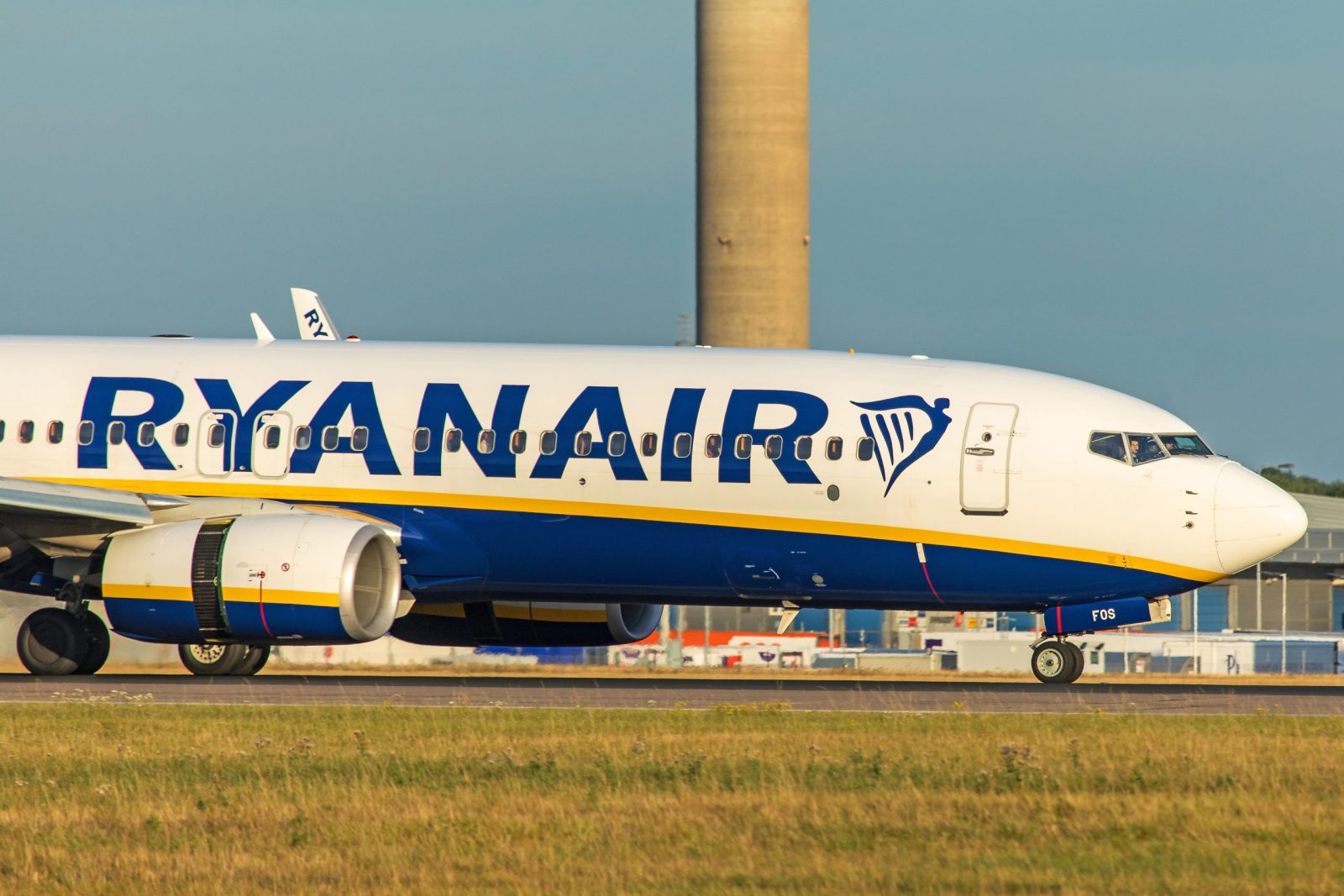
A Ryanair 737 taxiing in London. (Photo: AirlineGeeks | William Derrickson)
Over 3,000 Portuguese passengers were affected this week with the cancellation of 16 flights of Ryanair connecting Portugal to Morocco. The cancellations were triggered by the country’s civil aviation regulator – the National Civil Aviation Authority (ANAC) — since it did not provide the licenses for the operations in time. These are new routes between both countries. Affected were operations from Lisbon to Agadir, Fez and Marrakech.
The measure prompted a strong response from Ryanair, which, in a press release, stated that it was “unlawfully blocked by the Portuguese Ministry of Infrastructure and ANAC causing the totally unnecessary cancellation of flights.”
“This,” continued Ryanair the release, “is a clear breach of the EU Open Skies Agreement in place with Morocco. Ryanair has operated between Portugal and Morocco for over three years and it is inexplicable why the Ministry of Infrastructure/ANAC have not issued standard flight authorizations to allow these flights to operate.»
The airline claims that “Ryanair repeatedly tried to secure these permissions over the past month, but the faceless bureaucrats from the Ministry of Infrastructure all departed for their holiday break on Friday evening, refusing to issue the routine permissions.”
“Ryanair already has traffic rights to fly from Portugal to Morocco, successfully operating flights between Portugal and Morocco for over 3 years and there is no good reason for this unlawful action, which is a clear breach of EU law, on the operation of the EU Open Skies agreement,” added the company’s Director of Commercial, Jason McGuinness.
In typical Ryanair fashion, he closed the remarks by adding, “It is simply outrageous that faceless bureaucrats at the Department of Infrastructure refused to remain at their offices on Friday to resolve this matter but instead departed for the holiday weekend while they wrecked the holiday plans for over 3,000 of their fellow citizens.”
In their defense, Portugal’s ANAC answered with another press release. In it, it says that the permit requests were filed on Oct. 22, “out of deadlines, appearing after several insistencies from this Authorities since September for the airline to follow the Law and the applicable regulatory framework.”
“Despite Ryanair’s request having been presented to ANAC less than 15 days before the intention of exploring the routes, violating the minimum deadlines, this Authority invited the airline to supply the missing documentation,” the text adds. “Even yesterday missing documents with respect to the routes exploration’s filing were requested, and also clarifications regarding the regularization of its contributive situation with [Portugal’s Social Security].”
This is just another chapter between Ryanair and the Portuguese authorities, who have been openly fighting in the media for the a long period.
The latest complaints from Ryanair’s side are for the money injections and renationalization of flag carrier TAP, as well as “slot blocking” at Lisbon Airport that – according to the airline – would deliberately benefit TAP.
In his last press conference in Lisbon, O’Leary garnered attention from national press by showing a slide where the country’s Infrastructure Minister, Pedro Nuno Santos, had Pinnochio’s nose, as per a photo published by O Observador newspaper.
This article was written by João Machado for Aviacionline.
Parker joined AirlineGeeks as a writer and photographer in 2016, combining his longtime love for aviation with a newfound passion for journalism. Since then, he’s worked as a Senior Writer before becoming Editor-in-Chief of the site in 2020. Originally from Dallas and an American frequent flyer, he left behind the city’s rich aviation history to attend college in North Carolina, where he’s studying economics.
ITA Airways Becomes The Latest SkyTeam Alliance Member
ITA Airways new livery rendered on an Airbus A330. (Photo: ITA Airways)
On Oct. 15, ITA Airways became the new flag carrier for Italy replacing bankrupt Alitalia, putting an end to years of uncertainty over the destiny of the company that once dominated Italian skies.
ITA Airways started with a fleet of 52 aircraft, just about half the size of former Alitalia, and a smaller range of 45 destinations, just a handful of which are long-haul. In order to compete effectively in a very competitive marketplace, ITA Airways has managed to sign an agreement with the SkyTeam Alliance, taking the place left vacant by Alitalia.
ITA Airways has signed a 12-month agreement with SkyTeam and at the end of this term, it will decide whether to remain long-term in the Air France-KLM and Delta-led alliance or find other solutions, like joining rival Star Alliance with Lufthansa or United Airlines or pursuing other opportunities.
“For more than 20 years, the Italian market has been a cornerstone of SkyTeam’s European network and no other airline alliance connects Italy better to the world. We warmly welcome ITA Airways’ decision to join our alliance and ensure continuity of service for the millions of customers who choose SkyTeam as their preferred alliance to Italy,” said Walter Cho, SkyTeam Chairman in a press release. “SkyTeam and our members look forward to working with ITA Airways to establish long-term partnership opportunities going forward.”
Alfredo Altavilla, Executive Chairman of ITA Airways said, “Joining SkyTeam is a natural step, enabling us to continue to deliver a global network and seamless experience that customers flying to and from Italy expect. We look forward to close cooperation with our SkyTeam partners to support the start-up of our company, the Italian flag carrier.”
It will also be very important for ITA to become part of one of the immunized transatlantic joint ventures in order to further its competitive position in its most important markets. The Italian carrier is planning to operate flights to five destinations in the United States by March 2022, but given its relatively small size compared to all the other competitors, participation in one of the immunized joint ventures will be vital to its success.
SkyTeam carriers Air France-KLM, Delta Air Lines and Virgin Atlantic are all part of a joint venture allowing them to coordinate schedules and fares as well as sharing revenues on tickets sold on transatlantic routes. Alitalia was initially left out of the venture due to its financial troubles when approval was granted by antitrust authorities on both sides of the Atlantic, but now that ITA Airways has replaced Alitalia and is starting with a clean slate other members may be more inclined to include the start-up in the group.
In fact, sources internal to the company suggest that the main reason why ITA Airways has decided not to use the Alitalia brand it has purchased during the bankruptcy procedures is the very poor appeal it has among possible alliance partners. ITA spent 90 million euros ($104.6 million) to purchase the Alitalia brand, which also includes the ability to use the ‘AZ’ IATA code for flight numbers and the ‘055’ accounting code for ticketing, to make sure it is not used by other companies, but it has decided to create the new brand from the start in order to distance itself from the bad reputation Alitalia has created for itself throughout the years.
Vanni fell in love with commercial aviation during his undergraduate studies in Statistics at the University of Bologna, when he prepared his thesis on the effects of deregulation on the U.S. and European aviation markets. Then he pursued his passion further by obtaining a Master’s Degree in Air Transport Management at Cranfield University in the U.K. followed by holding several management positions at various start-up carriers in Europe (Jet2, SkyEurope, Silverjet). After moving to Canada, he was Business Development Manager for IATA for nine years before turning to his other passion: sports writing.
Alaska Airlines Announces Development of Hydrogen Engine
ZeroAvia is gaining altitude as the leader in zero-emission passenger aircraft as it announces a development collaboration with Alaska Air Group, the parent company of Alaska Airlines, for a hydrogen-electric powertrain capable of flying 76-seat regional aircraft in excess of 500 NM. (Photo: Alaska Airlines)
Alaska Airlines has announced a partnership with California-based ZeroAvia to develop a hydrogen-electric powertrain. The new engine will be installed on a De Havilland Q400, operated by Alaska’s wholly-owned subsidiary Horizon Air. Alaska and ZeroAvia will work together to modify one of ZeroAvia’s existing powertrains to a new ZA2000 engine family that will be able to produce between 2,000-5,000 kilowatts of power. The decision to develop a hydrogen-powered engine is aligned with Alaska Airlines’ goal of being net-zero by 2040.
The new ZA2000 engines are projected to give a range of 500 miles, ideal for the shorter journeys on which Alaska and Horizon utilize the Q400s. The powerplant will need to undergo rigorous testing and certification from the FAA before being allowed to operate in passenger service. The new power plant will produce zero emissions as it powers the 76-seat aircraft. As part of the development of the engine, Alaska and ZeroAvia will use a retired Q400 for development and testing.
In addition to working with ZeroAvia to develop the new engine, Alaska has announced that it has secured an order for 50 kits to begin transitioning their Q400 fleet to being powered by hydrogen. In addition to the order for the engines, the companies will work together to develop the necessary ground support infrastructure to support hydrogen power. ZeroAvia has already partnered with energy producer Shell to help develop ground support for hydrogen power. No timeframe has been announced for when the hydrogen-powered engine will be implemented on passenger service.
A Horizon Air Embraer E175 operating for Alaska Airlines.(Photo: AirlineGeeks | Katie Bailey)
A Net-Zero Future
Earlier this year, Alaska announced that it will introduce a five-focus area plan to achieve net-zero carbon emissions by 2040. The five areas include fleet renewal, operational efficiency, sustainable aviation fuel, novel propulsion, and high-quality carbon offsetting. Alaska had previously announced a partnership with SkyNRG to produce sustainable aviation fuel, made from solid municipal waste. By 2025 the airline group plans to cut emissions of its ground service vehicles in half.
ZeroAvia was founded in 2017 with bases in the U.S. and the United Kingdom. The company has been focused on developing a hydrogen-powered engine for use in the aviation industry. The company is in the deep stages of testing an engine capable of producing 600 kilowatts and powering a 19 seat aircraft with a 500-mile range. The company expects flight testing to begin soon in the United Kingdom, with commercial operations of their current engine beginning in 2024.
With developmental help from Alaska Airlines, a 2,000-5,000 kilowatt powertrain could be in commercial operation by 2026. The announcement comes as global leaders meet in Glasgow to discuss a strategy to fight climate change. The aviation sector has often been identified as a large contributor to emissions that produce climate change. The development of zero-emission engines, as well as alternate, sustainable fuels will likely be adapted industry-wide, both for the survival of the industry and the planet.
Daniel has always had aviation in his life; from moving to the United States when he was two, to family vacations across the U.S., and back to his native England. He currently resides in South Florida and attends Nova Southeastern University, studying Human Factors in Aviation. Daniel has his Commercial Certificate for both land and sea, and hopes to one day join the major airlines.
Four of the EAS carriers in this update, TOP: Denver Air Connection and Contour BOTTOM: Delta Connection operated by SkyWest and Alaska Airlines (Photos: AirlineGeeks | Joey Gerardi)
Essential Air Service (EAS) has been in the news frequently the past couple of months, and large airports aren’t the only airports that have news to report on. This is a continuation of the series, titled ‘EAS Round up’, and will touch on any news regarding the contracts in the EAS airport community since the last EAS Round-Up which can be viewed HERE.
Whether it is a new airline being selected for a city, the current airline being re-selected to serve the community, or there are noticeable services changed to the current contract, they will be announced in this series.
Airports With Service Changes
Fort Leonard Wood, Missouri (TBN)
This small city located in south-central Missouri was one of the few cities that was part of the ‘Alternate Essential Air Service’ Program, or ‘AEAS’. The AEAS program is nearly identical to the EAS program except for one major detail, the communities have a much larger say in what airline serves the community. The airline also has more freedom in which aircraft will operate to their city. This community will be re-entering the EAS program coming from the nearly identical AEAS program.
In the AEAS program, this Missourian city received service to St. Louis with Contour Air on board the carriers Embraer E135. With the re-entry into the EAS program, the airport will be receiving 50-seat CRJ-200’s operated by SkyWest under the United Express brand.
Flights will operate 12-times weekly in each direction from Leonard Wood to the United Airlines hub at Chicago O’Hare. The contract began on Oct.1, 2021, and will run for three years until Sept.30, 2024, at an annual subsidy rate of $3,467,553.
Butte, Montana (BTM)
Located in western Montana, Butte is another on the slowly growing list of EAS communities that will have two airline brands operating to its airport.
Before now, the airport has only recently received SkyWest-operated service under the Delta Connection banner to Salt Lake City. When the new contract begins on Jan. 1, 2022, SkyWest will continue to hold the EAS contract here, but instead of only twice-daily flights to Salt Lake City, they will have once-daily flights to Salt Lake City and also once-daily flights to Denver under the United Express brand.
All flights, both to Salt Lake City and Denver, will be operated on 50-seat CRJ-200’s and will operate 13-times a week between the two, assumably being split up almost evenly between the two cities. The contract will run from Jan. 2022 for two years until Dec.31, 2024, at an annual subsidy rate of $997,186.
A Delta Connection CRJ-200 in Butte, Mont. (Photo: AirlineGeeks | Joey Gerardi)
The upside of having a regional carrier that operates on behalf of multiple major carriers is the ability to split services between different hubs and brands. As time goes on, it wouldn’t be surprising to see more of this happening around the country.
Greenville, Mississippi (GLH)
Where Fort Leonard Wood went from AEAS to EAS, the community of Greenville will be going from EAS to AEAS. The Airport previously had San Francisco-based Boutique Air flying King Air 350’s and PC-12’s to Dallas Ft. Worth and Atlanta, then moved to Nashville, but that carrier ended services when their contract ended on the 30th of Sep.2021.
Contour Air was awarded the AEAS contract that began on Oct.1, 2021, and will continue through Sept.30, 2025, with flights operating to both Dallas Ft. Worth and Nashville with all flights scheduled to operate using the carriers 30-seat Embraer E135 jets. The Department of Transportation will provide up to $12,181,884 total for the entire 4-year period of the contract.
Ironwood, Michigan (IWD)
The community has been through a lot in the past twelve months, with two incidents with the previous EAS contract holder followed by the re-bidding of the contract more than a year before its intended end.
Located on the far western edge of Michigan’s Upper Penninsula, the community has chosen Denver Air connection who will operate flights to both Chicago O’Hare and Minneapolis St. Paul. The flights to Minneapolis will operate on the 30-seat Dornier 328 Jet and flights to Chicago will operate using 50-seat Embraer E145 jets.
The annual subsidy will be $3,398,947 for the first year and $3,466,926 for the second year until Sept.30, 2023. If you’d like to learn more about this specific re-bidding process you can find that HERE.
Merced, California (MCE)
One of only three EAS cities in the state, Merced will be receiving a new airline come the first of the new year. Hawthorne, Calif.-based Advanced Air will be taking over the contract which begins on Jan.1, 2022, and will run until Dec.31, 2025. This will only be Advanced Air’s second EAS contract, the other being Silver City, N.M. although it is only their second EAS city, they do serve a number of other cities throughout the Southwestern United States.
Flights will operate to both LAX and Las Vegas on board 9-seat Pilatus PC-12’s. The annual subsidy rate will be $3,552,016 for the first year, $3,658,576 for the second year, $3,768,333 for the third year, and $3,881,383. To read more in-depth about this particular contract, click HERE.
Airports Re-Selecting Current Carrier
Adak, Alaska (ADK)
The EAS round-up usually doesn’t go over changes with the EAS contracts in the state of Alaska, there are over 60 in this state alone and it is very difficult to keep track of all of the small Alaska-based airlines. But this city is definitely worth a mention.
Adak Island hosts the longest flight of any EAS or AEAS city in the entire country, the flight sits at nearly 1,200-miles and operates from Ted Stevens International Airport in Anchorage, Alaska. This EAS route is only flown twice and is scheduled to operate on Alaska Airlines Boeing 737 aircraft as well as other flights using a Boeing 737-700 freighters. This airport only sees two passenger flights a week total, that’s it, no other scheduled flights. They even fly in TSA Agents to work the checkpoint for the flight, and they leave with the flight.
Alaska Airlines was re-selected for the contract, it began on Oct.1, 2021, and will run two years until Sept.20, 2023. The passenger and freighter flights will have a combined subsidy of $2,309,263 for the first year and $1,785,586 for the second year.
Cedar City, Utah (CDC)
Utah-based SkyWest has been selected for the contract in this small community located in the southwestern corner of the airline’s home state, Utah. The contract is for 12-weekly round trip flights to Delta’s Salt Lake City hub under the Delta Connection brand with the contract running from Jan.1, 2022, until Dec.31, 2024. All flights will operate on a 50-seat CRJ-200 at an annual subsidy rate of $2,564,371 for each of the three years.
Clarksburg, West Virginia
SkyWest will continue to hold the EAS contract in this West Virginian city, flights will operate under the United Express banner. Flights will operate 12-weekly round trips to a combination of both Washington Dulles and Chicago O’Hare onboard 50-seat CRJ-200’s.
The contract will begin on Nov.1, 2021, and will run until Oct.31, 2024, at an annual subsidy rate of $2,998,996 per year. Despite being a relatively small state, West Virginia is a host to five EAS cities including Clarksburg.
Rutland, Vermont (RUT)
This small community located in Vermont has re-selected Hyannis-based Cape Air for this contract. The airline will operate the 9-passenger Tecnam P2012 Traveller to Boston Logan Airport. Flights will operate 21-weekly round trip flights between the city pairs.
Cape Air’s hub at Boston Logan (Photo: AirlineGeeks | Joey Gerardi)
Rutland to Boston was the first flight that Cape Air’s new Tecnam Traveller was flown on when it was first introduced. The contract will begin on Nov.1, 2021, and will run for two years until Oct.31, 2023. The annual subsidy rate will be $1,959,579 for the first year and $2,018,366 for the second year.
Quincy, Illinois (UIN)
Cape Air has been re-selected as the EAS provider in this small Illinois community. Flights will operate from Quincy to both St. Louis and Chicago O’Hare using the airline’s 9-seat Tecnam P2012 Travellers with flights to both airports operating 18-weekly flights each for a combined total of 36-weekly flights out of Quincy.
Quincy is a very interesting case as it is one of the few EAS cities that has gone from propeller service to jet service on a mainline carrier and then went back to propeller service. The community likes Cape Air so much that they recommended them for the contract in 2019 over SkyWest under the United Express brand, and they have been in Quincy ever since.
The contract will begin on Dec.1, 2021, and will run for four years until Nov.30, 2025, at an annual subsidy rate of $3,319,412 for the first year, $3,418,994 for the second year, $3,521,564 for the third year, and $3,627,211 for the fourth year.
This is the updated map, as of Oct.29, 2021, of all the EAS contracts and their operators in the lower 48 states and Hawaii.
A diagram of the current (Oct. 2021) providers of Essential Air Service in the United States, Excluding Alaska (Diagram: Gerardi Aviation Photography)
All numbers and information in this article come from publicly viewable documents on Regulations.gov
Joey has always been interested in planes for as long as he can remember. He grew up in Central New York during the early 2000s when US Airways Express turboprops ruled the skies. Being from a non-aviation family made it harder for him to be around planes and would only spend about three hours a month at the airport. He was so excited when he could drive by himself, the first thing he did with his driver's license was get ice cream and go plane spotting for the entire day. He graduated from Western Michigan University in 2022 with a B.S. in Aviation Management & Operations and a Minor in Business, and currently works for a major airline in his hometown.
Air India’s Problems Haven’t Ended With the Sale to Tata
An Air India Boeing 787-8. (Photo: AirlineGeeks | William Derrickson)
The drawn-out saga of Air India’s privatization finally came to a close with the Indian government agreeing to hand over the airline to the Tata Group, a large Indian conglomerate. This is great news since it was the Tatas that founded what is known as Air India now back in the 1930s as Tata Airlines and developed it into a world-class airline, so there’s hope they can bring the airline back to its former glory days. The airline has rapidly declined after it was nationalized and J.R.D. Tata was forced out.
The good feelings won’t last long though. There is a reason Air India has performed so poorly the past few decades, privatization isn’t going to fix it all overnight. The Tata Group has a long and complex journey ahead of them to try to revive the airline. There are two main problems, the aircraft, and the employees.
Aircraft Issues
While the Tata Group got much-coveted flying rights and landing slots across top international destinations, it will need to fly to them to actually make any money. This is easier said than done given Air India’s aging fleet and poor maintenance record. The situation had gotten so bad the airline was cannibalizing new Boeing 787 Dreamliners for parts to put into older aircraft.
There are estimates floating around that it would cost over $1 billion to refurbish Air India’s existing fleet which is filled with aircraft in various states of decay and decrepit interiors. In addition, there will most likely be additional costs to acquire new aircraft as the Tata Group will likely re-evaluate the current fleet to better meet market conditions. This will not be inexpensive.
Employee Troubles
Fleet issues seem to be more manageable when comparing it to the employee issue. Air India is not free from labor issues and they did not get resolved with the sale to the Tata Group.
The Tata Group is bound by an agreement with the airline to not fire employees in the first year of running the airline with exceptions for only special cases. If they were to fire employees in the second year they must be given retirement benefits. All employees will also get access to pensions and post-retirement medical benefits, which have the potential to be a continual drain on company coffers.
As with all airlines, there are many bad apples that have stuck on through the years and tarnished an airline’s reputation. Air India has many of those after decades of rampant nepotism and corruption.
It’s estimated that it will cost upwards of $300 million to retrain existing employees to new standards, though that doesn’t guarantee improved performance.
On top of that, there is brewing unrest at government housing facilities used to house many Air India employees.
The Indian government provides low-cost housing to Air India employees while they are employed by the airline. Many employees live in this kind of housing with their families until retirement. Since the government is privatizing the airline, it has asked the employees to vacate the government-subsidized housing. This isn’t sitting well with many employees since they are now being forced to find market-rate housing which for many is unaffordable.
Several union groups have banded together and stated their members will go on indefinite strike from Nov. 2 unless the demands to vacate government housing are retracted. The Indian government is aware of this and is trying to find a resolution. It’s possible that the government may provide higher housing allowances which will likely be obligations Tata will need to pick up in the future.
Unhappy Pilots
Pilots are also causing a bit of a ruckus too for another reason. Air India pilots took brutal pay cuts due to COVID-19 last year, some had their salaries cut up to 60 percent. They are arguing that since the Indian aviation industry is back on the upswing and recovering from COVID-19 they should have their full pay restored. The government says they’re working on restoring salaries but pilot unions are skeptical of the government actually taking action.
Happy pilots are essential to good operations for an airline and if these issues continue there could be a looming threat of a strike which could cripple operations.
On the bright side though, the Indian government has directed all ministries and departments to clear pending invoices for travel with Air India due to the privatization. Government officials regularly traveled on Air India and rarely paid the invoices for travel they were billed. Air India alleges that the government owes it nearly $40 million for travel that Air India facilitated for the government. It remains to be seen if the airline will actually get this money but moving forward the government can only purchase tickets on Air India in cash since the airline is going to be privatized. This will eliminate the issue of the government not paying for travel.
Air India is a diamond in the rough but there is a lot of polishing the Tata Group will need to do to get there. That polishing is going to cost a lot of money and take a lot of time to do. Hopefully, the Tata Group knows what it is doing and is ready for the challenge of making such a dramatic change to Air India.
Hemal took his first flight at four years old and has been an avgeek since then. When he isn't working as an analyst he's frequently found outside watching planes fly overhead or flying in them. His favorite plane is the 747-8i which Lufthansa thankfully flies to EWR allowing for some great spotting. He firmly believes that the best way to fly between JFK and BOS is via DFW and is always willing to go for that extra elite qualifying mile. Hemal's opinions are his own and do not reflect those of his employer.
Volaris Announces Flights from Mexico City’s Newest International Airport
A Volaris Airbus A320 with Sharklets. (Photo: AirlineGeeks | Ian McMurtry)
Mexican Low-Cost Carrier Volaris announced its decision Wednesday to commence operations out of Mexico City’s Felipe Ángeles International Airport beginning March 21, 2022. Volaris is the first airline to confirm plans to use the new international airport, located on Santa Lucía Air Force Base, deemed Mexico’s newest gateway.
Beginning March 21, 2022, the day the new airport is due to open, Volaris will operate once-daily service to and from Tijuana and Cancún. Volaris said the Tijuana and Cancún services will complement the Tijuana and Cancún services it currently operates out of Benito Juárez Airport.
Flights operating to and from Felipe Ángeles became available for booking upon the announcement.
“We have seen that only in the immediate area of the new airport there is a market of 4.8 million potential customers,” said Enrique Beltranena, Volaris’ Chief Executive Officer.
“Our leadership in the domestic Mexican market and experience in operational safety were crucial in the decision to reach (Felipe Ángeles International Airport) to continue democratizing air transport in Mexico.”
Volaris will begin operations from Felipe Ángeles International Airport on March 22, 2022. The first two routes will be to Tijuana and Cancún. (Photo: AirlineGeeks | Albert Kuan)
Although Volaris established it would operate out of both Benito Juárez and Felipe Ángeles, Volaris advised it would still maintain its Mexico City hub and crew base at Benito Juárez Aiport and continue its current operating strategy out of the airport. Earlier this month, the low-cost carrier launched a service to Colombia out of the airport.
Mexico City, the capital and financial center of Mexico, is the only city in the country to have multiple international airports. In addition to Felipe Ángeles, Toluca International Airport, located approximately 18 miles west of the city center, also serves the greater Mexico City metropolitan area. The secondary airport in Toluca has zero commercial airline activity and is now only being used for pilot flight training and private aviation. Until recently, the airport had scheduled services within the country operated by Volaris, VivaAerobus, and now-defunct Interjet.
Felipe Ángeles is located much further away – 28 miles north of the city center – and to address these concerns, the government has made sure the new airport would have ground connectivity and efficient public transportation. The airport will be well-connected with the city by a new airport rail link and newly-built highways. The airport rail link, an extension of Mexico City’s Tren Suburbano service, is scheduled to open in 2023 and will provide connections with the Mexico City Metro subway and Metrobús system at Buenavista Railway Station.
Benito Juárez Airport will still continue to hold the official title for “Mexico City International Aiport”, and within Mexico, the airport will still be referred to as AICM, the “international airport” of Mexico City – Aeropuerto Internacional de la Ciudad de México. The Felipe Ángeles Airport is referred to officially as AIFA – Aeropuerto Internacional Felipe Ángeles.
The airport is being built by the Mexican army and there are less than 5 months until the passenger operations are scheduled to commence. The Mexican federal government began inviting different airlines and media groups in late August to survey and tour the new airport. Air Canada is the only airline thus far to rule out flying to Felipe Ángeles citing its completion schedule and operational viability as areas of concern.
On the other hand, the construction manager for Felipe Ángeles suggested there are already several airlines expressing interest in operating out of Felipe Ángeles. Volaris concluded it would be viable to operate from Felipe Ángeles beginning March 2022. The airline explained it reached its decision to operate from the new airport after an extensive analysis of the airport’s construction progress and its passenger, operational and maintenance facilities.
“It is an honor to receive the support of the fastest-growing airline in (Mexico) with the announcement of the first flights to (Felipe Ángeles International Airport). This firm decision is proof of the capacity that Volaris has shown to face the challenges and opportunities of the future of aviation in the country” General Gustavo Vallejo Suárez, head of construction for Felipe Ángeles Airport, said.
Felipe Ángeles Airport, along with Toluca Airport, is part of the Mexican government’s plan to reduce constraints at the overly-congested Benito Juárez Airport, which served 50.3 million passengers in 2019 before Covid-19. The government indicated earlier last month it would limit flight operations at Benito Juárez if airlines don’t voluntarily decide to use Felipe Ángeles.
Shortly after Volaris’ announcement Wednesday, VivaAerobus also confirmed plans to operate out of Felipe Ángeles Airport, being the second airline to confirm operating plans. VivaAerobus, however, has not announced its destinations from the new airport. Aeroméxico, Mexico’s flag carrier, has yet to confirm any plans.
Most people hate long flights or overnight layovers, but Albert loves them. The airport and flying parts of traveling are the biggest highlights of any trip for him – as this avgeek always gets a thrill from sampling different airline cabin products and checking out regional developments happening at local U.S. airports. He’s flown on almost every major carrier in the U.S. and Asia Pacific, and he hopes to try out the new A350s soon.
Albert recently completed his undergraduate studies in Business Accounting at USC in Los Angeles and he is currently recruiting for a corporate analyst position at one of the U.S. legacy carriers. During his college years, he interned at LAX for Los Angeles World Airports working behind-the-scenes (and on the ramp) in public relations and accounting. Outside of writing for AirlineGeeks, he enjoys trekking the Hollywood hills, visiting new hotspots throughout SoCal, and doing the occasional weekender on Spirit Airlines.
Sign-up for newsletters & special offers!
Get the latest stories & special offers delivered directly to your inbox