Stories

Delta Prepares for Fall Travel, Expects Rapid Growth in Northeast

DL_Delta_738_SkyTeam_N3761R_737_800_SEA_katie_bailey
A Delta 737-800 in Seattle. (Photo: AirlineGeeks | Katie Zera)

Economic effects of the ongoing Covid-19 pandemic that crippled the airline industry throughout 2020 and into 2020 continue to loom large for the global travel industry, which remains a significant issue for airlines, specifically when several of the world’s major carriers are pushing for a rapid recovery and a restoration of normalcy through an increase of flight capacities and routes.

The fall holiday travel season — another time period during the year when travel demand typically is at a peak —  is right around the corner, and many major carriers are poised to use the surge in demand as an opportunity to maximize revenue for a swift recovery, even as they continue to push down costs, a holdover from the belt-tightening many were forced to undergo last year. For Atlanta-based Delta Air Lines, this means injecting thousands of seats into the New York market to rebuild its route network and start new routes.

The SkyTeam carrier plans to put New York’s John F. Kennedy International Airport and nearby LaGuardia Airport in the spotlight this fall as it prepares to add over 100 daily flights from the region. Ultimately, for the holiday travel season, Delta is scheduled to operate over 400 flights from the market and has proposed to rebuild its route network to accommodate routes to the region’s most popular, key domestic destinations.

“We’re adding 25% more capacity this fall to meet the significant demand for business and international travel going into next year,” Joe Esposito, Delta’s Senior Vice President of Network Planning, said in a statement. “We continue to provide more choice and convenience while rebuilding our global connectivity and delivering what Delta does best – putting our customers first with exceptional, reliable service and a premium travel experience.”

Recently, the airline focused heavily on providing more flights to Raleigh, N.C.; Boston; Washington and Miami. In addition, Chicago, Dallas and Houston join the list of destinations where Delta expanded service, in favor of shifting resources and staff to cities that are classified as critical business markets.

In Delta’s long-haul network, the carrier expects to operate 15 daily transatlantic flights to 13 cities while handling 20 daily flights to 18 cities in Mexico, the Caribbean and South America.

The Battle For The Northeast

Delta is not the only carrier that has focused on holding on to its network in the Northeast corridor. American Airlines and JetBlue are keen on fortifying and strengthening their route connectivity within their partnership known as the Northeast Alliance. The Atlanta-based carrier also plans to operate and position its new Airbus A321neos out of the Northeast.

However, in response to the Northeast Alliance, Delta is challenging the two carriers, with its new routes from Boston’s Logan International Airport. New domestic flights to Baltimore, Denver and San Diego will kick off next summer, which will eventually play a large role in complementing the airline’s presence out of New York City.

“We’ve strengthened our Boston hub as demand has accelerated, adding about 3,800 more seats a day by next summer than our last peak in 2019. Boston is a fast-growing market with a booming economy, and we’re committed to offering customers significant choice and better convenience when making their travel plans, in addition to Delta’s superior products and experience,” Esposito said, a sentiment accurately portrayed by the airline strategic decision to strengthen Boston and operate more efficient aircraft on the new routes.

New long-haul service from Boston will begin next summer as well, with Delta scheduled to fly to Athens, Greece and Tel-Aviv, Israel. All three carriers are vying to firmly hold to the Northeast and capture as much of the passenger demand.

Evidently, Delta has chosen to focus on its network in the Northeast U.S. as part of its process towards recovery from the effects of the ongoing dilemma. There is no doubt that with the upcoming holiday travel season, passengers will be eager to travel, and Delta responded with increased connectivity. However, the carrier will need to overcome the impending obstacles from American and JetBlue to secure as much of the traveling public.

Benjamin Pham

Benjamin has had a love for aviation since a young age, growing up in Tampa with a strong interest in airplane models and playing with them. When he moved to the Washington, D.C. area, Benjamin took part in aviation photography for a couple of years at Gravelly Point and Dulles Airport, before dedicating planespotting to only when he traveled to the other airports. He is an avid, world traveler, having been able to reach 32 countries, yearning to explore and understand more cultures soon. Currently, Benjamin is an Air Transporation Management student at Arizona State University. He hopes to enter the airline industry to improve the passenger experience and loyalty programs while keeping up to how technology is being integrated into airports.

Sun Country Announces Expansion with Schedule Extention

A Sun Country Boeing 737-800 sporting the airline's new livery touching down. (Photo: AirlineGeeks | Winston Shek)

Minneapolis-based Sun Country Airlines has announced another route expansion, including service to seven new cities. The expansion also comes as the airline is extending its schedule into fall 2022, as the airline prepares for a big summer. The new routes and destinations including the airlines’ first foray into Canada and will have the carrier operating 100 routes to 80 destinations across North America. The full eleven city expansion includes four seasonal routes that are returning for next summer. 

Returning Routes and New Cities

The new routes for Sun Country will be operated out of the airline’s primary hub and operating base, Minneapolis/St. Paul. The returning cities to the route map will be Asheville, NC, Milwaukee, New Orleans, and Savannah, GA. Asheville will be operated year-round, twice a week. Service to New Orleans and Savannah will resume on April 7 and will be operated four times a week to New Orleans and twice a week to Savannah. Milwaukee returns June 2 and will also operate twice weekly.

The new cities to Sun Country’s route map are Buffalo, Burlington, Charleston, Jacksonville, Pittsburgh, Spokane, and Vancouver. All routes will be operated twice weekly either on Wednesday, Thursday, or Friday, and Sunday. The route to Vancouver will be the airline’s first in Canada. Flights will begin operating in the beginning of April or the beginning of June depending on the destination. 

Growth in the Face of Adversity

Sun Country has been slowly expanding over the past year, despite the ever-present Covid-19 pandemic. The leisure-oriented airline has used its unique position to be able to expand services, despite the downturn in travelers. Historically the Minnesota-based carrier has exclusively catered to leisure travelers from Minnesota. However, the carrier has used the pandemic to offer leisure flights from other midwest cities to warm-weather destinations.

The airline is offering flights to destinations in Florida and Arizona from cities like Milwaukee, Indianapolis, Green Bay, Madison, and Duluth. The airline has leaned heavily on, seasonal leisure routes, with only about 10 routes operated year-round, according to the airline’s website. Sun Country has also been buoyed by winning a contract with Amazon to operate Boeing 737s as freighters to support the online marketplace delivery efforts. This has helped to keep the airline flying, even when demand collapsed in March 2020. 

Despite the airline’s expansion, the airline stays close to its Minnesota roots. Earlier this year Sun Country announced a revamp to the inflight service offerings, heavily focusing on offering passengers local brands such as Caribou Coffee and Dotz Pretzels. The airline also began offering inflight entertainment with many offerings shot or set in Minnesota.

The latest route expansion keeps Sun Country poised to capitalize on what is expected to be a strong summer season after the past two years in the pandemic. 

Daniel Morley

Daniel has always had aviation in his life; from moving to the United States when he was two, to family vacations across the U.S., and back to his native England. He currently resides in South Florida and attends Nova Southeastern University, studying Human Factors in Aviation. Daniel has his Commercial Certificate for both land and sea, and hopes to one day join the major airlines.

First Lufthansa Dreamliner To Be Named After Germany’s Capital

Lufthansa's first Boeing 787-9 Dreamliner "Berlin". (Photo: Lufthansa)

For more than 60 years, Lufthansa has had a tradition of naming its aircraft after German cities, but only less than a handful have been given the privilege of being named after the German capital, Berlin.

Besides being the German capital, Lufthansa and Berlin have had a long and special relationship as it has been flying to Berlin for more than three decades.

As of currently, the Lufthansa Group connects the German capital to about 260 destinations worldwide, which means that no other airline group flies as many Berliners all over the world as the Lufthansa Group does.

The prestigious name of “Berlin” started with the airline’s first Boeing 707 registered as D-ABOC, having been named after the German capital “Berlin” back in the last 1960s and ’70s, with the only recent addition holding the name to be an Airbus A380 registered as D-AIMI.

However, as the A380s do not seem to be returning to service, the Frankfurt-based carrier knew it was time for a new aircraft to bear the historic name.

And as such, Lufthansa revealed that its first-ever Boeing 787-9 Dreamliner, registered as D-ABPA, would bear the name “Berlin.”

New “Flying” Ambassador

Boasting high-efficiency, the ultra-modern long-haul aircraft only consumes an average of 2.5 liters of kerosene per passenger and 100 kilometers flown, which is around 30 percent less than older-generation aircraft.

What’s more, the carbon dioxide emissions from the Dreamliner are greatly improved as well which works for Lufthansa as it moves towards a more efficient fleet of aircraft after also having just recently signed leases for four new Airbus A350-900s.

However, the current pause on wide-body deliveries means uncertainty as to exactly which part of next year Lufthansa may be able to receive its aircraft.

As such, the naming ceremony for ‘Berlin” will only be able to take place following the delivery of the aircraft.

On the hindsight, as the first of five Dreamliners that Lufthansa ordered, “Berlin” is scheduled to have Toronto as its first intercontinental destination, departing from Frankfurt.

Currently, the airline is using its Airbus A350 for the Frankfurt to Toronto route and it is likely that the Dreamliners will be utilized as successors so that the as-efficient A350s can be utilized on other routes.

Positive Climb

The pandemic has left quite a number of big questions marks for the aviation industry, but it certainly does seem like things are starting to climb back up in a positive rate.

Having seen a continuous rise in demand for leisure destinations, Lufthansa has been adding in more flights from its Frankfurt and Munich hub.

Particularly, Spain has been seen as an extremely popular choice of destination and the German carrier has been offering extra flights to Palma de Mallorca, Gran Canaria, Fuerteventura and Malaga, as well as other European cities.

Additionally, the demand for business travel has been picking up as well, allowing for Lufthansa to expand its domestic flights to cater to business travelers.

Comparing between July and October, the airline has already expanded its services in October by up to 45% on routes from Frankfurt to Berlin, Hamburg, Munich and from Munich to Berlin, Hamburg and Düsseldorf.

With the expansion going on within the fleet as well as the airline’s route network, it would seem that the new additions to the fleet would have an array of destinations to fly with once they are delivered.

Charlotte Seet

Fascinated by aircraft from a very young age, Charlotte’s dream was to work alongside the big birds one day. Pursuing her dream, she went on to achieve her diploma in Aviation Management and is currently working on her degree in Aviation Business in Administration with a minor in Air Traffic Management. When she’s not busy with school assignments, you can find her aircraft spotting for long hours at the airport. In Charlotte’s heart, the Queen of the Skies will always be her favorite aircraft.

Southwest Reveals 10-Year Sustainability Plan

Southwest 737 MAX
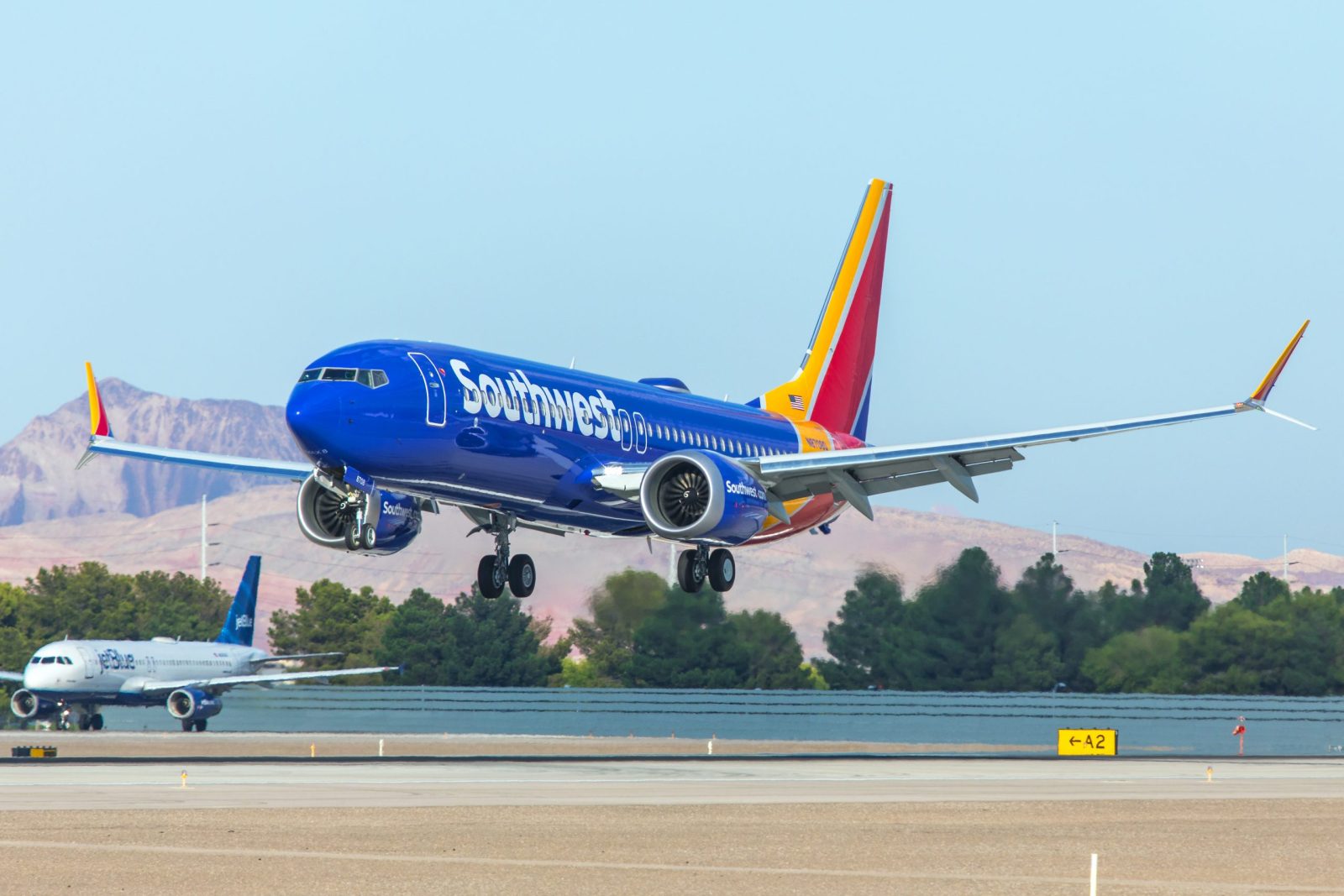
A Southwest 737 MAX 8 in Las Vegas. (Photo: AirlineGeeks | William Derrickson)

On Monday, Dallas-based Southwest Airlines introduced its 10-year sustainability plan. In the press release, the company revealed both its long- and short-term goals aimed at targeting 2019’s carbon neutrality levels, all while continuing to grow its operation. 

The announcement comes just weeks after the International Air Transport Association (IATA) voted to accept the Air Transport Action Group’s (ATAG) aggressive proposal of reaching net-zero carbon emissions by 2050.

In the press release, Executive Vice President and Incoming CEO at Southwest Airlines, Bob Jordan said, “As a leading global citizen, we’re building on prior efforts to address our environmental impact, and with today’s announcement, we’re setting goals to reduce our carbon emission intensity and increase SAF in our operations; and we’re working to advance knowledge in the field of sustainability.”

In its 10-year sustainability plan, the airline’s main objective to achieve 2019 carbon neutrality levels includes initiatives focused on reducing, replacing and offsetting. Southwest’s plan of action:

• Reduce its carbon emissions per available seat mile (including scope 1 and scope 2 emissions) by at least 20% by 2030 through fleet modernization, route optimization and other initiatives.  

• Replace 10% of its total jet fuel consumption with sustainable aviation fuel (SAF) by 2030.

• Offset emissions by providing the first U.S.-based airline carbon offset offer with loyalty points and for every dollar contributed toward offsetting Southwest’s carbon emissions, Southwest will match the contribution.

Reduce

A main contributor in reducing carbon emissions for the airline will be through the modernization of its Boeing 737 fleet. The airline continues to do away with its older 737-700 aircraft and move toward newer, more efficient models like the 737 MAX 7 and MAX 8, investing nearly $10 billion in aircraft orders.

In the company’s 2021 second quarter earnings release, Southwest acknowledged that its 2022 firm orders sit at 70 with the addition of 44 remaining options, bringing its order book with Boeing to 389 firm orders for the 737 MAX (240 MAX 7s and 149 MAX 8s) and 262 MAX options — for which the airline can select either MAX variant — for years 2021 through 2031.

Replace

Another effort of the airline will be through the replacement of 10% of total jet fuel consumption with more sustainable aviation fuels (SAF). It plans to achieve this through partnerships with companies like Neste, an oil refining company that will provide Southwest up to 5 million gallons of SAF through December 2023, as well as Marathon Petroleum Corporation and Phillips 66, with which it recently announced its memoranda of understanding to facilitate the development and production of SAF at significant scale. 

Offset

Offsetting energy consumption will also play a vital role in becoming carbon neutral. This will be accomplished through exploration of new technologies as well as engaging in different partnering companies such as Customers and ChooseTM, which are offsetting carbon emissions in unique ways.

For example, they are providing the first U.S.-based airline carbon offset offer with loyalty points, and for every dollar contributed toward offsetting Southwest’s carbon emissions, Southwest will match the contribution. Southwest will also be launching the Green Incentive Program, a performance-based incentive program that provides corporate customers the opportunity to earn and use funds for their company’s sustainability initiatives, which could include offsets or other initiatives.

Southwest’s 10-year plan will extend far beyond the stated planned ten years. With plans to become completely carbon neutral by the year 2050. The 10-year plan is a glimpse into how they plan to achieve such an aggressive goal.

Chase Hagl

Chase Hagl grew up in Twin Falls, Idaho. His love and passion for Aviation landed him in Orem, Utah where he obtained a B.S. in Aviation Management with a minor in Business Management from Utah Valley University. Chase currently works as a flight attendant in Charleston, SC and is also the primary Inflight ASAP ERC representative for startup airline, Breeze Airways. His experience in the aviation industry spans back four years, working in areas including agriculture application, customer service, maintenance, and flight ops. In his free time, Chase enjoys road biking, astronomy, and flying.

Qantas Brings Forward International Flights to Nov. 1

A Qantas 787-9 performs a test flight at Paine Field. (Photo: AirlineGeeks | Katie Zera)

Qantas will finally commence international flights to London and Los Angeles on Nov. 1, two weeks earlier than initially planned and some 20 months after the Australian government closed the country’s borders. Further destinations will be added from Dec. 18 including Singapore, Vancouver and Fiji.

The flights, which will be operated by the airline’s Boeing 787 Dreamliners, have also seen an increase in frequency with London served five times per week and Los Angeles four. All flights will be operated from Sydney, New South Wales, with its flagship kangaroo route to London temporarily operating via Darwin until at least April 2022. 

This follows a major change in policy by the New South Wales Government who has now abolished the need to home quarantine for seven days for vaccinated travelers on return. The national cabinet has stated that each state can recommence international flights after reaching a vaccination rate of 80%. New South Wales hit this milestone by October 18, but some states are not expected to achieve it until sometime in December. This means residents will effectively be able to travel internationally before they can travel on some domestic flights, with most domestic borders closed at this time. 

To the dismay of many, flights are currently only available to fully vaccinated Australian citizens and permanent residents. Temporary residents who have also been locked in the country since borders closed will have to wait even longer before they can board a flight to see loved ones. Some are very angry that they won’t have the chance to travel home for the holidays with citizens and permanent residents given preference. Australian Prime Minister, Scott Morrison, said the next priority would be skilled migrants and international students with tourists unlikely to be allowed into the country until March or later.

Qantas is also planning a major fleet upgrade. At the International Air Transport Association’s (IATA) annual meeting in Boston, Qantas boss Alan Joyce revealed that he will place a multibillion-dollar order for more than 100 new aircraft by the middle of next year to replace its aging domestic fleet, as well as for new long-haul aircraft to fly non-stop to England and the U.S.

A decision on aircraft type will possibly be made by December with the Boeing 737 MAX and Airbus A320 in contention to replace Boeing 737-800s. Airbus A220s and Embraer E-Jet E2s are being considered to replace the Boeing 717s in the 90-130 seat market. Deliveries are expected to be between 2023 and 2034.

The Australian national carrier will also likely make an order for the Airbus A350-1000 early next year as Project Sunrise is reinstated. Qantas was very close to putting pen to paper just prior to Covid-19 and will use the aircraft to connect the largest Oceanic country with non-stop flights to London and New York. 

Meanwhile, Qantas has gone back to the airline’s origins opening new routes between Queensland and the Northern Territories. Australia’s first airline was founded in 1920 as Queensland and Northern Territories Aerial Services and has recently announced new routes from Darwin to Cairns and Townsville.

The routes will be operated by Embraer E190s after a deal was struck to utilize the newly acquired Alliance Airlines aircraft. The 94-seat jet will operate under the QantasLink brand from early next year. Its size, range and economics allow more direct options not available with the airline’s current fleet and reduce travel times for customers.

Mark Evans

Mark has been interested in aviation since the age of eight when he first went plane spotting at Manchester Airport, England. Trips around various European airports in the following years and then to the USA as a teenager furthered his desire. This led to Mark wanting to work in the industry and at the age of twenty one was accepted to train as an Air Traffic Controller. After training and working for several years in England, Mark moved to Bahrain in the Middle East where he worked for six years. He then moved to Sydney, Australia where he resides today after twenty years in the profession. Mark's pursuit to see planes has seen him visit over 140 countries and territories, including places, like North Korea, Sudan and Iran. He has flown over 1,100 times, visited over 700 airports and can always be found researching his next trip.

Poised for Success in Eastern Europe: How Martin Gauss Is Leading airBaltic Through Trying Times

An airBaltic Airbus A220-300 departs from Riga. (Photo: AirlineGeeks | João Machado)

The face I saw entering the plane was familiar. He put his belongings on his seat and went to the cockpit to greet the pilots. That’s when I asked if he was who I thought I was — and the answer was yes. It was. Quite a coincidence, as I was myself preparing to interview him four hours after that.

CEO of Riga, Latvia-based airBaltic, Martin Gauss was returning to the headquarters after a weekend off. He sat down across the aisle from me. It was the perfect opportunity, so before the actual interview, we spent the flight talking. It was a great opportunity to meet a fascinating character who has led the only airline based in the Baltic states through the largest crisis of the industry’s history.

At that point in time, flying was already allowed and, with the EU Green Pass, we could even be in the offices maskless – given the local regulation at the time, provide everybody in the named “green zone” was vaccinated. It was not so just a few months before.

“We had that moment when we all sat here in this room,” recalls Gauss, “and the Prime Minister announced that they would do a lockdown that meant for us we wouldn’t fly at all, so we stopped completely. In the beginning, it was the same for everybody, you did not know what would come. We focused first on staying, cause nobody knew how long it would go, then we modified our business model, now we are growing.”

The very centered, straightforward German executive led an airline that did not fly for 62 days. A restructuring followed — the airline retired its last Boeing 737 Classics and Bombardier Dash 8 Q400s, transitioning into an Airbus A220-only fleet, cut jobs and after that, was burning “only” 3 million euros ($3.47 million) every week; it also received a 250 million euro injection from its largest shareholder, the Latvian government.

Now, what is the best way forward? Gauss believes the airline did its homework.

“The thing is, this airline now is just waiting to grow,” he said. “That’s it. What we need — the restrictions which still exist [to] ease, but they are easing now. We see [at] all airports the flow of passengers normalize. The people want to travel. They wanna meet each other. People didn’t meet each other for a very long time just because flying [was] so complicated, [but] we saw it now in July, August. We had promising numbers, all airlines in Europe.”

Gauss sat down for an hour with AirlineGeeks in his Riga headquarters, in an office from which he can oversee his airline’s operations at Riga Airport.

Going Forward: State Aid

While he sees uncertainty going into the winter season — “business travel is not yet picking up” — he’s looking forward to the seasons following that. The executive says that airBaltic’s smaller size — the airline currently operates 32 Airbus A220-300, the last of which arrived in Latvia a week ago — is both a curse and a blessing altogether.

“It’s easier and more difficult [to manage a smaller airline],” he said. “It’s easier because you can act faster in a small organization. That does not only apply to an airline — also to other companies — but large organizations normally can finance themselves differently because they have [a] different shareholder structure or the capital markets know them very well. Therefore the large airlines in this crisis are seen in the spotlight… I think we managed [the crisis] well, we are adjusting fast, and we also have a strong shareholder structure, whose shareholders are supporting us to get out of the crisis.”

The shareholder Gauss refers to is the Latvian state, which owns 96% of airBaltic.

“In this crisis where you need a lot of cash, the state is a very good shareholder. If you want to raise capital at the capital markets and you wanna grow in a good time, then maybe it’s better you are not owned by the state,” he said, adding that he is “very happy that the state did what they did and supported us with equity which we have to return, so it’s not a present.”

The executive says the money, a 250 million euro sum, will be returned through the airline going public. He reckons this should happen once the company’s finances are stabilized, likely by 2023 or early 2024. He says without this cash, airBaltic “wouldn’t exist anymore,” though he says the airline already reached a positive EBITDA — short for earnings before interest, taxes, depreciation and amortization, and a popular metric to capture operational profitability — during summer.

“If things go super, super good next year maybe we can achieve [a net profit] earlier, but at the moment we plan to be profitable again in 2023,” Gauss said.

The Secret Behind a Successful Small Airline

But airBaltic is an exception within Europe. The continent, before Covid-19 and now, was dominated by big groups of airlines, either low-cost carriers or legacy/network carriers, all private. State-owned carriers exist but were usually mismanaged, losing plenty of money in the process. airBaltic was profitable, and it is in the middle of the way in the low-cost, point-to-point/network carrier spectrum. Gauss often labels his airline a “hybrid” one.

While it has its hub in Riga, the airline also offers service in major routes to the capitals of the two other Baltic states, Tallinn, Estonia and Vilnius, Lithuania.

“We’re a hybrid airline as it’s business class with [an] ultra-low-cost economy cabin. We are connectivity providers for the Baltics and we fly with Riga as a hub, not only point-to-point which we do also from Tallinn and Vilnius,” Gauss said. “In Europe, we are the only airline that’s doing this, in the U.S. you have airlines that do this more than we do, but in Europe, we are that airline.”

But an airline can only rely so much on such a small market. All in all, from the demand side, the three Baltic states have just over 6 million inhabitants, and that’s with a growing competition of the ultra low-costs from the capacity side. In this regard, the hub in Riga comes as crucial, with a large percentage of its passengers only connecting through the airport.

That’s where the airline’s partnerships are useful. airBaltic currently has partnerships with dozens of carriers, such as Air France, Lufthansa and SAS. While this helps feed the Riga hub — and, residually, the other two bases — it also serves as a sort of shield against undesired competition from these very carriers.

Fighting the Big Guys

Now one carrier that is extensively growing in Latvia is Ryanair, the largest ultra-low-cost carrier in Europe. Gauss thinks that what shields airBaltic from the carrier’s attacks is that both cater to fundamentally different markets – despite airBaltic’s Economy product being self-labeled an “ultra-low-cost” one.

“[Ryanair] keep[s] opening routes, but also closes routes, [Riga to] Pisa was a good example,” he said. “We announced [it], then Ryanair came, they announced, then they didn’t fly it. Because the market maybe for them wasn’t seen as big enough; we had Wizz as well starting flying Riga to Lübeck, which they call Hamburg, […] and they started from 9.99 euros, and they kept the price until the very end. We continued flying to Hamburg, [with] our concept which also includes the transfer traffic and they withdrew of the route, we have routes, [as] Ryanair’s  original home base, and we saw an opportunity because we have a different traffic segment and we opened Dublin, and it became a profitable route for us at the time, so we are competing with the number one low-cost carrier, numbers one and two, successfully.”

And as the saying goes, if you can’t win them, join them. Gauss doesn’t rule out signing partnerships with the ultra-low-cost carriers in his home market, although he says that would be a move that would need to come from his competitors.

“They would have to open themselves to say ‘OK, we have to continue growing,’ for example in a market [in] which they don’t want to penetrate so much that they [would] say ‘OK, we [will] have a kind of a relation – could be. But right now, coming out of the pandemic, looking at the numbers, the winners at the moment are clearly Ryanair and Wizz Air, they are nearly back to their capacity which they had in 2019, the rest is 40-50% their capacity.”

The A220

In this process, the aircraft plays a big part. airBaltic is currently the largest operator in Europe of the Airbus A220, and trusted it in a time when few did. Apparently, this is paying dividends now. Not for nothing, Martin is a massive enthusiast of the plane, whenever he can, talking about the wonders his aircraft can do.

The company first ordered its first A220s — back then the CS300 — in 2012, back when the airline operated a fleet of Boeing 737 Classics and Bombardier Q400 turboprops, and currently now is expected to reach 50 units of the jet by 2024.

“We had a time when we also looked at [Sukhoi] Superjets, none of these aircraft would have been able to fulfill what we wanted to do, and still today do so the E2, for example, did not have the range, and therefore it was not an aircraft we wanted to use because already at that time we were connecting Abu Dhabi, before to Dubai then Abu Dhabi and now Dubai again, so we needed an aircraft with a [sizeable] range,” he said.

airBaltic currently operates Riga-Dubai nonstop with the A220, a flight of almost six hours.

Another component that helps Gauss’s airline to dodge the attacks of Ryanair and Wizz is the size of the A220. While Ryanair’s and Wizz’s smallest aircraft have 189 and 186 seats, respectively, the A220 carries 145 passengers, which, alongside the airline’s hub connectivity strategy and its relative focus on the corporate consumer, helps drive traffic and makes routes possible which, with Ryanair, would need to carry way more passengers to be viable.

“If you want to fly head to head with Ryanair, you should have such an aircraft like that [the 737],” Gauss said. “But we’re not going head to head to them on that same traffic; we have a business class, which is a completely different product,  not only product and price, but from what it does in distribution by travel agencies – so big corporations, for example, when they book the tickets they traditionally book by travel agencies.”

Much of airBaltic’s flexibility, he says, comes from the airline’s fleet.

“So we have with the A220 an aircraft [with which] we can open routes which we maybe wouldn’t open with a 189 [seater] either. So we cannot compete on the cost per seat as a 737, 321, we can’t compete with their operating cost. [But] we can serve the same market with a higher frequency, for example, because you do not have to fill each time. Most of the time, we fly high frequency. The ultra-low-cost flies twice a week. We fly every day.”

That sentiment extends beyond the airline’s schedule to its network, which Gauss said is better suited to most travelers than are those of airBaltic’s direct low-cost competitors.

“We depart at 7:30 in the morning, at the prime time,” he said. “[Or] we depart here going somewhere at the middle of the night, and if you have business to do or a transfer, with Ryanair you could fly to Dublin, you get to Dublin, full stop. With us, you can fly Dublin-Riga, Riga-Moscow, Kazan, Riga-Minsk, Riga-whatever. All the routes before the crisis, all the network, were open from Dublin, via Riga, so we did get also passengers wanting to go somewhere where the  connectivity we provided was the best, [such] as Moscow.”

Gauss is not concerned by the fact that airBaltic operates with a higher cost per seat than competitors like Ryanair, which he says is a result of the airline’s choice to invest in smaller aircraft. He believes his airline will come out ahead when looking at total costs across the schedule.

“So that’s one difference, and then [there’s] the frequency, that on Dublin — which is a bad example because that is a top route of Ryanair — but on other routes, they might fly once a week and we might have flown five times a week,” he pointed out. “And therefore, the cost per seat [becomes] irrelevant. On the day you go head to head, you are right, the cost per seat is unbeatable because you get more seats but if we fly both the aircraft empty, who has higher cost?  They have because the aircraft is heavier, bigger, and therefore they have higher cost.”

Outgrowing the Baltics

But while airBaltic sees a post-pandemic world, it sees the need to adjust its sails going forward – to avoid adding too much capacity it won’t be able to fill. In this regard, Gauss says the airline plans to add another nearby base in a fourth country in the near future.

“We always thought of [putting] about 50 aircraft in the Baltics. Now i think we will shift and say ‘OK, 40 for the Baltics,  ten aircraft outside’, and as we grow now we will be placing aircraft outside the Baltics.”

The German executive says that the airline plans to roll out this expansion before 2023, although he does not disclose the country he is looking at.

“We would first go where we are known, widen in the circle around the Baltics, without saying which airports. We’re now looking at what makes sense for us, flying from where to where. It [must] also be something we can do. We do fly charters, a small percentage, and we will see now, as we get more and more aircraft, [too] much capacity to place in the Baltics, and then looking at, we can also fly somewhere else, maybe place the aircraft outside the Baltics and then fly into the Baltics. ”

ESG

Gauss has ESG in mind. Casually, airBaltic’s main color is green, but according to him, he does not want the airline’s “green-ness,” so to speak, to stay confined to the color, and plans to unveil ambitious sustainability plans for his airline very soon, as he recognizes just doing his part in having aircraft that burn less fuel is not enough.

“We will be in the near future talking about what airBaltic wants to do differently,” he said. “It’s too early because we still are battling around the crisis, but we have plans, had them before the crisis, and we’ll then talk about it. […] We want to take part in changing this with a lot of initiatives: you see plastic bottles [in his office] that used to be glass, we are well ahead, had glass only here because of higiene, bring back a lot of plastic wrapping the food and all these things. Covid is there to stay, Covid will not be gone, but we will live with it, we will get vaccinated, people will have a [higher] hygiene standard, focus again on reducing unnecessary things like plastic waste, LED lights, our next car fleet, the company cars will be electric cars, so we will do all these things, the key is of course the fuel burn.”

He says carbon offsetting will be available in the near future for passengers to opt-in, as is already standard in several airlines – although he wants a program that focus on the Baltics.

“But it’s not the way out,” he says. “We need to find ways of using sun, wind, water, we need to use the energy which is already there on the planet, and not use fossil to create energy and I think once we have sufficient technology in place that we can replace today’s fossil energy use we will do, so every year we see more and more energy: one day will [it] not be the issue.”

“If we would have 100% today undisrupted solar energy you could use endless energy all coming from the sun. Nobody would really think about energy as it [is]. Today when people use the phone, they do not think about the cost of doing a call because we’re using the internet for the call WhatsApp for the call,  you can call somebody and talk for five hours. It might be the same for energy one day. That the energy is there and it’s free it’s endless because you’re not using fossil energy.”

Gauss is not ashamed of the reduction of flying for environmental concerns either.

“People will be flying because we will be having more and more efficient aircraft to transport us, so I look to a long term future [where] we have some full-electric planes, United ordered some, Azul, I think, too. [To] our size of aircraft will take a little bit longer to fly electric; we can do fossil fuels, e-kerosene is coming over, and we gradually go there.”

Looking at the future of the broader transportation industry, Gauss believes people’s continued desire to travel will lead to a resurgence in demand that will have to be paired with increased sustainability.

“Why would you think that the human race which has developed so nicely will now stop exploring the planet?” he asked. “No, but they want to do it and feel good about it with no damage to the planet, and that is the change. People will be commuting more than before when the crisis is over but will do it with more responsibility.”

The Road Ahead

But more than anything, the executive is optimistic with respect to the future of his airline. “In 5 years, we will definitely have our 50th, at minimum our 50th aircraft flying, we’ll have aircraft outside the Baltics, and we’ll have passenger numbers which are well over 2019 levels.”

When asked about this winter season, he reckoned, “It’s going to be cold as always in Latvia, also frosty from the passenger numbers; but we are prepared,” and he expects airlines that got this far to survive this next tough season. “Some airlines should have failed in the last three years according to the public. They haven’t. It’s never nice when somebody fails, therefore, I will be very happy when many, many people come back into the air.”

Topping off his five-year prediction, when asked if airBaltic could do it as profitably as before, he confidently said: “We did it profitably before the crisis. Why would we not do this afterward?”


João Machado

João has loved aviation since he was six-years-old when he started visiting his home airport in Porto Alegre, southern Brazil. As he always loved writing, in 2011, at age 10 he started his very own aviation blog. Many things have happened since then, and now he is putting all his efforts into being an airline executive in the future. João currently lives in Siena, Italy, where he studies Economics and Management at Unisi.

Ethiopian Airlines Renews SabreSonic Agreement With Minimum Commitment of $110 Million.

An Ethiopian Boeing 777 rotates out of Washington Dulles. (Photo: AirlineGeeks | William Derrickson)

Ethiopian Airlines and Southlake, Texas-based Sabre Corporation, announced they have renewed their long-standing strategic partnership in passenger management systems for yet another seven-year with a minimum commitment of $110 million.

Under the renewed agreement, Ethiopian airlines will continue to use Sabre’s passenger service system – SabreSonic – enabling it to automate sales and service, and helping it to maximize revenue opportunities and create efficient airport experiences for travellers.

Sabre’s Intelligence Exchange will also help enhance the airline’s passenger experience by providing intelligent real-time insights to help make more informed business decisions.

“Despite the effects of the pandemic, Ethiopian Airlines continues to be one of aviation’s greatest success stories,” said Dino Gelmetti, Vice President EMEA, Sabre Travel Solutions.

“COVID-19 has accelerated airline competitive pressure and the need for digital transformation, and as Africa’s strongest carrier, Ethiopian Airlines was able to quickly adapt to the changing landscape, further strengthening its position as recovery gains momentum,” he added.

The expanded agreement will also include Sabre’s Dynamic Availability – which will help Ethiopian airlines earn incremental revenue by enabling proactive response to ever-changing travel conditions with an optimized pricing solution – and Sabre’s Group Optimizer to help the East African carrier optimize the processes for managing group reservations, an area difficult for many airlines to streamline today.

Sabre’s solutions are overall expected to provide the airline with a competitive advantage by providing intelligent recommendations based on market demand and competition.

“At Ethiopian, having robust and cutting-edge technology in place plays a key role in our success story,” said Tewolde Gebremariam, Group CEO, Ethiopian Airlines.

“The pandemic created many unknowns in the travel industry, and Sabre’s intelligent technology will help us quickly understand and adapt to the new landscape. As travel starts to recover, it’s crucial that we remain laser-focused on driving profitability and growth.

“Our extended technology partnership with Sabre will support us moving toward a more flexible and modern environment while driving operational efficiencies.”

Sabre’s robust travel platform and security solutions provide the technology on which airlines, agencies and hoteliers rely with the suite using among the broadest array of innovative technology in the industry to help airlines market, sell, serve customers and operate more effectively.

Ethiopian Airlines migrated off a SITA system and onto the SabreSonic Passenger Solutions technology platform in 2006.

Interline Agreement with Airlink

Meanwhile, Ethiopian Airlines continues to implement various partnership agreements with African and global carriers to further expand its accessibility to its customers.

The Star Alliance member announced an interline agreement together with South Africa’s Airlink which seeks to attract more customers providing ease of connectivity to their destinations served by both Ethiopian and Airlink while customers enjoy seamless travel with a single ticket and lower fare tickets between points within the carriers’ networks.

While Airlink provides services between smaller, under-served towns and larger hub airports the airline will act as a feeder carrier for customers from southern Africa who will benefit from more than 60 African destinations.

Victor Shalton

Victor Shalton's love for aviation can be traced to when he was 11-years-old. As a seasoned aviation writer, he takes pride in providing the best aviation coverage around the globe and is passionate about advancing his skills in the aviation space. In addition, he loves travelling, writing, arts and while his speaking engagements have taken him around the world, he is proud to call Nairobi home.

Malaysia’s Aviation Industry is Seeing The Light At The End Of The Tunnel

A Malaysia Airlines 777-200 similar to the one involved in MH370 (Photo: Aero Icarus from Zürich, Switzerland [CC BY-SA 2.0 (https://creativecommons.org/licenses/by-sa/2.0)], via Wikimedia Commons)

Malaysia’s aviation industry is seeing the light at the end of the tunnel. In response to the Langkawi Travel Bubble, the domestic passenger movements in September in Malaysia have skyrocketed by 74 percent, compared to the previous month.

Earlier, the Malaysian government has rolled out the Langkawi Travel Bubble to stimulate the travel industries, allowing the citizens who have been fully vaccinated and the age over 18 to the country’s tourist hotspot.

According to Malaysia Airports Holding Bhd’s (MAHB), the operator of managing 39 airports across the country including Kuala Lumpur International Airport and its Turkish Istanbul Sabiha Gokcen International Airport, said the total passenger movements for Malaysia increased 55 percent to 458,000 passengers last month from 362,000. The domestic aircraft movement has increased by about 20 percent, compared to August.

“Local airlines also benefited from it with AirAsia recording the most aircraft movements with 176 flights and commanding the majority of the average sear factor at 64 percent during the same period,” MAHB said in a statement.

MAHB believed that the travel trend is likely to remain with the lifting of interstate and international travel in the fourth quarter of the year.

Last week, the government has achieved the aim of 90 percent of adults have been inoculated, announcing its travel restrictions will be lifted as a result. The citizens can go abroad without applying for permission from the government.

“We have to train ourselves to live with COVID, because COVID may not be eliminated fully.” Ismail Sabri, Prime Minister of Malaysia said.

Successful Vaccination Program

Following the remarkable success of the Langkawi Travel Bubble, AirAsia aims for the domestic market can reach the pre-pandemic level by late November. Bo Lingam, the president of AirAsia said the airline would reinstate 300 staff currently on furlough to operate the domestic flights.

AirAsia has reported a net loss of 1.3 billion ringgit (311.6 million) for the first half of 2021 and the passenger capacity was less than one million passengers in the first 10 months. The airline’s domestic capacity was 19 million in 2019, however, the passenger number has plummeted to 6.3 million last year.

In the meantime, Malaysia Airlines has also benefited from the Langkawi Travel Bubble. “We saw healthy forward booking reflecting customers’ confidence and strong demand for travel with Malaysia Airlines. We are happy to report that Malaysia Airlines recorded over 500% increase in our flight booking domestically, the highest booking following the reopening of Langkawi.” Group Chief Executive Officer of Malaysia Airlines, Captain Isham Ismail said.

Meanwhile, the flag carrier is trying to entice the citizens to return to the skies with a promotional fare and provided up to 50 percent discount on MHholidays Packages.

Maskless Travel Is Returning on SAS. When Could the U.S. Follow?

An SAS Airbus A350XWB (Photo: AirlineGeeks | Ben Suskind)

Scandinavian Airlines, known most commonly worldwide as SAS, made headlines this weekend as it announced that passengers traveling within Denmark, Sweden and Norway would no longer be required to wear a face mask onboard its aircraft. The move was followed by other local carriers Norwegian, Flyr, and Widerøe, the latter two of which have route networks that are much more heavily concentrated within the Nordic countries.

Masks are still required on all of the carriers’ flights to destinations outside those three countries, with the entirety of SAS’s long-haul network — in addition to the European networks of the other airlines — still falling under that umbrella.

The change came amid substantial rollbacks of restrictions within the three countries that had been implemented to curb the spread of Covid-19 within the nations’ borders. According to Reuters, Sweden has vaccinated nearly 70% of its total population, lagging slightly behind Norway and Denmark, which sit at approximately 74% and 76%, respectively. The countries’ health authorities also said they had seen a significant pullback in the number of people hospitalized for Covid-19.

“We believe the time is right now based on the infection situation in the country,” an SAS spokesperson told Norwegian media outlet TV2.

The four Nordic airlines have become an outlier in the global travel sphere, as masks have become the norm since travel began to resume in late-2020, begging the question of when the rest of the world will follow, whether weeks, months, or years into the future.

The Next Three Months

First put in place in early 2021, the Transportation Security Administration’s (TSA) originally mandated masks be used onboard aircraft and in airports until May 11. However, a further announcement in the spring extended the effective date to Sept. 13 before another release in mid-August set the new end date to Jan. 18, 2022.

As such, there is a date in place after which the potential of mask-free travel — at least for travel within the U.S. — exists. However, the odds of the mandate expiring as is currently planned are relatively unclear and likely rest on the trajectory of Covid-19 cases, related hospitalizations and vaccination numbers over the course of the three months leading up to Jan. 18.

AA B789 LAX William Derrickson (1)
An American 787 Dreamliner in Los Angeles. (Photo: AirlineGeeks | William Derrickson)

Indeed, with the current balance of power in the U.S. political system, an extension appears more likely than not as, according to the CDC, only 57% of Americans are fully vaccinated as of the time of writing, a total that lags behind Scandinavian nations when they pulled back some of their virus-related restrictions. The vaccination figure jumps to nearly 66% when including those that have received one dose of any vaccine.

U.S. airlines have not publicly endorsed a position on a mask mandate moving into 2022. Reports of unruly passengers as well as violence against flight attendants skyrocketed in 2020 and 2021 — particularly compared to pre-pandemic levels — with passengers refusing to follow crew member instructions with regard to masks contributing a significant amount to the new total. As such, crew unions — and, as an extension, airlines — may seek to have mask mandates removed as early as is feasible to keep flight attendants from being required to continue serving as enforcers in the air.

As vaccine mandates have been rolled out at most major airlines in recent weeks, in many cases as a result of an executive order requiring federal contractors to vaccinate workers, the total number of airline employees and crew that have received at least one shot has jumped, too. This could serve as another factor unions and airlines point to in order to encourage the loosening of mask-related restrictions.

However, both airlines and unions could go the opposite way as they work to maximize crew member protection from Covid-19 as they continue to interact with hundreds, if not thousands, of passengers every day.

All told, any prediction at this stage as to the future of the mask mandate in the U.S. will likely hinge on a prediction for Covid-19 case counts and hospitalization rates in the months ahead. And because U.S. airlines are unlikely to require vaccines on flights as Australian carrier Qantas is currently planning, the future of masks on travel in the U.S. continues to be, as it has been nonstop for the past 19 months, totally up in the air.

Parker Davis

Parker joined AirlineGeeks as a writer and photographer in 2016, combining his longtime love for aviation with a newfound passion for journalism. Since then, he’s worked as a Senior Writer before becoming Editor-in-Chief of the site in 2020. Originally from Dallas and an American frequent flyer, he left behind the city’s rich aviation history to attend college in North Carolina, where he’s studying economics.

Lufthansa Cargo Retires Final MD-11 Freighter

A Lufthansa Cargo MD-11 Freighter lands in Frankfurt.

Lufthansa Cargo retired its final McDonnell-Douglas MD-11 Freighter on Sunday, marking the end of a 20-year era of trijet operations for the airline. It operated legs to Cairo, Tel Aviv and Chicago before flying its last flight on Saturday, which operated under the flight number Lufthansa flight 8161, a transatlantic hop departing New York’s John F. Kennedy International Airport on Oct. 16, at 11:12 p.m. and arriving in Frankfurt at 12:03 p.m. the following day, per data from FlightRadar24.

The Lufthansa Cargo trijet scheduled for retirement is D-ALCC, a 23-year old MD-11 Freighter destined for operations with U.S.-based Western Global Airlines. D-ALCC sports a “Thank You MD-11, Farewell” sticker to commemorate the aircraft’s service and retirement, along with a thank you graphic on its forward left cargo door.

Lufthansa Cargo received its first MD-11 in June 1998, operating 19 freighters over the course of 23 years, replacing the Boeing 747-200F. As the backbone of its cargo operations through the late 2000s and early 2010s, these freighters delivered cargo through the airline’s Frankfurt, Germany hub. 

However, in 2011, Lufthansa Cargo ordered five Boeing 777 Freighters as part of an initiative to shift to a more efficient and newer two-engine widebody. As a result, the MD-11 Freighter was slowly phased out of the fleet, scheduling its retirement for December 2020. Due to the Covid-19 pandemic, increased cargo demand triggered the delay of its retirement until October 2021. Even the retirement of D-ALCC was postponed from Oct. 15 to Oct. 17 as the aircraft was scheduled on two extra runs from Frankfurt to New York.

Lufthansa Cargo retired three Mcdonnell Douglas MD-11 Freighters each in 2020 and 2021, facilitated by the entrance of four Boeing 777 freighters to the airline’s fleet. In September 2021 alone, the airline received two Boeing 777 freighters, a former Emirates SkyCargo freighter and a new Boeing 777 straight from the Boeing Everett plant.

MD-11 Freighter History

The McDonnell Douglas MD-11 program was launched by Mcdonnell Douglas in late 1986, after Mcdonnell Douglas conducted studies and trials regarding a derivative of the DC-10. The initial prototype of the aircraft was constructed in 1988, flying its inaugural flight on January 10, 1990. McDonnell Douglas received FAA certification in November of that year, allowing for the first delivery of the MD-11 to Finnair in December 1990.

In total, 200 MD-11s were built, including 131 of the passenger type — which saw orders from carriers like American Airlines, Delta Air Lines and Swissair. However, the trijet saw limited success in the passenger market, due to the MD-11’s inability to meet performance targets with its range and payload. Outside the passenger market, however, the MD-11 Freighter was engineered to reach up to 7,000 nautical miles with 28,000 kilograms of payload, instead, reaching 7,000 nautical miles with 22,000 kilograms of payload. 

These issues with payload and range affected carriers like American Airlines, which complained about range issues forcing frequent stopovers. These issues deterred carriers such as Singapore Airlines from ordering the jet, with Singapore swapping its order for MD-11s with Airbus A340s. Even after Mcdonnell Douglas attempted to resolve the range issues, new twin-engine programs like the Boeing 777 came online, drawing further orders away from the MD-11 program.

After McDonnell Douglas merged with Boeing in 1997., the focus of the MD-11 shifted to its usage as a freighter jet, due to competitive concerns with other Boeing aircraft. The aircraft saw some success with freighter operations and formed a niche, as some passenger aircraft were converted to freighters, in addition to 50 orders for a freighter type. The MD-11 Freighter became a workhorse with freighter airlines like FedEx and the United Parcel Service, in addition to long-haul freighter operations for Martinair Cargo and Lufthansa Cargo.

Only three McDonnell Douglas MD-11 operators will remain after the retirement of Lufthansa Cargo’s trijets: FedEx, UPS and Western Global. Currently, FedEx operates the most MD-11 Freighters with 59 of the type, followed by UPS with 42 of the type, per planespotters.net. Ultimately, the retirement of the Lufthansa Cargo Mcdonnell Douglas MD-11 marks the end of an era for European aviation and Lufthansa’s history.

Winston Shek

Ever since Winston was a toddler, he has always had a fascination for airplanes. From watching widebodies land at Washington Dulles to traveling the world, Winston has always had his eyes towards the skies. Winston began aviation photography in 2018 and now posts his photos occasionally on his Instagram account. He previously wrote for a blog. In his free time, Winston loves to play chess, do recreational activities, and watch sports. Looking into the future, Winston plans to service the aviation industry.
Sign-up for newsletters & special offers!

Get the latest stories & special offers delivered directly to your inbox

SUBSCRIBE