













On, Saturday millions of people around North and South America and the Caribbean were treated to one of the most spectacular astronomical phenomena freely visible from Earth: during the early hours of the morning, the Moon transited between the Earth and the Sun, causing an eclipse. Due to the peculiar distance between the Earth and the Moon, the phenomenon observed was a so-called “annular eclipse.” This was because the Moon did not cover the Sun entirely, but a “ring of fire” was visible as the black shadows as our satellite was passing in front of the Sun.
An eclipse occurs on average once every 18 months, but it is only visible from very small areas of the world, and most of the time these areas are very isolated or sparsely populated. Therefore, it is extremely rare that, within a six-month timespan, densely populated areas in North America will be able to observe an eclipse twice. In fact, on April 8, 2024, another total eclipse will be visible around the middle of the day, and the “path of totality” (the areas that will turn completely dark) will include many large cities in the United States and Canada, such as San Antonio, Texas, which itself was also located within the path of totality for the annular eclipse that occurred last Saturday. Other urban areas that will go dark on April 8 include Austin and Dallas in Texas; Indianapolis, Indiana; Buffalo, New York; and Montreal, Quebec.
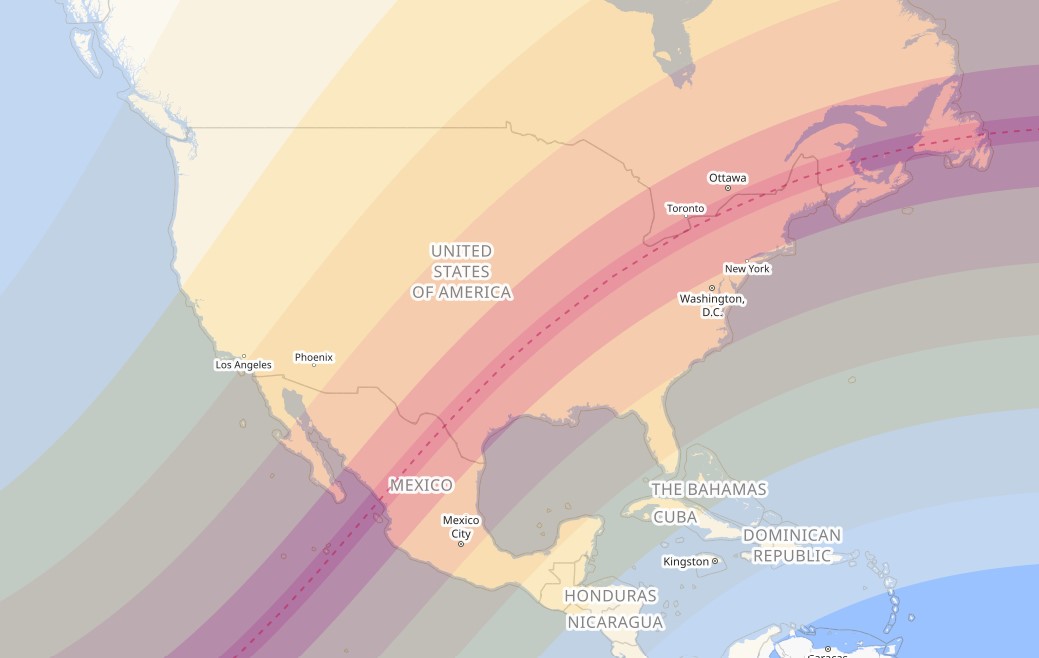
For this reason, this eclipse has already being christened “The Great American Eclipse.”
Flying Into the Eclipse
For this occasion, Southwest Airlines has communicated a list of the flights it will be operating on April 8 that will provide the best vantage point to observe the eclipse.
“Our Meteorology and Network Planning Teams identified the best opportunities for a potential view of this breathtaking sight,” said David Dillahunt, Chief Meteorologist at Southwest Airlines in a press release. “With our flight schedule, we’re able to offer hundreds of seats in the sky to view the eclipse, and we look forward to showcasing our Hospitality on this day while celebrating with our customers.”
“Network and Schedule Planners modeled the operational day against projections of the umbra and penumbra—shadows cast by the moon’s eclipse of the sun,” continues the press release. The Southwest Airlines flights listed below have the greatest likelihood of offering Customers onboard the best view of this moment:
- Southwest Flight #1252: departs Dallas (Love Field) at 12:45 p.m. CDT for Pittsburgh
- Southwest Flight #1721: departs Austin at 12:50 p.m. CDT for Indianapolis
- Southwest Flight #1910: departs St. Louis at 1:20 p.m. CDT for Houston (Hobby)
These flights may also cross the path of totality during their scheduled operating time:
- Southwest Flight #955 departs Dallas (Love Field) at 12:50 p.m. CDT for Chicago (Midway)
- Southwest Flight #506: departs Milwaukee at 1:05 p.m. CDT for Dallas (Love Field)
- Southwest Flight #1734: departs Houston (Hobby) at 1:35 p.m. CDT for Indianapolis
- Southwest Flight #1682: departs Chicago (Midway) at 1:30 p.m. CDT for Austin
- Southwest flight #3108: departs Nashville at 1:40 p.m. CDT for Dallas (Love Field)