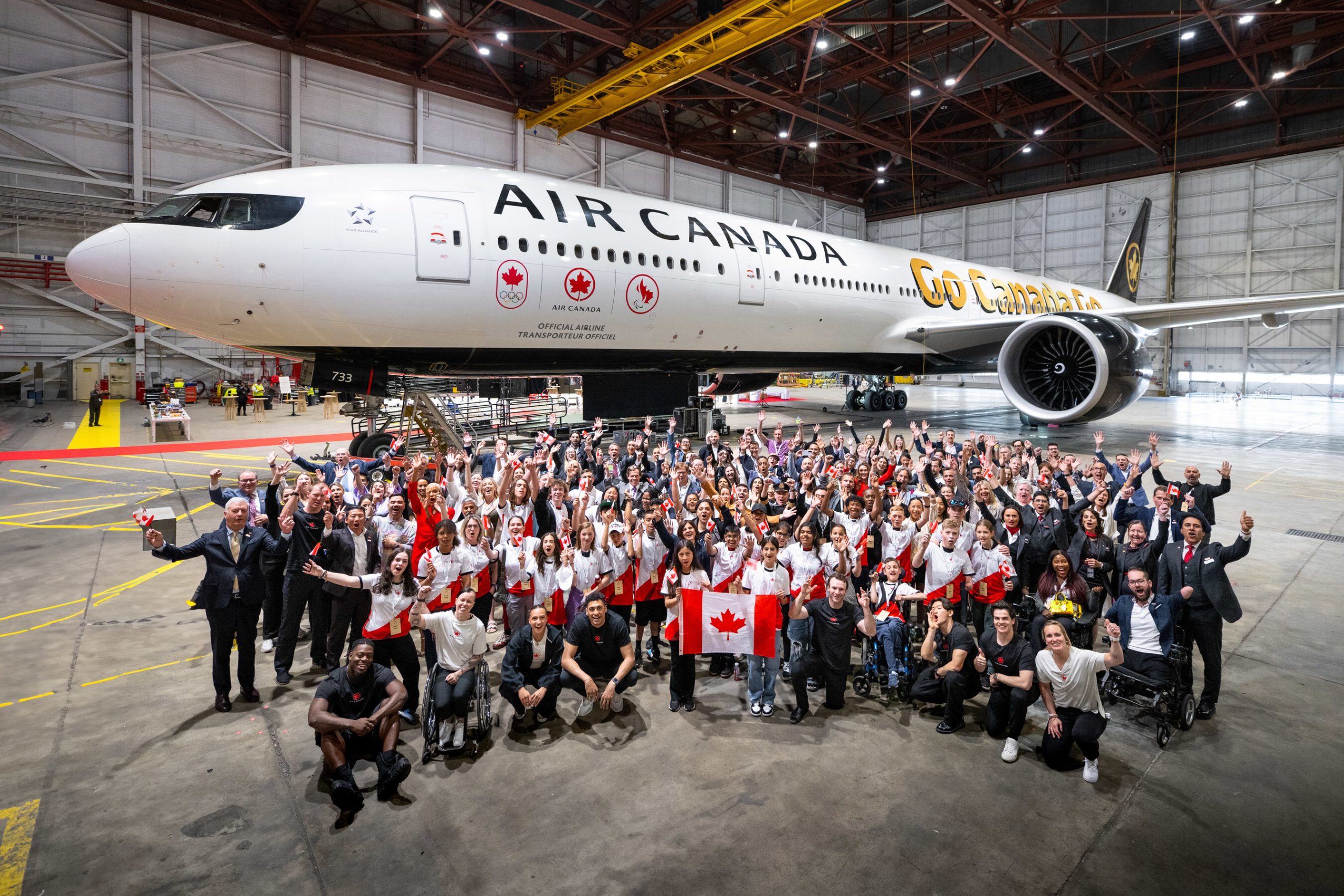
Air Canada's special livery for Team Canada for the 2024 Paris Olympic and Paralympic Games (Photo: Air Canada)
Editor’s Note: AirlineGeeks is proud to present our ‘Livery of the Week’ series. Every Friday, a team member will share an airline livery, which can be from the past, present, or even a special scheme. Some airline liveries are works of art. The complexity associated with painting around critical flight components and the added weight requires outside-the-box thinking from designers. The average airliner can cost upwards of $200,000 to repaint, creating a separate aircraft repainting industry as a result.
Have an idea for a livery that we should highlight? Drop us a line.
Air Canada has recently unveiled a new livery to celebrate Canadian athletes at the upcoming Paris 2024 Olympic and Paralympic Games. The new livery comes alongside a renewal of the airline’s partnership as the official airline of Team Canada.
Air Canada’s Newest Special Livery
The new livery adds to Air Canada’s standard black and white livery, with the phrase “Go Canada Go” adorned on the back portion of the fuselage in bold gold lettering. Given Air Canada’s obligation to provide services in both of Canada’s official languages – English and French – the phrase is bilingual. While the text is the same on both sides of the aircraft on this new livery, Air Canada’s last Olympic livery had “Fly the Flag” painted on one side of the aircraft and the French equivalent on the other.
Further forward on the new livery, the Canadian Olympic and Paralympic logos are painted underneath the first set of windows. Meanwhile, the iconic Air Canada maple leaf roundel on the aircraft’s tail is in gold instead of red. The livery has been painted on a 17-year-old Boeing 777-300ER, registered as C-FITW. The aircraft is slated to carry athletes to and from Paris for the Games.
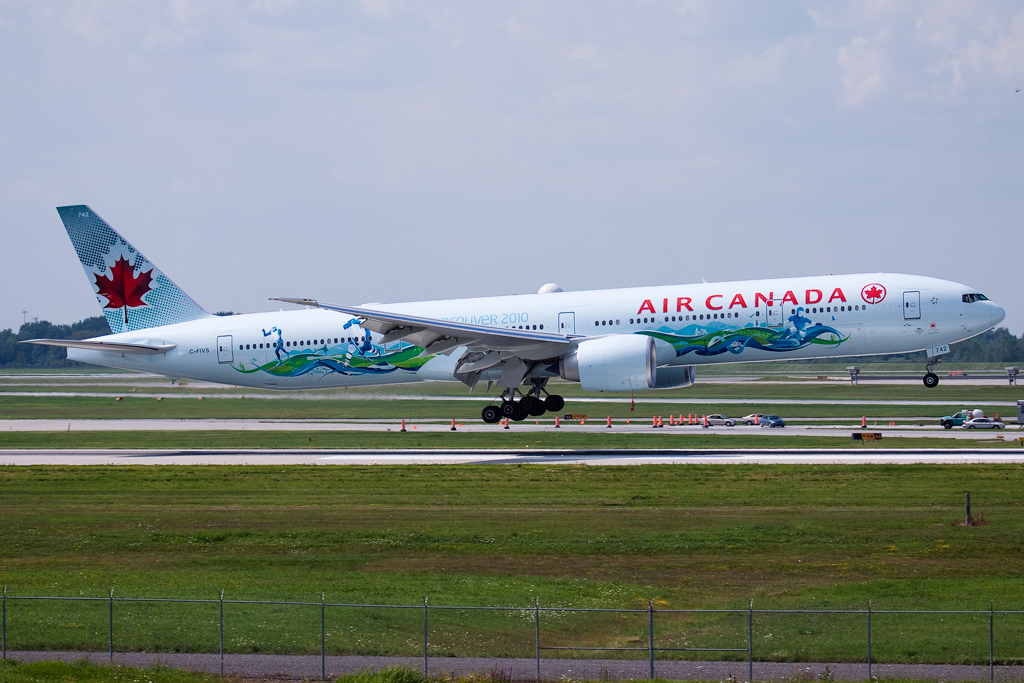
Alongside the new livery, Air Canada has announced that its partnership as the official airline of Team Canada has been extended to 2030. The Montreal-based carrier has been the official airline of the Canadian Olympic Team since 1988 and the Canadian Paralympic Team since 2007. The airline has had multiple Olympics-themed liveries in the past and was also a sponsor of the 2010 Vancouver Winter Olympic Games.
An Air Canada special livery for the 2010 Vancouver Winter Olympic Games (Photo: Patcard (Wikimedia Commons), licensed under CC BY-SA 3.0)
In addition to transporting athletes to and from the Games, the airline offers all athletes and coaches complimentary 35K Aeroplan Elite status in its loyalty program. The carrier will also hold airport celebrations for departing and returning athletes and have a presence at the Canada Olympic House and Canada Paralympic House in Paris.
Looking for a new airplane model? Head over to our friends at the Midwest Model Store for a wide selection of airlines and liveries.
Andrew is a lifelong lover of aviation and travel. He has flown all over the world and is fascinated by the workings of the air travel industry. As a private pilot and glider pilot who has worked with airlines, airports and other industry stakeholders, he is always excited to share his passion for aviation with others. In addition to being a writer, he also hosts Flying Smarter, an educational travel podcast that explores the complex world of air travel to help listeners become better-informed and savvier travelers.
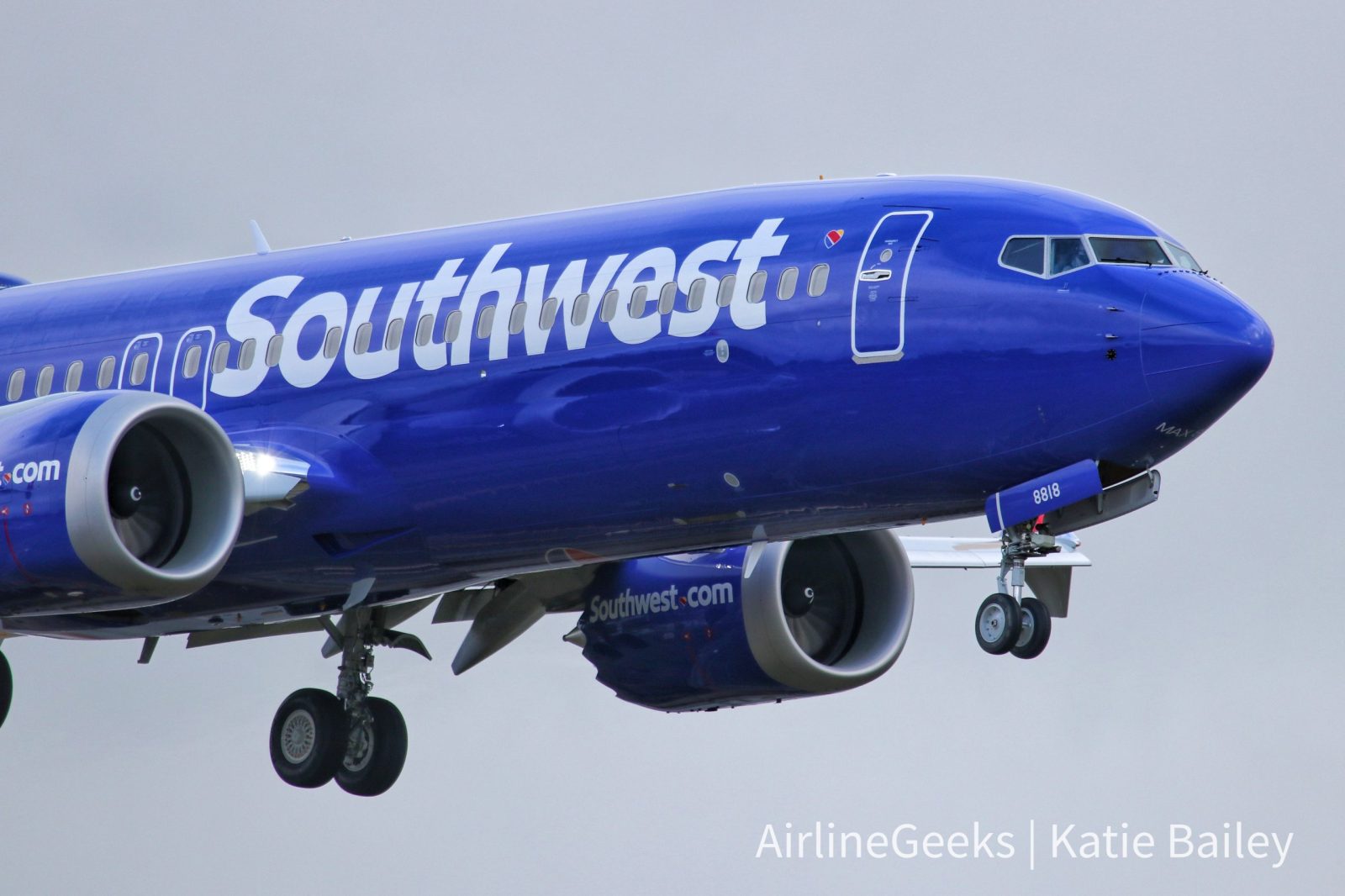
A Southwest Boeing 737 MAX 8 on approach to Paine Field.
(Photo: AirlineGeeks | Katie Zera)
The Federal Aviation Administration (FAA) and National Transportation Safety Board (NTSB) are investigating yet another alarming incident in which a Boeing 737 MAX 8 experienced a ‘Dutch roll’ at roughly 32,000 feet —a rare phenomenon when the aircraft rolls in one direction and yaws in the other.
The incident occurred May 25 during a Southwest Airlines flight from Phoenix to Oakland. Pilots managed to regain control of the aircraft and land safely, although the aircraft sustained substantial damage to the standby power control unit (PCU), according to a report.
On Thursday, the FAA released a statement indicating it was working closely with the NTSB and Boeing to determine the cause of the event while noting that no other airlines have reported similar issues. Southwest also stated it would cooperate with the agencies and the NTSB expects to have a preliminary report within 30 days.
The incident marks the latest setback for Boeing, as the manufacturer deals with intense scrutiny following the January door plug blowout on an Alaska Airlines 737 MAX 9 flight, leading to a temporary grounding of the fleet.
Editor’s Note: This story first appeared on AvWeb.com.
AirlineGeeks.com was founded in February 2013 as a one-person blog in Washington D.C. Since then, we’ve grown to have 25+ active team members scattered across the globe. We are all here for the same reason: we love deep-diving into the fascinating realm of the airline industry.
The agreement with Neste, a renewable fuels company, has seen roughly 3.3 million liters of blended SAF integrated into the Changi Airport fueling system over the past few weeks. Emirates meticulously tracks SAF deliveries and assigns its environmental benefits based on established industry methods.
Earlier this year, Emirates partnered with Neste to introduce 2.6 million liters of neat SAF at Amsterdam Schiphol Airport. Unlike blended fuel, neat SAF reduces lifecycle carbon emissions by up to 80% compared to conventional jet fuel. It’s produced from 100% renewable sources like used cooking oil and animal fat waste, ensuring sustainability throughout the process.
“This investment in Neste-produced SAF in Singapore represents a crucial first step for our adoption of SAF in Asia,” said Adel Al Redha, Emirates’ Deputy President and Chief Operations Officer. “The region is poised to become a major SAF supplier, and while this agreement signifies a milestone, we recognize the long road ahead. We’ve begun securing short-term supplies while pursuing longer-term agreements to guarantee a steady flow of SAF for our operations.”
Neste’s Vice President of Renewable Aviation Business, Alexander Kueper, echoed this sentiment. “We’re thrilled Emirates has chosen to utilize our Neste MY Sustainable Aviation Fuel at Changi Airport,” he stated. “This makes them the first international carrier to leverage SAF produced at our Singapore refinery and supplied through our integrated supply chain. We look forward to collaborating further to expand SAF availability for Emirates’ flights.”
A Multi-Faceted Approach to Sustainable Aviation
The airline’s comprehensive SAF strategy focuses on several key areas. The company explores opportunities to utilize SAF operationally across its network, shares potential emissions reductions with corporate clients and freight forwarders, collaborates on long-term SAF projects with partners, and actively supports SAF ventures within the UAE that could supply sustainable fuel directly to their Dubai hub in the future.
Emirates uses SAF in flights departing from Amsterdam, London Heathrow, Paris, Lyon, and Oslo. Additionally, the carrier integrated SAF into its Dubai hub’s fueling systems late in 2023. Notably, Emirates became the world’s first airline to conduct successful demonstration flights in 2023, utilizing 100% SAF in one engine on both a Boeing 777 and an A380.
Tolga is a dedicated aviation enthusiast with years of experience in the industry. From an early age, his fascination with aviation went beyond a mere passion for travel, evolving into a deliberate exploration of the complex mechanics and engineering behind aircraft. As a writer, he aims to share insights , providing readers with a view into the complex inner workings of the aviation industry.
Trip Report: Norse’s First Flight to Athens
Norse Atlantic Airways adds yet another new route out of New York JFK, and we had the opportunity to be on the first flight.
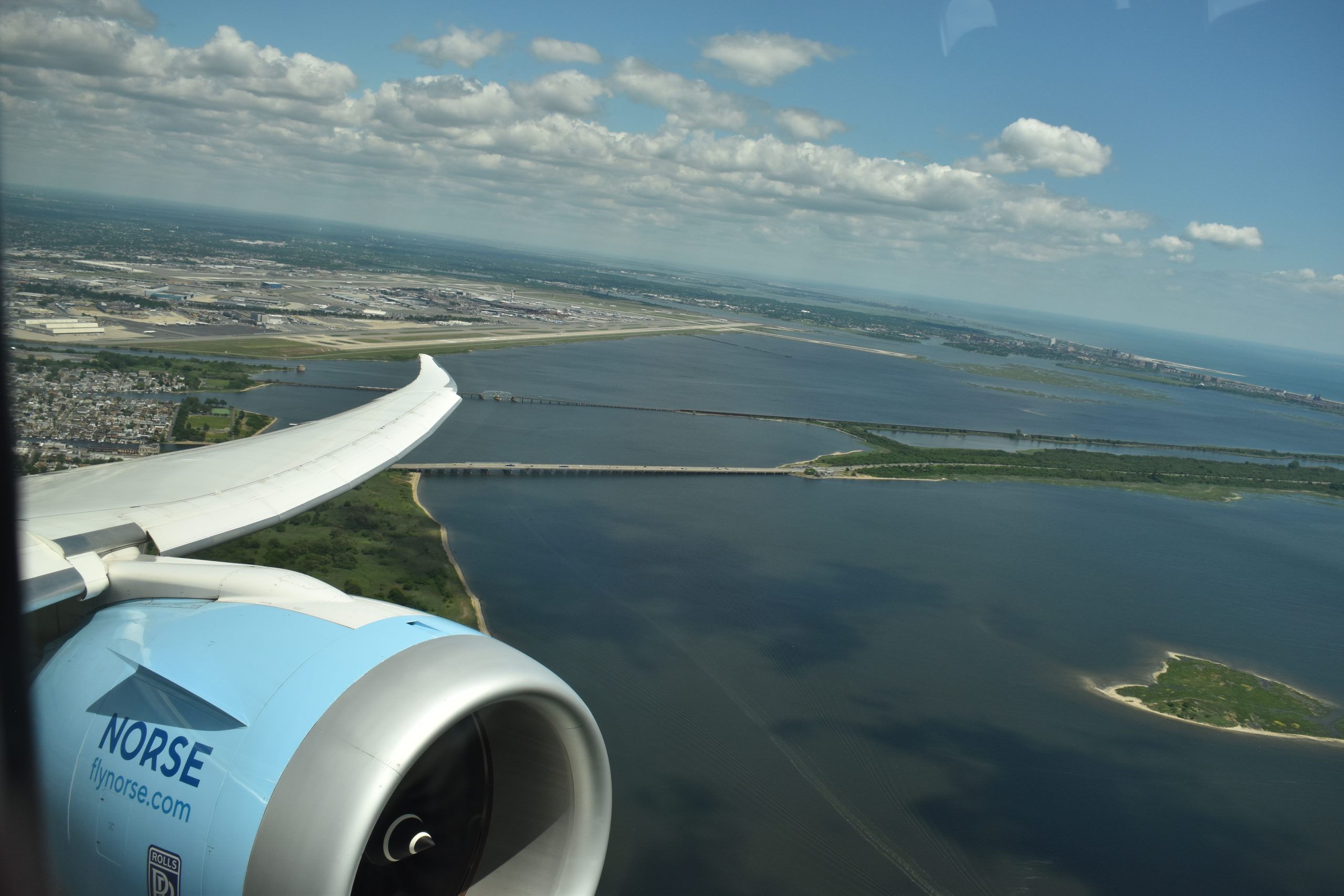
Taking off from JFK on Norse's inaugural flight to Athens (Photo: AirlineGeeks | Joey Gerardi)
As we enter the midst of summer, airlines are ramping up the busy schedules that come with high tourism demand. The weather is nice, many kids are off of school, and airlines are adding new flights and frequencies to their networks.
AirlineGeeks was fortunate enough to be able to ride onboard the airline’s first flight into the city, which departed from New York’s JFK Airport.
Day of the Flight
Norse’s flight to Athens out of JFK was scheduled to leave at 1:25 p.m., its counter opens four hours before the departure and closes one hour prior. I arrived in New York from another small city in New York State on a different carrier, so I was at the airport well before I needed to be. I headed to the check-in desks about two and a half hours before departure time.
Norse’s check-in area at JFK for the Athens inaugural (Photo: AirlineGeeks | Joey Gerardi)
For this inaugural flight, the check-in area was decorated with some balloons, but beyond that, the desks looked normal like they would for the other Norse departures to the other cities it serves from JFK. With the airline not offering online check-in for passengers, everyone did need to stop by the counter before heading to the gate.
Around this time of the day Terminal 7, where the airline departs from at JFK, was pretty quiet. In addition to it being a rather slow time, the airline also participates in the TSA PreCheck program so getting through security was easy and quick.
When I got to the gate, representatives from the airline were still setting up for the party. They did have balloons similar to the check-in area, and they also had a table that had cookies and cupcakes on them, the first of which had the airline’s logo.
The cookie and cupcake table at Norse’s Athens inaugural (Photo: AirlineGeeks | Joey Gerardi)
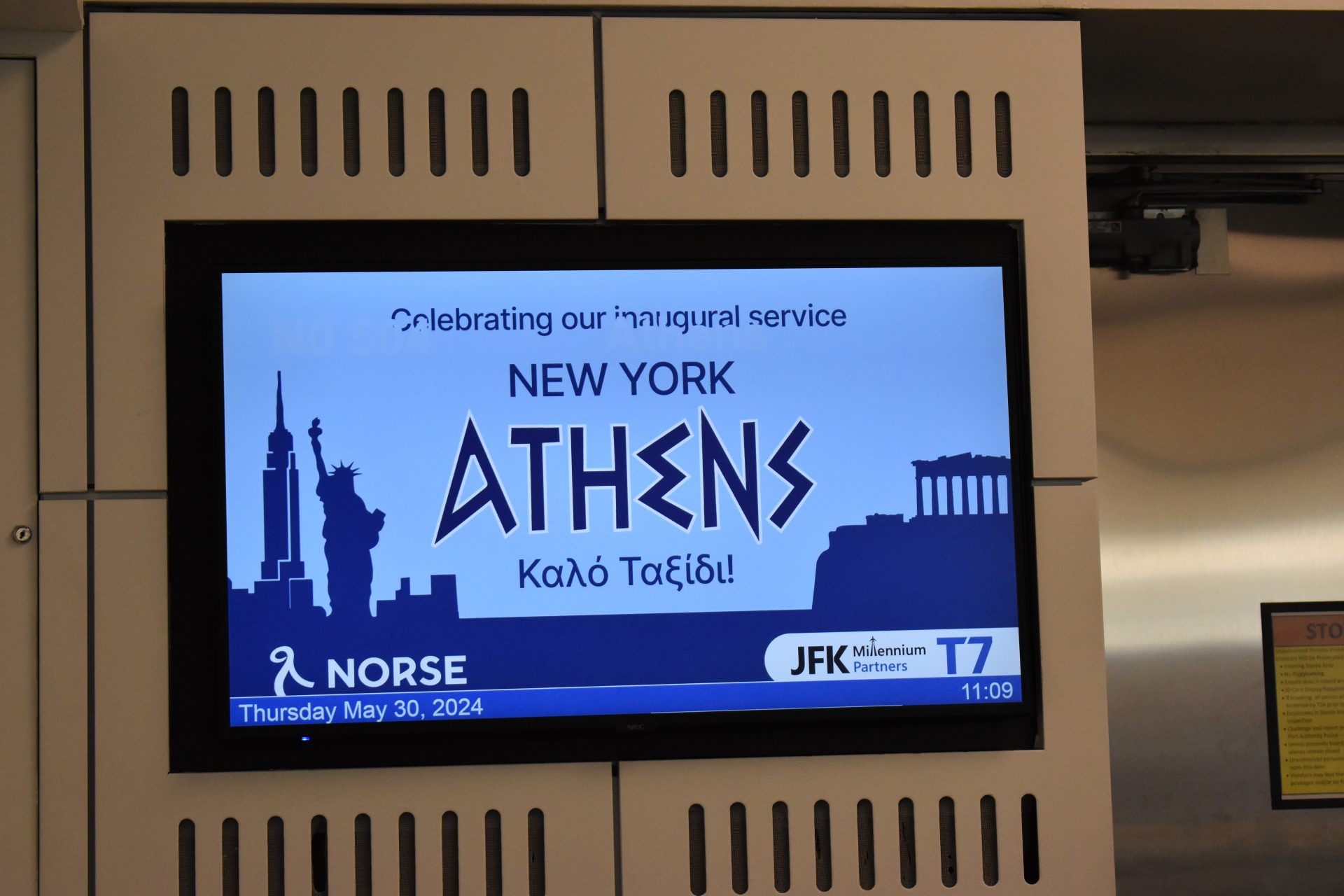
On the departure board, they had a custom backdrop for this first flight to Athens, featuring a lot of blue just as they do in their livery as well as some outlines of New York and Athens landmarks.
The custom departure board for the inaugural flight (Photo: AirlineGeeks | Joey Gerardi)
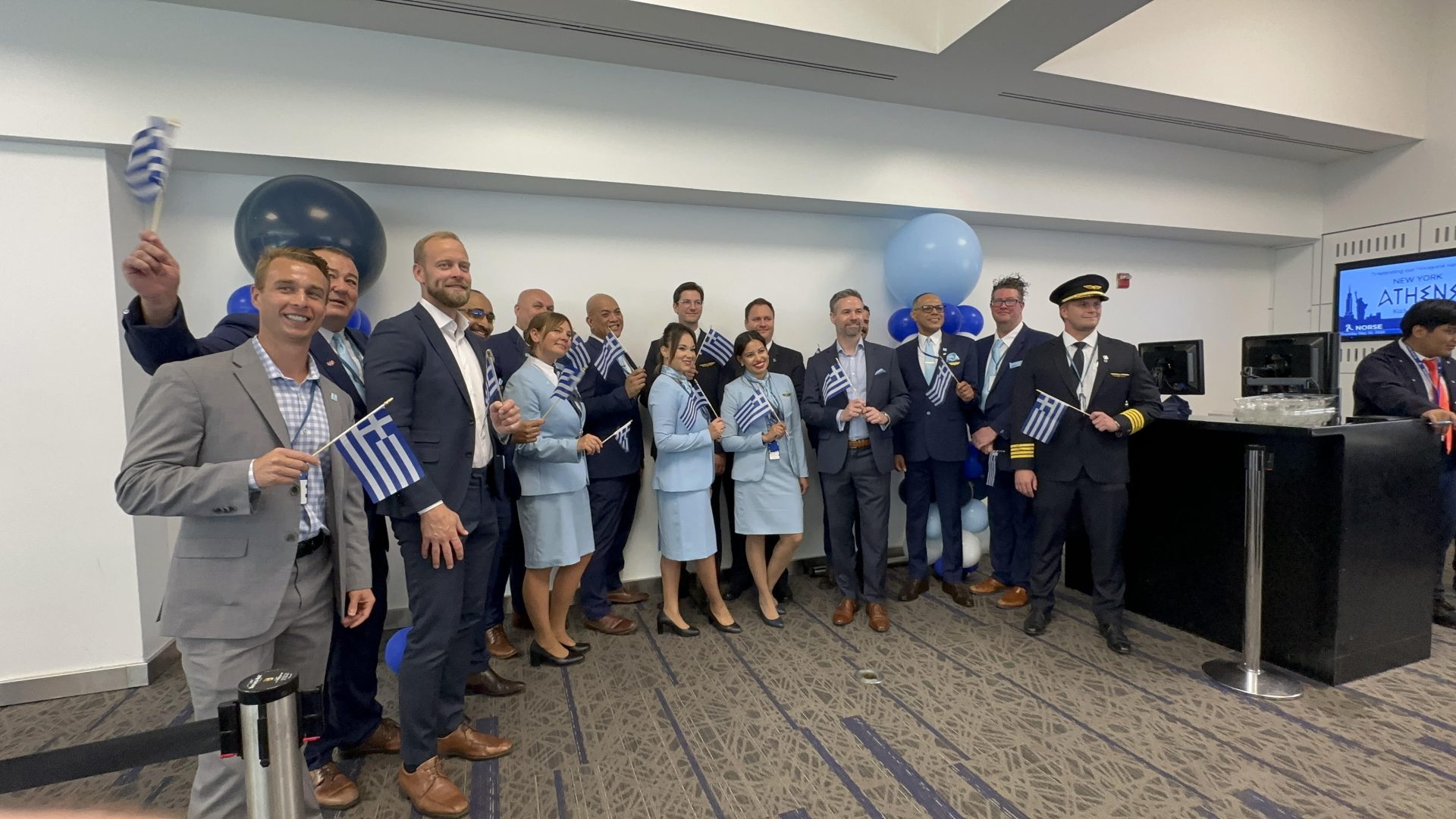
About an hour prior to the departure, they had some quick speeches done by Steven Thody, who is the CEO of JFK Millennium Partners, the company that runs Terminal 7 as well as the new Terminal 6 the airport is constructing. The other short speech was from Bård Nordhagen, who is the Commercial Director for the airline. Before boarding, there was also a photo op with the entire crew of the flight.
A group picture of the Norse crew operating the first flight, as well as company and airport executives (Photo: AirlineGeeks | Joey Gerardi)
On this flight, the airline operated a Boeing 787-9 that carried the registration LN-FND. It was originally delivered to Norwegian Air UK in March of 2018, before going to AerCap in March 2021 and finally coming to Norse Atlantic a year later in March 2022. All of the aircraft in the airline’s fleet also carry a name, and this one is named “Dartmoor,” which is a national park in southwestern England
After the photo op, it wasn’t long before the boarding process started for the flight. As I was seated in the airline’s Premium cabin, I was one of the first passengers to board, and it also meant I turned left when I stepped onboard as the jetway was attached to the second door of the aircraft. The premium cabin on Norse’s 787-9 is in a 2-3-2 configuration for eight rows.
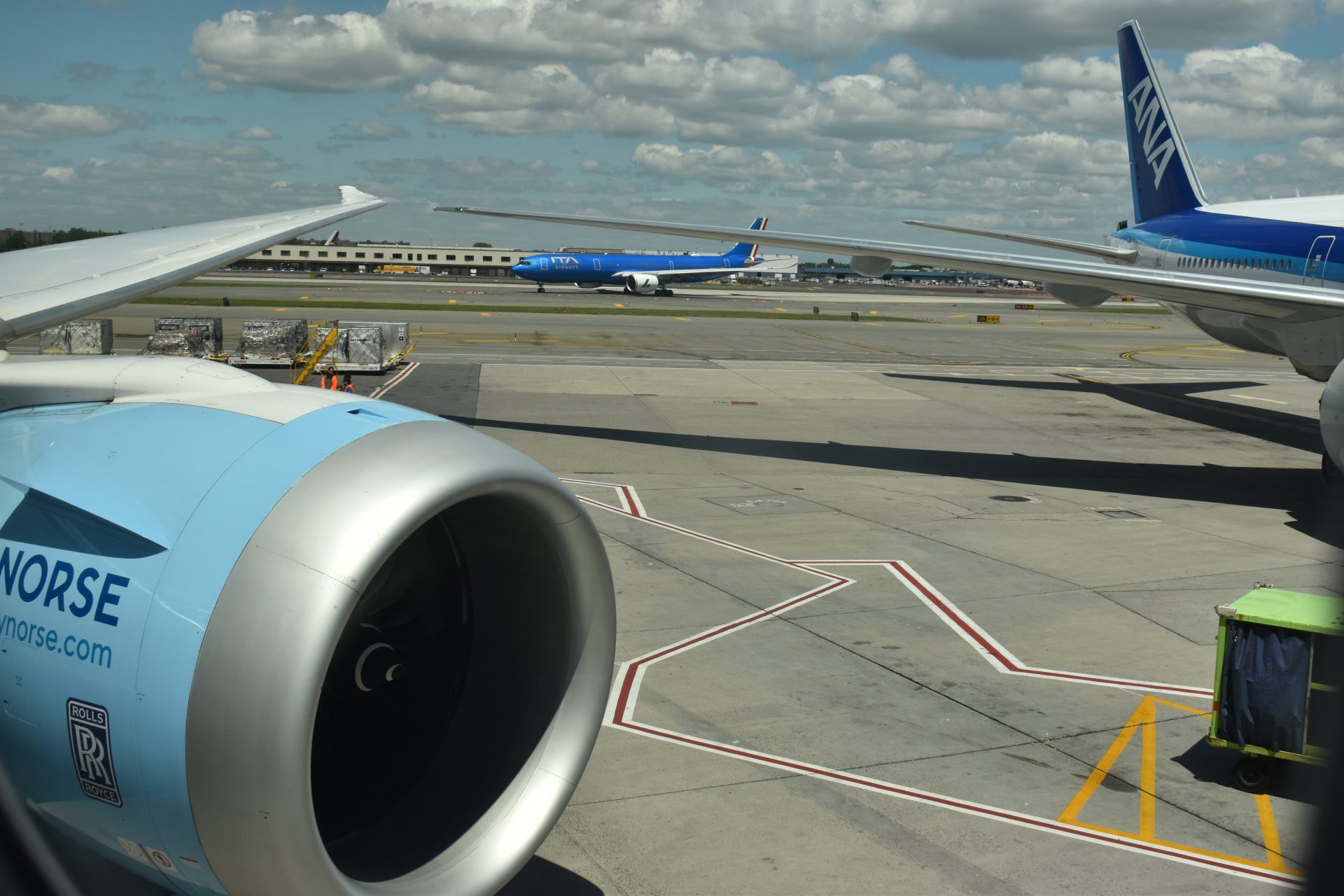
I was seated in 6A, rows 6 through 8 are the best rows in the cabin for viewing the engine and offered spectacular views once the jetbridge pulled back.
Looking at the engine from my window in row 6 (Photo: AirlineGeeks | Joey Gerardi)
All of the rows in the Premium cabin also had two windows which helped for optimal viewing so you didn’t have to lean way far forward to see out of it, except for row five, which only has one window.
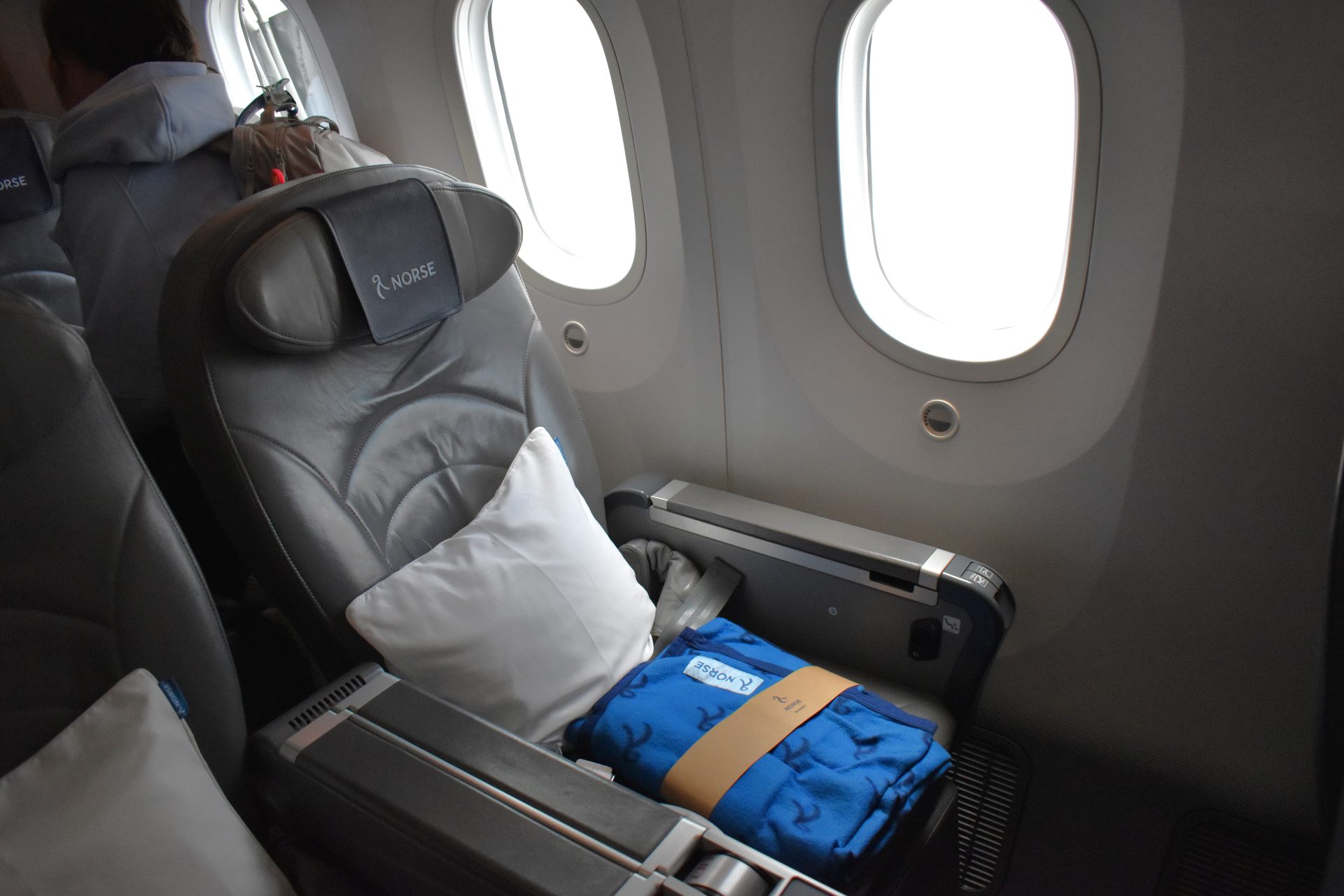
My seat, 6A, in Norse’s Premium cabin (Photo: AirlineGeeks | Joey Gerardi)
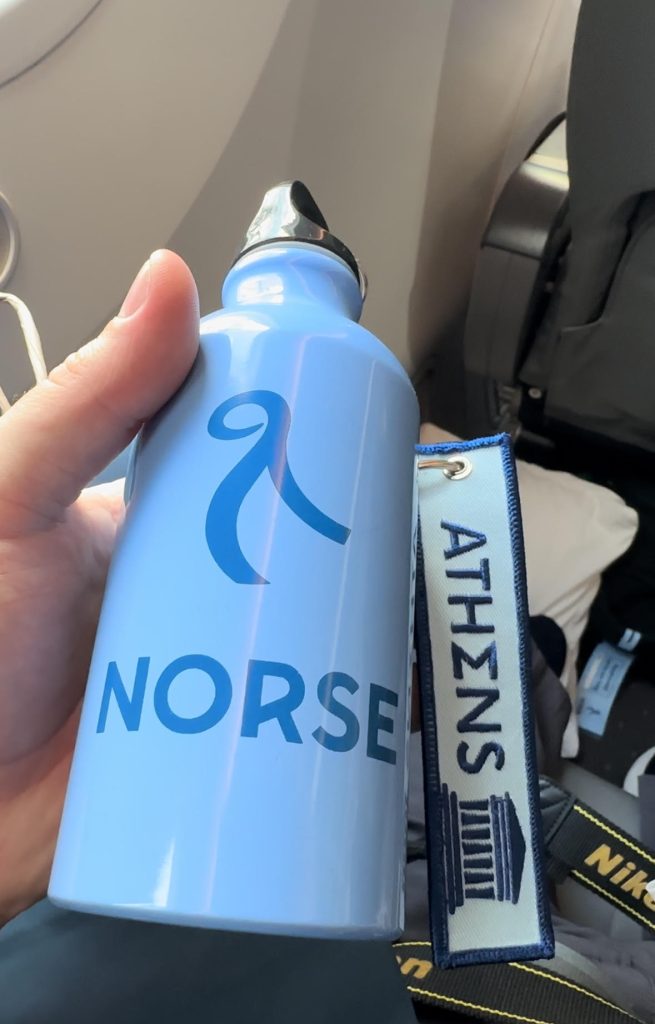
There was also a pillow and a blanket for passengers in the Premium cabin to use, and they did come around with a small amenity kit as well which had an eye mask and ear plugs. As this was an inaugural, the airline also handed out goodies to the passengers once we were on the plane. In a Norse branded bag, there was a small blue metal water bottle with the Norse logo, as well as a keychain that said Athens on it along with the logo.
The water bottle and keychain that was given to all on the inaugural flight (Photo: AirlineGeeks | Joey Gerardi)
Before pushback, the crew also came around and served us a choice of either champagne or orange juice. They also went around asking passengers if they had ever been on the airline before, and if the answer was a no they explained how to use the various controls and levers to operate the extras on our seats like the footrest, and where to find the IFE.
We pushed back and took to the skies after a couple of announcements from the flight crew about this being a special flight, along with the pilot explaining our route across the Atlantic. We then took off to the west and turned back east for the flight across the ocean on this inaugural flight.
The Flight
From this point on there wasn’t anything different from being an inaugural flight versus a regular Norse flight, but, it was still a unique flight for me as I had never been on the airline before or on the Boeing 787. After takeoff, some people took out their movie screens and some went right to sleep, but with the meal coming soon I decided to stay awake to enjoy it.
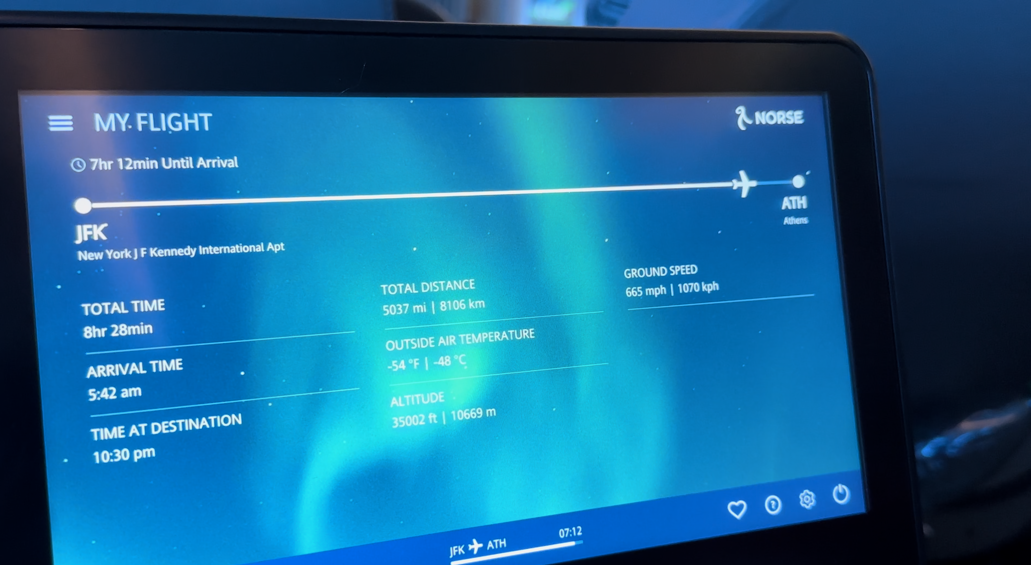
But in the meantime before food arrived, I explored the airline’s IFE screen, where you could look at flight details although they didn’t have a moving map. I did have a chance to speak to Philip Allport, Norse’s SVP of communication, about the moving map, and he said, “At this stage, we do not have plans to add a moving map to our personal entertainment screens across the fleet.” But, even without a map, it still had a lot of information about the flight, including a progress bar at the bottom showing how much time was left.
The ‘my flight’ section of the airline’s IFE system (Photo: AirlineGeeks | Joey Gerardi)
From the IFE screen, one could also order drinks and snacks, as well as watch movies, television, shop for duty-free items, and even call the flight attendant. If I am being completely honest, I didn’t even notice the ‘order’ feature for drinks on this flight and it wasn’t until my second flight with Norse that I actually used it, but it does work and is helpful, especially for those sitting in the window seat that don’t want to bother their seatmate to get up.
Along with the USB port in the IFE screen, each seat in the Premium cabin also had a power outlet that could accommodate plug types for all of the destinations that the airline currently serves.
Another unique feature of the Boeing 787 is the lack of window shades and the use of window dimmer buttons. During takeoff and landing the crew does lock these windows on ‘clear’ mode, which does make the AvGeek in me very happy that people can’t shut the windows.
About 45 minutes to an hour after takeoff, the flight attendants brought around the drink cart, and they had many options from wine, beer, and other alcoholic drinks, as well as soft drinks, and of course water. By the time the main meal came around we were over Price Edward Islands in Canada, so roughly an hour and a half into the flight.
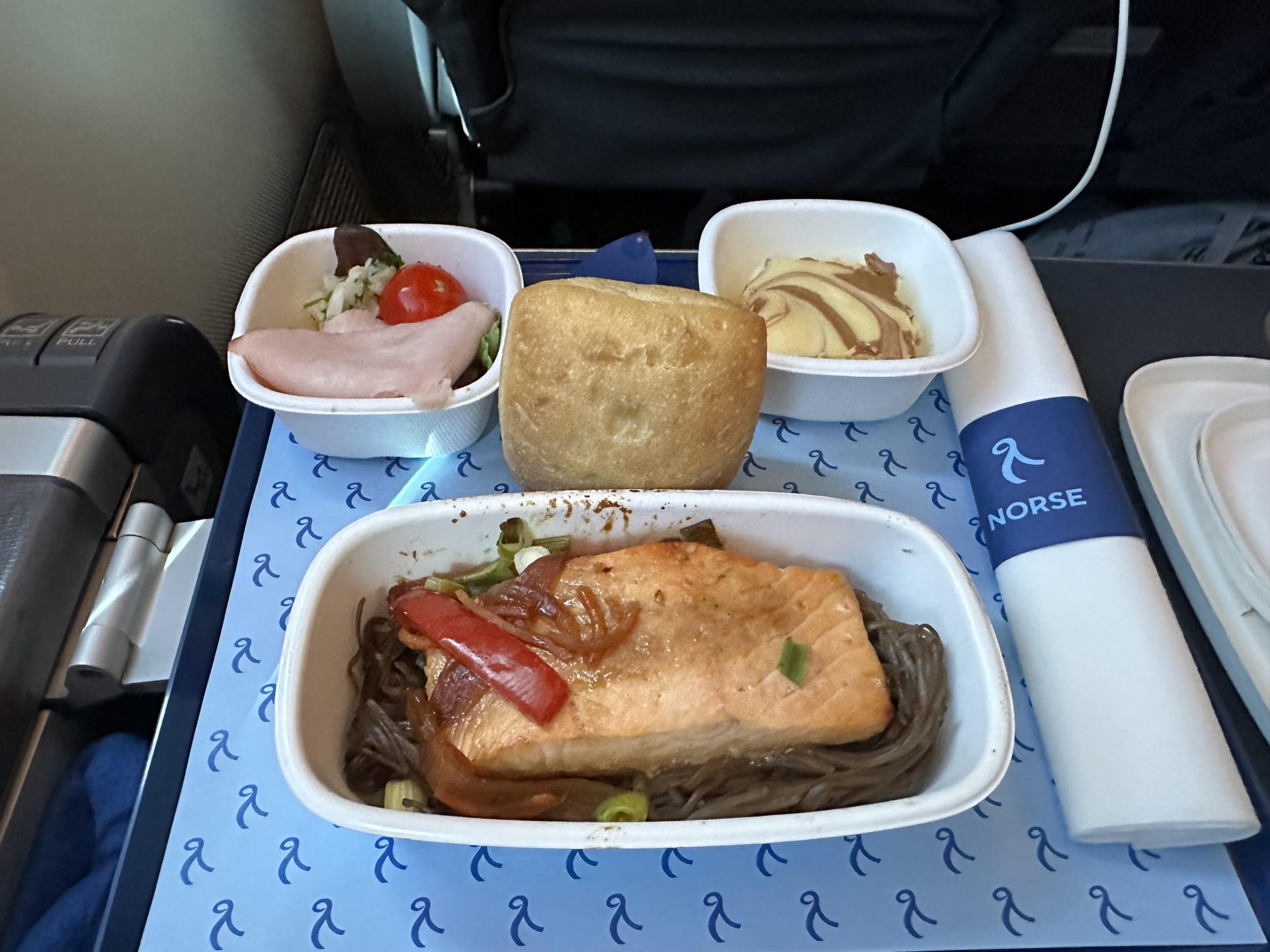
The main course that I chose for the flight over to Athens (Photo: AirlineGeeks | Joey Gerardi)
The choices for those in the Premium cabin included pasta or salmon, although they did have other specialty meals for those with food restrictions or allergies. If someone wanted to, they could also choose to eat one of the main cabin meals, which is what my seat neighbor did and got chicken.
The salmon I got came with Asian noodles, peppers, and spinach. The salad consisted of tomatoes, lettuce and turkey, a small piece of bread with butter, and there was a piece of cake for dessert.
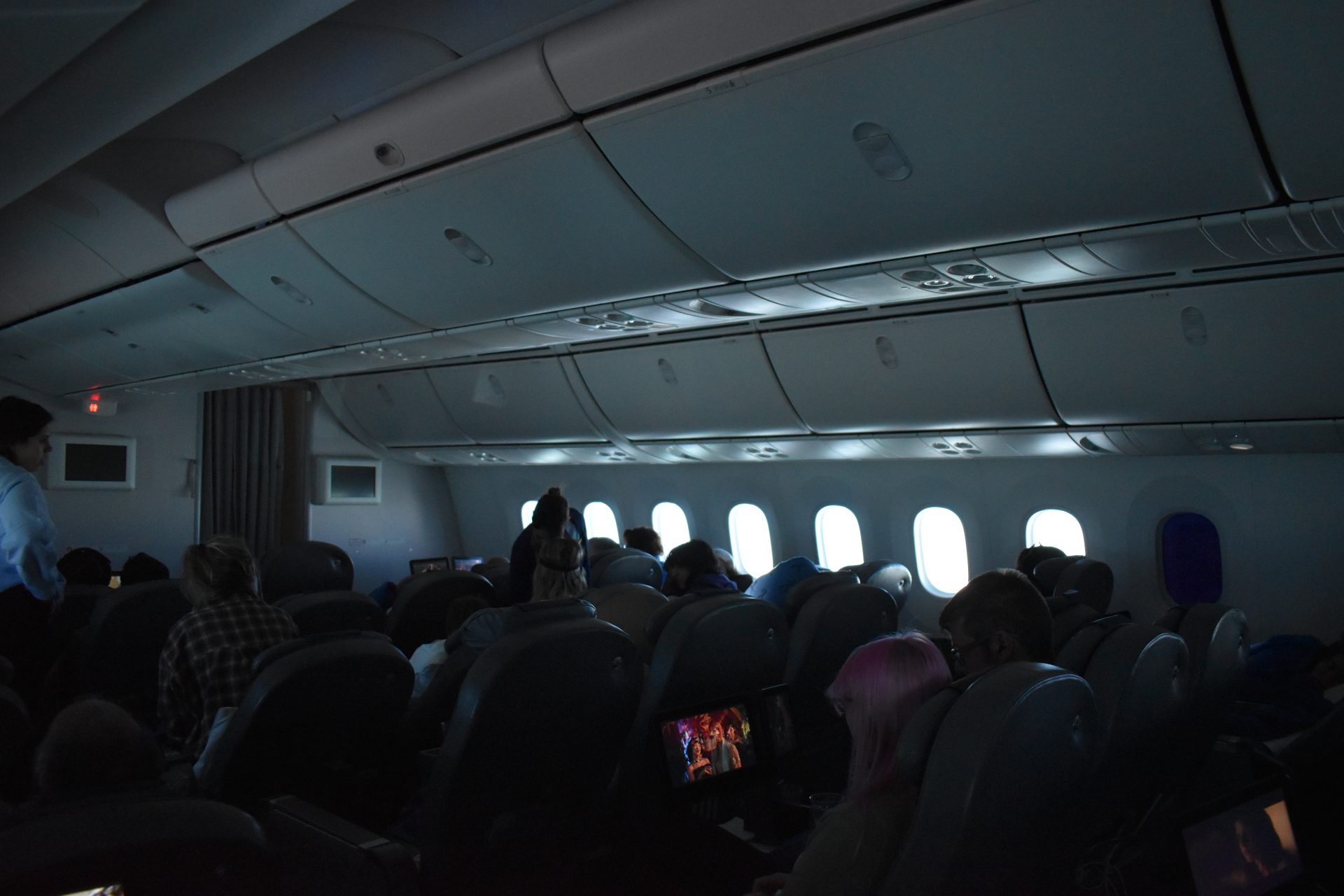
After the meal was over and with about 4.5 hours until landing, they turned off the cabin lighting for those who wanted to go to bed.
The crew turned off the cabin lights so people could sleep (Photo: AirlineGeeks | Joey Gerardi)
After about three hours of what some might consider sleep and 1.5 hours of the flight remaining, I woke up to the smell of food as the crew was getting the breakfast service ready. The cabin lighting had been turned to a blue color, to simulate the sun coming up.
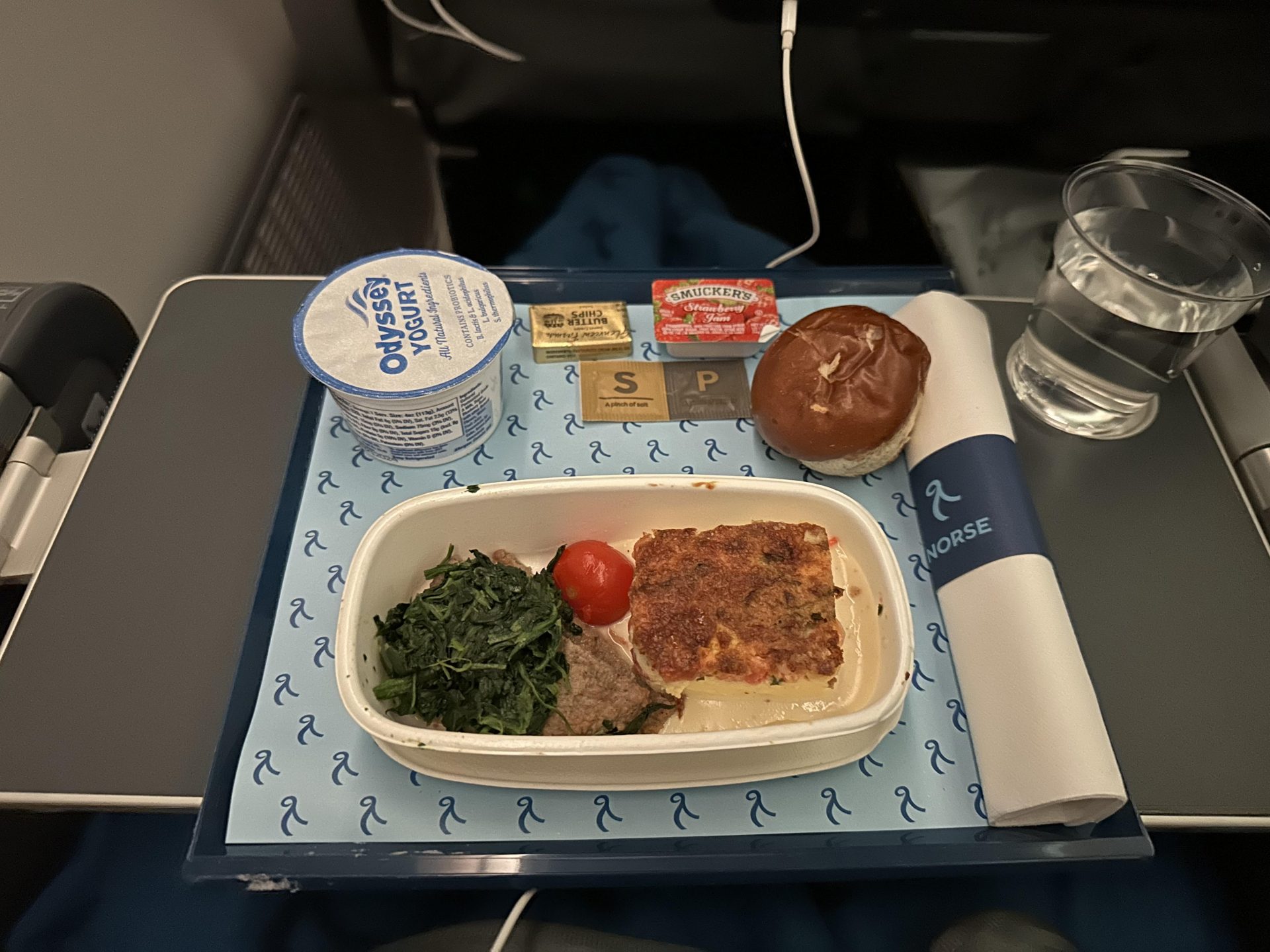
One by one, people started waking up and slowly the cabin lights were turned brighter in preparation for the breakfast service. Other than those with dietary restrictions, there was one option for breakfast, this consisted of quiche, sausage, spinach, yogurt, and an option of either regular bread or pretzel bread.
Breakfast for the flight to Athens (Photo: AirlineGeeks | Joey Gerardi)
After breakfast, we were roughly over the western coast of Greece, and the crew began to clean up in preparation for our arrival in Athens as the sun came up. They also collected the blankets from everyone but if you did want to keep one, they do sell them to passengers.
The sun starts to come up as we begin our descent into Athens (Photo: AirlineGeeks | Joey Gerardi)
Arrival
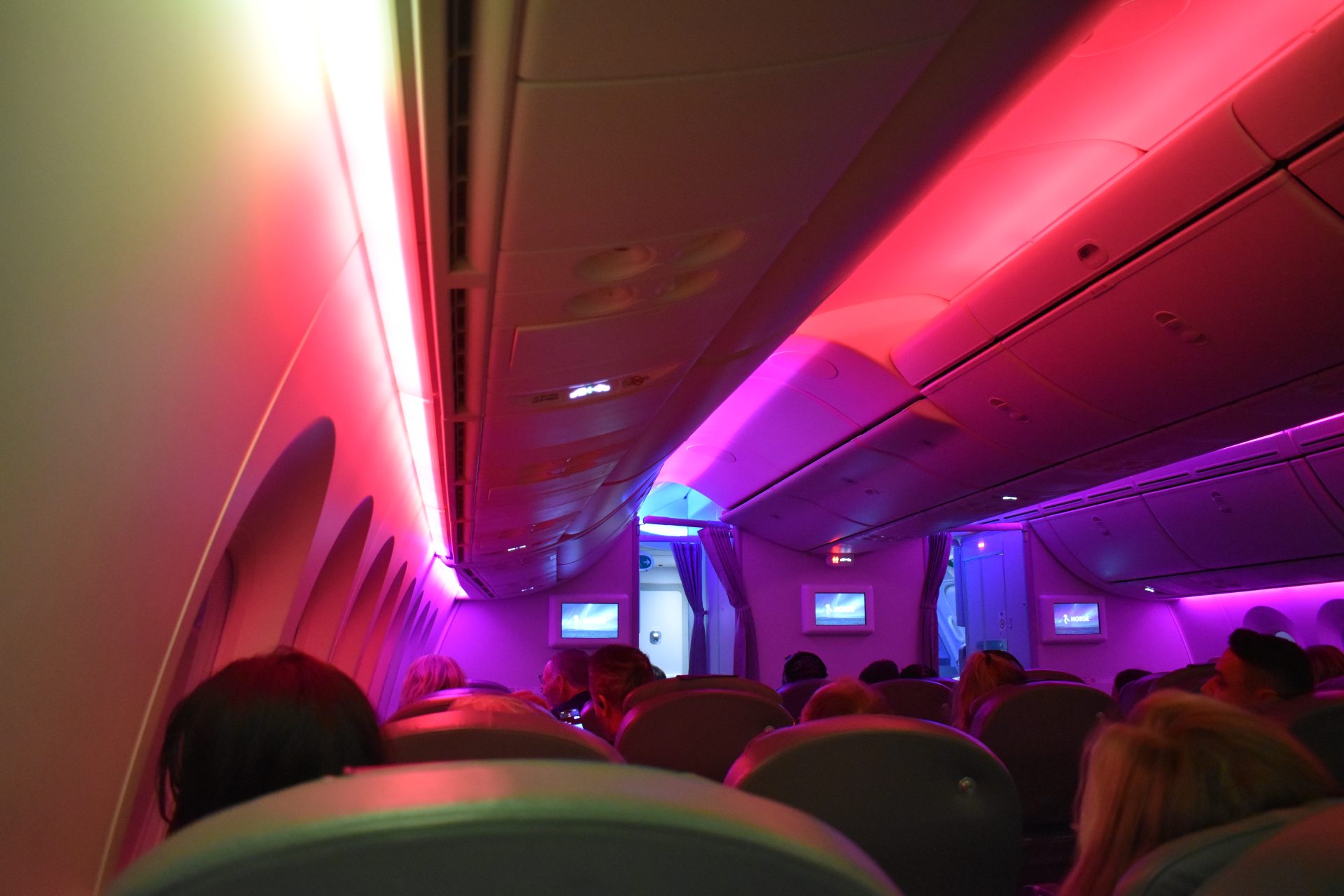
Norse is a Nordic airline, and given this and the fact that the Northern Lights or Aurora Borealis are such a big attraction and beauty of these countries in that region, they did a cabin light demonstration just before landing that was made to mimic the lights with bright and vibrant colors.
The Aurora Borealis cabin light display before landing (Photo: AirlineGeeks | Joey Gerardi)
We touched down in Athens, Greece at 5:41 a.m. after 8 hours and 28 minutes of flight time, and with the day barely started, passengers had all day to explore the wonder that is Athens. Another plus about arriving very early in the day is there are very few non-Schengen zone flights coming in, so we had customs all to ourselves.
This new link between JFK and Athens is another way to get between New York City and the country of Greece with Norse offering the route between the cities five times a week. They are the third option to get between NYC and Greece as both American and Delta fly from JFK to the country, and United also flies from nearby Newark as well.
Editor’s Note: Norse Atlantic Airways provided AirlineGeeks with a seat on this flight, but this trip report is an objective portrayal of the events and is in no way swayed by that aspect.
Joey has always been interested in planes for as long as he can remember. He grew up in Central New York during the early 2000s when US Airways Express turboprops ruled the skies. Being from a non-aviation family made it harder for him to be around planes and would only spend about three hours a month at the airport. He was so excited when he could drive by himself, the first thing he did with his driver's license was get ice cream and go plane spotting for the entire day. He graduated from Western Michigan University in 2022 with a B.S. in Aviation Management & Operations and a Minor in Business, and currently works for a major airline in his hometown.
Frontier Adds New Routes From Nine Airports
The carrier will launch nonstop service from nine airports, including Atlanta, Boston and Los Angeles starting in August.
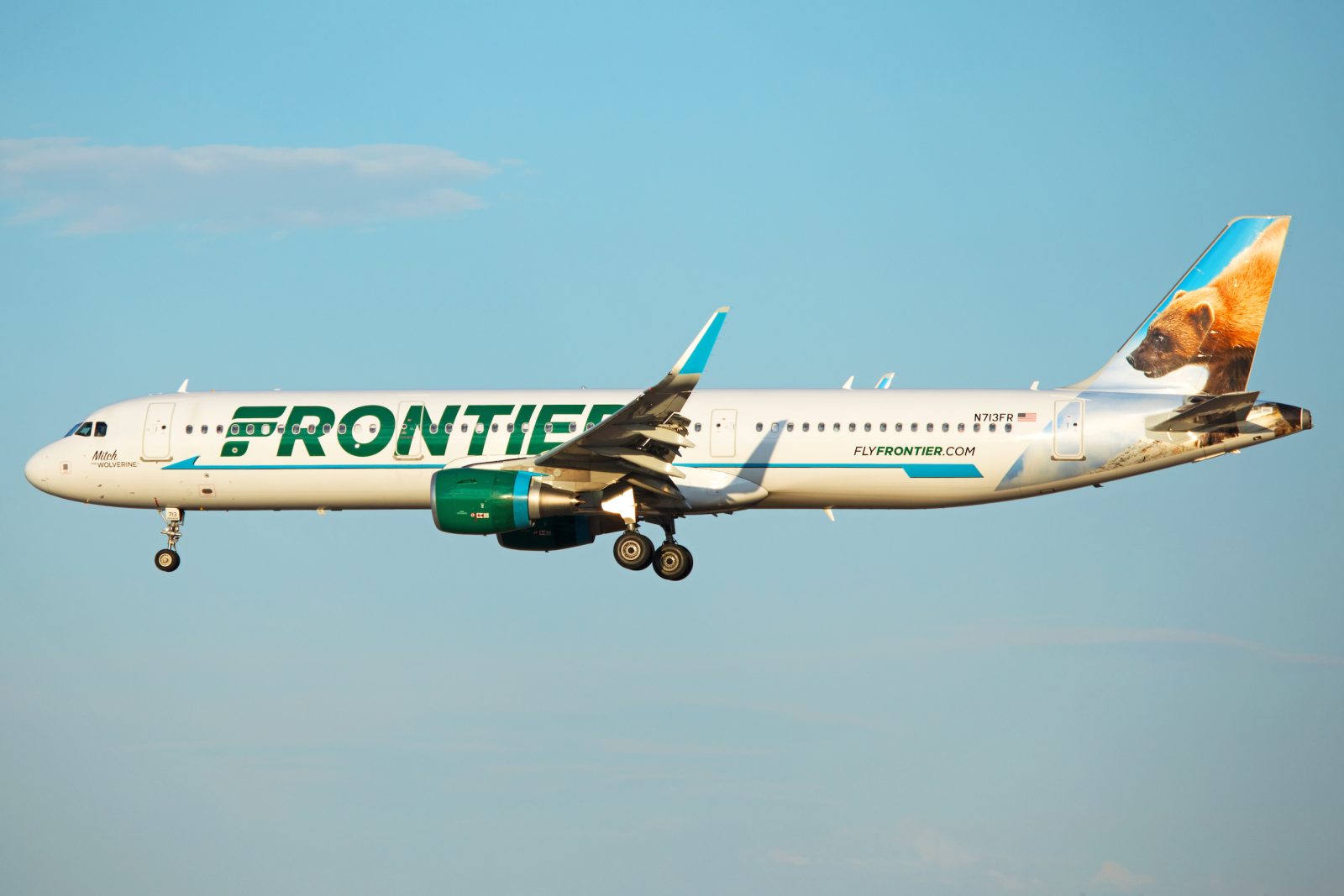
A Frontier A321 in Las Vegas (Photo: AirlineGeeks | William Derrickson)
Frontier Airlines will launch nonstop service from nine airports in August.
The company announced the following flights:
Daily service beginning Aug. 13 to and from Atlanta and Boston
Daily service beginning Aug. 13 to and from Atlanta and Los Angeles
Daily service beginning Aug. 13 to and from Boston and Charlotte
Daily service beginning Aug. 13 to and from New York City and Las Vegas
Daily service beginning Aug. 13 to and from Los Angeles and Sacramento
Daily service beginning Aug. 13 to and from San Diego and Sacramento
Service four times weekly beginning Aug. 14 to and from Boston and Dallas /Fort Worth
“By providing exceptional value and a superior travel experience, ‘The New Frontier’ is leading the way in the airline industry when it comes to convenience and affordability,” Josh Flyr, vice president of network and operations design, said in a news release.
The carrier initially scheduled a new route from JFK-LAX, but it has since been removed from its website and press release.
Brinley Hineman covers general assignment news. She previously worked for the USA TODAY Network, Newsday and The Messenger. She is a graduate of Middle Tennessee State University and is from West Virginia. She lives in Brooklyn with her poodle Franklin.
An Inside Look at UPS’ Louisville Hub
Nestled in Louisville, Ky. lies UPS Worldport, the global air hub for UPS Airlines, which operates roughly 400 daily flights from the airport.
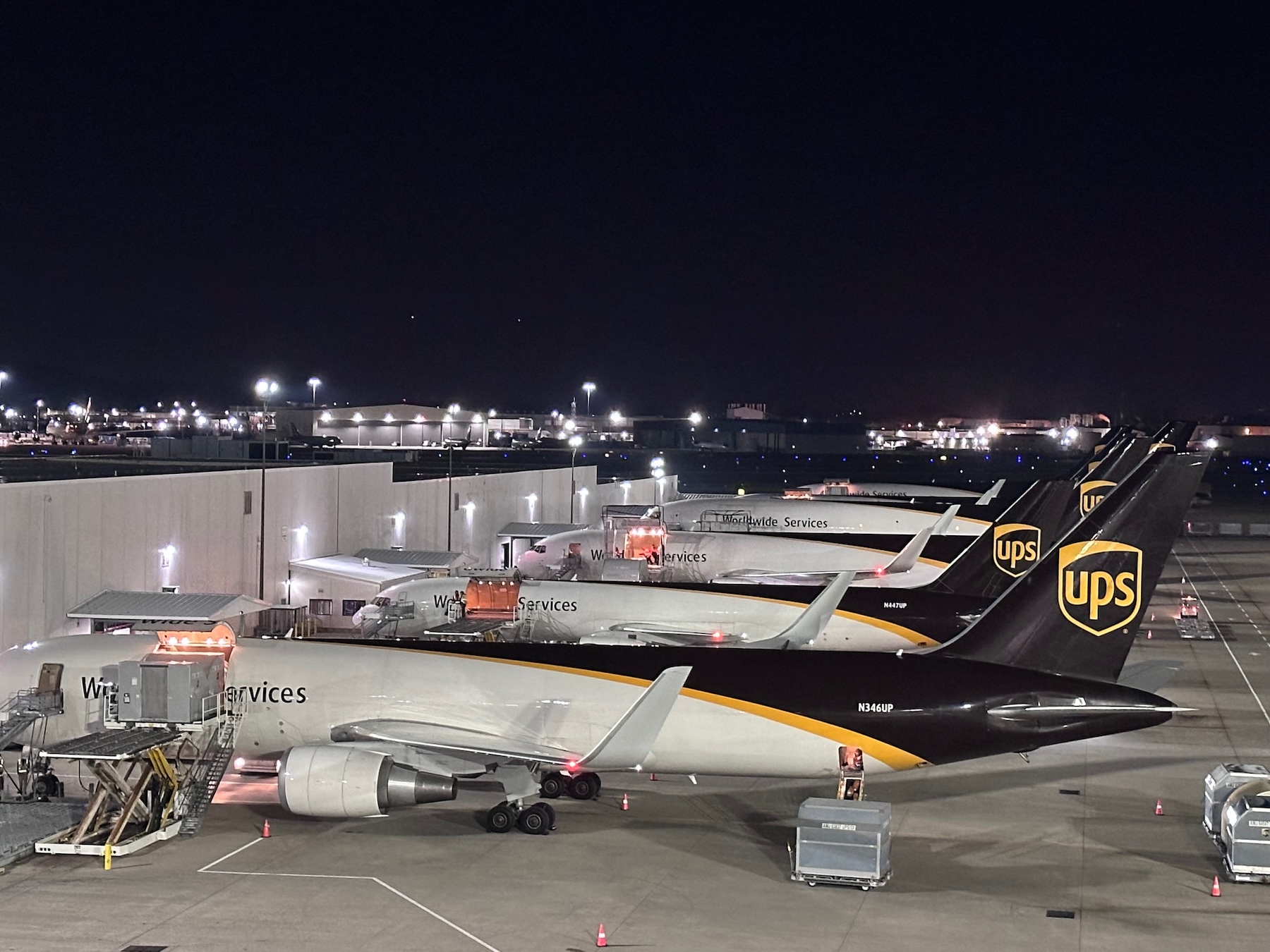
Aircraft at UPS' Worldport (Photo: AirlineGeeks | Ryan Ewing)
Nestled in Louisville, Ky. lies UPS Worldport, the global air hub for UPS Airlines. This massive facility, clocking in at 5.2 million square feet, is a central sorting location for millions of packages each day.
Worldport serves as a testament to modern logistics. With a network of conveyor belts stretching 155 miles and a team of over 7,000 employees, the hub sorts roughly 400,000 packages every hour. Advanced technology like barcode scanners ensures each package finds its way to the right destination quickly and efficiently.
Worldport is a key player in UPS’ global network, connecting over 200 countries and territories. The air hub sees roughly 400 UPS flights per day.
AirlineGeeks received a behind-the-scenes look at the facility earlier this year.
Ryan founded AirlineGeeks.com in February 2013 and has spent more than a decade covering the airline business. His work has been featured by CNN, WJLA, CNET, and Business Insider. His aviation experience spans airport operations, Part 135 regulatory compliance, and airline crew workforce planning, along with time behind the yoke of a Cessna 172 and interviews with airline executives. Ryan now serves as Group President of Firecrown Media’s Aviation Group. He holds a B.S. in Air Transportation Management and an MBA from Arizona State University and teaches Airline Management at Embry-Riddle Aeronautical University.
Inside the cockpit of an Airbus A220. (Photo: AirlineGeeks | Fabian Behr)
Aviation is defined by communities. It is impossible to become a pilot, spotter, or enthusiast without finding some sort of community. Whether it be an EAA chapter, a spotting group, a flying club, or even just an online thread, it seems that every member of the aviation community has found their own personal community to share their experiences and passions with.
These communities are what make aviation truly enjoyable and are what bring people together. Ultimately, aviation is a small world where everyone, to some degree, seems to know everyone else.
Continually furthering the aviation community is an important part of growing as one who cares to make the industry more caring and welcoming. Beyond pure enjoyment, maintaining a healthy community helps pilots in particular maintain a strong sense of responsibility and accountability in their flying. Connecting with others is a great way to see other perspectives and continue growing as a pilot.
Volunteering takes these connections to another level. Not only can you meet and bond with other like-minded people, but you can learn a new level of respect and admiration for aviation, its community, and the people you know in the industry. As pilots learn more about others around them on the ground, it becomes easier to navigate the air in a cohesive, respectful manner.
The importance of volunteering is not lost on professional aviation companies. Airlines, for example, often like to hire pilots with volunteer experience. Whether in the aviation world – such as flying Young Eagles interested in learning to be pilots – or not, volunteer experience demonstrates a high level of professionalism, a desire to understand others, and an ability to push your comfort zone in new situations.
Volunteer experience can be beneficial even for people interested in flying only for personal or recreational purposes. The scope of the volunteering need not be large. Rather, small day-to-day actions can be just as beneficial. Things such as preparing donation drives, organizing special interest groups, or hosting fundraisers can foster a sense of community and growth that impacts your decision-making and thoughtfulness as a pilot.
Volunteering would not be so important for professional pilots – not just those who want to get hired but those who have been flying for decades – if it did not have a material impact on how said professional pilots work together, as well as with their larger crews and within the air traffic system. Companies from small flight schools to the world’s largest airlines all agree on the instrumental value of giving back, whether it be on a small personal level or a larger communal level.
No two pilots, of course, are the same. Recognizing your strengths and talents is important for identifying the best opportunities for further growth. However, it is still the case that assisting others in the best way possible can be a major benefit for pilots of all levels and skills in furthering their own love of aviation and their commitment to excellence in the air.
Editor’s Note: Welcome back to the Private to Professional series. We will take time to break down a new regulation written for professional pilots in Part 121 and Part 135 flying, and we will consider different ways to apply those regulations to general aviation. Some regulations have straightforward applications to general aviation, but there is usually more that meets the eye. Thus, we will take time to explore a wide variety of ways general aviation pilots can apply even simple things, like minimum rest requirements, to their own flying. Check back in next week for the next installment of the series. Read the previous article here.
John McDermott is a commercial pilot pursuing a career in professional flight. His passion for aviation began in an Ann Arbor bookstore with a tale of enemy pilots during World War 2, and he hasn't looked back. Besides flying and writing for AirlineGeeks, John volunteers with Professional Pilots of Tomorrow and travels whenever he gets the chance.
Why the Airline Industry Isn’t a ‘Rigged Game’
Spirit isn’t doing well. The financially ailing airline never quite recovered from the pandemic, losing millions each quarter.
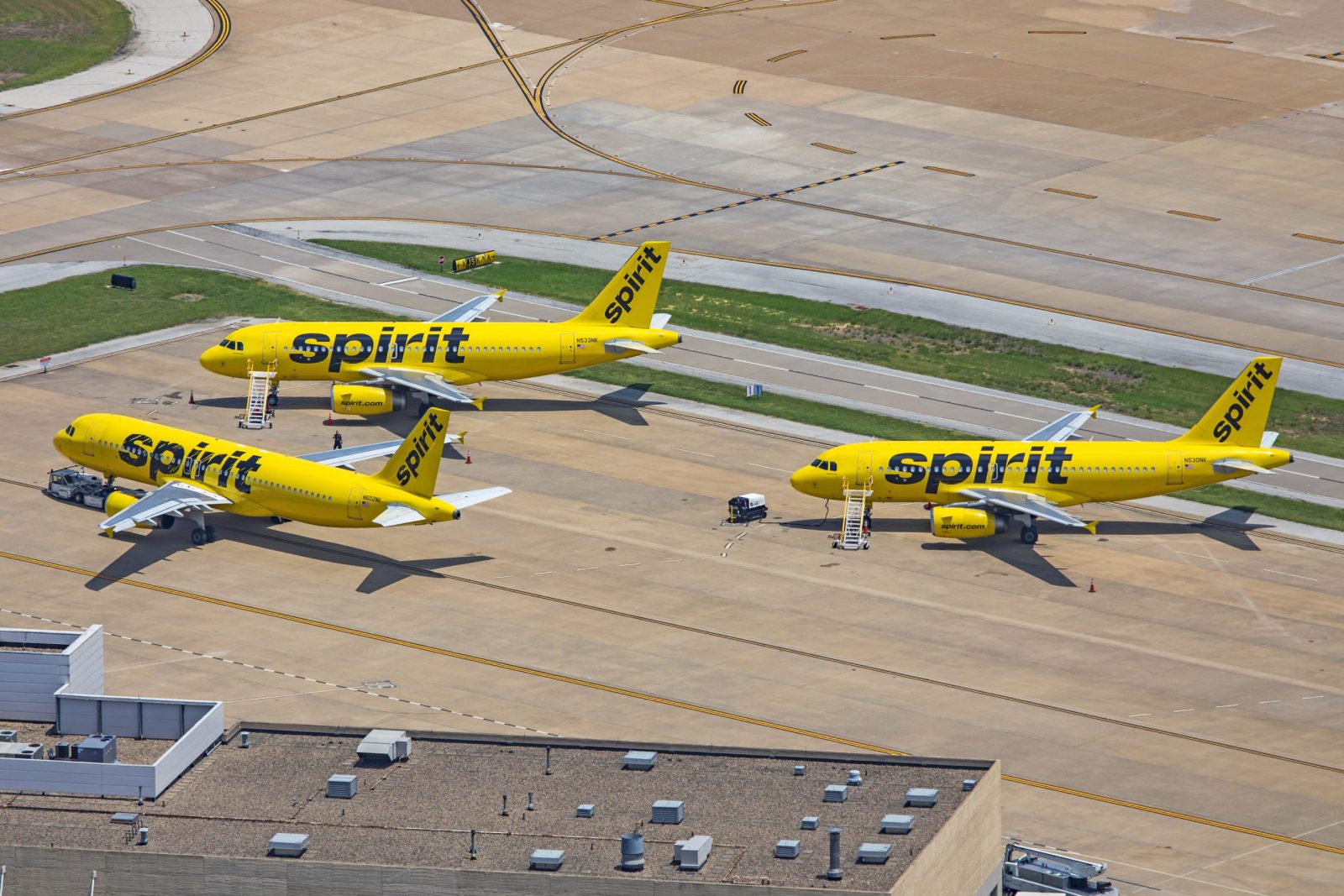
Spirit Airbus jets. (Photo: AirlineGeeks | William Derrickson)
Spirit isn’t doing well. The financially ailing airline never quite recovered from the pandemic, losing millions each quarter.
After losing out on a $3.8 billion merger deal with JetBlue, long-time CEO Ted Christie has been rather vocal on back-to-back earnings calls. During its fourth quarter 2023 call, Christie chastised the airline’s naysayers, calling claims against its continued well-being a “misguided narrative.”
Then, in May, he raised some eyebrows during the first quarter 2024 call, adding that the airline industry is “rigged” against his ultra-low-cost carrier (ULCC).
“Today, nearly all the profits of the entire U.S. airline industry are concentrated in just two companies, while the smaller non-legacy carriers scrambled to restore profitability in what seems ever more like a rigged game,” he said.
The airline business is far from “rigged” against carriers like Spirit. Its competitors – including Allegiant and Frontier – all posted better operating margins last quarter. Perhaps Spirit just isn’t winning anymore at a game it largely pioneered in the U.S.
Instead of blaming his airline’s problems on a “rigged” industry, perhaps Christie should call it spade-to-spade: a perfect storm.
Coming out of the pandemic, Spirit has been battered from all sides, including issues with Pratt & Whitney engines, major air traffic control delays in its home state, and of course betting a bit too hard on not one, but two failed merger attempts.
The Pratt & Whitney Problem
Airlines around the globe continue to experience issues with Pratt & Whitney’s Geared Turbofan Engines (GTF), resulting in the grounding of over 500 relatively new aircraft. According to Cirium Fleet Analyzer data, 34% of A320neo family aircraft powered by the engine type remain out of service as of May 2024.
Spirit operates the most GTF-powered Airbus A320neo series aircraft of any U.S. operator. It is second only to IndiGo in the world with 103 of the type.
Roughly 18% of Spirit’s A320/A321neo fleet remains out of service due to the powerplant issues. Altogether this represents nearly 9% of the carrier’s total fleet with that number expected to balloon up to 20% by the end of this year.
A Spirit A320neo (Photo: AirlineGeeks | William Derrickson)
While Pratt & Whitney is compensating the airline for the out-of-service aircraft, the inability to leverage several brand-new aircraft has severely stunted Spirit’s growth in recent years. A common theme on the company’s earnings calls, Spirit CFO Scott Haralson recently said, “The impact on our business associated with these Pratt engine issues cannot be understated.”
A Not-So-Sunny Sunshine State
Florida has long been home to Spirit, and the airline recently dug its roots deeper with the opening of a new $250 million headquarters campus in Dania Beach. Its largest hub is right up the street in Fort Lauderdale which sees up to 200 peak daily flights.
Orlando – Spirit’s third largest hub – sees nearly 150 peak daily flights, according to data from aviation analytics company Cirium.
Perhaps unsurprisingly, over 160,000 scheduled Spirit flights touched the state of Florida last year, making it the carrier’s largest state for operations. The airline was the fourth-largest carrier in the state by number of flights.
This volume of flight operations coupled with ongoing air traffic control-related challenges at Jacksonville Center create a less-than-stellar situation for the carrier. In 2023, both Fort Lauderdale and Orlando airports were ranked last out of the country’s major airports in terms of on-time arrivals, per Department of Transportation (DOT) data.
The number of on-time arrivals at the two airports hovered in the low 70% range with up to 9% related to ‘National Aviation System (NAS) Delays,’ which the Federal Aviation Administration (FAA) defines as “a broad set of conditions, such as non-extreme weather conditions, airport operations, heavy traffic volume, and air traffic control.”
At both airports, NAS arrival delays outpaced reported air carrier disruptions. For example, in Fort Lauderdale, 46% of last year’s NAS delays were attributed to air traffic volume, exceeding even weather delays by 5%.
All in all, stacking much of an airline’s operations into the Florida basket is a rough spot these days. According to site 123 ATC– which is widely regarded as an accurate source for U.S. air traffic control stats – both Jacksonville and Miami enroute centers have some of the lowest staffing levels in the country.
Irregular operations of any sort drive up costs for an airline over time and the continuing ATC issues in Florida aren’t showing signs of meaningful improvement in the near future. For Spirit, operational unpredictability in its largest operating state complicates the airline’s ability to plan and distribute capacity.
The airline’s Chief Commercial Officer acknowledged these ATC issues during the company’s recent earnings call. “Operationally, from a network design perspective, we are still being impacted by Jacksonville Center ATC issues,” he said.
Klein added that the carrier has added “self-imposed limitations” on growth in Florida to aid operational performance.
Before the JetBlue deal, fellow ULCC Frontier was also looking to merge with Spirit. This $2.2 billion deal ultimately failed because of a lack of shareholder support.
Spirit leadership has reiterated that the airline can stand on its own. But of course, failed mergers don’t come without consequences.
The Florida-based ULCC undoubtedly poured resources into both potential deals, including attorneys, analysts, and much more. Plus, when executives shift their focus to the M&A side, it’s rather easy to lose sight of the day-to-day operations.
To put even more icing on the cake, Spirit’s $460 million pilot agreement – signed in 2022 – was negotiated under the assumption that a merger would go through with JetBlue. Now that this hasn’t happened, both the carrier and the Air Lines Pilots Association (ALPA) will go back to the bargaining table.
A Path Forward
Spirit has faced some turbulence, but it isn’t completely alone. Allegiant and Frontier have also struggled on the financial front in recent quarters.
There are many top-level industry officials – including United CEO Scott Kirby – who say the ULCC model is dead. Coming out of the pandemic, skyrocketing costs – particularly for labor – have diluted the very business model that these airlines spearheaded.
Generally speaking, the ULCC model continues to work well in other parts of the world, take Ryanair or Wizz Air for instance. But the labor premium is generally far lower outside the U.S. and overall costs haven’t spiked nearly as much.
To some degree, the jury is still out on whether consumer interest in the ULCC model has also fallen by the wayside. Either way, Spirit has a lot of work to do in order to reposition itself in a vastly different post-pandemic operating environment.
Ryan founded AirlineGeeks.com in February 2013 and has spent more than a decade covering the airline business. His work has been featured by CNN, WJLA, CNET, and Business Insider. His aviation experience spans airport operations, Part 135 regulatory compliance, and airline crew workforce planning, along with time behind the yoke of a Cessna 172 and interviews with airline executives. Ryan now serves as Group President of Firecrown Media’s Aviation Group. He holds a B.S. in Air Transportation Management and an MBA from Arizona State University and teaches Airline Management at Embry-Riddle Aeronautical University.
An Air Canada CRJ-200 aircraft (Photo: AirlineGeeks | William Derrickson)
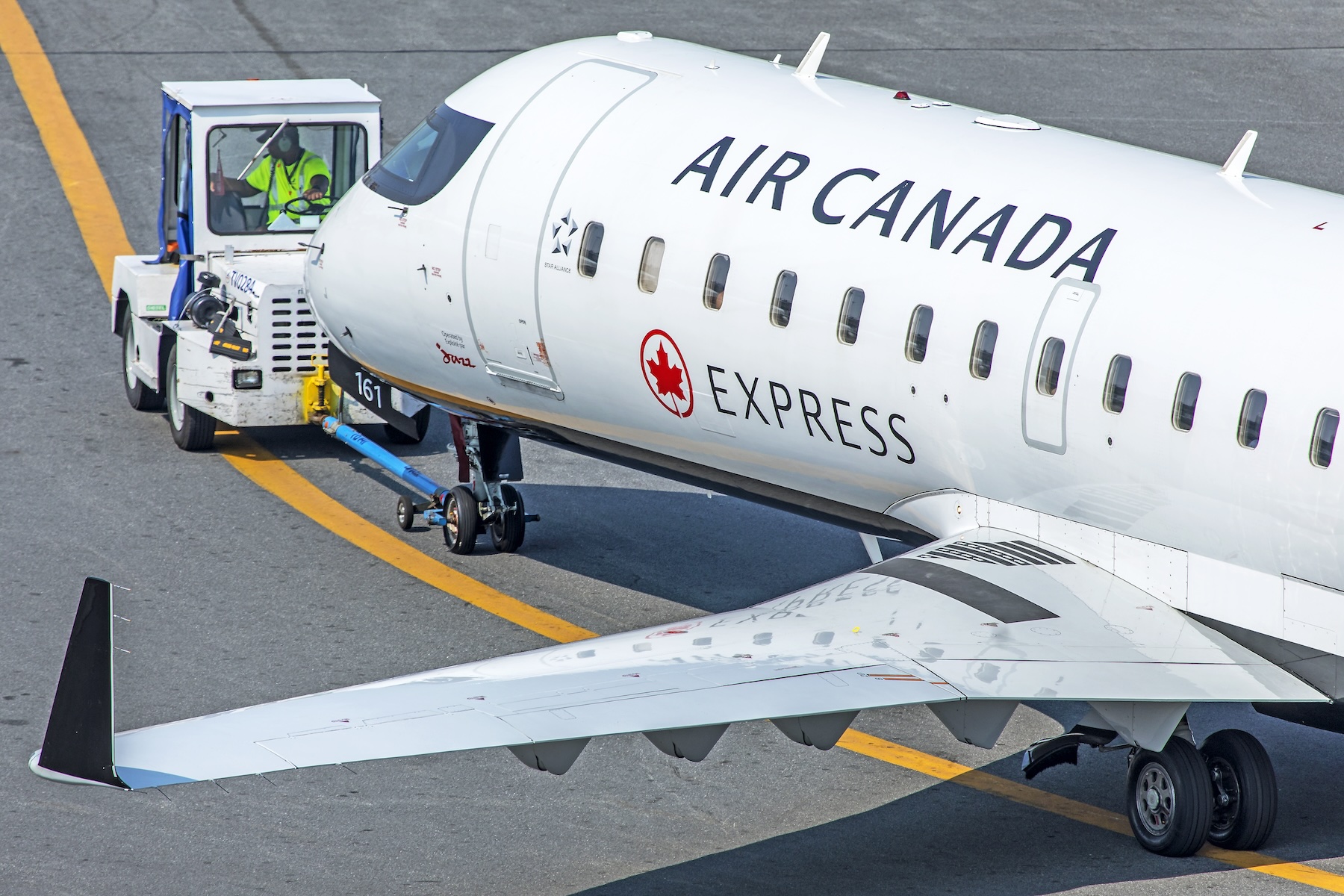
Air Canada has officially retired the last CRJ-200 aircraft from its regional fleet. The final flight of the type, registered as C-FEJA, took place on June 6, 2024 and was operated by regional carrier Jazz Air.
The CRJ-200, which had been a workhorse for the airline’s regional operations, completed a round trip between Toronto Pearson and Montréal before being ferried to storage in Kingman, Ariz. The aircraft, which is nearly 20 years old, was owned by Falko Regional Aircraft and had a single-class configuration with 50 economy seats.
The airline operated a total of 15 CRJ-200s, all of which are now stored in Kingman. The retirement of the CRJ-200 fleet is part of Air Canada’s ongoing fleet modernization efforts, which include the introduction of more efficient and modern aircraft.
The Canadian carrier’s regional fleet is now comprised of 102 aircraft, including 35 CRJ-900s, 39 Q400s, and 25 E175s.
Ryan founded AirlineGeeks.com in February 2013 and has spent more than a decade covering the airline business. His work has been featured by CNN, WJLA, CNET, and Business Insider. His aviation experience spans airport operations, Part 135 regulatory compliance, and airline crew workforce planning, along with time behind the yoke of a Cessna 172 and interviews with airline executives. Ryan now serves as Group President of Firecrown Media’s Aviation Group. He holds a B.S. in Air Transportation Management and an MBA from Arizona State University and teaches Airline Management at Embry-Riddle Aeronautical University.
Royal Air Maroc at Washington Dulles International Airport.
(Photo: J. David Buerk:
www.jdavidbuerk.com)
On Friday, June 7, 2024, Royal Air Maroc (RAM) announced the relaunch of its non-stop transatlantic route connecting Casablanca and São Paulo. Starting from Dec. 7, 2024, this service will operate using a Boeing 787-8 aircraft configured for 274 passengers, including 18 business and 256 economy class seats. Flights will run three times a week.
Departing from Casablanca, the flights will take place on Mondays, Thursdays, and Saturdays at 4:40 p.m. local time, arriving in São Paulo at 10:20 p.m. local time. Return flights will depart from São Paulo on Tuesdays, Fridays, and Sundays at 12:20 a.m. local time, landing in Casablanca at 1:15 p.m. Reservations will be available for sale starting from June 12, 2024.
“We are very happy to resume the Casablanca – São Paulo route, which had been suspended since the health crisis. This resumption is part of our development plan and will strengthen our far-reaching network, marking our return to the continent of Latin America. The route will facilitate travel for tourists and businesspeople from both continents, meeting the expectations of European tourists eager to plan combined trips to Africa and Latin America,” said Hamid Addou, CEO of Royal Air Maroc.
The airline slowed operations in March 2020 due to the COVID-19 health crisis. The company was already flying to Brazil, with service in São Paulo and Rio de Janeiro, which were suspended during the pandemic. Prior to the pandemic, Royal Air Maroc was the third airline with the largest offer of seats to Africa and the only one that provided connectivity in the north of the continent.
According to the press statement, this route will facilitate travel between the two continents, meeting the expectations of European tourists wishing to plan combined trips to Africa and Latin America. It will also contribute to strengthening economic and diplomatic ties between Morocco and Brazil, long-standing partners. The revival of this service is part of Royal Air Maroc’s mobilization to support the Kingdom’s major projects, including the 2030 FIFA World Cup organized by Morocco, Spain and Portugal. Brazilians, who are big football fans, will be able to travel easily between Sao Paulo and the three host countries via the Casablanca hub.
In 2019, Royal Air Maroc transported 129,468 passengers between Morocco and Brazil, with load factors of 76%, according to Brazil’s Agência Nacional de Aviação Civil (ANAC). With this return to Sao Paulo, Royal Air Maroc would bring its destinations in the Americas to five, following Montreal in Canada, Washington, New York, and Miami in the United States.
The oneworld airline will soon welcome 12 new aircraft, including two Dreamliners and ten Boeing 737 MAXs, to support its new routes. This information was revealed by the CEO Abdelhamid Addou in an interview with media website Jeune Afrique on May 11, 2024.
RAM expects the delivery of the 12 aircraft from Boeing between the fourth quarter of this year and March next year, supporting the growth of its fleet and the expansion of its flight network.
The airline plans to spend up to $25 billion to quadruple its fleet, from the current 50 to 200 over the next ten years. The airline flies to 82 destinations in 41 regions around the world, mainly to the largest capitals in Europe, Africa, North America, and the Middle East.
Victor Shalton's love for aviation can be traced to when he was 11-years-old. As a seasoned aviation writer, he takes pride in providing the best aviation coverage around the globe and is passionate about advancing his skills in the aviation space. In addition, he loves travelling, writing, arts and while his speaking engagements have taken him around the world, he is proud to call Nairobi home.