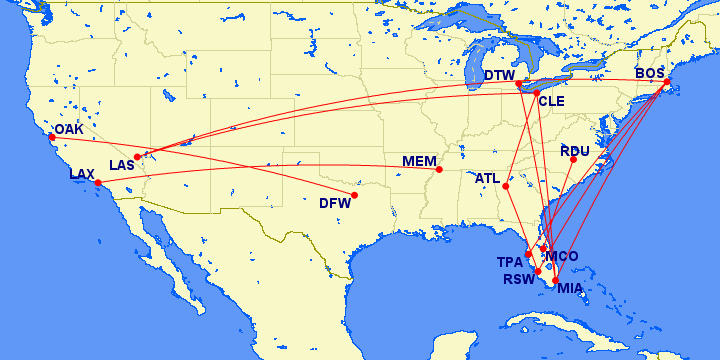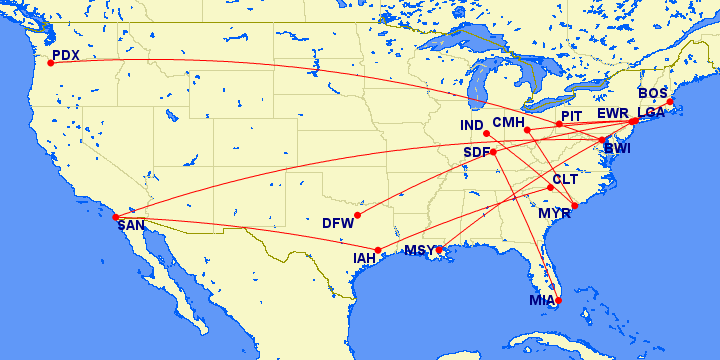










The Fort Worth-based airline is slated to add additional service from its Charlotte hub in the Summer 2024 season, according to a recent schedule update.
An American Airbus A321 landing in Charlotte.
(Photo: AirlineGeeks | William Derrickson)
American is planning to add four new seasonal markets from its Charlotte hub in 2024. According to the latest Cirium Diio schedule update, the Fort Worth-based airline intends to add two brand-new destinations while also resuming two others.
Seasonal Resumptions
The airline is slated to resume its flights from Charlotte to Bozeman, Mont. (BZN) and Jackson Hole, Wyo. (JAC) on June 8, 2024 and June 5, 2024 respectively. Jackson Hole is planned as a daily Airbus A319 service, while Bozeman is Saturday only on a Boeing 737-800.
An American Airlines 737-800 taxing at Boston Logan International Airport. (Photo: AirlineGeeks | William Derrickson)
Also, as part of the schedule update, American is adding two new routes from Charlotte, including Spokane, Wash. (GEG) and Calgary (YYC). Charlotte-Spokane is set to begin on June 5, 2024 with daily service. Charlotte-Calgary will start on June 8, 2024 as a Saturday only flight.
Calgary will be served with a Boeing 737-800 and Spokane with an Airbus A321. American currently operates regular service to Spokane from its Dallas/Fort Worth and Phoenix Sky Harbor hubs. Calgary is served regularly from Dallas/Fort Worth and seasonally from Chicago O’Hare.
At the time of writing, these added flights are loaded until September 2024; the Saturday-only flights to Calgary and Bozeman will end in late August.
Ryan founded AirlineGeeks.com in February 2013 and has spent more than a decade covering the airline business. His work has been featured by CNN, WJLA, CNET, and Business Insider. His aviation experience spans airport operations, Part 135 regulatory compliance, and airline crew workforce planning, along with time behind the yoke of a Cessna 172 and interviews with airline executives. Ryan now serves as Group President of Firecrown Media’s Aviation Group. He holds a B.S. in Air Transportation Management and an MBA from Arizona State University and teaches Airline Management at Embry-Riddle Aeronautical University.
A Qatar Airways-painted Boeing 787-9 Dreamliner on a test flight. (Photo: AirlineGeeks | Katie Bailey)
Qatar Airways is expanding its European network in Summer 2024 as it adds a further German city and returns to a popular Italian destination. The Doha-based airline announced this week that it would begin flights to Hamburg (HAM), Germany from Jul. 1 and recommence service to Venice, Italy from Jun. 12.
Chief Executive Officer of Qatar Airways Group Engr. Badr Mohammed Al-Meer stated: “As this year comes to an end, we are delighted to present our passengers with new and exciting travel opportunities for the year 2024. Starting with our resumption to Venice and an inaugural flight to Hamburg, Qatar Airways and its hub, Hamad International Airport, continues to position itself on the global map as a leading gateway for international travel and connectivity.”
Hamburg becomes the fifth city in Germany to be operated by the carrier joining Berlin, Frankfurt, Munich and Dusseldorf. A Boeing 787-8 Dreamliner will undertake the route from HAM to Doha’s Hamad International Airport (DOH). Qatar Airways anticipates that the northern German city ‘will serve as a gateway to South Africa, Thailand and the Philippines.’
In an interesting scheduling note, the daily flight will depart HAM at different times depending on the day of the week. Monday, Wednesday, Friday and Sunday will have a 3.40 p.m. departure time (10.40 p.m. arrival into DOH) and on Tuesday, Thursday and Saturday at 9.20 a.m. (4.20 p.m. arrival). Flights from DOH will depart at 8.35 a.m. arriving at 2.10 p.m. (Monday, Wednesday, Friday and Sunday) and depart at 2.15 a.m. arriving at 7.50 a.m. (Tuesday, Thursday and Saturday).
The Boeing 787-8 Dreamliner is expected to serve the carrier’s return to Venice with a daily flight departing Venice Marco Polo Airport (VCE) at 4.50 p.m. and arriving in DOH at 11.10 p.m.. The DOH-VCE flight is scheduled to depart at 9.00 a.m. and arrive at 2.20 p.m. Qatar Airways suspended operations to VCE in the early months of the Coronavirus pandemic in 2020 and expects to see considerable interest from the Japanese, Chinese and Australian markets. Badr Mohammed Al-Meer added: “We look forward to seeing our passengers uncover new experiences and resume flying to their favorite destinations.”
The announcement of the Hamburg and Venice flights followed increased frequencies to a number of Qatar Airways’ destinations. Amsterdam, Bangkok, Barcelona, Belgrade and Miami all saw recent increases in flights taking the carrier’s total number of destinations to more than 170. The airline’s hub at Hamad International Airport has also undergone significant expansion with construction continuing to deal with passenger demand. Phase A of the expansion was opened in 2022 and Phase B will see over 95,000 square meters in extension of Concourses D and E, and a new cargo terminal taking the airport’s capacity capability up to 70 million passengers per year.
John has always had a passion for aviation and through a career with Air New Zealand has gained a strong understanding of aviation operations and the strategic nature of the industry. During his career with the airline, John held multiple leadership roles and was involved in projects such as the introduction of both the 777-200 and -300 type aircraft and the development of the IFE for the 777-300. He was also part of a small team who created and published the internal communications magazines for Air New Zealand’s pilots, cabin crew and ground staff balancing a mix of corporate and social content.
John is educated to postgraduate level achieving a masters degree with Distinction in Airline and Airport Management. John has held the positions of course director of an undergraduate commercial pilot training programme at a leading London university. In addition he is contracted as an external instructor for IATA (International Air Transport Association) and has been a member of the Heathrow Community Fund’s ‘Communities for Tomorrow’ panel.
Livery of the Week: British Airways’ Centenary Retro Designs
Unfortunately, with the retirement of the 747 from British Airways' fleet as a result of the COVID-19 pandemic, these liveries became relics themselves.
The line-up of British Airways retro liveries in 2019 (Photo: British Airways)
Editor’s Note: AirlineGeeks is excited to launch our ‘Livery of the Week’ series. Every Friday, a team member will share an airline livery, which can be from the past, present, or even a special scheme. Some airline liveries are works of art. The complexity associated with painting around critical flight components and the added weight requires outside-the-box thinking from designers. The average airliner can cost upwards of $200,000 to repaint, creating a separate aircraft repainting industry as a result.
Have an idea for a livery that we should highlight? Drop us a line.
In 2019, British Airways celebrated its 100th anniversary with a unique and nostalgic tribute, adorning three of its Boeing 747-400s in retro liveries that spanned its broad history. These now-retired aircraft were each emblazoned with a distinct chapter of the airline’s past.
BOAC
This iconic navy blue livery, with its bold cheatline and golden “Speedbird” logo, represented the British Overseas Airways Corporation (BOAC), a predecessor to British Airways. It symbolized a time of glamour, jet-setting, and pioneering spirit when BOAC dominated the skies with its fleet of 747-100s and BAC VC-10 aircraft among others.
British Airways’ BOAC retro livery 747 at Washington Dulles International Airport (Photo: AirlineGeeks | Ben Suskind)
Named after Negus and Negus, which was the design agency that created the livery to combine elements of both BEA and BOAC’s identity, this livery marked a new era for British Airways. The understated red, white, and blue stripes reflected a more unified design concept for the newly combined carrier.
The British Airways Negus 747 seen inflight prior to being grounded as a result of the COVID-19 crisis. (Photo: AirlineGeeks | William Derrickson)
The Landor livery, designed by the renowned San Francisco design firm Landor Associates, ushered in a period of modernization and expansion for British Airways. Its bold red and blue lines, along with the stylized “British Airways” typeface, embodied an early 1980s version of British Airways.
Landor retro livery (Photo: Karam Sodhi)
The British flag carrier updated its livery again in 1997, putting an end to the regular use of the Landor design. The centenary retro livery was placed on G-BNLY.
BEA
While not a 747, the Airbus A319 adorned in the British European Airways (BEA) livery completed the quartet. With its vibrant grey, white, and blue design and stylized BEA logo, it recalls a time of shorter flights within Europe, North Africa, and the Middle East.
British Airways shows off its BEA retro livery on an Airbus A319 (Photo: British Airways)
Similar to BOAC, BEA was folded into British Airways in 1974. It no longer flies, either, as it was placed in storage in November 2022, according to planespotters.net.
These retro liveries weren’t just a nostalgic nod to the past; they were a celebration of British Airways’ century-long evolution and enduring legacy. They captured the imagination of aviation enthusiasts and casual travelers alike.
Ryan founded AirlineGeeks.com in February 2013 and has spent more than a decade covering the airline business. His work has been featured by CNN, WJLA, CNET, and Business Insider. His aviation experience spans airport operations, Part 135 regulatory compliance, and airline crew workforce planning, along with time behind the yoke of a Cessna 172 and interviews with airline executives. Ryan now serves as Group President of Firecrown Media’s Aviation Group. He holds a B.S. in Air Transportation Management and an MBA from Arizona State University and teaches Airline Management at Embry-Riddle Aeronautical University.
A JSX aircraft lands at Austin Bergstrom International Airport. (Photo: Shutterstock)
So-called semi-private carrier JSX is looking at the next evolution of its business strategy. Following a commitment for over 300 hybrid-electric aircraft from three different manufacturers, the Dallas-based carrier is eyeing service to small and underserved communities across the U.S.
According to the Regional Airline Association (RAA), 14 U.S. airports have lost all scheduled commercial air service as of late 2022. JSX’s founder and CEO – Alex Wilcox – believes his company is well-equipped to reconnect some of these small communities, especially with new hybrid-electric aircraft in its fleet.
A rendering of JSX’s ES-30 aircraft (Photo: Heart Aerospace)
Paying the Price
As the cost landscape has increased at major U.S. airlines in a post-pandemic world, small communities have been left to pay the price. Airlines have been forced to operate higher-density aircraft to recoup, but smaller markets often lack the demand to support larger jets.
“The side effect that people are now realizing is that big airplanes require a big market, and the more big airplanes you have, the fewer small markets you can fly to,” Wilcox told AirlineGeeks during a phone interview.
That’s where 20 to 50-seat regional jets like the Beechcraft 1900 and the Bombardier CRJ-200 come into the picture. As is often the case for regional aircraft, short stage lengths coupled with fewer seats lead to lower Available Seat Miles (ASMs). Therefore, higher unit costs in the numerator — otherwise known as Cost per Available Seat Mile (CASM) – create a situation where the smaller aircraft become less commercially viable.
“And so the Beech 1900 era is over. The Saab 340 era is over…This is definitely the era of the [737] MAX and the [A320] NEO,” he added. “And those are great airplanes, and they do certain things really efficiently. But, they are not airplanes that you can bring to a community like Del Rio, Texas three times, two times, or even one time a day. There’s 40,000 people that live there. They’ve got to travel like everybody else does, too…”
Joining a list of 13 other airports, Del Rio lost all commercial air service as of early 2023 after American Airlines ended its service from Dallas/Fort Worth. The Department of Transportation (DOT) awarded $1.2 million to Del Rio as part of the Small Community Air Service Development Program.
Uniquely Positioned
JSX is a part 135 and part 380 carrier, or more simply put, a ‘public charter’ operator. In essence, this regulatory classification allows it to operate in smaller airports and FBOs, lessen security screening requirements, and overall be subject to fewer restrictions when compared to part 121 air carriers. The carrier has built a business model around this classification as a self-described hop-on jet service with the perks of private air travel.
Although JSX currently operates a fleet of 30-seat Embraer aircraft to mostly premium-heavy markets, Wilcox sees some new opportunities with hybrid-electric aircraft.
“These airplanes are custom built for 9, 19, and 30 seats, and they’ll be much more efficient…than the planes we’re flying today. And that’s going to lower costs, and that’s going to make more of those [airports] available,” Wilcox said while referring to small community airports.
Onboard the recently refurbished JSX E-145. (Photo: AirlineGeeks: Mateen Kontoravdis)
He notes that JSX’s experience selling tickets puts it ahead of other regional carriers. “Any of the so-called regionals or commuter airlines, anyone that’s flying 50-seat airplanes, does not sell tickets…with very few exceptions. And we’re one of the exceptions.”
During the interview, Wilcox also emphasized JSX’s existing presence in some smaller communities, including Taos, N.M. and Lajitas in West Texas, However, both of those examples are premium leisure markets, which he notes require a “well-heeled” client given JSX’s aircraft configuration.
Subsidized Air Service
In the U.S., many small communities rely on the federal Essential Air Service (EAS) program to subsidize flights where it otherwise would not be commercially possible. Looking to the future, JSX is keeping an open mind.
When asked if an EAS contract may be in the cards for JSX, Wilcox said, “I wouldn’t rule it out. It’s not our main business. There are others that do a good job of that. But I would never rule it out.”
“Hopefully when these airplanes come to pass, and we are talking many years before they’re really in production in significant numbers, we won’t need subsidies anymore for these markets, because the airplanes will be so efficient, and the business will be so efficient that government subsidies are not required anymore,” he added.
Ryan founded AirlineGeeks.com in February 2013 and has spent more than a decade covering the airline business. His work has been featured by CNN, WJLA, CNET, and Business Insider. His aviation experience spans airport operations, Part 135 regulatory compliance, and airline crew workforce planning, along with time behind the yoke of a Cessna 172 and interviews with airline executives. Ryan now serves as Group President of Firecrown Media’s Aviation Group. He holds a B.S. in Air Transportation Management and an MBA from Arizona State University and teaches Airline Management at Embry-Riddle Aeronautical University.
An Air France 787-9 begins its takeoff roll at Paine Field. (Photo: AirlineGeeks | Katie Zera)
Air France is adding seven new destinations to its Summer 2024 schedule, including three new cities: Verona, Narvik, and Kalamata. In addition, the airline will also resume service to Minneapolis/St. Paul and extend service to Raleigh-Durham, Abu Dhabi, and Tromsø. All flights will be operated from the carrier’s Paris Charles de Gaulle (CDG) hub.
Long-Haul Network
The airline paused its seasonal flight to Minneapolis in Summer 2023, but is set to resume the route on May 13, 2024 with a Boeing 787-9 Dreamliner. Delta also operates this route.
Air France’s flights to Raleigh-Durham were previously operated only in winter, and the airline will now operate the flights year-round. The carrier says it will offer up to seven weekly flights between the two cities on an Airbus A350-900.
Abu Dhabi will see a similar extension into Summer 2024 with daily A350 service.
Short-Haul Network
Air France is adding three brand-new destinations to its route map, including:
Verona with up to three flights per week starting on April 2, 2024
Narvik with Saturday-only service from June 15 to Aug. 31, 2024
Kalamata with Saturday-only service from July 6 to Aug. 31, 2024
The airline’s flights to Tromsø in Norway will be extended through the summer. Air France will operate up to two weekly flights from Paris-CDG on an A319.
Ryan founded AirlineGeeks.com in February 2013 and has spent more than a decade covering the airline business. His work has been featured by CNN, WJLA, CNET, and Business Insider. His aviation experience spans airport operations, Part 135 regulatory compliance, and airline crew workforce planning, along with time behind the yoke of a Cessna 172 and interviews with airline executives. Ryan now serves as Group President of Firecrown Media’s Aviation Group. He holds a B.S. in Air Transportation Management and an MBA from Arizona State University and teaches Airline Management at Embry-Riddle Aeronautical University.
The major three carriers operate diverse fleet types consisting of Airbus and Boeing aircraft from narrow-body short-haul to wide-body long-haul jets. Southwest, on the other hand, operates a singular fleet type, the Boeing 737. In 1971, the Dallas-based carrier began operating solely within the confines of Texas between Dallas, Houston, and San Antonio. The carrier started operations with Boeing 737-200 aircraft and has operated the type for over 51 years. Southwest’s current fleet consists of 823 aircraft spread across Boeing 737-700, 737-800, and 737 MAX 8 aircraft.
Southwest 737 aircraft at SFO (Photo: AirlineGeeks | William Derrickson)
The pilot group TA has been long awaited by the carrier’s labor group. The $12 billion deal includes quality-of-life improvements across the board for the pilot group. Notably, pay rates will be bumped by 29% initially and 50% over the course of the proposed contract.
Pilot Pay
Pilots at the three major carriers and Alaska are paid hourly rates based on the hours they fly. Minimum monthly values vary between carriers, however, are typically around 70-75 hours. Southwest pays pilots based on a trip-for-pay concept. SWAPA estimates that a conversion rate of 1.149 trip-for-pay per hour gives a good benchmark to compare monthly earnings between airlines. The minimum guarantee for pilots at Southwest is 89 trips-for-pay per month. Using the 1.149 conversion, this equates to 77.45 hours per month, slightly higher than the other carriers.
Based on information gathered by Aero Crew News, first-year first officer (FO) pay will be higher than Alaska Airlines and the three major carriers, at a proposed $116.41. However, year two at $161.32 will be a couple of dollars short of what Alaska, American, Delta, and United currently pay their first officers on their respective 737 fleets.
At the top range of the FO scale, Southwest pilots will be paid $222.08 per hour, between $6 to $13 short per hour of their counterparts at the other major carriers. The highest top-of-scale rate goes to Alaska at $235.21 per hour. United is currently paying captains the most per hour to operate 737 aircraft at $341.87 per hour. Southwest will pay captains on the new contract at a top-of-scale rate of $317.25 per hour.
Each carrier has different formulas for holiday pay, overtime pay, and other overrides. These factors can increase pay for the pilot to an amount higher than what is seen at face value on scales. 401k contributions tie into this as well. The major carriers increased the 401k direct contribution for pilots, meaning the company contributes a percentage of what the pilot made without the pilot funding their respective 401k.
The three major carriers will contribute 17% directly across the board. Alaska is currently contributing 15.5% directly and Southwest 15% currently. However, the new agreement is suspected to have an increase in 401k contributions.
Qaulity-of-Life
Pay is focused on heavily when looking at pilot contracts, however, quality-of-life improvements are just as important. Southwest pilots, reserves or line holders, are required to work 15 days a month, any additional days are up to the individual pilot based on Aero Crew News information. The other carriers allow for a minimum of 12 days off per month for reservists and line holders.
Hotel language for Southwest has also been updated, with long-stay hotels being in an area downtown or by a beach for any longer than 14 hours 45 minutes. Shorter than 13 will be by the airport. This is on par with other carriers, except Delta having pilots stay downtown on overnights longer than 12 hours.
The agreement for Southwest’s pilot group has many more updated provisions that haven’t been covered in this article as well. Many address quality-of-life improvements which will benefit the pilot group outside of the heavily focused on pay scale comparisons. The over 11,000-strong labor group will vote on the TA within the next month, accepting or rejecting it. The proposed TA will go into effect if passed and remain that way until its amendable date in 2028.
Editor’s Note: This article was corrected on Dec. 24, 2023 at 3:30 p.m. ET to better reflect that Southwest pilots are not paid by the hour.
AirlineGeeks.com was founded in February 2013 as a one-person blog in Washington D.C. Since then, we’ve grown to have 25+ active team members scattered across the globe. We are all here for the same reason: we love deep-diving into the fascinating realm of the airline industry.
Despite record hiring at some low-cost airlines, many have turned into a leaky bucket as pilots leave for larger airlines after just a few months on the job.
A Southwest 737-800 takes off from Los Angeles. (Photo: AirlineGeeks | William Derrickson)
In the latest iteration of the pilot shortage saga, some U.S. low-cost carriers (LCCs) are facing additional headwinds. Most notable among them is Southwest, which – according to the company’s COO Andrew Watterson — is seeing an increase in pilots leaving for large airlines after just a few months on the job.
According to a Bloomberg report published on Wednesday, Watterson called this increasing phenomenon “resume washing.” Some pilots from regional airlines use the Dallas-based carrier as a stepping stone for a longer-term career path at American, Delta or United.
“So they use us as a premeditated way station. They come to Southwest, get hired, trained, spend six months and then they flip their resume and apply somewhere else,” says Watterson.
As the fourth largest U.S. airline, Southwest operates a fleet of only the Boeing 737 series aircraft, which leaves limited options for pilots looking to upgrade to higher-paying widebody positions. The top of the pay scale for a Southwest 737 captain is $245 per flight, while a Delta A350 captain can reach up to $354 on an hourly basis per Airline Pilot Careers.
Southwest’s pilot union – SWAPA – finalized a tentative agreement (TA) on Wednesday, which is set to be voted on by pilots in the coming days. If approved, the new contract is set to include higher pay, but neither the union nor the company publicly specified a number.
The airline’s CEO Bob Jordan confirmed to Bloomberg that it has seen an increase in the pilot attrition rate, especially among younger first officers who have a lower position on the seniority list.
A Wide-Ranging Issue
While this might be a newer issue for Southwest, it can also be by design for other low-cost airlines, including ultra-low-cost carriers (ULCC) Spirit, Frontier and Avelo. All three airlines have agreements with major flight schools such as ATP.
Flight school students who opt for these programs can dodge the more traditional regional airline route for the right seat on an Airbus or Boeing jet. Pilots can then build hours at these LCCs for a step up into a career at a larger airline.
A Spirit A320 in New York (Photo: AirlineGeeks | William Derrickson)
Attrition has more than doubled at Spirit and Frontier along with Southwest, according to the report. In November 2023, nearly 42% of pilots who started less than a year earlier left these airlines.
Record Hiring
While Southwest may be struggling to retain some of its first officers, it is still hiring in record volumes. So far in 2023, the airline has hired 1,796 pilots, up nearly 58% from last year, according to data from FAPA.
On the other hand, Spirit has halted pilot hiring altogether as it navigates financial woes. Frontier has steadily hired 480 new aviators so far this year while opening a handful of new crew bases.
Editor’s Note: This article was updated on Friday, Dec. 22, 2023 at 1:14 p.m. ET to accurately reflect that Southwest pilots are paid by flight segment, not hourly.
Ryan founded AirlineGeeks.com in February 2013 and has spent more than a decade covering the airline business. His work has been featured by CNN, WJLA, CNET, and Business Insider. His aviation experience spans airport operations, Part 135 regulatory compliance, and airline crew workforce planning, along with time behind the yoke of a Cessna 172 and interviews with airline executives. Ryan now serves as Group President of Firecrown Media’s Aviation Group. He holds a B.S. in Air Transportation Management and an MBA from Arizona State University and teaches Airline Management at Embry-Riddle Aeronautical University.
A Southwest aircraft taxis in Austin. (Photo: Shutterstock | Ceri Breeze)
The Federal Aviation Administration (FAA) has announced the formation of a three-member expert panel to address air traffic controller fatigue following a series of near misses across the U.S. airspace system. According to the agency, the panel will analyze the latest scientific research on sleep and fatigue, focusing on its impact on controllers and potential mitigation strategies.
Chaired by Mark Rosekind, formerly of the National Transportation Safety Board (NTSB), the panel includes Dr. Charles Czeisler of Brigham and Women’s Hospital and Dr. Erin Flynn-Evans of NASA’s Ames Research Center Fatigue Countermeasures Laboratory. The team will begin its work in January, reviewing existing research on controller fatigue before providing a final report to the FAA within six weeks.
The panel is likely to focus on examining current controller work schedules and shift durations through the lens of fatigue science, assessing the potential of advanced fatigue monitoring and mitigation tools in ATC facilities, and evaluating enhanced training programs for controllers to promote fatigue awareness and self-management.
In 2014, the FAA revised its regulations on flight duty limitations, codified under 14 CFR Part 117. This regulation provides more stringent requirements around fatigue management and rest requirements for flight crew members. However, limited regulations are in place for air traffic controllers and other industry workgroups.
Ryan founded AirlineGeeks.com in February 2013 and has spent more than a decade covering the airline business. His work has been featured by CNN, WJLA, CNET, and Business Insider. His aviation experience spans airport operations, Part 135 regulatory compliance, and airline crew workforce planning, along with time behind the yoke of a Cessna 172 and interviews with airline executives. Ryan now serves as Group President of Firecrown Media’s Aviation Group. He holds a B.S. in Air Transportation Management and an MBA from Arizona State University and teaches Airline Management at Embry-Riddle Aeronautical University.
Travel industry data platform OAG has revealed 2023's busiest airports and routes, showing an uneven post-pandemic recovery slope across different regions.
According to OAG, a leading data platform for the global travel industry. U.S. airports once again dominated the world’s busiest airports list in 2023; the figures include domestic and international flights, based on seat capacity. After over three years of the pandemic, some international hubs are also not out of the woods.
Atlanta Hartsfield-Jackson International Airport is again crowned the busiest global airport with 61 million seats. The capacity at Atlanta has increased by 12% year-over-year and is just 3% below 2019. Followed closely after is Dubai International Airport as the second with 57 million seats. The capacity in Dubai has increased by 5% compared to 2019.
Japan’s Tokyo International (Haneda) Airport is in third place with 52 million seats. London’s Heathrow Airport is fourth with 49 million seats and Dallas/Fort Worth International Airport ranked fifth with 48 million.
Denver and Los Angeles International Airport are ranked 6th and 8th respectively. Dubai and Dallas/Fort Worth have surpassed 2019 levels in the top five list.
Busiest International Hubs
In addition, the data shows New York’s JFK Airport offers more international connections than any other U.S. airport.
OAG also unveils the busiest international airports, which are calculated using international airline capacity only.
Dubai International Airport (DXB) is crowned the busiest international airport with 57 million seats in 2023. Dubai was also the busiest international airport in 2022 and 2019. London Heathrow Airport is the second busiest with 47 million seats. Amsterdam Schiphol Airport is the third with 37.2 million seats. Paris Charles de Gaulle Airport is the fourth with 36.7 million seats and Singapore Changi Airport is 5th place with 36 million seats.
Dubai is the only airport that has surpassed 2019 levels in the top five busiest international airports list.
A flydubai Boeing 737 departs from Dubai International (Photo: AirlineGeeks | Hisham Qadri)
Meanwhile, OAG data reveals the busiest European airports, which are using the total airlines’ domestic and international capacity in Western Europe. European airports are left behind after the pandemic as Munich Airport has dropped by 26% in capacity compared to 2019.
London Heathrow Airport is ranked number one with 49 million seats followed by Istanbul Airport with 46 million. Paris Charles de Gaulle Airport ranked 3rd. Istanbul is the only airport to see an increase in the top 10 list, compared to 2019. Amsterdam and Munich are ranked 4th and 5th respectively.
Busiest Route in 2023
Honolulu – Kahului is the U.S.’s busiest domestic flight with 3.6 million seats, only 3% more than Atlanta – Orlando in second place with 3.5 million. Las Vegas – Los Angeles ranked third with 3.49 million seats.
Los Angeles to San Francisco was the busiest route in the U.S. but in 6th place with 3.1 million in 2023.
Kuala Lumpur – Singapore was the busiest international route in 2023 with 4.9 million seats, and Cairo – Jeddah is in second place with 4.8 million seats. New York’s JFK Airport to London Heathrow is ranked 8th, the only international route originating in the U.S. featured in the Top 10 list.
Jeju International – Seoul Gimpo Airport is the busiest global domestic flight route with over 13 million seats. Sapporo New Chitose – Tokyo Haneda became the second with almost 12 million.
OAG also reveals Beijing Capital Airport to Shanghai Hongqiao is the busiest domestic airline route in China with 8 million seats.
A Southwest 737 MAX 8 in Las Vegas. (Photo: AirlineGeeks | William Derrickson)
Southwest and its pilots – represented by the Southwest Airlines Pilots Association (SWAPA) – have reached an agreement-in-principle (AIP) on a new contract. The union announced the AIP on Tuesday, which is one of the first steps in inking a new collective bargaining agreement (CBA).
The AIP will now head to the union’s 25-member board of directors where – if approved – will become a tentative agreement (TA) and be voted on by the carrier’s 11,000 pilots. Southwest is the last of the major U.S. carriers to finalize a new pilot contract. The airline and its pilots have been at the bargaining table for nearly four years.
“This AIP comes after three-and-a-half long years of negotiating. We are finally at a place where we think the value of our pilots and their productivity is being realized,” said SWAPA President Captain Casey Murray in a press release. “Our pilots and Southwest Airlines customers deserve security and confidence in our future and we believe that this contract achieves that.”
While the union did not provide details on the new agreement, aviation careers news outlet Aero Crew News says pay rates would be equivalent to Delta 757/767 first officer pay, and Delta 737 captain pay plus one percent, citing internal sources. These rates would equate to approximately $243 and $341 at the top of the pay scales respectively.
“We are pleased to reach an Agreement in Principle with the Southwest Airlines Pilots Association for Southwest’s nearly 11,000 Pilots. The AIP is a key milestone in the process, and we look forward to the next steps,” a Southwest spokesperson said in a statement.
In June, SWAPA petitioned the National Mediation Board (NMB) to be released from the federal mediation process. However, this request was later denied.
Southwest’s flight attendants – who are represented by the Transport Workers Union – are also voting on a new contract, which would see 36% pay increases over the tentative agreement’s term. The nearly 19,000 flight attendants are set to revote on a tentative agreement following hiccups with the voting system.
Ryan founded AirlineGeeks.com in February 2013 and has spent more than a decade covering the airline business. His work has been featured by CNN, WJLA, CNET, and Business Insider. His aviation experience spans airport operations, Part 135 regulatory compliance, and airline crew workforce planning, along with time behind the yoke of a Cessna 172 and interviews with airline executives. Ryan now serves as Group President of Firecrown Media’s Aviation Group. He holds a B.S. in Air Transportation Management and an MBA from Arizona State University and teaches Airline Management at Embry-Riddle Aeronautical University.