Thai Airways Aims to Bolster Its Services to India
Thai Airways continues to spread its wings after the pandemic. After announcing the increase in flight frequency to China, the flag carrier is aiming to expand its network in India.
A Thai Airways Airbus A380 taxis at London's Heathrow Airport.
(Photo: AirlineGeeks | William Derrickson)
Thai Airways continues to spread its wings after the pandemic. After announcing the increase in flight frequency to China, the flag carrier is aiming to expand its network in India.
Thailand is determined to lure more visitors from India. Thai Prime Minister Srettha Thavisin would negotiate with India to increase flight services between the two countries. Thai Airways will stand to benefit from the new flight operations.
“There aren’t that many incoming flights from India yet due to internal politics,” the Thai Prime Minister said.
Thai Airways and its subsidiary, Thai Smile, currently operate flights to the Indian cities of Delhi, Mumbai and Kolkata.
Thailand Increasing Visa-Free Travel Options
Meanwhile, Thailand has announced that travelers from China and Kazakhstan would be granted a visa-free to the country during the coming peak season. In response to the visa waiver program for Chinese tourists, Thai Airways is set to scale up its weekly flight to China from 25 flights to 35, starting on December 1. The new program is paving the way for the travel boom as both countries’ citizens don’t need to apply for a visa to Thailand between September 25 and February 29.
In addition, Thailand’s Chiang Mai Airport, a travel hot spot, goes further in providing 24-hour operation from November 1.
After years of keeping its head above water, Thai Airways is finally in the black in 2023. It recorded a net profit of 2.2 billion baht ($61.8 million) in the second quarter of the year. Compared to the same time last year, the airline recorded a net loss of 3 billion baht.
Expand Its Fleet
In spite of the flag carrier being in the midst of bankruptcy-protected debt restructuring. Thai is considering expanding its fleet to meet travel demand in the future. According to Reuters, deals are in the pipeline as the airline is holding talks with Boeing and Airbus on a potential order of more than 90 aircraft.
The potential deal includes 15 narrow-body aircraft and up to 80 wide-bodies and it could be one of the largest orders from South Asia airlines in recent years. The airline said that it is still at the “very early stage.” Both aircraft manufacturers didn’t provide any information on the orders.
Earlier this year, Chai Eamsiri, the chief executive, revealed that the ambition of enhancing its fleet by acquiring 30 widebody aircraft and a number of narrowbodies by the end of the year.
Currently, Thai and its subsidiaries have a total of 67 active aircraft, consisting of 20 narrowbody aircraft and 47 widebody aircraft. According to its website, Thai owns a wide variety of aircraft, ranging from Airbus A350-900s, A320-200s to Boeing 777-300s and 787 Dreamliners.
An Eastern Airlines 767 in the new livery. (Photo: Eastern Airlines)
Wayne, Penn.-based Eastern Airlines is looking to add service between New York (JFK) and Wuhan, China, per a recent Department of Transportation (DOT) filing. This comes after the low-cost airline scrapped plans for a JFK to Shanghai (PVG) flight following a lengthy approval process, according to Ishrion Aviation on Twitter. The carrier had also applied to fly between JFK and Jinan, China (TNA) in 2019, but never operated the route.
As part of the Tuesday filing, Eastern is applying to fly from JFK to Wuhan via Anchorage. If approved, the service is scheduled to start in January 2024. It is unclear whether the carrier will sell seats on the JFK-Anchorage segment.
“Granting Eastern the requested authority will greatly benefit the public interest. Eastern will increase the availability of “adequate, economic, efficient, and low-priced services” for both domestic and foreign travelers on a route currently served by no U.S. Carriers,” the filing states. “Eastern’s new service would also provide U.S. government employees and contractors service to Wuhan on a U.S. carrier, which currently does not exist.”
Previous Service to Wuhan
China Southern operated flights between San Francisco and Wuhan prior to the COVID-19 pandemic in early 2020, according to Cirium data. The Chinese carrier has also applied to resume this service, which would start on Nov. 4, 2023.
Eastern’s proposed service would be a first as no U.S. airline has operated regularly scheduled service to Wuhan. Seen around the world as an epicenter of the COVID-19 pandemic in 2020, Wuhan is starting to see more air service after being largely shuttered. According to Cirium data, Wuhan’s main airport is expected to see a 17% increase in flight operations between October 2019 and 2023.
AirlineGeeks.com was founded in February 2013 as a one-person blog in Washington D.C. Since then, we’ve grown to have 25+ active team members scattered across the globe. We are all here for the same reason: we love deep-diving into the fascinating realm of the airline industry.
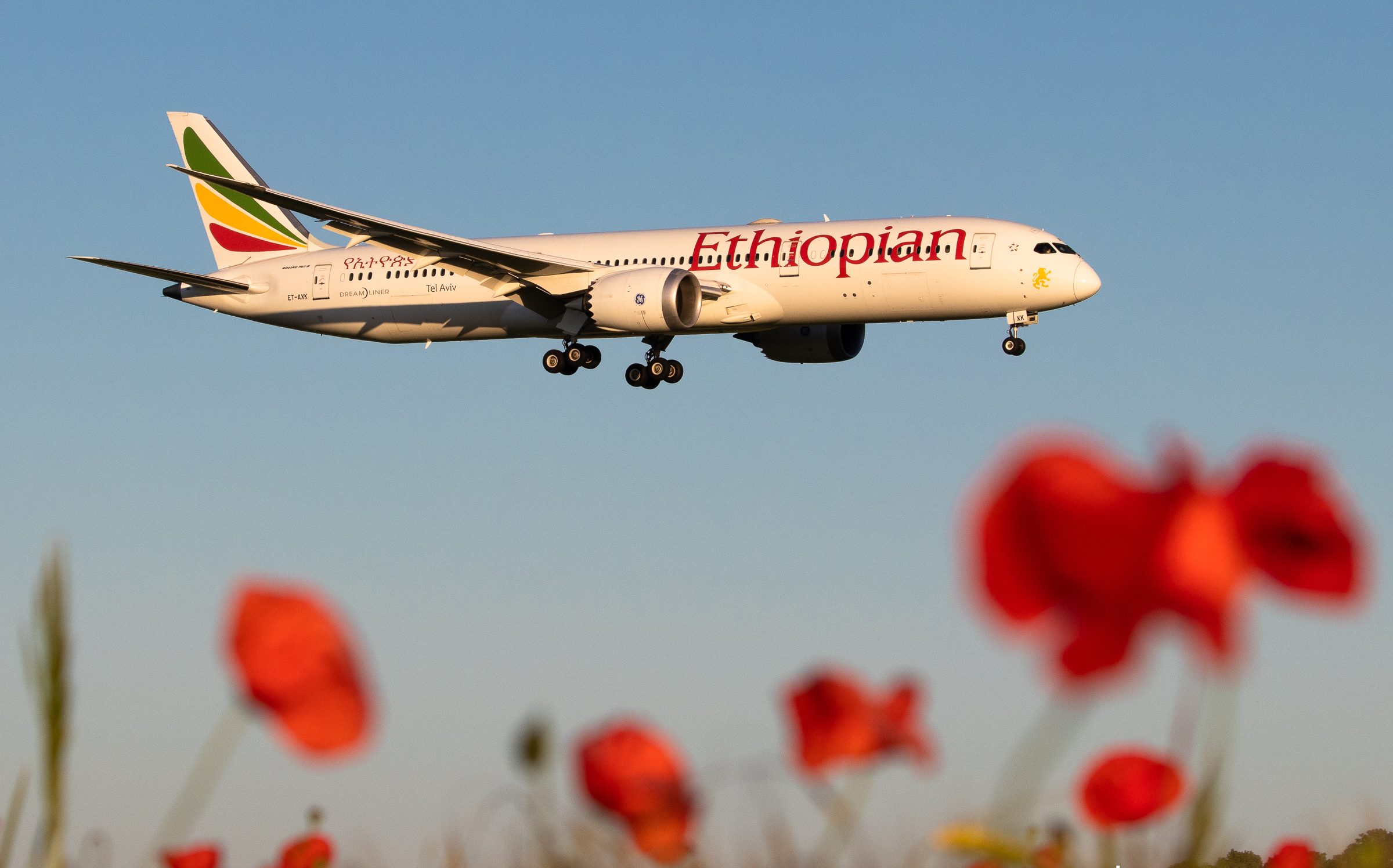
An Ethiopian Airlines Boeing 787-9 prepares to land in Brussels. (Photo: AirlineGeeks | Fabian Behr)
Boeing’s Commercial Market Outlook (CMO) for the years 2023–2042 has unveiled a fascinating aviation landscape in Africa. The report forecasts an extraordinary surge in intra-African passenger traffic, with expectations of quadrupling over the next two decades. This substantial growth, among the highest globally, will necessitate the addition of a remarkable 1,025 new aircraft to Africa’s aviation fleet.
Africa’s air traffic growth, as projected in Boeing’s CMO, stands at an impressive 7.4%. This rate not only surpasses the global average of 6.1% but also ranks as the third-highest growth rate in the world. Randy Heisey, Boeing’s Managing Director of Commercial Marketing for Middle East and Africa, expressed confidence in African carriers’ ability to support this extraordinary growth. He highlighted that the average aircraft size and seating capacity for African fleets are set to increase, with a particular emphasis on single-aisle planes like the Boeing 737 MAX.
The resurgence of African aviation traffic in 2023 can be attributed to pent-up demand and economic growth, driven in part by higher global commodity prices. Currently, airline flights in Africa have surged to levels 8% above those seen before the pandemic. Looking ahead, the long-term demand for air travel in Africa will continue to be fueled by an annual economic growth rate of 3.4%, urbanization rates, and the growing middle-class population.
Moreover, initiatives such as the African Continental Free Trade Area (ACFTA) and Single African Air Transport Market (SAATM) are poised to further stimulate trade and enhance intra-regional connectivity. Notable projections from the 2023 Africa CMO include:
1. Europe remaining the most prominent origin and destination for travelers to and from Africa, leading to a 4.5% annual fleet growth for airlines in the region.
2. Single-aisle jets dominating commercial deliveries, with 730 new planes primarily catering to domestic and intra-regional demand.
3. African carriers estimated to require 275 new widebody aircraft, encompassing passenger and cargo models, to facilitate long-haul routes and air freight growth.
4. Approximately 90% of African jet deliveries are expected to be fuel-efficient models like the 737 MAX, 777X, and 787 Dreamliner.
5. A surge in demand for aviation personnel, with a need for 69,000 new professionals, including 26,000 cabin crew members; 22,000 technicians; and 21,000 pilots.
6. Commercial services opportunities such as supply chain management, manufacturing, repair, and overhaul being valued at a remarkable $105 billion.
As the African aviation sector continues to soar, these projections from Boeing’s CMO shed light on the region’s promising future and its potential to become a prominent player on the global aviation stage. Stay tuned to airlinegeeks.com for more insights into the dynamic world of aviation.
Victor Shalton's love for aviation can be traced to when he was 11-years-old. As a seasoned aviation writer, he takes pride in providing the best aviation coverage around the globe and is passionate about advancing his skills in the aviation space. In addition, he loves travelling, writing, arts and while his speaking engagements have taken him around the world, he is proud to call Nairobi home.
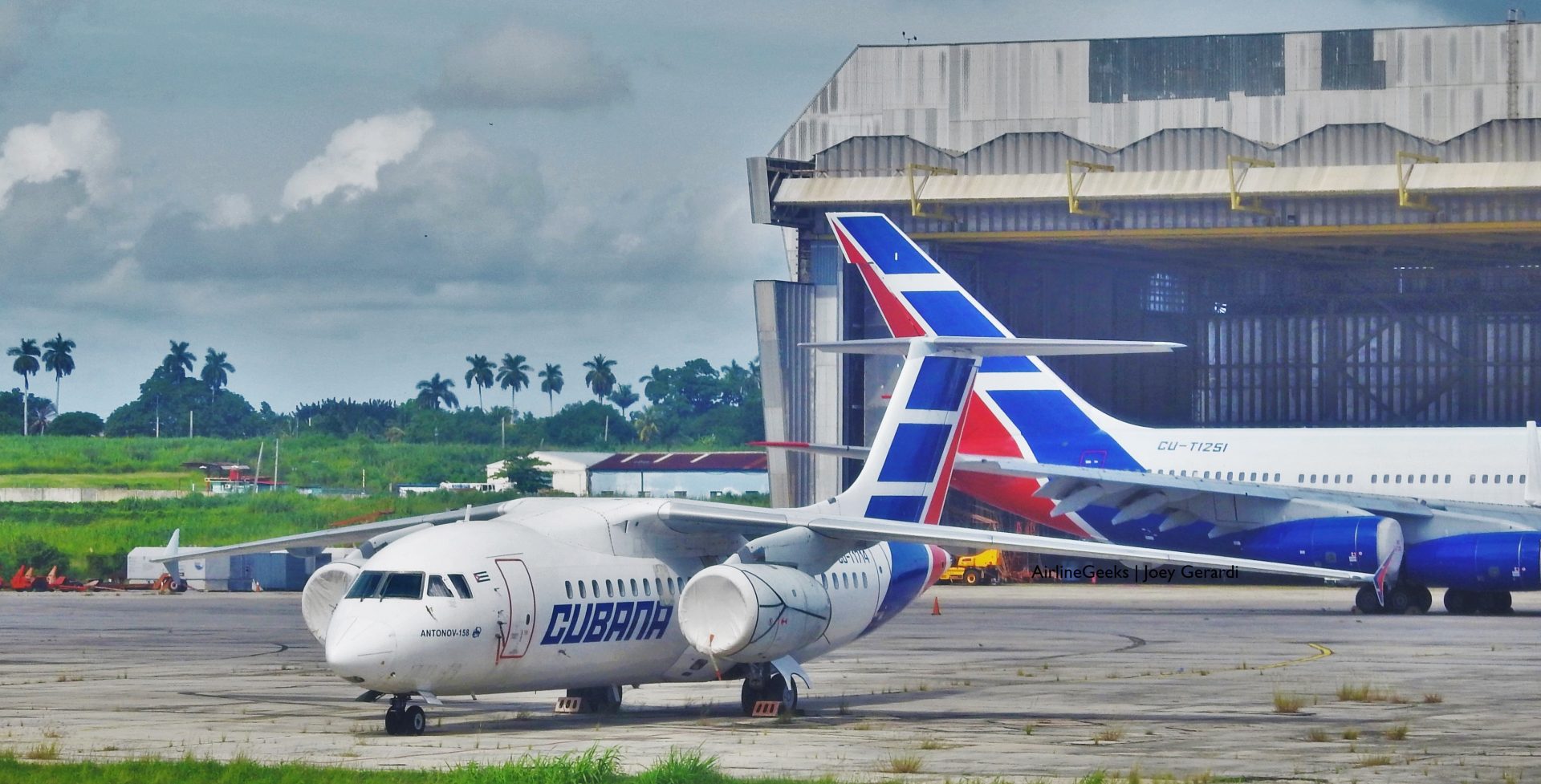
A Cubana Tupolev Tu204 parked in Havana (Photo: AirlineGeeks | Joey Gerardi)
Cubana, the Havana-based flag carrier of Cuba, has always been a bit of an enigma. It has quite a lengthy history as the carrier nears its 94th year of service on Oct. 8, 2023, yet most of its fleet is parked except for a single aircraft that flies domestically within the country.
A Tupolev TU204, which carriers the registration CU-T1702, has returned to its home country of Cuba after being flown from Ulyanovsk, Russia where it has been undergoing heavy maintenance since July of 2019, to Reykjavik, Iceland, and then to Gander, Canada on Sept. 17, 2023. Then on Monday, it took a flight from Gander to Havana where it landed at 4:53 p.m. local time.
As far as we are aware, this is the first actual Cubana aircraft that has been flown at all, except its single ATR-72, since one of its IL96s left for Russia back in August of 2022. All Cubana flights, except for some domestic flights on the ATR, have been accomplished using leased aircraft. Even the airline’s main international routes, from Cuba to Buenos Aries and Madrid, have been flown on leased Airbus A340-300s from Spanish company PlusUltra.
Where Does Cubana Fly Right Now?
As far as the internet is concerned, the airline currently has only 12 aircraft total most of which are stored due to a lack of available parts from Russia, maintenance, and ‘economic blockades imposed by the United States.’ Cuba itself is a media black hole of information, especially for Americans, although the airline does have a surprisingly active Facebook page that is updated frequently by the airline.
According to planespotters.net, Cubana has six Antonov AN158 aircraft, which have all been grounded since the 2018 crash of a Cubana AN158 near Holguin. Two Ilyushin IL-96-300s, one of which has been stored in Havana since July 2021, and the other has been at Voronezh International Airport in Russia since August 2022. Three Tupolev TU204s, two of which have been stored in Havana since 2015 and 2017, and the final one which landed back in Cuba on Monday. And the single ATR72, which is the only aircraft the airline has that is actively flying commercial flights.
Cubana aircraft stored in Havana (Photo: AirlineGeeks | Joey Gerardi)
With the Tu204 being flown to Cuba after maintenance, it could be a sign that the airline has plans to restart flights on the Russian-built aircraft. If Tu204 flights were to restart, it would only be the third country in the world that has scheduled passenger flights on the Tu204 after Russia and North Korea. For those who do have the ability to visit Cuba and fly on the airline, having the ability to fly on a Tupolev would be a surefire way to live out an AvGeek dream, as it is such a rare aircraft.
Joey has always been interested in planes for as long as he can remember. He grew up in Central New York during the early 2000s when US Airways Express turboprops ruled the skies. Being from a non-aviation family made it harder for him to be around planes and would only spend about three hours a month at the airport. He was so excited when he could drive by himself, the first thing he did with his driver's license was get ice cream and go plane spotting for the entire day. He graduated from Western Michigan University in 2022 with a B.S. in Aviation Management & Operations and a Minor in Business, and currently works for a major airline in his hometown.
British Airways Offers to Foot $100k Training Bill for Prospective Pilots
British Airways is making a bid to attract new aviators as a worsening pilot shortage looms.
A British Airways A320neo landing. (Photo: AirlineGeeks | William Derrickson)
British Airways announced on Monday that it plans to help some prospective pilots pay for flight training in full. A tightening pilot shortage coupled with increasing travel demand has forced many air carriers to think differently about pilot recruitment. Consulting group OliverWyman expects the aviation sector to be short nearly 80,000 pilots by 2032.
According to a press release, British Airways will fund training for up to 60 successful candidates per year as part of its Speedbird Pilot Academy program. The airline will also fund associated living expenses, such as housing and food, during the 16-month training period.
“The Speedbird Pilot Academy will make the ambition of becoming a British Airways pilot a reality for people who’d previously written the option off because of the cost barrier,” added British Airways CEO Sean Doyle in a press release.
How to Apply
The airline says anyone between the ages of 18 and 55 when they start their training can apply for the program. No prior flying experience is necessary. Upon completion of training, successful trainees will receive a fully-salaried position with the airline.
Applications are available via the British Airways career page.
Ryan founded AirlineGeeks.com in February 2013 and has spent more than a decade covering the airline business. His work has been featured by CNN, WJLA, CNET, and Business Insider. His aviation experience spans airport operations, Part 135 regulatory compliance, and airline crew workforce planning, along with time behind the yoke of a Cessna 172 and interviews with airline executives. Ryan now serves as Group President of Firecrown Media’s Aviation Group. He holds a B.S. in Air Transportation Management and an MBA from Arizona State University and teaches Airline Management at Embry-Riddle Aeronautical University.
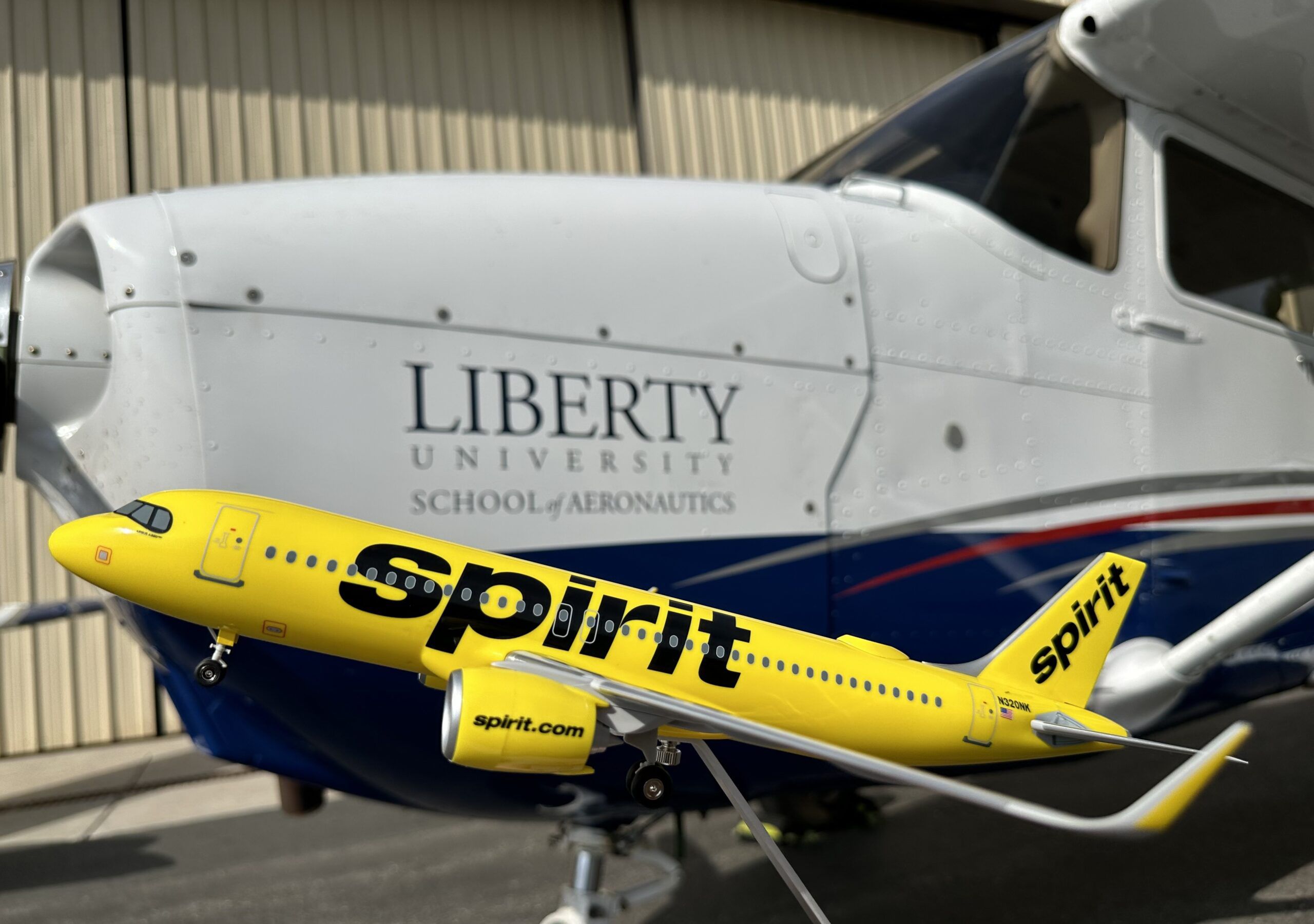
Spirit and Liberty University partner to direct hire pilots (Photo: Spirit Airlines)
Virginia-based Liberty University has announced a new partnership with Spirit Airlines, becoming the tenth institution to join the ultra-low-cost carrier’s Spirit Wings Pilot Pathway program. Aimed at growing Spirit’s professional pilot pipeline, the program accepts applications from faculty-recommended students pursuing an aviation degree. Applicants who pass Spirit’s interview process receive a conditional offer of employment as a Spirit first officer along with mentorship through the completion of their degree and flight hours and a Spirit electronic flight bag.
“We put a lot of hard work into developing the Spirit Wings Pilot Pathway program and assembling a great group of partners making it incredibly rewarding to reach this key milestone,” said Ryan Rodosta, Spirit senior director of flight operations and system chief pilot. “Liberty University offers a premier pilot training program designed to provide graduates with the skills to lead in the aviation field, and Spirit’s growth creates opportunities for those graduates to achieve their dreams with us.”
Spirit noted that, before being offered employment, program pilots must complete the airline-approved airline transport pilot certification training program (ATP CTP) and jet transition course after reaching restricted airline transport pilot (R-ATP) minimum requirements. Other institutions that have joined the Spirit Wings program in the last year include Illinois’ Lewis University, Florida-based Lynn University and flight training company CAE. Spirit Airlines currently flies to locations in the U.S., Latin America and the Caribbean.
This story was originally published on AirlineGeeks’ sister company AvWeb.
AirlineGeeks.com was founded in February 2013 as a one-person blog in Washington D.C. Since then, we’ve grown to have 25+ active team members scattered across the globe. We are all here for the same reason: we love deep-diving into the fascinating realm of the airline industry.
An Edelweiss A340 lands in Las Vegas (Photo: AirlineGeeks | William Derrickson)
Just a week after Swiss announced new products on its A350s, its subsidiary – Edelweiss – announced that it will acquire six A350-900s, set to be delivered though 2025 to replace its fleet of A340-300s.
In May this year, Lufthansa Group secured four second-hand A350-900s that once flew for LATAM. Lufthansa did not reveal which airline those aircraft will go to in the group but now it appears they will be going to leisure carrier Edelweiss. Edelweiss will keep the configuration and products LATAM had with 30 business class seats and 309 in economy, citing supply chain issues as a reason to not reconfigure the aircraft.
The first four Airbus A350-900s carry the MSNs: 35, 45, 79, 363. The remaining two aircrafts were originally ordered by LATAM and will be operated by another carrier before transferring to Edelweiss. Their MSNs are not yet known as the two airframes were scheduled to be delivered in 2026.
A Lufthansa A350 taxis in Munich. (Photo: AirlineGeeks | Fabian Behr)
Fleet Renewal
The Edelweiss A350s is a part of the renewal process Lufthansa Group is progressing through to improve its products and achieve greater efficiency with newer generation aircraft. Quad-jets such as the A340-300s are notoriously inefficient compared to the newer generation of long haul twin jets and Lufthansa Group has placed numerous orders to replace one of the world’s largest quad-jet fleet consisting of A340-300s, A340-600s, Boeing 747-400s, 747-8s and A380-800s.
Edelweiss’s parent company Swiss, is also set to introduce five A350-900s to its fleet to replace A340-300s. The move for Edelweiss to also acquire A350s allows standardization between the two airlines and enables operation flexibility. Historically, Edelweiss long-haul fleet has always operated the same aircraft type as Swiss and used the same products, albeit with different configurations.
As of June 2023, the Lufthansa Group has ordered a total of 50 A350-900s and ten A350-1000s, with 17 delivered. The group also acquired four Philippines Airlines A350-900s in 2021 and will acquire four ex-LATAM A350-900s for Edelweiss. The total number of A350s in Lufthansa’s group is expected to reach at least 68. The group also has sizable orders for 787s and 777Xs to replace other aging jets in the fleet, including 787-9s to replace Austrian’s aging 767s and 777s.
An Edelweiss A340-300 at LAS (Photo: AirlineGeeks | William Derrickson)
Destinations
The new A350s are expected to take over the destinations that Edelweiss A340s currently serve. They are mostly leisure destinations in the Americas and across the globe. Edelweiss also flies to the Canadian cities of Calgary and Vancouver, as well as Denver in the U.S., connecting passengers to Swiss’ network in Zurich. Edelweiss A340s also operate Swiss-marketed flights from Zurich to Montreal despite Swiss having its own fleet of four A340-300s, which are also set to be replaced by A350-900s.
Swiss and Edelweiss winter Intercontinental network, destinations in white are flown by Edelweiss (Photo: SWISS)
Edelweiss also recently announced new services for summer 2024, including new routes to Bogota and Cartagena. The service to Vancouver will become daily and frequencies on services to Calgary, Denver, Las Vegas and Tampa will be increased. It was announced together with the network expansions by Swiss and Lufthansa starting summer of 2024. The new services and aircraft are a result of Lufthansa’s strong financial performance coming out of the COVID-19 pandemic.
Anthony is an aviation enthusiast who grew up around the world from St. Louis to Singapore, and now lives in Amsterdam. He loves long-haul flying and finds peace in the sound of engine cruising. He aspires to share his passion for the sky though writing and providing another angle on the stories.
Putting an $8 Million Boeing 737 on a Credit Card
Purchasing a jet is often a complex process. One Reddit post shows how easy it can be when using a credit card, ideally without a limit.
A Swift Air Boeing 737-400 in the Fyre Festival special livery. (Photo: John Klos [CC BY-SA 2.0 (https://creativecommons.org/licenses/by-sa/2.0)])
Airline credit cards are all the rave as many carriers transition frequent flier programs to spend-based models. According to The Seattle Times, Delta recently announced wide-sweeping changes to its SkyMiles program, requiring at least $35,000 to achieve Diamond Medallion status. Perhaps there’s no better way to get top-tier airline status in 2023 than just buying an airplane.
A recent Reddit post shed some light on what it takes to buy a 737. The iAero Thrust receipt – presumably from May of 2014 – indicates that the 737-400 variant was sold for $7.9 million. Delivered to Piedmont Airlines in 1989, N418US continues to fly for iAero Airways today.
Most notable about this receipt is that the nearly $8 million jet was purchased on an American Express card outright. The buyer spent $62,411 alone in processing fees. Just imagine the reward points that come with this transaction.
Buying a Commercial Airplane
One Redditor commented: “I love how it’s a tiny stub receipt on the paper that fades over time. Hopefully the AMEX has some good rewards points on it now!” It is likely that this would qualify the buyer for the exclusive American Express Centurion card, which reportedly requires up to $500,000 in annual spending, per Upgraded Points.
Commercial aircraft sales occur almost daily, between both manufacturers and airlines or third parties. Rarely are the specifics of these transactions made public, and few are likely as simple as a credit card swipe.
Ryan founded AirlineGeeks.com in February 2013 and has spent more than a decade covering the airline business. His work has been featured by CNN, WJLA, CNET, and Business Insider. His aviation experience spans airport operations, Part 135 regulatory compliance, and airline crew workforce planning, along with time behind the yoke of a Cessna 172 and interviews with airline executives. Ryan now serves as Group President of Firecrown Media’s Aviation Group. He holds a B.S. in Air Transportation Management and an MBA from Arizona State University and teaches Airline Management at Embry-Riddle Aeronautical University.
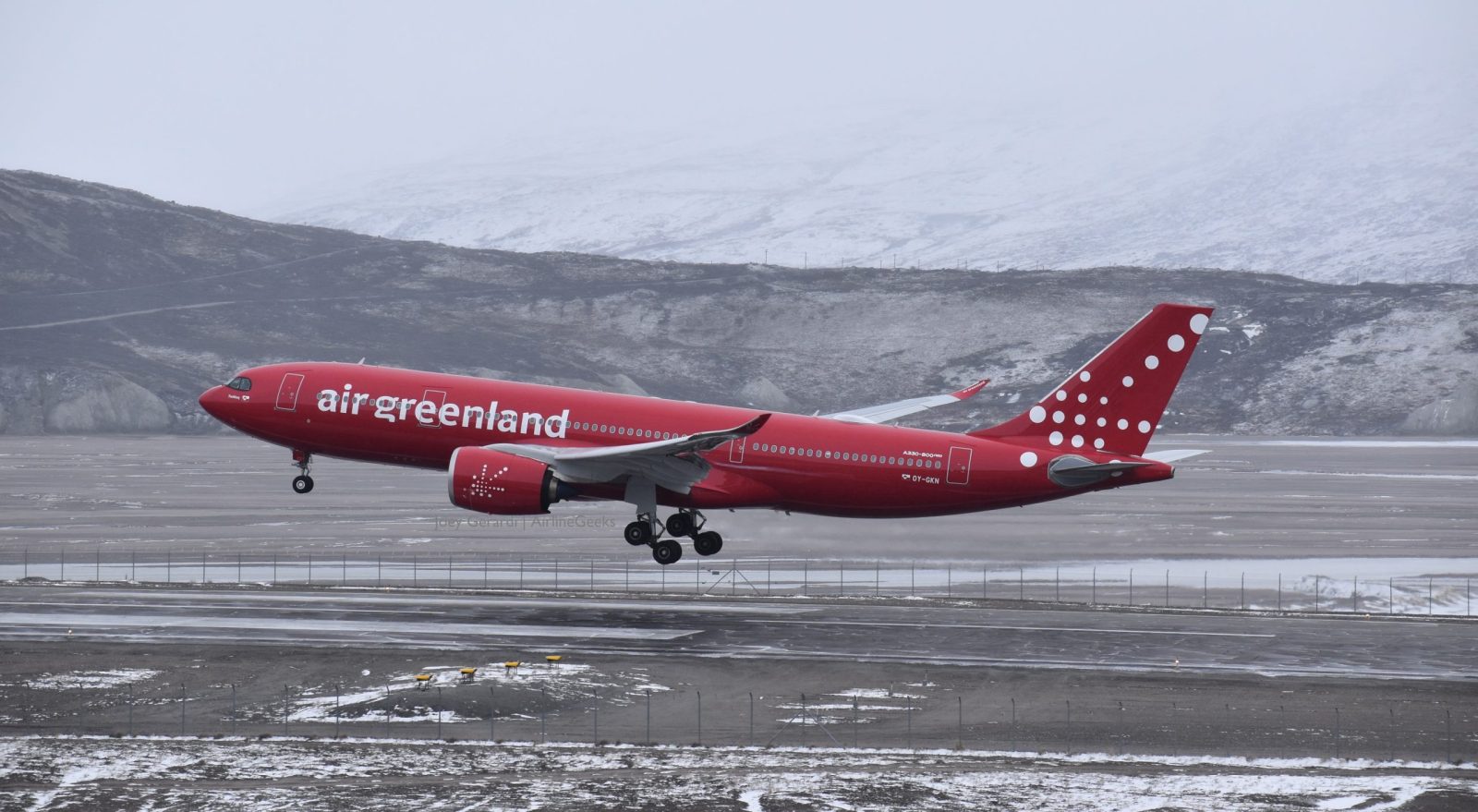
Air Greenland's sole Airbus A300-800neo seconds before touching down in Kangerlussuaq (Photo: AirlineGeeks | Joey Gerardi)
There are some aircraft that have hundreds of them built every year like the Airbus A321, with thousands in existence and thousands more on order. Then, there are older aircraft that are nearing the end of life that had many operators in the past when they were originally produced like the classic Boeing 737-200, and now has less than 30 frames actively flying.
But new aircraft produced in smaller numbers are hard to come by, even the Boeing 737’s least popular type, the -600 variant had just under 70 produced during its time. But the Airbus A330-800neo has less than 10 currently flying, and the order book of the type won’t even hit 15, unlike the much more popular Airbus A330-900neo which currently has around 100 of the type flying and hundreds more on order.
Current operators of the elusive A330-800neo include Kuwait Airways with four, Uganda Airlines with two, and Air Greenland with a single aircraft. The only A330-800neo in the order book are four that will be headed to Garuda Indonesia and one that will be flying privately, which will become the only VIP A330-800neo and will not fly for an airline.
Air Greenland A330 Background
Air Greenland holds possession of the only Airbus A330-800neo that belongs to a company in the Western Hemisphere and will be the truth for the foreseeable future unless there are more orders or the single privately owned aircraft goes to someone in North or South America.
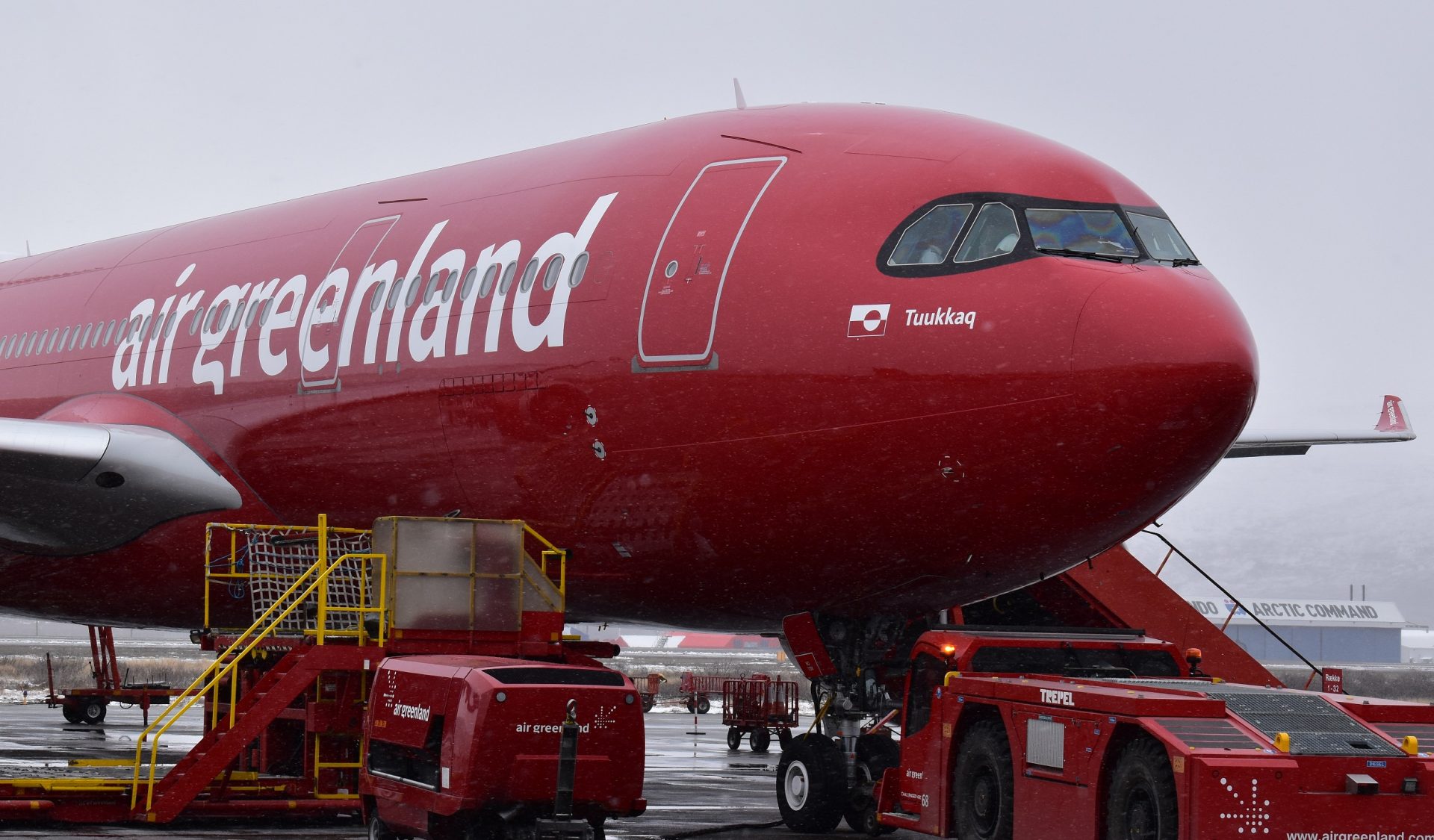
The A330-800 with the Greenlandic carrier is named “Tuukkaq” and means “Harpoon Head” in the native Greenlandic (Kalaallisut) language, and is a continuation of the airline’s previous flagship aircraft, an Airbus A330-200 that was named “Norsaq”, which translates to “Throwing Stick”.
Even the tail number pays homage to the country it calls home. Carrying a registration of OY-GKN, the ‘GKN’ stands for “Greenland Kalaallit Nunaat”, the second two words are how you say ‘Greenland’ in the native language.
The nose of my aircraft Tuukkaq (Photo: AirlineGeeks | Joey Gerardi)
The aircraft was delivered to the airline directly from Airbus in December of 2022, with their previous flagship A330-200 sticking around with the airline until March of 2023. The A330-200 did a final flyby over the country’s capital of Nuuk before making its way to the desert in the western United States.
At the time of writing this article, the aircraft flies almost five times a week from Copenhagen to Kangerlussuaq, which serves as the airline’s main international hub in Greenland. Kangerlussuaq itself only has a population of just above 500, and only serves as an international hub due to the fact it is one of the few commercial runways in the entire country that can handle the Air Greenland’s flagship.
A Panorama of the runway in Kangerlussuaq (Photo: AirlineGeeks | Joey Gerardi)
But, with new longer runways opening in the country’s capital of Nuuk, and the country’s biggest tourist destination city of Ilulissat, the route from Denmark to Greenland will shift away from Kangerlussuaq and go to the cities with the new runways once they open. This means that in the near future, the hub in Kangerlussuaq will close and shift to one of the country’s more populated cities, as Kangerlussuaq isn’t a final destination for the majority of the people visiting Greenland and is predominantly used as a connecting point to the rest of the country.
Even though the aircraft belongs to Air Greenland, the aircraft overnights and is parked in Copenhagen, Denmark during most of its a downtime. The aircraft starts there in the morning and flies to Greenland in the late morning/early afternoon, then operates the flight back to Denmark arriving in the evenings.
Day of the Flight
My flight to Copenhagen didn’t leave Kangerlussuaq until 12:40 p.m., but given that it’s a rare opportunity to get photographs of the A330-800neo landing in this location and I most likely will never have that chance again, I opted to take an early 7 am flight up to Kangerlussuaq from the country’s capital Nuuk. It left me with plenty of time to explore the airport and find the best place to get photos of the Air Greenland flagship landing.
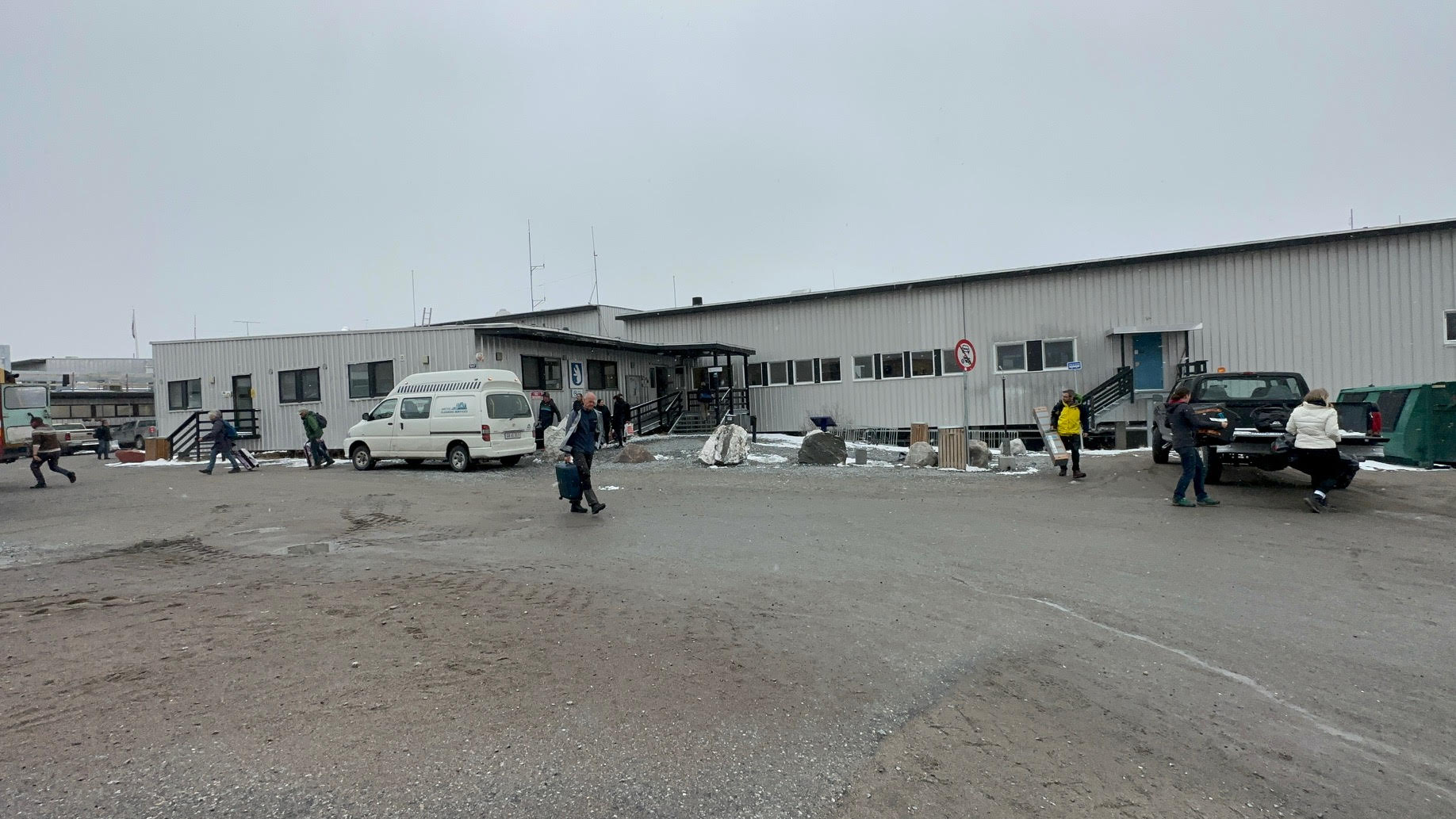
The terminal in Kangerlussuaq (Photo: AirlineGeeks | Joey Gerardi)
This airport truly revolves around this flight to Copenhagen, from the morning until the flight time, the airline’s eight Dash-8s would come in from the country’s surrounding cities, bringing in people for the outbound on the big plane. Then once the big plane lands, flights would start leaving on the Dash-8s bringing the inbound passengers all over the country. In addition, the shops and stores in and around the terminal also open and close around the Copenhagen flight’s arrival and departure as that is when most tourists will be here.
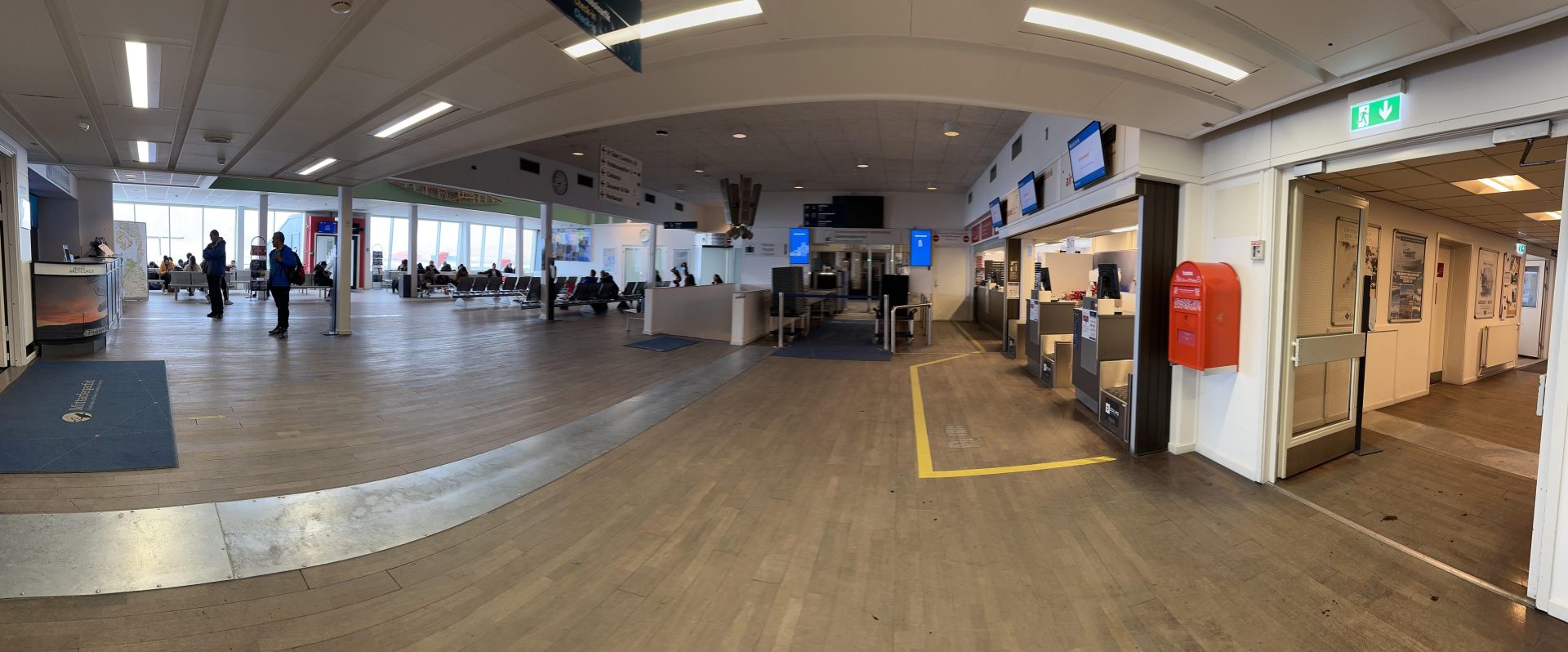
Inside of the terminal, before it got busy (Photo: AirlineGeeks | Joey Gerardi)
As mentioned above, the population of Kangerlussuaq is only around 500 so it’s not very large. Given that Air Greenland’s A330-800neo seats 305 passengers, with the inbound and outbound passengers combined in the terminal, it means the number of passengers in the terminal is more than the town’s entire population the flights are full, which they usually are as this is one of the few ways into and out of Greenland.
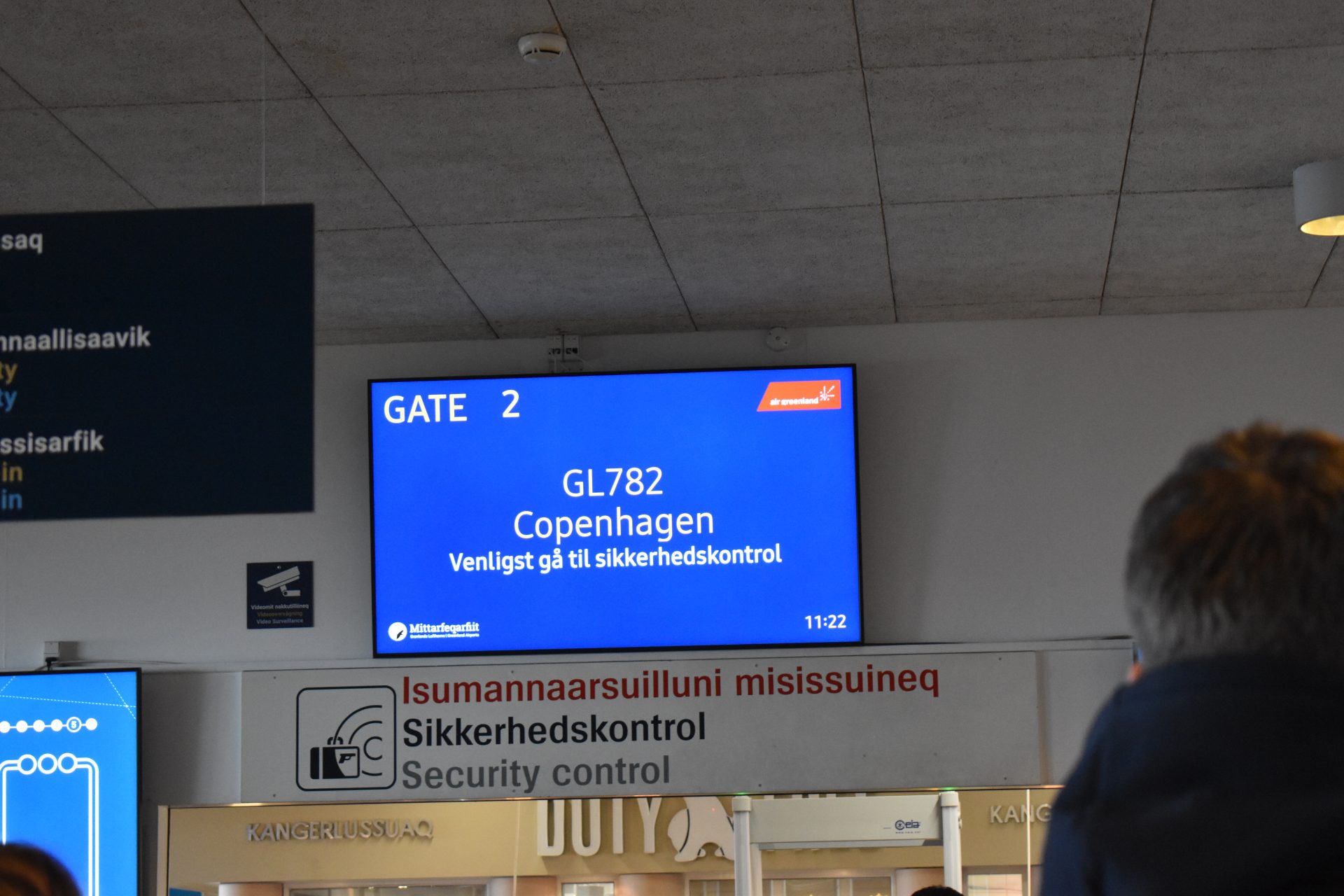
The Security checkpoint only opens 2hours before international flights (Photo: AirlineGeeks | Joey Gerardi)
They did have a security checkpoint, but it was closed as all domestic flights within Greenland aren’t required to go through security. The checkpoint only opens two hours before the departure of the flights out of Greenland.
Even though I had four hours before the aircraft arrived, the time flew by and I made my way down towards the end of the runway for photographs. Despite it being the end of May during this trip, Kangerlussuaq is located above the Arctic Circle, so snow ended up being in the forecast, but that wasn’t bad as it made the red Airbus aircraft pop against the terrain and white hills behind it and the photos came out amazing.
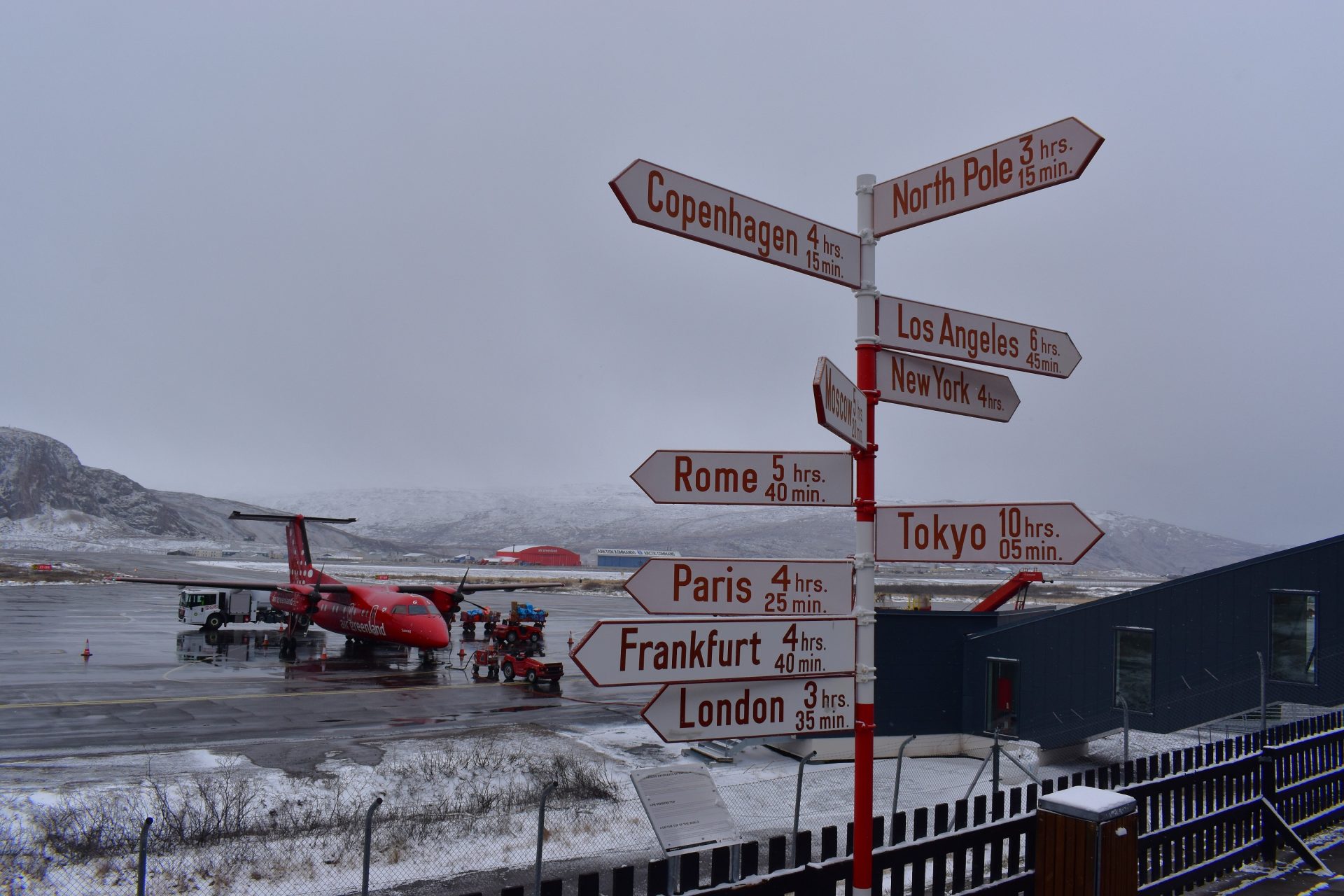
Once the aircraft landed, I quickly made my way back to the terminal as security had opened by this point. The terminal was a lot fuller than it was before, now with inbound and outbound passengers alike in the terminal. Before heading through security, I made sure to get a picture in front of the signpost, which is the most photographed spot in the entire country of Greenland.
The most photographed spot in Greenland (Photo: AirlineGeeks | Joey Gerardi)
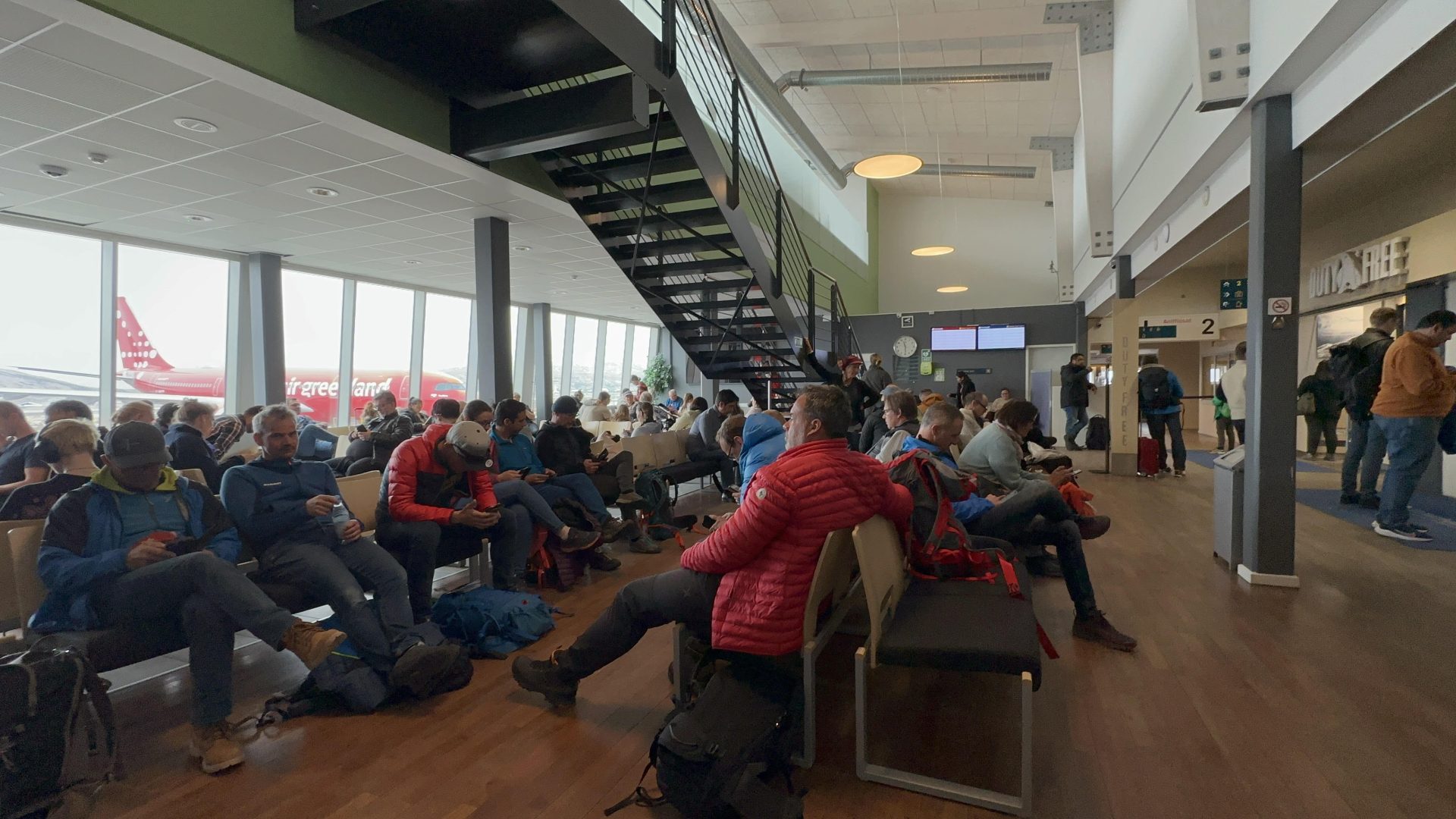
After security, there was a duty-free shop but not much else, other than the gate and a seating area. There was also an upstairs balcony that gave me a great overview of the operations on the ramp, with Air Greenland personnel sorting the bags from the domestic flights to points around Greenland, and vice versa for the bags going to Denmark.
The international gate area in Kangerlussuaq (Photo: AilrineGeeks | Joey Gerardi)
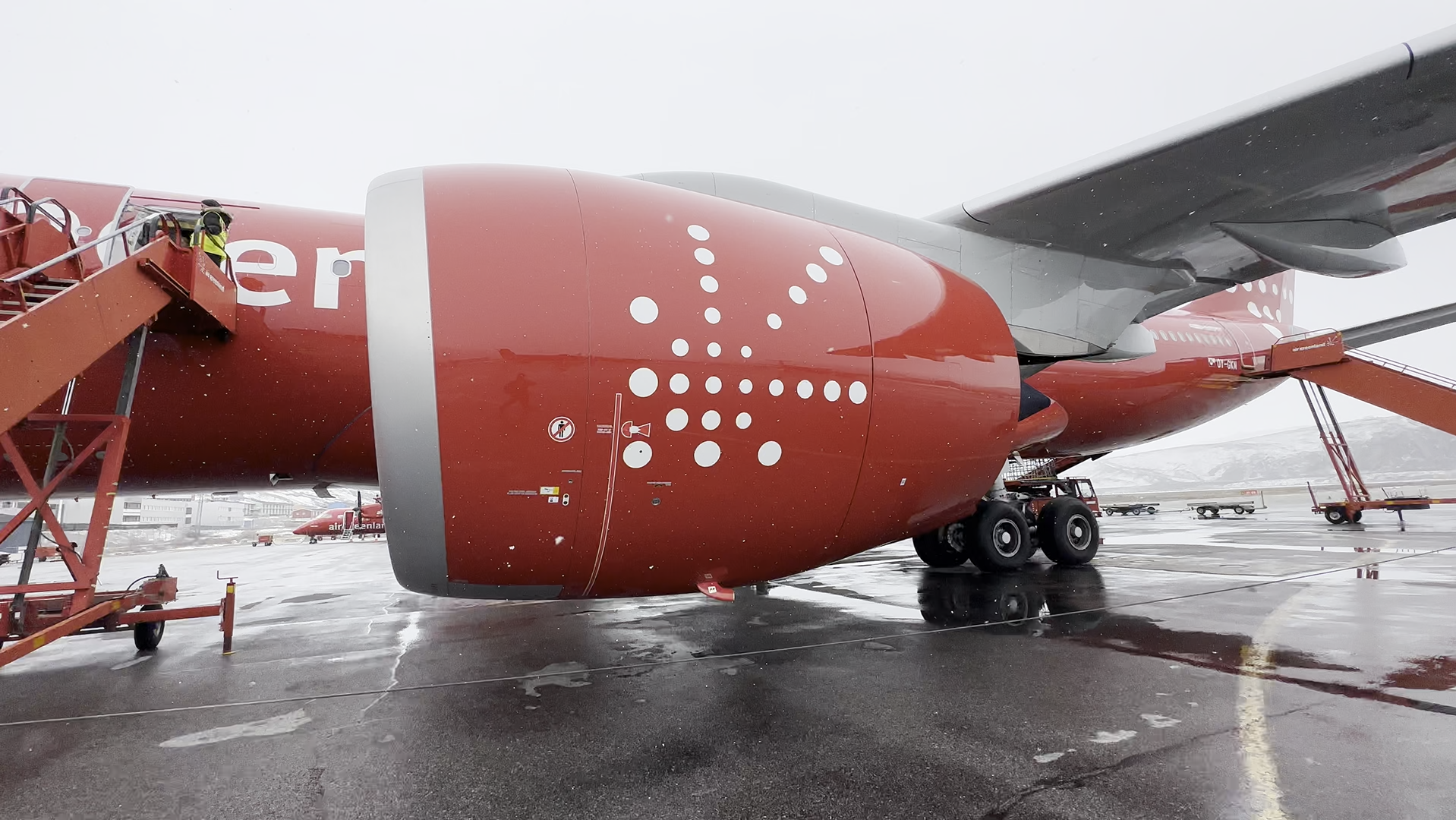
It wasn’t long before the main event was to begin, they called boarding for the flight and everyone made their way down the stairs to the ramp for boarding which is always fun, especially on a widebody jet. From the ground, you could truly see the size of this aircraft, and somehow the red livery looked even better from up close. They had dual boarding, with rows 1-32 using the forward stairs and 33-47 using the rear stairs. I was seated in row 36, so I used the rear steps, passing by the massive red engines on the way there.
Passing by the massive Airbus A330-800neo engine (Photo: AirlineGeeks | Joey Gerardi)
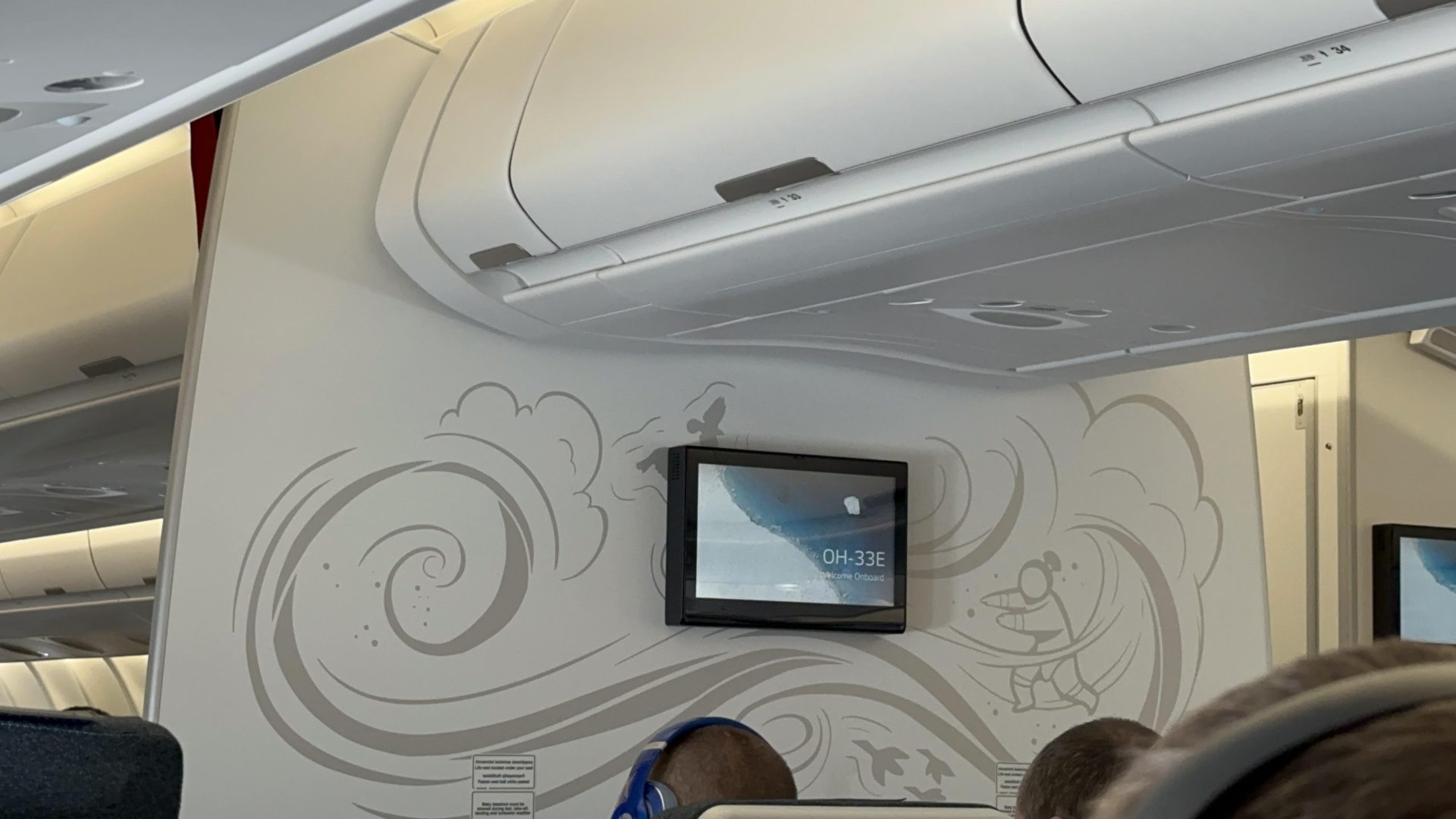
A majority of the main cabin is arranged in a 2-4-2 configuration, towards the back of the cabin where the plane narrows in rows 43-47 it changes to 2-3-2. Getting on board I also noticed the wonderful design on the bulkheads.
The bulkhead design on the Air Greenland A330 (Photo: AirlineGeeks | Joey Gerardi)
The safety briefing, along with all announcements, was done in Greenlandic (Kalaallisut), then Danish, and finally English. It was pretty interesting seeing the terminal from the aircraft window, especially given the smaller size of the terminal and the widebody aircraft I was sitting in.
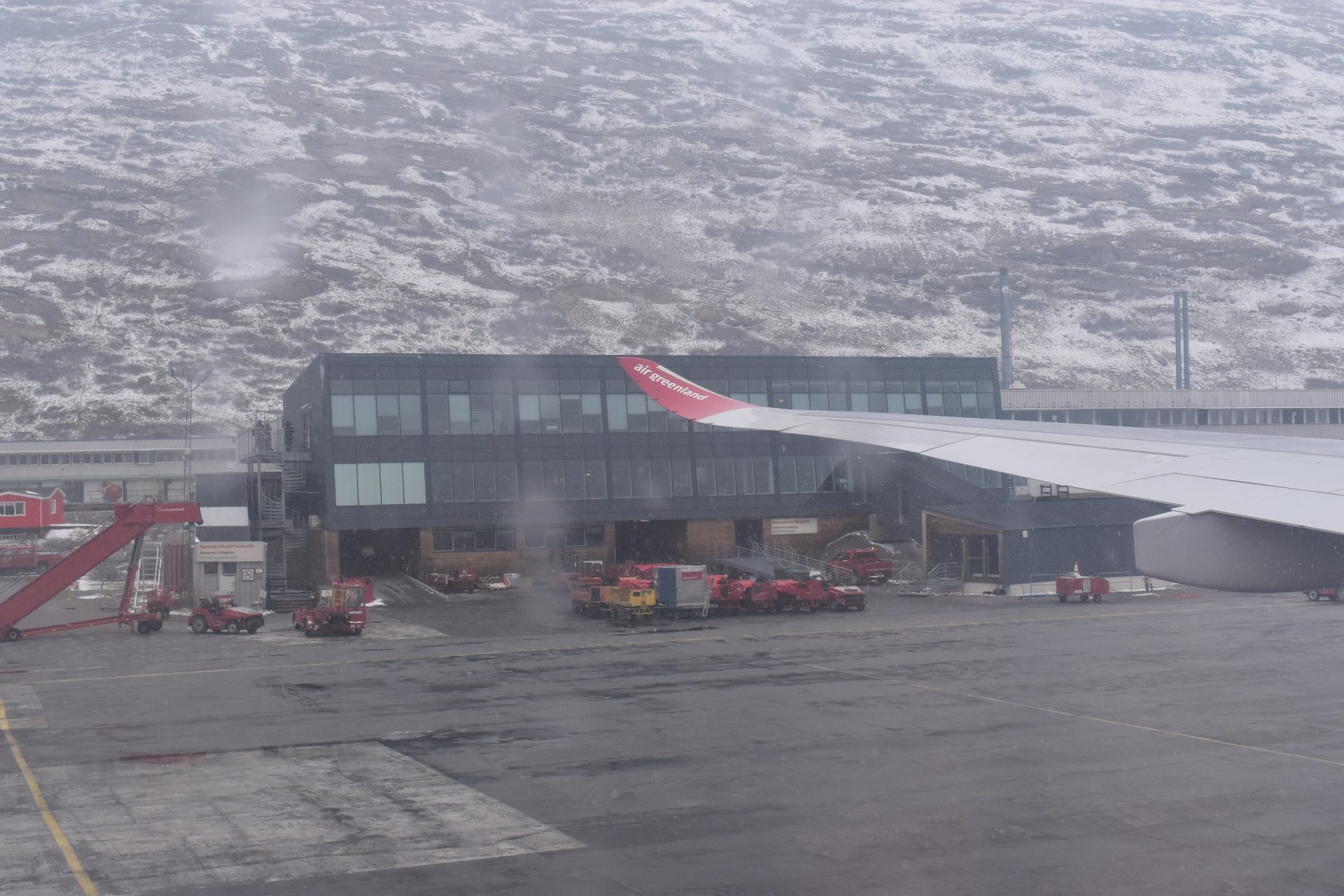
The terminal in Kangerlussuaq from my seat (Photo: AirlineGeeks | Joey Gerardi)
As it was snowing in Kangerlussuaq, we did get de-iced before taking off which didn’t take very long. After takeoff, we disappeared into the clouds almost immediately as it was overcast skies, which is a bit unfortunate, but at least the weather stayed relatively clear for the aircraft’s arrival photos.
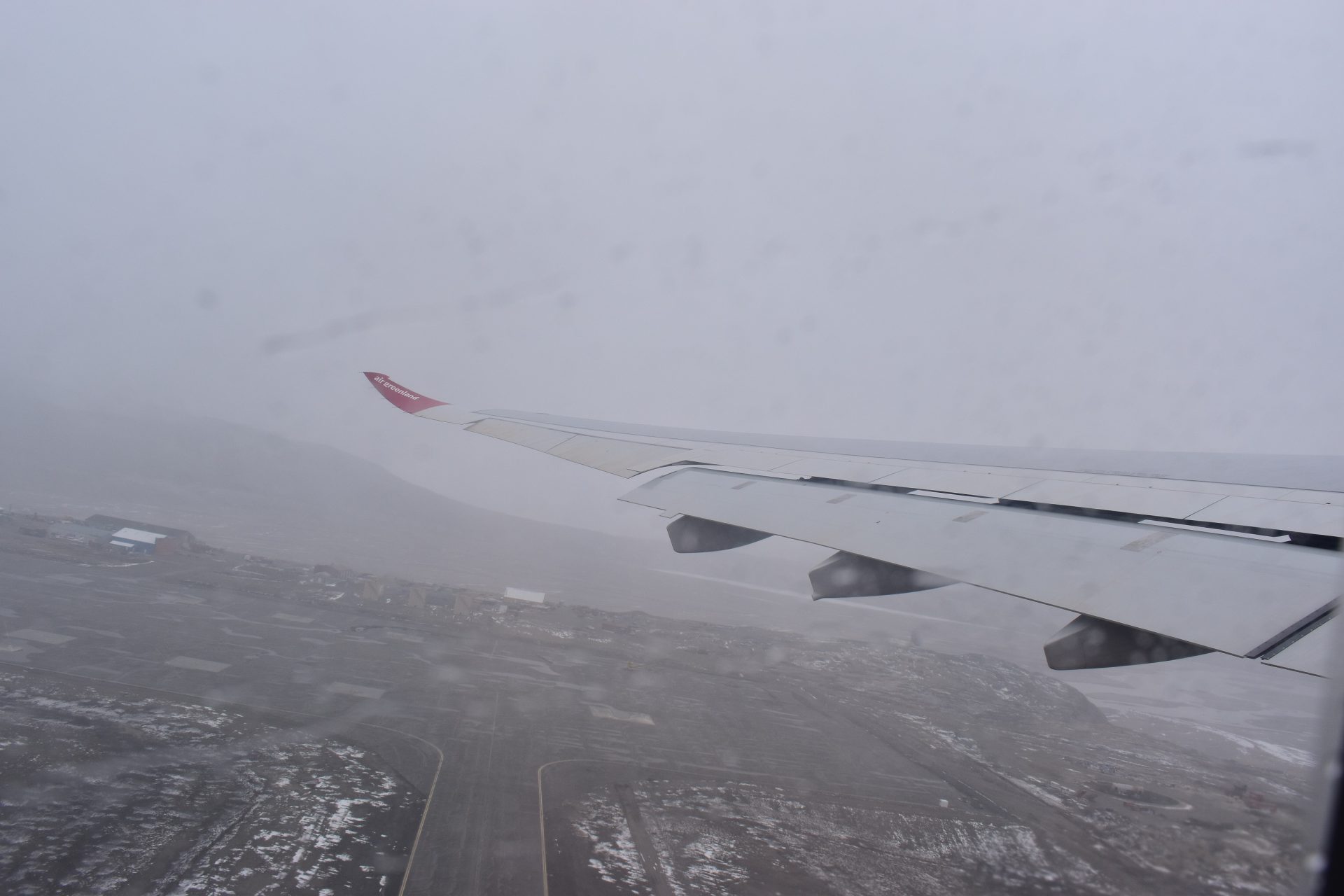
Departing out of Kangerlussuaq (Photo: AirlineGeeks | Joey Gerardi)
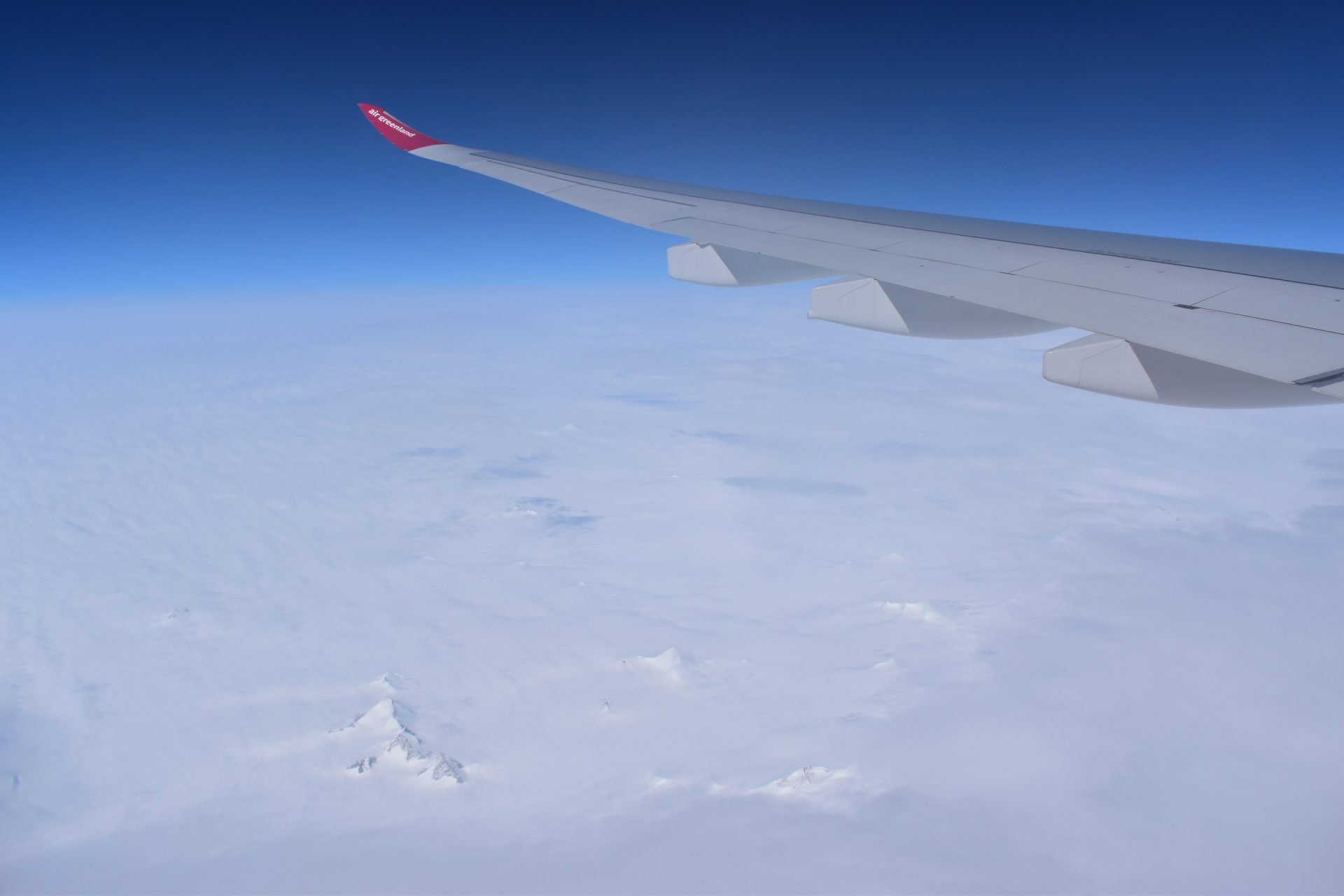
We climbed up to our cruising altitude of 39,000 feet/11,887.20 meters quite quickly. Despite the plane being pretty much full, this four-hour flight isn’t even close to the range this aircraft can fly, so there wasn’t much fuel required over to Copenhagen. Once we got away from the shoreline, the clouds cleared up and I could see the Greenland Ice Sheet below, although it was pretty hard to distinguish what was ice and what was clouds.
Flying over the Greenland Ice Sheet (Photo: AirlineGeeks | Joey Gerardi)
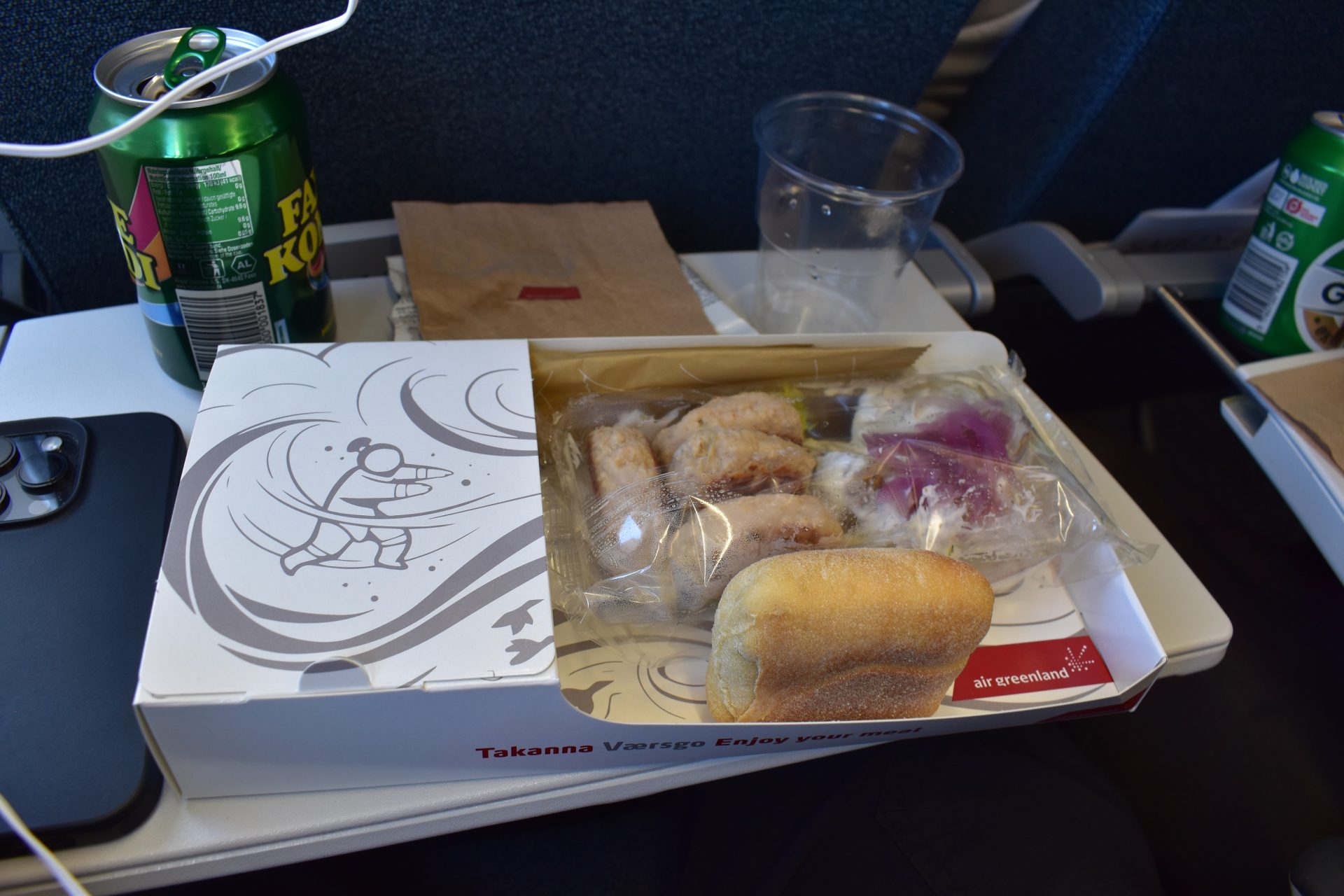
They did have a snack service which consisted of bread snacks and a drink from their extensive list of soft drinks. I chose Faxe Kondi, which is a Danish soft drink.
The initial service over to Copenhagen (Photo: AirlineGeeks } Joey Gerardi)
I began to watch a movie from their list, which included many popular blockbuster movies in English, Danish, and Greenlandic (Kalaallisut). There was a headphone jack as well as a USB port on the seatback screen so electronics could be easily charged.
An hour into the flight we flew over the eastern shores of Greenland and a meal was brought around. The meal was chicken and potatoes, a salad, and bread, with dessert being a brownie. This was nicely presented in a box, which had the same designs on it as the aircraft bulkhead.
The meal on the Kangerlussuaq to Copenhagen flight (Photo: AirlineGeeks | Joey Gerardi)
The next country we flew over was Iceland, which also brought us under the Arctic Circle as Iceland is located just south of the line.
It’s weird to think that just a few days prior I flew from Iceland to Greenland on a Dash-8, which was also on Air Greenland, although that journey did take longer than the length of the flight up to this point.
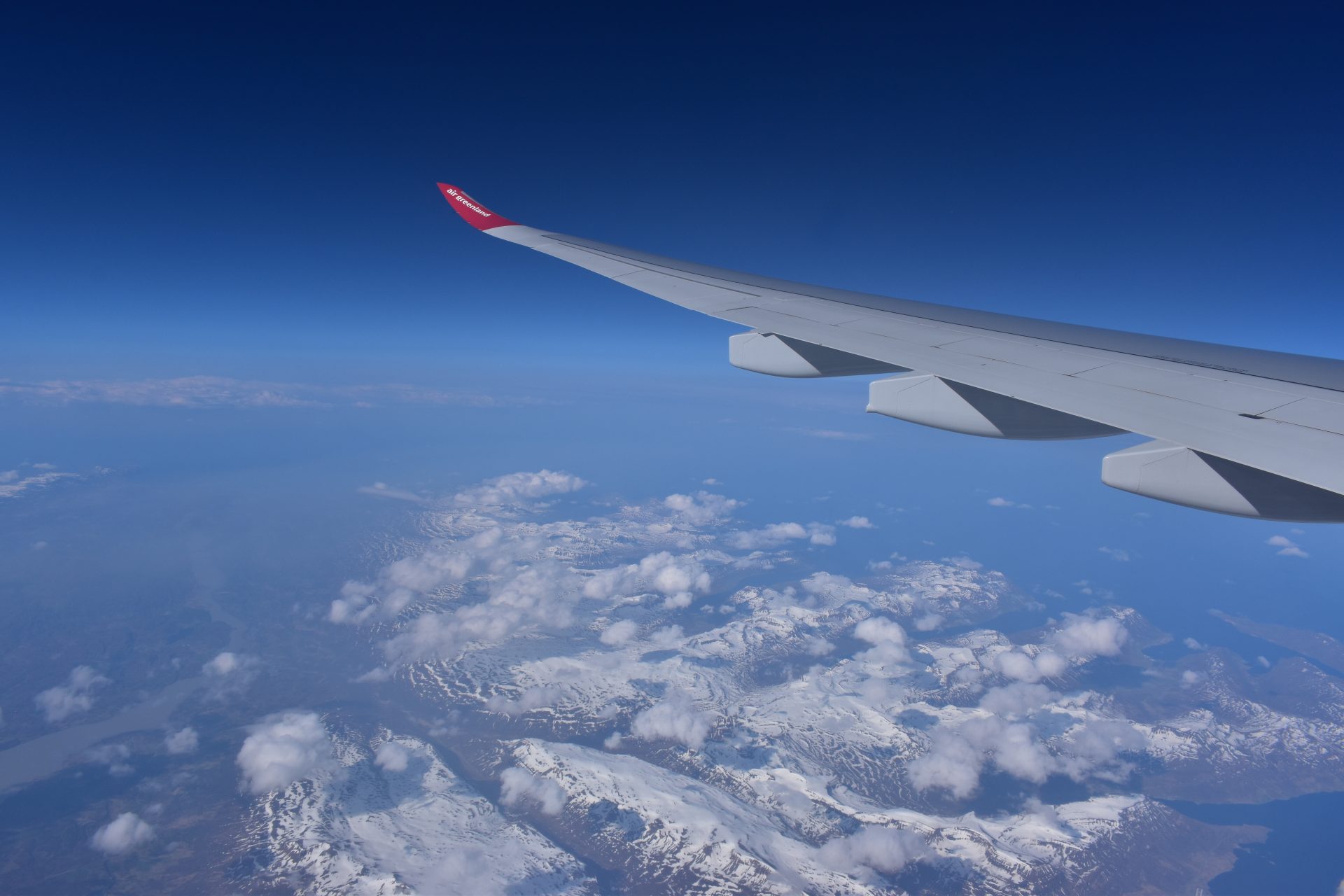
Flying over Iceland (Photo: AirlineGeeks | Joey Gerardi)
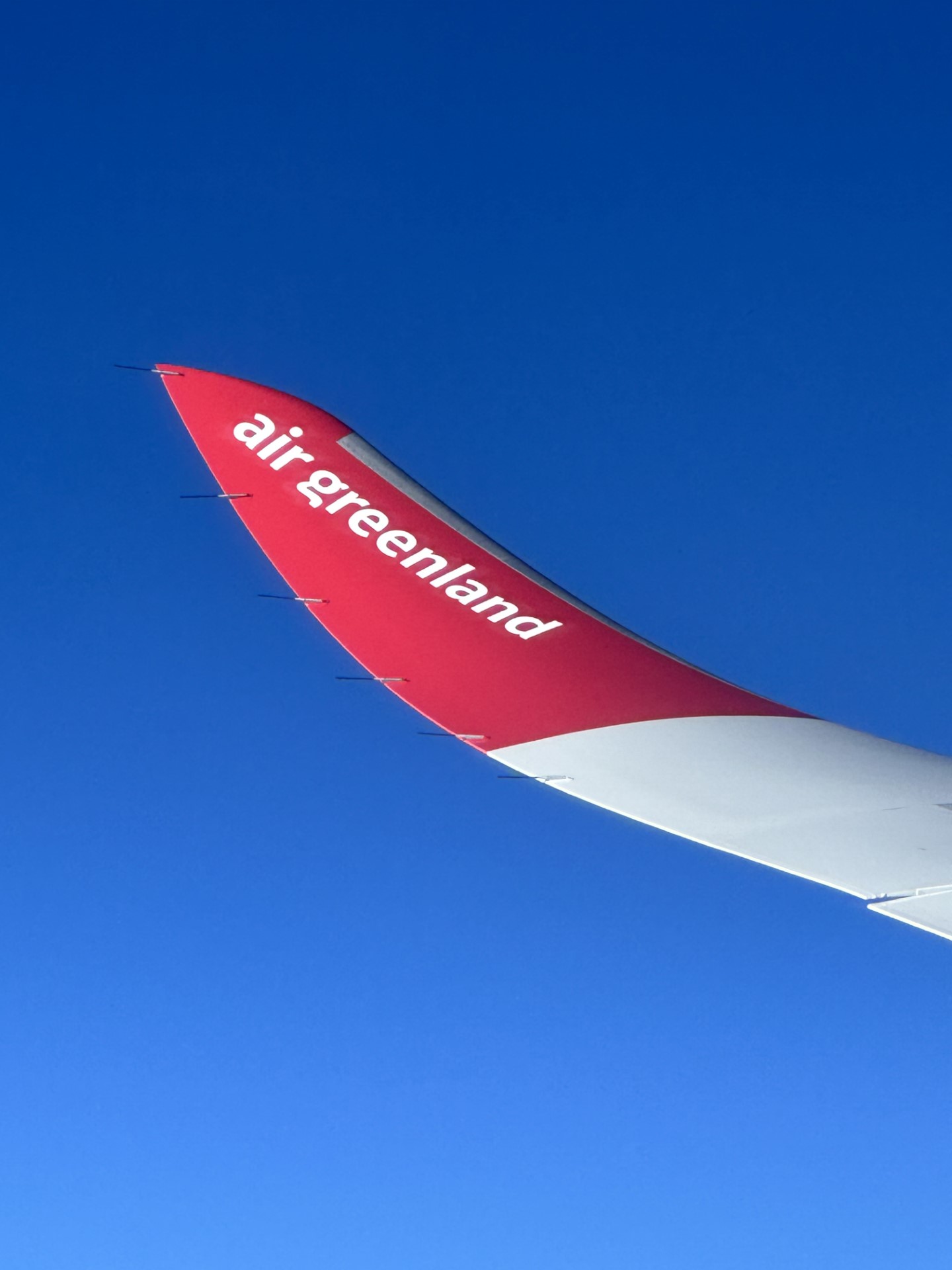
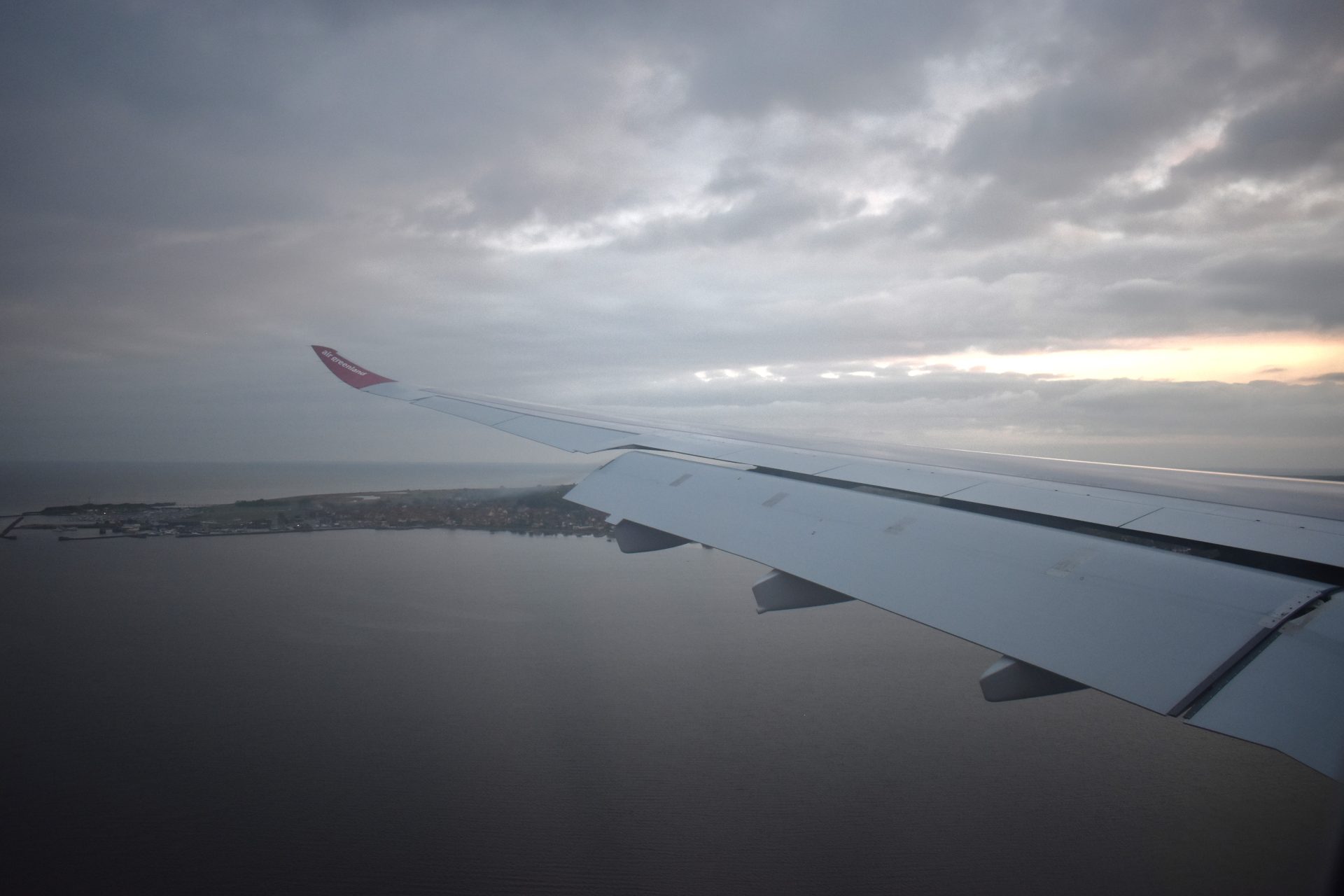
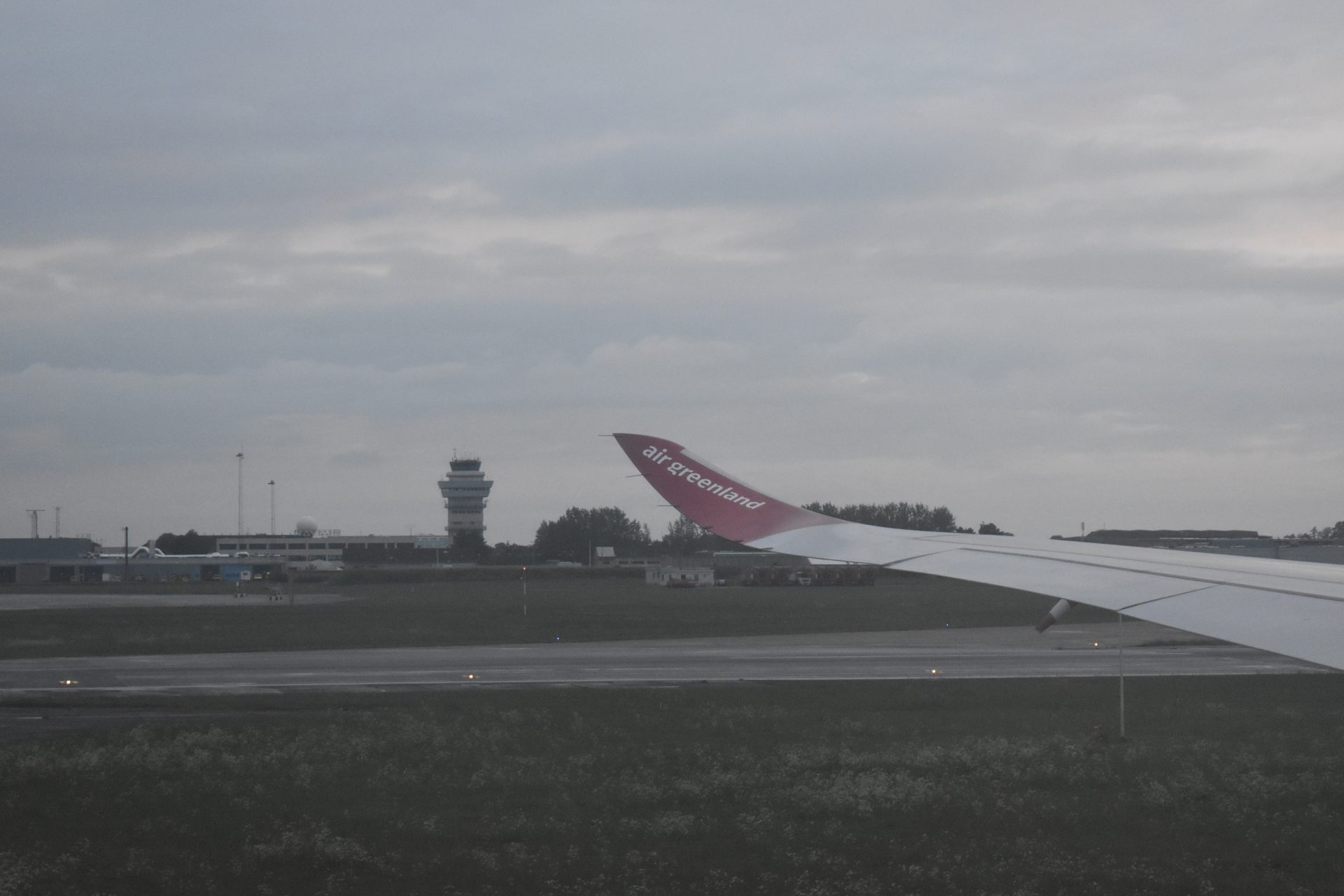
They did turn the fasten seat belt sign on at this point as there was a bit of turbulence going over Iceland, but I didn’t mind as I was still slowly going through my food. It was cool looking at the bright red winglet on the aircraft against the blue sky and the contrast was quite nice.
The winglet of my aircraft (Photo: AirlineGeeks | Joey Gerardi)
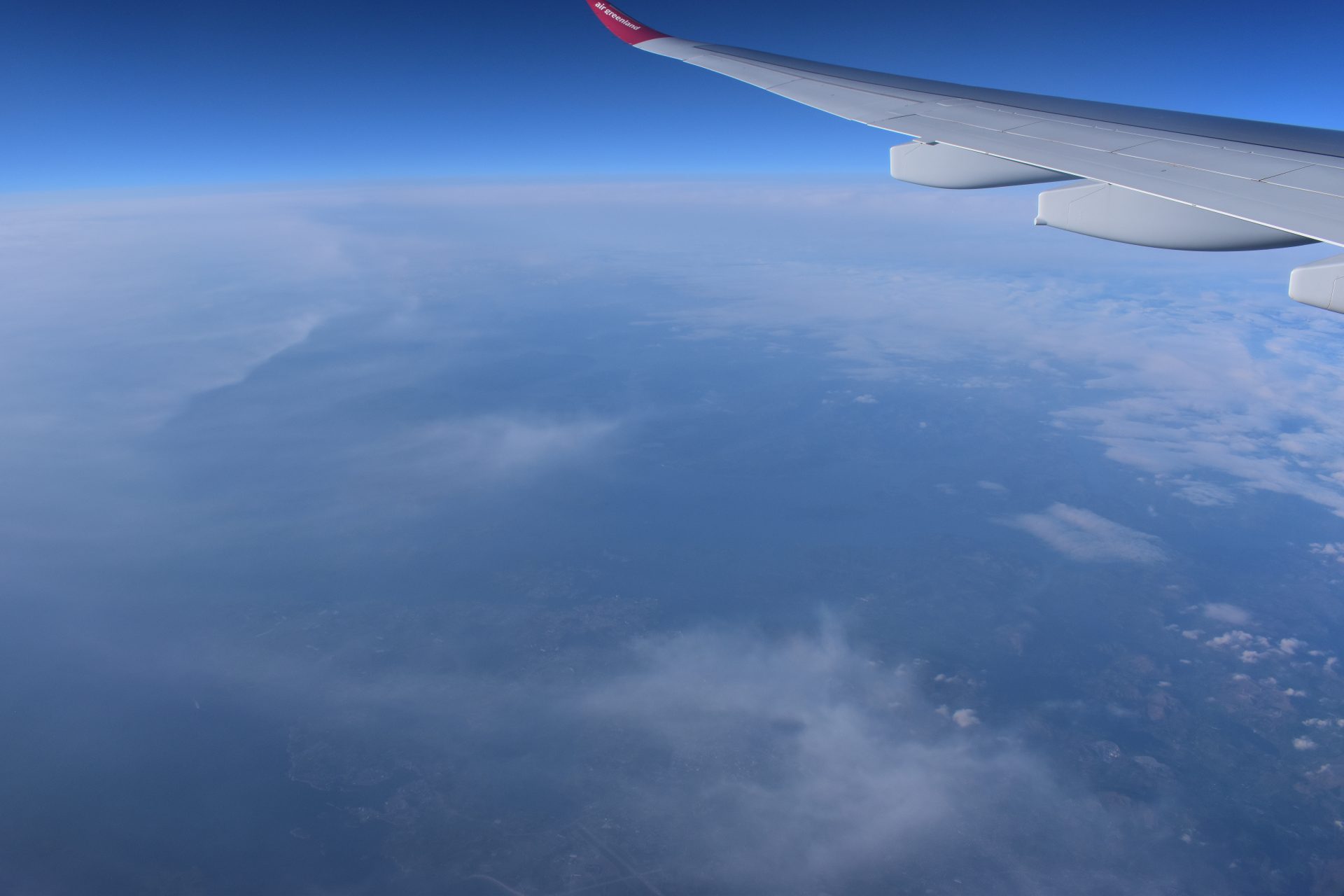
I did settle in and began to watch movies and TV for most of the flight, as we were flying over the ocean for the remainder of the flight there wasn’t much to see outside. However, being the true AvGeek that I am, I did occasionally take a picture of empty skies as it is still cool being onboard this aircraft.
A unique feature of this aircraft is the individual cupholders at each seat, which drop down from the seat in front of you, that way it is not necessary to lower the entire tray table for just a single cup.
Another unique feature about this aircraft was in the rear restroom in the main cabin, or I guess technically the two of them. The back two restrooms next to each other have a removable wall between them, and when opened up it becomes a handicap-accessible restroom, which is a neat feature I have never seen on an aircraft before that point and I hope continues to be on newer aircraft as it really helps those that do need that extra space as airplane bathrooms aren’t particularly known for their roominess.
There were a couple more snack services throughout the flight, but I did miss them as I had nodded off at some point without even realizing it, but I did luckily wake up before we hit landfall.
The first sighting of land after Iceland was Norway, and I could see Stavanger Airport below us.
Passing over Norway and Stavanger Sola Airport (Photo: AirlineGeks | Joey Gerardi)
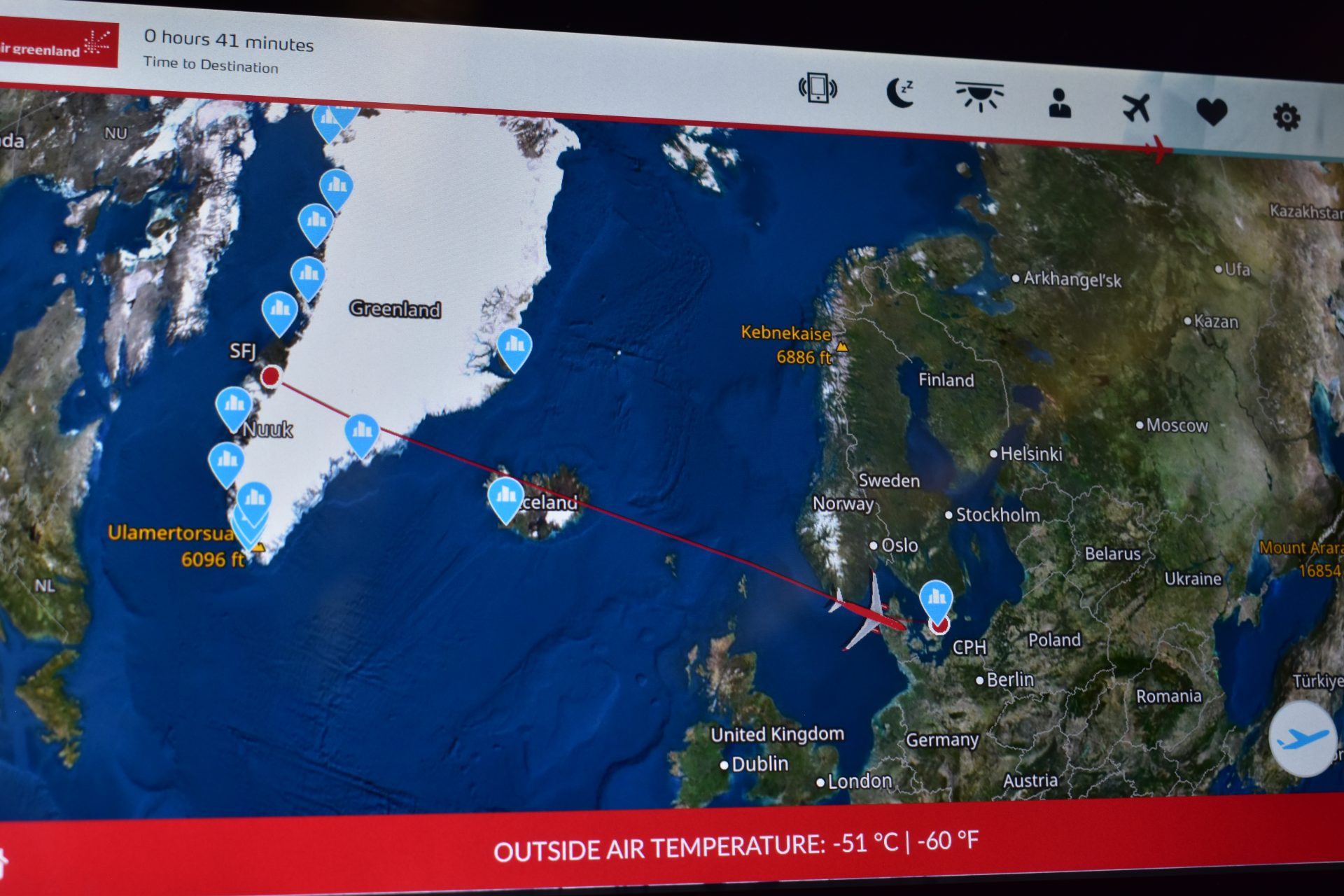
The IFE screen was very clean and neatly laid out, super easy to use and you could also put it in English, Danish, or Greenlandic. It also had a time zone feature where you could look at different clocks from around Europe, Greenland, and one from North America which was New York.
Looking at the route on the IFE screen (Photo: AirlineGeeks | Joey Gerardi)
It wasn’t long after entering Denmark airspace when we began descending towards Copenhagen. As this flight was roughly 4-hours long and we were flying east, the sun also began to set as we grew closer to the destination. The sky began to turn a wonderful shade of pink, which went nicely with the red winglet of the aircraft.
While the A350 is famous for its tail and other exterior cameras being one of the first commercial aircraft to have this, these cameras area also fitted on the Airbus A330-800neo. You can’t see much out of them while in mid-air, but as we got closer to the ground, the cameras proved to be very useful.
The flight attendants cleaned up the cabin and had a seat as we went into Copenhagen.
Just before landing in Copenhagen, Denmark (Photo: AirlineGeeks | Joey Gerardi)
I did look at the front view camera on the IFE screen as we were on final approach to the airport, which was really pretty given the color of the skies that evening and that I could see the runway lights as well.
Looking out of the front-view camera on the IFE, with Copenhagen Airport in view (Photo: AirlineGeeks | Joey Gerardi)
We landed at Copenhagen Airport at 9:13 p.m. local time after just over 4 hours of flying time and we taxied to the gate. Even though Greenland is geographically located in North America, it is considered an “autonomous territory of Denmark”, so this was treated as a domestic flight. This also makes the 2,138-mile flight between Kangerlussuaq and Copenhagen the longest domestic flight in Denmark, as Denmark itself is not a large country.
On the ground in Copenhagen (Photo: AirlineGeeks | Joey Gerardi)
Conclusion
There are so many cool aspects and AvGeek features of this flight; It is one of the only seven Airbus A330-800neos that exist worldwide, and the only one belonging to a company in the western hemisphere, the route out of such a small community like Kangerlussuaq is also pretty neat and the fact this route is on borrowed time as the newer runways will soon be opening in Nuuk and Ililissat, shifting this route to one or both of those cities and finally the fact you are flying on Air Greenland is perhaps the coolest aspect as it is a unique airline to fly on, that not many people can claim.
Time is running short for those AvGeeks who wish to fly the jet to the small community of Kangerlussuaq and check it off your AvGeek bucket list. But for now, the route operates five times a week year-round, and even when it does eventually shift to another city, you will still be on the airline’s mighty flagship A330-800neo, one of only seven worldwide and you’ll be in Greenland too.
Air Greenland operates in one of the most secluded locations on the planet, and it is so unique to be able to fly on a long-haul jet for 4-hours from a large city and end up on the world’s largest island.
A video account of this flight can be found below in 4K quality:
Editor’s Note: Air Greenland provided AirlineGeeks with the seat on this flight, but this trip report is an accurate portrayal of the events and is in no way swayed by that aspect.
Joey has always been interested in planes for as long as he can remember. He grew up in Central New York during the early 2000s when US Airways Express turboprops ruled the skies. Being from a non-aviation family made it harder for him to be around planes and would only spend about three hours a month at the airport. He was so excited when he could drive by himself, the first thing he did with his driver's license was get ice cream and go plane spotting for the entire day. He graduated from Western Michigan University in 2022 with a B.S. in Aviation Management & Operations and a Minor in Business, and currently works for a major airline in his hometown.
Boom Supersonic Embarks on Military Application Projects
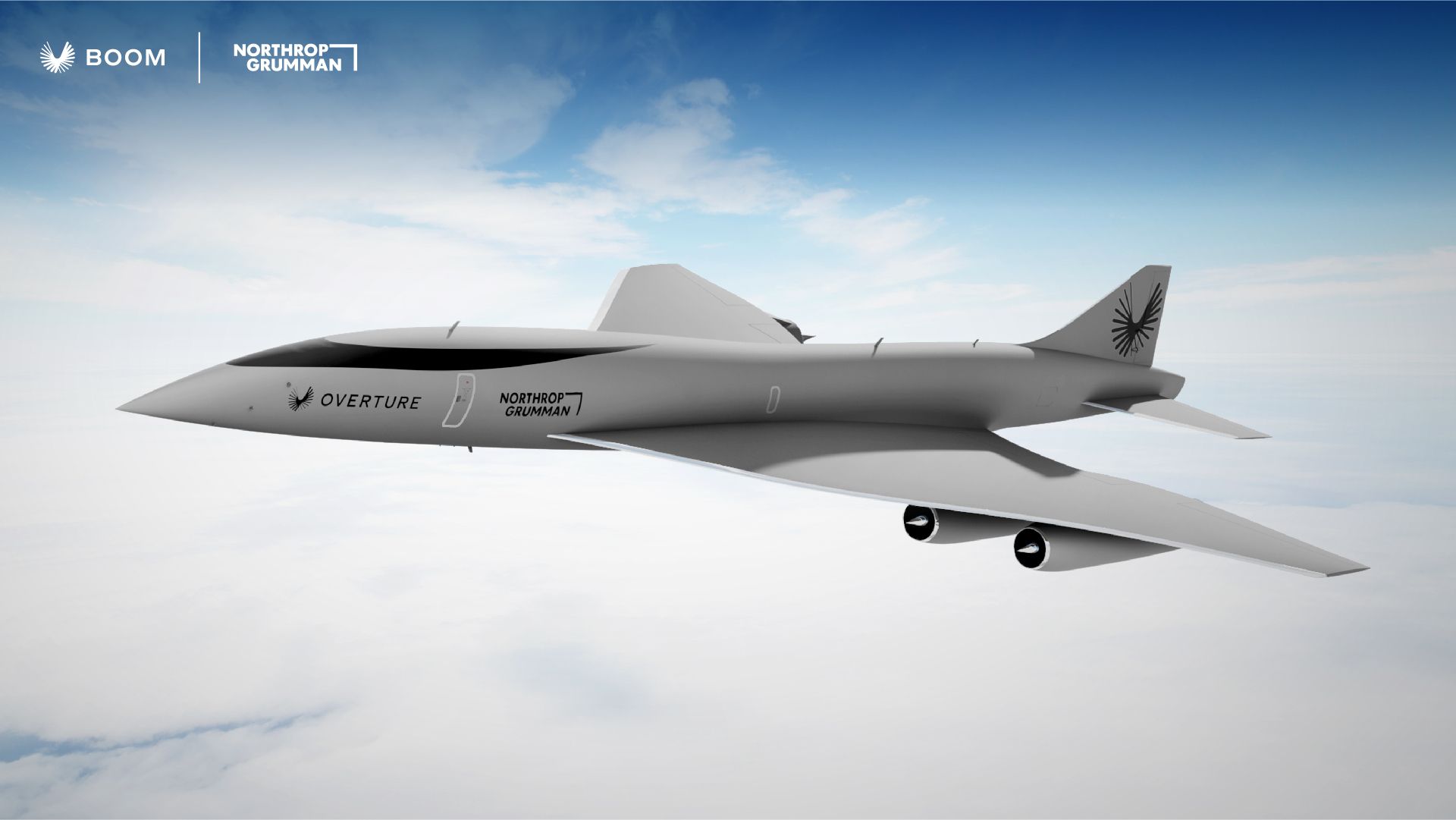
Special mission variant of Overture. (Rendering: Boom Supersonic)
Boom Supersonic, the US-based supersonic aircraft manufacturer, is actively working on adapting its supersonic aircraft for defense purposes and advancing its technology for commercial and military applications. The special mission variant of Overture could support various tasks such as quick-reaction surveillance, reconnaissance, command, and control, as well as mobility and logistics missions, such as emergency medical evacuation and troop transport.
Overture will be twice as fast as current airliners and operate on 100% sustainable aviation fuel (SAF) and take-off; it will use the world’s first automated noise reduction system. The aircraft will fly without the use of afterburners and will meet the same strict regulatory noise levels as the latest subsonic airplanes.
Boom Supersonic has introduced a Defense Advisory Group to evaluate its Overture aircraft for national security purposes. This independent council comprises military and defense experts with expertise in various defense-related areas: three former USAF Generals, one retired USAF Lieutenant General, a former Senior Executive Service for the Air Force Rapid Capabilities Office, and two retired USAF Major Generals.
This move builds on Boom’s previous collaboration with Northrop Grumman and aims to identify valuable and critical use cases for supersonic transport in military missions. The council’s goal is to advance the development of defense versions of the Overture, a sustainable supersonic aircraft capable of flying twice as fast as current airliners with a range of 4,250 nautical miles. The group aims to optimize the Overture for government customers, focusing on the Department of Defense.
Additionally, Boom has announced its support for Northrop Grumman on a NASA contract related to commercial supersonic flight efficiency for the High-Speed Endo-atmospheric Commercial Vehicle Conceptual Design Study and Technology Roadmaps Development program. Northrop Grumman and Boom Supersonic entered a partnership in July 2022 at the Farnborough International Airshow to develop a supersonic special-mission aircraft for the US government and allies.
The company has progressed in its Overture program over the last months, securing agreements with structural suppliers and expanding its partnership for the propulsion system Symphony™. Key partners in the Overture program include Aernnova, Leonardo, Aciturri, Safran Landing Systems, Eaton, Collins Aerospace, and the United States Air Force. The propulsion system, Symphony™, collaborates with partners like Florida Turbine Technologies, GE Additive, and StandardAero.
Boom Supersonic has also secured 10 million gallons of SAF annually for Overture’s net-zero carbon flight test program through agreements with Dimensional Energy and AIR COMPANY.
Designed to carry up to 80 passengers at twice the speed of today’s subsonic airliners, the Overture aircraft is set to enter commercial production in 2024, with flight tests in 2026 and passenger service in 2029. Boom Supersonic has 130 aircraft in its order book, including American Airlines, United Airlines, and Japan Airlines orders.
Vincenzo graduated in 2019 in Mechanical Engineering with an aeronautical curriculum, focusing his thesis on Human Factors in aircraft maintenance. In 2022 he pursued his master's degree in Aerospace Engineering at the University of Palermo, Italy. He combines his journalistic activities with his work as a Reliability Engineer at Zetalab.