Aeroflot aircraft tails. (Photo: aeroprints.com [CC BY-SA 3.0 (https://creativecommons.org/licenses/by-sa/3.0) or CC BY-SA 3.0 (https://creativecommons.org/licenses/by-sa/3.0)], via Wikimedia Commons)
The current war in Eastern Europe, following the Russian invasion of Ukraine, is the focus of worldwide attention as it is the cause of numerous sanctions against Russia by Western NATO countries. These sanctions include a ban on overflying European airspace, suspension of logistical support to Russian carriers by Airbus and Boeing, and an obligation on Aeroflot to return aircraft to leasing companies such as AerCap.
Bipolarity between the West and the Soviet Union has its origins shortly after the end of World War II. In 1949 the Western world (United States of America, Canada, United Kingdom, Italy and other Western European countries), was beginning to feel tensions towards the Soviet Union, which was the other winner of WWII.
So NATO (North Atlantic Treaty Organization) was created, as an international organization for collaboration in the defense sector. To oppose NATO, the Warsaw Pact had been signed in 1955 between the USSR and the closest states of Eastern Europe, dissolved in 1991, following the dissolution of the Soviet Union. Between the 1990s and 2000s, most of the former Warsaw Pact members joined NATO and the European Union.
One of these “satellite” countries that wanted to join the European Union and NATO for many years now is Ukraine, which in recent days has been clamoring for the activation of a NATO no-fly zone on Ukrainian territory to end Russian bombing raids. A no-fly zone is a part of the sky where any aircraft is forbidden to enter and it is considered a “demilitarized zone” of the sky. This means that if any aircraft, not authorized to fly over, would enter the no-fly zone it would be immediately shot down. In the current case of the war in Ukraine, it would mean to impose a no-fly zone on all Russian military aircraft.
The imposition of an overflight ban on Russian aircraft by NATO would effectively mean going to war. To enforce this imposition NATO would have to send its air force to Ukraine (which is not yet part of the alliance) contravening the regulation that states that the defense pact can only be activated militarily when one of the 30 signatory countries is threatened or attacked.
Establishing a NATO no-fly zone over Ukraine would imply the possibility of shooting down Russian military aircraft, i.e. a declaration of war against Russia.
Therefore, to avoid a global nuclear conflict, the NATO alliance has decided that there will be no no-fly zone over Ukraine. The allies agree that NATO aircraft should not operate in Ukrainian airspace as already stated by the Secretary-General of the Atlantic Alliance Jens Stoltenberg, reiterating that the support for the Ukrainian army should be limited to providing training and equipment to be able to repel the Russian attack.
Therefore, strict sanctions are currently the only way to stop the war in Eastern Europe and more importantly are the only way to prevent escalation beyond Ukraine. There is a fear that the conflict could also expand into Ukraine’s neighboring nations, such as Romania and Moldova or even further north to the Baltic countries.
Vincenzo graduated in 2019 in Mechanical Engineering with an aeronautical curriculum, focusing his thesis on Human Factors in aircraft maintenance. In 2022 he pursued his master's degree in Aerospace Engineering at the University of Palermo, Italy. He combines his journalistic activities with his work as a Reliability Engineer at Zetalab.
A United 787-9 in San Francisco. (Photo: AirlineGeeks | William Derrickson)
In an application with the Department of Transportation, United Airlines filed for the rights to fly between Washington-Dulles and Cape Town, South Africa, with its Boeing 787-9 Dreamliner. If accepted, these flights will commence around November 17, 2022, with thrice-weekly services on Tuesdays, Fridays and Sundays.
The proposed flight would depart Washington-Dulles at 6:30 P.M. and arrive in Cape Town at 4:15 P.M. the following day. The flight would return from Cape Town at 9 P.M. and arrive in Washington-Dulles at 6 A.M the next day. These flights would operate year-round with “seasonal flexibility to adjust capacity to potential fluctuations in demand.”
United Airlines touts its ability to offer multiple services to South Africa, including its flights from Newark/New York to Johannesburg, South Africa and Cape Town, South Africa. With both flights to Cape Town, the Chicago-based carrier proposes a combination of near-daily services to Cape Town. In total, United Airlines would enhance consumer access to 45 destinations, serving nearly 90 percent of all U.S. to Cape Town demand. From Cape Town, United Airlines’ passengers can experience further connectivity via a codeshare with Airlink and access 15 destinations in Botswana, Namibia, South Africa, and Zimbabwe.
United Airlines would add its fifth service from the United States to the continent of Africa and add its third African service from Washington-Dulles. In 2021, the carrier improved its connectivity to West Africa by adding flights from Washington-Dulles to Accra, Ghana and Lagos, Nigeria, on its Boeing 787-8 Dreamliner. United Airlines hopes to intensify its competition on Delta Airlines, the largest U.S. carrier to Africa and the incumbent carrier to Africa.
Washington-Dulles would receive its first service to Cape Town, South Africa. In the past, South African Airways operated a daily nonstop service between Washington-Dulles and Johannesburg, before converting the flight into a Johannesburg to Dakar, Senegal to Washington-Dulles routing. Later, South African Airways changed the routing with a stop either in Dakar or Accra and suspended the route in 2020 due to the COVID-19 pandemic.
United Airlines plans to operate the 257-seat Boeing 787-9 Dreamliner from Cape Town to Washington D.C. This aircraft features 48 Polaris Business class seats, 21 Premium Plus seats, 39 Economy Plus seats and 149 economy class seats.
Competition with Delta Air Lines
Similarly, Delta Airlines applied for the rights for thrice-weekly flights between Atlanta and Cape Town in February 2022. These flights would commence on November 18, 2022, with 305-seat Airbus A350-900 service, supplementing existing service from Atlanta to Johannesburg. Delta Airlines would depart Atlanta at 8:45 P.M., arriving in Cape Town at 6:45 P.M. the following day. The aircraft would depart Cape Town at 9 P.M., arriving in Atlanta at 6:25 A.M. the next day.
However, allocated flights between South Africa and the United States are limited, with only 21 frequencies, and there are currently only four frequencies available. Since both carriers are competing for frequencies, United Airlines replied to Delta Airlines’ application, claiming that Delta Air Lines’ proposal offers unpredictability and lacks vision. The airline cited that the Atlanta-based carrier terminated services in April 2020 due to the retirement of its Boeing 777-200LR, the aircraft most suitable for services to South Africa.
Earlier in 2020 and 2021, Delta Air Lines proposed a triangle route from Atlanta to Johannesburg to Cape Town to Atlanta, spurred out of the need to operate flights at a maximum payload on the Airbus A350. Later, this proposal was rejected by the South African Government, and now, Delta Airlines connects Atlanta and Johannesburg nonstop.
In a reply to Delta Air Lines, United Airlines proposed that if Delta Air Lines agrees, each carrier should split the frequencies, so that each airline receives two each. Therefore, this leaves the Department of Transportation with the opportunity to grant rights to either Delta Air Lines or United Airlines or split the frequencies between both carriers.
Ever since Winston was a toddler, he has always had a fascination for airplanes. From watching widebodies land at Washington Dulles to traveling the world, Winston has always had his eyes towards the skies. Winston began aviation photography in 2018 and now posts his photos occasionally on his Instagram account. He previously wrote for a blog. In his free time, Winston loves to play chess, do recreational activities, and watch sports. Looking into the future, Winston plans to service the aviation industry.
New International Arrival Facility Opened at Seattle-Tacoma Airport
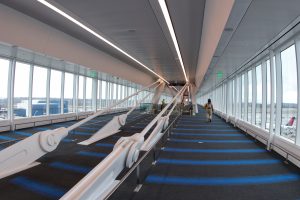
On March 3, the Port of Seattle has officially presented the new International Arrival Facility (IAF) at Seattle-Tacoma International Airport, which includes a Grand Hall, an International Security Corridor and the spectacular 780-feet long, 85-feet high Pedestrian Walkway, which represents the world’s longest structure over an active taxi lane. Becoming one of the most daring architectural structures at any airport in the United States and around the world.
This new facility replaces the current Customs facility that was opened 50 years ago and allows the airport to almost double the number of gates from 12 to 20 and increase its processing capability from 1,200 to 2,600 passengers per hour.
International Arrival Facility – Seattle Tacoma Airport (photo: Katie Bailey|Airlinegeeks)
“We needed to improve the customer experience to make travel less stressful and more predictable,” says Lance Lyttle, Managing Director of SEA Airport. “This is your first impression of our region and airport. Everything from the views out the window to the simplicity of getting on your way should put you at ease.”
“Everything about this new facility — from its design to its artwork to its vistas, and even the way passengers move through the building — demonstrates our region’s most enduring values, and reinforces our commitment to being the best connected, most convenient, sustainable, and welcoming airport in the world,” said Ryan Calkins, Port of Seattle Commission President.
A New Dawn for Seattle Airport
Ribbon cutting for the International Arrival Facility – Seattle Tacoma Airport (photo: Katie Bailey/Airlinegeeks)
The inauguration event took place on the upstairs mezzanine level where the passengers with Global Entry would stop to check-in via kiosk and overlooking the baggage claim area that has increased the number of claim carousels from four to seven, allowing the airport to reduce the minimum connecting time from 90 to 75 minutes. After the Managing Director for Seattle-Tacoma Airport opened the ceremony reminding of the new international services that will come to the airport during the summer, such as Finnair to Helsinki and Delta Air Lines to London, the Governor for the State of Washington Jay Inslee made a surprise appearance: “This is a great morning here in the state of Washington, to see this beautiful facility, and I am just here to say thanks from the seven and a half million Washingtonians – to everyone involved in this incredible facility, from the construction people to the designers, to the administrators who worked through the middle of a pandemic to deliver this facility. “
Bag claim hall, International Arrival Facility – Seattle Tacoma Airport (photo: Katie Bailey/Airlinegeeks)
Throughout its construction, the IAF project has supported approximately 10,600 jobs for a total of 3 million labor hours. The approved cost of the project was just under $1 billion.
An Environmentally Sustainable Facility
This new part of Seattle Airport has been built “to fulfill the Port’s mission of environmental stewardship and sustainability”, and therefore includes:
Low-flow restroom fixtures to reduce indoor water use
Energy-saving features like LED lighting, energy-efficient escalator motors and variable speed motors on baggage handling devices
Two-thirds of the building has daylighting to connect travelers to outdoors, reinforce circadian rhythms, and reduce energy consumption
Conscientious construction with 7,163 tons of contaminated soil and 62,405 gallons of impacted stormwater removed from the project site, many materials sourced within 100 miles, low-emitting adhesives, materials, and coatings, and most of the construction waste was diverted from landfills
The most stunning piece of this entire project is the impressive pedestrian walkway connecting the international gates to the new Grand Hall. The structure is similar to the one that can be found at London Gatwick Airport but it’s longer and has a higher vertical clearance. Its 610-feet clearspan allows for an aircraft’s wingspan and tailfin (even for Boeing 747s and 777s) to safely pass underneath the structure. Most of this monumental masterpiece was built offsite with 17 major pre-fabricated components that were made using 3,000 tons of steel.
There will be five escalators in the elevated pedestrian walkway, and they will rank among the top 10 longest in the U.S. with the longest measuring 191 feet for an 80-foot rise.
Vanni fell in love with commercial aviation during his undergraduate studies in Statistics at the University of Bologna, when he prepared his thesis on the effects of deregulation on the U.S. and European aviation markets. Then he pursued his passion further by obtaining a Master’s Degree in Air Transport Management at Cranfield University in the U.K. followed by holding several management positions at various start-up carriers in Europe (Jet2, SkyEurope, Silverjet). After moving to Canada, he was Business Development Manager for IATA for nine years before turning to his other passion: sports writing.
Interview: Northern New York Communities Reject Replacement Carrier
The terminal building in Ogdensburg, N.Y. (Photo: AirlineGeeks | Joey Gerardi)
Ogdensburg and Plattsburgh, two Essential Air Service communities located in northern New York State have been in aviation news a lot recently. It started back in January 2022 when SkyWest, the carrier that holds the current Essential Air Service Contract in the communities, requested to terminate the EAS contract in both cities. That was swiftly denied by the Department of Transportation (DOT) until they could find a replacement carrier for each respective contract. That is the point when the EAS bidding process began for both cities.
Meanwhile, SkyWest requested to reduce the number of weekly frequencies from 12 to only seven for both communities, of which the reply to this was recently announced. On Feb. 23, 2022, a document was posted to regulations.gov regarding the request to reduce frequencies.
The response was that the carrier is required to maintain the contracted service levels, 12-weekly flights, until May 11, 2022, or a new carrier has been found. Further down the page, it did make an adjustment to that ruling, “Congress has given the Department limited discretion to waive this required level of service, but only if an eligible community requests the waiver, and only for a limited period of time”. That ruling essentially means that SkyWest is allowed to reduce the number of flights, but only if the community asks for it which they haven’t thus far.
A United Express CRJ-200 in Ogdensburg, N.Y. (Photo: AirlineGeeks | Joey Gerardi)
So the EAS bidding process has begun, and both communities had only a single eligible bidder; Plattsburgh had Cape Air bid, and Ogdensburg had Boutique bid. There was a second carrier that bid for Ogdensburg, Air Charter Express, but they didn’t meet the qualifications and weren’t counted. There is an old saying, “beggars can’t be choosers”, but that won’t apply in this case as both communities rejected the only carrier that bid for their cities.
On Feb. 25, 2022, NNY360 News posted an article saying that Ogdensburg has rejected the bid from Boutique as it didn’t meet the minimum EAS standards. On the same day, a document was posted to regulations.gov from the Clinton County Legislature, where the Plattsburgh Airport is located, informing the DOT that they were rejecting Cape Air’s bid for the same exact reason, service wouldn’t be able to accommodate historical traffic levels.
In the document posted by Plattsburgh, they went over how switching from 50-seat jets to 8/9-seat prop planes just isn’t enough for their community. Just before the pandemic in 2019, SkyWest carried 36,889 passengers to/from Plattsburgh, and a switch to Cape Air would mean annual capacity would go down to just 17,472 seats. Both communities are now looking at the same exact alternative, Alternate Essential Air Service, with Smyrna, Tenn.-based Contour Airlines using a 30-seat Embraer E135 aircraft.
A Contour Embraer E135 nicknamed “Pride of Contour” (Photo: AirlineGeeks | Joey Gerardi)
AirlineGeeks had the chance to talk to Steve Lawrence, the Executive Director of the Ogdensburg Bridge and Port Authority, about this interesting situation happening in Northern New York.
AirlineGeeks (AG): I know you are looking at an Alternate EAS service, but what exactly goes into applying for that as opposed to normal EAS service?
Steve Lawrence (SL): I’m new to it too, but what I am told is we will create a proposal that we work out with Contour and submit that directly to the US DOT. The main thing about this is with EAS service, airlines submit bids for the communities and the government pays the airlines directly, but with AEAS it’s a grant to the communities and it’s up to us to make payments to the respective airline, in this case, Contour.
(AG): Have you been talking to other cities that Contour currently flies to or have recently started serving to see what they are all about?
(SL): Yes, we have reached out to them and they have all been very complimentary and given glowing recommendations of the Contour service.
(AG): Is there any other reason you have rejected the current bidder, or is it simply because their aircraft are too small?
(SL): Well, that’s one of them. The other aspect is that we are entitled to twin-engine service and Boutique runs a Pilatus PC-12 which is only single-engine. Another thing is that if we were to accept that, then it would be a waiver and for the future EAS contracts we would have to entertain single-engine proposals which is a thing we definitely don’t want to do. We are entitled to twin-engine service, it works for us, it is our model. We need the aircraft for enplanements, and since we expanded the airport and lengthened the runway in 2016 we have done very well. In 2019 before the pandemic we were close to 25,000 passengers with just EAS service and Boutique Air simply wouldn’t be able to do that with their Pilatus. We did have Allegiant before the pandemic as well, but they are not included in that 25,000 number.
(AG): Are you looking at any specific cities or hubs you want to serve with Contour?
(SL): At this point, we are just focused on getting Contour here, but we have briefly talked with them about Philidephia, especially with their American partnership it would be good for those passengers wanting to connect elsewhere.
(AG): Plattsburgh is also looking at Contour, is there a possibility you will combine your Contour Air flights into a single tag service similar to what they do in Parkersburg and Beckley, W.V.?
(SL): No, we want nonstop. For years with EAS we had a sorta milk run service where they would run Massena-Ogdensburg-Watertown then onto Pittsburgh, and most recently Cape Air to Boston they had to make a stop in Albany, so if you got on at the first stop you were landing two or three times before you even get to the hub. Everyone has gone out on their own with nonstop service and we haven’t talked to Plattsburg about that.
(AG): Pilot shortages have been a huge issue in the aviation industry, are you worried about running into this issue with Contour?
(SL): No, when we preliminarily reached out to them they haven’t said anything about shortages so far, when we asked them that would’ve been the first things they would tell us. They have shown interest, so that really isn’t a worry right now but it is a concern cause it did affect SkyWest and that is the main reason they are choosing to leave us. If that were the case and Contour couldn’t come here, we have assurance from the DOT that we could go out and re-bid for airlines and hopefully, someone bigger would bid if it did come to that.
Until a new carrier is chosen for both communities, SkyWest under the United Express banner will remain in both Northern New York communities. We would like to thank Steven Lawrence for taking the time to briefly talk to us about this most unique situation happening in New York State. We also attempted to contact Plattsburgh Airport, but they were unable to be reached in time for publishing.
Joey has always been interested in planes for as long as he can remember. He grew up in Central New York during the early 2000s when US Airways Express turboprops ruled the skies. Being from a non-aviation family made it harder for him to be around planes and would only spend about three hours a month at the airport. He was so excited when he could drive by himself, the first thing he did with his driver's license was get ice cream and go plane spotting for the entire day. He graduated from Western Michigan University in 2022 with a B.S. in Aviation Management & Operations and a Minor in Business, and currently works for a major airline in his hometown.
Mexico’s Calafia Airlines Makes Another Move for Leisure Travelers
Departure hall of Beijing Daxing International Airport | Photo: Lei Yan
Beginning April 29, Tijuana Airport (TIJ) will have an air link with Puerto Peñasco via Calafia Airlines. The governor of Mexico’s Sonora state, along with directors of Calafia Airlines and tourism officials, announced the new service at a press conference Tuesday.
Calafia Airlines will operate twice weekly — on Monday and Friday — a short-hop service linking the San Diego-Tijuana metropolitan area with the Mexican beach city in Sonora state 300 miles away using its Embraer ERJ 145 jets. The airline based in Cabo San Lucas operates regular scheduled flights within Mexico’s Baja California peninsula and cities along the Mexican Pacific coast.
On Mondays, Calafia Airlines Flight 901 leaves Tijuana at 10:15 a.m. and arrives in Puerto Penasco in the same time zone at 11:25 a.m. The flight then returns back to Tijuana at 11:50 a.m. and arrives back at 12:55 p.m.
On Fridays, Calafia Airlines Flight 901 leaves 90 minues later at 11:45 a.m. and arrives in Puerto Peñasco at 12:55 p.m. The flight then returns back to Tijuana at 1:20 p.m., arriving back at 2:25 p.m.
The service will be the shortest commercial flight operating out of Tijuana International Airport at 70 minutes, beating Volaris’ twice daily service to Hermosillo, the capital of Sonora state, which is blocked at 82 minutes.
Calafia Airlines’s three ERJ 145 jets, the largest in the regional airline’s fleet, have seating capactiy for 50 travelers in economy class configuration. Eight seats are designated with more space. Travelers on Calafira will also be able to check-in one bag free of charge.
Calafia Airlines also posseses a fleet of two Embraer 120ERs and one Embraer ERJ 145. From Tijuana, travelers flying Calafia Airlines can connect onwards to Loreto and La Paz, Mexico in Baja California Sur state.
The new route is targeted to bring travelers from Tijuana and Southern California to beach and fishing attraction in Puerto Peñasco. Puerto Peñasco is well-known amongst Mexicans and tourists from nearby Arizona for its resort-style hotels, shopping centers, water sports and golf courses.
The Governor of Mexico’s Sonora state, Alfonso Durazno, acknowledged Califonia is also a market with high purchasing power. Durazno hopes Calafia’s new service will attract California tourists to the coastal attractions of Sonora state.
“[The new service] creates more transportation options to those that Puerto Peñasco already has on land and this, then, will allow us to offer all the attractions of this extraordinary city to the Tijuana market, but particularly to the California, United States market.” Durazno explained.
Cross Border Xpress, an enclosed pedestrian bridge connecting Tijuana International Airport with San Diego, allows air traverlers to cross the border between Mexico and the U.S.
With Calafia’s arrival in Puerto Penasco, Puerto Peñasco’s Mar de Cortes International Airport will once again be served by commercial flights. Mexico’s TAR Airlines was the last airline to operate flights to Mar de Cortes International Airport. TAR operated scheduled flights to Puerto Peñasco from Hermosillo, Tijuana and Ciudad Juárez, Mexico for a short period between July and November 2016.
Most people hate long flights or overnight layovers, but Albert loves them. The airport and flying parts of traveling are the biggest highlights of any trip for him – as this avgeek always gets a thrill from sampling different airline cabin products and checking out regional developments happening at local U.S. airports. He’s flown on almost every major carrier in the U.S. and Asia Pacific, and he hopes to try out the new A350s soon.
Albert recently completed his undergraduate studies in Business Accounting at USC in Los Angeles and he is currently recruiting for a corporate analyst position at one of the U.S. legacy carriers. During his college years, he interned at LAX for Los Angeles World Airports working behind-the-scenes (and on the ramp) in public relations and accounting. Outside of writing for AirlineGeeks, he enjoys trekking the Hollywood hills, visiting new hotspots throughout SoCal, and doing the occasional weekender on Spirit Airlines.
European Carriers Suspend Asia Flights Amid Ukraine Crisis
A Finnair Airbus A350-900 XWB approaching. (Photo: Antti Lehto)
As the conflict between Russia and Ukraine continues escalating, more countries are closing their airspace to Russian carriers and Russia-registered aircrafts. In return, Russia closed its airspace to those countries to retaliate. As most of the routes between Europe and Asia pass through Russia, the result of those sanctions forced multiple European airlines to cease their operations to Asia, including Air France, KLM, and Lufthansa.
The British Government was the first authority to impose restrictions on Russian aircrafts. Since then, the entire EU, the United States, and Canada have imposed the same restrictions as a reaction to Russia’s military actions in Ukraine. The restriction forced Aeroflot, the biggest international airline in Russia, to cancel all of its westbound flights to Europe and North America.
As a countermeasure to the resections imposed by the west, Russia closed its airspace to those nations as well. Major carriers in the US, such as United Airlines, American Airlines, and UPS, announced that they will reroute or cancel the flights that are using Russian airspace. The influence of restrictions is only on flights between the U.S. and South Asia, such as India and Singapore.
On the other hand, the impact of restriction was far worse on European Airlines. On top of suspending flights to Russia and Ukraine, Airlines are forced to take significant detours or even cease operations to their Asia destinations due to the unavailability of Russian airspace.
Air France announced on Feb. 28, that, due to the ongoing conflict between Russia and Ukraine, the airline will cancel all flights from Europe to China, Japan, and Korea until further notice. Today, the airline updated that announcement and resumes its operations from Pairs’ De Gaulle Airport to Beijing, Shanghai, Seoul, and Tokyo. The flights will fly via Turkey, Uzbekistan, Kazakstan, and China to avoid using Russia’s Airspace. The reroute is expected to add more hours to the journey.
Under the same roof as Air France, KLM, however, is still working on its solutions to resume flights between Amsterdam and its Asia destinations.
Lufthansa Group — with Lufthansa, Swiss International Air Lines, and Air Austria — is maintaining its operations in Asia. However, flights have all been updated with two more hours on the journey, due to the detour to avoid Russian airspace.
A Two-Continent Problem
From the Asia side, no airspace restrictions have been imposed from East Asian countries to Russia at this moment. At the moment when this reporting was authored, a number of aircrafts from China, Korea, and Japan are flying over the Russian airspace as usual.
The restrictions came in a bad time for airlines as the international oil price hits a record high. The detour and cancellation will further trim Airlines’ profitability, as they are recovering from the impact of the Covid-19 pandemic. Meanwhile, passengers may face high fares and a reduced supply of seats between Europe and Asia, making the slow recovery of flights stagger.
As the military conflict in the region goes on, further impacts are expected on a global scale.
March 4 at 2:15 p.m. ET: Correction — an earlier version of this article misstated the name of a member airline of the Lufthansa Group. It is Swiss International Airlines, not SwissAir.
Lei is from Inner Mongolia, China, and now lives in Guangzhou. He grew up in an aviation family, where his passion began. During his time at Penn State University, he studied Industrial Engineering specializing in operations research, and he graduated with an honor’s thesis on airport gate assignment optimization. Now, he is a Purchasing Manager with Procter & Gamble. In his free time, he enjoys flying, reading, and wandering around the city.
South African Government Concludes Sale Agreement for South African Airways
A South African Airways A340 pushing back at Washington Dulles International Airport. (Photo: AirlineGeeks | Ben Suskind)
The South African government said last Thursday that Takatso consortium will now take up 51% of the South African Airways’ shares after a sale agreement was concluded — marking eight months since the consortium. The agreement that consists of Global Airways, owners of low-cost airline LIFT and an infrastructure investment firm called Harith General Partners was announced as the preferred shareholding firm.
According to an announcement by the Ministry in the Presidency following a Cabinet meeting on February 23, “The Sales and Purchase process has now been concluded and signed by the Department of Public Enterprises and Takatso Consortium. The next step involves the approval of this transaction by various regulatory bodies.”
It is expected that the new partners will pump up to $194 million onto the airline project over the next 3 years. In a statement to Fin24, Takatso said it is “confident that the relaunched SAA has strong growth prospects domestically, regionally, and internationally.”
“The consortium is working with the DPE to fulfill the conditions of the transaction timeously” and that “All matters related to the Business Rescue process of SAA will be resolved during this time.”
According to CH-Aviation, South African Airways will introduce long‐haul commercial flights during the second half of 2022. The flag carrier resumed limited commercial operations in September 2021 in line with plans for a conservative re-entry into domestic and regional markets following a protracted business rescue process started on December 5, 2019, following years of continuous losses.
While in business rescue, the carrier defaulted on 890 million South African Rand (USD.58.5 million) of revenue owed to former franchise partner Airlink from South Africa. It still owes Comair also from South Africa, 750 million South African Rand as part of a South African Competitions Tribunal settlement.
Harith General Partners – the majority shareholder in the Takatso Consortium which has been leading the negotiations with the government – is 30% owned by South Africa’s state-owned Public Investment Corporation (PIC). It manages the Government Employees Pension Fund (GEPF), which continues to be “well funded and financially sound”, according to the 2022 Budget Review. “At the end of March 2021, the GEPF had a net cash flow position of ZAR34 billion (USD2.2 billion),” the document states.
Delivering his 2022 Budget Speech in Parliament on February 23, Finance Minister Enoch Godongwana did not mention any allocation to SAA but warned of “tough love” for state-owned companies going forward. According to Godongwana, the future of state-owned companies was under review by a Presidential State-Owned Enterprises Council. “Their future will be informed by the value they create and whether they can be run as sustainable entities without bailouts from the Fiscus.”
“Some state-owned companies will be retained, while others will be rationalized or consolidated. To reduce their continuing demands on South Africa’s public resources, the National Treasury will outline the criteria for government funding of state‐owned companies during the upcoming financial year,” he said.
Victor Shalton's love for aviation can be traced to when he was 11-years-old. As a seasoned aviation writer, he takes pride in providing the best aviation coverage around the globe and is passionate about advancing his skills in the aviation space. In addition, he loves travelling, writing, arts and while his speaking engagements have taken him around the world, he is proud to call Nairobi home.
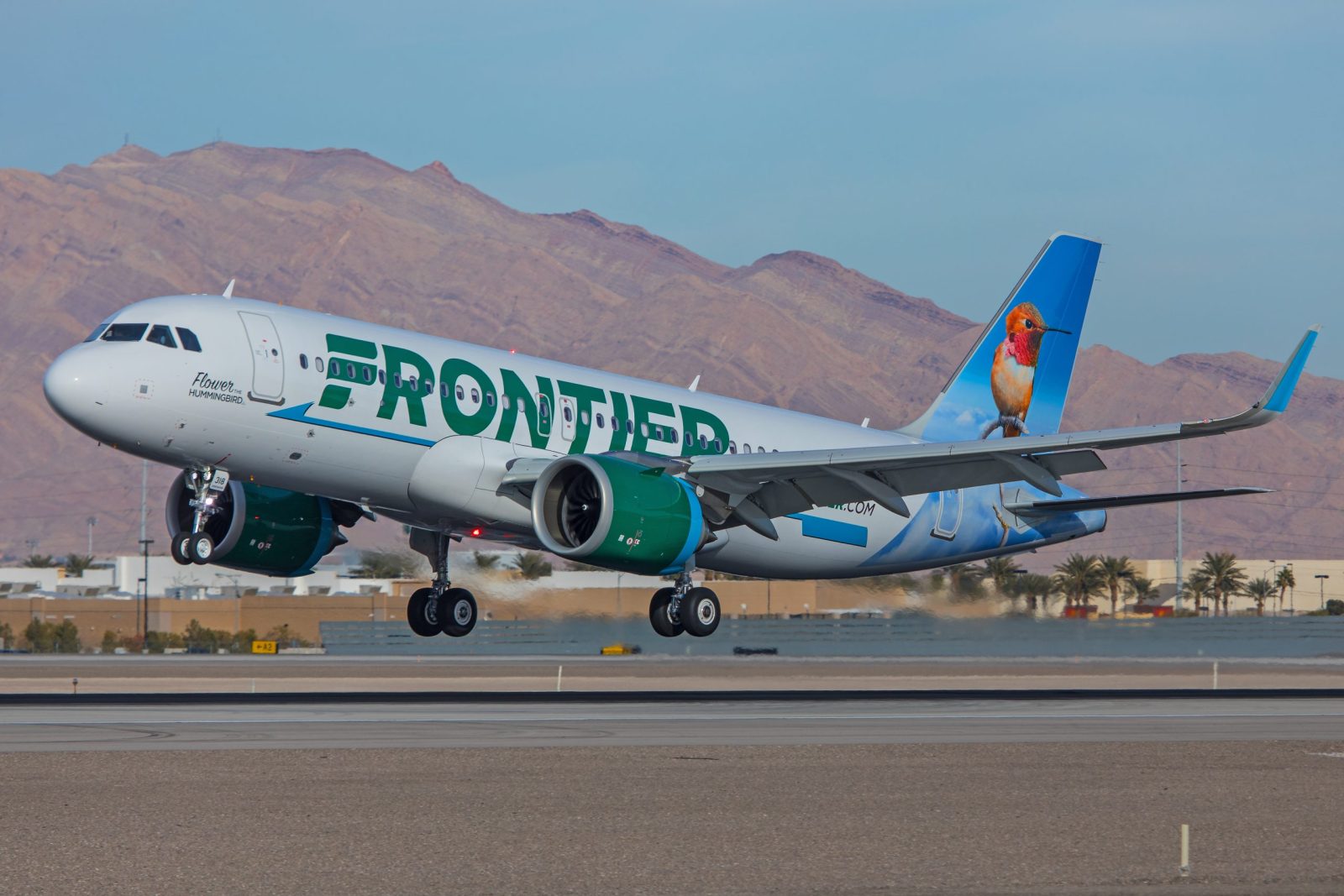
A Frontier Airbus A320neo in Las Vegas. (Photo: AirlineGeeks | William Derrickson)
On Tuesday, Frontier — one of the U.S. major ultra-low-cost carriers — announced plans to open a new crew base at Phoenix’s Sky Harbor International Airport. The crew base is set to open in November, later this year and is expected to be a base for 180 pilots and 275 flight attendants during the first year of operation.
Tuesday’s announcement comes just four weeks after Frontier and Spirit Airlines announced their $6.6 billion merger — creating the country’s largest low-cost carrier and the fifth-largest airline.
Currently, the Denver-based carrier operates 14 nonstop routes from the airport, with additional flight connection opportunities through the company’s broad network. The already large presence in Phoenix and the addition of a crew base give the carrier that much more potential to expand its network outward from this location.
Another indicator of Frontiers’ extensive growth is their fleet size. The carrier currently operates 110 Airbus A320 family aircraft, with that number set to triple by the year 2029 — thanks to the addition of 230 Airbus aircraft that are on order.
“We are currently the third largest airline at PHX based on a number of destinations served and we anticipate continued growth as our fleet and route network further expand,” President and CEO of Frontier Airlines, Barry Biffle, said. “Phoenix is a highly desirable place to live and our crew has been asking for a base at PHX for some time. Whenever we add a new crew base to our network, it creates more flexibility for our team members and greater opportunities for career growth.”
The crew base in Phoenix will be the airline’s eighth pilot base within the U.S. and its ninth flight attendant base. The move will not only benefit the carrier, but it will also be of great economic benefit for the city of Phoenix through the creation and addition of jobs — adding to the already 57,432 jobs supported by the airport. The crew base will also increase Sky Harbor’s $12.3 billion contributions in economic activity
“With our ultra-low fare business model that caters to leisure travelers, Phoenix is well poised to benefit from our continued growth at PHX as well as the economic gain derived from additional jobs and residents contributing to the local economy,” Biffle said. “We are extremely pleased to become an even stronger part of the greater Phoenix community and we thank our partners at Phoenix Sky Harbor International Airport for their continued support and collaboration, which has made today’s announcement possible.”
In addition to Phoenix, Frontier’s focus cities also include Trenton, N.J.; Tampa, Fla.; Orlando, Fla., Atlanta, Chicago, Denver, Las Vegas, Miami and Philadelphia.
“We look forward to welcoming the new crew base members and sharing the vibrant quality of life these new residents will enjoy in this community, “Phoenix Mayor Kate Gallego, said, in a news release. “This is a great advancement in Frontier’s continued growth and success in Phoenix.”
Chase Hagl grew up in Twin Falls, Idaho. His love and passion for Aviation landed him in Orem, Utah where he obtained a B.S. in Aviation Management with a minor in Business Management from Utah Valley University. Chase currently works as a flight attendant in Charleston, SC and is also the primary Inflight ASAP ERC representative for startup airline, Breeze Airways. His experience in the aviation industry spans back four years, working in areas including agriculture application, customer service, maintenance, and flight ops. In his free time, Chase enjoys road biking, astronomy, and flying.
Aeroflot A320 taxiing to the gate at Berlin Brandenburg. (Photo: AirlineGeeks|James Dinsdale)
The rapid evolution of the conflict between Russia and Ukraine has seen wide implications for commercial aviation, from the complete closure of airspace above Ukraine and Moldova to the strict limits imposed on Russian-registered aircraft by Western countries and the similar retaliatory measure put in place by Russia.
However, one area that is going to be profoundly affected by the new scenario full of restrictions emerging in Russia is the aircraft leasing market, in particular those companies that own the aircraft being operated by Russian companies. The European country most exposed to this risk is certainly Ireland. According to the Irish Times newspaper, the leasing company Aercap owns 149 aircraft operated in Russia and SMBC Aviation Capital has 34 jets leased to Russian operators.
These are just a fraction of the Boeing 777 leased aircraft currently being operated by Russian airlines, according to aviation data firm Cirium. 515 are owned by foreign firms for an estimated market value of $10 billion.
The Irish press is reporting that these companies are setting up specific task forces to repossess their assets and bring them out of Russia so that they can be repurposed to other operators. In fact, the present situation will most likely force most Russian carriers to ground a number of aircraft given the practical impossibility to fly international routes, and this is going to affect their ability to generate enough revenue to keep up with leasing payments. “You’re talking about roughly $100 million being paid out every month by Russian airlines to Irish-based leasing companies. If the banks that these airlines use are sanctioned, it’s going to be very difficult to make payments,” said Tim O’Connell, a Grant Thornton Ireland partner specializing in aviation advisory to the Irish Times.
Russia’s Banking Restrictions
The cash situation of Russian carriers will also be further hampered by the restriction affecting the financial services. The European Union and the U.S. have decided to exclude select banks from the global SWIFT system used by banks to exchange messages related to financial transactions. As a result, this will make it considerably harder, if not impossible to move funds in and out of Russia. Furthermore, this sanction imposed on the Russian banking system is expected to have a devastating effect on the exchange rate between the rubles and the U.S. dollar, which is the currency in which most if not all leasing contracts are regulated.
According to preliminary indications of the currency markets that were closed last weekend, the Russian ruble should lose more than half its value against the dollar, which in turn means that airlines will see their leasing bills double almost overnight — together with a number of other expenses.
The lessors are also faced with more complicated matters, as these leasing contracts may have as collateral a letter of credit from a Russian bank. However, if these banks are unable to honor these letters due to the sanctions this may lead to an unwanted exposure that may convince the lessor to repatriate their assets.
Vanni fell in love with commercial aviation during his undergraduate studies in Statistics at the University of Bologna, when he prepared his thesis on the effects of deregulation on the U.S. and European aviation markets. Then he pursued his passion further by obtaining a Master’s Degree in Air Transport Management at Cranfield University in the U.K. followed by holding several management positions at various start-up carriers in Europe (Jet2, SkyEurope, Silverjet). After moving to Canada, he was Business Development Manager for IATA for nine years before turning to his other passion: sports writing.
Aero California’s McDonnell Douglas DC-9s, Where Are They Now?
An Aero California DC-9 in Mexico City (Photo: Aero Icarus from Zürich, Switzerland)
Aero California — an iconic low-cost Mexican airline — has been missing from the skies since 2008. Its yellow, orange and red cheatline were arguably one of the best liveries around. It operated 35 McDonnell Douglas DC9s in total and amazingly nearly 14 years on, most of them can still be seen parked up in various places.
Founded in 1960, the airline didn’t actually start scheduled services until 1982 when the first DC9 joined the fleet. It wasn’t until 1988 that the airline started significant expansion. The original DC9 was disposed of and 10 more DC9s joined the La Paz, Mexico-based carrier by 1991. There was further expansion in the mid to late 1990s with the acquisition of another 12 DC9s. In 2005, it acquired another 11. The remaining DC9s it operated was on lease from Aeromexico but this lasted less than three months during 1997 before being returned.
After retiring a couple of the older machines and one of them being written off in 2004, Aero California had a fleet size of 30 DC9s in its heyday.
Unfortunately, it seemed this last major fleet growth was a step too far for the carrier from Baja California. The airline was suspended for alleged deficiencies of administrative and operative nature in April 2006 and forced to ground its fleet. The Mexican airline was reinstated but left 13 of its DC9s in storage. Unable to recover the airline was once again suspended in July 2008 for an alleged debt with Mexican Air Traffic Control. It was unable to overcome the suspension this time and the remaining 17 DC9s joined the others.
Where Are They Now?
The original DC9 was XA-BCS. Appropriately registered after the airline’s home state of Baja California Sur. Since it left in 1988 it was mostly operated by Evergreen in the USA. However, the aircraft found its way back to Mexico in 2020 with Aeronaves. The only one of the 35 DC9s is still in service.
XA-TFO, which was the short-term lease from Aeromexico has been preserved on a private ranch a couple of hours southwest of Mexico City near the town of Teacalco, Mexico. It can be seen on google earth at Rancho Joan Sebastian Alejandra.
Aero California registered a second DC9 XA-BCS shortly after the first one left the fleet. Its fate was sealed in 2004 when it overran the runway at Mexico City. It has remained there ever since and was joined by a further 5 aircraft when the airline ceased operations. They can be seen on wasteland just to the east of the airport boundary:
XA-BCS, XA-SWG, XA-UDF, XA-UDH, XA-UDS, XA-UEI
Eleven migrated to the USA and ended life at Mojave. Unfortunately, these are gradually being broken up, but it looks like at least eight of them can still be seen in some sort of disrepair:
Mark has been interested in aviation since the age of eight when he first went plane spotting at Manchester Airport, England. Trips around various European airports in the following years and then to the USA as a teenager furthered his desire.
This led to Mark wanting to work in the industry and at the age of twenty one was accepted to train as an Air Traffic Controller. After training and working for several years in England, Mark moved to Bahrain in the Middle East where he worked for six years. He then moved to Sydney, Australia where he resides today after twenty years in the profession.
Mark's pursuit to see planes has seen him visit over 140 countries and territories, including places, like North Korea, Sudan and Iran. He has flown over 1,100 times, visited over 700 airports and can always be found researching his next trip.
Sign-up for newsletters & special offers!
Get the latest stories & special offers delivered directly to your inbox