A GOL 737 MAX at Paine Field. (Photo: AirlineGeeks | Katie Bailey)
Low-cost airline GOL Linhas Aéreas Inteligentes S.A., one of Brazil’s leading carriers based in Rio de Janeiro, announced that they have signed a non-binding letter of intent with Avolon for purchase and/or lease of 250 electric vertical takeoff and landing aircraft (eVTOL).
Avolon is the world’s third-largest leasing business specializing in providing aircraft leases and lease management services to airlines and their investors. The company is based in Dublin, Ireland with offices worldwide including in the United States, Dubai, Hong Kong, Shanghai and Singapore. Currently, Avalon’s fleet consists of 837 aircraft, including aircraft leased by US carriers American Airlines, Delta Airlines, Hawaiian Airlines and Southwest Airlines.
“Today’s announcement represents a significant step in building an eVTOL ride sharing platform that will reshape the commercial aviation market in Brazil. Gol and Grupo Comporte both bring broad and diverse networks, along with proven track records in scaling multiple businesses, making them the ideal strategic partners for Avolon,” stated Avolon’s CEO Dómhnal Slattery. “Their unparalleled market access, coupled with our deep knowledge and relationships in the Brazilian aviation market, leaves us strongly positioned to capitalise on the expected demand for VA-X4 zero-emissions, ultra-short-haul transport.”
The Brazilian carrier placed the order for 250 VA-X4 eVTOL aircraft manufactured by Vertical Aerospace, a British aircraft manufacturer. Founded in 2016 and based in Bristol, England, Vertical Aerospace specializes in the designing and building of zero carbon, electric vertical take-off and landing aircraft.
Faster, Quieter, Greener, Cheaper
The Vertical Aerospace VA-X4 aircraft prides itself on its speed, quietness, affordability and sustainability. Reaching speeds higher than 200 mph, the vehicle is 100 times quieter than a helicopter at cruise. The eco-friendly aircraft produces zero emissions and is capable of carrying one pilot and four passengers at ranges of 100+ miles. Maximum performance of the aircraft is achieved through its lightweight carbon fiber composite airframe.
“The VA-X4 is ideal for a city like Sao Paolo with a population of over 22 million people. Our eVTOLs will transform how we travel around high population density cities that are clogged with traffic by taking to the skies with zero emissions aircraft,” said Vertical Aerospace CEO Stephen Fitzpatrick. “We look forward to working with our existing partners Avolon and our newest partners Gol and Grupo Comporte, on bringing this revolution in air travel to Brazil.”
The entity helping fund the project is Grupo Comporte, an entity in conjunction with the airline’s leading shareholder.
Founded in 2001, GOL currently operates a fleet of 127 Boeing 737 aircraft. Utilizing these aircraft, the airline leads in Brazil’s corporate and leisure segments and continues to operate with the lowest unit cost in Latin America.
The VA-X4 could quite possibly be the first commercial aircraft utilized by airlines that has a zero carbon footprint. It will be exciting to see how the carrier decides to utilize the aircraft and which direction they move in developing this unique route network. The aircraft will help GOL further capitalize in the corporate and leisure market segments with its plans to begin operations in 2025.
Chase Hagl grew up in Twin Falls, Idaho. His love and passion for Aviation landed him in Orem, Utah where he obtained a B.S. in Aviation Management with a minor in Business Management from Utah Valley University. Chase currently works as a flight attendant in Charleston, SC and is also the primary Inflight ASAP ERC representative for startup airline, Breeze Airways. His experience in the aviation industry spans back four years, working in areas including agriculture application, customer service, maintenance, and flight ops. In his free time, Chase enjoys road biking, astronomy, and flying.
An AirBaltic Airbus A220 painted in Estonia's flag.
(Photo: AirlineGeeks | Fabian Behr)
The lengthy, ongoing circumstances and challenges from the Covid-19 pandemic are evolving and continue to be at large as new scientific developments emerge. Simultaneously, the airline industry has been attempting to be constantly responsive and alert, adapting to overcome obstacles from the dilemma. Passenger travel demand continues to experience ebb and flow, gradually rising as travel restrictions are eased and more borders reopen.
While some travel safety protocols remain in place, the higher passenger load factors encouraged several major airlines like airBaltic to hire more staff to accommodate the surge ahead of time, along with adding new flight frequencies while expanding its fleet in favor of more efficient aircraft.
Currently, 320 brand new crew members consisting of 120 pilots and 200 flight attendants are expected to join ahead of the summer 2022 holiday and leisure travel season. The Latvian flag carrier plans to welcome back former pilots who were released from duties at the height of the Covid-19 predicament last year as well as graduates from the airline’s pilot academy.
“We are pleased to see a growing demand for travel and have launched various new destinations this year. In line with an increasing vaccination coverage worldwide and eased travel restrictions, we are ready to scale our flight operations again. That is why we have come to a decision to rehire our former employees and add new team members to our crew for the next summer season,” Martin Gauss, Chief Executive Officer of airBaltic, said.
Meanwhile, as the airline’s workforce returns and grows for its flight operations, the carrier intends to expand its fleet of Airbus A220-300s by the end of next year after recently receiving its 31st aircraft, which was the carrier’s sixth of seven deliveries expected this year. The Riga-based carrier solely operates this aircraft variant after strategically planning and deciding to phase out its older and less efficient Boeing 737s in 2019 and 2020.
Gauss added, “In 2022, we also plan to receive eight additional brand new Airbus A220-300 aircraft. By hiring additional flight crew now, we will continue our preparations for performing flights with a fleet of 40 aircraft which we expect to have by the end of 2022.”
airBaltic’s Regional Presence
Throughout the Covid-19 conundrum, airBaltic sustained its flight operations, which potentially played a significant role in staying afloat and preserving its route network. In mid-September, the carrier announced that its current route network exceeded its offering from 2019. The airline currently flies nearly 90 routes from its hubs in Riga, Latvia; Tallinn, Estonia and Vilnius, Lithuania.
“airBaltic connects the Baltic region with over 30 different countries. Thanks to a strong codeshare network of 24 different partners, many of whom offer global connectivity, airBaltic passengers can conveniently reach many regions of the world,” Gauss said, a philosophy accurately portrayed by the carrier’s strategy and the decision to receive more aircraft, pump hundreds of more seats and strengthen its workforce.
Clearly, airBaltic is preparing itself to have a larger presence across Europe and being attentive to the ongoing trends within the aviation industry. There is no doubt that passengers are eager to travel next year as well, and crew members are needed to operate the flights. However, it is imperative that airBaltic is aware of the new costs and smoothly integrating the staff and aircraft back into operations.
Benjamin has had a love for aviation since a young age, growing up in Tampa with a strong interest in airplane models and playing with them. When he moved to the Washington, D.C. area, Benjamin took part in aviation photography for a couple of years at Gravelly Point and Dulles Airport, before dedicating planespotting to only when he traveled to the other airports. He is an avid, world traveler, having been able to reach 32 countries, yearning to explore and understand more cultures soon. Currently, Benjamin is an Air Transporation Management student at Arizona State University. He hopes to enter the airline industry to improve the passenger experience and loyalty programs while keeping up to how technology is being integrated into airports.
First COMAC C919 Sets to Deliver by the End of 2021
The Comac C919 after receiving its type inspection authorization. (Photo: Comac)
The first deliverable COMAC C919, a Chinese-designed narrow-body jet, is now entering the final assembly process at the manufacturer’s Shanghai factory, aiming for a year-end delivery for this highly anticipated jet. China Eastern will be the owner of the first C919, and its maiden flight is projected to take off in the first half of 2022.
The C919 roll out marked a milestone for Comac. (Photo: Zhang Anchao/Comac)
According to the news shared by the Eastern China division of the Civil Aviation Administration of China (CAAC), the Production Certification Board (PCB) of the division audited the manufacturing plan and overall testing of the jet before the first deliverable C919 entered the final assembly. The C919 was originally planned to be delivered to customers by 2016. However, the timing was pushed back multiple times due to technical difficulties.
Currently, the aircraft has over 900 orders, three hundred and fifty of which are confirmed orders; the only confirmed order from a company outside of Greater China is an order for 10 C919s from GE Capital Aviation Services (GECAS), and the ordered jets will likely be leased to Chinese airlines as well.
C919 Development Process
The first COMAC C919 completed production in November 2015 and took off for the first time on May 5, 2017. A fleet of six test aircraft are completing certification at multiple airports in China. Like other mainstream aircrafts, C919 has a global supply chain to obtain the more advanced aviation technology.
The Aviation Industry Corporation of China (AVIC) will produce the fuselage and many other components for C919. Additionally, the aircraft is equipped with LEAP-1C engines made by CFM International, the same manufacturer that makes engines for the Boeing 737MAX and Airbus A320neo. The Chinese-made engine for the aircraft is still under development and is planned to enter service by 2025.
Other than AVIC and CFM, Honeywell, Rockwell Collins, and many other leading aviation manufacturers will be suppliers for C919. Leveraging established foreign suppliers for C919 is also one of the strategies of COMAC to have global customers trusting its product.
The C919’s Role in the Global Fleet Outlook
According to the latest forecast by Boeing, until 2040, the global narrow-body aircraft market is projected to need more than 32,500 new aircraft, three times the current on-hand orders of Boeing 737MAX and Airbus A320neo planes. Among the 32,500 new aircrafts, 8,700 will be delivered to Chinese carriers.
New players are joining the competition for the enormous unfulfilled demands of the market. Russia’s Irkut MS-21 is also targeting this market, and Irkut is expected to make the first delivery of MS-21 to Rossiya Airlines, a subsidiary of Aeroflot, in 2022. C919’s entrance to the market will likely not cause any short-term impact to Boeing or Airbus. However, the Chinese state-owned manufacturer is likely to obtain help from the government to push sales to the largest airlines in China, which are state-owned as well. That may cause Boeing and Airbus to lose sales to major customers such as Air China, China Southern and China Eastern, all of which have hundreds of 737s and A320s.
As one of the nation’s most ambitious projects to uplift development, the Comac C919 is certainly bearing the hope of China to demonstrate the country’s rejuvenation. However, with all the uncertainties of international relations and geopolitical situations, only time will tell whether this aircraft can carry the wish of the entire nation to climb through the cloud.
Lei is from Inner Mongolia, China, and now lives in Guangzhou. He grew up in an aviation family, where his passion began. During his time at Penn State University, he studied Industrial Engineering specializing in operations research, and he graduated with an honor’s thesis on airport gate assignment optimization. Now, he is a Purchasing Manager with Procter & Gamble. In his free time, he enjoys flying, reading, and wandering around the city.
An Alitalia A321 (Photo: AirlineGeeks | William Derrickson)
The change of the guard between the historic Alitalia and the newly created ITA as Italian flag carrier is less than a month away, but the situation is far from defined. Alitalia is going through its bankruptcy procedure and will stop flying on Oct. 15; on the same date, the new state-owned carrier Italia Trasporto Aereo (ITA) will take over some of its routes and will begin its adventure with 52 aircraft and 2,800 employees, putting it at roughly half the size of its predecessor.
The latest phase of Alitalia’s bankruptcy is quite delicate as the Alitalia brand has been put up for auction, and it will be awarded to the best bidder. The European Commission did not allow ITA and Alitalia to include the brand in the transfer of the assets that built ITA’s skeleton since one of the guiding principles of this operation was the need for a clear break between the old company and the new one. However, ITA could really use Alitalia’s brand: it would save the new carrier a lot of time and money exploiting the awareness that the green, white and red ‘A’ logo already has around the world.
Despite being evaluated approximately 150 million Euros ($175.9 million) on Alitalia’s books, the brand is being put for auction at a starting price of 290 million Euros, plus 22% V.A.T. and related fees. Parties interested have until Sept. 30 to request access to the data room and until Oct. 4 to place a binding offer with a 40 million Euros advance. Should there be no offers during this period, there will be a second auction with no minimum starting price.
Of course, ITA appears to be the most obvious bidder for the Alitalia brand: it certainly has more value to them than to anyone else, but there could be other bidders that may take part in the auction just to deprive ITA of a useful tool like an already established brand and force them to start from the beginning or to push the price higher in order to compel ITA to burn a higher percentage of the 1.3 billion Euros they have available to start operations, from the total of 3 billion Euros earmarked for ITA by the Italian Government.
The most obvious culprit for the predatory operation could be Irish low-cost airline Ryanair, which has already complained many times about the multiple state handouts Alitalia has benefited from in the past.
But the auction of the Alitalia brand is not the only problem ITA has to face just weeks before its inaugural flight. Negotiations between the company and trade unions for the work contract of the 2,800 employees broke down earlier this week, and a strike has been declared for Friday, Sept. 25. The Unions are trying to preserve as many jobs as possible for the almost 6,000 existing Alitalia employees who may or may not be called to join the new ITA, and they are also requesting the same conditions granted at Alitalia to remain in the new company.
A new industrial action, however, is only going to weaken even further a carrier whose operations are winding down and that is already in a very dire financial situation. Italian financial newspaper “Il Sole 24 Ore” reported that Alitalia’s debts towards Italian airports have already surpassed 100 million Euros and have reached “unsustainable levels.” Furthermore, public support for protesting Alitalia’s employees is at an all-time low, as those who will not be able to join ITA will benefit from a very generous arrangement granted by the Italian law that will see them continue to receive 80% of their salaries for up to seven years, with full pension contributions paid by the Italian taxpayers.
Vanni fell in love with commercial aviation during his undergraduate studies in Statistics at the University of Bologna, when he prepared his thesis on the effects of deregulation on the U.S. and European aviation markets. Then he pursued his passion further by obtaining a Master’s Degree in Air Transport Management at Cranfield University in the U.K. followed by holding several management positions at various start-up carriers in Europe (Jet2, SkyEurope, Silverjet). After moving to Canada, he was Business Development Manager for IATA for nine years before turning to his other passion: sports writing.
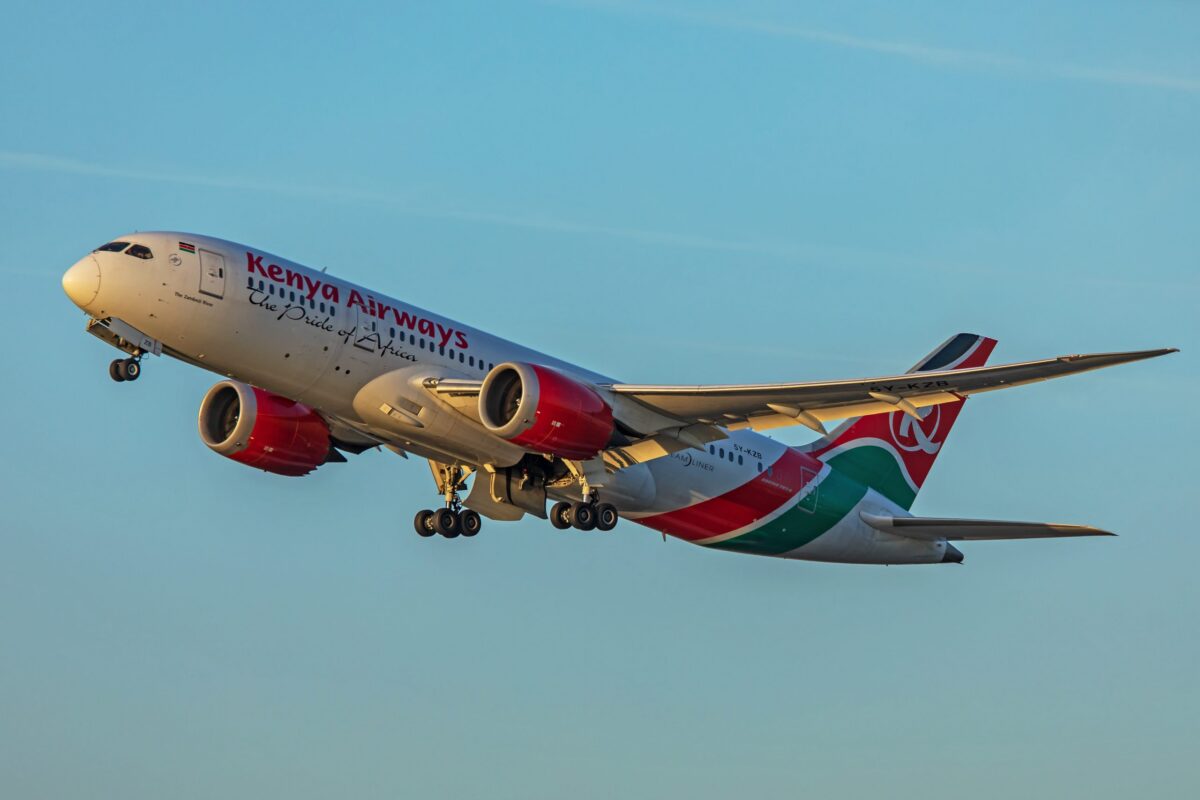
Kenya Airways Leases Embraer Aircraft to Congo Airways, Leverages On New Partnership
According to CH-Aviation, 5Y-FFM and 5Y-FFL, both Embraer E190 aircraft, were ferried from Nairobi to Kinshasa on September 15 and 16, respectively, and are expected to boost domestic operations and flight frequencies in the Democratic Republic of Congo.
The two aircraft mark the beginning of E190 service at Congo Airways and joins a current fleet of two Dehavilland 8-Q400s and two Airbus A320-200s.
Congo Airways’ CEO Pascal Kasongo Mwema Mwenda said, “Increased air connectivity will offer more choices to passengers in the DRC and between the two countries. It will also provide better connectivity to international destinations, enabling both countries to fly to a better future and build a resilient aviation industry that can stand the test of time.”
“The Government has reduced fares on domestic routes. The demand became high and Congo Airways needs more capacity,” Director (Cooperation and Cargo) Norbert Sengamali Lukukwa speaking to media outlet ch-aviation.
Part of the strategic partnership between the two carriers, Kenya Airways will offer courses through its Pride Centre and explore the exchange of technical personnel in various areas to ensure skills transfer between the two airlines.
Kenya Airways Group MD and CEO Allan Kilavuka hailed the partnership as the first of many steps in actualizing Pan Africanism by creating a model for cooperation between two African Airlines, which will contribute to Africa’s socioeconomic development.
“KQ is a key player in the aviation space in Africa, and with over 40 years of experience, this is an important step in enhancing cooperation to increase air connectivity and offer greater passenger and cargo options between the two countries,” said CEO Allan Kilavuka.
“The timing of this agreement is correct, considering the severe impact of the COVID-19 pandemic on the aviation industry, as it will increase the utilisation of our aircraft,” he added.
Increased Cargo Operations
Besides the lease agreements, Kenya Airways commenced direct cargo flights from Johannesburg to Lubumbashi in the DRC.
Speaking about the newly launched cargo direct flights between Johannesburg and Lubumbashi, Kilavuka added that, “Cargo has provided new opportunities in the face of the pandemic, and we are keen to continue building our operations and leveraging partnerships.”
“The enhanced network is built around KQ’s southern Africa operations in Johannesburg and is expected to provide further connections to additional points within the DRC and Africa. This will provide customers with more convenient schedules and capacity at a time when the global industry has suffered capacity shortfall due to the pandemic as well as improve profitability of KQ’s regional freighters on the return sector from Johannesburg,” he explained.
The two airlines will also codeshare on Kenya Airways’ cargo network.
Victor Shalton's love for aviation can be traced to when he was 11-years-old. As a seasoned aviation writer, he takes pride in providing the best aviation coverage around the globe and is passionate about advancing his skills in the aviation space. In addition, he loves travelling, writing, arts and while his speaking engagements have taken him around the world, he is proud to call Nairobi home.
A Lufthansa 747-8i at LAX (Photo: AirlineGeeks | William Derrickson)
German flag carrier, Lufthansa, has brought their last Boeing 747 out of storage from Twente Airport to be returned to service. The Twitter account for the Twente Airport in the Netherlands tweeted out photos of the German queen departing for Frankfurt. From there the aircraft will go through the process to return to regular passenger flight. The aircraft, D-ABTL, had been in storage at the Dutch airport for 15 months.
The last @lufthansa Boeing 747, #DLH1ENS, safely departed from Twente Airport today. After 15 months of parking, she flew back to Frankfurt to return to service. We wish you a lot of good flights with this Queen of the Skies! ? pic.twitter.com/rUc7IhFmYx
Last year Lufthansa, like many carriers, sent nearly all of its large, long-haul aircraft to storage as the Covid-19 pandemic took its hold around the globe. As restrictions went in place, demand almost completely dried up for air travel. The Lufthansa Group, which includes Lufthansa, Austrian, Swiss, Eurowings, and Brussel Airlines, parked 700 of the group’s 763 aircraft towards the end of March 2020. Demand has begun to pick up again as restrictions lift and vaccinations allow travel to resume.
The Boeing 747 became a heavy casualty of the pandemic. British Airways retired its entire fleet of Boeing 747 aircraft in October last year. The airline had been one of the largest passenger operators of the aircraft prior to the onset of the pandemic. The airline was expected to keep the aircraft till 2050 and had even refreshed the interior of some aircraft prior to being parked. KLM and Qantas, also large passenger operators of the 747, retired their fleet of Boeing 747 due to the Covid-19 pandemic.
Retirements Speed Up Due to Pandemic
Even before the pandemic the Boeing 747 was declining in use in passenger operations. The onset of more fuel-efficient long haul aircraft, such as the Boeing 787 and the Airbus A350, has led airlines to retire the Queen of the Skies. However, the airliner still remains popular with cargo and ad-hoc operators, like UPS, Atlas Air, and Cargolux. Cargo airlines use older aircraft as they can be cheaply acquired and they use the aircraft less frequently than passenger airlines.
The Boeing 747 wasn’t the only aircraft casualty from the pandemic. Lufthansa announced last year that it would retire its Airbus A380 aircraft completely due to the pandemic. Some of Lufthansa’s A380 aircraft were only six years old when they were retired. The decision is opposite to British Airways, who although retiring their Boeing 747, have announced that their fleet of Airbus A380’s will return to service at some point.
The emptying of stored aircraft shows that air travel is beginning to rebound as preventative measures for Covid-19 become widely available. The return of the last 747 from Twente also coincided with the announcement from the United States government to allow vaccinated UK and EU citizens to enter the country again. The border had been closed to UK and EU citizens since March 2020 as a strong mitigation method to prevent the spread of the then little-known virus. This combined with the lessening of restrictions across the continent should give European carriers a glimpse of life for what was looking to be another dark winter.
Daniel has always had aviation in his life; from moving to the United States when he was two, to family vacations across the U.S., and back to his native England. He currently resides in South Florida and attends Nova Southeastern University, studying Human Factors in Aviation. Daniel has his Commercial Certificate for both land and sea, and hopes to one day join the major airlines.
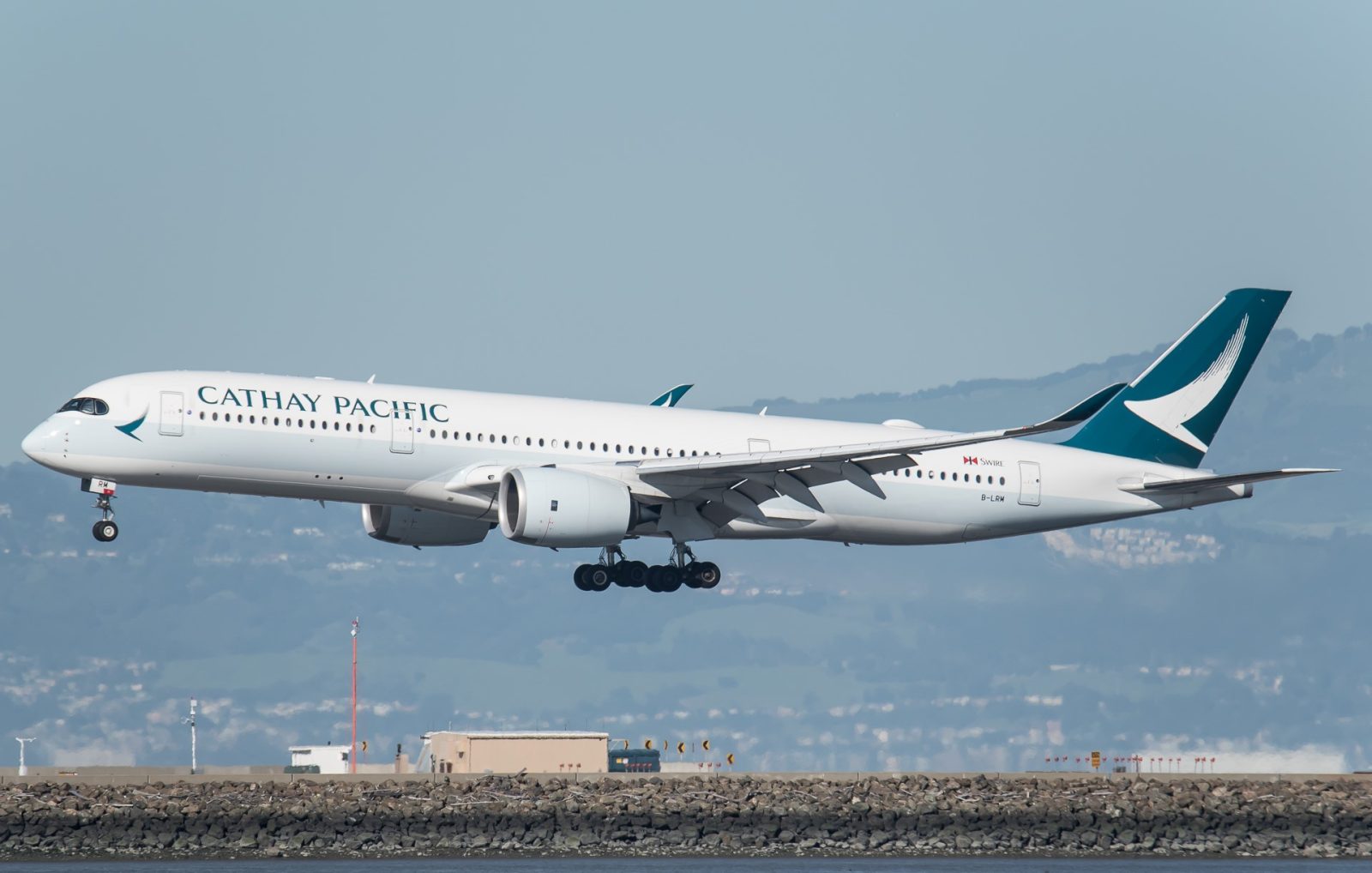
A Cathay Pacific A350. (Photo: AirlineGeeks | Ben Suskind)
Cathay Pacific is celebrating its 75th anniversary. However, the airline is also facing its biggest challenge at the same time.
The Hong Kong-based carrier announced its traffic figure for August, when it carried 135,353 passengers, an increase of 278.4% compared to August 2020, but a 95.3% decrease from August 2019.
Earlier, Cathay Pacific forecasted to operate 30% of pre-pandemic by the end of the year, but many global travel restrictions remain in place. The airline revised its forecast and expects to maintain similar passenger capacity levels to last month for the remainder of the year.
In response to the increase of student traffic, the airline has seen “some improvement” in the performance of its passenger business in the last month. The passenger capacity increased by 81% compared with July and the load factor reached 46.4%, the highest number since the pandemic begun. Cathay Pacific currently operates 13% of pre-pandemic levels.
In the wake of the surge in demand, Cathay Pacific has resumed services to Chicago, Boston, Manchester, U.K, Paris, Phuket, Thailand and Qingdao, China. Meanwhile, its New York, San Francisco and Los Angeles services have seen capacity increases. Also, the airline has increased its frequencies to the Shanghai to three times a day.
Since the pandemic has begun, Hong Kong has implemented the most restrictive Covid-19 policies. Last month, the government tightened up quarantine rules for travelers from 16 territories, and inbound traffic has been seen a drop after Aug. 20 as a result.
During the pandemic, cargo services have become the airline’s main source of income. Cathay Pacific’s cargo capacity has increased 9% month on month, although August is not the cargo peak season. The cargo capacity was approximately 66% of its August 2019 pre-pandemic levels. According to Hong Kong International Airport, cargo recorded a year-on-year increase of 15.5% to 429,000 tonnes.
Cathay Pacific emphasized that it will focus on prudent cash management, targeting cash burn of less than $128.4 million per month for the rest of 2021. For cargo, the airline forecasts a “strong peak season driven by the need for inventory replenishment.”
In response to prolonged pandemic, Cathay Pacific will close its London pilot base following the closure of bases in Australia, New Zealand, Canada and Germany. London-based pilots could be laid off or relocate to Hong Kong.
“The decision is not one we have taken lightly and does not reflect on the professionalism of the pilots based in London.” The airline said in a statement. Meanwhile, the struggling airline is reviewing the U.S pilot bases.
Earlier, the airline mandated its employees take the vaccine, saying about 93% of Hong Kong-based employees have been inoculated, including 99% of pilots and 93% of air crew. According to local media, around 60 to 80 staff will be sacked after refusing to take the vaccine.
Deboarding Volotea's A320 EC-NON in Pisa. (Photo: AirlineGeeks | João Machado)
This is Part Three in a short series of trip reports aboard European ultra-low-cost carriers. To view Part One, click here, and to view Part Two, click here.
As explained in the previous article, the plan was to fly DAT from Catania, Italy to Olbia, Italy then return to Pisa, Italy in the same night. In June, Volotea opened a base in Olbia, so they had quite a lot of destinations from that city. Thankfully, Pisa was one of them.
Originally founded in Spain, Volotea is a small player in Europe, but one that saw considerable growth during Covid-19 in terms of trying different strategies and routes, as most ultra-low-cost carriers did, benefitting from a leaner structure and European Union rules that allow the free flow of foreign airlines within member countries, which, for example, allow Malta Air and Volotea to operate domestic operations in Italy. In January, it said goodbye to its last Boeing 717, reaching a fleet composed only of the efficient A319s and A320s.
Volotea has an awesome website, very easy to use and find the best fares for a specific route, though I think the calendar (as seen below) could be a little bit smaller, so the overview of dates could be easier and wider. The booking process and ancillary-dodging was also quite easy, and in few minutes, I had my ticket confirmed in my email inbox.
Volotea’s fare search engine is very easy to use. (Photo: AirlineGeeks | João Machado)
It was a sweet deal, too. I paid 19 euros ($22) for the one-way trip a month before the flight.
Following the local aviation news, it became clear to me that Volotea and WizzAir were struggling massively with their on-time performances in Italy during the summer, with the national Civil Aviation regulator even calling both out for their continued disruptive performances. So it came as no surprise to me when I received an email a month before my flight saying they had delayed the departure time 15 minutes.
However, I didn’t really buy their claim that the delay was “given the current context of uncertainty about the evolution of the Covid-19 pandemic.” Not everything in the world happens because of Covid, it’s nice to remember sometimes.
Email informing the rescheduling of my flight with Volotea. (Photo: AirlineGeeks | João Machado)
I also bought their food selection during the booking process for 5.65 euros, which was a sweet deal as I could then skip dinner by having hot noodles and a soft drink.
I arrived at Olbia Airport with a lot of time to spare. The terminal looked neat and quite comfortable even in the peak of the summer season.
Olbia Airport’s terminal. (Photo: AirlineGeeks | João Machado)
Bar Rome’s Fiumicino Airport, it’s the best terminal I’ve used so far in Italy, very modern and fresh.
Olbia Airport’s check-in area. (Photo: AirlineGeeks | João Machado)
I really hope I can return with a little bit of time.
A view at Olbia Airport’s apron. (Photo: AirlineGeeks | João Machado)
As the night fell and the time of the flight approached, I got to my gate, which was on ground level. This meant boarding would be in a remote position. It was full, but not excessively crowded.
Remote boarding area in Olbia Airport. (Photo: AirlineGeeks | João Machado)
Boarding was called on time, however, and the passengers that were cleared started to get rounded up in two bays to the left and to the right of the gate, adjacent to the gate itself, while we waited for the buses. This generated unnecessary crowding. Why didn’t they just leave everyone in line waiting for the next bus? I don’t know.
Boarding in Olbia on Volotea’s flight to Pisa. (Photo: AirlineGeeks | João Machado)
This is what I don’t get from airlines during the pandemic. They speak so much about having and following Covid-19 protocols, only to take actions like this and to crowd buses.
Anyway, tonight’s flight would be operated by EC-NON, an Airbus A320 that, according to Airfleets, was received by Volotea on July 1, in the same month I took the flight. This meant the cabin, already in Volotea’s standard, was really well maintained. The airframe was built in 2008 and was originally operated by Thai AirAsia, operating for the carrier until its phase-out in November of last year.
Boarding EC-NON. (Photo: AirlineGeeks | João Machado)
I quite liked Volotea’s cabin. It was pretty comfortable. Contrary to many ULCCs, that cram 186 seats into the A320, the airline chose to have only 180. The leather gave the 13-year old bird a very fresh look.
Seats in Volotea’s A320. (Photo: AirlineGeeks | João Machado)
Seat pitch was alright, too, and the solution the airline found to avoid having seatback pockets was also quite smart.
I had been allocated seat 8C, on the aisle, and asked the flight attendant if I could pick a window. She told me after boarding was finished I could.
Standard seat pitch in Volotea’s A320. (Photo: AirlineGeeks | João Machado)
Doors were closed one minute before the scheduled time of departure 9:09 p.m. At that point, the flight attendant offered me an emergency exit seat, but I prefered to stay in 8C. The flight was quite full anyway, with 154 passengers making for an 86% load factor.
At 9:14 p.m., EC-NON was taxiing. A rapid take-off from runway 23 followed at 9:20 p.m. and the Airbus easily lifted for the 40-minute leg to Pisa.
Soon after we were airborne, I opened my cellphone to try the mobile entertainment Volotea subtly promoted in their seatback advertisement space.
Advertisement on Volotea’s A320 seat. (Photo: AirlineGeeks | João Machado)
It did work. The interface was good, and so were the entertainment options, let alone for a short flight like this.
Homepage of Volotea’s entertainment system. (Photo: AirlineGeeks | João Machado)
My entertainment option of choice, however, didn’t work properly, so I resigned myself to trying deciphering the safety instructions on the tray table.
Safety instructions in Volotea’s A320. (Photo: AirlineGeeks | João Machado)
Anyway, soon we had passed the 10,000 feet mark.
The malfunctioning flight map in Volotea’s A320. (Photo: AirlineGeeks | João Machado)
I was waiting to see how the service would work on a short flight like this. Unfortunately, shortly afterward the flight attendant said over the PA that, owing to operational issues, they would not serve anything, with the customers that pre-ordered their meals being refunded.
It’s a shame since the flight would arrive quite late in Pisa, and I’d prefer having spent that 5.65 euros on a meal and a drink rather than paying scam prices in the airport.
The rest of the flight was very uneventful. Soon descent was started and EC-NON made a smooth landing back in the Italian mainland at 9:59 p.m., 21 minutes before schedule.
A short taxi to the parking position followed, and the aircraft stopped. And there we went for a row-by-row deboarding only for everyone to be cramped in a bus to the terminal.
Anyway, I stayed a little to photograph the empty cabin. The flight attendants, who were Spanish and located in the Olbia base just for the summer, told me the food was actually not served because the flight was too short. Then why did they sell pre-ordered food in the first place?
Not only that, but Volotea was not capable of refunding the actual price of the meal. I had paid 5.65 euros for it and they only refunded 5.50 euros. Of course, that is nothing, but it shows a lack of care in a situation where things were mishandled. They should not have even sold that meal in the first place. Very disappointing.
Apparently Volotea was not aware of the correct value I had paid them for the food they did not offer. (Photo: AirlineGeeks | João Machado)
Anyway, at least the flight attendants were in a great mood, and I got at least a glass of water while everyone waited for the next packed bus to the terminal.
Cabin of Volotea’s A320 EC-NON. (Photo: AirlineGeeks | João Machado)
Soon I was on the bus, not without registering a detail I like about Volotea’s livery. All of its aircraft have this funny decal which say, “Mom, I’m arriving” near the door in the languages of the countries they serve. EC-NON’s was in French — “Maman, j’arrive”.
Detail of EC-NON. (Photo: AirlineGeeks | João Machado)
The bus trip was quick — Pisa is not a particularly big airport — and soon I was out of the airside in the overpriced bar, which thankfully was still open, having dinner.
Final Remarks
Out of the three low-costs I flew, Volotea was the least impressive, perhaps because the flight was so short. Sure, charging for a meal you did not actually sell and then not returning the full value I had paid did not leave a good impression on me, but at least they got me from point A to point B — and what’s better, in time, a fear I had they wouldn’t.
All in all, they offered very good prices, the crew was cool and the cabin was comfortable. All things equal, I would opt for Ryanair or Wizz over Volotea, but if they can gain me on price or they are the only carrier in a route I’m looking at — as they were this time — I’d definitely fly with them again…I just wouldn’t risk pre-ordering a meal.
João has loved aviation since he was six-years-old when he started visiting his home airport in Porto Alegre, southern Brazil. As he always loved writing, in 2011, at age 10 he started his very own aviation blog. Many things have happened since then, and now he is putting all his efforts into being an airline executive in the future. João currently lives in Siena, Italy, where he studies Economics and Management at Unisi.
A Sun Country 737 lifts off.
(Photo: AirlineGeeks | William Derrickson)
Sun Country Airlines has revamped its inflight menu to consist of several new food and beverage options sourced from local Midwestern brands. The Minneapolis-based carrier has newly partnered with Caribou Coffee, Fulton Brewing and Dot’s Pretzels, all Minnesota-based companies, as part of its new initiative to provide a more Midwest experience to travelers on its flights.
In addition to a Midwest-sourced food and beverage program, Sun Country is also screening 15 Minnesota-themed movies and TV shows as part of its free onboard offerings. Travelers will be able to enjoy titles such as Purple Rain, The Mighty Ducks, Grumpy Old Men, The Mary Tyler Moore Show and Juno.
Travelers on any of Sun Country’s 95-plus routes in the U.S., Mexico, Central America and the Caribbean will be able to peruse the new buy-on-board items in phases beginning as early as this month. The partnership with Caribou Coffee, Fulton Brewing and Dot’s Pretzels is in addition to the airline’s existing partnerships with Midwest brands, including Prairie Organic Spirits and Jack Link’s Protein Snacks.
Sun Country has partnered with Caribou Coffee, Fulton Brewing and Dot’s Pretzels, all Minnesota-based companies, as part of its new initiative to provide a more Midwest experience to travelers on its flights. (Photo: Sun Country Airlines)
As part of its partnership with Caribou Coffee, Sun Country has designated Caribou Coffee the “Official Coffee” of Sun Country Airlines. The partnership also includes a $250,000 investment by Sun Country in galley equipment upgrades onboard its Boeing 737 jets to ensure the high flavor quality and consistency of Caribou Coffee freshly brewed across its fleet.
As part of these upgrades, however, Sun Country flights won’t begin serving complimentary fresh-brewed Caribou Coffee to passengers until early 2022 when these upgrades are completed. In the meantime, ready-to-drink Cold Brew cans are now available for purchase.
Beginning this week, travelers will be able to purchase Fulton Brewing’s “Sweet Child of Vine” IPA. Sun Country will also continue to stock the Minneapolis brewery’s Lonely Blonde Ale, which has stayed on the in-flight menu since 2019.
Passengers who purchase tickets in Sun Country’s “best seats,” will receive a complimentary bag of Dot’s Pretzels. Additional bags of Dot’s pretzel and other snack options are also available for in-flight purchase.
“We are thrilled to share more of what Minnesota has to offer onboard our flights,” said Brian Davis, Sun Country’s chief marketing officer. “With the addition of new local products from our friends at Caribou, Fulton Brewing and new food offerings like Dot’s Pretzels, we can share a little more of our hometown with our guests.”
To entice travelers to try the new Minnesota items, the airline offers the “Hometown Flavor Bundle” which gives travelers a discount for choosing Minnesota-based items. For example, travelers who purchase any Minnesota beer or liquor will be able to save $1 off the purchase of any snack.
Despite being a low-cost carrier, Sun Country provides free in-flight entertainment and complimentary non-alcoholic beverage service onboard its flights, including fruit juices, Coca-Cola, tea and coffee. The airline only charges for its snacks and alcoholic beverages. The airline has remained committed to supporting local and family-owned businesses, especially during the Covid-19 pandemic.
Most people hate long flights or overnight layovers, but Albert loves them. The airport and flying parts of traveling are the biggest highlights of any trip for him – as this avgeek always gets a thrill from sampling different airline cabin products and checking out regional developments happening at local U.S. airports. He’s flown on almost every major carrier in the U.S. and Asia Pacific, and he hopes to try out the new A350s soon.
Albert recently completed his undergraduate studies in Business Accounting at USC in Los Angeles and he is currently recruiting for a corporate analyst position at one of the U.S. legacy carriers. During his college years, he interned at LAX for Los Angeles World Airports working behind-the-scenes (and on the ramp) in public relations and accounting. Outside of writing for AirlineGeeks, he enjoys trekking the Hollywood hills, visiting new hotspots throughout SoCal, and doing the occasional weekender on Spirit Airlines.
DOT Holds Ex-Southwest Gates for Low-Cost Carrier Use Only
Frontier, Spirit and Southwest planes meet in Orlando (Photo: AirlineGeeks | Ian McMurtry)
After the departure of Southwest from Newark Liberty International Airport, the Department of Transportation noted that those vacant slots would not go to any airline moving forward. The government agency announced that the airport will freeze the eight vacant landing slots into New Jersey’s largest airport and will only be unfrozen once a low-cost carrier or ultra-low-cost carrier sees the need to use them for further expansion.
The airport is currently a hub for United Airlines, but has seen expansion and competition in recent years from JetBlue, Spirit, Sun Country and Allegiant. The airport hopes that in doing this, it will promote low airfare and keep existing legacy carriers from absorbing the gates previously used by Southwest.
Southwest vacated service to six cities when it pulled flights back in 2019, citing that the entire market was not profitable for the airline. Those routes included service to Chicago, Nashville, Austin, Denver, Phoenix and St. Louis. All six routes are covered by other airlines, with St. Louis being the only route to sit under United’s sole control. At least one low-cost carrier — ranging from Frontier to Spirit to JetBlue — competes on the other routes.
Southwest also still serves some of the retired Newark routes in the New York City market through New York’s La Guardia Airport. The airline flies to Chicago, Nashville, Denver and St. Louis from the airport, while Austin and Phoenix services were lost completely when the low cost carrier departed the New Jersey airport.
JetBlue offers the most routes of the low-cost carriers out of Newark, with 36-year-round destinations ranging from Orlando and Charleston to Aguadilla, Puerto Rico and Santo Domingo, Dominican Republic. While JetBlue will not be growing in the near future, Spirit and Frontier continue their Newark expansion with Spirit starting Miami flights in October and Frontier inaugurating service to Montego Bay, Jamaica; Nassau, Bahamas and Providenciales, Turks and Caicos in December.
“JetBlue has long advocated for more opportunities which will allow smaller carriers to grow and compete against legacy carriers — particularly at congested airports across greater New York City. One of the most common requests from our customers is more JetBlue service at the New York metro area’s three major airports,” noted JetBlue spokesman Philip Stewart.
This move comes after the airlines originally had to fight to keep the slots active. The Federal Aviation Administration had initially planned to remove the Southwest slots from the table when the airline departed, noting a potential reduction in Newark’s congestion as a result of the disbanded services. Spirit Airlines sued the FAA, citing a potential obstruction to their growth plans at the airport with the slot retirements. Spirit would go on to win the case.
Although Ian McMurtry was never originally an avgeek, he did enjoy watching US Airways aircraft across western Pennsylvania in the early 2000s. He lived along the Pennsylvania Railroad and took a liking to trains but a change of scenery in the mid-2000s saw him shift more of an interest into aviation. He would eventually express this passion by taking flying lessons in mid-Missouri and joining AirlineGeeks in 2013. Now living in Wichita, Kansas, Ian is in college majoring in aerospace engineering and minoring in business administration at Wichita State University.