










Stories

Livery of the Week: Thai AirAsia

Thai AirAsia, the Bangkok-based airline controlled by the Malaysian multinational conglomerate AirAsia, has unveiled its latest aircraft livery.

Thai Air Asia Airbus A320 "AirAsia MOVE" livery (Photo: AirAsia)

Editor’s Note: AirlineGeeks is proud to present our ‘Livery of the Week’ series. Every Friday, a team member will share an airline livery, which can be from the past, present, or even a special scheme. Some airline liveries are works of art. The complexity associated with painting around critical flight components and the added weight requires outside-the-box thinking from designers. The average airliner can cost upwards of $200,000 to repaint, creating a separate aircraft repainting industry as a result. 

Have an idea for a livery that we should highlight? Drop us a line

Thai AirAsia, the Bangkok-based airline controlled by the Malaysian multinational conglomerate AirAsia, has unveiled its latest aircraft livery to promote AirAsia MOVE, the travel app launched in 2024 as an evolution of the AirAsia Superapp to centralize booking for flights, hotels, airport transfers, and other activities.

With the new slogan “Travel More For Less” painted across the tail area of one of their Airbus A320 aircraft, AirAsia wants to consolidate its presence in the Thai market where the slogan is becoming the tagline of the AirAsia MOVE campaign.

Thai Air Asia Airbus A320″AirAsia MOVE” livery (Photo: AirAsia)

“Thailand has always been a vibrant hub for travelers, and we are deeply committed to this market. That’s why we chose Thailand to launch this next phase of our journey. MOVE is not just a name change—it’s a mindset shift. Travelers today want more than just flights. They want flexibility, simplicity, and value. And that’s exactly what MOVE is built to deliver – traveling more, for less,” said Nadia Omer, CEO AirAsia MOVE, in a statement.

The new livery was unveiled on Jun. 4 at Don Mueang Maintenance Center (DMC), Thai Aviation Industries Co,.Ltd (TAI) in Bangkok, on the grounds of Don Mueang International Airport, the commercial airport that was closed in 2006 following the inauguration of the new Suvarnabhumi International airport and later reopened to help ease operational issues at the new facility and to provide lower-cost options to low-cost carriers.

Thai Air Asia Airbus A320-200 “AirAsia MOVE” livery (Photo: AirAsia)

An 11-Year-Old Aircraft

The aircraft repainted in this new bright green livery is an Airbus A320 aircraft, callsign HS-BBG, configured in a standard all-economy configuration with 180 seats. It was delivered to Thai AirAsia in October 2013, and it has always operated for the same carrier, except for the period May 2021-April 2022, during which it was stored at Don Muang Airport.

Looking for a new airplane model? Head over to our friends at the Midwest Model Store for a wide selection of airlines and liveries.

Vanni Gibertini

Vanni fell in love with commercial aviation during his undergraduate studies in Statistics at the University of Bologna, when he prepared his thesis on the effects of deregulation on the U.S. and European aviation markets. Then he pursued his passion further by obtaining a Master’s Degree in Air Transport Management at Cranfield University in the U.K. followed by holding several management positions at various start-up carriers in Europe (Jet2, SkyEurope, Silverjet). After moving to Canada, he was Business Development Manager for IATA for nine years before turning to his other passion: sports writing.

Delta Warns It May Stop Buying Foreign Aircraft Over Tariffs

Delta warned in a filing with the U.S. Commerce Department that it may stop buying foreign-made aircraft.

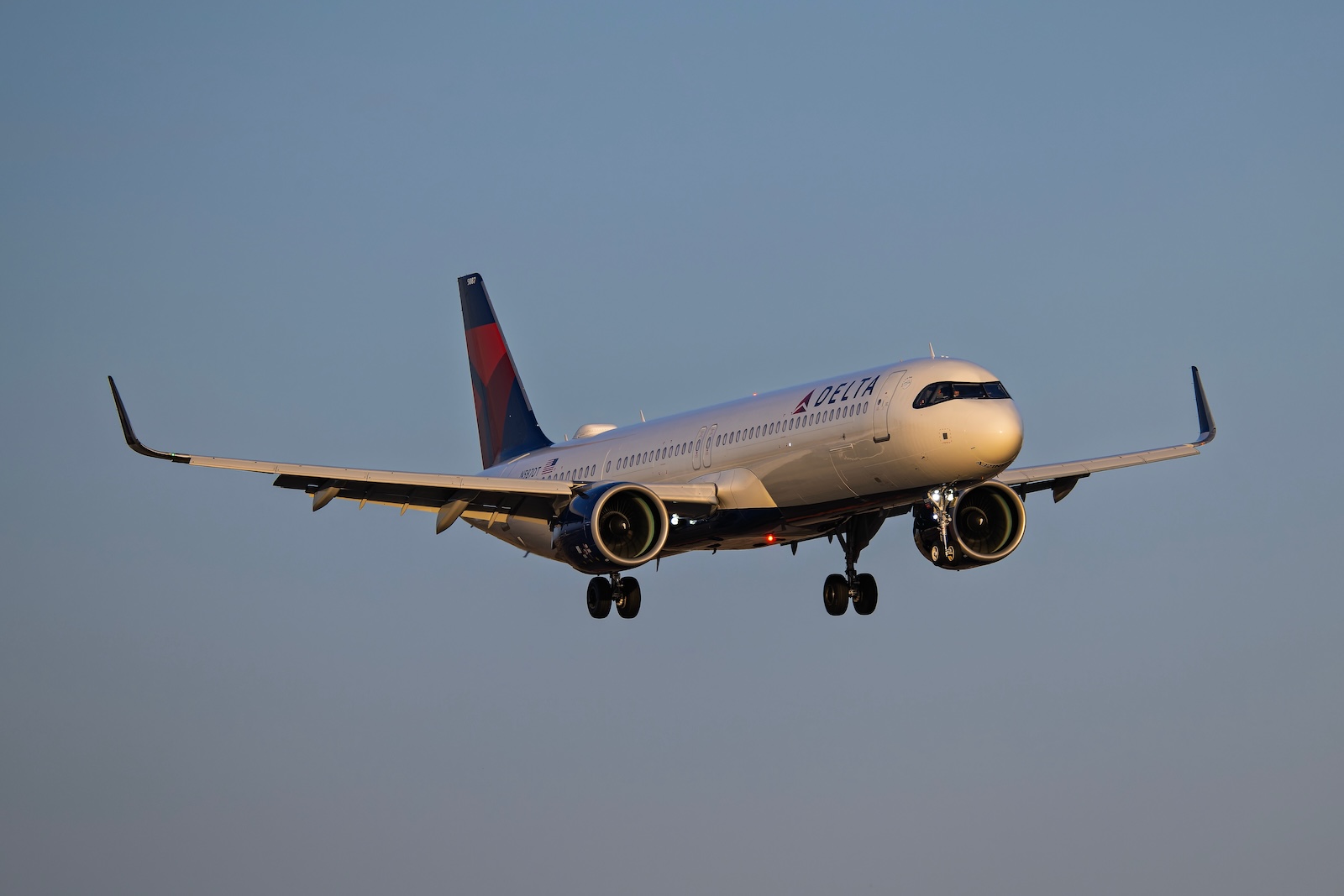
Delta A321neo
A Delta A321neo. (Photo: Delta)

Delta has warned the U.S. Commerce Department that it may stop buying foreign-made aircraft as a result of new tariffs imposed by the Trump administration.

According to Reuters, the airline told the Commerce Department that, if it had not been able to obtain aircraft from manufacturers in Canada, France, and Germany in 2023 and 2024, it would have had to cut flights serving up to 10 million passengers. For comparison, Delta served a total of 200 million passengers last year.

The airline anticipates a “similar impact” going forward if buying from foreign companies becomes too costly, the filing said.

Aside from U.S.-based Boeing, Delta currently uses aircraft produced by Europe’s Airbus, Canada’s Bombardier, and Brazil’s Embraer.

Delta’s first A330neo at the airline’s TechOps hangar. (Photo: Delta)

The Trump administration has placed a baseline 10% tax on imports from certain countries, including some of the United States’ biggest trading partners. Some nations, like China, face a higher tariff, and certain industries, like aluminum and automobiles, are being taxed at a rate above the 10% baseline regardless of where they are situated.

The new rules have the potential to seriously disrupt the aviation industry, which relies on aircraft and parts produced by a large number of companies distributed around the world.

Earlier this week, Alaska Air Group, the parent company of Alaska Airlines, announced it was temporarily dropping flights flown by its Horizon Air subsidiary because it could not take delivery of two Embraer E175s.

The Commerce Department has also moved to block the flow of aerospace technology to China. In May, it paused the sale of CFM International’s LEAP 1-C engine to Chinese airplane maker Comac, which has no other way to power its upcoming narrowbody C919.

Zach Vasile

Zach Vasile is a writer and editor covering news in all aspects of commercial aviation. He has reported for and contributed to the Manchester Journal Inquirer, the Hartford Business Journal, the Charlotte Observer, and the Washington Examiner, with his area of focus being the intersection of business and government policy.

NTSB: Engine Maintenance Issues Behind American 737 Fire

The agency found multiple engine component failures that led to engine vibrations, an emergency landing, and a post-landing fire.

American 737-800
An American Boeing 737-800. (Photo: AirlineGeeks | William Derrickson)

The National Transportation Safety Board has released its preliminary report on the March 13 incident involving American flight 1006, finding multiple engine component failures that led to engine vibrations, an emergency landing, and a post-landing fire.

Incident Description

According to the NTSB report, the Boeing 737-800, registered as N885NN, experienced engine vibrations during takeoff from Colorado Springs Airport. The flight crew continued the takeoff and diverted to Denver.

After the plane landed and taxied to the gate, a fire broke out in the right engine area after both engines were shut down.

Airport surveillance footage captured a fluid trail leaking from under the right engine nacelle as the aircraft taxied to the gate. The fire was extinguished within one minute by gate ramp personnel before airport firefighters arrived.

737 damage
Damage to the 737 (Photo: NTSB)

Of the 178 people aboard – including 172 passengers, two flight crew, and four cabin crew – 12 passengers sustained minor injuries during the evacuation.

The aircraft had “substantial damage,” investigators said, primarily affecting the right engine nacelle, wing, and fuselage.

Initial Findings

NTSB investigators discovered multiple technical issues with the right engine, a CFM56. Their examination revealed:

  • One fractured fan blade platform.
  • A fuel fitting lockwire on the variable stator vane that was loose and incorrectly installed.
  • An incorrectly fastened VSV actuator rod end, which allowed fuel to leak from the fitting.
  • A fractured VSV rod end muscle line in the weld.
  • A blocked seal drain line in the inboard thrust reverser half, with sealant obstructing the lower bifurcation fire seal and exit tube.

Evacuation Challenges

The investigation revealed several issues during the emergency evacuation:

  • The L2 door was found “cracked open” with its escape slide jammed in the door, preventing operation.
  • The R2 evacuation slide deployed automatically when that door was opened.
  • Passengers who used the left overwing window exits evacuated using a combination of ground vehicles, ladders, and a belt loader.
  • The aircraft’s flaps remained at zero degrees during the evacuation, complicating the exit from overwing positions.

The L2 slide, which was found removed from its bustle and on the cabin floor with its safety pin installed, was sent to the manufacturer for detailed inspection.

According to investigators, “Soon after arriving at the gate, flight attendants heard passengers yelling ‘fire’ and ‘smoke’ and saw smoke start to fill the cabin. One of the flight attendants tried calling the flight crew but did not get an answer. Another flight attendant knocked on the cockpit door to alert the flight crew of the fire outside the airplane and smoke in the cabin.”

Flight attendants later initiated an evacuation.

The aircraft remains out of service at the time of writing. The agency says its investigation into the incident will continue.

Ryan Ewing

Ryan founded AirlineGeeks.com back in February 2013 and has amassed considerable experience in the aviation sector. His work has been featured in several publications and news outlets, including CNN, WJLA, CNET, and Business Insider. During his time in the industry, he's worked in roles pertaining to airport/airline operations while holding a B.S. in Air Transportation Management from Arizona State University along with an MBA. Ryan has experience in several facets of the industry from behind the yoke of a Cessna 172 to interviewing airline industry executives. Ryan works for AirlineGeeks' owner FLYING Media, spearheading coverage in the commercial aviation space.

Airline Pilots Report High Rates of Anxiety, Alcohol Misuse

A recent survey of airline pilots in France turned up high rates of self-described anxiety, depression, and alcohol misuse.

Pilot in flight deck
Pilot executing pre-flight procedures in a commercial airliner cockpit before takeoff. (Photo: Shutterstock | l i g h t p o e t)

A recent survey of airline pilots in France turned up high rates of self-described anxiety, depression, and alcohol misuse.

Researchers recruited 1,220 airline pilots from the French pilots union SNPL and had them fill out a questionnaire focusing on their mental health and well-being. The results, published in Frontiers in Public Health in May, showed more than one-third of the pilots (40 percent) misused alcohol in the last year, though less than 1 percent described themselves as dependent.

About 25 percent suffered from anxiety, with 11 percent having a confirmed clinical diagnosis, while 13 percent described depressive symptoms, with 4 percent reporting a confirmed diagnosis.

Most of the pilots surveyed (90 percent) were male, and their average age was 45.

About 8 percent of the respondents said they took medication to treat insomnia. Almost 10 percent said they had a psychiatric history of some kind. Just under 3 percent reported suicidal thoughts in the last year.

Only a small number of the pilots (0.8 percent) said they used cannabis.

The researchers found that socioeconomic stress and requirements to fly multiple trips in the same day seemed to increase pilots’ risk for anxiety. They also found that respondents who described themselves as depressed were most likely to misuse alcohol.

About 14 percent of the pilots said they had sought psychological help, while 12 percent reported feeling isolated in dealing with their problems. Around 28 percent said they did not want to report psychological problems to their employer or governing agency out of fear of losing their license. But 54 percent said they would report symptoms if a rule ensured that it would not affect their career.

The researchers said their study underscores the need for preventative mental health programs for pilots and ways for them to address their psychological problems without fear of immediately losing their jobs.

Editor’s Note: This story first appeared on FlyingMag.com

Zach Vasile

Zach Vasile is a writer and editor covering news in all aspects of commercial aviation. He has reported for and contributed to the Manchester Journal Inquirer, the Hartford Business Journal, the Charlotte Observer, and the Washington Examiner, with his area of focus being the intersection of business and government policy.

How Much Did U.S. Airline CEOs Make in 2024?

Reports from major United States airlines provide data showing the compensation of their CEOs in relation to that of their employees.

Airline CEOs
Airline CEOs appear at a press conference for a planned air traffic control overhaul project. (Photo: U.S. Department of Transportation)

Reports from major United States airlines provide data showing the compensation of their CEOs in relation to that of their employees.

Airlines report these figures as part of annual proxy statements filed with the Securities and Exchange Commission.

American

In 2024, the total compensation for American Airlines CEO Robert Isom was $15,610,843, while the median compensation for an employee was $81,744. This results in an estimated pay ratio of 191-to-1.

During the prior year, Isom made $31,438,162 while the median employee salary was $67,788.

The proxy statement for American notes that this ratio may be difficult to compare with those of other airlines. Factors that make the comparison complex include the airline’s large workforce, the extent of its route network, and its ownership of three regional airlines.

Delta

For Delta, CEO Ed Bastian’s compensation was $27,117,069, and median employee compensation was $105,269. This boils down to a ratio of 258-to-1.

Delta CEO Ed Bastian speaks at CES 2023 in Las Vegas (Photo: Delta Air Lines)

In 2023, Bastian made $34,214,328, and the median employee salary was $101,947.

United

United CEO Scott Kirby’s total compensation was $33,924,988, with a median employee compensation of $89,197, resulting in an estimated pay ratio of 380-to-1.

Kirby made $18,573,299 in 2023 with median employee compensation at $81,050.

United CEO Scott Kirby
United Airlines CEO Scott Kirby addresses members of the Houston business community at an event showcasing the Terminal B transformation project on Thursday, November 30, 2023 (Photo: AirlineGeeks | Andrew Chen)

Southwest

Southwest CEO Bob Jordan’s total compensation was $10,562,384, and median employee compensation was $91,442. The resulting CEO pay ratio is 115.5-to-1.

In 2023, Jordan earned $9,307,298, and median employee compensation was reported at $89,699.

The reports indicate that a variety of methodologies are used to calculate these figures, which can affect the comparability of the ratios among airlines.

AirlineGeeks.com Staff

AirlineGeeks.com was founded in February 2013 as a one-person blog in Washington D.C. Since then, we’ve grown to have 25+ active team members scattered across the globe. We are all here for the same reason: we love deep-diving into the fascinating realm of the airline industry.

Africa’s Blocked Funds Impact Airline Operations

IATA has urged governments to remove all barriers preventing airlines from the timely repatriation of their revenues from ticket sales and other activities.

Kenya Airways 787
A Kenya Airways Boeing 787 Dreamliner (Photo: AirlineGeeks | William Derrickson)

Airlines operating services to, from and within Africa often experience significant challenges with funds not being repatriated.

The International Air Transport Association (IATA) reports that $1.3 billion is being blocked by various governments as of end April 2025. Though this amount is significant, it is an improvement of 25%, compared with the $1.7 billion in blocked funds recorded in October 2024. That said, ten countries account for 80% of the total blocked funds, amounting to $1.03 billion.

Blocking Repatriation of Airline Revenues

The majority of the countries with the highest blocked funds are located in Africa.

Mozambique tops the list with $205 million in blocked funds. This is followed by the Central African Franc Zone. The zone, which uses a common currency comprises various independent states.

The countries include Cameroon, Central African Republic, Chad, Republic of the Congo, Equatorial Guinea and Gabon. Unblocked funds from this zone totals $191 million.

In addition, Algeria comes with in $178 million, Angola with $84 million, Eritrea with $76 million, Zimbabwe with $68 million and Ethiopia with $44 million in blocked funds.

Also featuring in the top ten on the list, but located outside of Africa are: Lebanon with $142 million, Bangladesh with $92 million and Pakistan with $83 million.

Impact of Blocked Funds

Blocked funds is a significant obstacle to airline operations and poses a threat to the sustainability of airline operations. This could therefore threaten connectivity for passengers in parts of the world. In fact, in 2022, Emirates suspended its scheduled services to Nigeria over blocked revenues.

IATA has urged governments to remove all barriers preventing airlines from the timely repatriation of their revenues from ticket sales and other activities, in accordance with international agreements and treaty obligations.

“Ensuring the timely repatriation of revenues is vital for airlines to cover dollar-denominated expenses and maintain their operations. Delays and denials violate bilateral agreements and increase exchange rate risks. Reliable access to revenues is critical for any business—particularly airlines which operate on very thin margins. Economies and jobs rely on international connectivity. Governments must realize that it is a challenge for airlines to maintain connectivity when revenue repatriation is denied or delayed,” Willie Walsh, IATA’s Director General, said in a press release.

Lorne Philipot

Lorne is a South Africa-based aviation journalist. He was captivated and fascinated by flying from the day he took his first airline flight. With a passion for aviation in his blood, he has flown to destinations in all corners of the globe. Lorne has traveled extensively and lived in various countries. Drawing on his travels and passion for aviation, Lorne enjoys writing about airlines, routes, networks, and new developments.

Pan Am Considering Comeback

Pan Am Global Holdings, which manages the intellectual property of Pan Am, is evaluating the airline’s prospects for a relaunch.

A Pan Am 707
A Pan Am 707. (Photo: Shutterstock | Peter Scharkowski)

An iconic airline brand once synonymous with luxurious international travel is eyeing a comeback 34 years after it ceased operations.

Pan Am Global Holdings, which manages the intellectual property rights for the long-defunct Pan American World Airways, announced Thursday that it is exploring options to revive Pan Am as a scheduled commercial airline.

The company is working with aviation merchant bank and consulting firm AVi8 Air Capital to assess the “feasibility, structure, and financial strategy” of a potential relaunch.

“We are excited to partner with AVi8 to explore how best to bring the Pan Am brand back to the skies as a scheduled commercial airline,” said Craig Carter, CEO of Pan Am Global Holdings. “With its legacy of innovation, service excellence, and global connectivity, Pan Am remains a cherished name in aviation. Through this collaboration, we aim to assess a sustainable and forward-thinking approach to reintroducing scheduled commercial service under the Pan Am name – one that not only honors its legacy but also makes the Pan Am experience more accessible.”

AVi8 said it will assist Pan Am Global Holdings in analyzing various aspects of the airline industry, including market dynamics, fleet strategy, and operational infrastructure.

More details will be released in the coming months, the partners said.

Golden Age

Pan Am, originally founded as Pan American Airways, was for decades the largest international carrier based in the U.S. In the carefully regulated market of the mid-20th century, it enjoyed a near-monopoly on foreign travel, and in exchange, did not fly domestically.

The airline led the industry’s adoption of jet aircraft, which allowed for the launch of longer routes to destinations around the world. It reached the height of its prestige between the 1950s and early 1970s, and its name became synonymous with the glamour of international air travel and high-quality amenities.

A Pan Am Boeing 737 in 1988.
A Pan Am Boeing 737 in 1988. (Photo: Guido Allieri, made available through Wikimedia Commons)

Pan Am’s fortunes turned after the oil shock of the ’70s, which hurt demand. Deregulation of the American airline industry under President Jimmy Carter exposed the carrier to new levels of competition, and it struggled to build a domestic network. After years of losses, it filed for bankruptcy in 1991.

Due to its strong brand recognition, the Pan Am name has been reused over the years, including for a short-lived low-cost airline in the late 1990s, nicknamed “Pan Am II.” Fashion brands have also signed agreements to use the name on shirts and watches.

Zach Vasile

Zach Vasile is a writer and editor covering news in all aspects of commercial aviation. He has reported for and contributed to the Manchester Journal Inquirer, the Hartford Business Journal, the Charlotte Observer, and the Washington Examiner, with his area of focus being the intersection of business and government policy.

Delta Opening New A350 Base

Currently, the A350 operates a handful of routes from Seattle, including to Tokyo Haneda, Taipei, and Seoul Incheon, replacing the A330-900neo.

A Delta A350
A Delta A350 (Photo: AirlineGeeks | William Derrickson)

Delta is poised to open a new widebody pilot base in the coming months. The Atlanta-based airline continues to deploy its A350s in Asia-Pacific markets, replacing the A330.

According to various sources – including aviation insider JonNYC – the carrier is set to open an Airbus A350 pilot base in Seattle. Positions for the new widebody base will be open as early as this month, Delta told pilots in a memo.

In terms of widebody aircraft, the airline currently offers an A330 base in Seattle. Other A350 bases include Los Angeles, Atlanta, and Detroit.

An airline spokesperson did not immediately respond to AirlineGeeks’ request for comment on the new base.

Delta continues to shift much of its Asia-Pacific network to A350 operations. The carrier began deploying A350s on regularly scheduled flights from Seattle in March.

Currently, the A350 operates a handful of routes from Seattle, including to Tokyo Haneda, Taipei, and Seoul Incheon, replacing the A330-900neo.

The carrier’s plan to open an A350 pilot base in Seattle comes as Delta’s rival, Alaska Airlines, bolsters its long-haul presence with new flights to Tokyo Narita, Seoul Incheon, and Rome.

Ryan Ewing

Ryan founded AirlineGeeks.com back in February 2013 and has amassed considerable experience in the aviation sector. His work has been featured in several publications and news outlets, including CNN, WJLA, CNET, and Business Insider. During his time in the industry, he's worked in roles pertaining to airport/airline operations while holding a B.S. in Air Transportation Management from Arizona State University along with an MBA. Ryan has experience in several facets of the industry from behind the yoke of a Cessna 172 to interviewing airline industry executives. Ryan works for AirlineGeeks' owner FLYING Media, spearheading coverage in the commercial aviation space.

FAA Not Looking at Lifting Boeing 737 MAX Cap

Reuters reported Wednesday that FAA Acting Administrator Chris Rocheleau is not relaxing a limit on the number of 737 MAX aircraft Boeing can produce per month.

737 aircraft at Boeing's Renton facility.
737 aircraft at Boeing's Renton facility. (Photo: Shutterstock | Thiago B Trevisan)

The acting head of the FAA has no plans to lift the 38 aircraft per month limit imposed on Boeing’s 737 MAX program following a door plug blowout on an Alaska Airlines flight last year.

Reuters put the question to Acting Administrator Chris Rocheleau on Wednesday after a U.S. House hearing on the FAA’s budget. He replied, “Not at this time.”

Boeing executives have said they are confident they can get 737 MAX production above 38 per month once the ceiling is eventually lifted. CEO Kelly Ortberg said last week that 42 per month is a realistic target.

Rocheleau also said the agency will continue to inspect all 737 MAXs and 787 Dreamliners before issuing airworthiness certificates, a task previously performed by Boeing itself. The planemaker lost the authority to self-certify the two aircraft due to 787 quality issues and the crash of two 737 MAX jets, which killed a combined 346 people.

The FAA has said it will continue independently inspecting the 737 MAX and the 787 until Boeing completes improvements to its manufacturing and quality control processes. The company was close to winning back its control over the 737 MAX certification process until the Alaska incident.

Last week, the FAA extended Boeing’s ability to carry out some delegated functions through the Organization Designation Authorization program. The agency said Boeing has made meaningful strides in improving its independent ODA units, including insulating them from outside pressure. The extension will last three years, rather than the five requested by Boeing.

Zach Vasile

Zach Vasile is a writer and editor covering news in all aspects of commercial aviation. He has reported for and contributed to the Manchester Journal Inquirer, the Hartford Business Journal, the Charlotte Observer, and the Washington Examiner, with his area of focus being the intersection of business and government policy.

Air Cote d’Ivoire Suspends Abidjan-Johannesburg Service

Air Cote d’Ivoire has suspended flights between Cote d’Ivoire's largest city, Abidjan, and Johannesburg, South Africa, citing operational reasons.

A320
An Air Côte d'Ivoire A320 (Photo: Sm105, CC BY-SA 4.0 , via Wikimedia Commons)

Cote d’Ivoire’s national carrier announced that it has suspended flights between that country’s largest city, Abidjan, and Johannesburg, South Africa.

Air Cote d’Ivoire launched the route in 2022, initially offering the service four times a week. The service was operated as an extension of the carrier’s route to Kinshasa, Democratic Republic of the Congo.

The airline used an Airbus A320neo, seating 16 passengers in Business class and 132 in Economy class, on the route. Air Cote d’Ivoire cited operational reasons for the suspension of the service.

Abidjan-Johannesburg Route

When Air Cote d’Ivoire launched its Abidjan-Johannesburg service, it was the only carrier flying nonstop between the two cities. South African Airways had previously operated flights between Abidjan and Johannesburg, but it was in the middle of restructuring and had suspended the route.

South African Airways gradually restored its old routes, including between Abidjan and Johannesburg, offering three flights a week, with an Airbus A330.

Travel News reports that Air Cote d’Ivoire expects to resume the service in October this year. However, African aviation analyst Sean Mendis said that demand and yields on the route have been less than desirable for the carrier.

“The Johannesburg-Abidjan market has too much capacity with both Air Cote d’Ivoire and South African Airways serving it, the latter with A330 widebodies. And Air Cote d’Ivoire’s schedule and reliability were especially poor to compete,” Mendis said.

That said, Air Cote d’Ivoire expects to take delivery of two Airbus A330-900neo aircraft this month. The widebody jets will be used to expand the airline’s intercontinental route network. The carrier intends to launch scheduled services to Paris and Beirut.

Lorne Philipot

Lorne is a South Africa-based aviation journalist. He was captivated and fascinated by flying from the day he took his first airline flight. With a passion for aviation in his blood, he has flown to destinations in all corners of the globe. Lorne has traveled extensively and lived in various countries. Drawing on his travels and passion for aviation, Lorne enjoys writing about airlines, routes, networks, and new developments.
Sign-up for newsletters & special offers!

Get the latest stories & special offers delivered directly to your inbox

SUBSCRIBE

Uh-oh! It looks like you're using an ad blocker.

Our website relies on ads to provide free content and sustain our operations. By turning off your ad blocker, you help support us and ensure we can continue offering valuable content without any cost to you.

We truly appreciate your understanding and support. Thank you for considering disabling your ad blocker for this website