A Delta Airbus A321 rockets out of Reagan National Airport in Washington, D.C.
(Photo: AirlineGeeks | William Derrickson)
Aviation groups breathed a collective sigh of relief late Saturday after Congress passed an interim measure that avoids a government shutdown and also gives the FAA some breathing room. The bill, which was signed by President Biden a few hours before the midnight deadline to avert a shutdown, pushes that date 45 days to Nov. 17 and also extends the FAA’s authorization until the end of the year.
However, if the government shuts down in November, the FAA will also lose its funding.
National Air Traffic Controllers Association President Rich Santa said the reprieve is welcome but the politicians need to use the time to craft lasting legislation. “Funding must be secured as soon as possible—not 45 days from now,” Santa said.
After a week of fractious political maneuvering, both houses eventually approved a stripped-down bill that keeps the government running but doesn’t allow any funding for Ukraine, a major sticking point in the debate.
This story was originally published on AirlineGeeks’ sister company AvWeb.
AirlineGeeks.com was founded in February 2013 as a one-person blog in Washington D.C. Since then, we’ve grown to have 25+ active team members scattered across the globe. We are all here for the same reason: we love deep-diving into the fascinating realm of the airline industry.
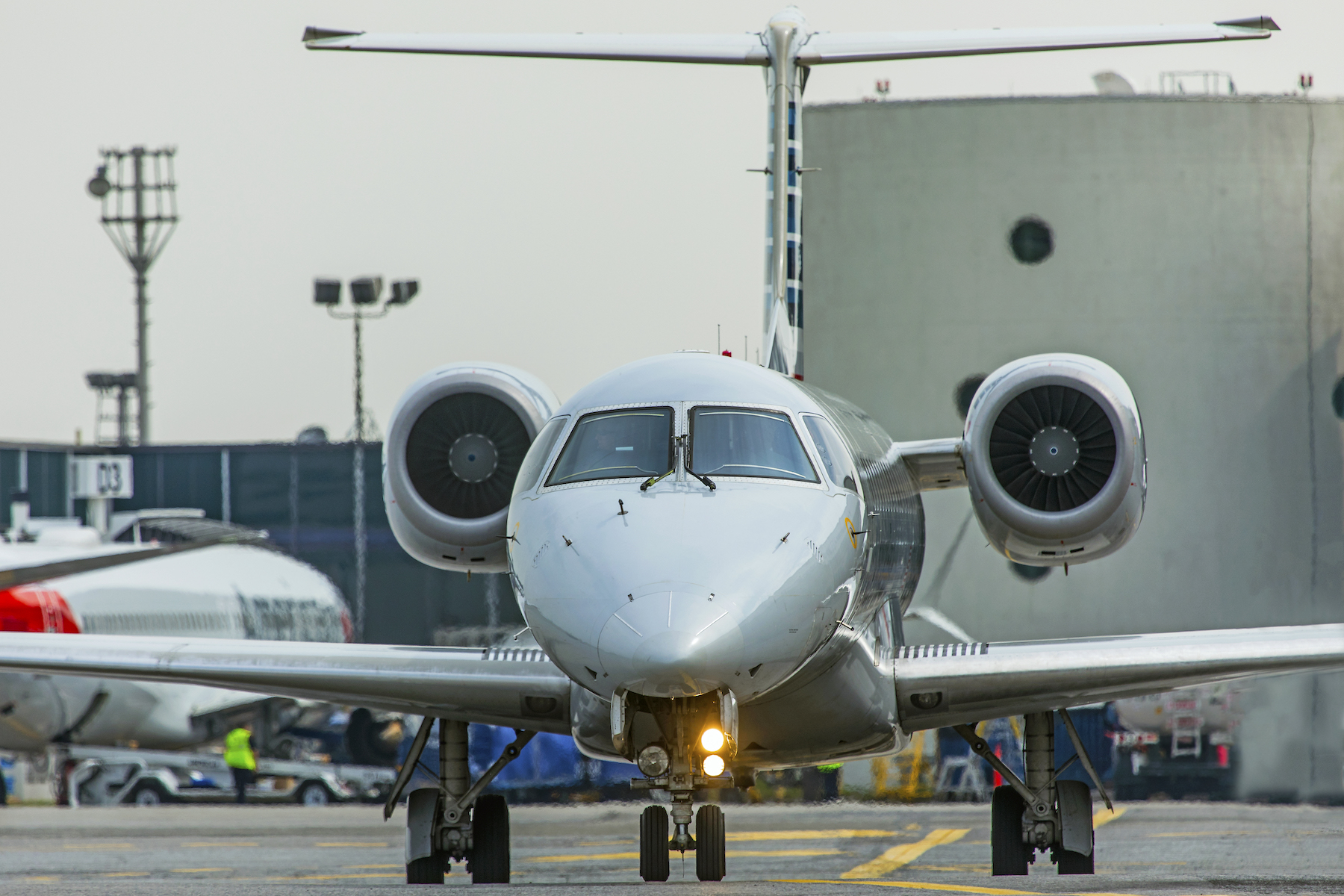
An American Eagle E145 (Photo: AirlineGeeks | William Derrickson)
The Small Community Air Service Development Program is another government-funded program that is used to provide the funding smaller communities need to develop their air service portfolios. Generally, it is not as well-known compared to the widely-used Essential Air Service (EAS) program.
This program is meant to benefit communities and assist with the implementation of the air service initiatives proposed in their grant applications. Essentially, it provides mostly revenue guarantees, so airlines will be more willing to start new services; that way they can develop the route enough to where they won’t need a grant and will become economically self-sustainable. But, there are a couple of basic rules that are laid out in the program;
The airport serving the community or city is not larger than a small hub airport, which is determined using the Department of Transportation (DOT)’s most recently published classification.
The airport has insufficient air carrier service on a specific market/route or unreasonably high airfares, the latter of which most of these airports are.
The airport presents characteristics, such as geographic diversity or unique circumstances, that demonstrate the need for, and feasibility of, the Small Community Program.
If awarded a grant, An applicant may not receive an additional grant from the federal government (local or state governments are allowed to), to support the same project more than once in a 10-year period, except in certain circumstances.
And finally, an applicant may not receive an additional grant prior to the completion of its previous grant.
Plus it Is pretty strict, as there can’t be more than four cities in the same state that get awarded a grant during the fiscal year. This also doesn’t guarantee that cities will acquire the air service that the grant is made for, as sometimes airlines just don’t want to operate a particular service even with the revenue guarantees, or they will start it but then end it once the revenue guarantee money is all gone.
In this grant awarding term, 20 cities have been given grants which include the following communities along with the amount they were awarded, according to publicly available documents on Regulations.gov. Also included is what they “plan” on doing with the funding.
Monterey, Calif. – $750,000
They would use the grant to provide a revenue guarantee to start and support nonstop flights to Chicago. The community would provide significant local funding for the project as well. Although it didn’t say which Chicago airport, American Airlines has provided a letter of support for the project, which means the airport would probably be Chicago O’Hare.
Dubuque, Iowa – $1,500,000
The funding will be used for a revenue guarantee and marketing to support new services to a large or medium hub. While they do currently have service to Orlando and Las Vegas on Avelo, the service is not daily, and the town is looking for more sustained daily flights as Avelo is currently the only airline serving this airport.
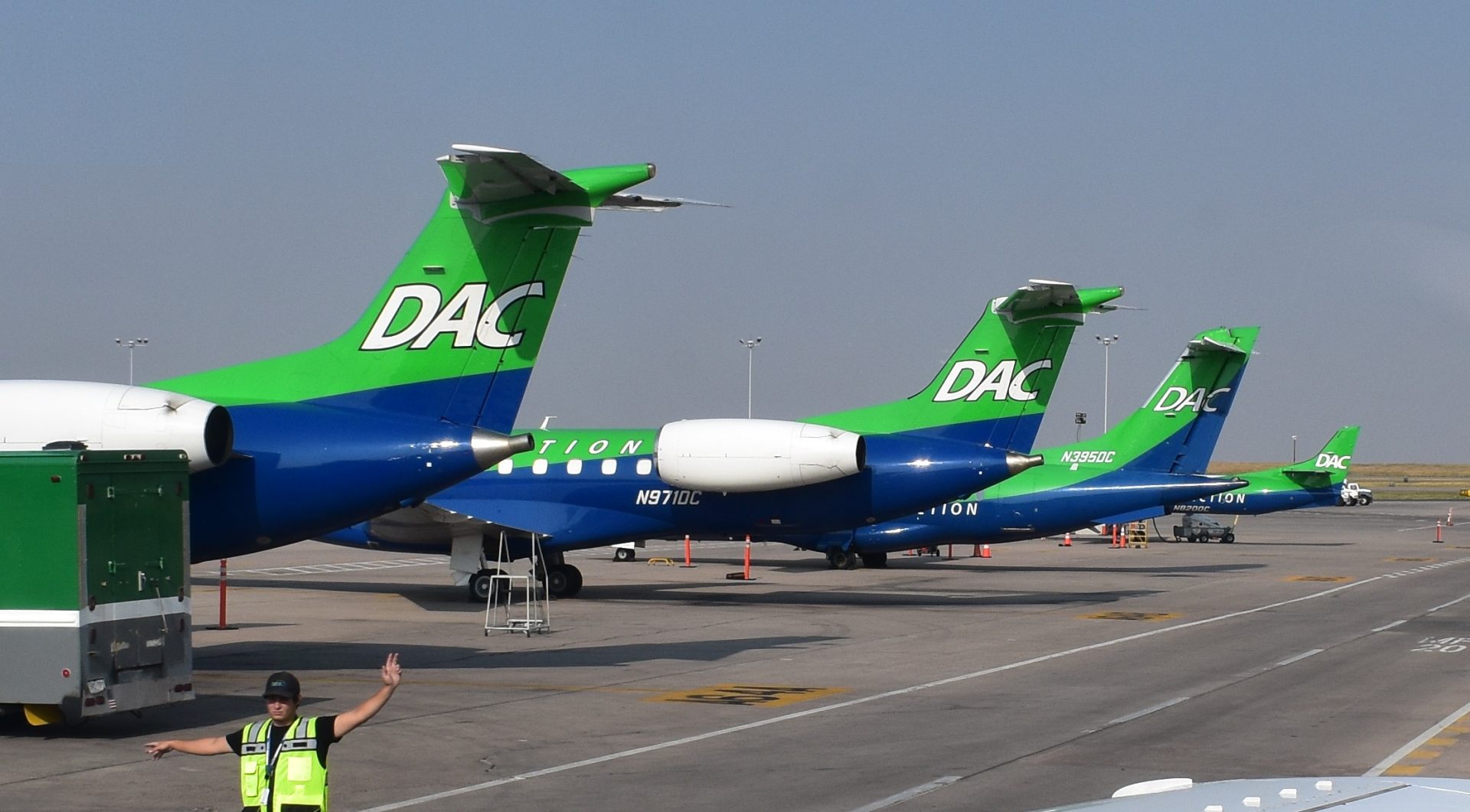
Denver Air Connection, or DAC for short, has provided a letter of support for the project, and while they didn’t name a specific airport, the closest medium or large hub airport that DAC serves is Chicago O’Hare located 147 miles away.
Denver Air Connection planes lined up in Denver. (Photo: AirlineGeeks | Joey Gerardi)
Idaho Falls, Idaho – $950,000
The funding in this city will be used for a revenue guarantee to initiate and support new service to a Los Angeles area airport, as the airport currently has no nonstop flights to anywhere in California. Alaska Airlines provided a letter of support for this project, and the airline already operates a hub at LAX.
Peoria, Ill. – $500,000
The funding here will be used for a revenue guarantee and marketing to initiate and support new daily services to a west-central hub, preferably Denver, Houston, Phoenix, or Salt Lake City. The community states that it has lost prior west-central hub service to Denver and that it has “adversely affected its economy and its travelers.” They also state that starting service to one of these airports alleviates that deficiency.
They also plan to increase sustainability by installing solar panels and EV parking spaces in the airport parking lot. American and United have provided letters of support for the project to their own hubs.
Springfield, Ill. – $250,000
The funding here will be used for a marketing campaign to support its existing Allegiant Air and American Airlines service. American already serves Charlotte, Chicago, and Dallas/Fort Worth; while Allegiant flies to Austin, Las Vegas, Los Angeles, Orlando, Phoenix, Punta Gorda, St. Petersburg/Clearwater, Destin, and Houston Hobby.
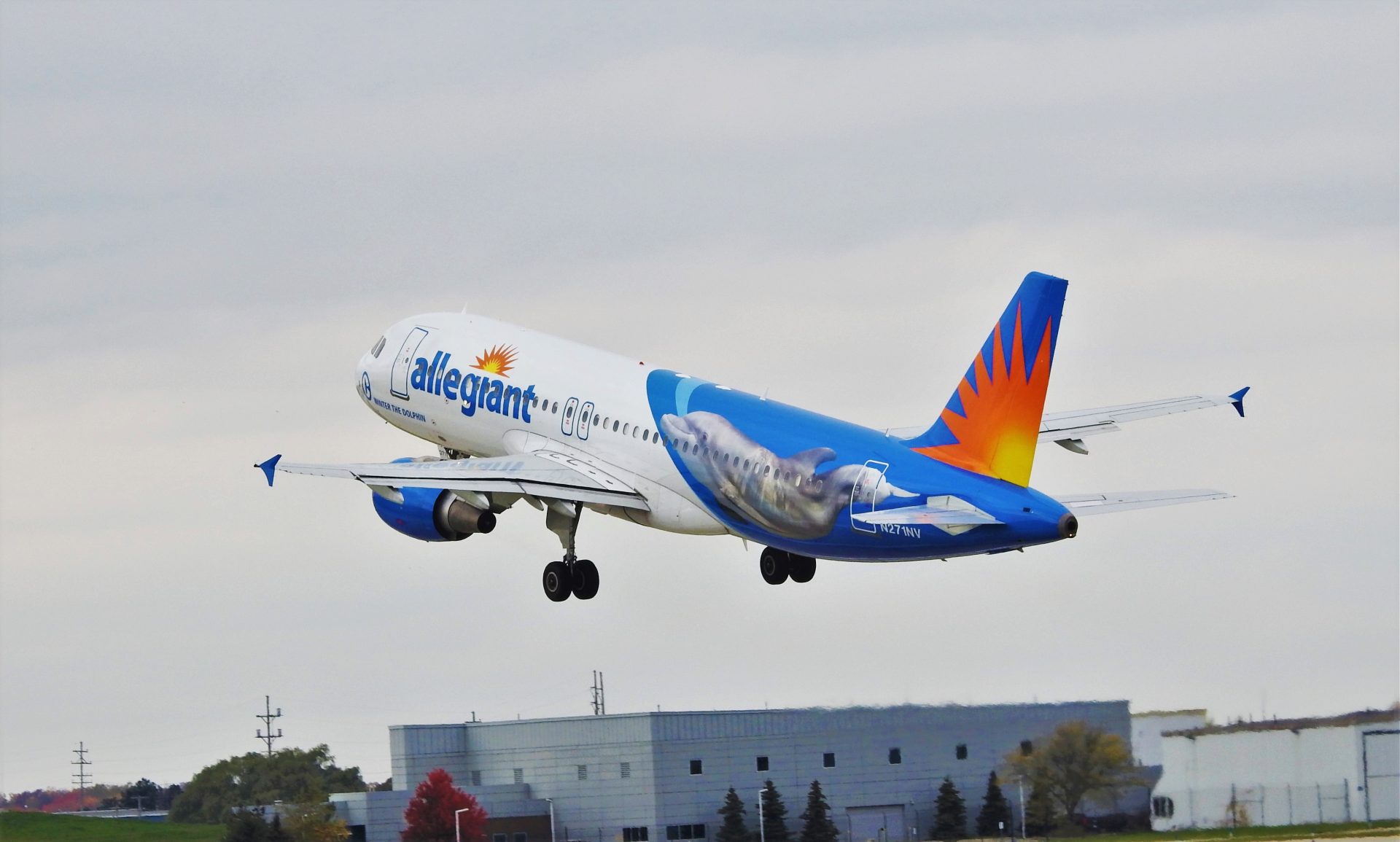
Allegiant’s “Winter The Dolphin” livery departing for a flight (Photo: AirlineGeeks | Joey Gerardi)
The municipality has also said that over the past decade, the number of scheduled departures from Springfield’s airport has declined by at least half and proposed a marketing program tailored to increase public awareness of its remaining service. American Airlines has provided a letter of support for the project.
South Bend, Ind. – $750,000
The funding in South Bend will be used for a revenue guarantee and marketing to initiate and support new service to the West Coast, more specifically San Francisco or Los Angeles, but would alternatively accept Washington D.C. as a compromise if the West Coast isn’t an option.
Hometown of Secretary of Transportation Pete Buttigieg, substantial local funding for the project has also been announced, including state funding from the Indiana Economic Development Corp., and while they didn’t say what airline specifically, they did say “a confidential airline letter of support was filed with the Department.”
Ft. Wayne, Ind. – $600,000
This community will use the funding to provide a revenue guarantee and marketing to initiate and support new services to Denver, as they state they have no service to the western United States as the farthest westward destination is Chicago. The community is going to provide very substantial local funding for the air service, and United provided a letter of support for the Denver flights.
An United Express Embraer E175 (Photo: Embraer)
Monroe, La. – $500,000
The funding in this community would be used to provide a revenue guarantee and marketing to initiate and support new services to Charlotte, as they have lost a lot of service in recent years and this service would help regain some of its capacity. American Airlines has provided a letter of support for this air service.
Traverse City, Mich. – $750,000
Funding here would be used for a revenue guarantee and marketing to initiate and support new services to Houston. It would provide the community another option to get to and from the southwestern part of the country as well as provide connections onward. Although they didn’t say what Houston airport they would serve, United has provided a letter of support, so it is assumed service will be to Houston-Bush.
Gulfport/Biloxi, Miss. – $365,000
Funding for this Mississippi airport will be used for a revenue guarantee and marketing to initiate and support new services to the Washington D.C. area. They also state that Hurricane Katrina, the Deepwater Oil spill, and the COVID-19 pandemic have negatively impacted the area’s long-term growth, and this new service will assist in the economic recovery.
The State of Mississippi is also going to be providing substantial funding for the project, with additional funding coming from the community. American Airlines and Breeze Airways provided letters of support for the project, American would most likely serve Washington-Reagan, but is unknown which airport Breeze would serve in the D.C. area.
Billings, Mont. – $1,000,000
Funding here would be used for a revenue guarantee and marketing to initiate and support new services to Los Angeles and/or San Francisco. They state that it needs additional air service destinations in order to combat its high airfares. The community will also be providing substantial local funding for the project, and Alaska Airlines has provided a letter of support for the project, they have hubs at LAX as well as San Francisco.
Fargo, N.D. – $500,000
Funding in Fargo would be used for a revenue guarantee and marketing to initiate and support new service to Charlotte and is the only one of two communities that specifically names a carrier they wanted to start the service rather than just getting a letter of support, seeking American Airlines.
They state that the proposed service will significantly increase connectivity to the eastern United States through American Airlines’ extensive hub network at Charlotte, including operations to points on the East Coast, the Caribbean, and Europe. American Airlines has already provided a letter of support for the service.
Ithaca, N.Y. – $750,000
Funding in the New York community will be used to start and provide a revenue guarantee for service to a Washington D.C.-area airport or a similar southern hub. They state that the proposed service to Washington, and the additional seat capacity it will bring, will address its need for expanded air service, and will complement its existing New York City-area service.
As with most communities, they will be providing substantial local funding for the project. United has provided a letter of support which means the Washington D.C. area airport will most likely be its Dulles hub.
Wilkes-Barre/Scranton, Penn. – $500,00
This is the only community that would use its funding in this round of awards to get an ultra low-cost carrier. They would use it to have a revenue guarantee and marketing to initiate and support new services to Ft. Myers, Orlando, Sarasota, and/or Tampa, FL, on Avelo Airlines.
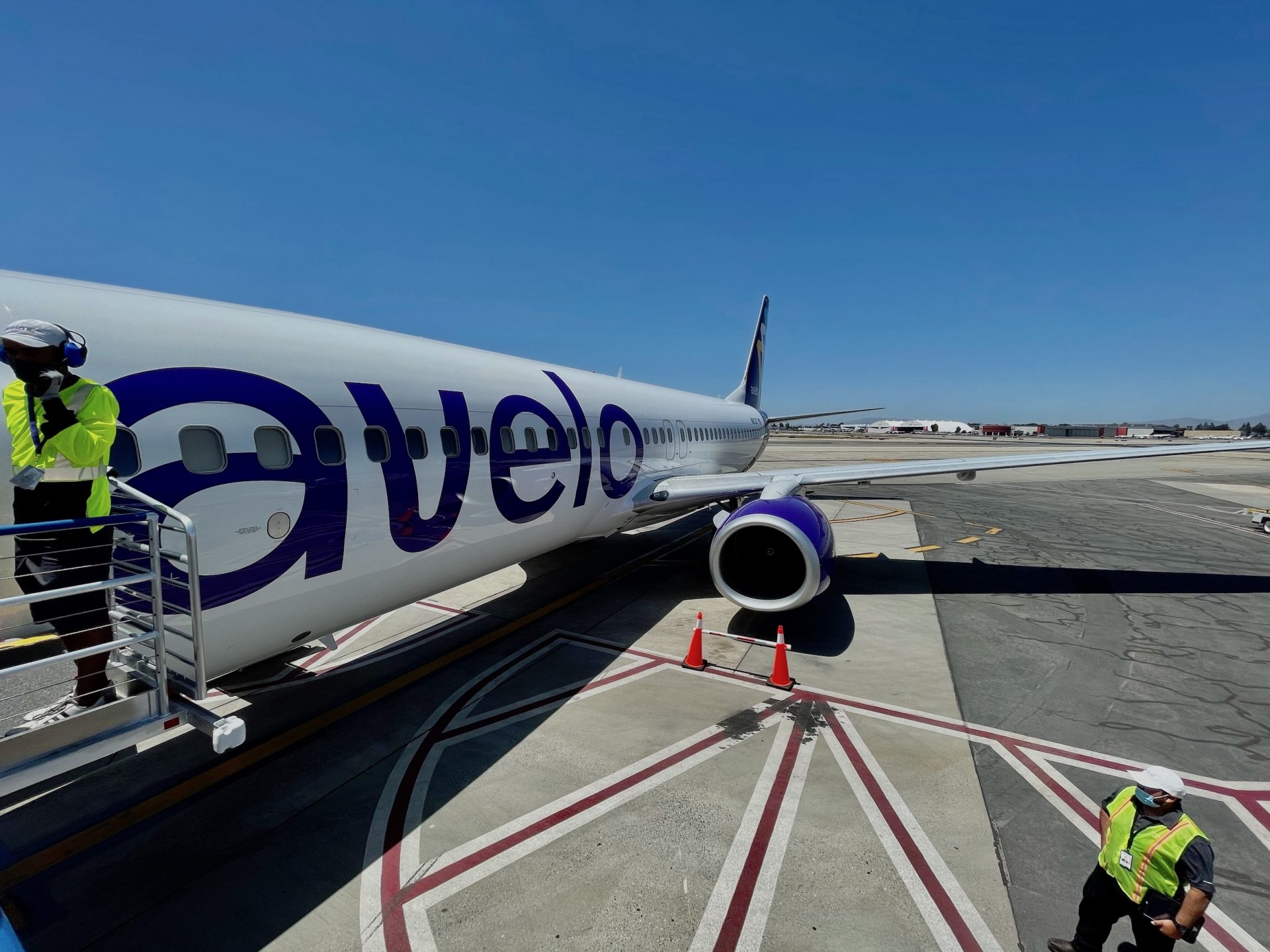
Avelo’s 737-800 aircraft in Burbank (Photo: AirlineGeeks | Ryan Ewing)
They have also partnered with surrounding counties and organizations to develop the new service, which they believe would help restore capacity that was lost during the COVID-19 pandemic. Avelo has provided a letter of support for the service.
Chattanooga, Tenn. – $750,000
Funding here would be used for a revenue guarantee and marketing to initiate and support new services to Denver, but would alternatively support Houston instead if Denver cannot be attained.
They state that seat capacity and traffic have suffered a recent decline at Chattanooga, and service to a hub in the west would restore this lost traffic. The community is providing substantial local funding for the project, and United Airlines has expressed interest with a letter of support.
Tri-Cities/Blountville, Tenn. – $900,000
Funding would be used to provide a revenue guarantee and marketing to initiate service to Chicago. They have no air service to the north and only fly to places south of the region, and this new service will address this shortfall in service.
The community is providing substantial local funding for the project, and while no specific airport in Chicago has been noted, given that American Airlines has expressed support the airport is assumed to be Chicago O’Hare.
Del Rio, Texas – $1,200,000
Del Rio lost all air service in April of last year and this grant would provide a revenue guarantee and marketing to initiate and support the resumption of service to the community. They would like to re-gain air service to Dallas/Ft. Worth or a similar destination, which was what service the airport had before American ended service here in 2022.
An American Eagle Embraer E145 departing (Photo: AirlineGeeks | Joey Gerardi)
The community is providing substantial local funding for the project, but they are the only community in this list that does not have a letter of support from an airline, confidential or otherwise, to start service to their desired airport.
Lynchburg, Va. – $600,000
This community will use the funding to have a revenue guarantee and marketing to initiate and support new service to Chicago, as well as support an aircraft ungauge and increase frequencies to Charlotte.
This will provide additional options for passengers with a western hub and increase connectivity as well as capacity. The community is providing very substantial funding for the project, and American Airlines has provided a letter of support for the service.
Richmond, Va. – $1,000,000
This community will use the funding to start more service to the West Coast, but more specifically Seattle. This will provide increased connectivity to Alaska, Hawaii, and western Canada as well. While they have service to the West Coast, they currently have no service to the Pacific Northwest. The community is providing substantial local funding for the project, and Alaska Airlines has provided a letter in support of the project.
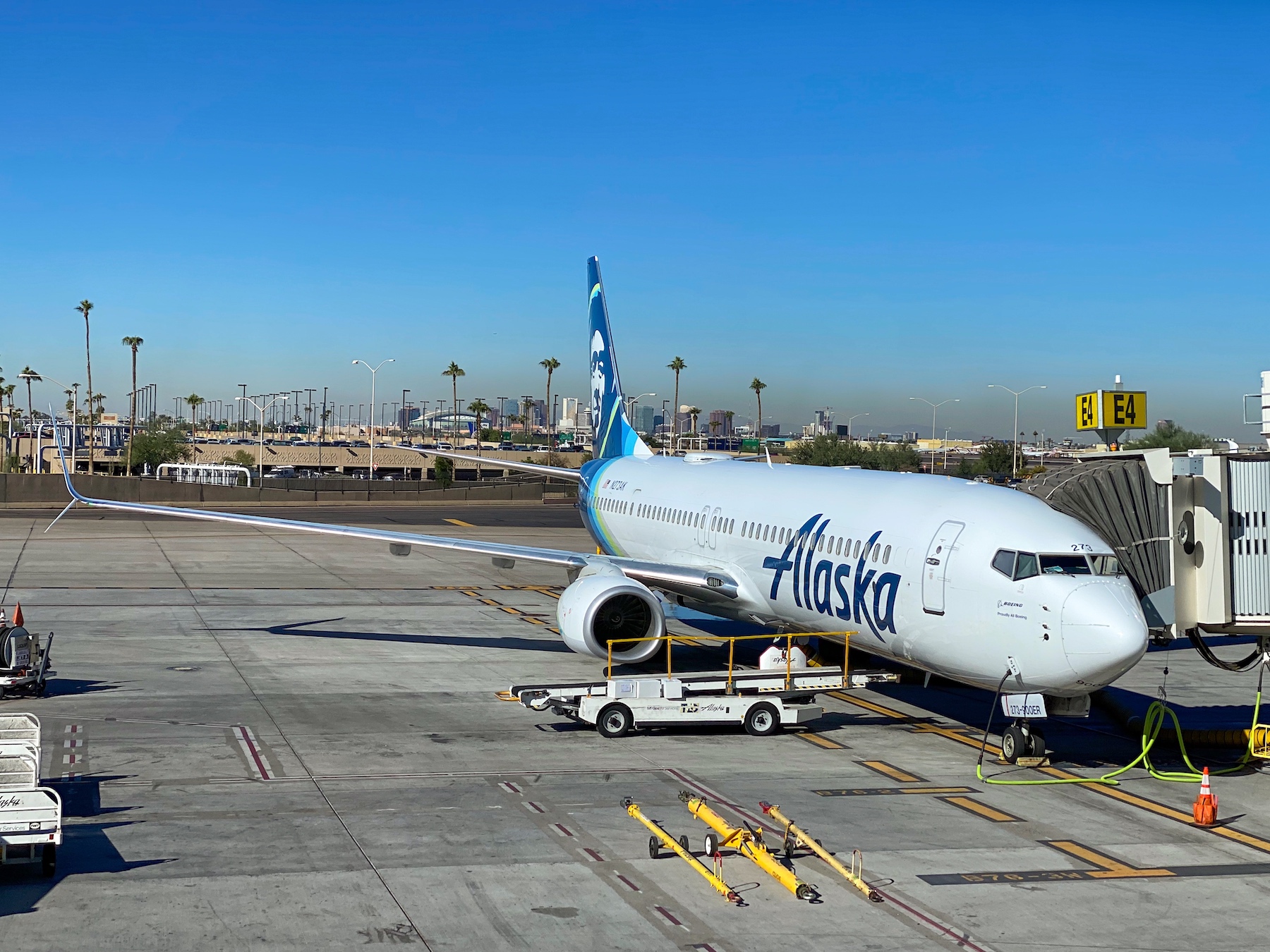
An Alaska 737-900ER in Phoenix (Photo: AirlineGeeks | Katie Bailey)
Yakima, Wash. – $700,000
This funding will be used to restore something they had in the past; a second frequency on their current Seattle flights, but would accept and support service to an additional hub instead of the extra Seattle frequency.
The second frequency is crucial to the welfare of its business community and thus its local economy, and as such the community is providing local funding for the project as well. Alaska Airlines has provided a letter in support of the project.
Bottom Line
Just because a community has been awarded the funding or even has a letter of support, this doesn’t guarantee that an airline will start service on the desired or requested route. In fact, sometimes the awards and letters of support have fallen through in the past and communities don’t get the air service that they desire.
Joey has always been interested in planes for as long as he can remember. He grew up in Central New York during the early 2000s when US Airways Express turboprops ruled the skies. Being from a non-aviation family made it harder for him to be around planes and would only spend about three hours a month at the airport. He was so excited when he could drive by himself, the first thing he did with his driver's license was get ice cream and go plane spotting for the entire day. He graduated from Western Michigan University in 2022 with a B.S. in Aviation Management & Operations and a Minor in Business, and currently works for a major airline in his hometown.
A Comac C919 conducting high-speed taxiing (Photo: COMAC)
On Sept. 28, China Eastern and COMAC announced a new order of 100 COMAC C919s. This order is yet the largest confirmed order of C919 from a single airline, and the 100 jets will be delivered to China Eastern from 2024 through 2031. The delivery schedule reported by the media is listed below:
Year
2024
2025
2026
2027
2028
2029
2030
2031
Delivery
5
10
10
10
15
15
15
20
Other major airlines with COMAC C919 intentional orders, such as China Eastern’s fellow Chinese state-owned airlines Air China and China Southern, have not yet announced any new orders for C919. Experts estimate that, with this order, China Eastern has locked a quarter of the production capacity of C919 until 2031.
According to the delivery plan, COMAC is set to deliver all five initial orders of C919 placed in 2021 to China Eastern before the end of 2023. However, this task may be challenging considering the last quarter of the year has already begun and three more jets need to be delivered.
The COMAC C919 has already carried 50,000 passengers
COMAC C919 was certified in September 2022, and the first C919 was delivered to China Eastern in December 2022. After a five-month trial and test flights, it finally entered service on May 28, 2023. The second C919 was delivered to China Eastern later on July 16. Two C919s are currently scheduled to fly two pairs of flights between Shanghai’s Hongqiao International Airport and Chengdu’s Tianfu International Airport. The third C919 delivered to China Eastern was already rolled out of the production line and doing test flights at COMAC’s facility in Shanghai and elsewhere in China, which indicates that the jet will be delivered to China Eastern soon.
Since entering into service, two COMAC C919s are steadily flying the MU9197/9198 and MU9189/9190 flights between Shanghai and Chengdu. With 164 available seats per flight, likely, C919 has already carried over 50,000 passengers. The comments have been mostly positive, on the passenger experience, noise level, reliability, and China Eastern’s C919 special onboard supplies.
Another COMAC jet, the COMAC ARJ21 regional jet, has also been successful in Chinese regional markets. Compared to the performance and passenger experience with ARJ21, C919 has made a major leap in efficiency, reliability, cabin environments, and more. Some successful technologies from C919 were also able to upgrade the ARJ21.
Overall, this 100-jet order was a major win for COMAC, marking a successful trial run for its C919. Moving forward, we will continue to focus on C919’s future deliveries, as well as further major deals with this newest competitor for Airbus’ A320neo and Boeing’s 737MAX.
Lei is from Inner Mongolia, China, and now lives in Guangzhou. He grew up in an aviation family, where his passion began. During his time at Penn State University, he studied Industrial Engineering specializing in operations research, and he graduated with an honor’s thesis on airport gate assignment optimization. Now, he is a Purchasing Manager with Procter & Gamble. In his free time, he enjoys flying, reading, and wandering around the city.
A Big Year For Airbus’ A350
The Airbus A350 is on the third wave of big orders in its history as airlines all over the world race to prepare for future demand,
An Airbus A350-1000 in Airbus' paint scheme.
(Photo: AirlineGeeks | William Derrickson)
Seems like the game is on for the Airbus A350. This year’s orders from Qatar Airways, Lufthansa, Air India and the most recent from Air France-KLM are rejuvenating the order book of the Airbus A350 completely.
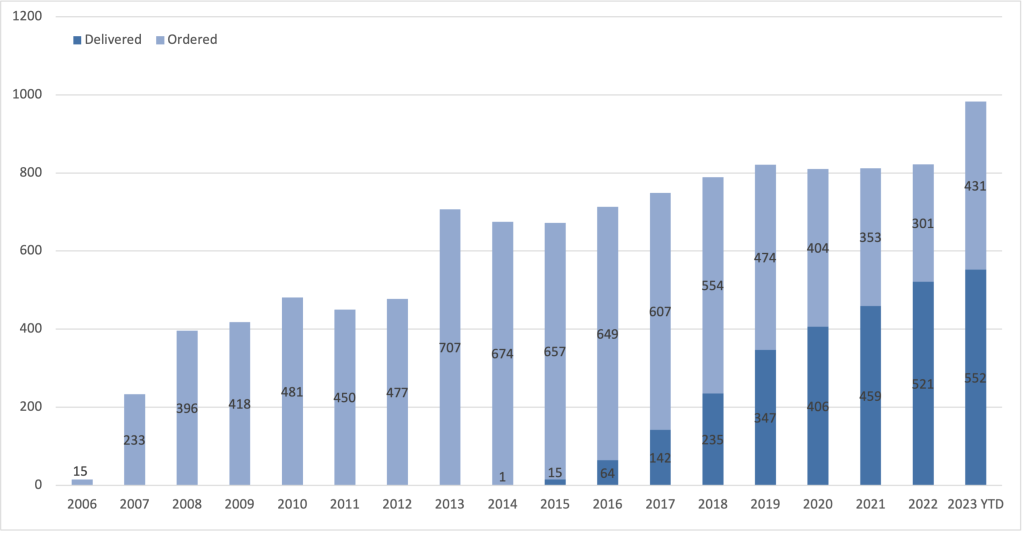
The sudden blow of the 2020 pandemic brought the order flow to a stall. During the three years of 2020-2023, the Airbus A350 gained exactly one net new order according to the manufacturer. That came to a change in 2023.
Born For The Third Time
Since the announcement of the type, the Airbus A350 had two big moments when it comes to orders. The first big tickets came in 2007 and 2008 from the likes of Emirates, Qatar Airways and Singapore Airlines. Following the first flight on the 14 June 2013 further operators gained trust in the type. Large orders from Air France, Iberia and Lufthansa signified all of the biggest airline groups from Europe opting in on the Airbus A350.
Now, closing Q3 of 2023, it’s been a bit over a year since major market reopenings. South Korea and India contribute significantly to the long-haul flows. The pent up demand is fully visible in the passenger flown data. Teams at network planning departments had the time to assess the trajectory of the market. The year started off with Qatar Airways and Lufthansa Group adding to the existing orders notably with 23 and 10 units.
The real breakthrough in the perception came in though with the earth-shaking Air India order that included 34 A350 seemingly like a cherry on top.
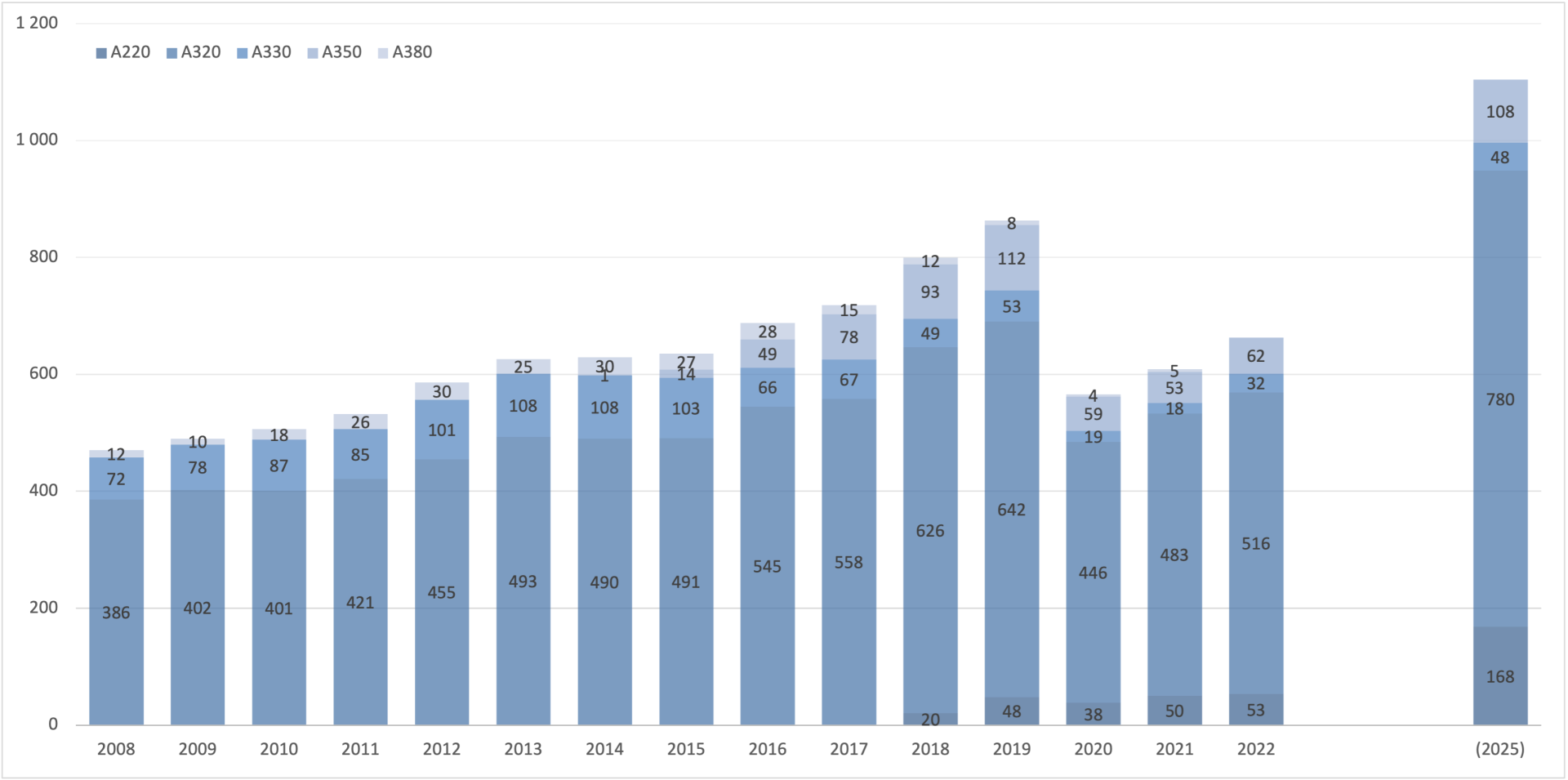
Airbus commercial jet deliveries according to the manufacturer (Photo: Airbus)
The Air France-KLM order brings the number to 161, meaning 2023 is the fourth best year so far, but 2023 is not done yet. Hopefully, we will see more carriers coming forward. Is that something that Airbus could handle?
The Queue
The A350 model production was turned down significantly at the brink of the pandemic. The manufacturer cut the production rate by approximately half. This meant going down to only around five units rolled-out in an average month – a level that is not even sufficient to reach the breakeven point for production.
Airbus A350 XWB fuselages awaiting components for final assembly. (Photo: AirlineGeeks | William Derrickson)
Due to continuous supply chain constraints, the rate has not seen a similar comeback as did the passenger demand. As of now, it stands barely at six units per month, which is far from the 2019 watermark of almost 10. The roadmap set by the manufacturer in the 2022 Annual Report predicts reaching an average of nine units produced monthly by the end of 2025. A rough calculation says that the backlog for an Airbus A350 is currently 5-7 years long.
Airbus A350 net orders and deliveries according to the manufacturer (Photo: Airbus)
Overall, the Airbus A350 is nowhere near close to the numbers produced of the A320 family. Given the aircraft is bringing approximately three times higher unit revenue, though, it is still a meaningful part of the portfolio.
The manufacturer is visibly taking a course correction and ramping up production of all the aircraft families to match the pre-pandemic trend. This will only mean more orders and deliveries that will be welcomed by aviation professionals and passengers traveling onboard.
A passionate aviation enthusiast that started off his career as an aerospace engineer, but found his true calling on the commercial side of the airline business. Now as a finance guy among avgeeks and an avgeek among finance guys, he has experience working in the Revenue Divisions of three airlines. In his spare time he enjoys traveling, but admittedly sometimes is more about the journey than the destination.
U.S. Pilot Hiring on Track to Eclipse 2022 Levels
Major United States airlines are continuing to hire pilots at a record pace, which is now on track to exceed 2022 numbers.
Inside the cockpit of an Airbus A220. (Photo: AirlineGeeks | Fabian Behr)
The aviation industry is currently in an unprecedented time for multiple reasons, however, one in particular stands out compared to the rest: pilot hiring. In 2022, airlines in the United States set a record by hiring just over 13,000 pilots, almost tripling the previous high of just over 5,000 in 2021.
While the industry has seen significant peaks and lulls over the years, the current state shows pilot hiring climbing to previously unseen levels, with 2023 forecasted to surpass the hiring that occurred in 2022.
Aircraft manufacturing giant, Boeing, anticipates a global demand of 649,000 new pilots over the next 20 years. The Arlington, Va.-based manufacturer believes the commercial North American sector will need 129,000 pilots, while China and Eurasia will necessitate even more.
Future and Active Pilot Advisors (FAPA) has tracked pilot hiring with the major carriers since the 1990s. The organization anticipates the hiring trend to continue this year, marking yet another record in the number of pilots hired by major carriers in a year. FAPA categorizes the major carriers as Alaska, Allegiant, American, Atlas, Delta, FedEx, Frontier, Hawaiian, JetBlue, Southwest, Spirit, United, and UPS. Regional carriers and corporate operators are not included in the data detailed below.
Regional carriers will need to continue hiring pilots who meet the Airline Transport Pilot certificate (ATP) requirements or the Restricted Airline Transport Pilot certificate (R-ATP) requirements. Corporate operators have different requirements set forth to hire pilots, however, many hire at the same requirements that regional carriers do.
Record Hiring
In 2021, major carriers hired 5,426 pilots according to FAPA, with United Airlines hiring the most at 1,280 pilots. At the time, this was the largest number of pilots hired in a single year. 2022 on the other hand brought unfathomable numbers.
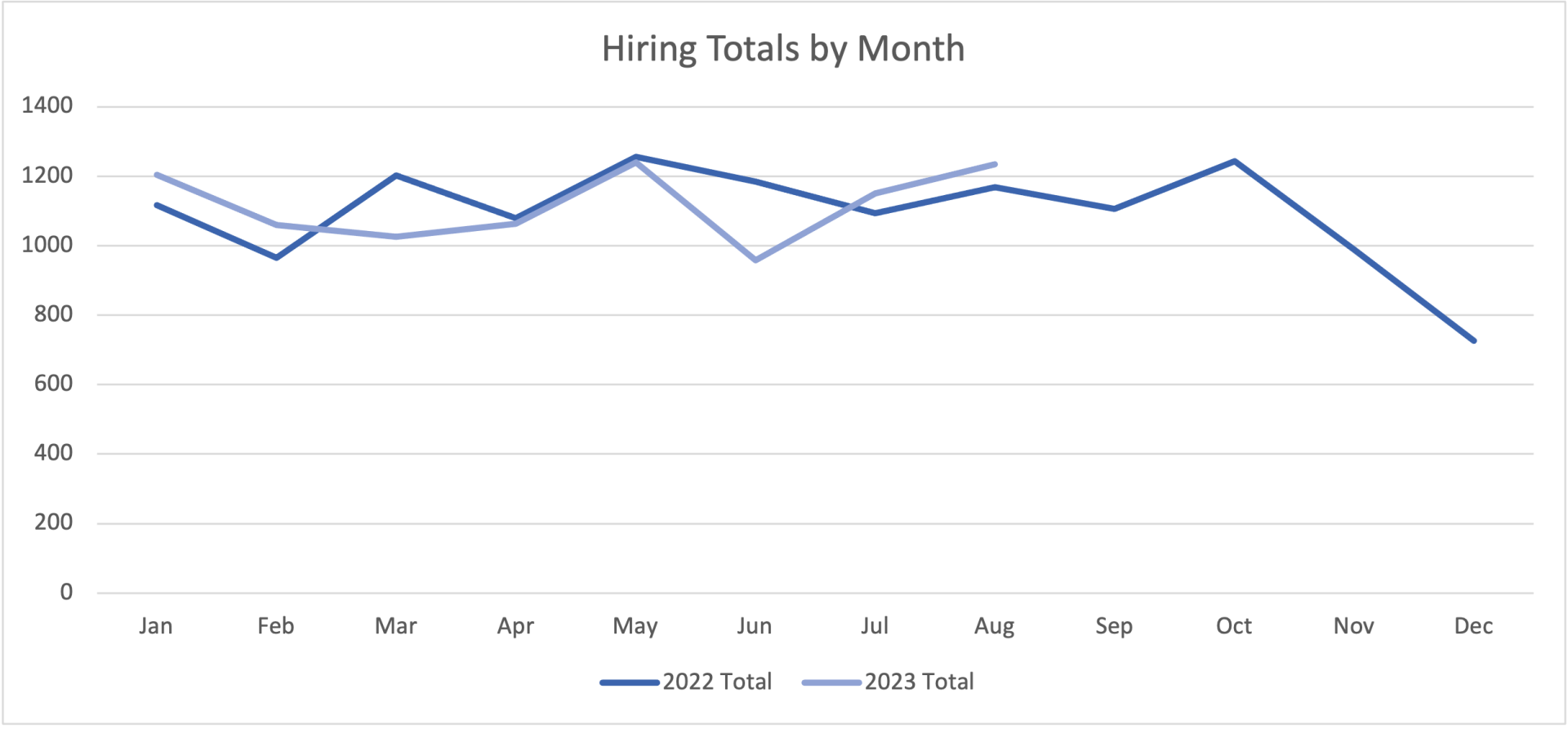
Last year, 13,128 pilots were hired by the majors. This represented an increase of 142% in one year. So far in 2023, the major carriers are on track to break that record as well, with FAPA anticipating over 13,000 pilots set to be hired. Through August, 8,920 pilots have been hired, leaving four more months in the year for additional growth.
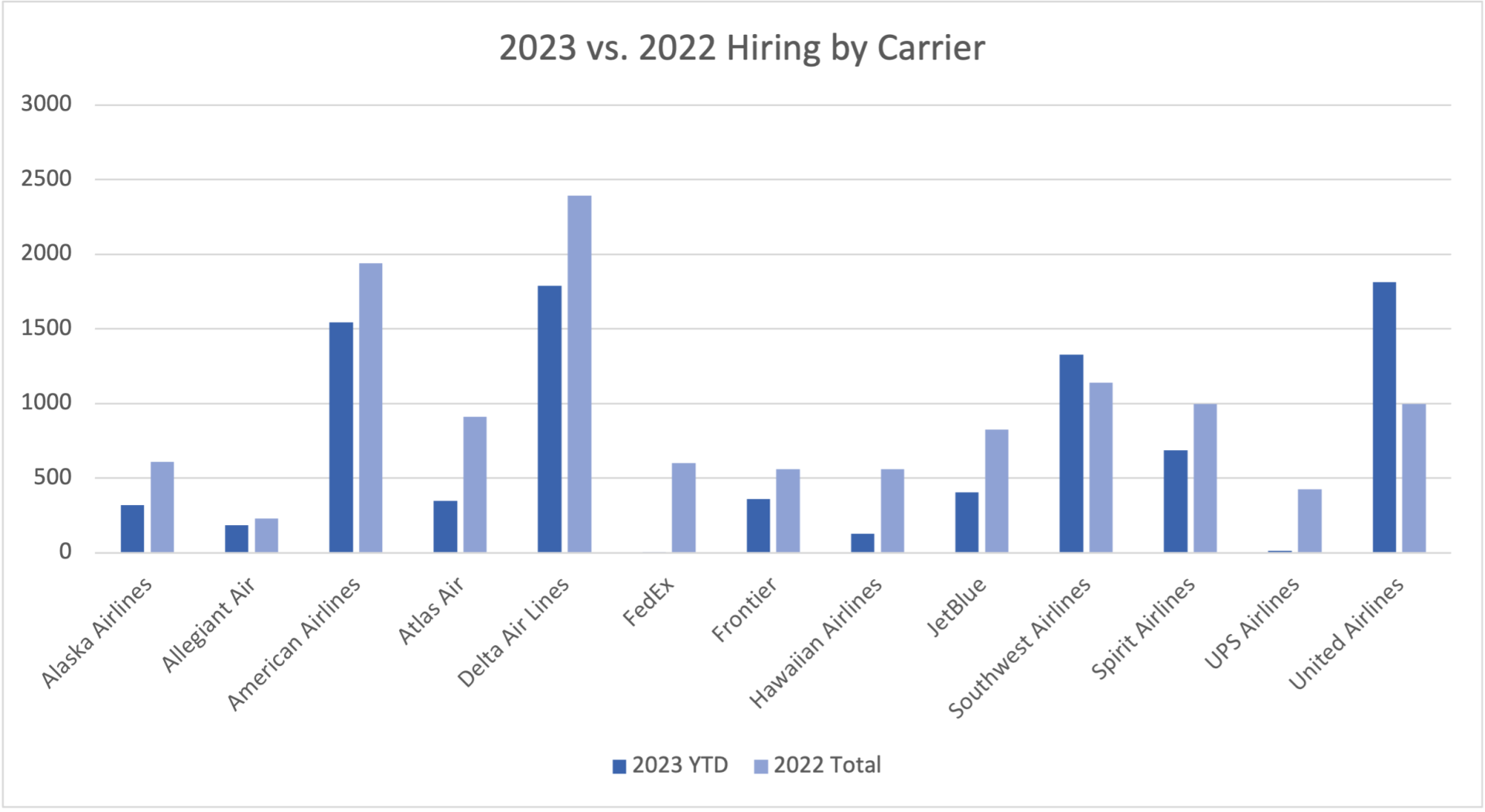
Year-to-date pilot hiring by U.S. carrier ((Data: FAPA)
Freight Operators Buck the Trend
It is not all positive news though. Cargo giants FedEx and UPS are currently seeing a post-COVID decline in operations. According to ch-aviation, FedEx has accelerated the retirement of the carrier’s MD-11 aircraft with a fleet retirement year of 2028. Trans-Pacific flying is being cut by 30% for the Memphis, Tenn.-based carrier, and overall flight hours are being reduced transforming the company’s operation to have more presence on the ground. FedEx hired two pilots in January of 2023 and zero since. UPS started the year with nine hires, four in February and none since.
On the flip side, passenger carriers are hiring at rates never before seen. Year-to-date totals for the big three include American Airlines bringing aboard 1545 pilots so far this year, Delta Air Lines with 1790, and United Airlines hiring 1813 pilots. American had the largest class month out of all the carriers, bringing aboard 284 pilots in May alone per FAPA.
2022 and 2023 pilot hiring totals by month (Data: FAPA)
Hiring droughts in the past have correlated with major world events involving a decline in air travel. Immediately following Sept. 11, 2001, carriers furloughed pilots for years without recall. Hiring then resumed after those who had been furloughed had returned, however, some carriers waited longer than others. American Airlines, for instance, hired zero pilots from 2002 to 2012, a period of 10 years.
Many of the carrier’s pilots spent years furloughed awaiting the call to return to the job they had worked years to earn. This was a similar story for those at other carriers during the time period as well. Delta and United did not hire pilots again until 2007, lasting only two years before another year of zero pilots added to the ranks. The post-2007-2008 financial crisis showed 30 pilots being hired across the major carriers in 2009, all of which were by JetBlue.
Looking Ahead
The past two and half years show a very different picture compared to the ones painted just a decade ago. The United States Bureau of Labor Statistics believes that between 2022 and 2032, there will be around 16,800 openings for airline and commercial pilots each year over the course of the decade. This number accounts for retirements and attrition across the industry and other workforces. United Airlines alone is expecting to add 10,000 pilots over the course of the decade.
Major carriers are also addressing one of the largest barriers to entry into the industry: cost. The big three carriers are making strides to bring those without experience in the field into the workforce. Delta Air Lines has partnered with a Florida-based flight school to create the Propel Flight Academy. The carrier is offering financial assistance as well to help students get into the cockpit at an accelerated pace. United Airlines also has its own in-house flight school in Arizona. American has the American Cadet Academy, partnering with CAE to give those without experience a path into an American Airlines cockpit.
United also just announced a new way for military aviators to transition into the civilian sector. Applicants need not have an ATP certificate, just the minimum requirements to possess one. Scott Kirby, United’s CEO stated “Launching this program is a win-win: our airline gets direct access to some of the best, most talented aviators in the world, and military pilots – and their families – get the time they need to plan their civilian career while still serving.”
While there is no magic ball to query for what the future will hold, the aviation industry needs pilots.
AirlineGeeks.com was founded in February 2013 as a one-person blog in Washington D.C. Since then, we’ve grown to have 25+ active team members scattered across the globe. We are all here for the same reason: we love deep-diving into the fascinating realm of the airline industry.
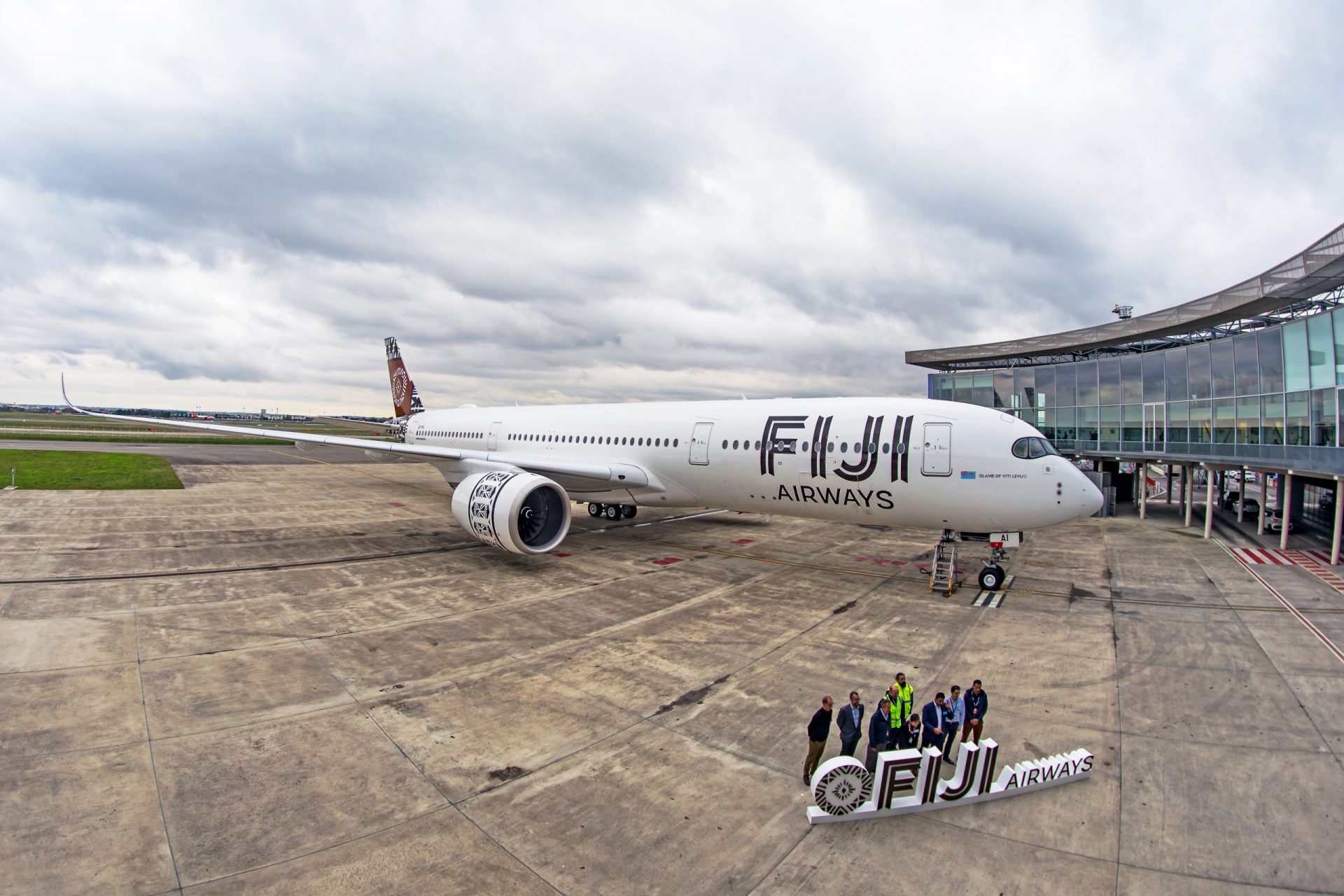
A Fiji Airways A330 landing at LAX. (Photo: AirlineGeeks | William Derrickson)
Editor’s Note: AirlineGeeks is excited to launch our ‘Livery of the Week’ series. Every Friday, a team member will share an airline livery, which can be from the past, present, or even a special scheme. Some airline liveries are works of art. The complexity associated with painting around critical flight components and the added weight requires outside-the-box thinking from designers. The average airliner can cost upwards of $200,000 to repaint, creating a separate aircraft repainting industry as a result.
Influenced by its tropical domicile, Fiji Airways’ striking livery adorns a fleet of 14 aircraft. The livery debuted in 2013 following a rebranding effort from the Air Pacific name.
A part of the Air Pacific Group – which has various government and private owners – Fiji Airways and its subsidiary Fiji Link operate over 400 flights per week to 10 countries. From its home base at Nadi International Airport, the airline uses A350 and A330 aircraft to serve long-haul markets, such as Los Angeles, San Francisco, and Sydney.
Fiji Airways was the name of the airline between 1951 and 1970. The name was changed to ‘Air Pacific’ in 1970, according to a press release. The airline reverted back to its 1950s-era name while also debuting a vibrant paint scheme.
The ‘Very Best Flying Ambassador’
Even though Fiji Airways’ livery is largely white across aircraft fuselages, it features artful designs. The livery is an ode to the carrier’s Pacific Island roots.
TheDesignAir describes it best. On the outside of each aircraft, three Masi motifs will represent Fiji Airways. The distinctive ‘Teteva’ symbol is designed by renowned Fijian Masi artist Makereta Matemosi, serving as the airline’s main logo design.
Located on the tail of Fiji Airways’ aircraft, the symbol represents the friendliness and caring nature of Fijians. Also on the engines, the ‘Rova’ motif symbolizes the warm greeting Fijians extend to visitors, according to TheDesignAir.
Fiji Airways first Airbus A350. (Photo: Airbus)
Fiji Airways’ CEO David H. Pflieger Jr. at the time was quoted as saying: “Our mission was to create a proud symbol that would stand out at some of the world’s busiest international airports, a symbol that would allow us to become the very best ‘Flying Ambassador’ that Fiji could ever have.”
Across the airline industry, a wide-reaching trend has emerged, dubbed ‘Eurowhite,’ where airlines paint their aircraft mostly all-white to save costs. Fiji Airways makes up for a predominantly white fuselage with a colorful and intently-made design on its tail and engines.
Looking for a new airplane model? Head over to our friends at the Midwest Model Store for a wide selection of airlines and liveries.
Ryan founded AirlineGeeks.com in February 2013 and has spent more than a decade covering the airline business. His work has been featured by CNN, WJLA, CNET, and Business Insider. His aviation experience spans airport operations, Part 135 regulatory compliance, and airline crew workforce planning, along with time behind the yoke of a Cessna 172 and interviews with airline executives. Ryan now serves as Group President of Firecrown Media’s Aviation Group. He holds a B.S. in Air Transportation Management and an MBA from Arizona State University and teaches Airline Management at Embry-Riddle Aeronautical University.
Sun Country Boeing 737s sitting at its main base in Minneapolis/St. Paul (Photo: AirlineGeeks | Joey Gerardi)
Sun Country, a Minneapolis/St. Paul-based ultra-low-cost carrier which operates a fleet of Boeing 737-800s, has begun the process of applying for more Essential Air Service (EAS) contracts.
Roughly a year ago, the carrier took the aviation community by surprise winning its first EAS contract in the Wisconsin community of Eau Claire. This became Sun Country’s shortest route at only 85 miles, the largest aircraft to regularly fly to an EAS city, and also the longest EAS route as the contract also has them operating flights from Eau Claire to Las Vegas. AirlineGeeks even had the chance to fly on Sun Country’s inaugural flight to Eau Claire.
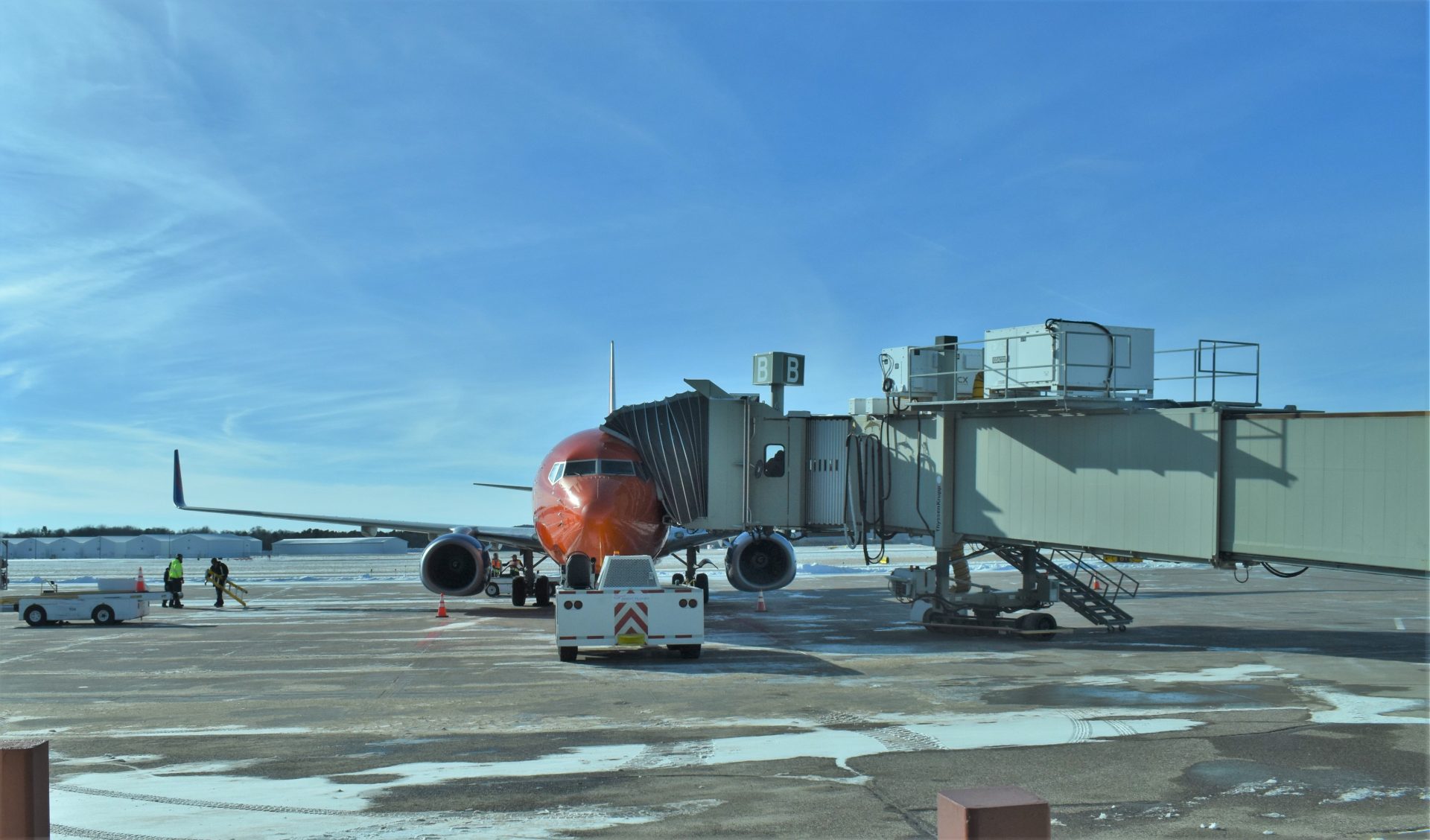
Sun Country 737-800 in the EAS community of Eau Claire, Wis. (Photo: AirlineGeeks | Joey Gerardi)
One year ago, nobody would’ve thought that Sun Country would end up with an EAS contract, let alone be applying for more. Technically the airline does not even qualify for EAS service given that it has less than daily service, but nonetheless, Sun Country was awarded the contract in Eau Claire and is coming up on the one-year anniversary of the inaugural.
The two EAS communities it has now applied for include Brainerd in Minnesota as well as Rhinelander in Wisconsin. Both communities currently see SkyWest service under the Delta Connection brand onboard CRJ-200s, but will soon switch to CRJ-700s or CRJ-900s due to a directive from Delta that all branded service must be dual-class service starting October 2023.
Rhinelander and Brainerd, along with three other midwestern EAS communities will have their current contract end on January 31, 2024, with the new term date beginning the next day, on February 1, 2024. The two communities that Sun Country will be bidding for also have other applicants; including Boutique Air and current operator SkyWest.
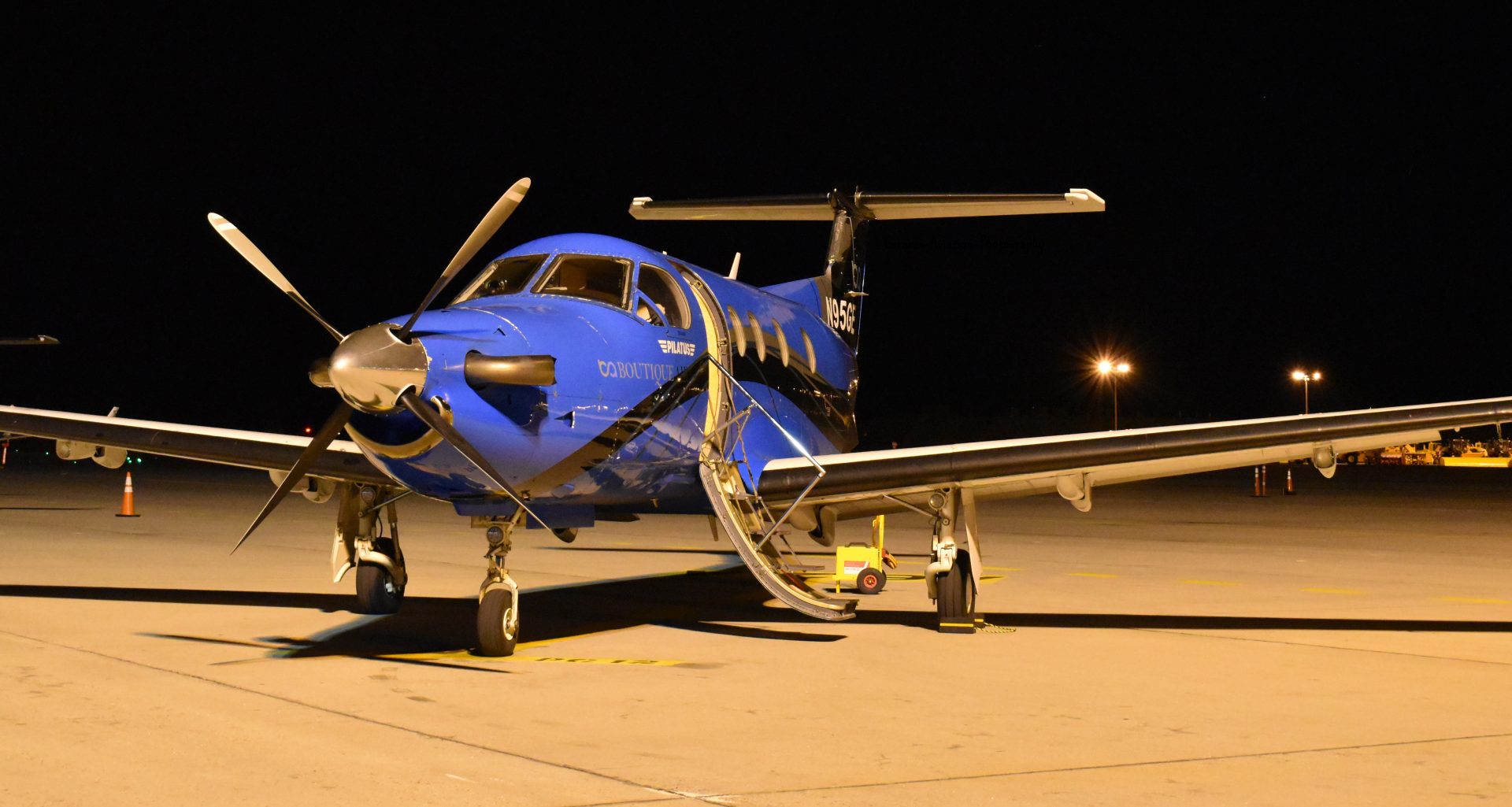
Boutique Air is proposing 30-weekly flights to Brainerd and 24-weekly flights to Rhinelander either on the Pilatus PC-12 or the Piaggio P180. The subsidy that the carriers are asking for is somewhere between $5,300,000 and $6,800,000 per year depending on the route and aircraft type.
SkyWest is offering a unique bid, as per the previously noted Delta directive it has to operate dual-class service to all Delta-branded destinations. But, SkyWest has always served these communities in the past with 50-seat jets as anything larger including the 69-76 seat jets such as the CRJ-700s and CRJ-900s would be too much capacity for some of these smaller communities. So, in the proposal, SkyWest does note “CRJ-550/700/900” as the aircraft which will serve the route.
United’s CRJ-550 (Photo: AirlineGeeks)
This hints toward the fact that SkyWest is actively retrofitting or willing to retrofit some of its CRJ-700 aircraft into CRJ-550s, as the directive only says is it has to be dual-class service. This will also bring the aircraft down to 50 seats, while also offering a premium class.
SkyWest would service both cities from Minneapolis/St. Paul, with Brainerd getting 12-weekly round trips, and Rhinelander getting 14-weekly round trips. The requested subsidy is roughly $5,600,000 to $6,7800,000 per year depending on which route and aircraft type.
Sun Country’s Recent Proposal
The Sun Country proposal is an interesting one. As noted, the carrier technically doesn’t qualify for an EAS subsidy as the service is less than daily and doesn’t offer connecting onward flights from three of the four destinations on offer. For both communities, Sun Country is proposing year-round service to Minneapolis/St. Paul that will operate two to three times per week, which means it will be closer to two most weeks with some weeks offering three frequencies.
From January through April, it will offer up to six times per week flights to Fort Meyers. From May through August it will offer up to five times per week to Orlando, and finally from September through November, it will offer up to three times per week flights to Phoenix Sky Harbor. This will equate to 414 departures per year out of each individual airport on 186-seat Boeing 737-800s aircraft.
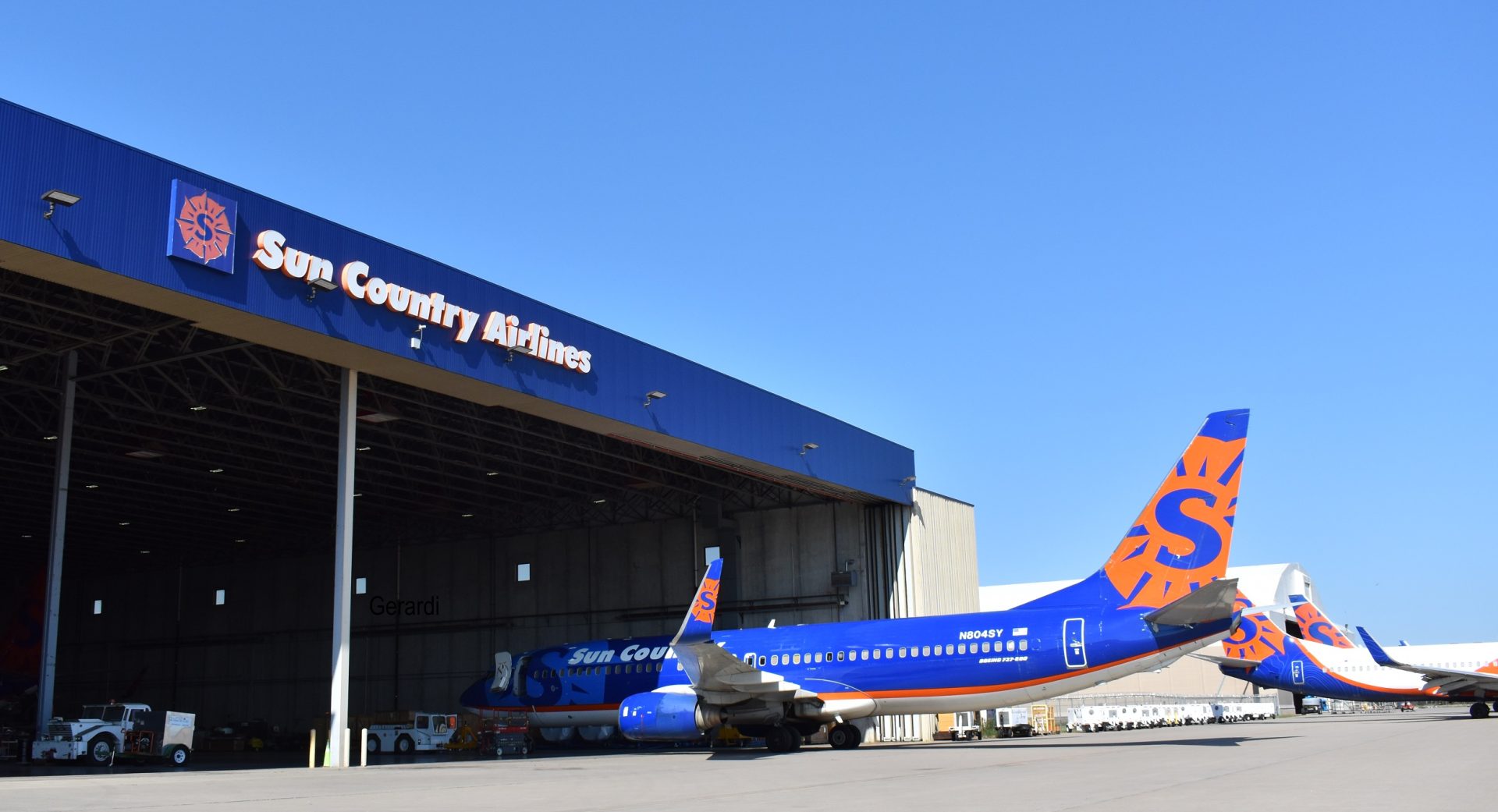
A Sun Country 737-800 at the airline’s hangar in Minneapolis (Photo: AirlineGeeks | Joey Gerardi)
Even though it still wouldn’t bring the Minneapolis service up to daily, Sun Country also mentioned that it would offer Landline bus service to its Minneapolis/St. Paul hub, but that is not part of the EAS subsidy request. The subsidy request per year for Sun Country in both communities is around the $6,800,000 to $6,900,000 range, so it is more expensive than the other two airlines are proposing and there will also be a lot fewer flights per year along with fewer opportunities for connections. But despite the number of flights being less, the yearly amount of seats Sun Country will offer out of each community is a lot more as the aircraft is larger, which Sun Country hopes will sway the communities into choosing them, similar to Eau Claire.
Conclusions
Costs aside, as they are pretty close to being the same, all of the contracts have positives and negatives. For Boutique, it has much smaller aircraft with only eight seats, but the positive is their service is a lot more frequent with flights 30 times a week, meaning there would at least be four daily flights but the number of available seats per year would also be closer to 12,000. Passengers can also connect and check baggage through to United and American flights in Minneapolis.
A Boutique Air Pilatus PC-12 (Photo: AirlineGeeks | Joey Gerardi)
SkyWest has been in these communities for many years and they have a long-standing foundation, and generally people don’t like change so this may be the path of least resistance. It will service the communities with 69-76-seat regional jets that also offer first-class cabins, and passengers can connect to the Delta network. Using numbers from the 76-seat jet, the amount of yearly available seats will be around 47,500 for Brainerd and around 55,300 for Rhinelander.
Sun Country simply has bigger jets, and communities may just go with them when they catch a case of ‘big shiny jet syndrome,’ similar to when communities with propeller flights see SkyWest applying. They have the most overall seats per year with just over 77,000 annual seats for each community on Boeing 737-800s and passengers can fly nonstop to Phoenix, Orlando, and/or Fort Meyers depending on the time of year.
Joey has always been interested in planes for as long as he can remember. He grew up in Central New York during the early 2000s when US Airways Express turboprops ruled the skies. Being from a non-aviation family made it harder for him to be around planes and would only spend about three hours a month at the airport. He was so excited when he could drive by himself, the first thing he did with his driver's license was get ice cream and go plane spotting for the entire day. He graduated from Western Michigan University in 2022 with a B.S. in Aviation Management & Operations and a Minor in Business, and currently works for a major airline in his hometown.
Aviation, Trade Sectors Brace for Government Shutdown
Agencies will be stretched to keep functioning at normal levels, businesses fear
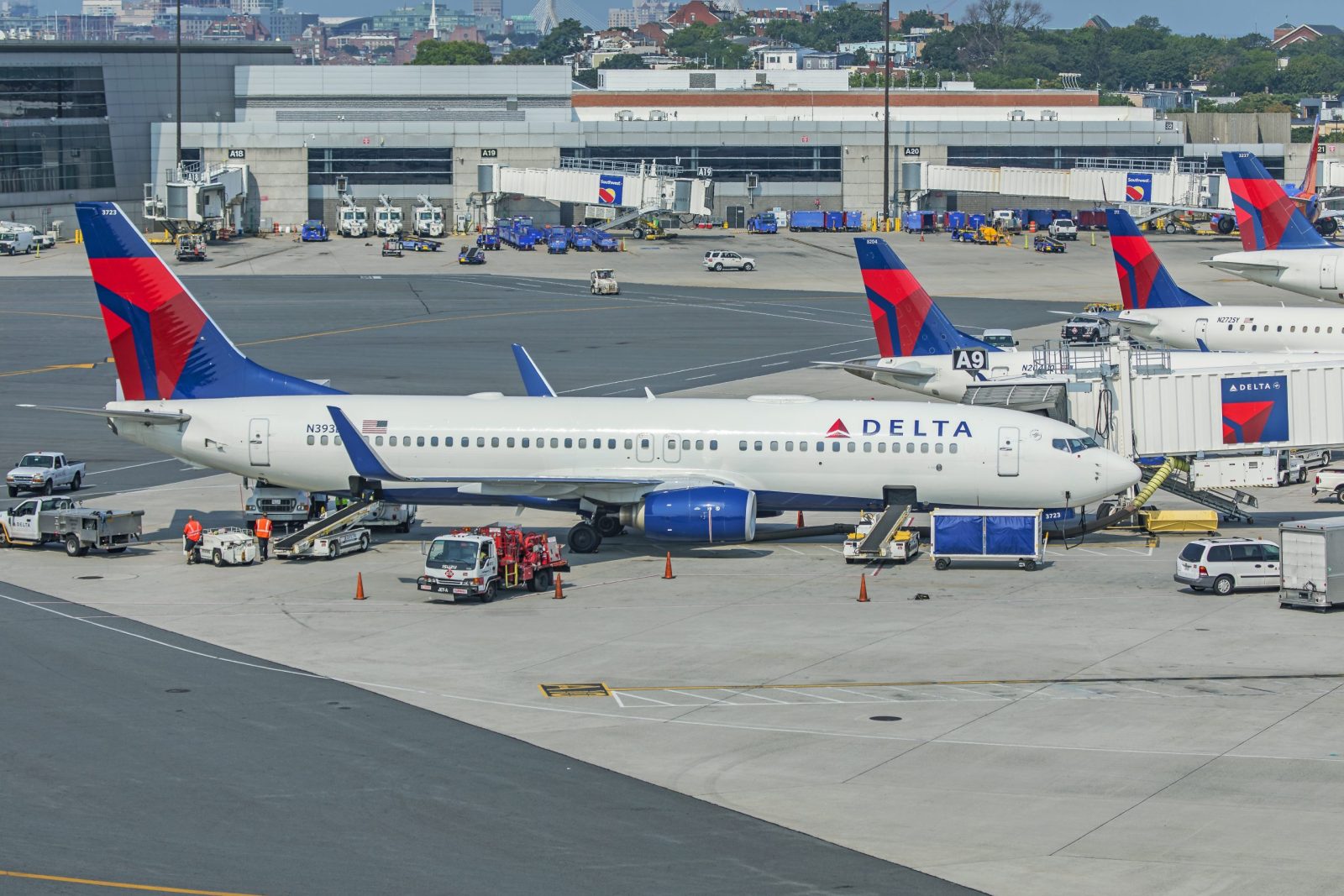
Delta aircraft parked on the ramp in Boston.
(Photo: AirlineGeeks | William Derrickson)
Aviation and logistics industry officials are frustrated with lawmakers’ inability to fund the government beyond this Saturday and say there will be real-world consequences for commerce if agencies are forced to halt all nonessential services at the end of the month.
Airlines will continue to fly and goods will be able to flow through land and sea ports as front-line Customs and Transportation Security Administration personnel stay on the job without pay, but shortages of workers, especially for support functions deemed nonessential, could reduce processing efficiency and delay travelers and shipments. Other consequences could extend beyond the immediate term as programs and activities important to businesses get halted.
“We’re heading into the busiest time of year for the supply chain when you need things to work. Yes, volumes are down, but we’re up against pretty firm deadlines with lots of new product introductions from a variety of companies and lots of shipping going on. Government should function like a well-oiled machine,” said Neel Jones Shah, executive vice president of air strategy and carrier development at Flexport.
The Federal Aviation Administration will furlough more than 17,000 employees on Sunday if Congress doesn’t pass a short-term continuation of fiscal 2023 funding, according to a shutdown plan for the Department of Transportation. The FAA will continue to provide air traffic control, hazardous material inspections and airworthiness directives, and it will maintain navigational aids. But activities related to airport infrastructure investments, aviation rulemaking, facility security inspections and development of new navigation technologies will cease.
Transportation Secretary Pete Buttigieg said on CNN that a shutdown will prevent hiring and training more air traffic controllers when the system is experiencing a 3,000-person shortfall that has contributed to severe flight delays in the past year.
“A government shutdown would reduce federal safety oversight, strain airport security, delay much-needed infrastructure and planning projects, and furlough thousands of hard-working public servants,” said Greg Regan, president of the Transportation Trades Department of the AFL-CIO, in a letter sent Wednesday to members of Congress. “To be clear: transportation systems and federal workers are not the only ones who will be affected by a shutdown. A shutdown affects the entire country and your constituents will also suffer the consequences as the public transit, passenger rail, and aviation systems they rely on are thrown into havoc.”
Some stakeholders expressed concern that some federal employees may self-furlough, or call in sick, because they may not want to work without getting paid.
“In terms of resiliency and motivation of a workforce, particularly when there have been staffing challenges with air traffic control at the FAA, that’s not a conducive environment for retaining a motivated workforce or recruiting,” Lauren Beyer, the new president of the Cargo Airline Association, said in an interview earlier this month on the sidelines of an aerospace policy summit here organized by the U.S. Chamber of Commerce.
Airline executives also said they are dismayed that Congress has yet to pass legislation reauthorizing funding for the FAA, which is also set to expire on Saturday. House and Senate committees with jurisdiction over aviation in June introduced bipartisan versions of bills to update the agency’s programs for the next five years. The current road map allowed for $96.7 billion over six years. Policy watchers say the most likely outcome is a short-term, pro-rated extension of the current road map, which allowed for $96.7 billion over six years.
The House FAA reauthorization bill would provide $104 billion in funding for the FAA over five years, a 7.5% increase over the current law. The Senate bill calls for a 10.6% increase to $107 billion.
The House passed its legislation in July, but the Senate has yet to complete edits to its legislation because of disagreements over amendments that would change the number of flying hours required to obtain a pilot’s license and add slots to Reagan National Airport, which serves the Washington metropolitan area.
The FAA needs more resources to do its job, airline executives say.
“The frustrating thing from an airline perspective is we’re not even talking about modernization. We’re talking about let’s staff for the technology we have today. Let’s get enough controllers hired, let’s get them through training, let’s get them fully qualified so we can manage the system,” said Hawaiian Airlines CEO Peter Ingram on stage at the event. “I’d love to be talking about modernization, but it’s just about catching up because we have a deficit in many places in the country in staffing.”
A simple extension of FAA funding at current levels would be “an opportunity lost,” Ingram told FreightWaves. He and American Airlines CEO Robert Isom also called for swift approval of a permanent FAA administrator providing leadership so the air traffic control system can be modernized and operated more efficiently.
President Joe Biden recently nominated former Deputy Administrator Michael Whitaker for the job.
“The air traffic control is understaffed throughout the country. The current hiring plans aren’t making a big enough dent in that, and we really need to see hiring and training going on at a faster pace so that we’re not only keeping pace with the retirements, but we’re filling the deficits of air traffic controllers that are in place at many centers across the country,” Ingram said.
For importers and exporters, the concern is that U.S. Customs and Border Protection inspectors may not have the ability to consult import specialists to determine if certain entries are in compliance and that partner agencies, such as the Consumer Product Safety Commission, may be short personnel to sign off on certain imports.
The National Customs Brokers and Forwarders Association of America rallied 40 trade associations to sign a petition calling on agencies that regulate cross-border trade to stay in close touch with industry representatives so problems clearing shipments can be quickly resolved.
CBP has established a “war room” to monitor imports and exports at ports of entry and address bottlenecks.
The groups asked for a direct line of communication to the incident-response team and for CBP to invite partner government agencies, such as the Food and Drug Administration, to send staff to the meeting site. The trade community also urged Customs to ensure technical support for the Automated Commercial Environment, the portal through which imports and exports are reported to the government, so it continues to operate normally.
CBP should also pre-plan how industry-focused import centers coordinate with the local ports to prevent unnecessary slowdowns in moving shipments, the message said.
AirlineGeeks.com was founded in February 2013 as a one-person blog in Washington D.C. Since then, we’ve grown to have 25+ active team members scattered across the globe. We are all here for the same reason: we love deep-diving into the fascinating realm of the airline industry.
An Emirates A380 arriving in London.
(Photo: AirlineGeeks | William Derrickson)
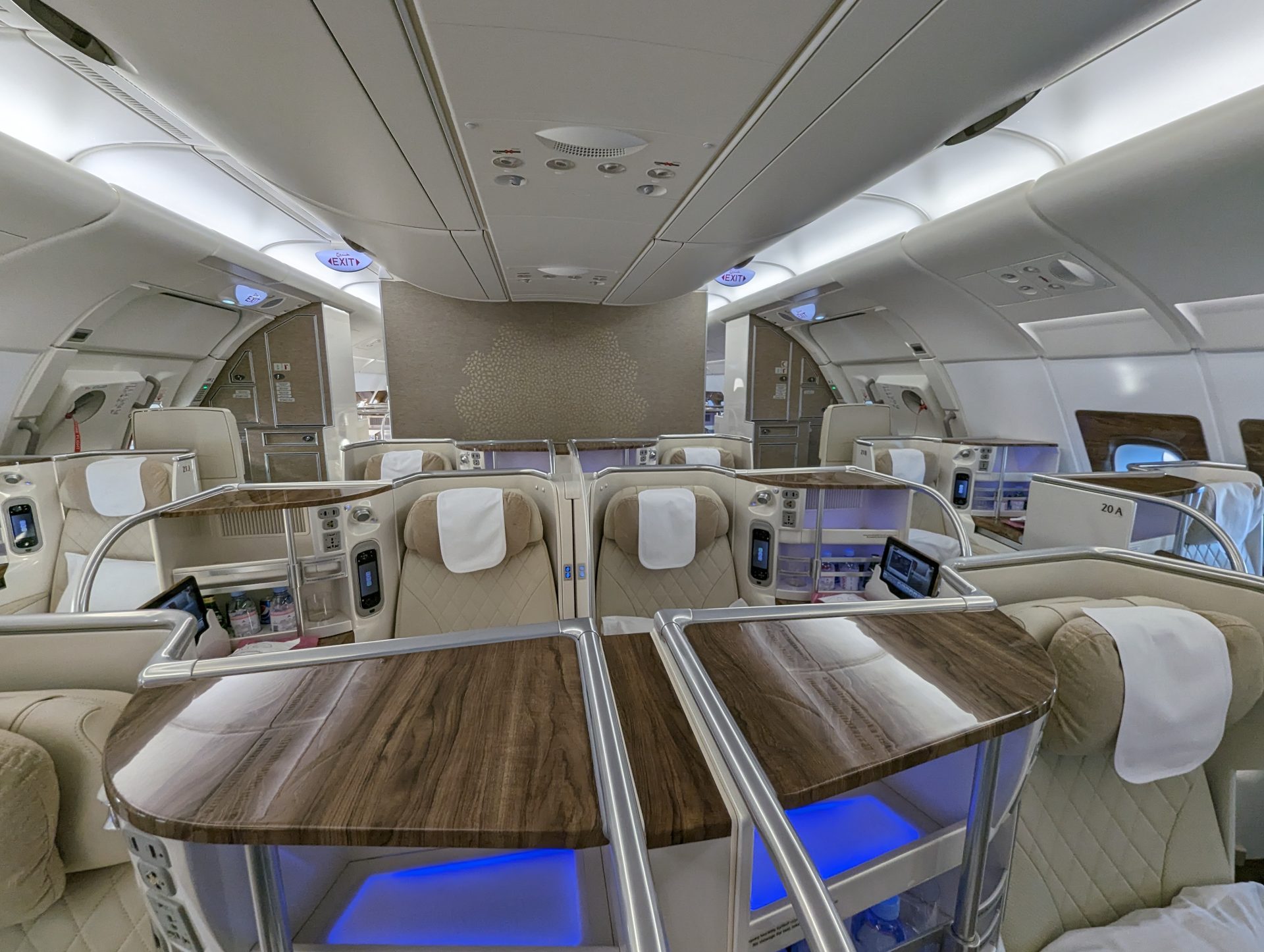
A little under a year ago, Emirates announced a $2 billion aircraft retrofit program aimed at refreshing the interiors of 67 Airbus A380 and 53 Boeing 777 aircraft. These retrofits were primarily to install several thousand premium economy seats, upgrades to nearly 7,000 business class seats, and the refurbishment of over 1,000 first class suites.
When the retrofit project was first announced in November of last year, the details were relatively scarce, not much was known beyond the airline’s intention to introduce new tones and design motifs to cabin interior panels along with cosmetic upgrades to existing seats. We knew that premium economy was being installed but not much beyond that.
This past summer, AirlineGeeks had the opportunity to tour one of these refurbished A380s to see the changes firsthand.
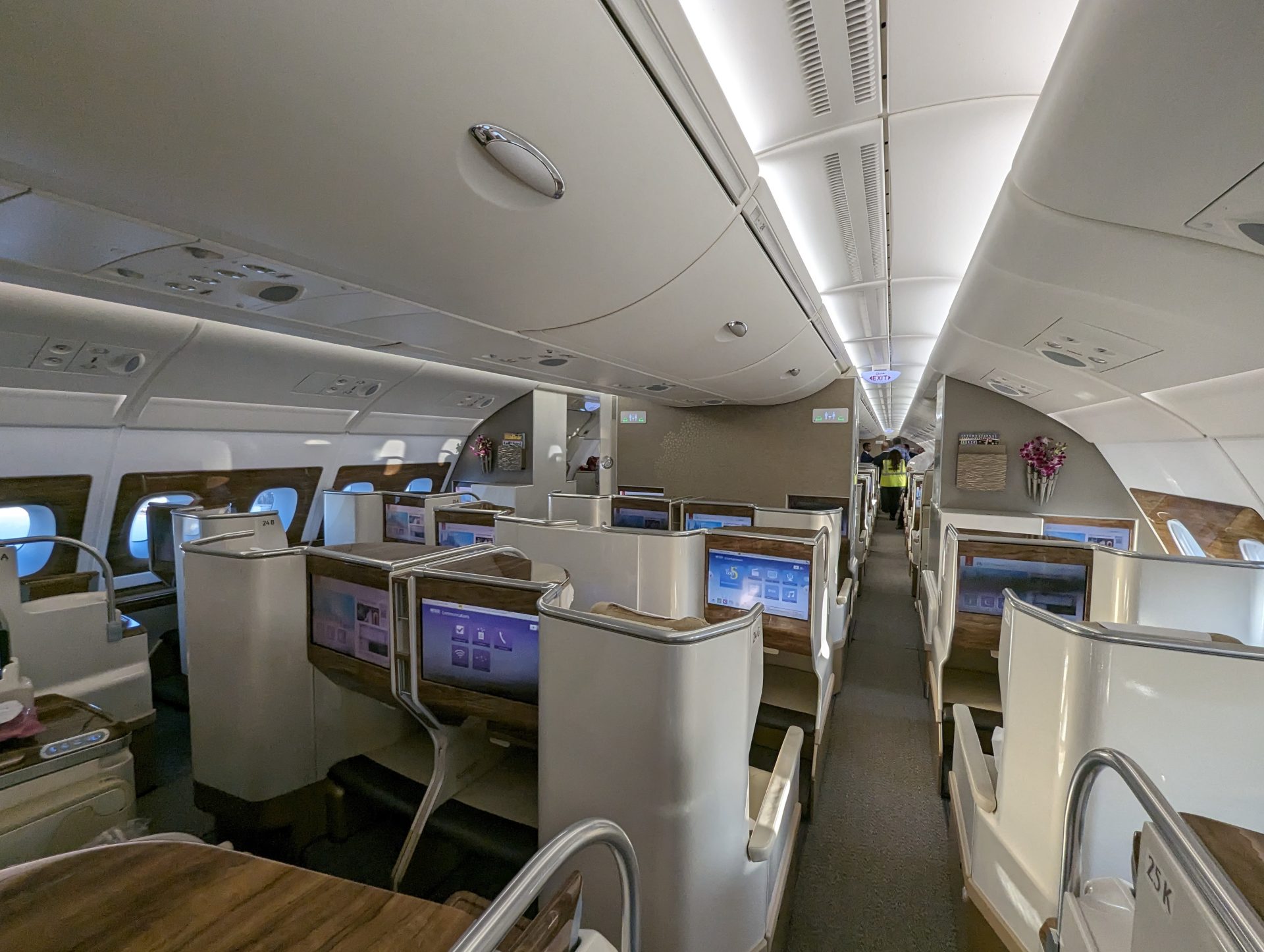
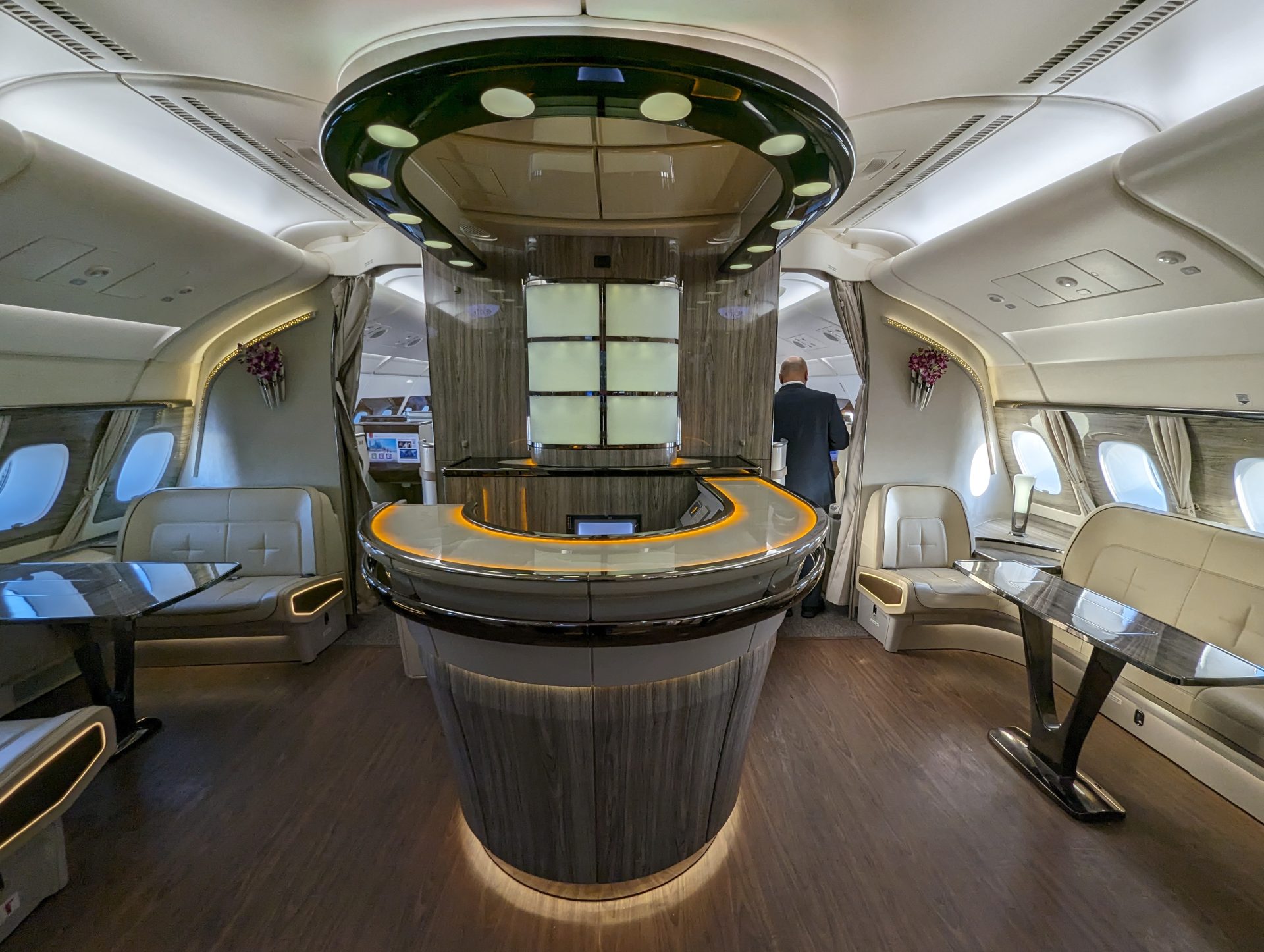
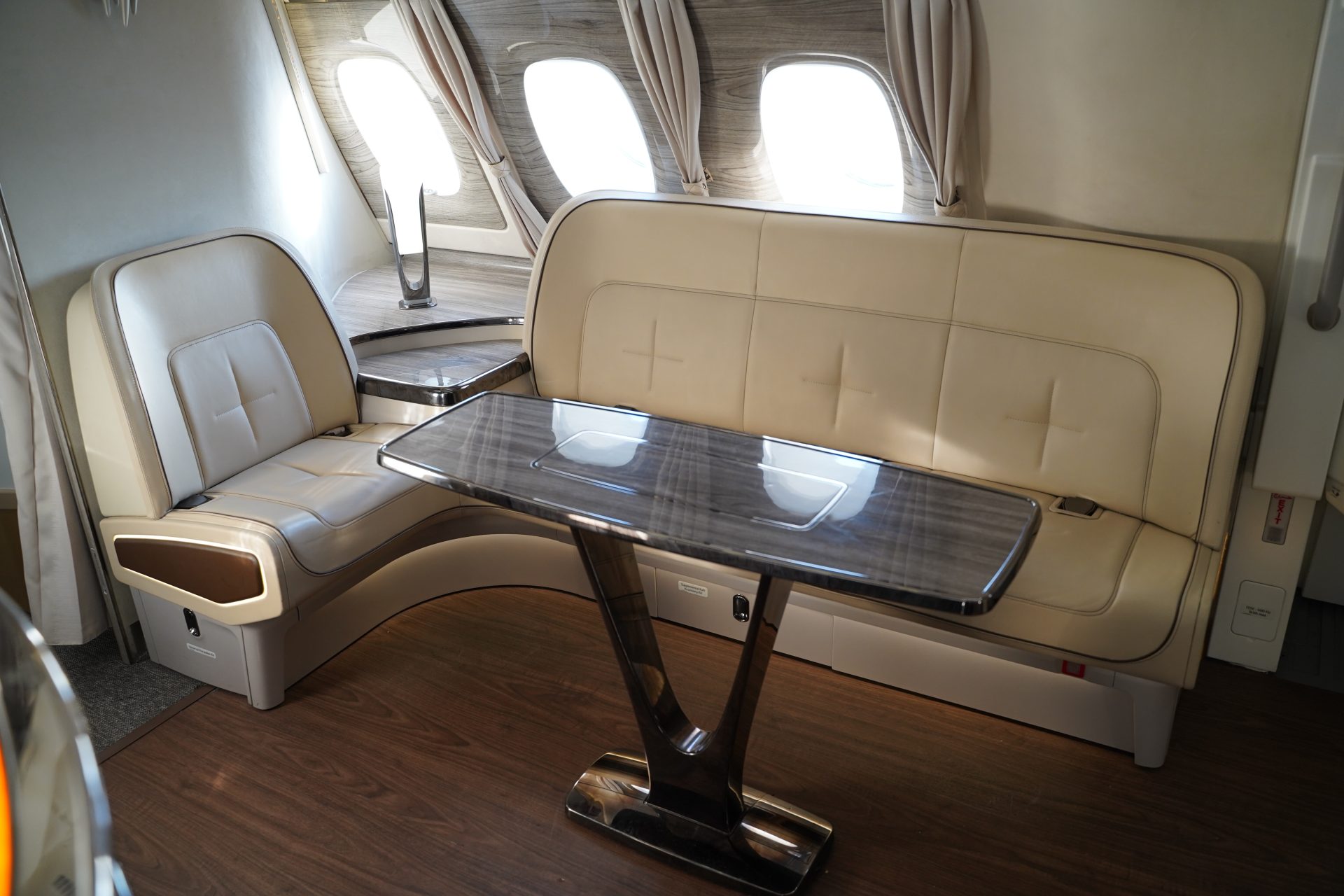
The first thing that is noticeable when stepping on the aircraft is how the entire color scheme of the aircraft interior has changed. Emirates is well known for the dark wood paneling and gold finishes but the new interiors are anything but. Essa Sulaiman Ahmad, divisional vice president for the U.S. and Canada, called this the next generation of the Emirates brand during the walkthrough of the aircraft.
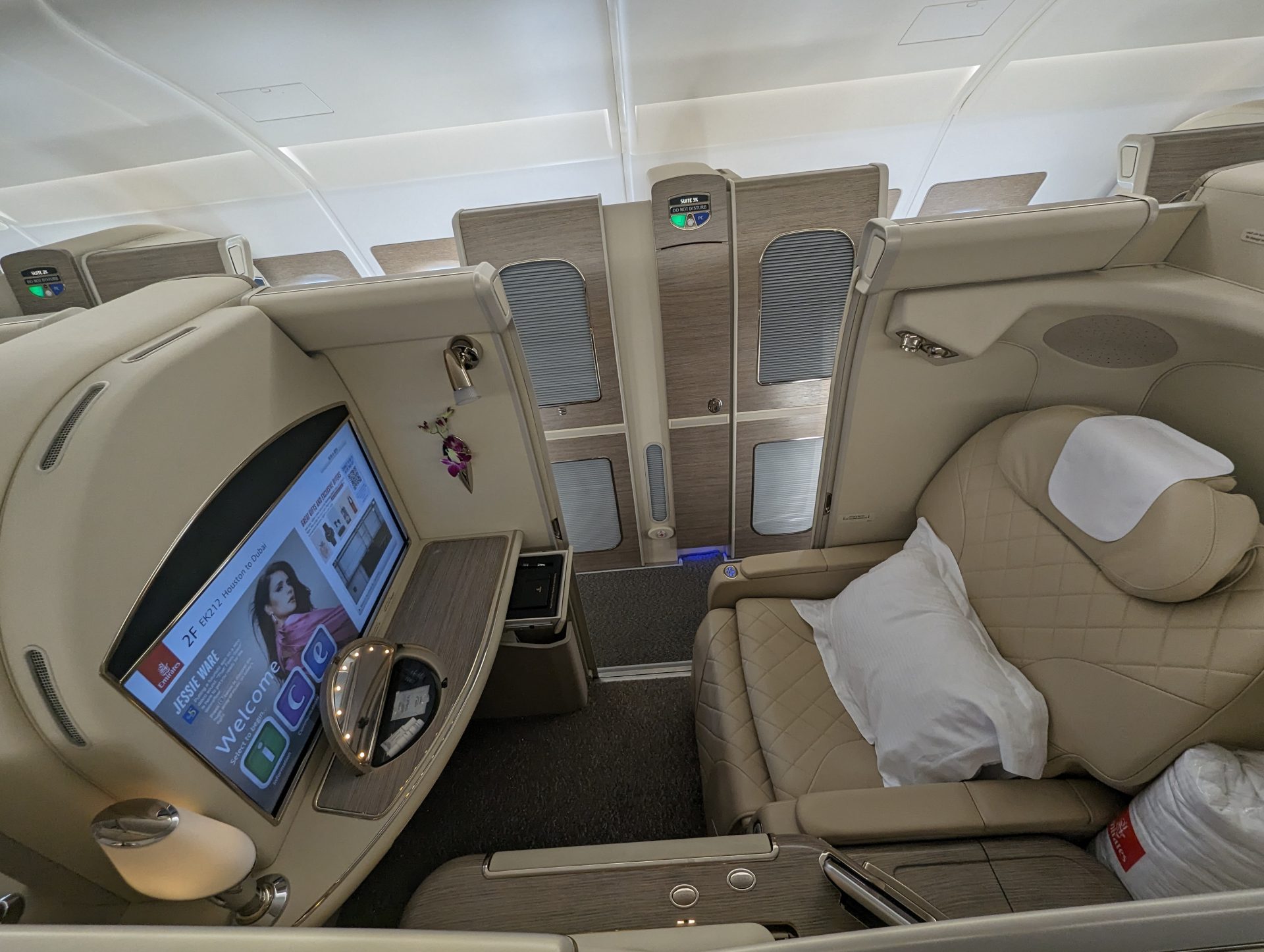
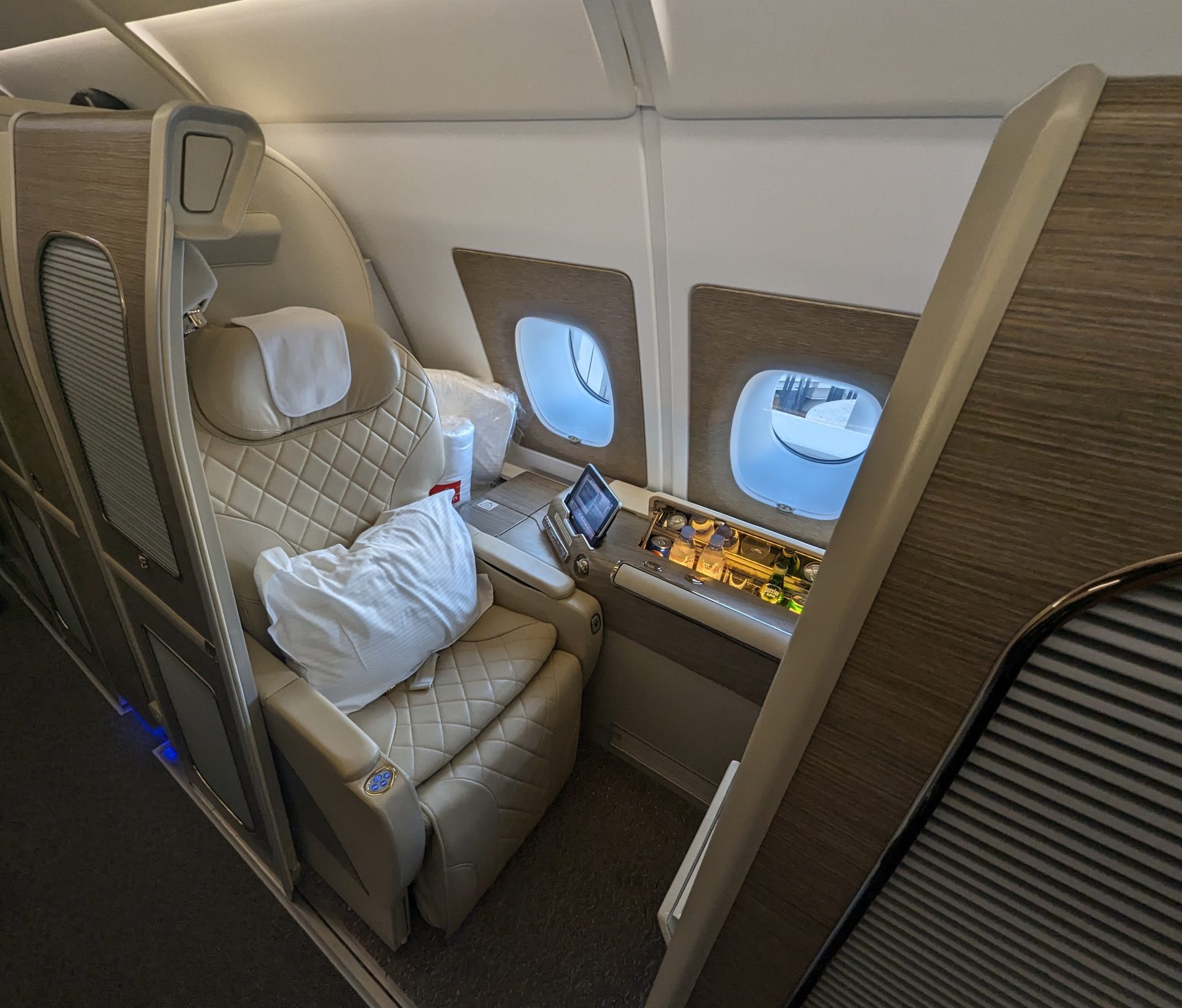
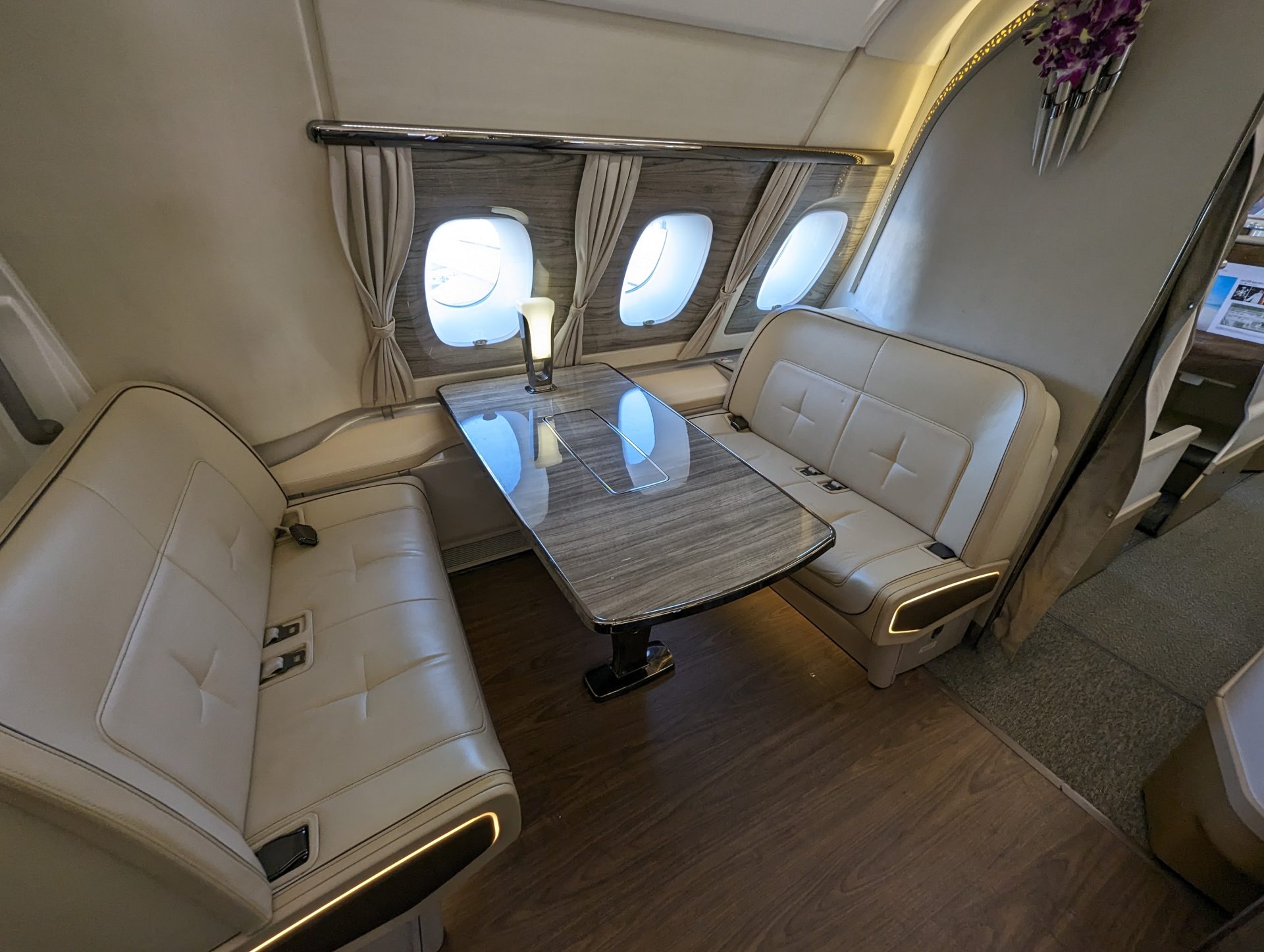
Now when walking onto a refurbished Emirates aircraft the one thing that immediately jumps out is how incredibly bright the cabins are with the lighter color scheme. The dark wood and gold finishes have been entirely replaced by cleaner and brighter champagne-colored panels and finishing which make the cabins feel significantly larger and more open. Seat covers have also been changed to a lighter cream color.
First Class
This is most prominent in the first class cabin. The paneling and seats have all been changed to what Emirates is calling the new look of their brand
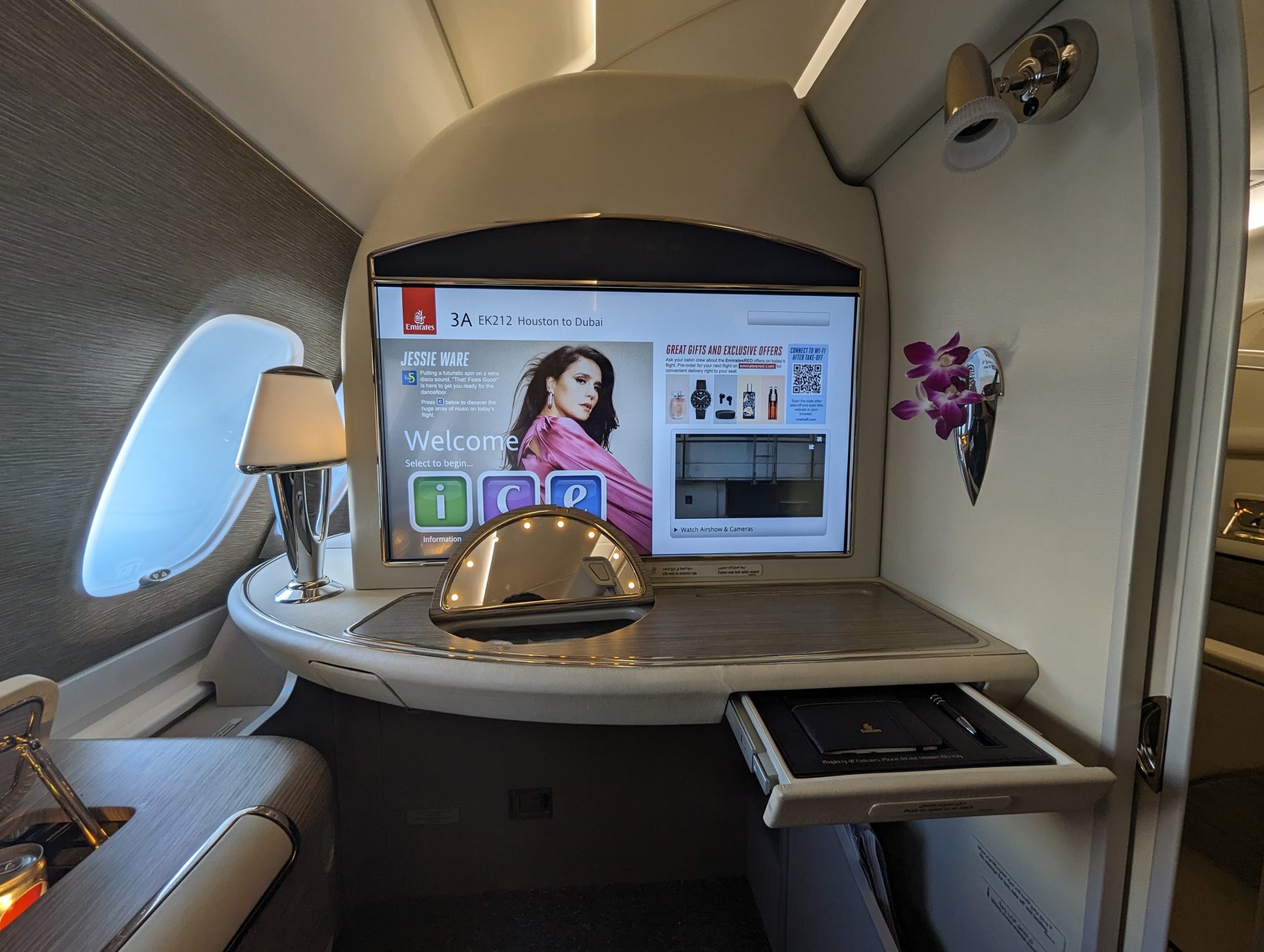
Emirates A380 first class (Photo: AirlineGeeks | Hemal Gosai)Emirates A380 first class seat (Photo: AirlineGeeks | Hemal Gosai)Emirates A380 first class seat IFE (Photo: AirlineGeeks | Hemal Gosai)
The first class shower suite has also been refurbished to match the new design.
Emirates A380 first class bathroom and shower (Photo: AirlineGeeks | Hemal Gosai)The Emirates A380 spa (Photo: AirlineGeeks | Hemal Gosai)
This past summer the airline has also introduced a swanky new amenity kit to go along with the revamp of first class.
The black and lilac kits, primarily targeted at women, include an engraved Bulgari mirror, a 30ml bottle of Bvlgari Le Gemme Desiria, a matching face and body emulsion, along with a dental kit, deodorant, tissues, and a hairbrush.
Emirates first class black and lilac amenity kit (Photo: Emirates)
The black and tan kits, primarily targeted at men, include a 30 ml bottle of Bvlgari Le Gemme Gyan, aftershave, body emulsion, cleansing towel, shaving kit, dental kit, deodorant, tissues, and a hairbrush.
Emirates first class black and tan amenity kit (Photo: Emirates)
Premium Economy
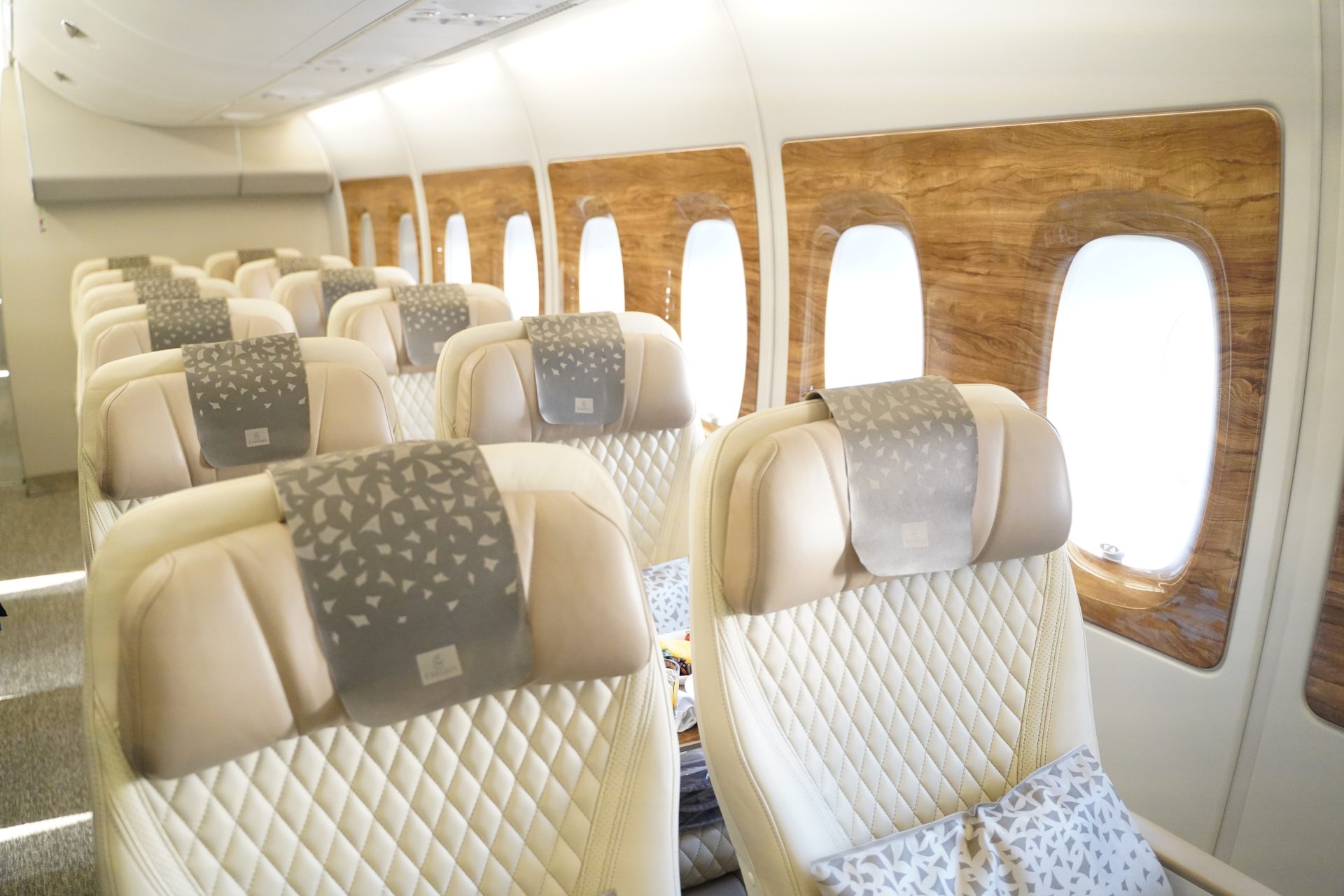
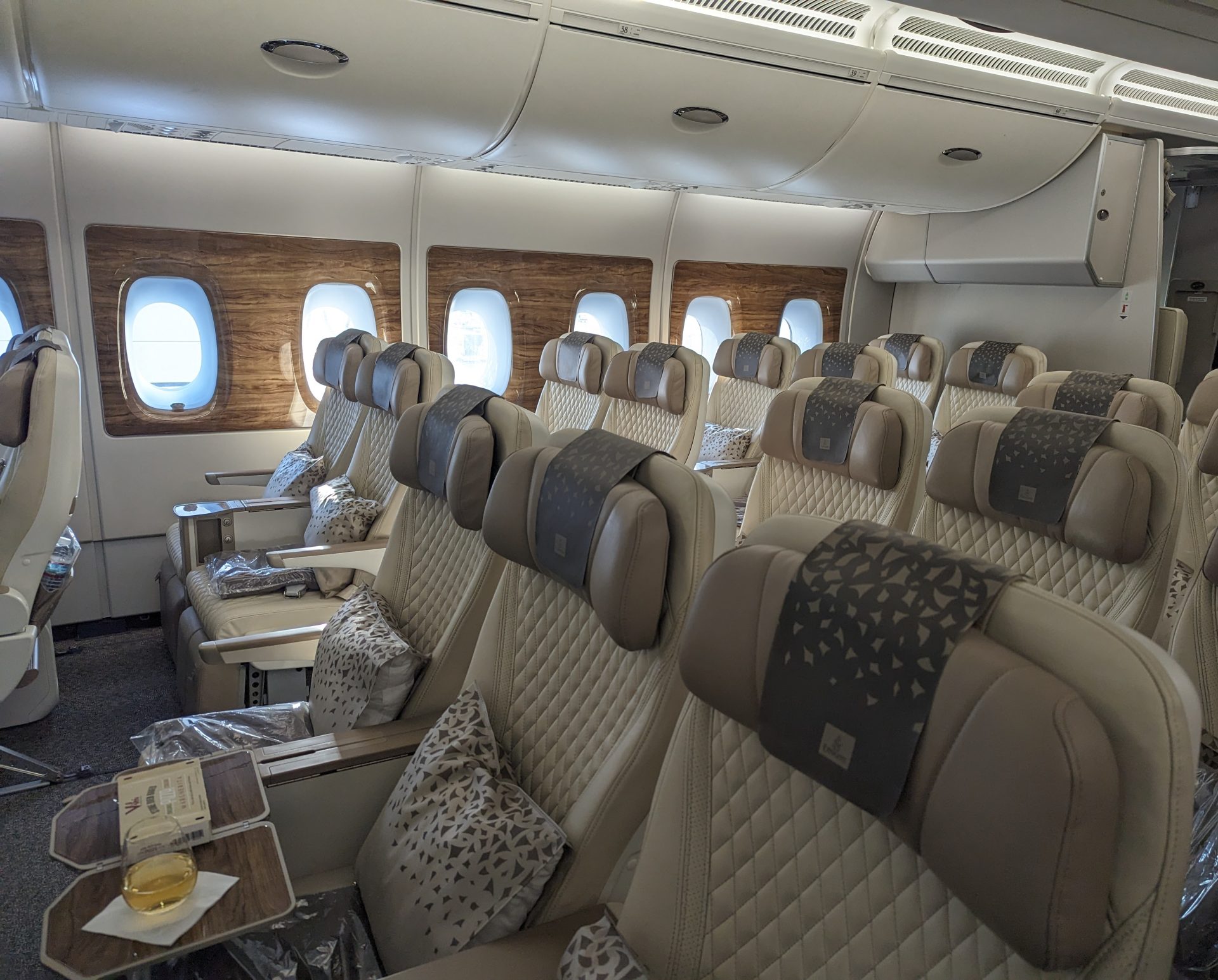
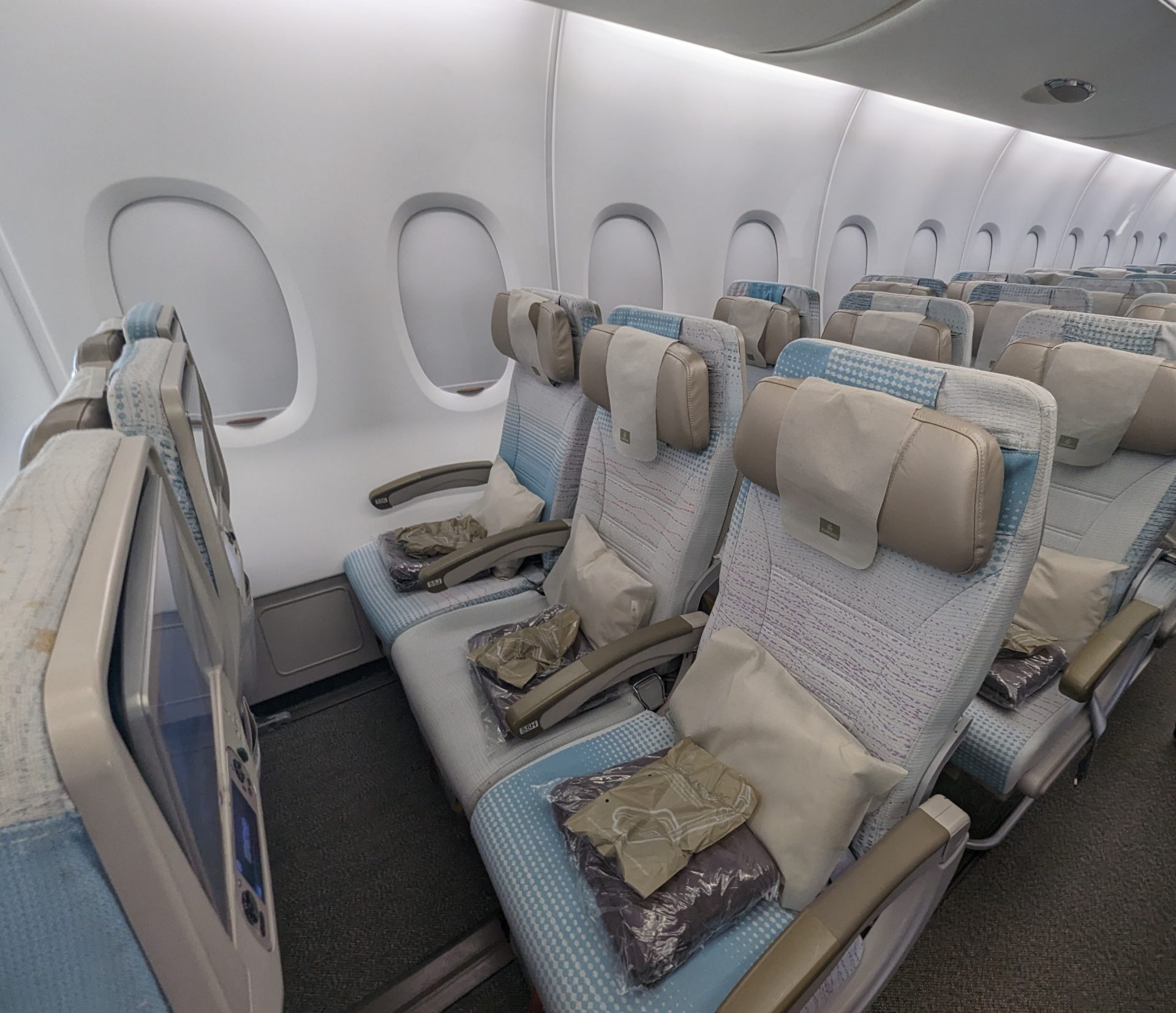
Premium Economy, a new addition to the airline, is found at the front of the aircraft on the lower deck. The cabin features a 2-4-2 configuration.
The seats measure 19.5 inches wide with a generous 40 inches of pitch accompanied by a footrest and calf rest. The seats recline up to eight inches without significantly invading the space of passengers in the row behind. There is also a 13.3-inch seatback entertainment screen featuring the Emirates ICE system. Window shades are also electronically controlled like the premium cabins on the aircraft.
The revamping of the interiors is a massive jump for the airline. Many commented that the interiors were often glitzy and over-the-top just like the airline, however, the new interiors are anything but. They showcase a refined and subtle elegance instead of opulence that will continue to permeate the airline as the brand continues to mature. Additionally, the ghaf tree makes an appearance across the aircraft. The tree, which is the national tree of the United Arab Emirates, is present in each cabin painted onto the bulkhead and other areas such as the first class shower suite.
Emirates Business Class Ghaf Tree (Photo: AirlineGeeks | Hemal Gosai)
New retrofitted aircraft are entering service at a rapid pace. The airline is putting a plane with the new interiors into service just about every 16 days with the expectation of completing the project in 2025. All the work is being done in a massive custom facility right in Dubai.
Hemal took his first flight at four years old and has been an avgeek since then. When he isn't working as an analyst he's frequently found outside watching planes fly overhead or flying in them. His favorite plane is the 747-8i which Lufthansa thankfully flies to EWR allowing for some great spotting. He firmly believes that the best way to fly between JFK and BOS is via DFW and is always willing to go for that extra elite qualifying mile. Hemal's opinions are his own and do not reflect those of his employer.
Viva Aerobus Expands With New U.S. Markets
Viva Aerobus becomes the first Mexican air carrier to add additional service to the U.S. following a change in the FAA's safety rating.
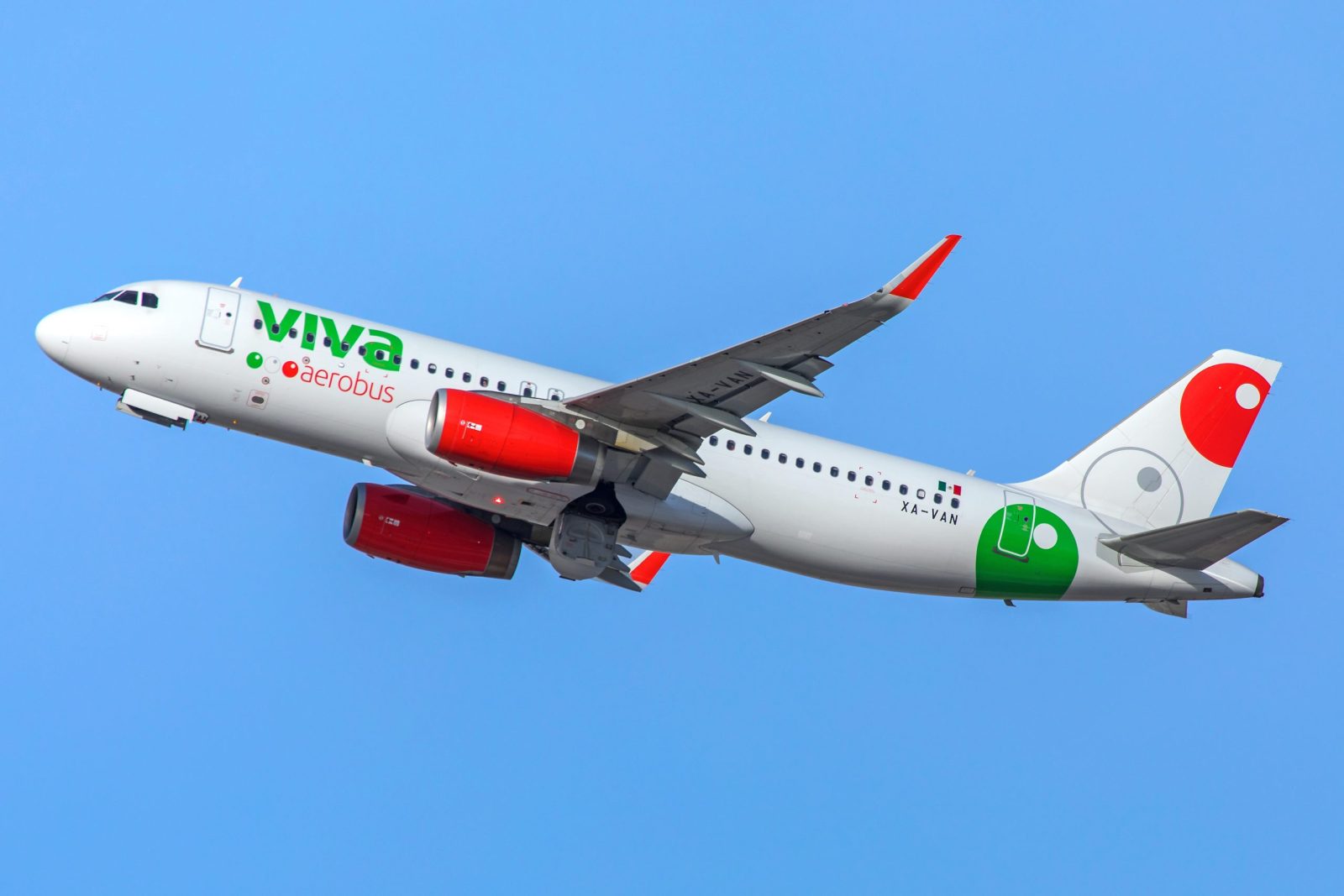
A Viva Aerobus Airbus A320. (Photo: AirlineGeeks | William Derrickson)
Mexican low-cost carrier Viva Aerobus is adding five new routes to the United States. The routes are the first new U.S. markets introduced by a Mexican airline after the Federal Aviation Administration (FAA) restored Mexico’s safety assessment rating to Category 1. As reported by Ishrion Aviation on Twitter/X, the new routes span from coast to coast.
FAA Restores Mexico’s Category 1 Safety Rating
The FAA’s International Aviation Safety Assessment (IASA) program is designed to assess a foreign country’s ability to adhere to international safety standards and recommended practices set out by the International Civil Aviation Organization (ICAO). Under the Chicago Convention – the international agreement that formed ICAO – countries are required to exercise regulatory oversight over areas such as aircraft airworthiness and personnel licensing.
Through the IASA, the FAA periodically audits foreign countries and assigns them a Category 1 or Category 2 rating. Category 1 means that the country’s civil aviation regulator meets ICAO safety standards and Category 2 means that it does not. In May of 2021, the FAA downgraded Mexico’s rating from Category 1 to Category 2. Only a few other countries, including Russia, Pakistan and Venezuela, currently have Category 2 ratings.
Having a Category 2 rating means that carriers from the affected country cannot expand services to the United States or codeshare with U.S. airlines. However, carriers from Category 2 countries can continue operating services to the U.S. that existed prior to the audit. Mexico remained a Category 2 country until the FAA upgraded its rating back to Category on Sept. 14, 2023. This meant that Mexican airlines were once again allowed to add new routes to the U.S. following a two-year pause on expanding services.
Viva Aerobus’ Five New US Routes
Viva Aerobus is adding five new routes to the United States from its home base at Monterrey International Airport in Mexico:
Denver International Airport, starting in January of 2024
Austin–Bergstrom International Airport, starting in March of 2024
Orlando International Airport, starting in May of 2024
Oakland International Airport, starting in July of 2024
Miami International Airport, starting in July of 2024
The routes are slated to be operated a few times per week with Viva Aerobus’ fleet of Airbus A320 family aircraft. While Denver and Oakland are new destinations for the airline, it has served Austin, Orlando and Miami in the past. Between 2008 and 2009, Viva Aerobus flew to Austin from Monterrey, Cancun and Puerto Vallarta. Viva Aerobus operated routes to Orlando and Miami during the 2010s as part of a short-lived transborder push.
The airline was set to start flights from Cancun and Mexico City to Miami back in December of 2021, but these plans were thwarted by the FAA’s downgrade of Mexico’s safety rating. Viva Aerobus currently serves several other airports in the United States, including Dallas/Fort Worth International Airport, Chicago O’Hare International Airport and Los Angeles International Airport.
Andrew is a lifelong lover of aviation and travel. He has flown all over the world and is fascinated by the workings of the air travel industry. As a private pilot and glider pilot who has worked with airlines, airports and other industry stakeholders, he is always excited to share his passion for aviation with others. In addition to being a writer, he also hosts Flying Smarter, an educational travel podcast that explores the complex world of air travel to help listeners become better-informed and savvier travelers.