Stories

A Next-Generation Suite and the World’s Lightest Seat: Highlights from AIX 2024

Not only is the event a platform for suppliers and airlines to meet, but it is also an opportunity for companies to showcase their cabin interiors.

Airbus A330neo Airspace cabin (Photo: Airbus)

The 2024 edition of the annual Aircraft Interiors Expo (AIX) was held last week from May 28-30 in Hamburg, Germany. Not only is the event a platform for suppliers and airlines to meet, but it is also an opportunity for companies to showcase their cabin interior and inflight entertainment products. Here are some highlights from this year’s event:

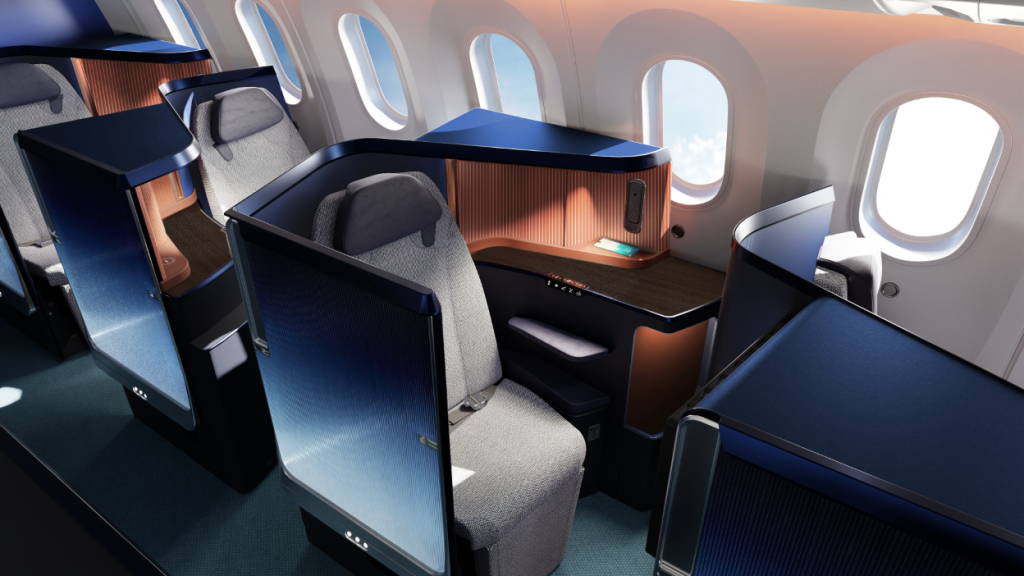
A High-Tech Next-Generation Business Class Suite

One of the biggest announcements from Hamburg last week was Panasonic Avionics’ and Collins Aerospace’s joint unveiling of MAYA, a next-generation business class concept. MAYA draws from Collins Aerospace’s expertise in design and Panasonic Avionics’ experience in technology to create a futuristic business class suite.

The suite has a seat comfort technology known as ARISE, which automatically optimizes cushion pressure, regulates environmental temperature, and reduces peak vibration disturbances. Meanwhile, the most visually captivating feature of the product is the 45-inch ultra-wide, ultra-high-definition curved screen with a headphone-less audio system. Panasonic noted that the screen is three times larger than typical business class screens and is in the same 21:9 screen format used in cinemas.

A next-generation business class suite known as MAYA, jointly unveiled by Collins Aerospace Panasonic Avionics at AIX 2024 (Photo: Collins Aerospace)

An All-Business Turboprop

Last year, French–Italian aircraft manufacturer ATR unveiled a collection of cabin configurations for its turboprops known as ATR HighLine. Among these was an all-business class configuration. The company revealed details of the design at AIX last week.

The all-business class interior has a 1-1 configuration with seats that were custom-made for ATR by seating manufacturer Geven. Each seat will have direct window and aisle access and a width of 21.6 inches – a size rarely seen on board turboprop aircraft, which typically feature economy-only seating. Seats will also have a personal side console that serves both as a storage compartment and as a table.

Malaysia-based Berjaya Air will be the launch customer for the product. The airline will operate two ATR 72-600 with the HighLine all-business class configuration from 2025 to serve the group’s luxury hotels and resorts.

ATR’s HighLine all-business class cabin design (Photo: ATR)

The World’s Lightest Aircraft Seat: Expliseat’s TiSeat 2

French seat manufacturer Expliseat produces the world’s lightest lineup of commercial aircraft seats. The current iteration is known as the TiSeat 2 and has different variations for turboprops and larger narrowbody jets.

The company unveiled a third model in Hamburg, known as the TiSeat 2 X. This new product is designed for regional jets and will debut on Embraer 190s operated by Air France subsidiary HOP!. In addition to typical seat features like a tray table and literature pockets, the TiSeat 2 X will also include a personal electronic device holder equipped and USB A and C ports.

Expliseat’s TiSeat 2 X lightweight seat will debut on Air France’s regional subsidiary HOP! (Photo: Expliseat)

During AIX, Expliseat also signed a purchase agreement with Jazz Aviation to renew the cabins of 25 De Havilland Canada Dash 8-400 with the TiSeat 2 V turboprop product. The Canadian carrier operates regional flights under the Air Canada Express brand.

New Airspace Interior Features for the A330neo

Airbus has announced that it will be introducing enhancements to its A330neo Airspace cabin concept. The changes will bring consistency with the Airspace features seen on the A350 and A320 family.

New ceiling lighting at the second set of doors with the Airspace stencil pattern will become standard on all new A330neos delivered from Q1 of 2026. Starting in 2027, airlines will also have the option of having a new “Airspace Hero Light” in the premium cabin space between the first two sets of doors. The lighting system will be customizable with 16 million colors and a unique pattern.

The Airbus Airspace stencil lighting pattern on board an Airbus A321neo (Photo: AirlineGeeks | Andrew Chen)

There will also be a new sidewall and matching ceiling panels consistent with A250 and A320 family Airspace cabins. These elements create five millimeters of extra shoulder clearance for each window seat and 50 millimeters more foot space for passengers. The lighter weight of these panels will also provide weight savings throughout the aircraft for airlines.

Electro-dimmable windows will also become an option on A330neos in the premium cabin area between the first two sets of doors. These windows replace traditional window shades with technology that allows passengers to adjust the level of dimming, while also having the ability to block 99.999% of visible light and the sun’s infrared energy.

Airbus Airspace electro-dimmable windows (Photo: Airbus)

Andrew Chen

Andrew is a lifelong lover of aviation and travel. He has flown all over the world and is fascinated by the workings of the air travel industry. As a private pilot and glider pilot who has worked with airlines, airports and other industry stakeholders, he is always excited to share his passion for aviation with others. In addition to being a writer, he also hosts Flying Smarter, an educational travel podcast that explores the complex world of air travel to help listeners become better-informed and savvier travelers.

American Sends 68 World War II Veterans on a Boeing 787 Charter to France

A group of 68 World War II veterans embarked on a whirlwind trip to France in recognition of the 80th anniversary of D-Day.

World War II veterans embark on a charter flight from DFW Airport (Photo: AirlineGeeks | Ryan Ewing)

A group of 68 World War II veterans embarked on a whirlwind trip to France in recognition of the 80th anniversary of D-Day. Leaving Dallas/Fort Worth on Friday, American donated a specially-chartered Boeing 787-9 Dreamliner for the trip across the pond.

Of the veterans onboard, the oldest was 107 years old with the youngest being 96. They were also joined by six Medal of Honor recipients along with over  50 cadets and midshipmen from various service branches who accompanied the veterans.

Starting in Paris, the group will venture north over the next several days as they visit memorial sites in Normandy. The 80th anniversary of the D-Day operation is on Thursday, June 6.

American held a send-off ceremony for the veterans at its Fort Worth headquarters with actor Gary Sinise (Photo: American Airlines)

“It’s not every day that we get an opportunity to host our nation’s heroes,” said American’s Chief Operating Officer David Seymour during a send-off event at the carrier’s Fort Worth headquarters.

An Army veteran himself, Seymour added, “We fly around this world today because of what you did 80 years ago.”

Veterans from across the U.S. participated in the trip. For many, it was their first time back in France since the war.

“Every one of us here is in your debt. You brought victory to the freedom-loving world and we thank God that you won that war. Where would the world be today if the outcome had been reversed?” said actor Gary Sinise, best known for his role as ‘Lieutenant Dan’ in the film Forrest Gump. His foundation sponsored this trip and many like it.

The airline is no stranger to giving back to the military community. Since 2017, it has partnered with the Gary Sinise Foundation to take Gold Star families to Disney World. Last year, this airlift consisted of 11 charted aircraft and around 1,800 family members. 

Ryan Ewing

Ryan founded AirlineGeeks.com in February 2013 and has spent more than a decade covering the airline business. His work has been featured by CNN, WJLA, CNET, and Business Insider. His aviation experience spans airport operations, Part 135 regulatory compliance, and airline crew workforce planning, along with time behind the yoke of a Cessna 172 and interviews with airline executives. Ryan now serves as Group President of Firecrown Media’s Aviation Group. He holds a B.S. in Air Transportation Management and an MBA from Arizona State University and teaches Airline Management at Embry-Riddle Aeronautical University.

easyJet Expands Malta Base With New Route

European low-cost carrier easyJet has recently revealed that it will commence a new route from Malta to Liverpool’s John Lennon International Airport.

An EasyJet A320 with Sharklets (Photo: AirlineGeeks | Fabian Behr)

European low-cost carrier easyJet has recently revealed that it will commence a new route from Malta to Liverpool’s John Lennon International Airport. This comes after the airline has rapidly grown the Mediterranean island nation’s hub with flights to Amsterdam, Bristol, Basel, and Nice. 

The route marks the 10th out of the carrier’s southern European hub since it started flying there in March 2008. The flights to Liverpool will operate twice weekly, departing on Tuesdays and Sundays.

Flights to John-Lennon will only increase the number of passengers who travel through the hub, with the current figures according to easyJet being over 400,000 customers annually. This only adds to the running total of passengers who have traveled with easyJet to the Mediterranean island, a number which the airline claims to be over four million. 

Rather than being a seasonal route, something which is extremely prevalent for European carriers operating to warmer destinations, easyJet plans to fly to Malta all year round. The Luton-headquartered airline declared the starting date for the flights linking the two cities to be Dec. 10, 2024.

easyJet has not only continued to incorporate more destinations into its Malta base but also into its Northern England hub, having added four more for the UK’s fifth most populous city in the last year. 

To the CEO of Malta International Airport, Alan Borg, the benefits of the network expansion are clear. In a press release submitted by easyJet, the CEO stated that “the addition of the Liverpool route to easyJet’s schedule will support Malta International Airport’s efforts to enhance connectivity with the United Kingdom, as this market, one of our biggest in terms of tourism, edges closer to pre-pandemic traffic levels.”

On the other side of the new flight, Paul Winfield, the aviation director of Liverpool John Lennon airport referenced easyJet’s competition on the route, namely Ryanair,  and how they’ve only managed to operate 9% of all flights to Malta from the Northwest. Winfield said that he believed that this route had “significant potential to grow from here.”

Sam Jakobi

Sam Jakobi is a young aviation journalist based in London, U.K. A lifelong Airbus fan, he has adored aviation for as long as he can remember. Sam writes articles and conducts interviews with members of the aviation community.

Etihad Stays Nimble With Its Fleet Plan

The Airbus A380 Superjumbo may get to stay longer in the carrier's fleet with Neves being quoted to leave them till "at least 2032."

An Etihad Airways Boeing 787-10 Dreamliner (Photo: AirlineGeeks | William Derrickson)

In a recent interview with aeroTelegraph, Etihad’s CEO Antonaldo Neves shared the company’s fleet plan for the next several years.

After a significant restructuring in 2017-2020, Etihad Airways became stronger and more resilient. The active fleet consists of more than 80 frames with an orderbook telling a growth story.

Neves outlined the goals that the future fleet should be able to support. Rather than competing directly with the Middle Eastern giants, he sees Etihad focused on the key growth areas in its region. This would mean four daily flights to most airports in neighboring countries like India, Pakistan, and countries in the GCC region, allowing for more seamless connectivity both ways.

Complementary to such expansion, the carrier would grow operations to farther points like Europe, the U.S. East Coast, or Southeast Asia to double daily. To fulfil such plans, Etihad would need  “around 150 to 160 aircraft,” the CEO mentioned.

Etihad Airways network in June 2024 (Photo: flightconnections.com)

A Strong Backbone With a Nimble Spear

Compared to its pre-2017 fleet, Etihad acquired a significant number of Boeing 787 Dreamliners and five Airbus A350 aircraft. Those are going to be the widebody workhorses for the carrier in the coming years. Complementary to the new frames, the airline still operates Boeing 777-300s and, recently reintroduced, Airbus A380 aircraft. They are well-fitting into serving long-haul markets like the U.S. East Coast or Australia and, in the case of the A380s, also the high-density London Heathrow route.

The Airbus A380 Superjumbo may get to stay longer in the carrier’s fleet with Neves being quoted to leave them till “at least 2032.” By this time the Boeing 777-300 fleet will also need replacement.

Even though Etihad Airways was one of the first carriers to place an order in 2013 for the upcoming Boeing 777X aircraft, now the deal is restructured with the airline being able to get more Boeing 787 Dreamliners instead. This might very well be the case as the CEO doesn’t see the airline ordering back the 777Xs for at least five years now. This move would create a very strong backbone for the carrier of almost 70 Boeing 787 Dreamliners.

The exciting part of Etihad’s fleet plans lies in the narrowbody segment. The entire fleet of the carrier consists of Airbus A320 family airframes, including the A320, A321, and soon-to-be-delivered A321LR. On top of the existing A320/A321 fleet that the carrier has already reactivated, it has secured leases on six new A321neos that were intended for Bamboo Airways in Vietnam but are not being taken by that carrier.

Those are expected to arrive in Abu Dhabi as soon as June and July of this year. The 10 Airbus A321LRs will arrive more gradually with the first expected also in June 2024, according to the CEO. The entire Airbus A320 fleet with allow the carrier great flexibility from short one-hour-long GCC flights up to seven-hour-long routes in Europe and Asia.

Etihad Airways fleet in June 2024 (Photo: Filip Kopec)

Up To 40 Airbus A321LRs

From the outlined future fleet of 150 to 160 planes, Neves sats around 80 to 100 will be widebodies, while 60 to 80 will be narrowbodies, including 30 to 40 A321LRs. The current orderbook seems to be confirming the first part already, but so far there are only 10 Airbus A321LRs on order. Will that change over time? This will probably depend on the performance within the fleet.

The CEO says that the aircraft is expected to be equipped with 144 economy class seats and 16 fully flat business class seats. That will be a significant improvement over the current business class seats mounted in the carrier’s narrowbodies as they do not recline to fully flat. This is foreseen to be a setup similar to JetBlue’s Mint Suite and Mint Studio, with the first rows of seats featuring additional space.

Filip Kopeć

A passionate aviation enthusiast that started off his career as an aerospace engineer, but found his true calling on the commercial side of the airline business. Now as a finance guy among avgeeks and an avgeek among finance guys, he has experience working in the Revenue Divisions of three airlines. In his spare time he enjoys traveling, but admittedly sometimes is more about the journey than the destination.

American Flight Attendants Told to Prepare for Strike Action

Despite months of negotiations and mediation, American failed to reach an agreement with the union representing its flight attendants.

American Airbus aircraft in Phoenix (Photo: AirlineGeeks | William Derrickson)

Recently, the union representing roughly 28,000 flight attendants at American announced that the airline failed to reach an agreement after intensive contract negotiations and that as a result, members should prepare for strike action when given permission.

The Association of Professional Flight Attendants (APFA) and American had two weeks of mediation with the National Mediation Board (NMB) in Washington, D.C. The sessions were followed by three weeks of discussions in Dallas.  However, the two parties failed to reach an agreement.

In a statement, according to the union, the NMB will potentially bring the airline and union back together in a so-called last-ditch effort within the next two weeks. Even so, if American and the union refuse to budge and resolve the ongoing matter, the NMB may release the flight attendants for strike action.

In the meantime, it will be up to the NMB and potentially other federal government officials to decide whether the carrier’s flight attendants can strike and not before a 30-day cooling-off period. Flight attendants were advised not to engage in illegal work stoppages and slowdowns.

Benjamin Pham

Benjamin has had a love for aviation since a young age, growing up in Tampa with a strong interest in airplane models and playing with them. When he moved to the Washington, D.C. area, Benjamin took part in aviation photography for a couple of years at Gravelly Point and Dulles Airport, before dedicating planespotting to only when he traveled to the other airports. He is an avid, world traveler, having been able to reach 32 countries, yearning to explore and understand more cultures soon. Currently, Benjamin is an Air Transporation Management student at Arizona State University. He hopes to enter the airline industry to improve the passenger experience and loyalty programs while keeping up to how technology is being integrated into airports.

Iberojet to Launch Barcelona to Honduras Service

Iberojet expands its service to Honduras with a new flight from Barcelona to Tegucigalpa, adding to their existing Madrid route.

An Iberojet A350 (Photo: Bene Riobó, CC BY-SA 4.0 , via Wikimedia Commons)

Iberojet, a Spanish-Portuguese charter airline, announced an addition of service to Honduras starting in October 2024. The carrier will add a once-weekly flight from Barcelona to Tegucigalpa to complement its current offering of a twice-weekly flight from Madrid to Tegucigalpa.

The carrier inaugurated its Madrid to Tegucigalpa service in December 2022, connecting the Spanish and Honduran capitals. The new flight will be served with the Airbus A350-900XWB, which is already deployed on the Madrid route.

This route will serve the new airport of Tegucigalpa, the Palmerola International Airport (XPL). The airport began operations in December 2021 as a replacement for Toncontin Airport.

The new flight to Barcelona will become the second European flight from the airport, alongside Madrid. From a wider lens, the only other airport in Honduras with scheduled European service is Ramón Villeda Morales International Airport near San Pedro Sula, which sees nonstop service to Madrid on Air Europa.

Arya Karnik

Ever since he was a kid, Arya has been interested in aviation. With his entire family overseas, he has taken many family trips worldwide to places like the United Kingdom and India. He lives in Colorado but attends The University of Alabama, studying Computer Engineering with a minor in Computer Science. He hopes to obtain his PPL and eventually translate his engineering degree to working in operations at an airline.

Livery of the Week: Southwest’s Shamu Scheme

In 1988, Southwest Airlines, known for its line-up of special liveries, partnered with SeaWorld of Texas for a unique marketing campaign.

Southwest's Shamu-themed livery (Photo: aeroprints.com, CC BY-SA 3.0 , via Wikimedia Commons)

Editor’s Note: AirlineGeeks is proud to present our ‘Livery of the Week’ series. Every Friday, a team member will share an airline livery, which can be from the past, present, or even a special scheme. Some airline liveries are works of art. The complexity associated with painting around critical flight components and the added weight requires outside-the-box thinking from designers. The average airliner can cost upwards of $200,000 to repaint, creating a separate aircraft repainting industry as a result. 

Have an idea for a livery that we should highlight? Drop us a line

In 1988, Southwest Airlines, known for its line-up of special liveries, partnered with SeaWorld of Texas for a unique marketing campaign. The result? Shamu One, a Boeing 737-300 transformed into a flying killer whale.

Shamu, SeaWorld’s iconic orca, became the star of the show. The aircraft donned a black and white paint scheme, mimicking Shamu’s markings. The whale’s signature smile graced the nose, and its splash was depicted on the tail.

Shamu One wasn’t alone for long. Soon, Shamu Two and Shamu Three joined the fleet, bringing the Shamu experience to more flyers. These special liveries served as flying billboards, promoting both Southwest Airlines and SeaWorld across the country. The partnership lasted for over two decades, with Shamu-themed aircraft becoming a familiar sight in the skies.

However, by 2014, public perception of SeaWorld shifted due to concerns about animal welfare. Southwest Airlines responded by phasing out the Shamu livery. The whales eventually returned to their standard blue and gold color scheme.

Looking for a new airplane model? Head over to our friends at the Midwest Model Store for a wide selection of airlines and liveries.

Ryan Ewing

Ryan founded AirlineGeeks.com in February 2013 and has spent more than a decade covering the airline business. His work has been featured by CNN, WJLA, CNET, and Business Insider. His aviation experience spans airport operations, Part 135 regulatory compliance, and airline crew workforce planning, along with time behind the yoke of a Cessna 172 and interviews with airline executives. Ryan now serves as Group President of Firecrown Media’s Aviation Group. He holds a B.S. in Air Transportation Management and an MBA from Arizona State University and teaches Airline Management at Embry-Riddle Aeronautical University.

American Resumes Flights to Haiti Amid Violent Civil Unrest

American Airlines resumed flights to Haiti’s Port-au-Prince International Airport on Thursday after a long hiatus due to civil unrest.

American 737-800
An American 737-800 aircraft. (Photo: AirlineGeeks | William Derrickson)

American Airlines resumed flights to Haiti’s Port-au-Prince airport on Thursday after a long hiatus due to civil unrest in the Caribbean country, and contingency plans are in place to move pilots and crew members to safety by armored vehicles if conditions worsen.

This comes after Haiti has undergone violent and deadly civil unrest since armed gangs organized a mass prison break in early March and later ousted the country’s former president. The capital’s airport was closed for nearly three months during the chaos.

Two American missionaries were killed during the violence on May 23. The victims were Davy and Natalie Lloyd, a young married couple working for the ministry Missions for Haiti. Natalie is the daughter of Missouri state Rep. Ben Baker. Davy grew up in Haiti and was actively involved with his family’s ministry efforts there.

In a letter addressing union members on Thursday, Ed Sicher, president of the Allied Pilots Association (APA) which represents American Airlines pilots, said that he personally chose to fly to the country after it reopened to commercial air traffic on May 17 to observe the situation for crew members firsthand.

“I chose to fly the first flight (AA819) back to Port-au-Prince, Haiti (PAP) today after a long hiatus due to civil unrest,” Sicher stated in the letter. “My objectives were to observe firsthand what our crews can expect to encounter, verify that the security protocols and precautions in place are sufficient, and gauge whether it is reasonably safe. I would never condone flying to a location unless I’m personally comfortable doing so.”

Sicher said that Haitian national carrier Sunrise Airways has operated since May 20 without incident. He also said that U.S. authorities have also operated over 50 charter and cargo flights into and out of  the airport during the past three weeks, also without incident.

“Still, I didn’t consider those facts alone to be adequate assurance that a U.S. flag-carrying airline can operate safely there,” Sicher said. “American Airlines Corporate Security – in concert with the U.S. State Department and the U.S. military – has enacted a series of security measures in preparation for the resumption of service.”

Sicher said that crews flying to Haiti will likely notice increased security at the airport. New guard towers have been built along the northern perimeter wall, and the U.S. military is operating several C-17 flights in and out of the airport daily on the eastern side of the field. He notes that many squatter houses along the northern perimeter where gangs had taken up residence have been destroyed.

“U.S. security forces are aiding the Haitian National Police to secure the perimeter and ensure the roads between Port-au-Prince and the airport are safe,” Sicher continued. “I have emphasized that we must collectively do everything in our power to avoid stranding crews in Haiti. American Airlines has established contingency plans addressing maintenance issues, [other airline] transport, rescue flights, and as a last resort, secure transportation in armored vehicles to secure lodging where the U.S. military and UN forces stay.”

Additionally, Sicher added that the U.S. Embassy in Port-au-Prince has a Regional Security Office located near the airport. The embassy has expedited the deployment of the United Nations-authorized Multinational Security Support mission, which is located on the east side of the airfield.

“I personally worked with some of these same individuals when I served in the military and participated in counter-narcotics operations in the Caribbean and consider them much mor trustworthy than the Haitian National Police,” Sicher said.

American Airlines crew members going to Haiti are advised by Sicher to stay focused and alert. He said that APA will continue to monitor the situation daily and inform its members if conditions worsen.

The Fort Worth-based carrier is the only major U.S. airline to serve Port-au-Prince. JetBlue and Spirit also halted their services to the region.

AirlineGeeks.com Staff

AirlineGeeks.com was founded in February 2013 as a one-person blog in Washington D.C. Since then, we’ve grown to have 25+ active team members scattered across the globe. We are all here for the same reason: we love deep-diving into the fascinating realm of the airline industry.

Canadian Competition Bureau Commences Study on Airline Industry

The independent Canadian law enforcement agency regulating competition within the country is undertaking a ‘market study’ on the airline industry.

Tail of an Air North 737-500 in Yellowknife, N.W.T. (Photo: AirlineGeeks | Joey Gerardi)

The independent Canadian law enforcement agency regulating competition within the country, Competition Bureau Canada, is undertaking a ‘market study’ on the airline industry. According to the bureau, there will be a particular focus on domestic air passenger services, seeking to improve competition to benefit passengers and those who operate and work within the sector.

The scope of the study will encompass examining three key topics: the state of competition in Canada’s airline industry; barriers to entry and expansion; and impediments to informed customer choice. Out of scope will be the examination of any specific allegations of wrongdoing. However, the Bureau states that should it ‘uncover any evidence during the study that the Competition Act has been contravened, it will investigate and take appropriate action.’

The Canadian domestic air travel market is notoriously challenging given the country’s geographic size. Flight time from Vancouver, British Columbia in the west to St. John’s, Newfoundland and Labrador in the east is approximately six hours over a distance equivalent to 3,121 miles.

Canada’s 40 million citizens are mainly concentrated in a few key cities across six time zones with only six Canadian cities having a population greater than one million. The U.S. by comparison covers a marginally smaller land area but boasts a population of 333 million with multiple metropolitan areas.

Part of the bureau’s study into domestic air travel will need to be mindful of regional variations in operating air services. To this end, representatives of two air operators to northern Canada spoke to the government’s standing committee on transport, infrastructure, and communities on Thursday. The presidents of Canadian North and Air North were detailing how their airlines’ operation costs could be burdened by some of the federal regulations pertaining to the industry, as opposed to other operators in the country.

Yahoo! News reported the president and chief executive officer of Canadian North, Shelly De Caria, stating:  “We operate in a very unique environment, and the regulatory policies that we have in place do not contribute to the success that we have.” De Caria noted adverse weather’s disproportionate impact on the airline’s operations. Also, some routes to smaller communities ‘aren’t as profitable as other routes — and major airlines like Air Canada and WestJet aren’t interested in serving those communities.”

The views of these airlines will no doubt be submitted to the Competition Bureau Canada market study, alongside those of other aviation interests and the general public. Final terms of reference for the market study are scheduled to be published in July with written submissions from the public accepted up until August. The final report is expected to be published in June or July 2025 after stakeholder engagement and analysis of potential solutions and recommendations.

John Flett

John has always had a passion for aviation and through a career with Air New Zealand has gained a strong understanding of aviation operations and the strategic nature of the industry. During his career with the airline, John held multiple leadership roles and was involved in projects such as the introduction of both the 777-200 and -300 type aircraft and the development of the IFE for the 777-300. He was also part of a small team who created and published the internal communications magazines for Air New Zealand’s pilots, cabin crew and ground staff balancing a mix of corporate and social content. John is educated to postgraduate level achieving a masters degree with Distinction in Airline and Airport Management. John has held the positions of course director of an undergraduate commercial pilot training programme at a leading London university. In addition he is contracted as an external instructor for IATA (International Air Transport Association) and has been a member of the Heathrow Community Fund’s ‘Communities for Tomorrow’ panel.

Qantas, Perth Airport Sign Historic Agreement to Create Major Hub

Qantas and Perth Airport announced a landmark 12-year agreement on Friday, unlocking a multi-billion-dollar investment in infrastructure.

A Qantas 787 Dreamliner lifting out of Paine Field in Washington. (Photo: AirlineGeeks | Katie Zera)

Qantas and Perth Airport announced a landmark 12-year agreement on Friday, unlocking a multi-billion-dollar investment in infrastructure and plans to bolster Australia’s tourism industry. This agreement represents the largest airport infrastructure deal in Qantas’ history and the largest private infrastructure development ever undertaken in Perth, the airline noted in a press release.

Perth Airport Transformation

Perth Airport will invest around $3 billion in new terminal facilities and a new parallel runway, creating a larger hub in Western Australia. This investment is part of a larger $5 billion capital investment program that includes multi-story parking garages, major roadworks, and the airport’s first hotel.

Qantas and its Jetstar subsidiary will relocate all services to a new terminal in the Airport Central precinct. This move, along with Qantas’ investment in new aircraft, aims to turn Perth into a major domestic and international hub for the airlines. Combined, Qantas and Jetstar plan to add 4.4 million seats to and from Perth annually by 2031.

Enhanced Connectivity

According to the airline, the new terminal will offer a world-leading travel experience with seamless connections and state-of-the-art check-in facilities. Qantas will collaborate with Perth Airport to develop a multi-lounge precinct with a new design and upgraded dining and wellness options.

“Not only will it allow us to bring hundreds of thousands more travelers to and through Western Australia each year, it will also make it easier for overseas tourists to connect to more destinations across Australia,” Qantas CEO Vanessa Hudson said in a news release.

In addition, Perth Airport will invest in upgrading Terminals 3 and 4 to create additional capacity while the new terminal is built. These upgrades will allow Qantas to add new services and destinations from Perth, including Auckland and Johannesburg, starting from mid-2025.

Ryan Ewing

Ryan founded AirlineGeeks.com in February 2013 and has spent more than a decade covering the airline business. His work has been featured by CNN, WJLA, CNET, and Business Insider. His aviation experience spans airport operations, Part 135 regulatory compliance, and airline crew workforce planning, along with time behind the yoke of a Cessna 172 and interviews with airline executives. Ryan now serves as Group President of Firecrown Media’s Aviation Group. He holds a B.S. in Air Transportation Management and an MBA from Arizona State University and teaches Airline Management at Embry-Riddle Aeronautical University.
Sign-up for newsletters & special offers!

Get the latest stories & special offers delivered directly to your inbox

SUBSCRIBE

Uh-oh! It looks like you're using an ad blocker.

Our website relies on ads to provide free content and sustain our operations. By turning off your ad blocker, you help support us and ensure we can continue offering valuable content without any cost to you.

We truly appreciate your understanding and support. Thank you for considering disabling your ad blocker for this website