Stories

TUI Airways Retires Final Boeing 767

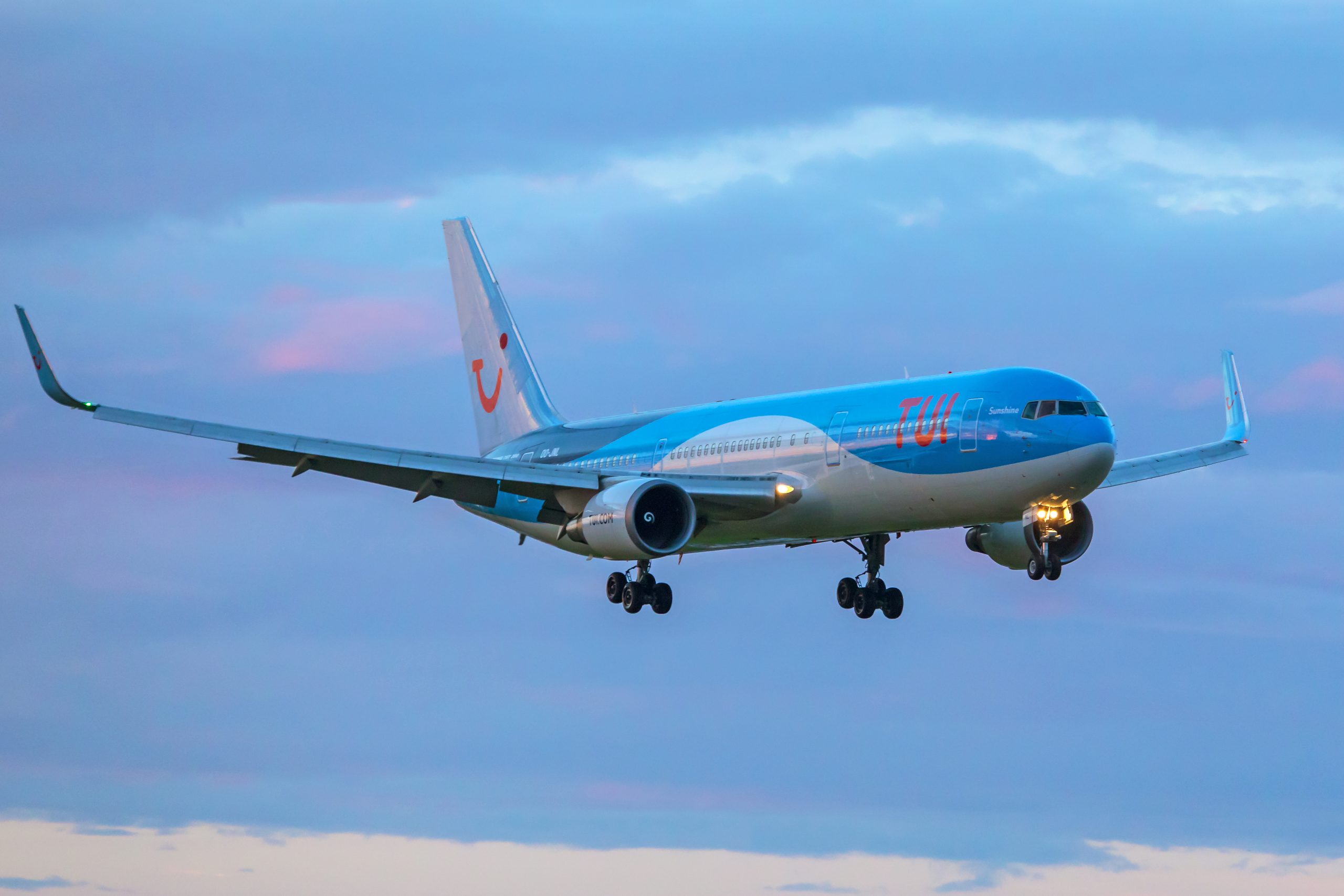
A TUI Boeing 767 on final approach into Miami. (Photo: AirlineGeeks | William Derrickson)

UK-based TUI Airways retired its final Boeing 767 aircraft. The particular aircraft in question has been operating for 40 years, and its retirement leaves the United Kingdom without any active passenger 767s.

The TUI group has operated 35 Boeing 767 aircraft, distributed through three subsidiaries. 767s have flown for the airline and its predecessors for 40 years, with the first being delivered in 1984. The final 767 flew for nearly half a dozen airlines within TUI’s portfolio before being retired.

The 767 flew its last passenger service from Greece to Manchester, UK on Oct. 31. On November 1, it was flown to Turkey for maintenance, where it will be converted to a freighter.

Airline Fleet Planning

TUI’s long-haul fleet now consists entirely of Boeing 787 Dreamliners, which are younger and more fuel efficient. TUI’s change is emblematic of a wider shift throughout the aviation industry, which has seen airlines shifting towards planes that will save them money. Fuel savings are of particular importance for long haul aircraft, which are flying all day to far-flung destinations.
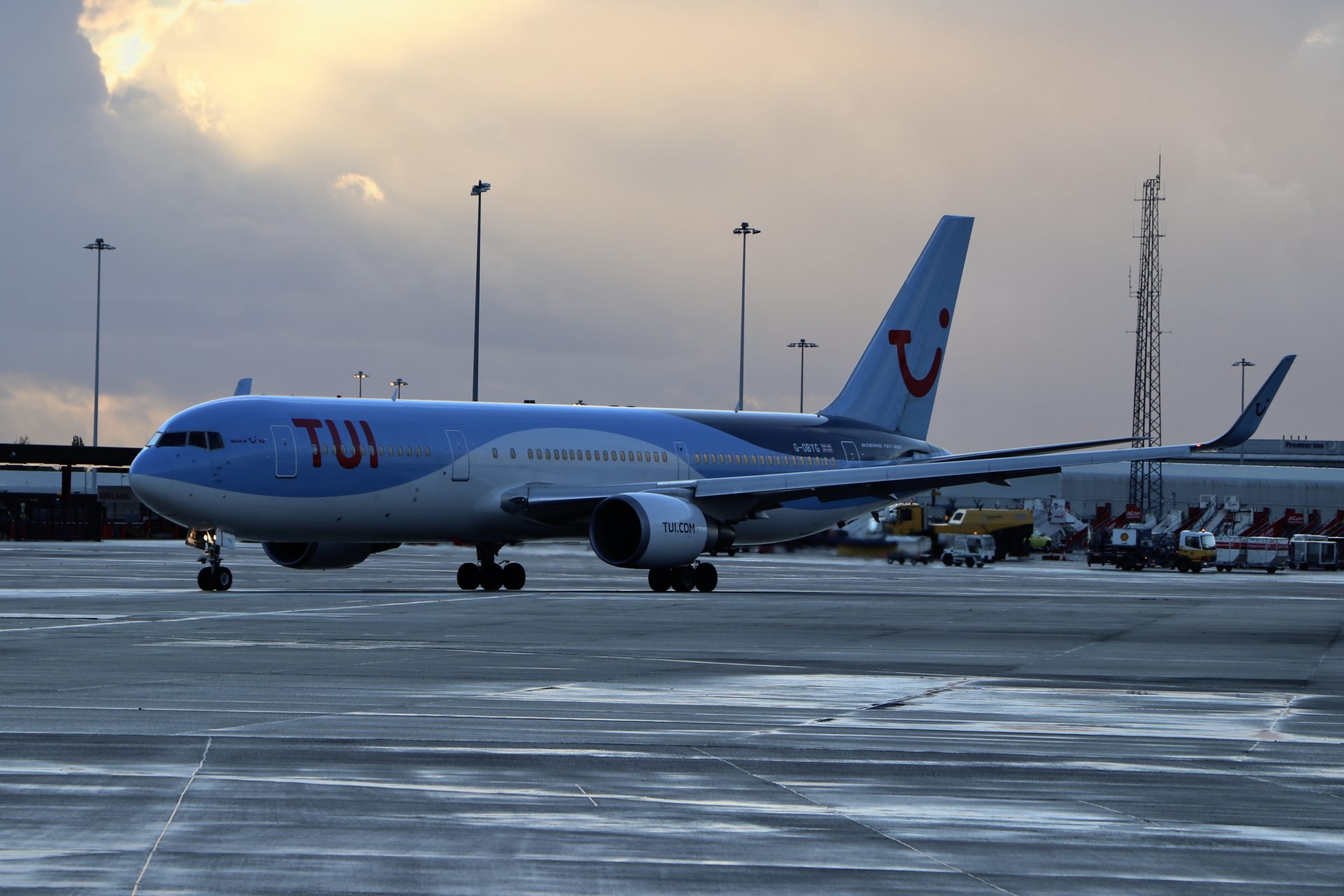
A TUI Boeing 767-300 preparing to depart from Manchester Airport (Photo: AirlineGeeks | James Dinsdale)

These long-haul aircraft also tend to have longer lifespans than short-haul airplanes: since they might only be pressurized once per day for a seven-hour-plus flight, lounghaul airplanes develop fewer microcracks than shorthaul aircraft that are pressurized multiple times per day. Thus, having a more-efficient plane saves airlines money on particular flights as well as over decades of operations.

If picked up by the right carrier, this final aircraft can likely continue to operate for decades to come. Freight carriers especially are, after all, more likely to pick up older aircraft towards the end of their service lives. This is because freighters usually don’t fly as much as passenger longhaul planes, so the lower purchase price of an older jet is more advantageous than fuel savings.

The 757 vs the 767

TUI operated Boeing 757 airplanes inherited from predecessors until 2021. The 757 and 767 are quite similar aircraft; in fact, there is a single type rating that covers both airplanes, meaning that a pilot is simultaneously certified to operate both. This is something not seen for other aircraft; usually, a single type rating covers a singular family of aircraft, meaning that a pilot typed only on the Airbus A320 can operate everything from an A318 to an A321 but nothing else.

The 757 and 767 are both often used for long-haul routes, with the major difference being that the 757 only has one aisle, while the 767 has two. The 767, thus, has more seats, and is usually used on long haul routes that have higher demand, while the 757 covers some lower-demand segments.
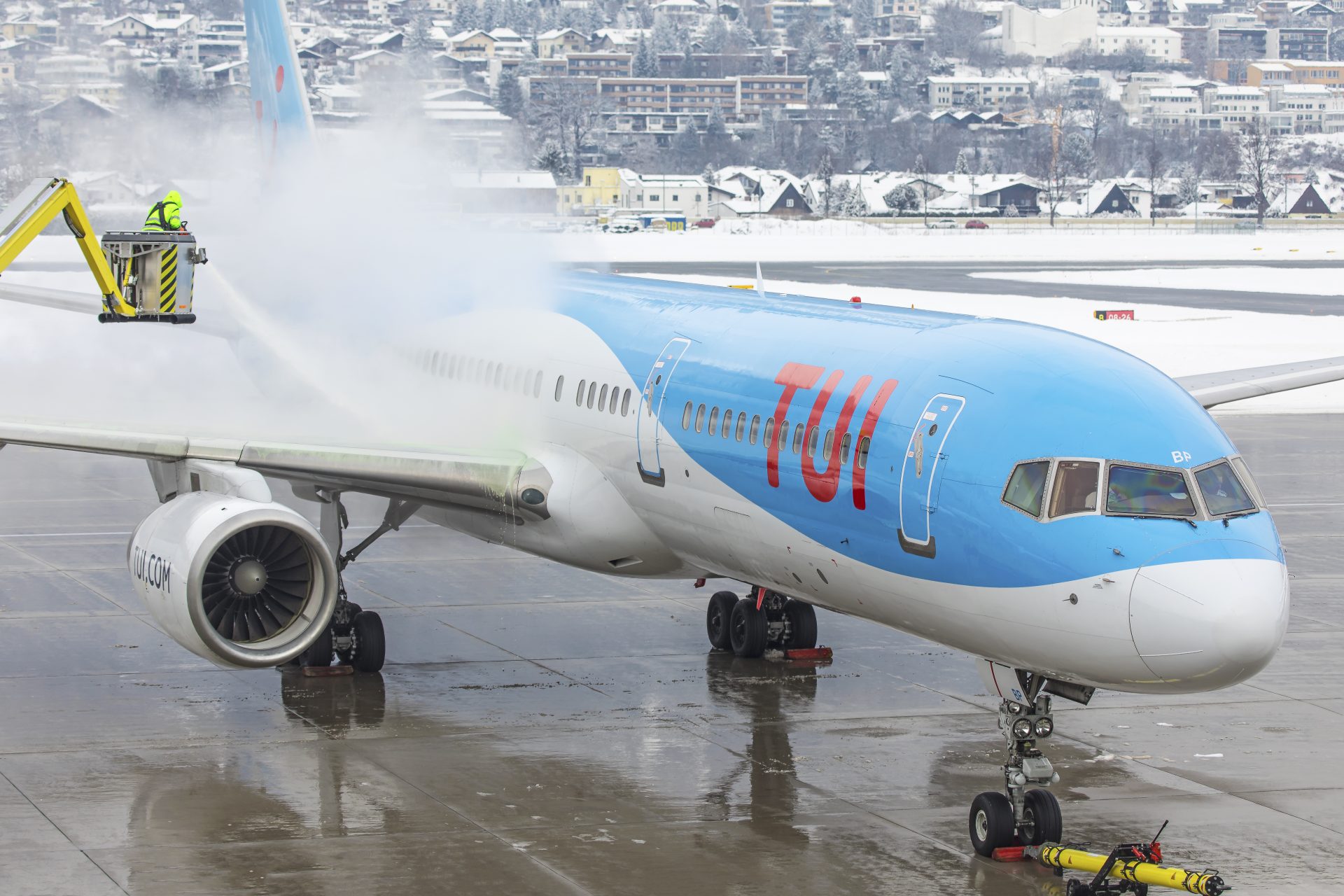
A TUI Boeing 757 gets de-iced.
(Photo: AirlineGeeks | William Derrickson)

Both aircraft types have come to be known as workhorses in airline fleets. In the United States, 757s and 767s are often the oldest airplanes in airlines’ fleet. Delta and United plan to retain their aircraft until the end of the decade. The planes have undeniable value as both passenger and freight aircraft, and they are spoken of highly by the crews that operate them.

John McDermott

John McDermott is a commercial pilot pursuing a career in professional flight. His passion for aviation began in an Ann Arbor bookstore with a tale of enemy pilots during World War 2, and he hasn't looked back. Besides flying and writing for AirlineGeeks, John volunteers with Professional Pilots of Tomorrow and travels whenever he gets the chance.

Southwest Eyeing DFW Airport Service

The Dallas-based airline is looking to head west in the DFW Metroplex bucking a long-standing history at nearby Love Field.

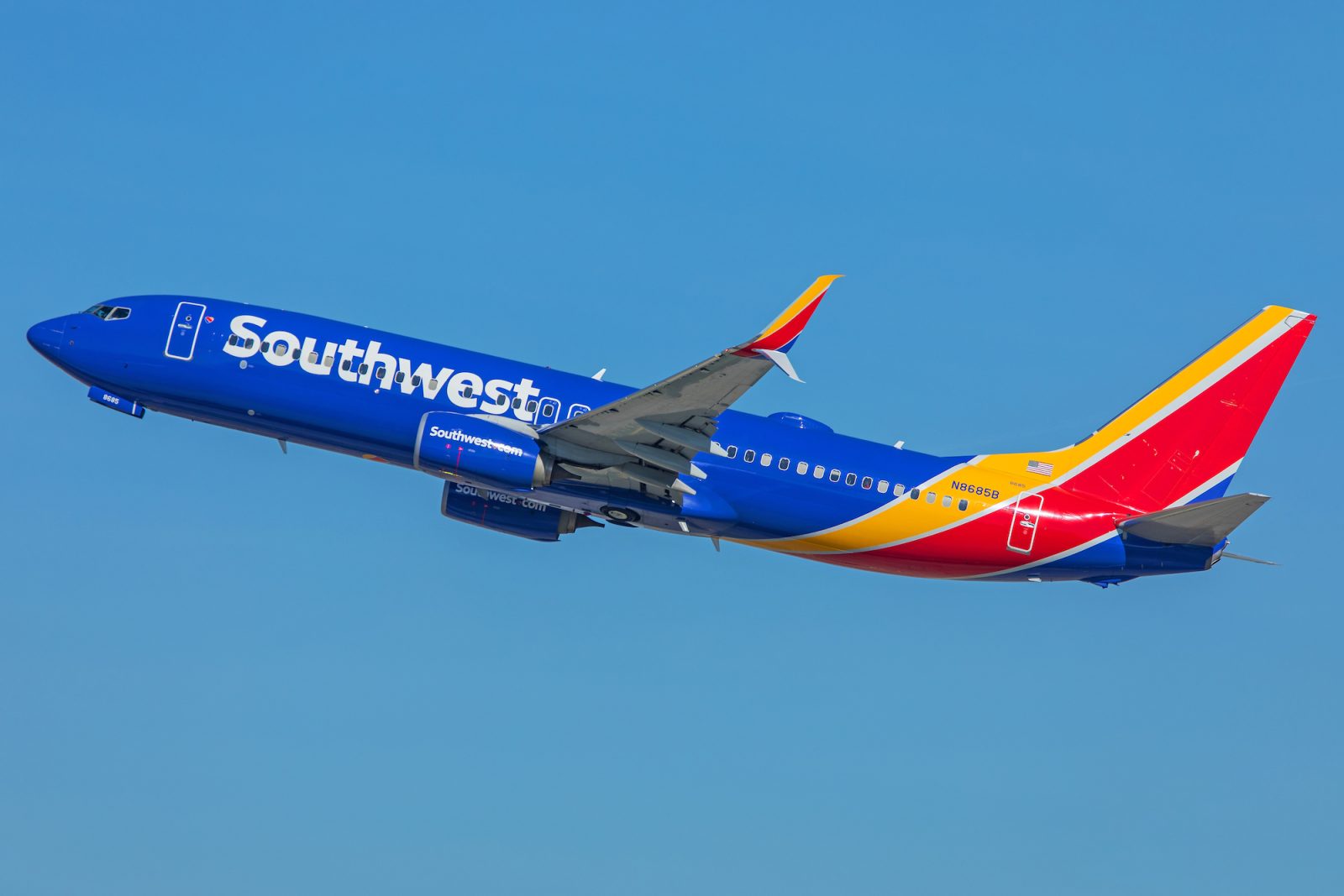
Southwest 737-800
A Southwest 737-800 takes off from Los Angeles. (Photo: AirlineGeeks | William Derrickson)

Bucking its long-standing operation to Dallas Love Field, Southwest is looking to add flights at DFW Airport. At Skift’s Aviation Forum in Fort Worth, the airline’s CEO Bob Jordan confirmed plans for a ‘modest presence’ at the larger airport in the DFW Metroplex, which is American Airlines’ largest hub.

Southwest has a long and complex history in the DFW Metroplex. In its over 50 year history, the carrier has never entered DFW Airport, thanks to an agreement born out of the 1979 Wright Amendment.

To protect the newer DFW Airport, U.S. Representative Jim Wright and Southwest agreed to only fly in Texas and states nearby. According to the Fort Worth Report, that agreement limited Southwest’s network expansion across North Texas as well. The agreement ends in 2025.

International Expansion

The 2025 end date coincides with DFW Airport’s planned opening of Terminal F in 2026. The new $1.63 billion terminal project will feature 15 gates.

The airline’s COO Andrew Watterson shared a bit more insight into Southwest’s DFW Airport plan at a media luncheon during the forum. Watterson confirmed that the carrier asked for space in Terminal F.

DFW would be a compliment to Love Field, which Watterson says is not sufficient for serving the entire DFW Metroplex. While a modest market size according to Watterson, adding service to DFW Airport could open the door for international operations, which Southwest can’t do at Love Field.

Southwest first took flight from Dallas Love Field in 1971. The company’s headquarters are located adjacent to the airport.

Ryan Ewing

Ryan founded AirlineGeeks.com in February 2013 and has spent more than a decade covering the airline business. His work has been featured by CNN, WJLA, CNET, and Business Insider. His aviation experience spans airport operations, Part 135 regulatory compliance, and airline crew workforce planning, along with time behind the yoke of a Cessna 172 and interviews with airline executives. Ryan now serves as Group President of Firecrown Media’s Aviation Group. He holds a B.S. in Air Transportation Management and an MBA from Arizona State University and teaches Airline Management at Embry-Riddle Aeronautical University.

Abu Dhabi Airport Debuts Long-Awaited New Terminal

The new terminal promises significant capacity improvement as well as state of the art amenities, according to the government.

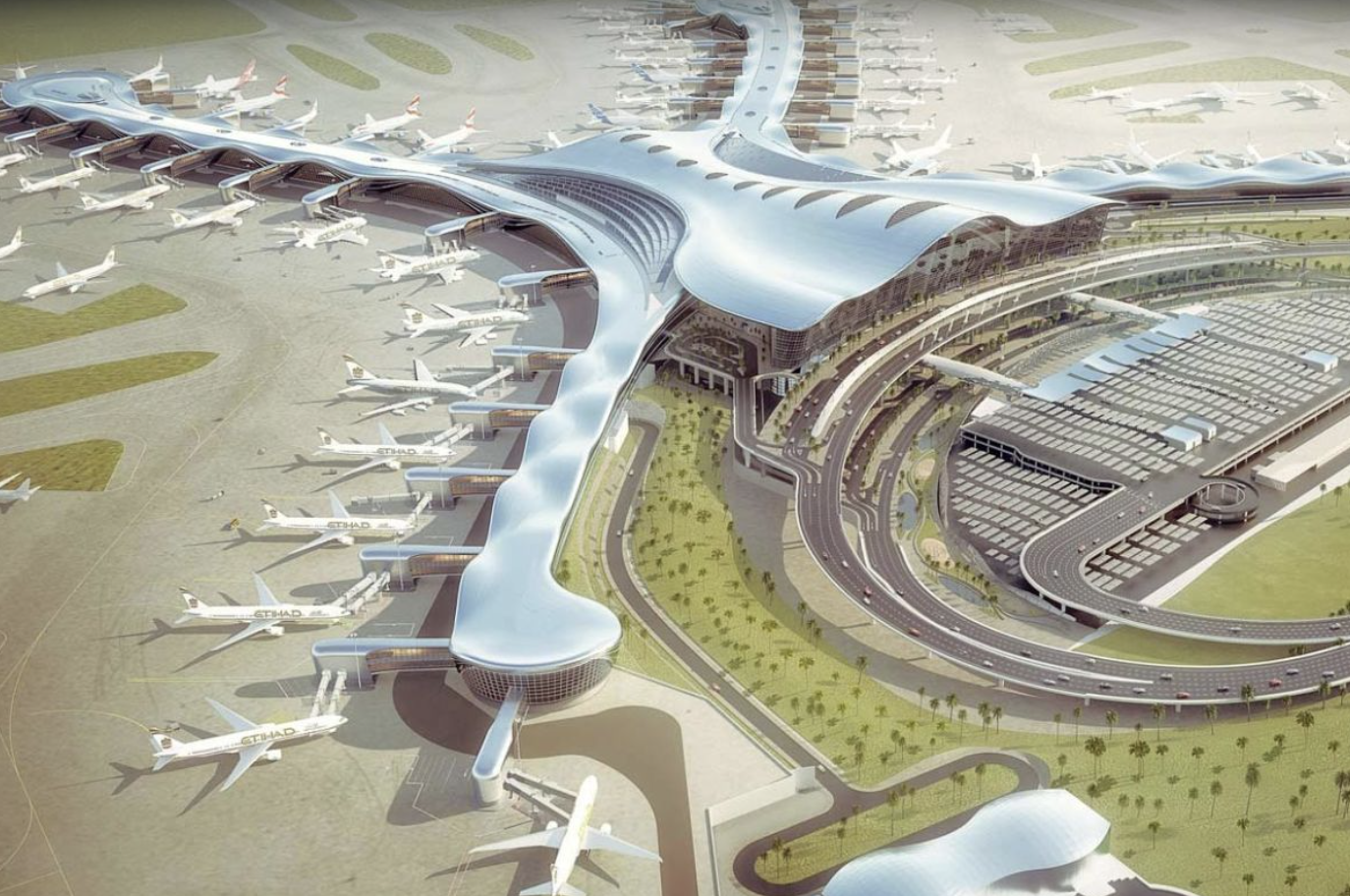
Abu Dhabi Terminal A (Photo: Abu Dhabi Airports)

Following over a decade of construction and operational limbo, the new Terminal A, formerly known as the Midfield terminal, at the Abu Dhabi airport has been officially opened. Originally scheduled to commence operations in 2017, the building suffered a “timing incident.” With the original intent to become a home hub for the ever-growing Etihad Airways, the strategy changed in the time when the carrier started to scale down its operations. The area of 742,000 square meters that the new Terminal A brings to the table is a major step up over the existing Terminals 1-3.

The United Arab Emirates national carrier is scheduled to progressively move all its operations to Terminal A between November 9 and Nov. 14, 2023. On November 1, a day after the opening ceremony, 16 of the carriers operating at Abu Dhabi airport will use the new building. A bit over two weeks later, On November 16 all 28 airlines will operate there.

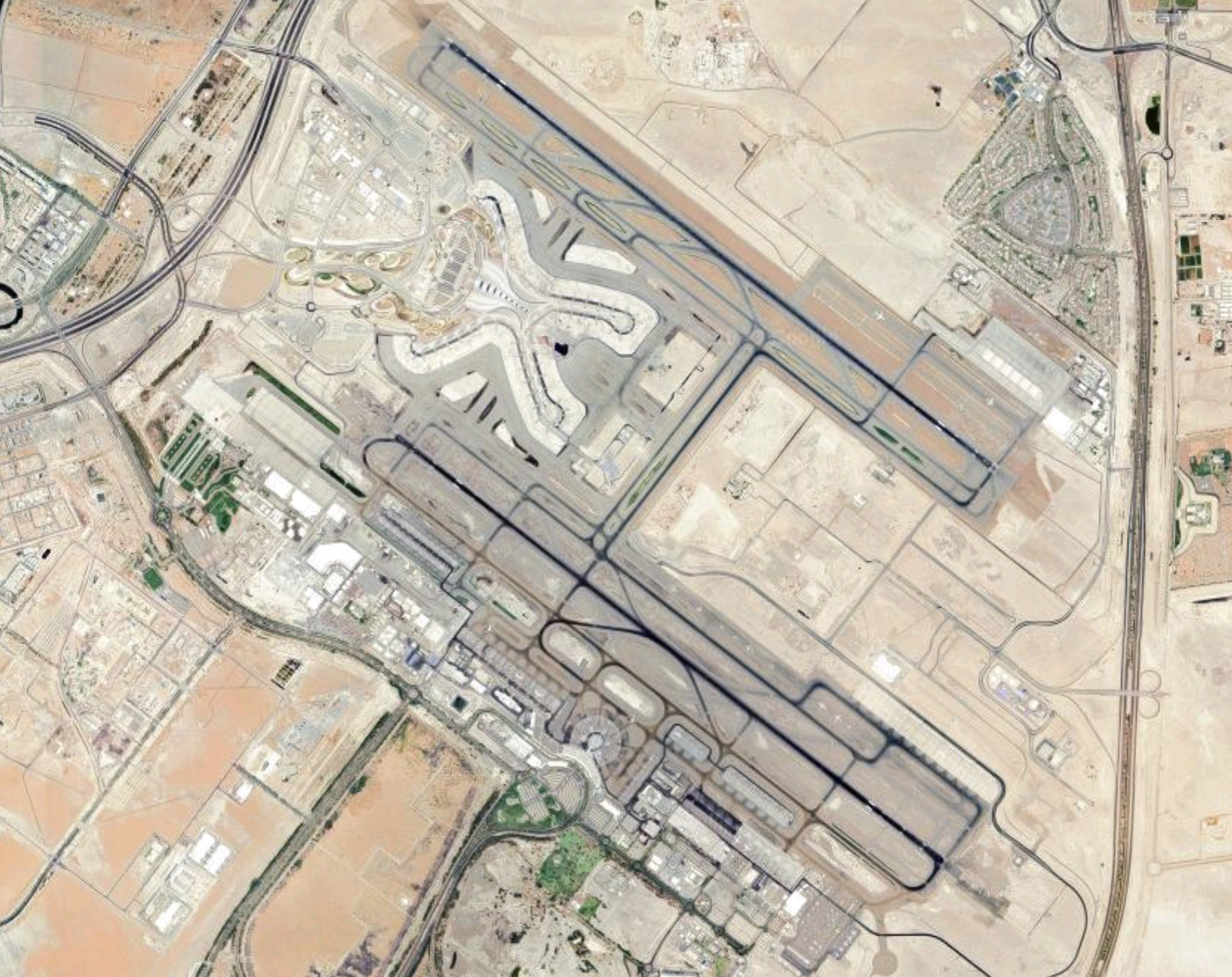
Abu Dhabi airport with the new Terminal A between the two runways and the existing Terminals 1-3 south of the runways (Photo: Google Maps)

Pearl in the Desert

The Government of Abu Dhabi, with the Ruler of Abu Dhabi and Sheikh Mohammed bin Zayed Al Nahyan, envisioned the project as one of the shaping stones for the capital of the United Arab Emirates years earlier, in 2006. The plan of “Abu Dhabi Economic Vision 2030” sets 7 priorities for the growing UAE’s economy. Two of them, referring to building a strong infrastructure to support the growth and building a globally integrated business environment, are directly supported by the development of the Abu Dhabi Airport.

Abu Dhabi Terminal A (Photo: Abu Dhabi Airports)

Etihad’s New Home

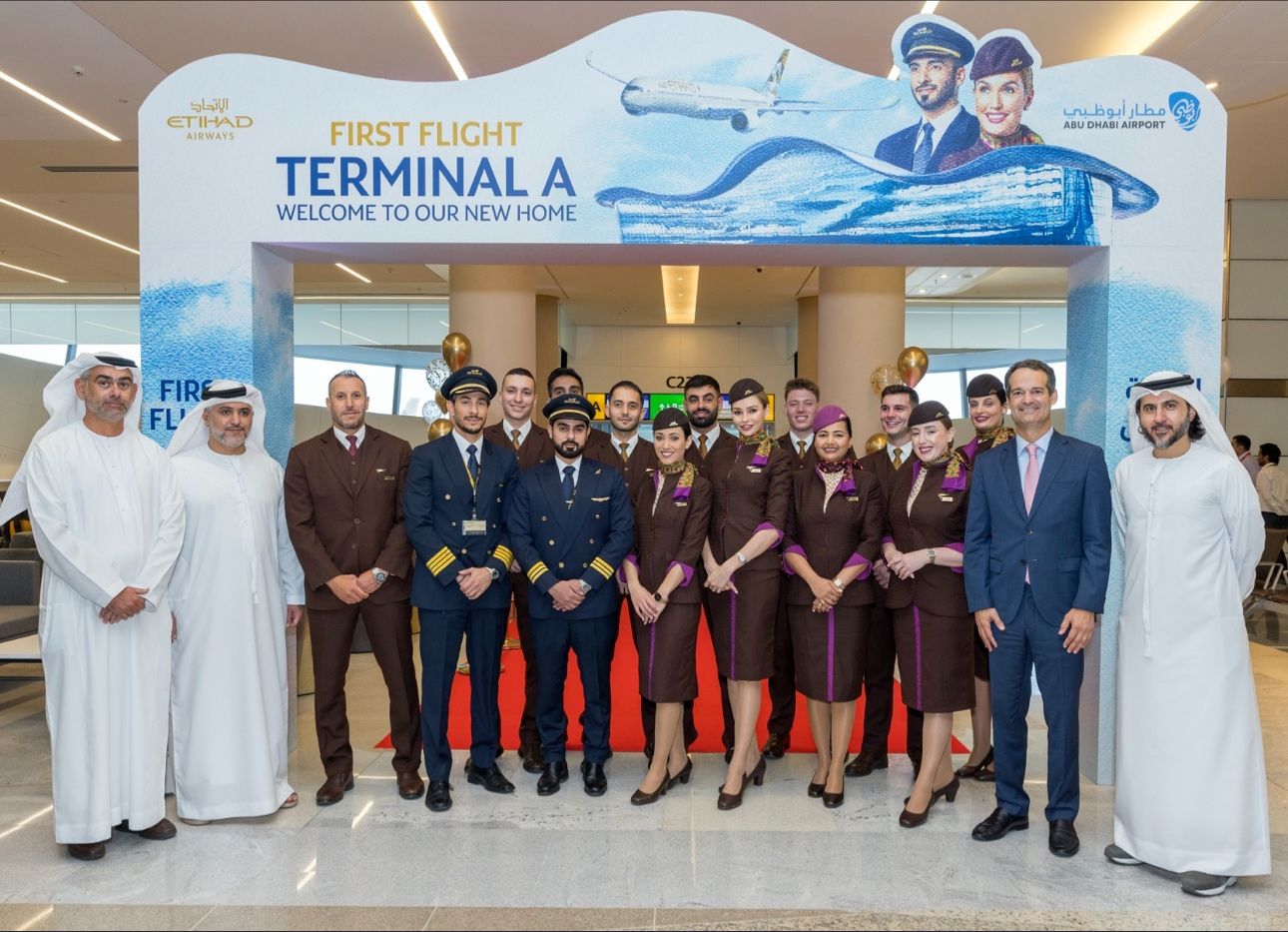
With flight ‌EY224, from Abu Dhabi to New Delhi, Etihad has welcomed the first guests onboard that had the opportunity to try out the new terminal. As it usually is the case with the inaugural flights they could experience quite the spectacle. ‌To commemorate the occasion, all passengers, including those in both Economy and Business classes, had the unique opportunity to be the inaugural guests at the new flagship Etihad Lounges, which span three floors in Terminal A. ‌The short celebration with themed decorations and a photo followed at gate C27. At 2.35 p.m. local time, the flight took off with 359 passengers on board.

Terminal A celebration at the gate (Photo: Etihad)


UAE’s Commitment to Its Legacy

With all the thrills ahead, in UAE it is not forgotten what is already behind. A development of today is that Abu Dhabi International Airport is set to be renamed Zayed International Airport. This change, ordered by President Sheikh Mohamed, will be effective from Feb. 9, 2024. It will symbolize the commitment to honoring the legacy and vision of the late President Sheikh Zayed.

Filip Kopeć

A passionate aviation enthusiast that started off his career as an aerospace engineer, but found his true calling on the commercial side of the airline business. Now as a finance guy among avgeeks and an avgeek among finance guys, he has experience working in the Revenue Divisions of three airlines. In his spare time he enjoys traveling, but admittedly sometimes is more about the journey than the destination.

Comparing the A321neos of Major U.S. Airlines

The A321neo has rapidly expanded its presence in U.S. markets with a diverse array of seating arrangements and route offerings.

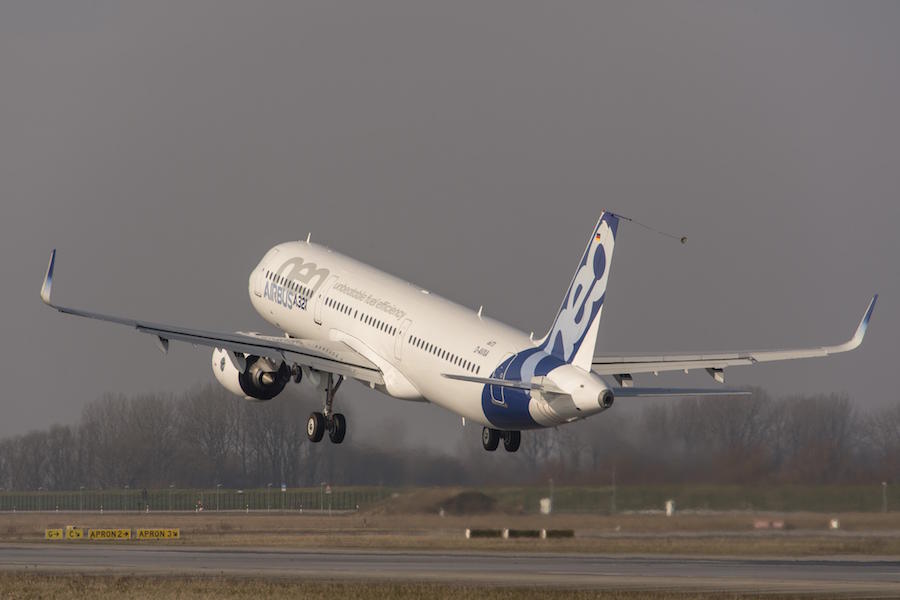
The first A321neo with Pratt and Whitney engines performs its maiden flight (Photo: Airbus)

Airbus’ A321neo has rapidly expanded across the world, but especially in the U.S. With United just taking delivery of its first aircraft, most major airlines and low-cost carriers now operate it. Over 1,153 of the type have been delivered worldwide, according to data from the manufacturer.

Across U.S. airlines, taking a look at the markets served, seating arrangements, and fleet size shows diverse use cases for the A321neo.

American Airlines

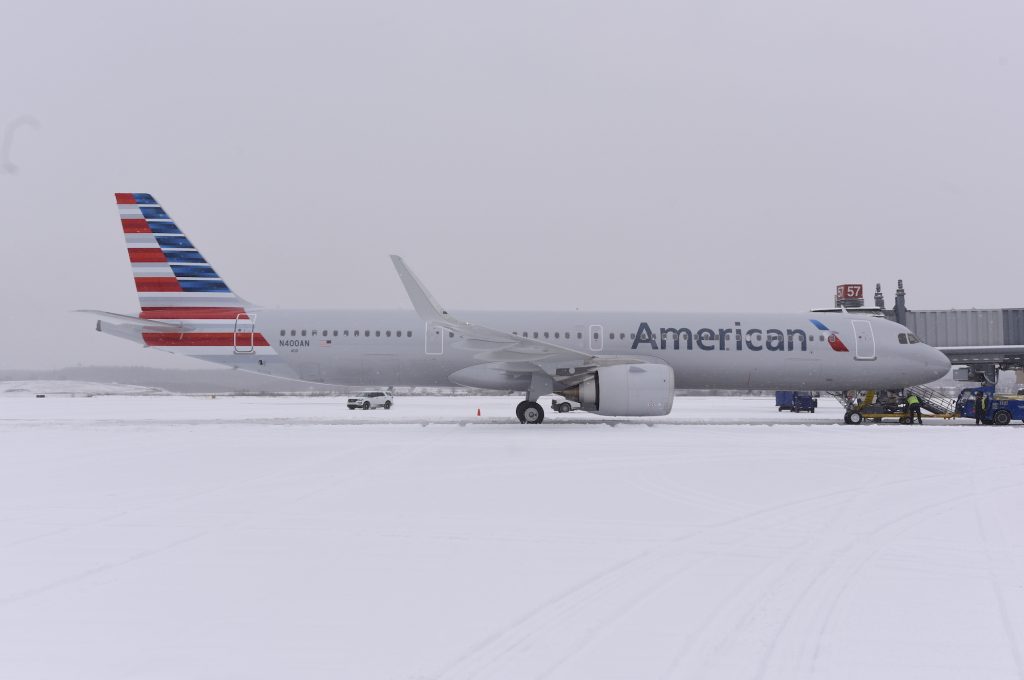
With one of the largest A321neo fleets worldwide, American operates 70 of the type. On top of these, the Fort Worth-based airline is set to get 10 more from Alaska Airlines, who reverted back to an all-Boeing fleet in September.

American operates the A321neo across its domestic network, but notably from the airline’s Phoenix and Los Angeles hubs to Hawaii. It also is not uncommon to find them on deeper South American routes, such as Miami to Lima.

The carrier’s A321neos are equipped with 196 seats, including 20 in first class along with 176 in economy.

American’s first A321neo in Pittsburgh (Photo: American Airlines)

Delta Air Lines

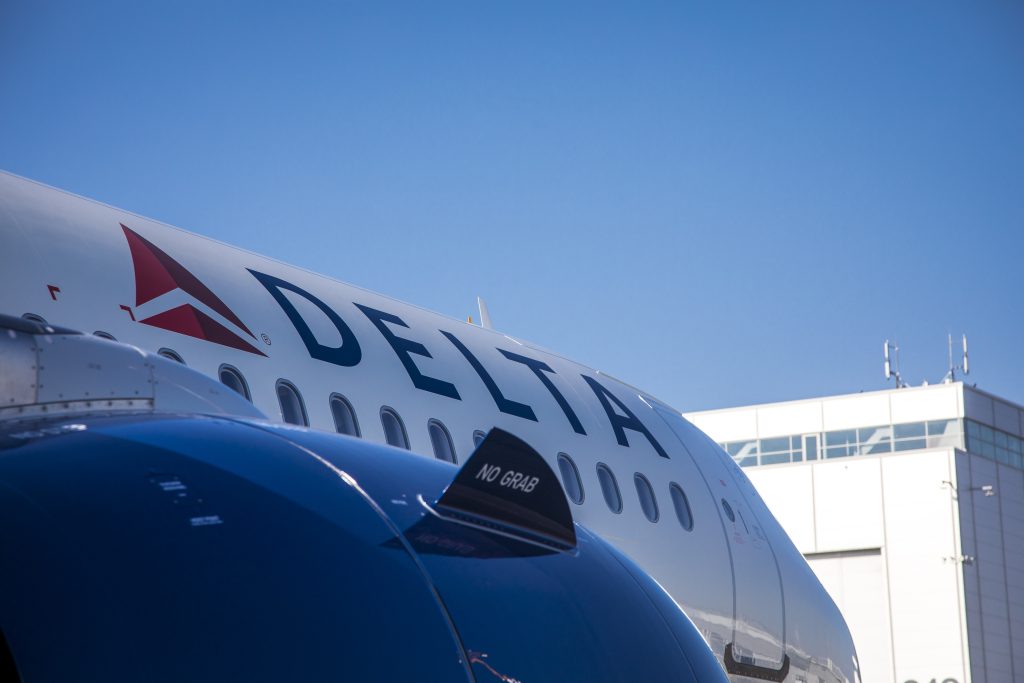
Delta received its first A321neo in March 2022 and currently has 43 in the fleet, according to planespotters.net data. Compared to the airline’s regular A321s, the A321neos offers some enhanced seating options, including a redesigned First Class seat. Each seat cushion is also made with memory foam.

Similar to American, Delta’s A321neo fleet can be found operating across a wide spectrum of routes, including Hawaii/Alaska and longer transcontinental domestic flights. In October 2023, the airline had 3,990 scheduled A321neo flights, according to Cirium Diio schedule data.

Delta’s new Airbus A321neo. (Photo: Delta Air Lines)

The Atlanta-based airline does take the prize for the fewest seats of any U.S. carrier’s A321neos. There are only 194 seats on Delta’s A321neos with 20 in first and 174 in economy.

United Airlines

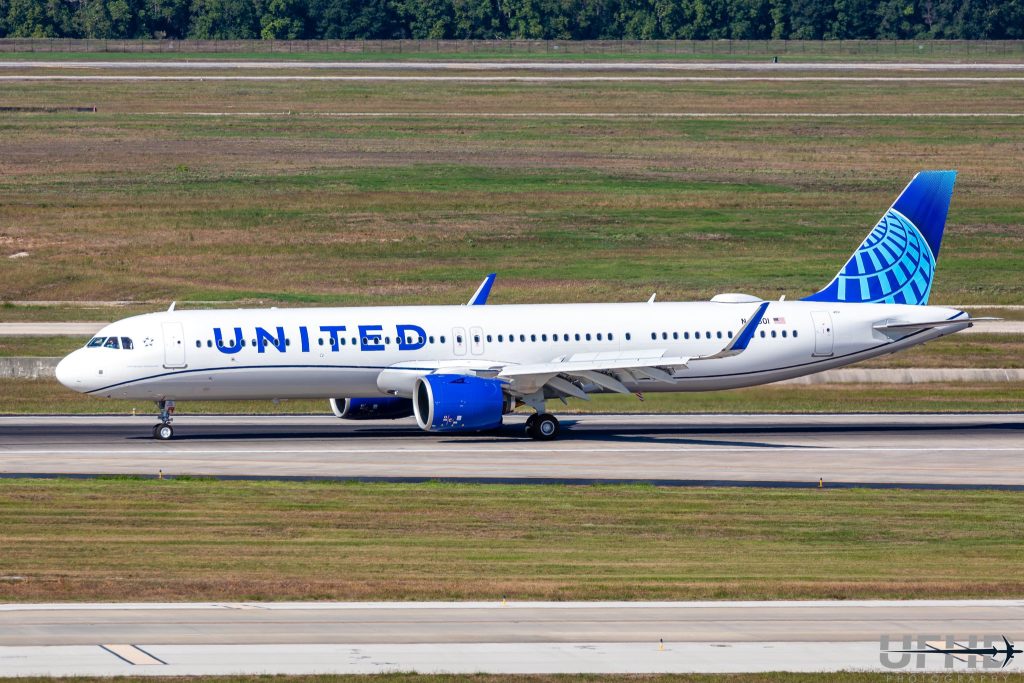
United is the latest U.S. airline to join the A321neo bandwagon, having taken delivery of its first aircraft in September 2023. The airline has penciled in the inaugural flight for Dec. 14, 2023 from Chicago O’Hare to Phoenix with the flight number UA321.

As of now, the airline has scheduled a handful of routes with the new aircraft type, all of which are from its Chicago O’Hare hub. Las Vegas, Fort Lauderdale, Fort Myers, and Orlando join Phoenix in early 2024 as the airline takes delivery of additional A321neos.

Among the major U.S. airlines, United is set to have the most seats on its A321neos. The aircraft will have 20 first class seats and 180 in economy for a total of 200. This is four more seats than American and six more than Delta.

United’s first A321neo arrives in Houston (Photo: @unitedflyerhd)

JetBlue Airways

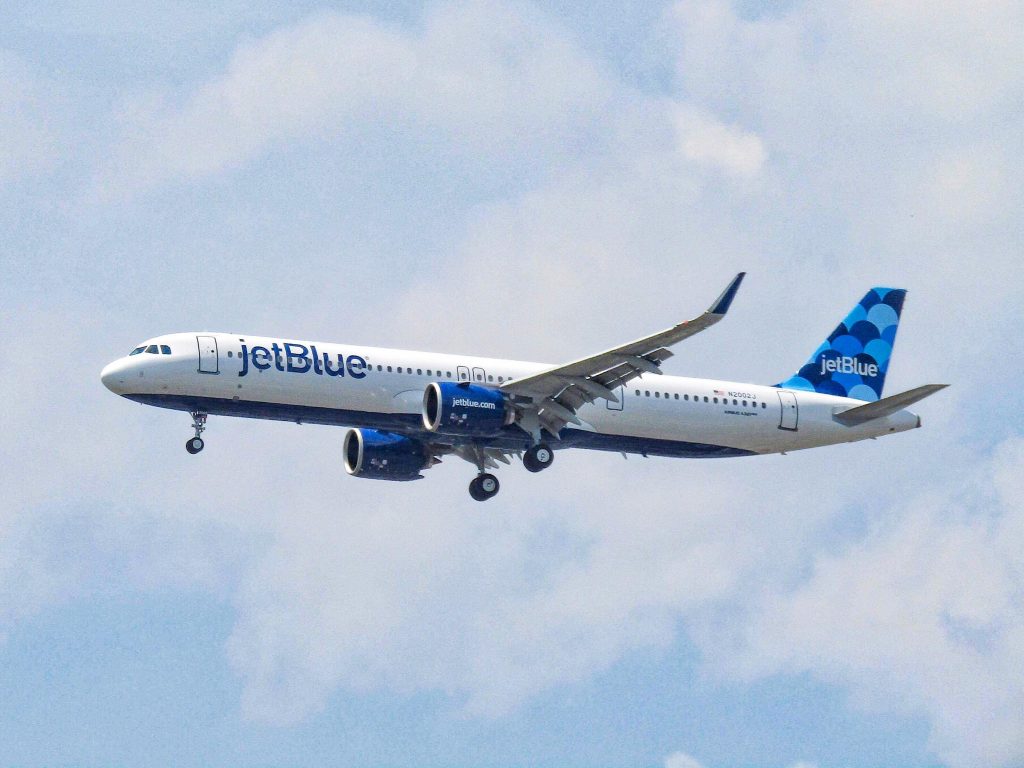
Unlike some of its peers, JetBlue has a few different variants of the A321neo, including the A321LR (Long Range). The carrier uses the regular A321neo on short to medium-haul routes, while the A321LR is configured for European flights.

The carrier’s A321LRs have a less dense 138 seats with 24 in its Mint class and 114 in economy. Largely used on transcontinental flights, the carrier has a sub-fleet of A321neos with Mint class seating. These have 144 economy seats and 14 Mint seats for a total of 158.

JetBlue also has an all-economy A321neo sub-fleet with a total of 200 seats. These are mostly used on domestic flights.

JetBlue’s first A321neo arrives from Hamburg at New York’s JFK Airport. (Photo: AirlineGeeks | Tom Pallini)

Hawaiian Airlines

Hawaiian’s A321neo fleet has opened the door for the carrier to connect secondary mainline markets with The Aloha State. For example, Hawaiian added service between Sacramento and Maui in 2018 using the aircraft.

Thanks to the aircraft type’s better performance characteristics, Hawaiian uses its A321neos mostly on flights between the mainland and various Hawaiian islands. While the carrier does have a fleet of A330s, the A321neo is its only narrowbody Airbus.

The airline’s fleet of A321neos has 16 first class seats and 173 in economy for a total of 189. Per Aviation Week, recent woes with Pratt and Whitney engines have caused Hawaiian to park some of its A321neo fleet for inspection.

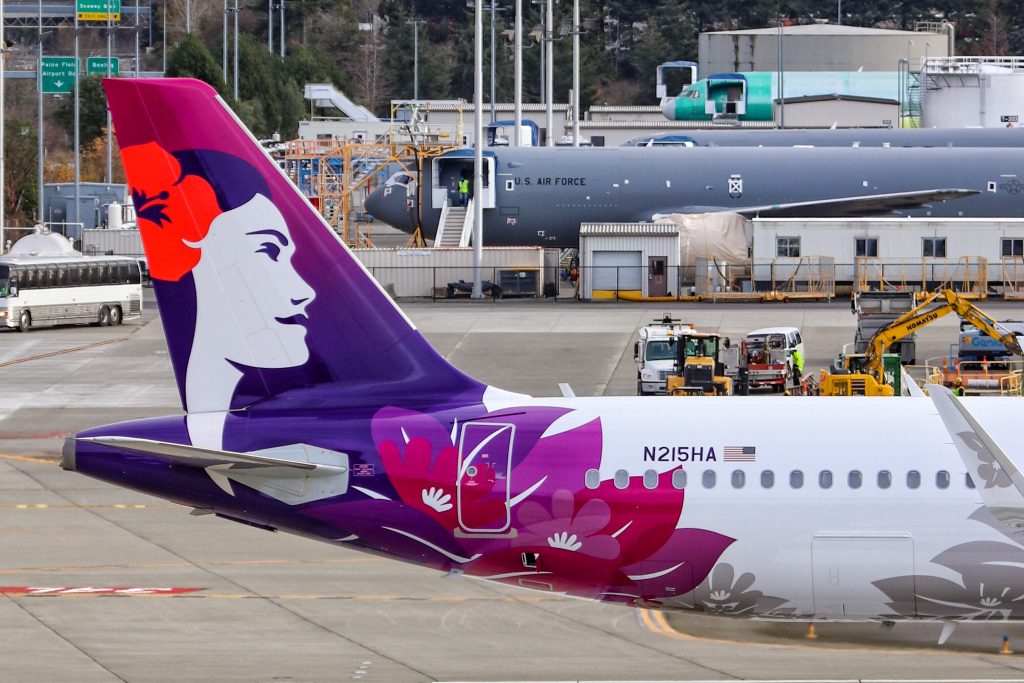
A Hawaiian Airlines A321neo at Paine Field. (Photo: AirlineGeeks | Katie Bailey)

Spirit Airlines

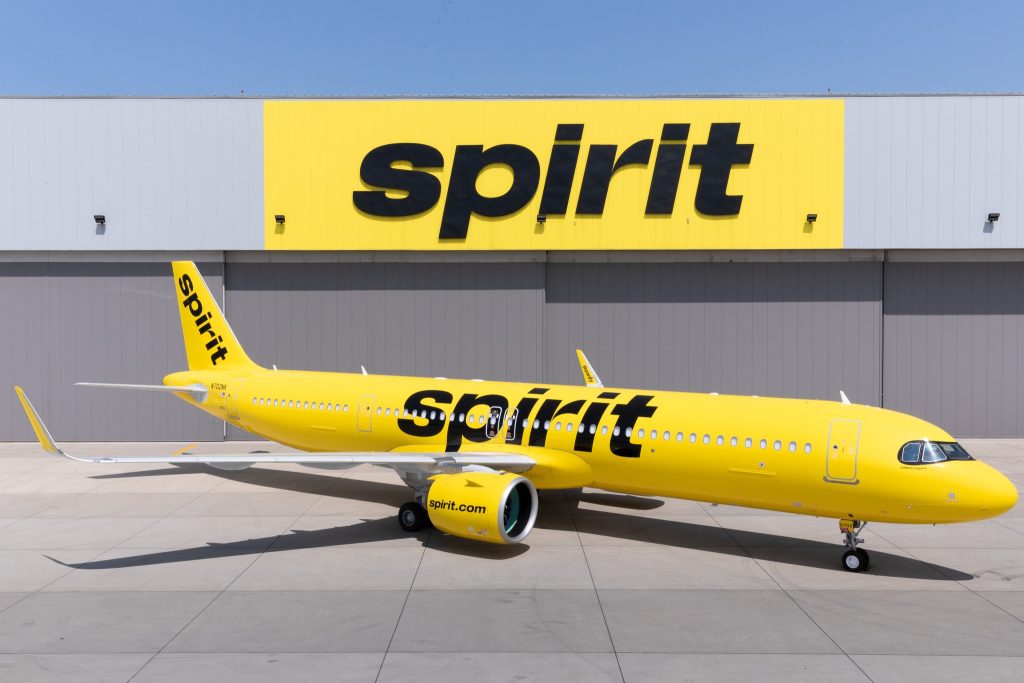
Ultra-low-cost carrier Spirit has a fleet of eight A321neo aircraft. The aircraft operate a variety of routes within the carrier’s network, most of which are domestic.

It shouldn’t come as a surprise that the airline has one of the most dense A321neo configurations. There are 235 seats on its A321neos with eight larger Big Front Seats. For comparison, the airline has only 228 seats on its regular A321s.

Spirit’s first A321neo (Photo: Spirit Airlines)

Frontier Airlines

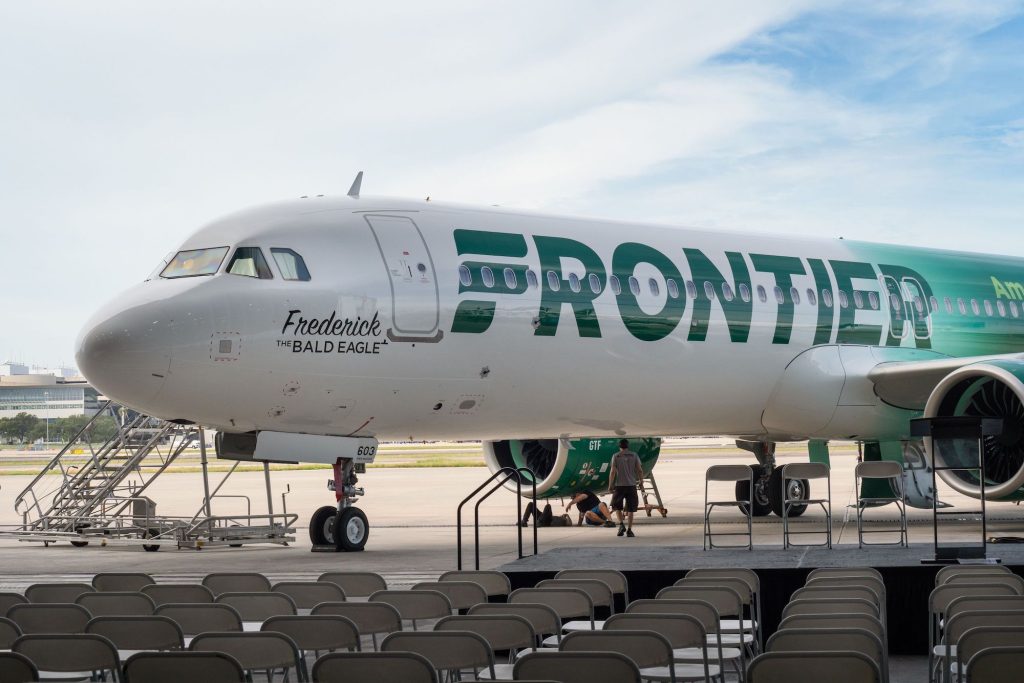
Similar to Spirit, Frontier also has a highly-dense A321neo configuration. The Denver-based ultra-low-cost carrier has 22 A321neo aircraft in its fleet.

A Frontier A321neo (Photo: Frontier Airlines)

Operating across Frontier’s network, the carrier’s A321neos have 240 seats, which is five more than Spirit. Frontier also does not have a similar product to Spirit’s Big Front Seats. Instead, the airline has Stretch Seats, which are standard seats with extra legroom.

Editor’s Note: Most of the seating data in this article was made available via Cirium Diio. 

Ryan Ewing

Ryan founded AirlineGeeks.com in February 2013 and has spent more than a decade covering the airline business. His work has been featured by CNN, WJLA, CNET, and Business Insider. His aviation experience spans airport operations, Part 135 regulatory compliance, and airline crew workforce planning, along with time behind the yoke of a Cessna 172 and interviews with airline executives. Ryan now serves as Group President of Firecrown Media’s Aviation Group. He holds a B.S. in Air Transportation Management and an MBA from Arizona State University and teaches Airline Management at Embry-Riddle Aeronautical University.

New Routes Coming to Agadir and Marrakesh

Two airlines are expanding into Morocco with unique routes from North America and Europe, including Marrakesh's first long-haul market.

A Ryanair Boeing 737-800.
A Ryanair Boeing 737-800. (Photo: AirlineGeeks | William Derrickson)

Morocco is emerging as a focal point for global travel, with two significant introductions marking its importance as a sought-after destination. Ryanair has inaugurated a nonstop flight route from Cologne/Bonn Airport to Agadir, while Air Transat is set to introduce its first African route, connecting Montreal to Marrakesh, solidifying the North American carrier’s entry into the African continent.

Ryanair’s commencement of flights from Cologne/Bonn Airport to Agadir began with the first flight on October 29. The Irish airline plans biweekly flights to the Moroccan port city, scheduled on Wednesdays and Sundays, departing from Cologne/Bonn on Wednesdays at 6:30 a.m. and Sundays at 7:35 a.m., with return trips on the same days from Agadir.

Thilo Schmid, CEO of Cologne/Bonn Airport, expressed enthusiasm, emphasizing Agadir’s appeal to travelers seeking sun-soaked beaches and modern amenities.

Agadir, situated on Morocco’s southwest coast along the Atlantic Ocean, allures visitors with its array of contemporary hotels, expansive boulevards, and ample opportunities for water sports. Moreover, it serves as a gateway to traditional villages, offering diverse travel experiences beyond beach holidays. The flights, operated by a Boeing 737-800, maintain a four-hour travel duration.

Marrakesh’s First Long-Haul Route

Simultaneously, Air Transat announced its groundbreaking venture, unveiling a year-round service between Montreal and Marrakesh, commencing from June 14, 2024 and operating twice a week on Wednesdays and Saturdays until October 24. The route will continue with a weekly flight on Saturdays until April 20, 2025.

The airline’s introduction of the nonstop route is strategically targeted to accommodate both VFR (Visiting Friends and Relatives) traffic and leisure passengers. The move is notably significant given Montreal’s substantial Moroccan community, with nearly half residing in the city.

Annick Guérard, President and CEO of Air Transat, highlighted the milestone achievement in expanding the carrier’s network by adding Marrakesh as its inaugural African destination. The service, utilizing Airbus A321LR aircraft, is set for twice-weekly operations during the summer months, and once a week during the winter, further reinforcing Air Transat’s commitment to enhancing its transatlantic offerings.

With Air Transat poised to become the exclusive North American airline operating a direct service to Marrakesh, the airline stands at the forefront of connecting the continents and bridging diverse cultures. The Montreal-Marrakesh route is projected to not only fulfill the travel demand for the Moroccan community in Montreal but also captivate the interest of leisure travelers intrigued by Marrakesh’s distinctive appeal.

This venture not only symbolizes an expanded network for Air Transat but also holds promising prospects for Moroccan tourism. Adel El Fakir, CEO of the Moroccan National Tourism Office, expressed enthusiasm about the new route and the possibilities it opens for travelers, extending beyond Marrakesh to explore the coastal resorts and southern regions of Morocco.

Victor Shalton

Victor Shalton's love for aviation can be traced to when he was 11-years-old. As a seasoned aviation writer, he takes pride in providing the best aviation coverage around the globe and is passionate about advancing his skills in the aviation space. In addition, he loves travelling, writing, arts and while his speaking engagements have taken him around the world, he is proud to call Nairobi home.

Air China Turns Profit in Third Quarter

On October 26, Air China released its Q3 2023 financial report, showing the airline has made its first profitable quarter since 2020.

An Air China 737 MAX 8 (Photo: AirlineGeeks | Katie Bailey)

On October 26, Air China released its Q3 2023 financial report, showing the airline has made its first profitable quarter since 2020. The airline has made RMB4.2Bn ($0.59Bn) in profit during Q3 and has cleared all losses in the first half of 2023 (1H23). This is a major milestone for the airline post-pandemic, and major efforts have been invested to ensure such a result. Projecting to the end of 2023, although Air China has laid a solid foundation for its FY2023 performance, a profitable fiscal year 2023 (FY2023) still needs endeavors to achieve.

Results

In the previously reported half-year report published by the airline, the RMB3.45Bn ($0.48Bn) losses compared to the same time last year have been significantly reduced thanks to the release of China’s COVID-19 control measures, and the recovery of the Chinese economy since the beginning of 2023. Q3 is the traditional rush season for aviation markets as it covers the summertime. The public expects Air China to significantly reduce their losses with Q3 performance, and everyone is surprised that the carrier was able to turn the situation upside down to profit.

Operations

During Q3, Air China invested major efforts to ramp up capacity and occupancy. For Air China’s routes between its major Hubs, such as Beijing, Shanghai, Guangzhou, Shenzhen, Chengdu, and Hangzhou, it rolled out a new program called Air China Express, which Air China will schedule frequent flights every half-hour, and allows business travelers to change flights more easily.

To increase operational efficiency, Air China found the opportunity to further squeeze the daily usage of its wide-body jets by triangulating their routings. For instance, an Air China Boeing 777-300ER on a summer schedule will fly its first four-hour leg from Beijing to Urumqi, China, which was a major tourist destination during summer; then, it will fly another five-hour to Guangzhou, carrying the tourists from South of China back home; after that, the 777 make its trip back to Beijing with a three-hour flight, and finally, end its day on a red-eye international flight to Frankfurt.

To make such a route operable, Air China invested in previous years in setting up subsidiaries and bases in the Chinese provinces of Xinjiang and Guangdong. By breaking the traditional City A – City B – City A scheduling, the carrier is able to increase the daily usage of its fleet and put sufficient capacity to demands.

Economy

During Q3 of this year, many believed that China was experiencing a sluggish recovery from its COVID-19 impacts on its economy. From metrics, that may be so, however, the travel demand was still high since most Chinese people have significantly cut down their travel during the past three years. This year, with all the restrictions lifted, some previously unfulfilled demands move to 2023. This was suggested by the high demand during the quarter, even under a record-high average airfare.

Q4 and Beyond

Without a doubt, Air China is striving for a profitable 2023. Though the past quarters have laid a solid foundation for the carrier to do so, it may still be a challenging task to break even for the entire year as Q4 is traditionally the off-season for both tourism and business travels. However, the carrier is also investing in attracting more international students and convention guests to fly with Air China, as Q4 covers Western holidays, and multiple major trade conventions take place in China during Q4. Finally, Air China is also putting more work into its regional jet fleet of COMAC ARJ21 to fulfill routes with less traffic, making sure its network can cover as much as possible, and doing so with the highest efficiency.

Overall, the carrier handed in a top-notch result for Q3, and its performance for the year 2023 will continue to be focused on by the public. We will continue to observe the actions taken by Air China to improve its efficiency and its profitability.

Lei Yan

Lei is from Inner Mongolia, China, and now lives in Guangzhou. He grew up in an aviation family, where his passion began. During his time at Penn State University, he studied Industrial Engineering specializing in operations research, and he graduated with an honor’s thesis on airport gate assignment optimization. Now, he is a Purchasing Manager with Procter & Gamble. In his free time, he enjoys flying, reading, and wandering around the city.

JetBlue, Spirit Merger Trial Looms

Plans for a trial come as Spirit is facing a sharp drop in demand that is severely impacting its profits. The airline has halted pilot hiring.

JetBlue A220
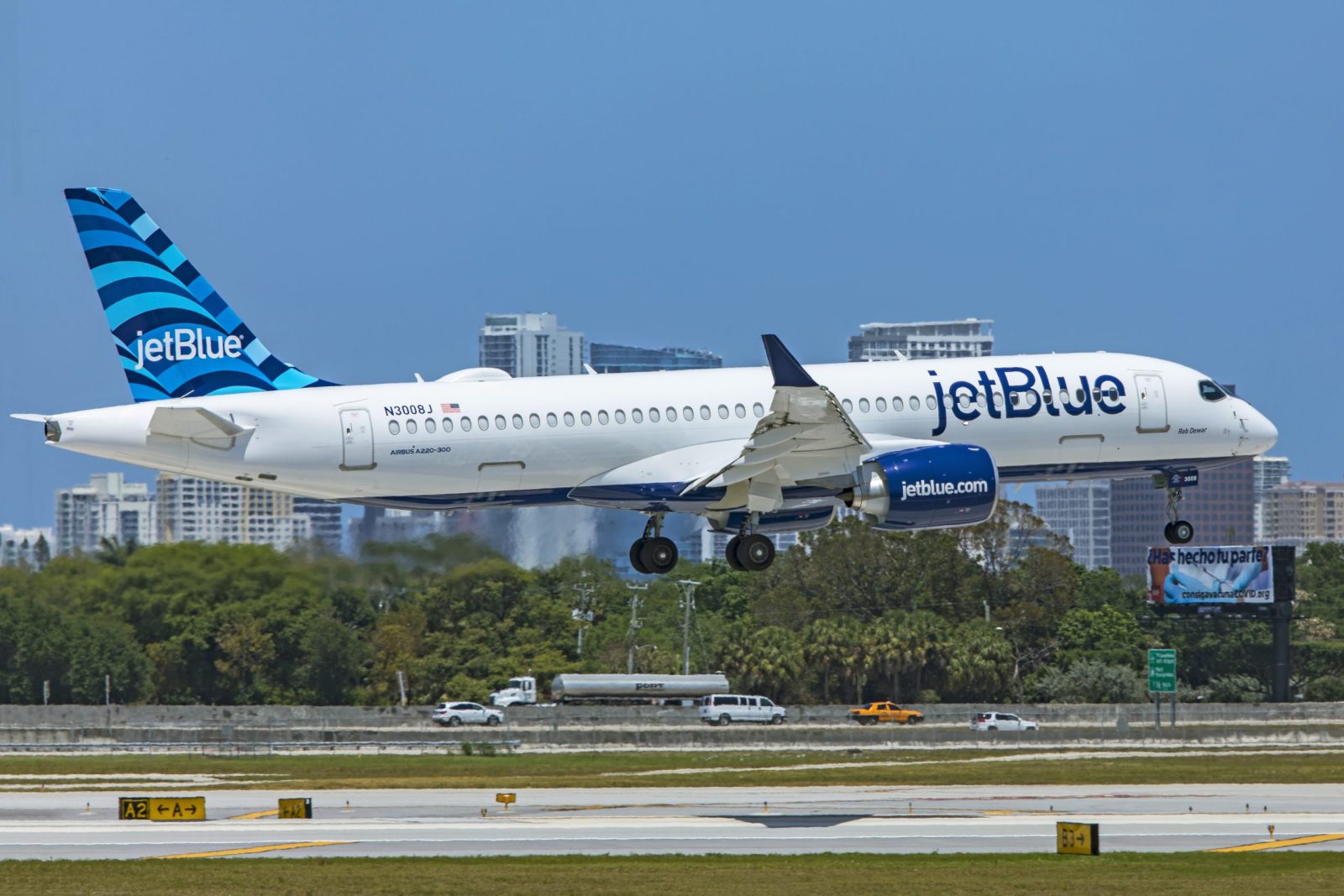
A JetBlue Airways Airbus A220 prepares for landing in Fort Lauderdale, Florida. (Photo: AirlineGeeks | William Derrickson)

The potential merger between JetBlue and Spirit Airlines has already been a long process. JetBlue took months to convince Spirit shareholders to choose their merger over a deal Spirit had already struck with fellow ultra-low-cost carrier, Frontier. After doing so, the Department of Justice announced they would sue to block the potential merger on anti-trust grounds.

Now, a trial will begin in U.S. District Court in Boston to examine whether the $6.8 billion can go through. It is the first time that the Department of Justice is taking a merger to court. The Department challenged American’s merger with US Airways. However,  that case was settled out of court before a trial even began.

“This is a different DOJ,” said William J. McGee, a consumer advocate and senior fellow for aviation and travel at the American Economic Liberties Project. “In my lifetime, in this industry, we have never seen the DOJ be so aggressive on the airline front.”

The Department of Justice has lately been more apt to take antitrust cases to court, though their results have lately been mixed. However, the Department of Justice did win an anti-trust case against JetBlue earlier this year, when a judge barred future collaboration between JetBlue and full-service carrier American Airlines in the Northeast United States. The judge found the two were too powerful when working together. Thus, JetBlue declined to appeal the ruling to focus more on its proposed merger with Spirit.

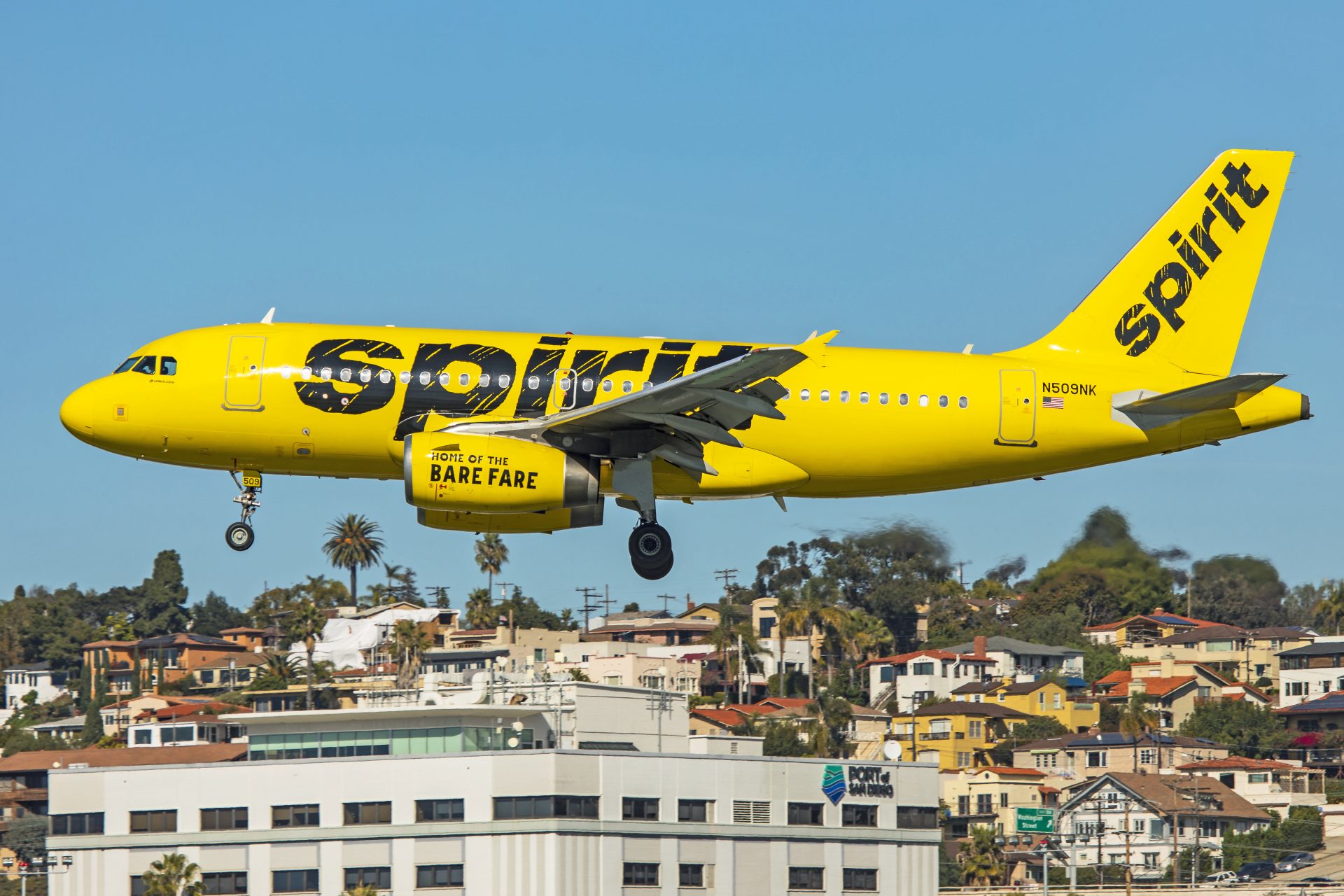
A Spirit Airlines Airbus A319 prepares for landing. (Photo: AirlineGeeks)

This particular case will be quite notable, as if the merger goes through, one of the United States’ two major ultra-low-cost carriers will disappear. If that happens, consumer prices can be expected to go up, as the pressure placed on full-service carriers to match low-cost airlines’ prices will be present.

Spirit would also potentially disappear from numerous markets, providing the potential for another airline, whether it be Frontier, a full-service carrier, or JetBlue, to enter the market at higher prices without the fear of a low-cost carrier coming for them.

“The proposed acquisition would eliminate Spirit, a disruptive and innovative competitor and reduce consumer choice in hundreds of markets that it serves today or would serve in the future,” the Justice Department argued in court filings.

Connecticut senator Chris Murphy agrees with the Justice Department, arguing during a roundtable discussion that small communities will lose out from a potential merger.

“When these mergers happen, it seems to be that the haves — geographically — have more, and the cities that are smaller and needed the presence of these smaller airlines or smaller companies that get gobbled up by bigger companies lose out,” Murphy said.

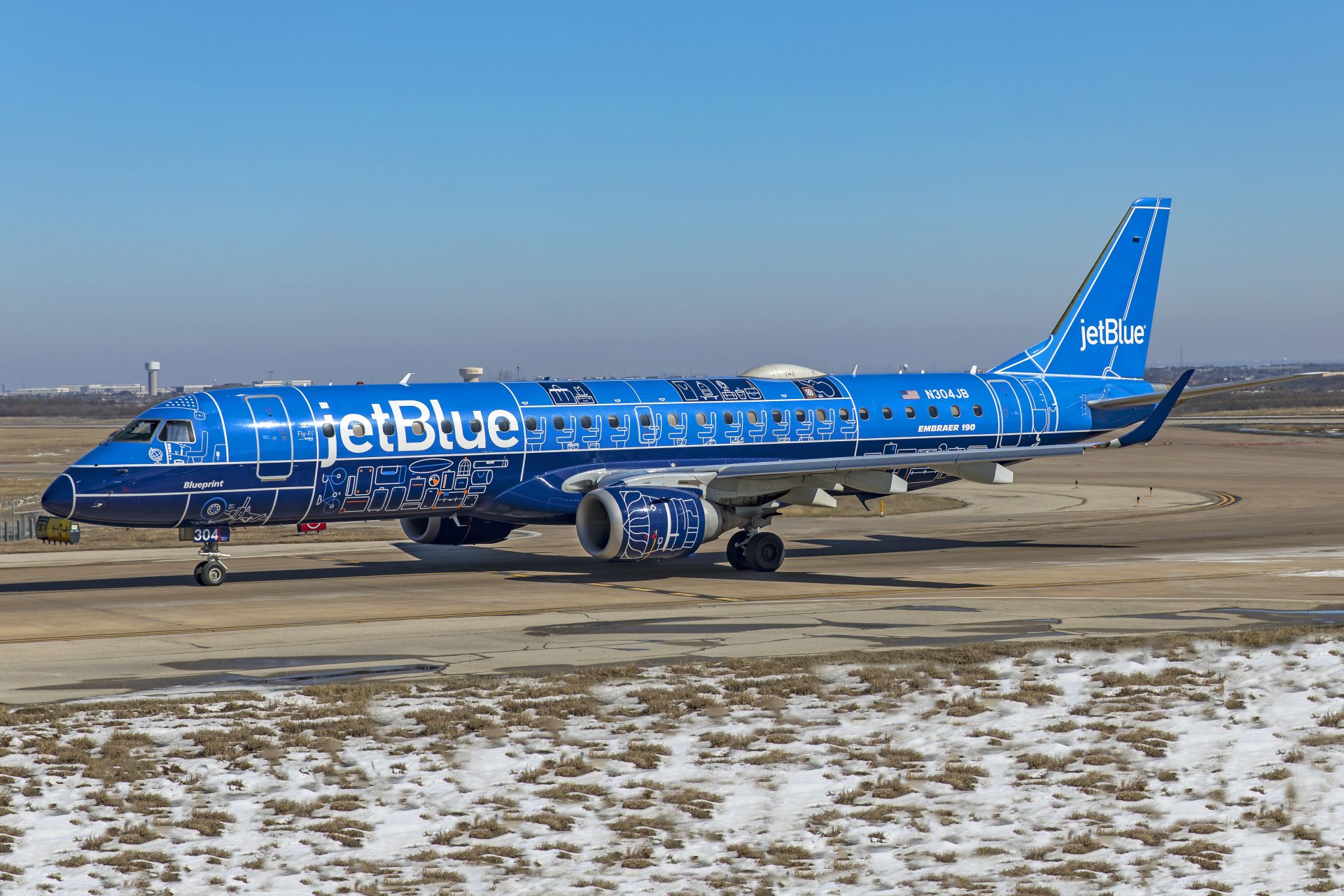
A JetBlue Embraer ERJ190 in the airline’s Blueprint livery.  (Photo: AirlineGeeks)

Still, JetBlue is making a strong case for its merger. The airline argues that a bigger JetBlue would end up being better for consumers after all.

“We look forward to presenting our case in court as we strongly believe our combination with Spirit is the best opportunity to disrupt the industry by increasing competition and choice, creating a long overdue national low-fare challenger to the dominant Big Four airlines,” JetBlue said in a statement.

A Justice Department filing has found that the top four U.S. airlines account for 80% of the market in the United States. JetBlue has been trying to work its way off of the east coast to have a larger presence across the entire country. Once the airline has access to Spirit’s airplanes and airport slots, the carrier will have a useful tool for them to get that access.

“Organic growth of the sort needed to mount a national challenge to the legacies would take decades,” JetBlue argued in court filings. “JetBlue’s merger with Spirit would turbocharge JetBlue’s growth and create a strong fifth national player in the domestic airline market.”

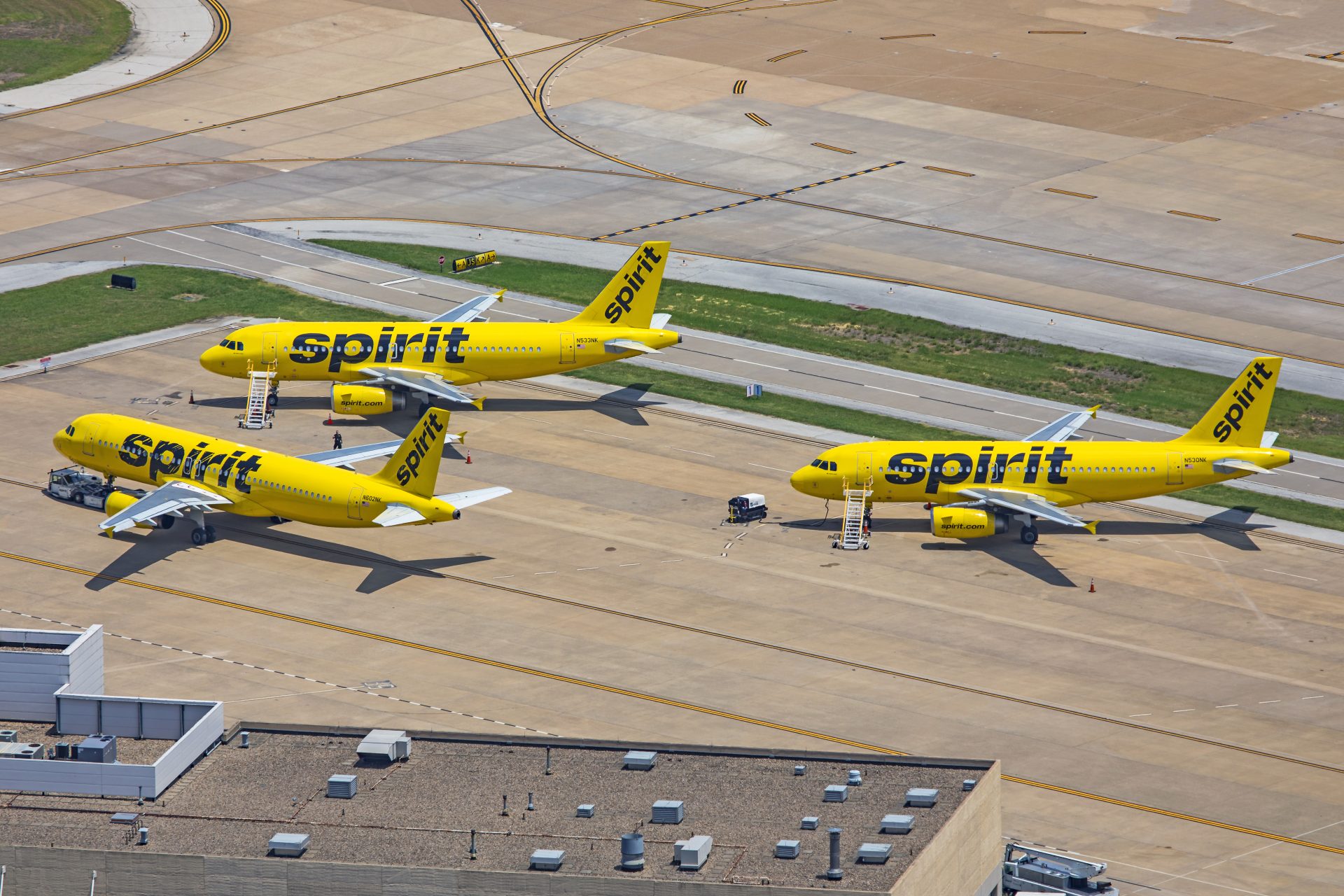
Spirit Airlines Airbus jets parked on the ramp. (Photo: AirlineGeeks)

JetBlue would be able to compete with the major US carriers throughout the entire country, instead of focusing only on connections to and within the East Coast and Caribbean. They would be able to appeal to passengers who wouldn’t fly an ultra-low-cost carrier like Spirit on the West Coast but want an alternative to the higher prices offered by the three full-service airlines.

The last major airline merger in the United States came when Alaska Airlines outbid JetBlue to merge with Virgin America. That merger would have effectively had the same effect on JetBlue that a merger with Spirit could have: it could have opened them up to the West Coast market and helped them grow their network beyond the East.

Plans for a trial come as Spirit is facing a sharp drop in demand that is severely impacting its profits. The carrier recently announced they are halting crew training, given reduced demand and engine issues that have grounded many of its Airbus A320 aircraft.

John McDermott

John McDermott is a commercial pilot pursuing a career in professional flight. His passion for aviation began in an Ann Arbor bookstore with a tale of enemy pilots during World War 2, and he hasn't looked back. Besides flying and writing for AirlineGeeks, John volunteers with Professional Pilots of Tomorrow and travels whenever he gets the chance.

When IATA Calls for Order

The ONE order initiative intends to revolutionise the order management process in the airline industry. The legacy system using PNR, e-ticket and EDM formats would be replaced by a single Customer Order record, capturing all data elements obtained and required for order fulfillment of air travel.

New York LaGuardia Airport
Aircraft movements at New York LaGuardia Airport. (Photo: AirlineGeeks | William Derrickson)

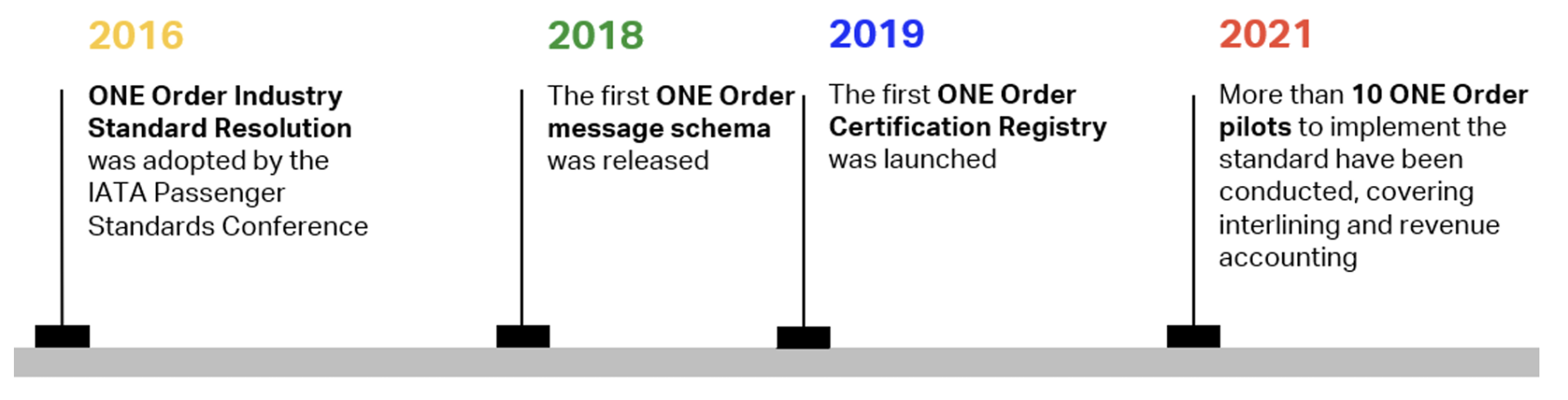
Back in 2016, IATA committed on behalf of its members to establish a single order process related to the delivery of airline products and services and related accounting processes. This meant the introduction of a new messaging and business process standard. The bill got passed as a “Resolution 797 – ONE Order.”

The Legacy System

Selling airline tickets dates back further than the internet. Given the long-distance character of air travel that spans even across the oceans, there had to be a way to sell a ticket at an outpost. A look into the cards of history will show a story about the Airline Tariff Publishing Company, commonly known as ATPCO. A non-profit, privately held company, commissioned to distribute the airline fares across the globe. Even as late as the 1990s it was still common practice to print and ship fare books around the world that were valid for months at a time.

ATPCO revolutionized the publishing game with digitization, providing fare data to Global Distribution systems in the EDIFACT format – Electronic Data Interchange for Administration, Commerce and Transport, which is a United Nations-approved format. This allowed not only to publish the fares but to also sell various additional products.

Unfortunately, what propelled it forward became the weight dragging it down. In the Internet era exchanging data is no longer an issue. But the airlines, bound to publish the fares in the legacy system through GDSs, are now stuck in the past. They are unable to follow the internet-first type of distribution that became popular with the rise of low-cost carriers.

A Decade-Old Buzzword

Ideas about ditching the EDIFACT format have been sparking since 2012 when the New Distribution Capabilities initiative, NDC in short, was launched at IATA. This was purposefully aimed to introduce the new generation of notation to the airline industry – XML was to replace EDIFACT. Fast forward more than 10 years later and it seems like it barely took off the ground. To be fair though, many airlines around the world are at least capable of handling the new notation.

The ONE Order should build on top of that and further streamline the airline retailing. From the passenger’s point of view, they could buy a single product catered precisely for them, instead of a bucket of products bundled together. Everything else other than the pure service of transportation needs a separate ID – Electronic Miscellaneous Document or EMD in short. Here is where the ONE Order comes into place. It should all be ONE.

The airline side of handling a customer would benefit greatly too. So far the operational side of handling a passenger was completely separate from the financial one. The first would proceed with a Passenger Name Record or PNR, while the second with an e-ticket. Those two worlds would come together only after the passenger flies.

The industry roadmap to ONE Order by IATA (Iamge: Delivering with Orders (ONE Order) Factsheet by IATA, May 2023)

More Complex Than It Seems

The concept is noble and seems useful. Why does it take so long to implement then? The issue lies with the number of parties involved. The new notation would not be only used to communicate between the airline and the customer. It will crawl into almost every detail of the airline business. The products in their new form will need to be distributed through all the existing channels. That means not only direct online sales of the carrier but also online third parties and more importantly traditional travel agents as well. Each of those parties needs to equip themselves to handle the new technology. Each of the existing stakeholders, like GDS providers, will need to keep their skin in the game.

Internally, the project spans across the entire airline too. It involves the financial division of an airline right with the commercial one. Operational implications will follow including the cooperation between the carriers, codesharing and interlining. This will be a challenge both in terms of communication but also the technology back end with the Departure Control Systems as well.

Is It Close?

Given strong legacy influences and an incredible number of moving parts, it starts to make sense why it takes so much time to progress on such front. Nevertheless, from the passenger’s point of view, the new development seems to have only upsides. IATA also mentions goals like reducing overall complexity and improving interoperability inside the industry and beyond, which should help reduce costs and introduce new revenue streams for airlines.

With air travel reignited after the pandemic and the new wave of innovations, like Flybondi offering tickets in the form of Non-Fungible Tokens, hopefully the project had to take a few small steps to be able to now take a leap forward.

Filip Kopeć

A passionate aviation enthusiast that started off his career as an aerospace engineer, but found his true calling on the commercial side of the airline business. Now as a finance guy among avgeeks and an avgeek among finance guys, he has experience working in the Revenue Divisions of three airlines. In his spare time he enjoys traveling, but admittedly sometimes is more about the journey than the destination.

EasyJet Achieves Major Carbon Reduction Milestone

easyJet completes multi-million-pound retrofit, equipping its entire fleet with advanced technology, saving 88,600 tonnes of CO2 annually.

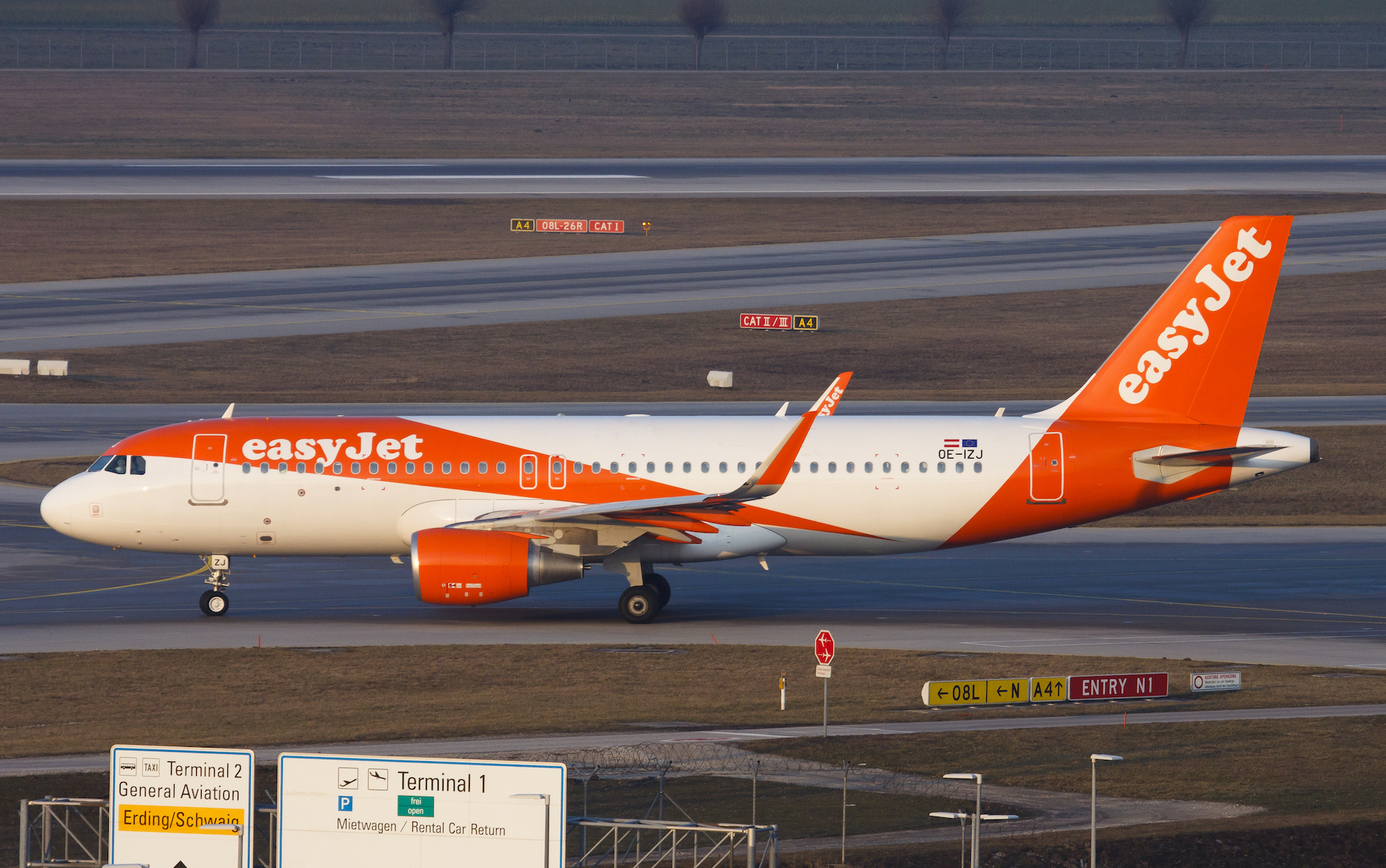
An EasyJet A320 with Sharklets (Photo: AirlineGeeks | Fabian Behr)

British low-cost carrier easyJet has completed a fleetwide retrofit with Descent Profile Optimisation (DPO) and Continuous Descent Approach (CDA) software on all its aircraft. This state-of-the-art technology significantly reduces carbon emissions and fuel costs, resulting in a permanent fuel saving of up to 1% or 88,600 metric tonnes of CO2 annually.

Last year, according to a survey published by the British low-cost airline, out of 2,000 British vacationers, more than 75 % believe that airlines urgently need to define ways to achieve net zero CO2 emissions. Also, 78 % will choose an airline based on its sustainability credentials when traveling in the future, and 70 % will commit to a “zero carbon” vacation if it were available.

This achievement makes easyJet the largest operator in the world with DPO and CDA capability. The initiative is part of the airline’s roadmap to achieve net-zero emissions by 2050. It will reduce carbon in the short term, benefiting British airlines, airports, and surrounding communities.

Descent Profile Optimization (DPO) enhances the Flight Management System (FMS). This enhancement fosters more consistently efficient descents by extending the aircraft’s time in the cruise phase and eliminating the ‘level-off’ stage at the end of the destruction, reducing carbon emissions.

In addition to its fuel-saving benefits and the consequent reduction in carbon emissions, Descent Profile Optimization (DPO), in synergy with the Continuous Descent Approach (CDA) based on easyJet’s FY24 forecast, also plays a vital role in reducing noise, particularly important due to the increasing enforcement of stricter noise regulations.

easyJet has committed to achieving net-zero carbon emissions by 2050 and has joined the UN-backed Race to Zero initiative. Their plan involves using new technology, collaborating with partners like Airbus and Rolls-Royce, and implementing measures like fleet renewal, operational efficiencies, Sustainable Aviation Fuel, and carbon removal technology. They also aim for a 35% reduction in carbon emissions intensity by 2035 compared to 2019.

Captain David Morgan, COO of the British low-cost carrier, emphasized the program’s contribution to permanent CO2 reduction and its commitment to its net-zero target. He also stressed the need for governmental action to fully modernize airspace to utilize such advanced technologies.

EasyJet is the second-largest low-cost airline in Europe after Ryanair, so its commitment to decarbonize the European civil aviation sector is significant. The British carrier actively advocates for airspace modernization, including initiatives like the Single European Sky, which aims to achieve 10% carbon emissions savings in European aviation. The airline is a founding member of SESAR, a partnership to expedite the Digital European Sky’s implementation. Additionally, easyJet is involved in the IRIS program, an air traffic management initiative aimed at improving efficiency, reducing flight delays, saving fuel, and minimizing the environmental impact of air travel.

Vincenzo Claudio Piscopo

Vincenzo graduated in 2019 in Mechanical Engineering with an aeronautical curriculum, focusing his thesis on Human Factors in aircraft maintenance. In 2022 he pursued his master's degree in Aerospace Engineering at the University of Palermo, Italy. He combines his journalistic activities with his work as a Reliability Engineer at Zetalab.

Livery of the Week: JetBlue’s Stand Out Retro Jet

Several airlines pay homage to their roots with retro liveries, including both American and United in the U.S., but JetBlue's is unique.

A JetBlue A320 with the airline's retro livery in Las Vegas (Photo: AirlineGeeks | William Derrickson)

Editor’s Note: AirlineGeeks is excited to launch our ‘Livery of the Week’ series. Every Friday, a team member will share an airline livery, which can be from the past, present, or even a special scheme. Some airline liveries are works of art. The complexity associated with painting around critical flight components and the added weight requires outside-the-box thinking from designers. The average airliner can cost upwards of $200,000 to repaint, creating a separate aircraft repainting industry as a result.

JetBlue has a wide array of retro liveries across its fleet of 285 aircraft. From sports teams to art pieces, the New York-based airline has no shortage of eye-catching paint jobs. However, one in particular does stand out: an A320 named ‘What’s Old Is Blue Again.’

Having been founded in 1998, JetBlue is not exactly an airline with a long history, especially when compared to American, United, or Delta which have been around for almost a century. In fact, the carrier just recently rolled out a new standard livery that deviates from its early-2000s roots.

Nevertheless, the airline went ahead and embraced a 1960s-era design with its retro special livery on N763JB. The livery was unveiled in 2016 alongside the carrier’s inaugural seasonal service to Palm Springs, Calif.

“The 1960s were rich with sleek but bold graphics and style – characteristics of today’s JetBlue brand,” said Jamie Perry, vice president of marketing at JetBlue said in a press release during the unveiling.

“With that in mind our team broke from our tradition of timeless designs and instead imagined a look to celebrate this iconic era of aviation and what JetBlue may have looked when it would have been introducing humanity to air travel,” Perry added.

JetBlue’s retro-themed special livery. (Photo: JetBlue Airways)

Embracing 1960s Flair

Even though the airline had not even been thought of in the 1960s, JetBlue did not hold back on embracing design elements.

The livery features bold orange and blue “speed stripes” down the aircraft’s fuselage, which was a notable element among liveries of the era. The airline’s name is also printed in a retro-themed font.

In addition to the fuselage, the A320’s tail is well-decorated too. According to the airline, N763JB’s tail features three colors and 1960s-era font that ‘would have stood out among other airlines of the time.’

JetBlue describes this retro livery as ‘a jet age take on JetBlue’s hallmark tails of today.’

Retro Liveries

Several airlines pay homage to their roots with retro liveries, including both American and United in the U.S. Even though the aircraft may be newer, these livery designs are a throwback to the so-called ‘golden years’ of commercial aviation.

Looking for a new airplane model? Head over to our friends at the Midwest Model Store for a wide selection of airlines and liveries. 

Ryan Ewing

Ryan founded AirlineGeeks.com in February 2013 and has spent more than a decade covering the airline business. His work has been featured by CNN, WJLA, CNET, and Business Insider. His aviation experience spans airport operations, Part 135 regulatory compliance, and airline crew workforce planning, along with time behind the yoke of a Cessna 172 and interviews with airline executives. Ryan now serves as Group President of Firecrown Media’s Aviation Group. He holds a B.S. in Air Transportation Management and an MBA from Arizona State University and teaches Airline Management at Embry-Riddle Aeronautical University.
Sign-up for newsletters & special offers!

Get the latest stories & special offers delivered directly to your inbox

SUBSCRIBE

Uh-oh! It looks like you're using an ad blocker.

Our website relies on ads to provide free content and sustain our operations. By turning off your ad blocker, you help support us and ensure we can continue offering valuable content without any cost to you.

We truly appreciate your understanding and support. Thank you for considering disabling your ad blocker for this website