An Ethiopian Boeing 737 MAX departs after delivery from Boeing Field (Photo: Boeing)
The Ethiopian Accident Investigation Board recently released the final report on the crash of an Ethiopian Airlines Boeing 737 Max.
Released on Friday (December 23), the state investigators in their final report on ET302 confirm that a software bug is the main cause of the 2019 Boeing 737 Max crash.
The Ethiopian Airlines flight bound for Nairobi crashed six minutes after takeoff from Addis Ababa, southeast of the Ethiopian capital, killing all 157 passengers and crew.
Consistent with the preliminary report, the final report confirmed that the angle-of-attack sensor on the left side of the aircraft “failed immediately after takeoff, sending erroneous data to the flight control system,” said Dagmawit Moges, Ethiopia’s minister of transport.
The erroneous data triggered the MCAS flight control system, which repeatedly pointed the plane’s nose down until the pilots lost control of the plane, she said. The report should be public in the coming days.
In the aftermath of the crash of Ethiopian Airlines flight ET302, there is discord between investigative authorities in Ethiopia and the United States.
The NTSB wrote in a statement that it took the unusual route of publishing the comments on Ethiopia’s report on its own website because the Ethiopian authorities did not include them in its report.
The NTSB also noted with concern that the EAIB final report included significant changes from the last draft the EAIB provided the NTSB.
Bird Strike As a Possible Factor
While the investigators in Ethiopia identified the malfunction of the Maneuvering Characteristics Augmentation System MCAS as the cause of the accident, the NTSB agrees that in the United States, too, the faulty system inputs that led to the nosedive are believed to be the primary cause.
However, the authority’s statement states that the Ethiopian colleagues fail to mention other relevant factors.
The NTSB points out that bird strikes could also have played a role. Incidents involving birds damaging planes at Addis Ababa airport are frequent.
Apparently, the collision with a bird could have damaged the sensor that fed the MCAS erroneous input.
For example, Collins Aerospace, the manufacturer of the plane’s sensor, has said the flight data recorder readings are similar to previous cases of damage from a bird strike.
Crew Performace Not Discussed
In addition, the Ethiopian Aircraft Accident Investigation Bureau did not take into account that the aircraft would have remained controllable despite the MCAS malfunction if the crew had reduced the thrust manually and used the manual electrical trim appropriately.
Ethiopian Airlines received corresponding instructions from the USA months before the accident.
“The lack of information about flight crew performance limits the ability to address broader and equally important safety issues,” the NTSB release said.
However, data to analyze the pilots’ performance throughout the flight was actually readily available.
No Complete Transcript of the Voice Recorder
The US agency also criticizes the fact that the report does not contain a complete transcript of the data from the cockpit voice recorder.
“The current presentation of the transcript prevents one from obtaining a full and objective understanding of the event,” the NTSB concluded. It also accuses the Ethiopian counterpart of making false statements.
The adjustments that Boeing implemented on the 737 Max 8 have not received final approval, NTSB said.
Misleading Statements
Boeing’s failure to properly respond to Ethiopian Airlines’ request for more information about the MCAS following the October 2018 Lion Air 737 Max crash is also not factual.
According to the NTSB, on December 3, 2018, Boeing provided specific guidance on how to deal with uncontrolled stabilizer trim movements for all operators of the model to supplement the previously released operations manual.
Victor Shalton's love for aviation can be traced to when he was 11-years-old. As a seasoned aviation writer, he takes pride in providing the best aviation coverage around the globe and is passionate about advancing his skills in the aviation space. In addition, he loves travelling, writing, arts and while his speaking engagements have taken him around the world, he is proud to call Nairobi home.
Deplaning onto the ramp in Paris (Photo: AirlineGeeks | Joey Gerardi)
Paris, France-based Frenchbee was founded in 2016, originally under the name Frenchblue, and under the leadership of founder Marc Rochet, the airline has grown to six routes worldwide with four of them being routes from France to the United States, the fifth one being the United States to Tahiti, and the sixth route being Paris to the French Réunion Island.
The inaugural flight of their route to Miami, which this trip report is about, lines up with the delivery of the airline’s second Airbus A350-1000 which will initially be used on routes to Réunion. The new flight from Miami to Paris-Orly began on Dec. 15, 2022 and will operate three times a week on board the carrier’s 411-seat Airbus A350-900. The airline hopes to attract more leisure travelers as their chosen hub airport, Paris-Orly, is closer to downtown and Paris landmarks than the much larger Charles De Gaulle.
Day of the Flight
On the morning of the flight, I was coming from another airport within south Florida so I arrived much earlier than most would. I arrived roughly five hours before the 9 P.M. departure time. Frenchbee passengers should enter through door 13 in Terminal E at Miami Intl. and have a check-in area near JetBlue, Cayman Airways, Surinam Airways, and Royal Air Maroc.
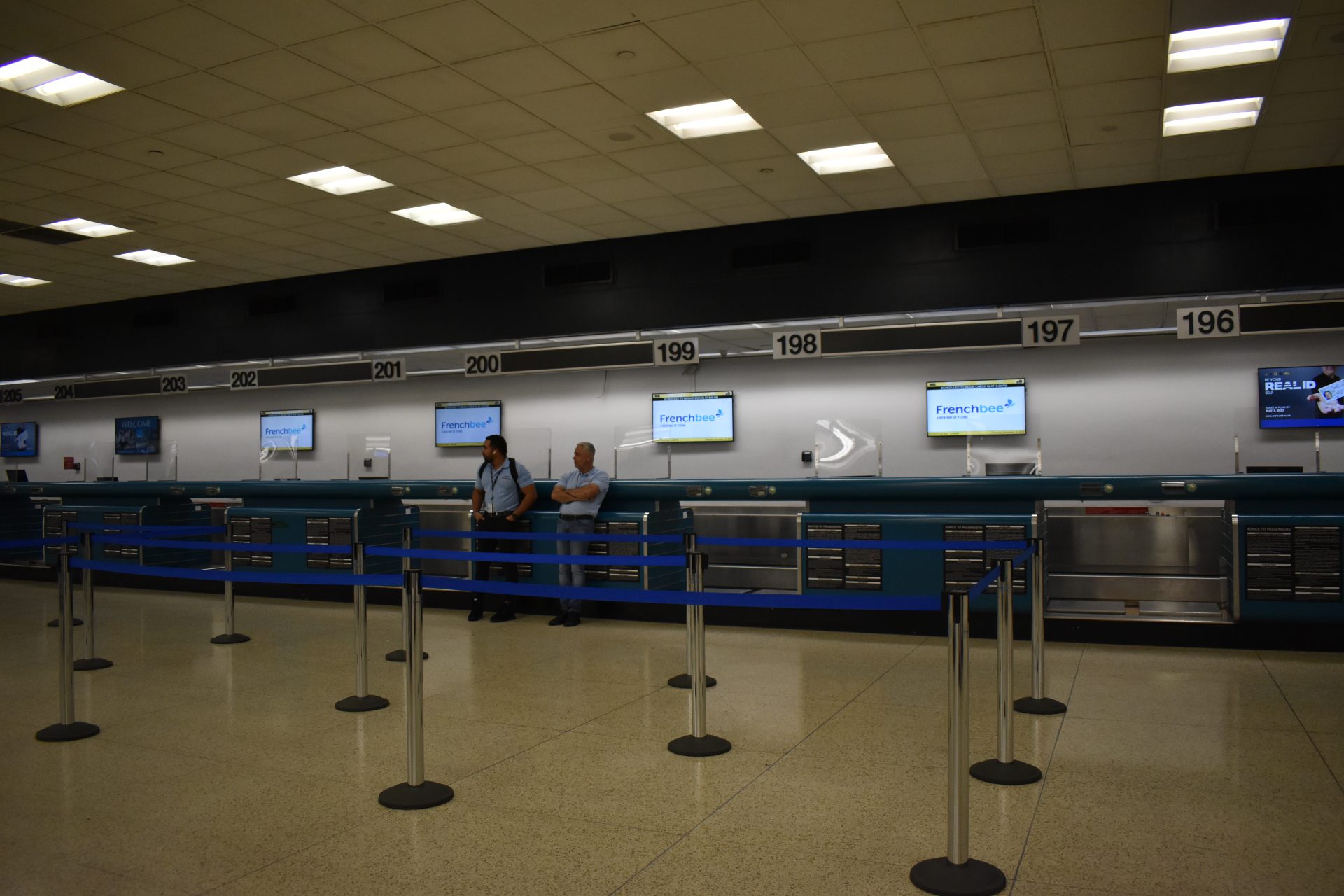
Frenchbee check-in at Miami Intl. (Photo: AirlineGeeks | Joey Gerardi)
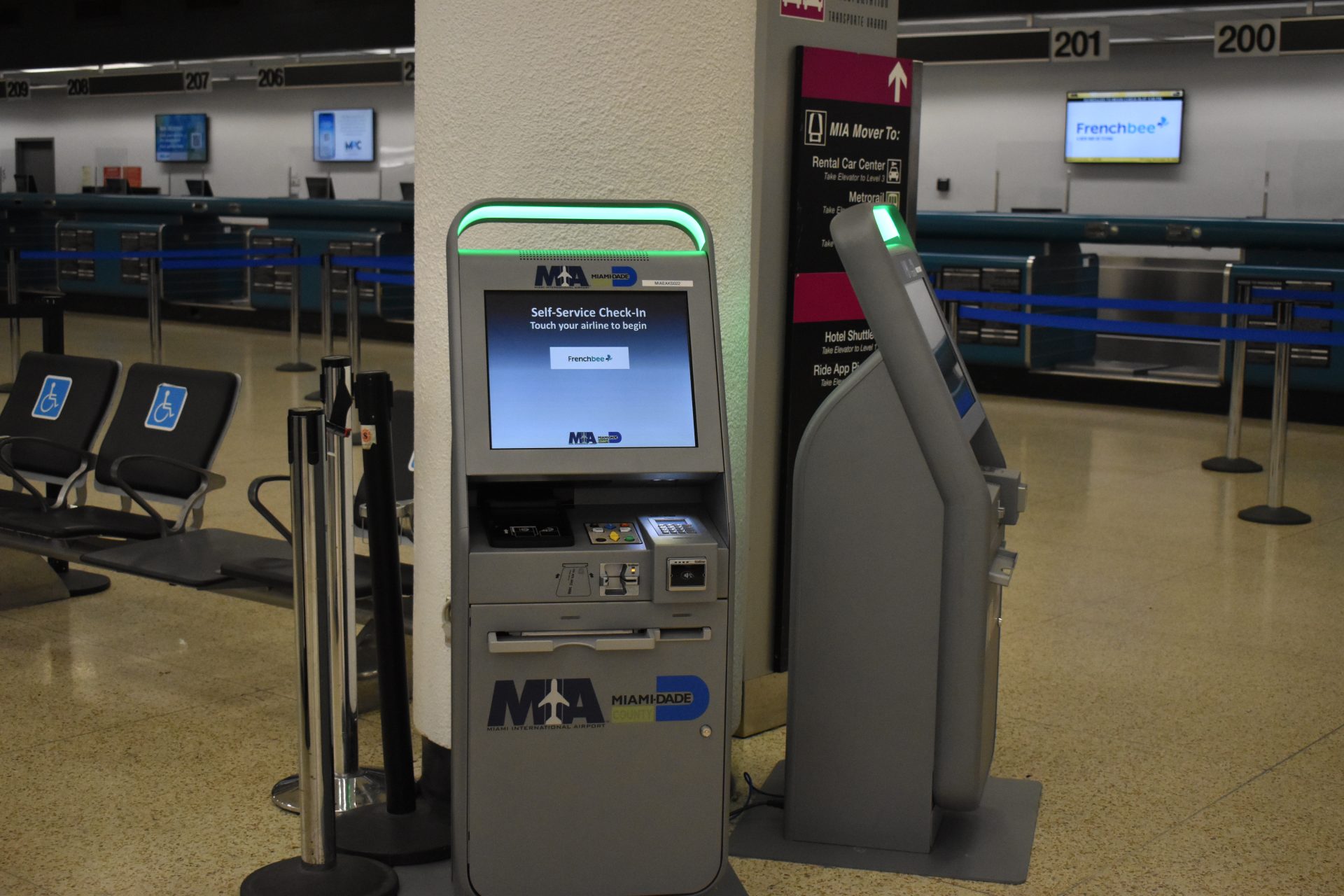
The check-in area opens at 5 p.m., four hours before the flight is scheduled to depart, and I would also like to note that they have a strict cutoff for check-in and the counters close 1hr and 30min before the flight departs. Since I arrived before the counter opened there weren’t any agents yet, but they did have self-service check-in kiosks that do work if you are not checking any bags.
Self-service kiosks at Miami Intl. (Photo: AirlineGeeks | Joey Gerardi)
Another thing to note, Frenchbee still doesn’t participate in the TSA PreCheck program, meaning you’ll have to leave yourself some extra time to get through security as the lines do get rather long when multiple international flights are scheduled to depart at once.
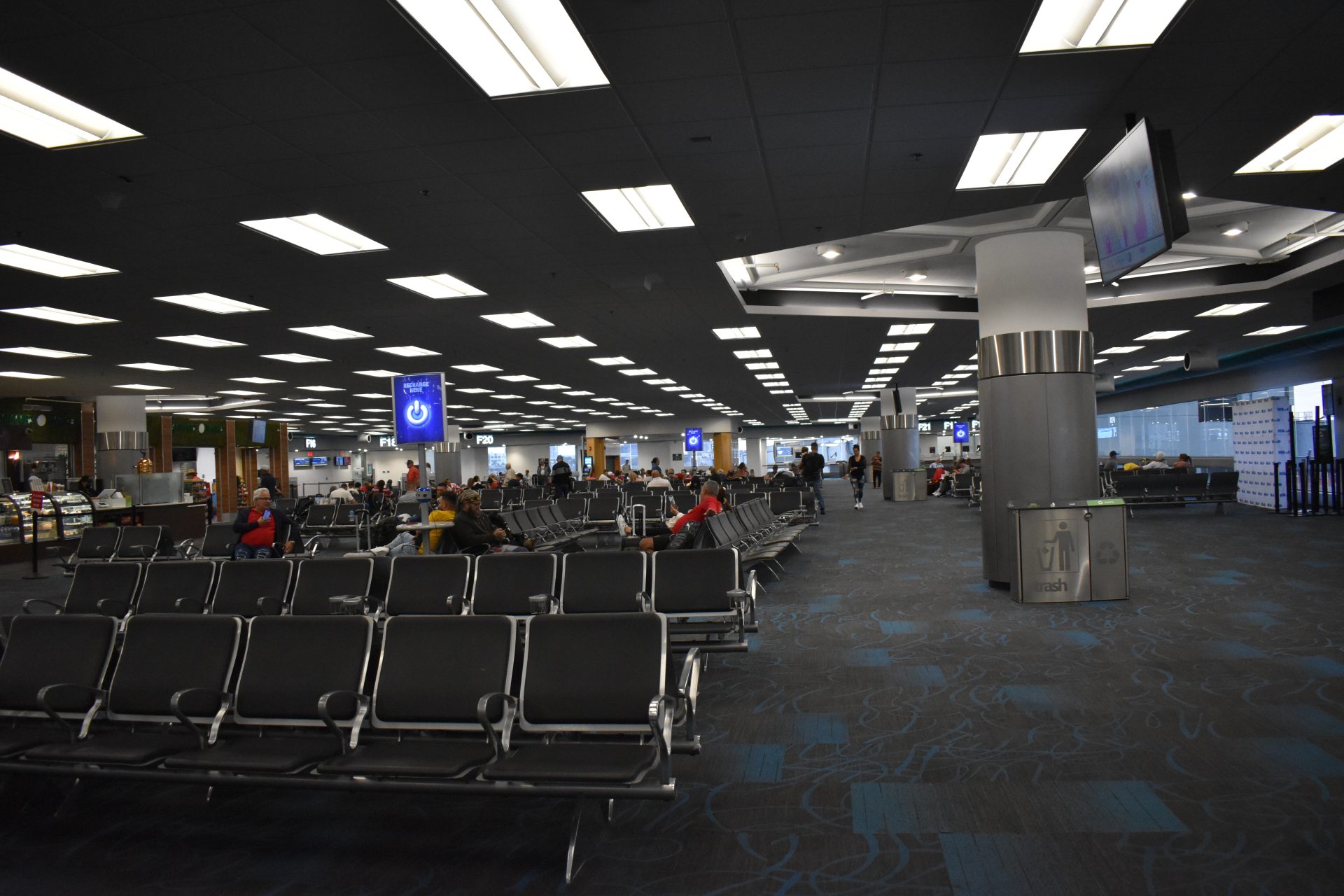
For my flight they used gate F15, which is located in terminal F and houses mostly international flights. The ‘F gate’ area was nice and had plenty of seats for passengers even when Frenchbee would have a full load of 411 going out on their flight.
The F Gates seating area (Photo: AirlineGeeks | Joey Gerardi)
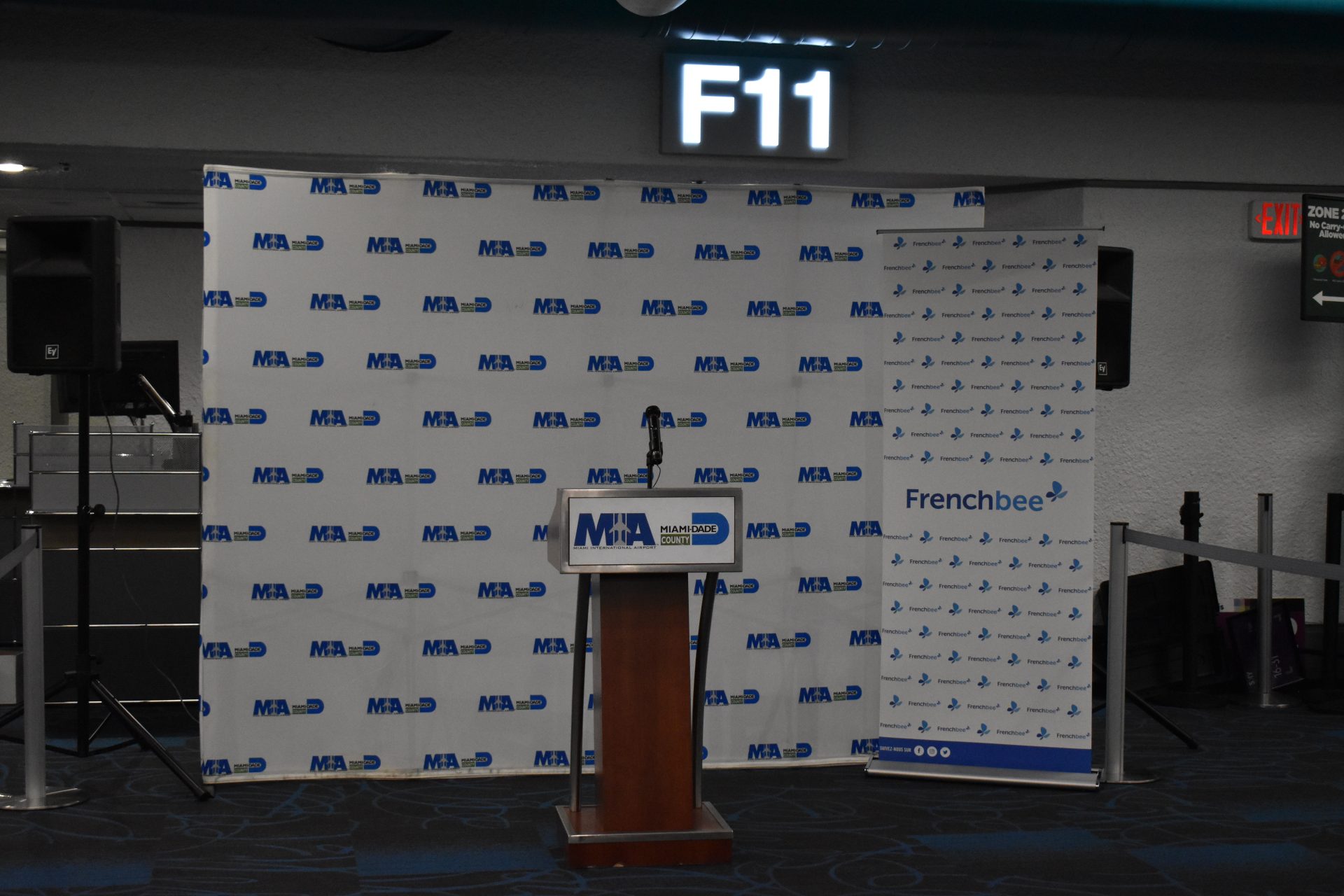
At this point the flight was still a while out, I took the time to eat and relax before the crowds started to flock to the gate. But, it didn’t take long for the airport to start setting up the banners and podium for the party and speeches that were to come later on.
Decorations set up at the gate for the inaugural (Photo: AirlineGeeks | Joey Gerardi)
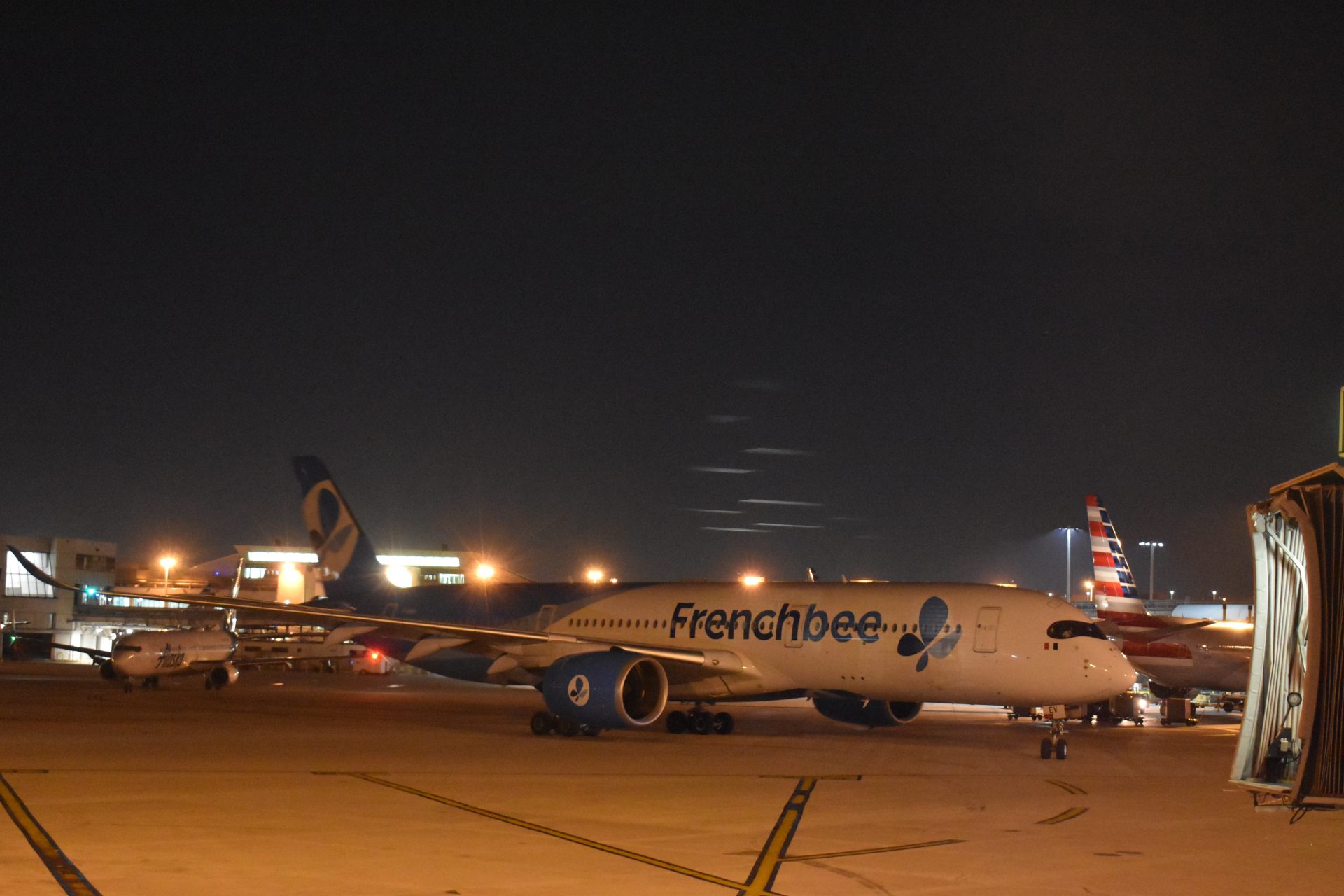
As it was an international flight on a large aircraft, the plane was scheduled to arrive at the airport two hours before the departure. My aircraft pulled into the gate just after 7 p.m., an Airbus A350-900 that was delivered directly to Frenchbee in March of 2018 and carried the registration F-HREV.
My aircraft F-HREV (Photo: AirlineGeeks | Joey Gerardi)
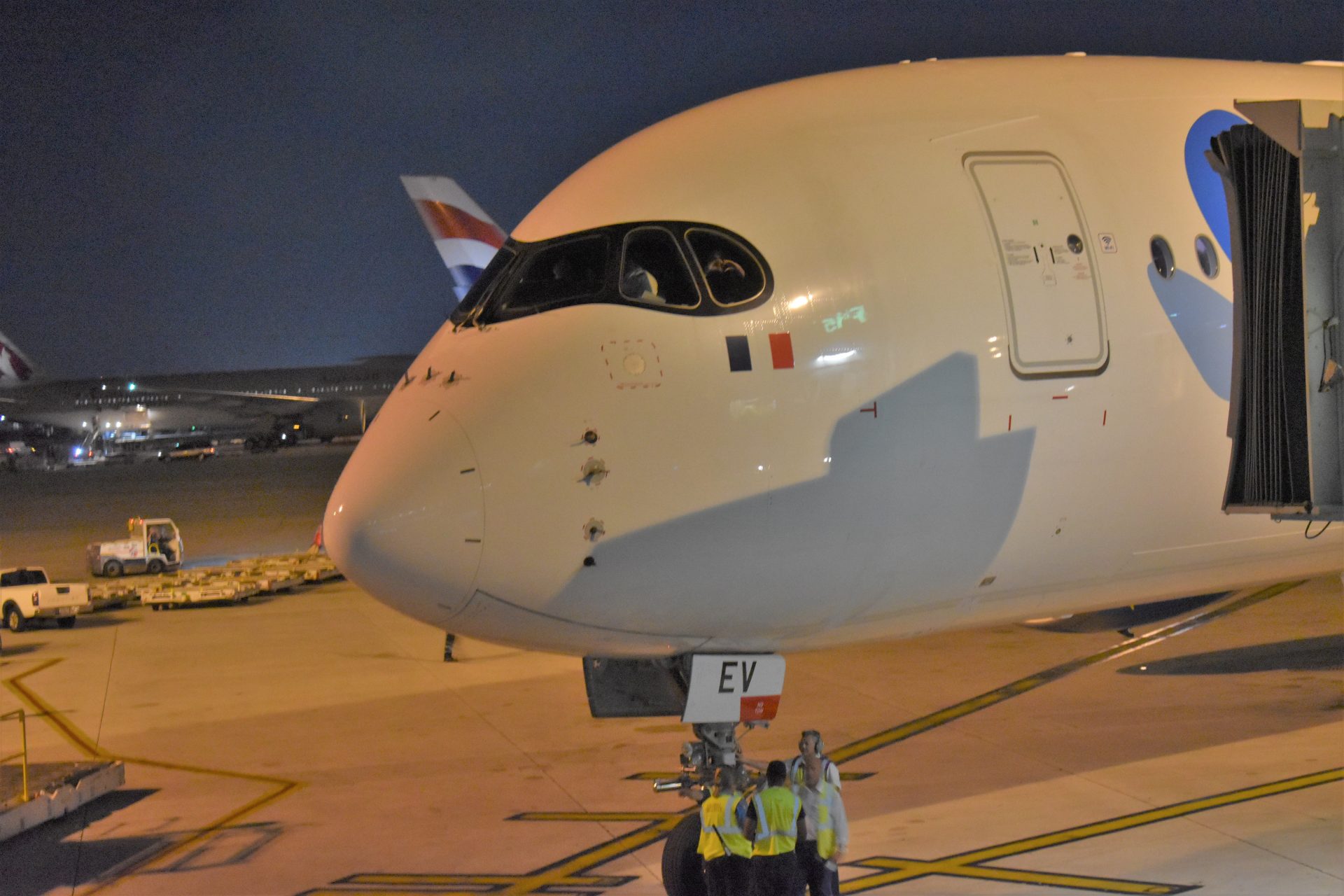
After the aircraft pulled up to the gate it was easy to see the massive size of the aircraft with people near the nose gear for comparison. The captain of the flight even gave me a heart through the front window on arrival before getting off, which was a nice AvGeek picture to get.
The captain of the arriving flight showing a heart through the front window (Photo: AirlineGeeks | Joey Gerardi)
After a while, local press and dignitaries started showing up for the speeches and events of the evening. There were speeches given by Greg Chin, the Communications Director of MIA; Rafael (Ralph) Cutié, the director and CEO of MIA; Thomas Renault, the head of sales for Frenchbee in North America; and Raphaël Jean Claude Trapp the Consul General of France in Miami.
Following the speeches, there was a ribbon cutting, which was performed by the people mentioned above as well as Basil Binns II who is the MIA Deputy Director. Unfortunately, unlike the other inaugural flights I have been on, I was unable to grab a piece of the ribbon which was a little disappointing, but I was still glad I got to see it occur.
After the ribbon cutting, passengers were invited to partake in the celebrations and goodies, which included coconut macaroons, Frenchbee branded reusable straws, ‘Miami Beaches’ bags, Coffee, water, and Orangina which is a sparkling citrus beverage.
Goodies from the inaugural party at Miami Intl. (Photo: AirlineGeeks | Joey Gerardi)
There were a fair number of press and media members on the flight as well as some AvGeeks, including one person who was flying around the world and this was their first leg. Thankfully the other AvGeeks loved these types of events like I do and were willing to take a picture of me in front of the banner near the podium as long as I would do the same for them.
Myself in front of the Frenchbee banner at the inaugural (Photo: AirlineGeeks | Joey Gerardi)
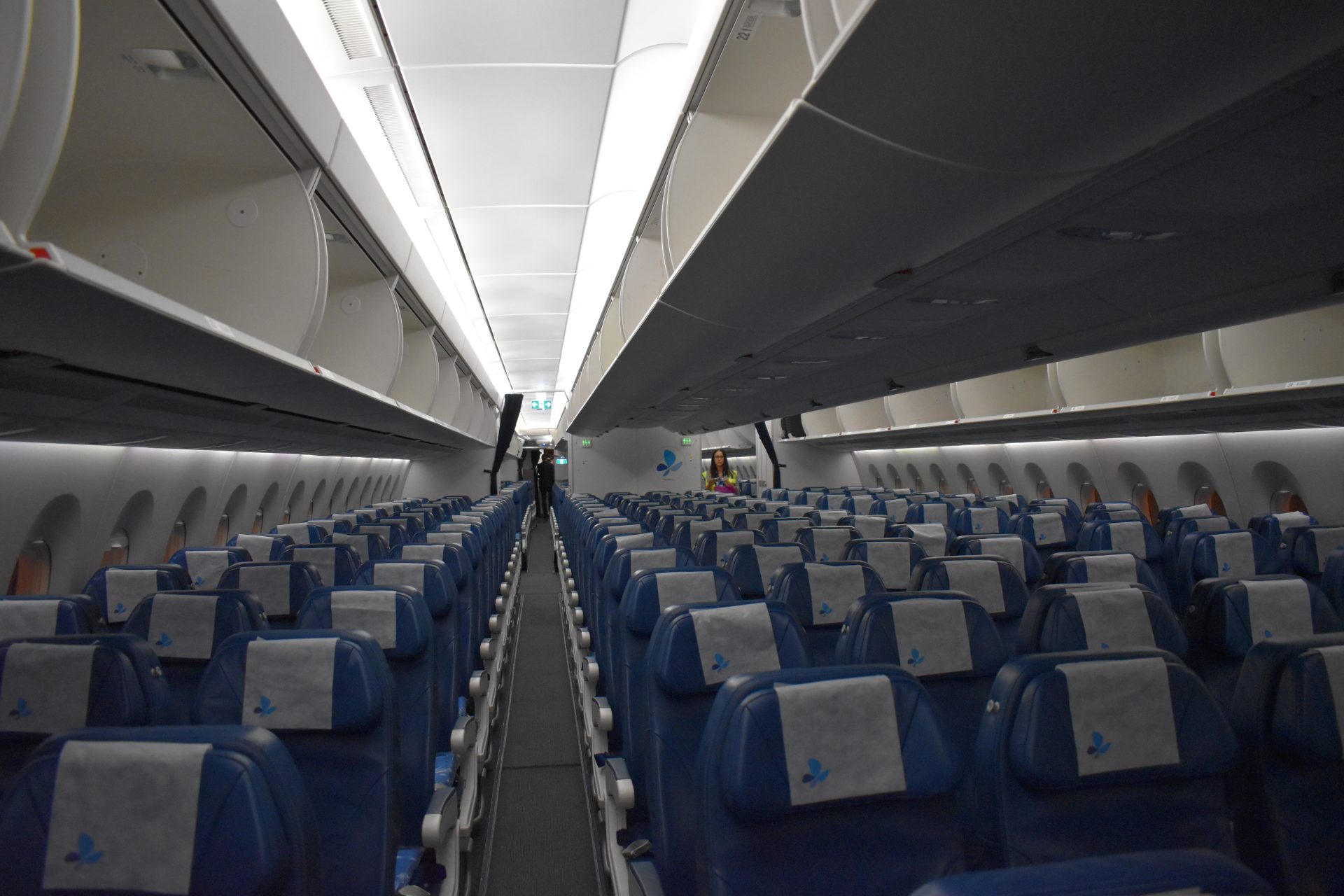
The boarding of the flight was delayed due to a security search of the plane, which is required before every international departure, so it is good they were taking their time to do this as if it were done wrong it would have to start all over again. Prior to the normal boarding process, I was invited to get on a little early in order to get some pictures of the passenger cabin before it was filled with people.
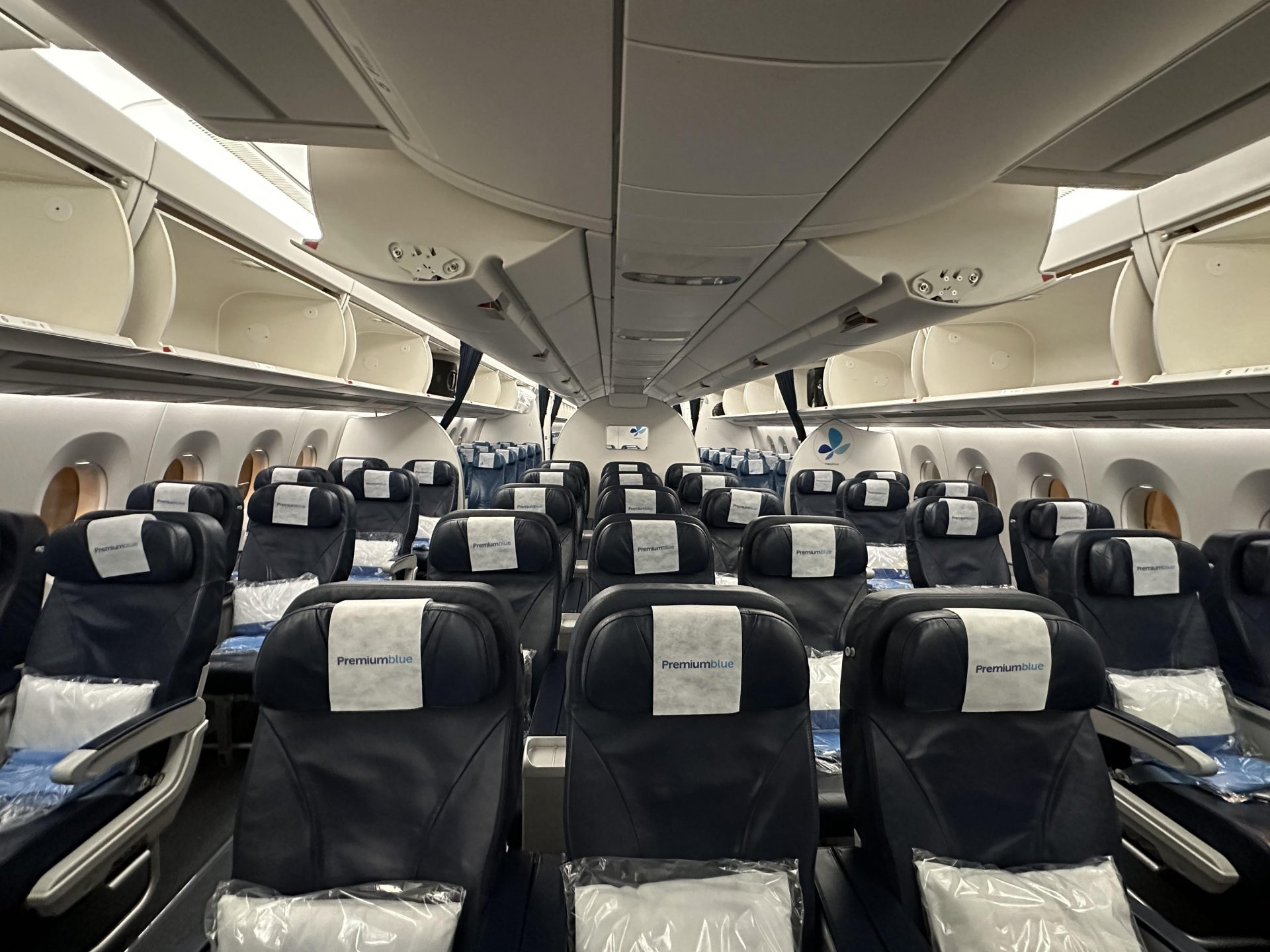
Frenchbee’s Airbus A350-900 holds 411 passengers, 376 in the main cabin in a 3-4-3 configuration and 35 seats in their premium cabin which they call ‘premium blue’.
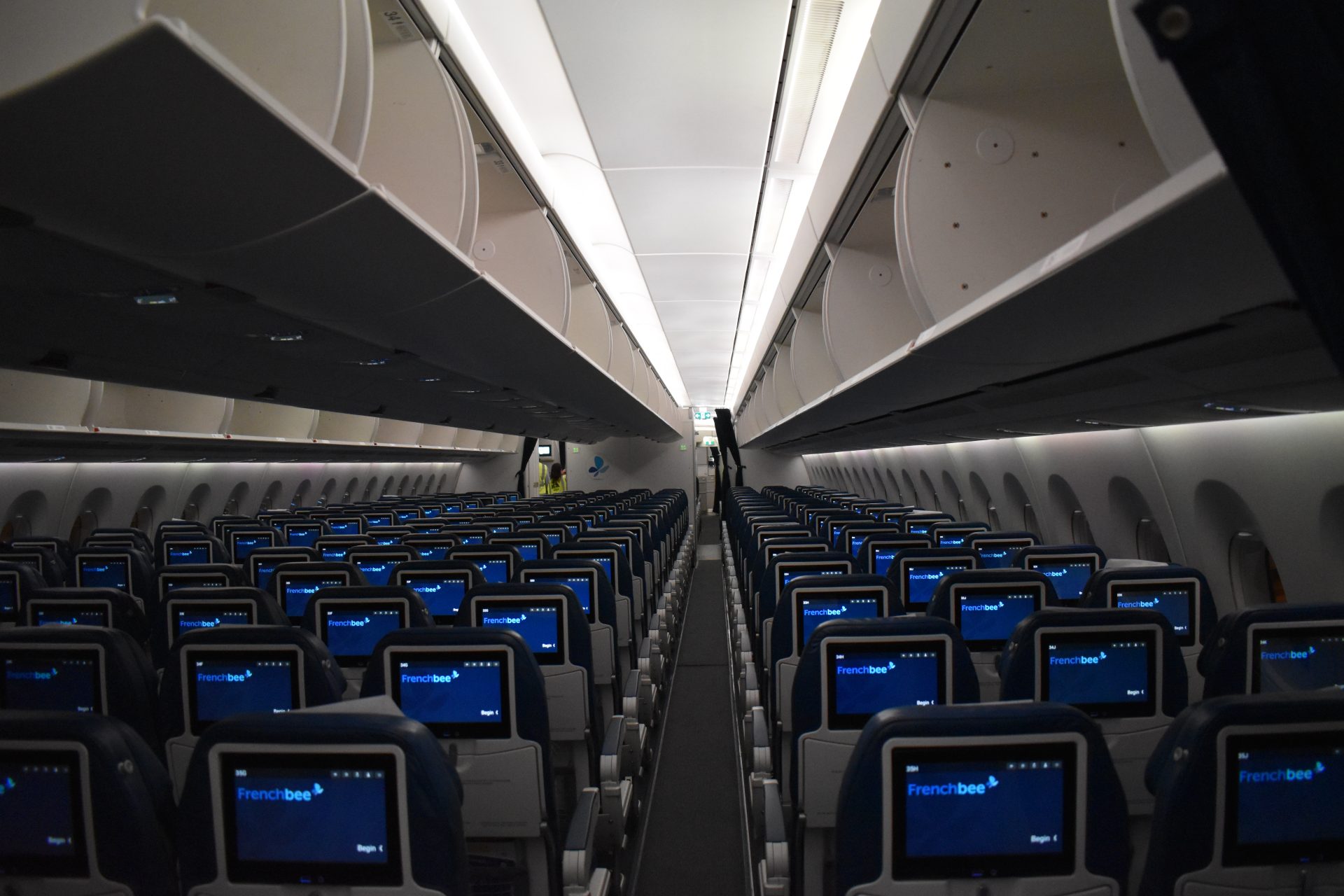
Every seat came equipped with power outlets and an IFE screen, perfect for flights as the airlines shortest flight is still over six-hours long.
The rear of the seats in the main cabin (Photo: AirlineGeeks | Joey Gerardi)
The ‘Premiumblue’ cabin contained 35 seats in a 2-3-2 configuration, the seats were very well padded and had a pillow and blanket waiting for us. For this flight across the Pond, I was seated in 7K, a window in the Premiumblue cabin.
Also waiting at the premium seats was a bottle of water. For each IFE screen you could choose what language you wanted it to be in: English, French, or Spanish. The IFE included many movies and tv shows in multiple languages, as well as a tail camera which at night doesn’t leave much to see, but it was still cool.
Prior to pushback they offered premium passengers either orange juice or champagne, and figuring it was going to be a long night I opted for no alcohol. They also handed out amenity kits which included items from mini travel toothpaste to socks and an eye mask. Almost everything in the kit had the Frenchbee logo on it, which meant more AvGeek items to take away from the trip and save for a future date.
Both cabins were relatively full, with 28 out of 35 seats filled in premium and 324 out of 376 in the main cabin. 352 out of 411 overall meaning the flight had an 85% load factor which is quite good considering it isthe very first flight, and I do expect the flight to be close to full, especially during the winter months.
Pushback came quickly and the crew thanked us for being a part of this inaugural flight, we did end up leaving almost 1.5 hours late due to the security search and celebrations at the gate, but that’s not a huge deal and the agents and crew kept everyone informed.
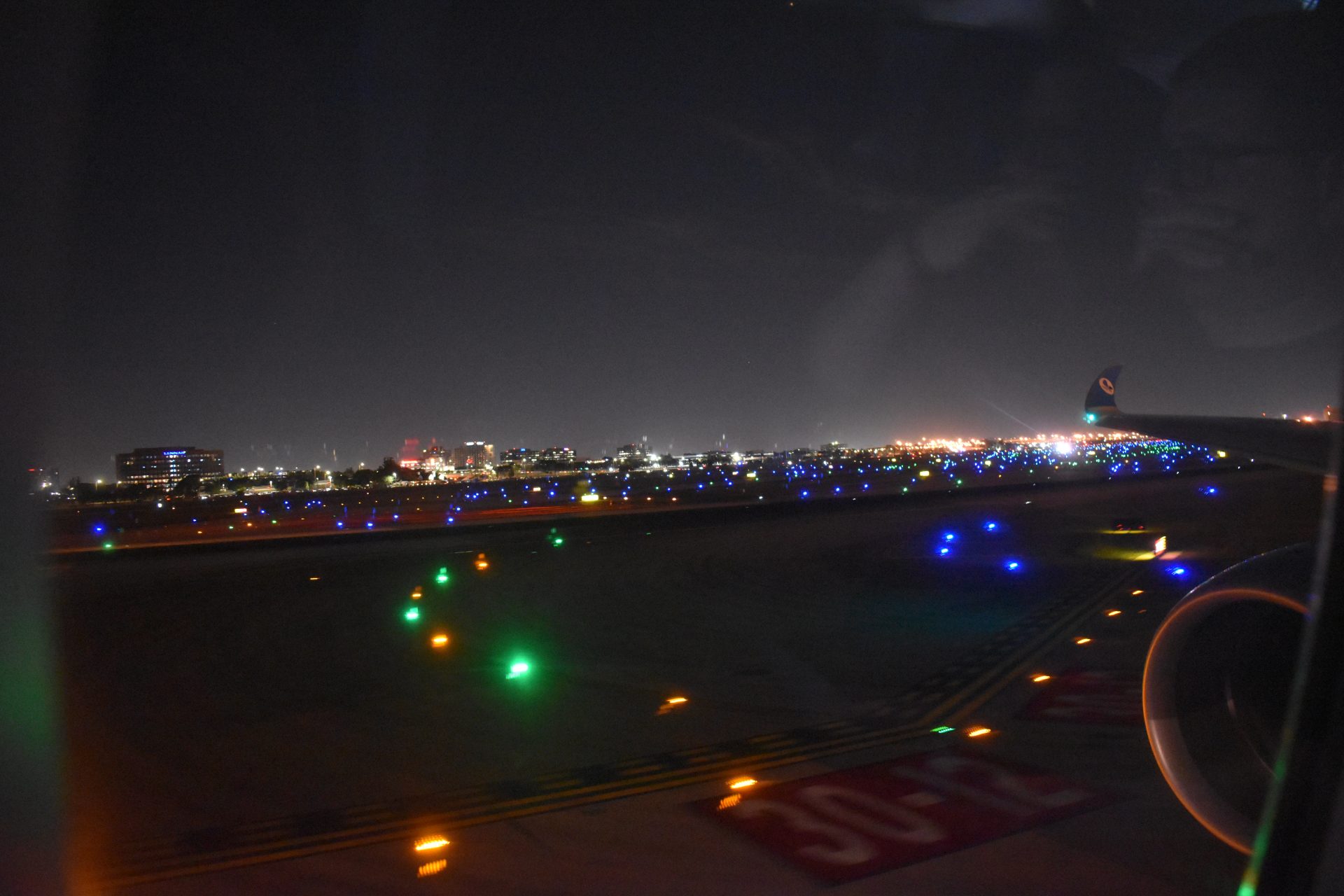
Taxiing to the runway in Miami (Photo: AirlineGeeks | Joey Gerardi)
Takeoff was quick and easy, and we rocketed into the skies for the flight across the pond.
Just after taking off from Miami (Photo: AirlineGeeks | Joey Gerardi)
Taking off was pretty spectacular at night seeing all of the lights in south Florida shining, but slowly the lights started disappearing as we got further from the coast into the Atlantic Ocean. About 20 minutes after takeoff, the flight attendants came around and gave everyone a towel to get ready for the meal service.
Hot towels were given to each Premiumblue passenger (Photo: AirlineGeeks | Joey Gerardi)
Shortly after the hot towel, each of us was given a light snack of ‘scrocchi con semi di sesamo’, which translates from Italian to English as ‘crackers with sesame seeds’. Next was the dinner service which occurred about one hour after takeoff.
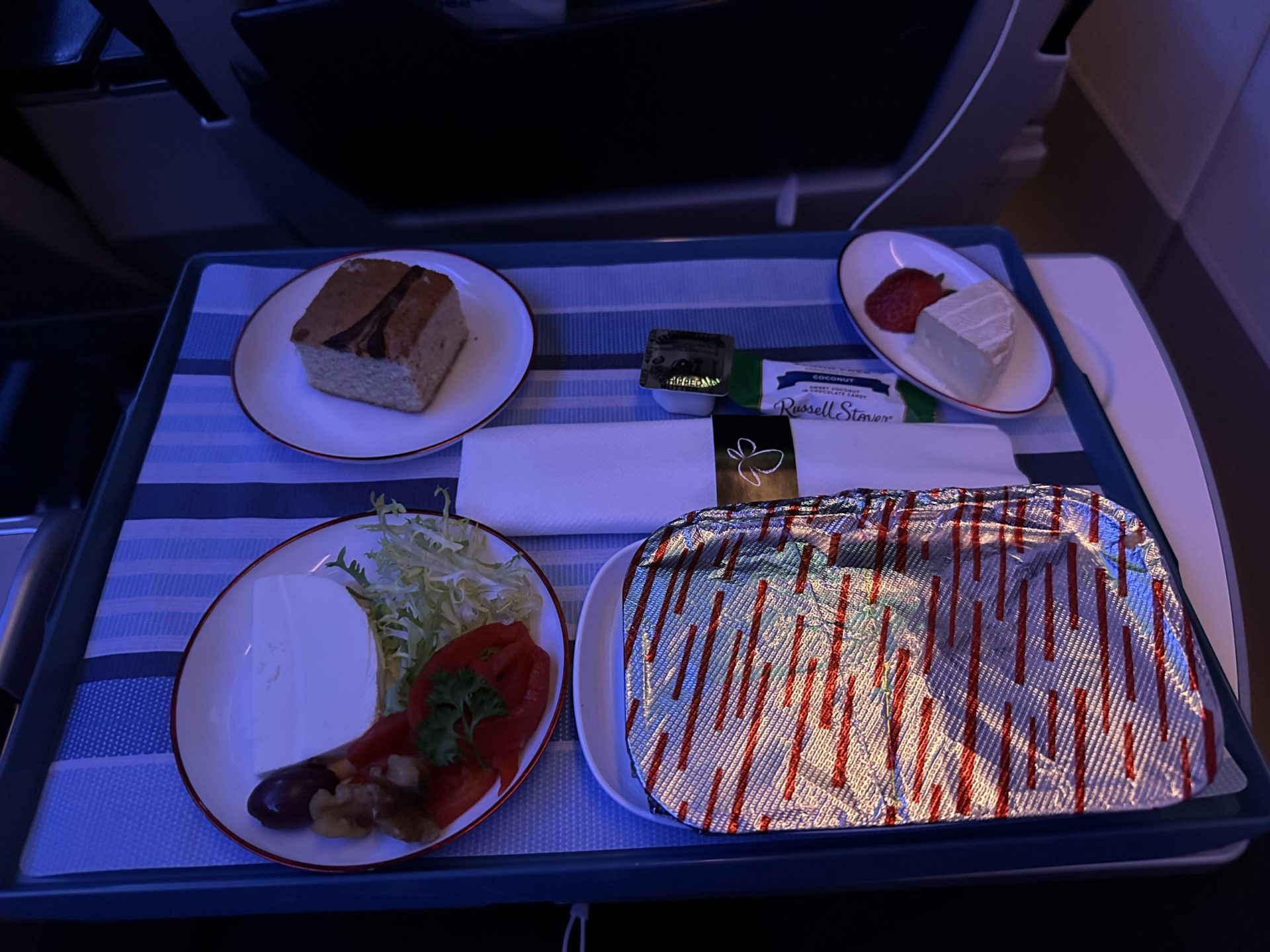
Dinner on the Miami to Paris-Orly (Photo: AirlineGeeks | Joey Gerardi)
Dinner consisted of two choices, a chicken or a fish plate. They do offer vegan, kosher, and other special types of meals but must be pre-selected ahead of time on their website. I chose the chicken dinner option, which was “chicken with rice and beans” for the main course, a salad plate with tomatoes, olives, lettuce and cream cheese, and other items included bread, banana bread, strawberry with brie, and coconut chocolate for the desert.
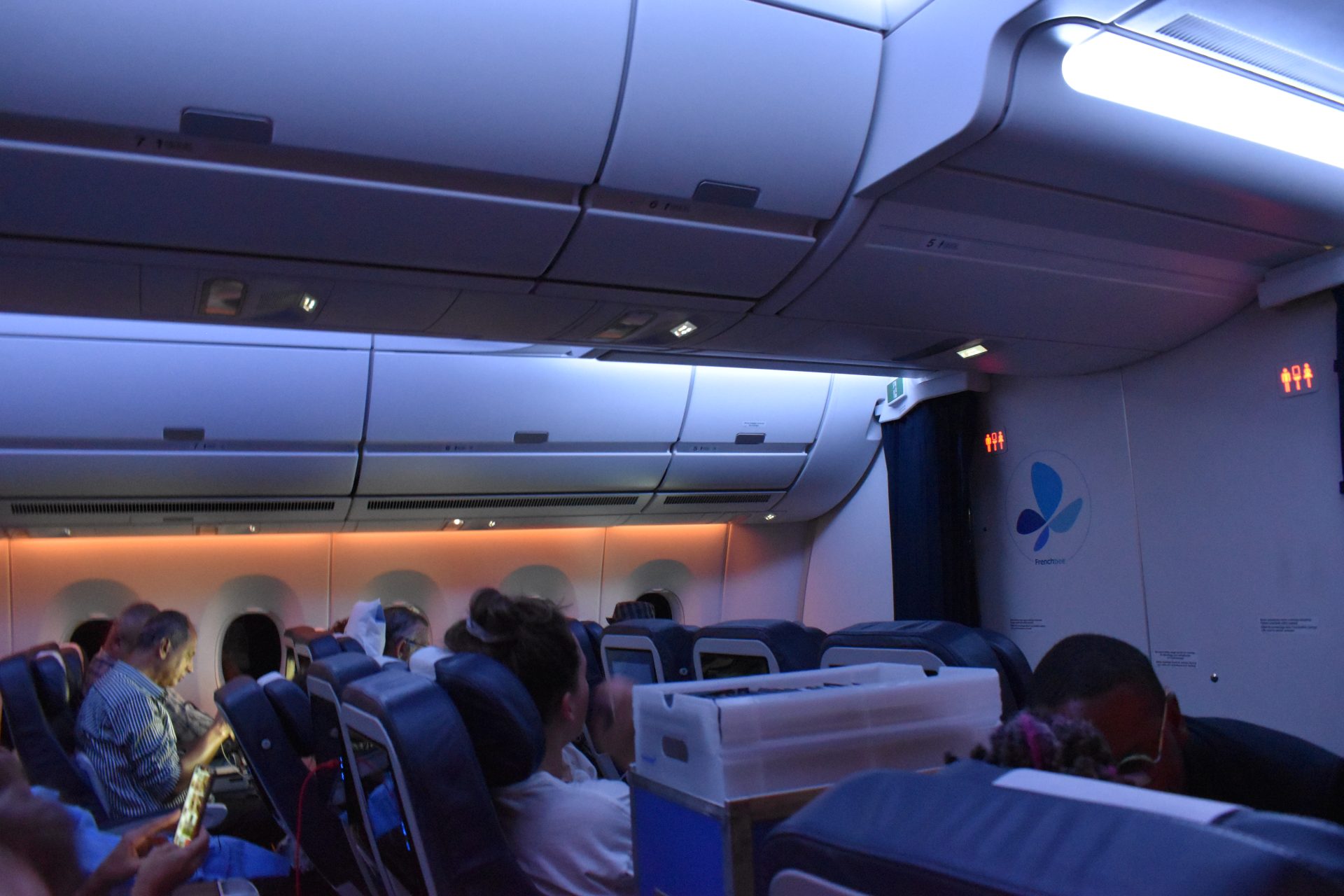
They let everyone enjoy their dinners for a while before they started to clean up the dishes and did a final tea and drink service before settling in for the night. By this time they had turned the cabin lights to a light blue and orange mimicking a setting sun to get everyone in the mood for sleep.
The dark skies over the Atlantic Ocean (Photo: AirlineGeeks | Joey Gerardi)
Finally, 2-hours after takeoff they turned off the cabin lights and told everyone to close their window shades for the overnight section of the flight. I took out my eye mask,and blanket and got some rest for the busy day ahead of me when I landed in Paris.
I woke up after 4.5 solid hours of sleep later, the most sleep I’ve ever gotten on a redeye flight and I definitely felt more relaxed and refreshed being in the cabin of an Airbus A350 versus older aircraft. This is due to the cabin being set at a lower altitude, better air ventilation, and higher humidity in the cabin. By this point there was only 1.5 hours left on the flight.
Morning over the Atlantic Ocean (Photo: AirlineGeeks | Joey Gerardi)
The rest of the cabin slowly began waking up as they brought out breakfast. The breakfast consisted of bread, raspberry spread, a croissant, and a Chobani yogurt. With the sunlight showing, it was now easy to see below from our 41,000-foot cruising altitude.
It wasn’t long before the coast of France was visible from the window.
Flying over the French coastline (Photo: AirlineGeeks | Joey Gerardi)
People continued to wake up and we began our slow descent into Paris. With not enough time to watch a movie, I decided to stare out the window and admire the scenery as we approached our destination.
Slowly descending into Paris (Photo: AirlineGeeks | Joey Gerardi)
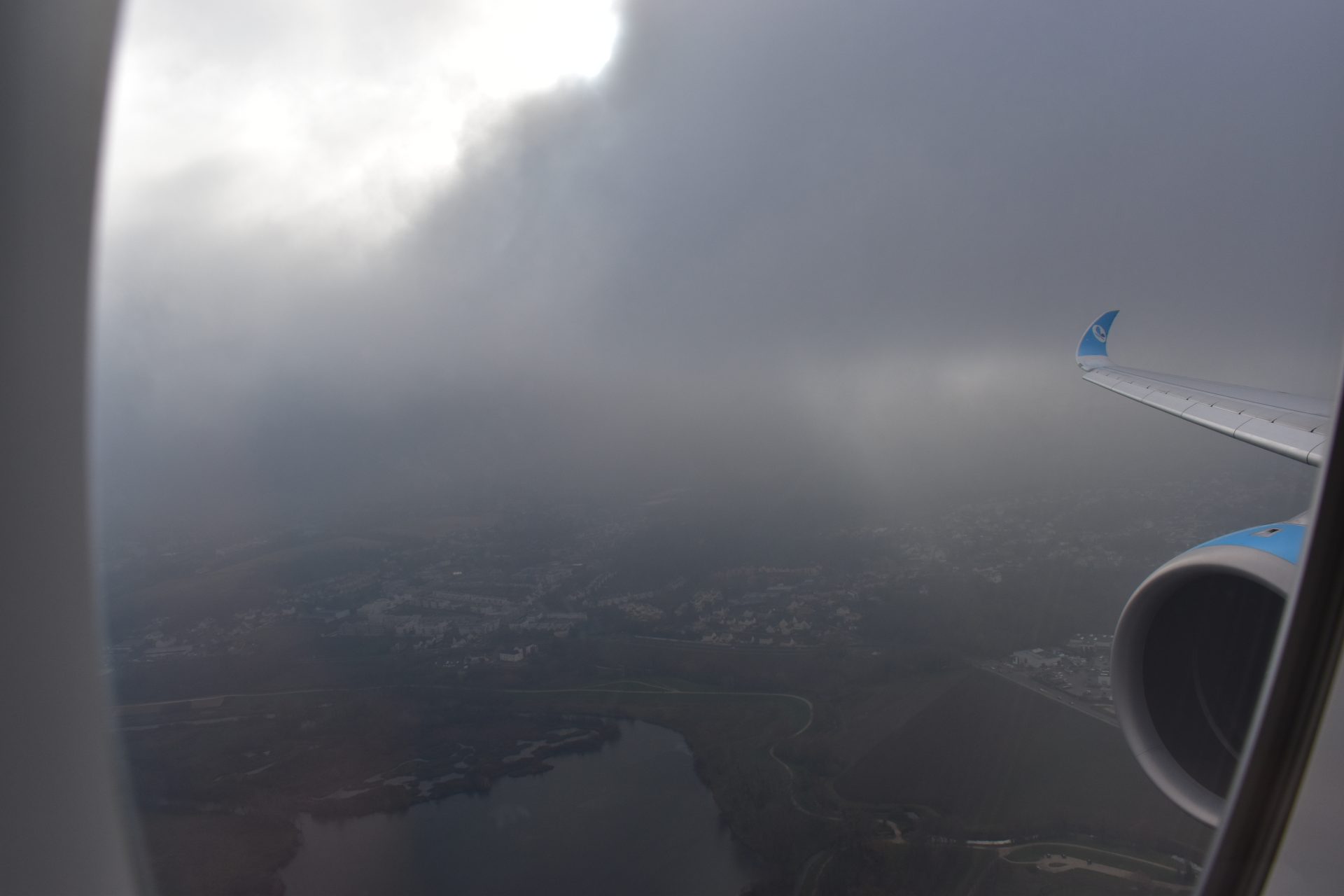
The cabin crew cleaned up the cabin and everyone put their seats upright, just before landing in Paris the clouds rolled in and there was a low cloud layer surrounding the airport which looked cool.
A low cloud layer surrounding the airport as we approach Orly (Photo: AirlineGeeks | Joey Gerardi)
Just before touching down at Orly (Photo: AirlineGeeks | Joey Gerardi)
We touched down at Paris-Orly at 12:28 p.m. after 8 hours, 2-minutes of flight time. It was a great flight and definitely didn’t feel like a low-cost carrier given the abundance of food and drink options we were given. The flight also went by relatively fast in my opinion and I spent most of the time either sleeping, eating, or looking out the window, I didn’t even get a chance to browse through the movie or television options.
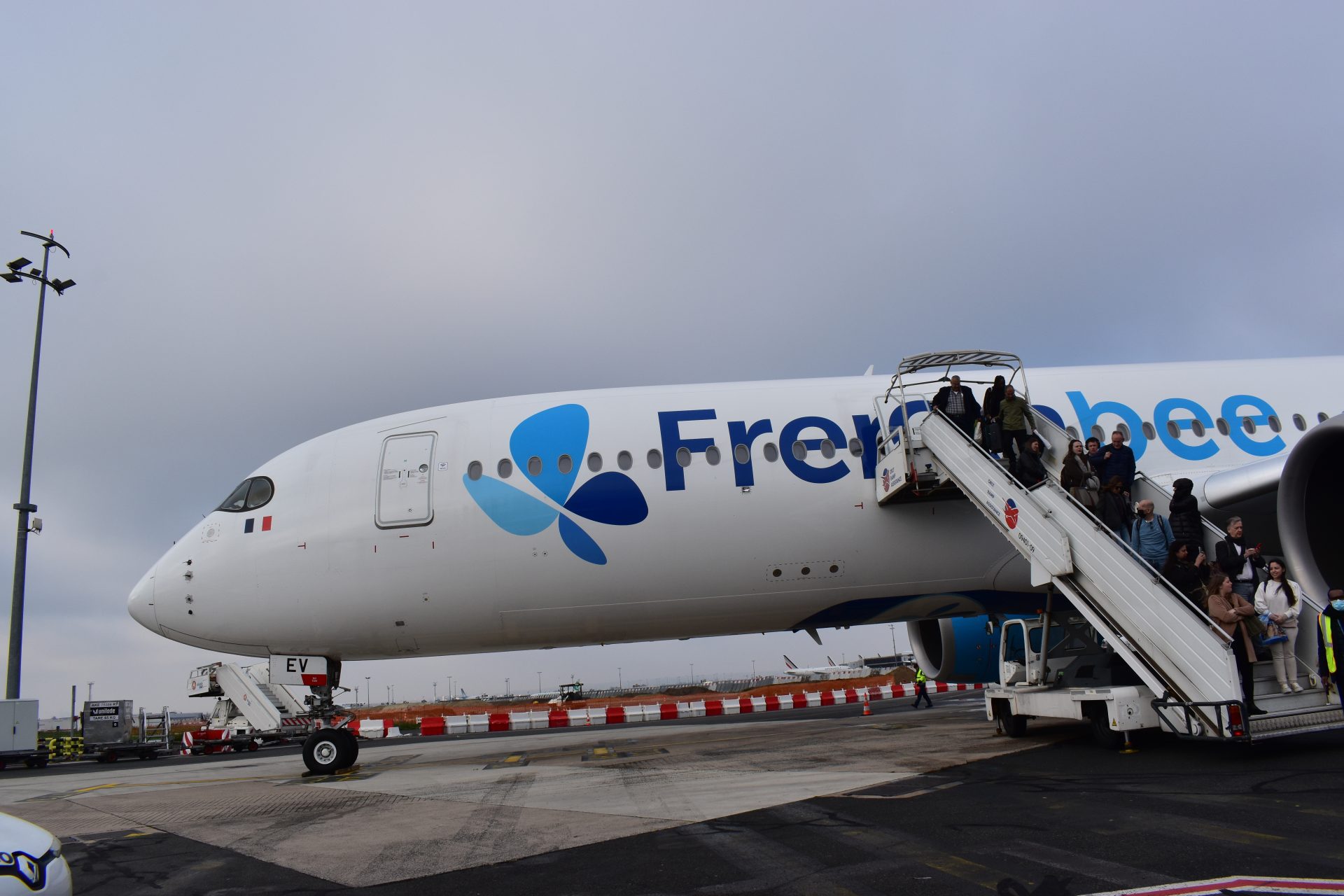
In Orly, another AvGeeky aspect is that we deplaned using stairs and boarded a bus to the terminal, something I have never done on a widebody aircraft before and was certainly fun seeing the plane’s massive size from the ground.
Deplaning onto the ramp in Paris (Photo: AirlineGeeks | Joey Gerardi)
Reflecting back on the flight, it was very pleasant and featured multiple AvGeek aspects from the inaugural celebration and the deplaning in Paris, to the amenity kits and headrests on the plane. You can definitely tell the difference from a passenger perspective between the Airbus A350 and older long-haul planes, especially on overnight flights like this as you land feeling much better and well-adjusted to the timezones.
From here I went to Frenchbee’s headquarters near the airport and had the privilege of interviewing the founder, chairperson, and CEO of Frenchbee, Marc Rochet, but that is for another article, which will be posted in the next week or two.
Joey has always been interested in planes for as long as he can remember. He grew up in Central New York during the early 2000s when US Airways Express turboprops ruled the skies. Being from a non-aviation family made it harder for him to be around planes and would only spend about three hours a month at the airport. He was so excited when he could drive by himself, the first thing he did with his driver's license was get ice cream and go plane spotting for the entire day. He graduated from Western Michigan University in 2022 with a B.S. in Aviation Management & Operations and a Minor in Business, and currently works for a major airline in his hometown.
Jetstar Flight Makes 8-Hour Flight Back to Destination Due to ‘Miscommunication’
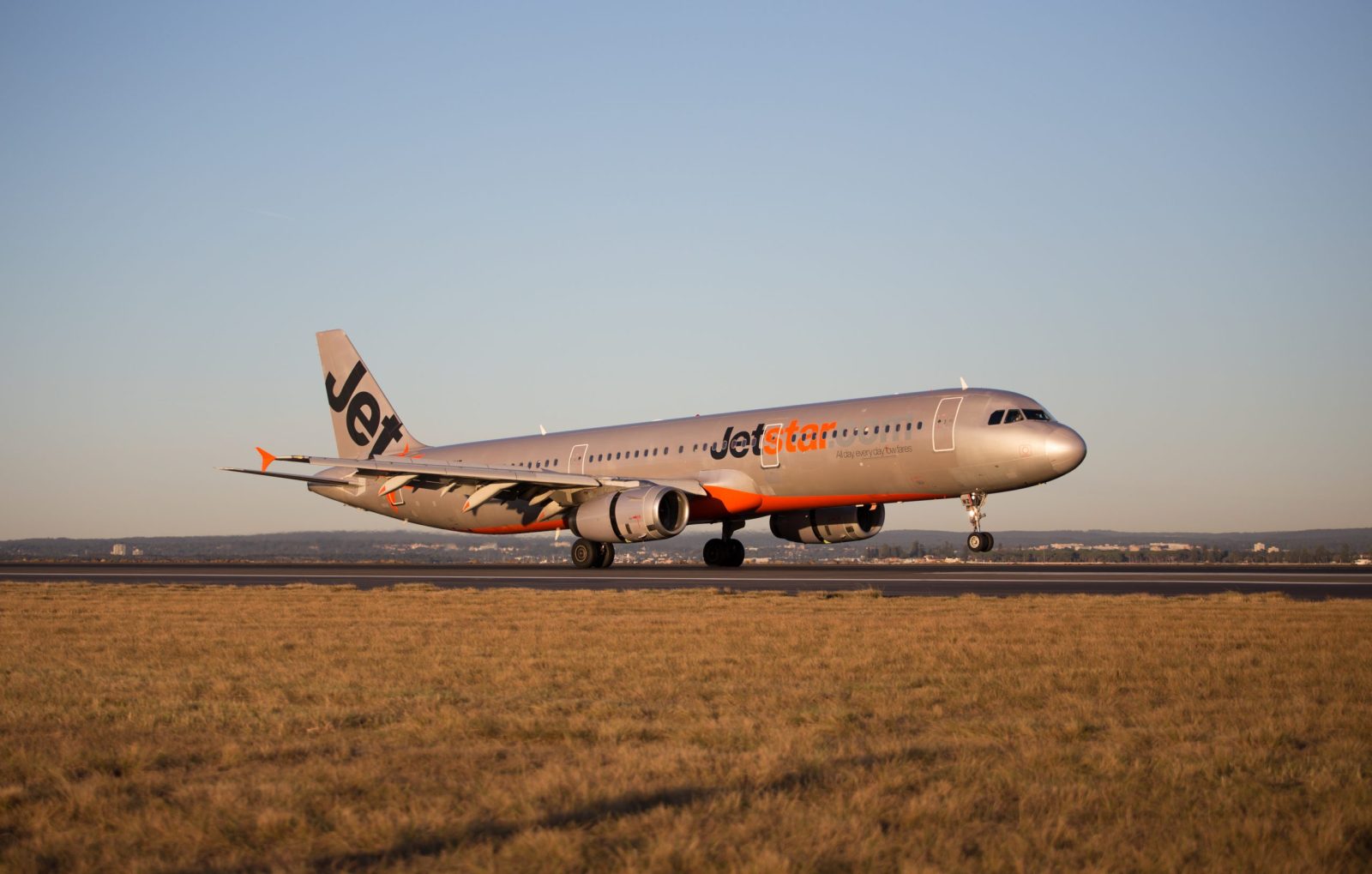
A JetStar A321 in Sydney (Photo | AirlineGeeks | Hisham Qadri)
A Jetstar flight from Melbourne, Australia to Denpasar, Indonesia was forced to turn back to Melbourne after being en route for four hours. The aircraft had just left the coast of Australia when it was discovered that the airline would be exceeding capacity restrictions under the terms of the air service agreement between the two countries. Though Darwin was a possible airport to divert to, the decision was made to return to Melbourne due to operational reasons such as crew availability and alternative flight options.
The flight’s departure had already been delayed for five hours and by the time passengers landed back in Melbourne they had spent eight hours in the air. The scheduled flight time between the capital of the Australian state of Victoria and the popular holiday destination was five hours and forty minutes.
According to The Age newspaper Jetstar ‘had upgraded the plane from an Airbus A321 to a larger Boeing 787 to carry more customers during the busy holiday season, but “due to a miscommunication, the aircraft swap was not approved by the local regulator in Indonesia”’. Some passengers have disputed this claim as bookings made a number of months ago specify the operating aircraft type as a 787.
Under the terms of the bilateral air service agreement between the two countries, Australian airlines have specific capacity restrictions and operating a widebody aircraft instead of the single-aisle would have breached these limits for Jetstar. The terms of air service agreements are continually monitored and airlines may be required to reapply to increase or decrease services to maintain operations. In some cases airlines may lose the ability to continue operations between countries if it is determined that they are failing to meet the terms of an air service agreement.
In Australia this revocation of rights by the International Air Services Commission (IASC) may occur if ‘an allocation is generally no longer of benefit to the public.’ The Act pertaining to this cites several reasons that this may be the case for example ‘the carrier has failed to service the route effectively’ or ‘the Commission is satisfied that a different allocation of capacity would be of greater benefit to the public.’
In 2020, after Covid-19 caused the Australian government to restrict travel into the country, Virgin Australia applied for a change to the terms of operation between Australia and Indonesia. Prior to the pandemic, the carrier had been operating ‘up to 21 services a week using a B737-800 aircraft between Denpasar and the following points in Australia: Brisbane, Port Hedland and Sydney.’ Under the original terms of the agreement Virgin Australia was allocated 2800 seats per week in each direction. However, due to the Australian government’s restrictions, the airline asked for the capacity allocation to be reduced to 120 seats per week in each direction.
John has always had a passion for aviation and through a career with Air New Zealand has gained a strong understanding of aviation operations and the strategic nature of the industry. During his career with the airline, John held multiple leadership roles and was involved in projects such as the introduction of both the 777-200 and -300 type aircraft and the development of the IFE for the 777-300. He was also part of a small team who created and published the internal communications magazines for Air New Zealand’s pilots, cabin crew and ground staff balancing a mix of corporate and social content.
John is educated to postgraduate level achieving a masters degree with Distinction in Airline and Airport Management. John has held the positions of course director of an undergraduate commercial pilot training programme at a leading London university. In addition he is contracted as an external instructor for IATA (International Air Transport Association) and has been a member of the Heathrow Community Fund’s ‘Communities for Tomorrow’ panel.
WestJet Concentrates Long-Haul Operations in Calgary
A WestJet 787-9 prepares for a test flight at Paine Field. (Photo: AirlineGeeks | Katie Zera)
WestJet is carrying through on its commitment to Western Canada by concentrating on Calgary, Alberta for its long-haul network. In June 2022, the Canadian carrier announced a new strategic path for the company following the appointment of the new Chief Executive Officer Alexis von Hoensbroech in February.
According to the airline, they would base their Boeing 787 Dreamliner fleet in Western Canada. Recent announcements and schedule changes made by the carrier show that its long-haul network will be primarily based out of Calgary, Alberta going forward.
WestJet is currently operating the following long-haul routes:
Calgary International Airport to London’s Heathrow Airport (daily)
Calgary International Airport to Amsterdam’s Schiphol Airport (three times weekly until March 23, 2023)
Next summer, the airline is planning to operate the following long-haul routes with its Boeing 787-9s next year:
Calgary International Airport to Tokyo’s Narita International Airport (three times weekly from April 30)
Calgary International Airport to Josep Tarradellas Barcelona–El Prat Airport (up to three times weekly from May 6)
Calgary International Airport to Edinburgh, U.K.’s Airport (up to three times weekly from May 17)
Calgary International Airport to London’s Heathrow Airport (daily, continued from winter)
Calgary International Airport to London’s Gatwick Airport (up to daily from April 30)
Calgary International Airport to Paris’s Charles de Gaulle Airport (up to daily from April 13)
Calgary International Airport to Dublin’s Airport (up to five times weekly from April 6)
Calgary International Airport to Rome’s Leonardo da Vinci-Fiumicino International Airport (up to daily from April 30)
WestJet’s new service to Tokyo’s Narita International Airport marks the carrier’s expansion into the Asian market. The airline’s summer 2023 European routes are scheduled to end in the fall, except for flights to London’s Heathrow Airport and Paris’ Charles de Gaulle Airport, which will continue into the winter.
Significant Summer Travel Changes
This set of long-haul routes is a significant change from WestJet’s summer 2022 offerings. This past summer, WestJet’s transatlantic network consisted of the following:
One European route from Vancouver International Airport: London’s Gatwick Airport
Five European routes from Calgary International Airport: Dublin’s Airport, London’s Gatwick Airport, London’s Heathrow Airport, Rome’s Fiumicino International Airport, Paris’ Charles de Gaulle Airport and Dublin Airport
Four European routes from Toronto’s Pearson International Airport: Dublin Airport, Edinburgh, U.K’s Airport, Glasgow, U.K.’s Airport and London’s Gatwick Airport
Four European routes from Halifax, Canada’s Stanfield International Airport: Dublin’s Airport, Glasgow, U.K.’s Airport, London’s Gatwick Airport and Paris’ Charles de Gaulle Airport
These routes were operated by WestJet’s Boeing 787-9 and Boeing 737 MAX aircraft. WestJet has announced that it is turning its home base at Calgary International Airport into its only hub for its Boeing 787-9s, despite previously operating the aircraft out of Vancouver and Toronto as well. The carrier also canceled the rest of its Boeing 787-9 orders and announced a focus on narrowbody aircraft.
With the latest developments, WestJet will be pulling back from certain transatlantic markets. In the summer of 2022, the Calgary market made up less than half of WestJet’s long-haul operations. However, the summer of 2023 will be very different. With WestJet concentrating its long-haul network in Calgary, Air Canada, Air Transat and foreign carriers will be the main transatlantic players at other Canadian airports.
These airlines will have the opportunity to fill in the transatlantic market gaps that WestJet has left in Vancouver, Toronto and Halifax. While passengers originating in Western Canada can still connect onto WestJet transatlantic flights in Calgary, the same cannot be said about many passengers further east that would have connected in Toronto or Halifax, making transatlantic developments from those two cities particularly interesting to watch.
A New Path for WestJet: Calgary Consolidation
While WestJet is clearly focusing its transatlantic operations in Calgary, the carrier’s announcements leave open the possibility that there could still be Boeing 737 MAX transatlantic routes that have yet to be announced for next summer. Changes could occur without much notice. Until early December, WestJet still appeared to be selling tickets on routes such as Vancouver International Airport to London Gatwick Airport and Toronto Pearson International Airport to Glasgow Airport but these routes have since been pulled from sale. Given WestJet’s reinvigorated focus on Western Canada, it appears likely that the carrier’s summer 2023 long-haul operations will be solely based out of Calgary.
WestJet’s network changes will also be felt in Europe. In the summer of 2022, London Gatwick Airport had up to four daily WestJet flights to four different Canadian airports. In the summer of 2023, this will go down to one daily WestJet flight. Similarly, Dublin Airport will go from three WestJet routes down to one. Glasgow Airport will lose WestJet service altogether. On many of these routes, WestJet was the only airline offering nonstop service.
Opportunities Moving Forward
There are a few areas to watch going forward. Firstly, it will be interesting to see how WestJet’s long-haul network continues to develop. While the airline has announced that it will not be investing in more Boeing 787-9s for now, it could replace long-haul routes or add new ones.
WestJet is making a conservative entry into Asia but its new flights to Japan could open the door to further transpacific routes. Should some of the recent changes be unsuccessful, WestJet could also reduce its long-haul network altogether and use its Boeing 787-9s more on flights within Canada and to popular sun destinations, as the airline currently does in the winter.
The second item to watch is the possibility that WestJet will announce additional transatlantic routes operated by its Boeing 737 fleet for the summer of 2023. However, this seems fairly unlikely given the carrier’s commitment to focusing on Western Canada. WestJet CEO Alexis von Hoensbroech was quoted in a press release saying that, “future announcements will focus on domestic and North American additions that will bring even more affordable travel options to our guests in the new year.”
Finally, what also remains to be seen is whether or not other airlines will step in to fill gaps that WestJet has left. For example, Air Canada already has Boeing 737 MAX 8 transatlantic operations out of Halifax Stanfield International Airport and may be looking at some of WestJet’s former Halifax routes as possible options for expansion.
Despite some uncertainty in these areas, it is clear that WestJet’s changes to its long-haul network bring new opportunities for other Canadian and foreign carriers. WestJet is also optimistic that it is setting itself up for success in Western Canada.
“This is an exciting day for the WestJet Group, our guests, and partners as we deliver on our new strategy and demonstrate our western focus as we increase our Calgary capacity by more than 25 percent in 2023,” Von Hoensbroech said earlier this month. In announcing the carrier’s Boeing 787-9 transatlantic routes for summer 2023, he added that, “with Calgary as home base to our 787 aircraft, access between western Canadian communities and these intercontinental destinations will play a vital role in creating an economically prosperous aviation pipeline that better connects Canadians to the world and the world to Western Canada.
Andrew is a lifelong lover of aviation and travel. He has flown all over the world and is fascinated by the workings of the air travel industry. As a private pilot and glider pilot who has worked with airlines, airports and other industry stakeholders, he is always excited to share his passion for aviation with others. In addition to being a writer, he also hosts Flying Smarter, an educational travel podcast that explores the complex world of air travel to help listeners become better-informed and savvier travelers.
A TAP Air Portugal Airbus A321NEO climbs out of Munich.
(Photo: AirlineGeeks | Fabian Behr)
TAP Air Portugal increases its operations on six routes to the United States, the company’s second most important intercontinental market. The service increases are via Lisbon (LIS) and Porto (OPO). According to data obtained through Cirium, the Portuguese flag carrier will have in July 2023 an offer of 31,038 weekly seats between Portugal and the United States, a 16.14% increase when compared to 2019 levels.
Boston (BOS)
As of May 31, 2023, services to Boston will increase from 11 weekly operations to two daily flights operated on Airbus A321LRs with a capacity of 168 passengers.
From June 4, 2023, services to the U.S. capital will increase from 8 to 10 weekly flights all operated on Airbus A321LR.
Flight Itinerary
Lisbon – Washington Flight TP 231 LIS 11:55 – IAD 15:15 Tuesday, Wednesday, Thursday, Saturday and Sunday.
Lisbon – Washington Flight TP 235 LIS 17:15 – IAD 20:35 Monday, Wednesday, Thursday, Friday and Sunday.
Washington – Lisbon Flight TP 232 IAD 17:50 – LIS 06:05+1 Tuesday, Wednesday, Thursday, Saturday and Sunday.
Washington – Lisbon Flight TP 234 IAD 22:05 – LIS 10:20+1 Monday, Wednesday, Thursday, Friday and Sunday.
Miami (MIA)
As of July 2, 2023, the route will increase from 7 to 10 weekly flights. TAP Air Portugal is the only airline offering flights between Portugal and the state of Florida.
Flight Itinerary
Lisbon – Miami Flight TP 223 LIS 10:40 – MIA 14:40 daily flights operated by Airbus A330-900neo.
Lisbon – Miami Flight TP 225 LIS 17:35 – MIA 21:35 Wednesday, Friday and Sunday operated by Airbus A330-200.
Miami – Lisbon Flight TP 224 MIA 16:25 – LIS 05:45+1 daily flights operated on Airbus A330-900neo.
Miami – Lisbon Flight TP 226 MIA 23:25 – LIS 12:45+1 Wednesdays, Fridays and Sundays operated on Airbus A330-200.
Chicago O’Hare (ORD)
Beginning June 5, 2023, service to Chicago will increase from 3 to 4 weekly operations, then in the period June 6 through September 28 will offer 5 flights per week. The route will be operated on Airbus A330-900neo.
Flight Itinerary
Lisbon – Chicago Flight TP 243 LIS 17:00 – ORD 20:20 Monday, Wednesday, Thursday, Friday and Sunday.
Chicago – Lisbon Flight TP 242 ORD 22:05 – LIS 12:05+1 Monday, Wednesday, Thursday, Friday and Sunday.
San Francisco (SFO)
As of June 6, 2023, the route to San Francisco increases from 3 to 4 flights per week, then in the period from July 8 to September 30 will increase to 5 weekly operations, all services will be operated on Airbus A330neo. The airline is the only carrier to offer non-stop flights between Portugal and the West Coast of the United States.
Flight Itinerary
Lisbon – San Francisco Flight TP 237 LIS 09:55 – SFO 14:35 Tuesday, Wednesday, Friday, Saturday and Sunday.
San Francisco – Lisbon Flight TP 236 SFO 16:20 – LIS 11:25+1 Tuesday, Wednesday, Friday, Saturday and Sunday.
Porto (OPO) – Newark (EWR)
As of March 26, 2023, the carrier increases the Porto – Newark route from 2 to 5 weekly operations operated on Airbus A321LR and from June 1 increases again to daily flights. The Portuguese airline during the 2023 summer season will have four daily flights between Portugal and the New York metropolitan area.
A Lufthansa A340-600 in Munich. (Photo: AirlineGeeks | Fabian Behr)
Lufthansa will modify its operation in Colombia for the summer season 2023, increasing its services on the Frankfurt (FRA) – Bogota (BOG) route and changing aircraft. Currently, the company is the only airline that offers non-stop flights between Germany and the South American country.
From March 26 to July 1, 2023, the airline will increase its operation from 3 to 5 flights per week on Airbus A340-300 and will offer 2,790 seats per week according to Cirium, representing a 67% increase in capacity compared to the previous season.
As of June 5, 2023, Lufthansa will switch to Airbus A340-600 aircraft and will once again offer First Class service. The company is the only company offering this product between Colombia and Europe. The company’s last scheduled operation with this aircraft to the Colombian capital was on March 22, 2020.
Flight schedule
Frankfurt – Bogota Flight LH 542 FRA 14:35 – BOG 18:55 Tuesday, Thursday, Friday, Saturday and Sunday.
Bogota – Frankfurt Flight LH 543 BOG 23:30 – FRA 17:55+1 Tuesday, Thursday, Friday, Saturday and Sunday.
Route details
As of July 2, the service will increase to daily flights and will have an offer of 3,934 weekly seats, recovering its pre-pandemic offer. The Airbus A340-600s that will operate on this route have capacity for 281 passengers in four classes (8 First Class/56 Business Class/28 Premium Economy/189 Economy) and promotional fares are available from EUR 539 each way.
According to data compiled by the Civil Aeronautics Administration, Lufthansa mobilized 79,860 passengers in the period January – November 2022 in Colombia, a 50.7 percent recovery in passenger traffic compared to 2019 levels.
The AirlineGeeks banner placed perfectly next to the last flying Super Constellation. ( Photo: AirlineGeeks | Mike Mangano )
Perhaps, this year is best summed up by one word — lively. From the chaos of reopened airports to the incredible development of new aircraft, we certainly are finding ourselves in a new era of aviation and air travel. While the dreaded COVID-19 has not yet disappeared, it would appear that the airline industry has found a footing and begun returning to some sense of normality.
We’ve witnessed declining airline reputations, the continuing fallout of the 737 MAX fiasco, and tragedy from the war in Ukraine. But there has been some positive news; new airlines have continued to takeoff, flight frequencies have returned to pre-COVID levels, large investments have been made as the industry continues to define what the future will look like, and – of course – AirlineGeeks managed to support two major Australian air shows!
Here, then, is the year that was — 2022 in review:
January
Philippine Airlines’ new A350 (Photo: Philippine Airlines)
It was an interesting start to the year, with many nations opening up borders and airlines struggling to get back into their pre-COVID business.
Having flown its maiden flight in 1994, the Airbus A300-600ST Super Transporter — also known as the adorable and oversized Airbus BelugaST — became the world’s most unique cargo carrier as it featured one of the biggest cargo holds of any civil or military aircraft flying today in quite an unorthodox shape.
It is no surprise that 2021 was a bad year for aviation globally, however, for many players, a timid recovery began to be seen. In the case of Boeing, such recovery became visible in the last quarter but did not prevent a loss of $4.3 billion, pushed mainly by the production problems of its airplanes.
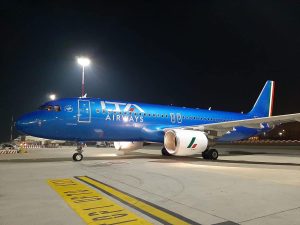
An ITA Airways Airbus A320 with the new livery named after “Fausto Coppi” at Leonardo Da Vinci International Airport. (Photo: ITA Airways)
According to ITA Airways, the Italian national airline offers three travel classes onboard its aircraft: Business Class on long- and medium-haul flights, Premium Economy on long-haul flights only, and Economy. However, on Dec. 26, the airline launched its new Superior Class, a service that was present in the old Italian flag carrier Alitalia but had since been eliminated. Superior Class will be available on some domestic flights, and later — after Jan. 10 — it will be available throughout the airline’s entire domestic network.
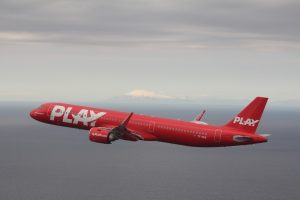
Today, Icelandic low-cost airline PLAY is announcing a new service connecting Iceland to the United States. Starting June 9, PLAY will fly between its main base at Rekjavik, Iceland’s Keflavik Airport and New York’s Stewart International Airport.
The low-cost carrier industry is about to have some major breakthrough changes, beginning with the definitive merger between two of the largest and most prominent low-cost carriers in the U.S.; the first airline merger since Alaska purchased Virgin America back in 2016.
On Tuesday, Ethiopian Airlines operated its first Boeing 737 MAX flight almost three years after regulators grounded the fleet globally — following two deadly accidents involving the aircraft.
On Feb. 14, ANA and Joby Aviation announced an agreement that will see Japan’s largest airline unite with the aerospace company to offer aerial ridesharing services to Japan. Toyota Motor Corporation has also joined the agreement — with plans to study potential topics such as ground-based mobility.
The situation on the border between Ukraine and Russia has always been very tense. To better comprehend the reasons for this war, it is necessary to understand the events of recent years.
March
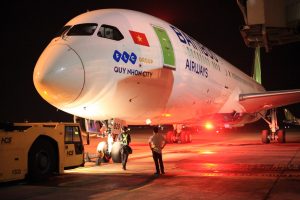
A Bamboo Airways 787 departs from Hanoi for its inaugural flight to the U.S. (Photo: Bamboo Airways)
Bamboo Airways — a Vietnamese leisure carrier — hasn’t stopped expanding its route map during the pandemic. Recently, the carrier announced the launch for flight operations between Ho Chi Minh City, Vietnam and Sydney on March 30.
As the conflict between Russia and Ukraine continues escalating, more countries are closing their airspace to Russian carriers and Russia-registered aircrafts. In return, Russia closed its airspace to those countries to retaliate.
Today there are only three Italian airlines with an Air Operator Certificate (AOC), ITA Airways, Air Dolomiti (part of the Lufthansa group) and Neos Air.
The Australian Civil Aviation Safety Authority (CASA) has recently released an airworthiness bulletin stating that “CASA has not confirmed any RA (radar altimeter) system failure from 5G interference but continues to monitor this situation.”
On the afternoon of March 21, a China Eastern Boeing 737-800 flying domestically from Kunming to Guangzhou crashed in a mountainous of Southern China. According to official sources, the aircraft had 123 passengers and 9 crew members on board flight MU5735.
April
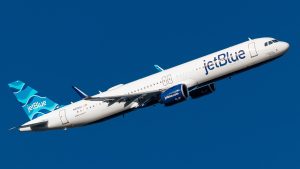
JetBlue Airbus A321 departing London Heathrow [AirlineGeeks | James Dinsdale]
Following reports by the New York Times, JetBlue announced that it had submitted a $3.6 billion all-cash offer for Miramar, Fla.-based Spirit Airlines, putting the New York-headquartered carrier in direct competition with Frontier Airlines — the ultra-low-cost carrier with which Spirit had agreed to merge earlier this year.
This year’s Easter weekend has seen Australian airports and airlines struggle to manage the highest amount of passengers some airports have seen in over two years.
One of Europe’s busiest airports is set to have further disruption this weekend after an unannounced baggage handlers strike caused chaos last weekend.
A KLM 737-800 in Amsterdam (Photo: AirlineGeeks | William Derrickson)
May
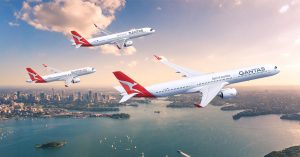
A rendering of Qantas’ new Airbus A350-1000, A321XLR and A220-300. (Photo: Qantas)
The Essential Air Service – or EAS – communities have been taking a major hit over the past eight months. First Boutique Air requested to terminate Jackson, Tenn. followed by Show Low, Ariz. Altoona, Penn., and Pendleton, Oregon, although the latter three were just so the carrier could get a higher subsidy and is in the process, they are planning to leave Jackson in the next month or so.
Dubai, the United Arab Emirates-based Emirates will convert six more of its Boeing 777s into freighters which will serve to provide capacity growth, according to Cargo Facts.
Airline passengers this summer can continue to expect record flight cancellations as the aviation industry wages its battle against one of the largest pilot shortages to date.
As the travel industry attempts to return to a semblance of normality after months of restrictions due to the COVID pandemic, each country tried to find its own way to deal with the situation balancing the need to protect its population in a rapidly changing health environment and the need to restart business and leisure air traffic to support the economy.
Air New Zealand unveiled its plan on Wednesday for completely redesigned cabins on its Boeing 787-9 Dreamliners, creating a much more comfortable experience for passengers on the carrier’s long-haul flights.
An Air New Zealand Boeing 787 Dreamliner landing in Houston. (Photo: AirlineGeeks | William Derrickson)
On 30 June 2022, Etihad Airways celebrated the arrival of its new Airbus A350-1000 (one of five new Airbus A350s to join Etihad’s fleet this year) in the United States, with 371 passengers, following the inaugural commercial flight from Abu Dhabi International Airport (AUH) to New York’s John F. Kennedy International Airport (JFK).
American Airlines has announced company-record second-quarter revenue earnings of $13.4 billion for Q2 2022. The revenue figure is a 12.2 percent increase over the same quarter in 2019, despite capacity being down 8.5 percent.
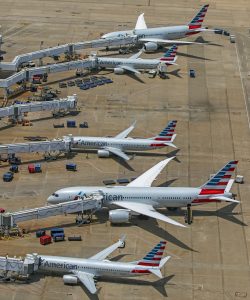
American Airlines jets on the ramp at DFW. (Photo: AirlineGeeks | William Derrickson)
August
Delta’s new Airbus A321neo. (Photo: Delta Air Lines)
Earlier this week, United announced new direct flights between Washington, DC’s Dulles Airport and Cape Town, South Africa —becoming the first airline to provide nonstop round-trip service from the United States’ capital to one of South Africa’s main gateways.
While the airline industry recovers from the drastic collapse in demand caused by the COVID-19 pandemic, airlines and airports worldwide are struggling to cope with the sudden uptick in demand triggered by the removal of many restrictions on international mobility.
This month, AirlineGeeks took advantage of the opportunity to review the US airline described by Forbes magazine as “top in reliability for the second year running.”
It wouldn’t be a Hawaiian air show without Hawaiian Airlines. Photo: AirlineGeeks | Mike Mangano
This past week, Emirates announced an expansion of their premium economy offering, making it available across more routes. Premium Economy was initially not a focus for the airline, but over the years its popularity has been growing and airlines have quickly come to see the dollar signs tagged to it.
Virgin Atlantic revealed images on Twitter of its freshly painted Airbus A330neo. The highly anticipated aircraft is just one of the carrier’s 16 Airbus A330-900s firm orders that were placed during the 2019 Paris Airshow.
United Airlines has requested an additional 30-day waiver from the U.S. Department of Transportation (DOT) ahead of an Oct. 31 deadline to resume flights to Cuba.
Air travel was dead in late-2020. Airlines had slashed their schedules to fractions of 2019 levels, potential travelers had hunkered down to protect themselves from Covid-19 and airports had little to do but sit idly by.
October
Rex Finalises Purchase of National Jet Express. (Photo: Regional Express)
At its global headquarters in Montreal, Canada, the International Civil Aviation Organization (ICAO) has just concluded its 41st Assembly, a global event that every three years gathers all Member States to decide the way forward for all global items involving commercial aviation.
Amazon Air, the cargo airline of Amazon.com, Inc. which operates exclusively for Amazon’s parcel transportation business, has signed a lease agreement for ten converted to freighters (P2Fs) Airbus A330-300.
Another earnings presentation, another negative result for Boeing. In recent years, the U.S. manufacturer found no way to escape this sequence, and Q3 2022 was no exception.
Boeing’s 737 MAX 10 on its maiden flight (Photo: AirlineGeeks | Katie Bailey)
November
HARS’ Lockheed Super Constellation. Photo: Ryan Imeson
The chance to visit any air show is, of course, a delight. The opportunity to attend an air show based at an aviation museum, however, is extraordinary. That’s what makes Wings Over Illawarra so distinctly unique.
Wizz Air is among the fastest-growing European airlines in 2022. It was also recently named Global Environmental Sustainability Airline Group of the Year at the inaugural Centre for Aviation Asia Aviation Summit and Sustainability Expo in Singapore and received the Europe, Middle East and Africa Environmental Sustainability Airline of the Year.
As China continues to pursue its zero-Covid-19 strategy imposing heavy restrictions on international travel and countries in East Asia continue to feel the impact of the closure of Russian air space to European and North American carriers, efforts are being made to boost commercial relationships with other Asian countries that represent viable commercial partners for Western economies.
The airline plans to be based in Belfast, Northern Ireland in the summer of 2024. Operating flights to both the United States and Canada, Fly Atlantic will look to change the narrative on ultra-low-cost transatlantic travel.
December
A United Express CRJ-200 exiting the runway in Ogdensburg, N.Y. (Photo: AirlineGeeks | Joey Gerardi)
Denver based startup Boom Supersonic announced on Tuesday that it had finally found a designer and manufacturer for the engine it hopes will power its Overture aircraft.
The week leading to Christmas is usually a very busy travel period in North America, but this year it has been made particularly chaotic by Winter Storm Elliot, an extra-tropical bomb cyclone that created blizzard conditions over large parts of the United States and Canada and wreaked havoc into airline schedules.
One Door Closes, Another Opens
It’s no lie that this year has been incredible – we’ve worked around the clock and around the globe to deliver all things airlines and aviation. We are thankful most for you — our cherished reader. This year saw us crack 60,000 followers on Twitter alone, and with all the comments and retweets, you sure know how to make us feel appreciated. Thank you.
As this year ends, we are excited for the next! We thank you for your support, and we — AirlineGeeks — look forward to delivering the very best we can.
All the best, and however you welcome 2023, be safe and keep your eyes on the skies!
Mike’s love affair with flight and mechanical objects in the sky began at an early age, fascinated by space documentaries and the vintage Flight Simulator ’95. He currently works as an instructor for UAVs and is training to receive his Private Pilot Licence with the goal of working in manned flight instruction. An avid reader of all things aviation and manned space flight, Mike stays close to developments in aerospace while reminiscing and sharing the rich history of flight with others. He loves writing, engineering and science.
A New England Airline's Britten-Norman BN2 Islander landing at Block Island State Airport. (Photo: AirlineGeeks | Fangzhong Guo)
With all the renewed discussion on single pilot operation, it’s important to remember it is not an entirely new concept. Many commuter flights already utilize single-pilot operation, and here’s one of my experiences flying on one.
I took the flight in April 2022 from Westerly, R.I., to New Shoreham, R.I., on New England Airlines. The Westerly-based airline was the only airline serving this route. In fact, it’s the only scheduled service in either of these airports.
It’s also the only scheduled Britten Norman BN-2 Islander flight in contagious 48. Several other airlines fly the BN-2 as well. However, almost all of them are based in Puerto Rico.
The entire experience was nostalgic, unlike anything I’ve seen before.
Booking
A hand-written ticket in 2022. (Photo: AirlineGeeks | Fangzhong Guo)
Despite offering ‘scheduled services,’ the airline is in no way traditional. The only way to reserve a seat is to call the airline directly. Since my flight was at the end of spring, before their peak season, I was able to get a reservation on the day of my flight.
On top of that, you can only pay for your flight when you arrive at the airport. What’s more interesting is instead of a plain receipt from the POS machine, you also get a handwritten ticket. The last time I saw a paper ticket was in the early 2000s, not to mention a handwritten one.
Why did an airline choose not to offer conveniences such as online booking? The DOT rules on interstate services may have played a part. In previous rulings and the ongoing feud between Dash Air Shuttle and Kenmore Air, the DOT has considered online booking a form of inter-state operation, which requires the carrier to apply for an additional certificate to carry out the service. The tiny airline in Rhode Island may have chosen to keep it simple, which also enabled us to have more memorabilia.
Departure
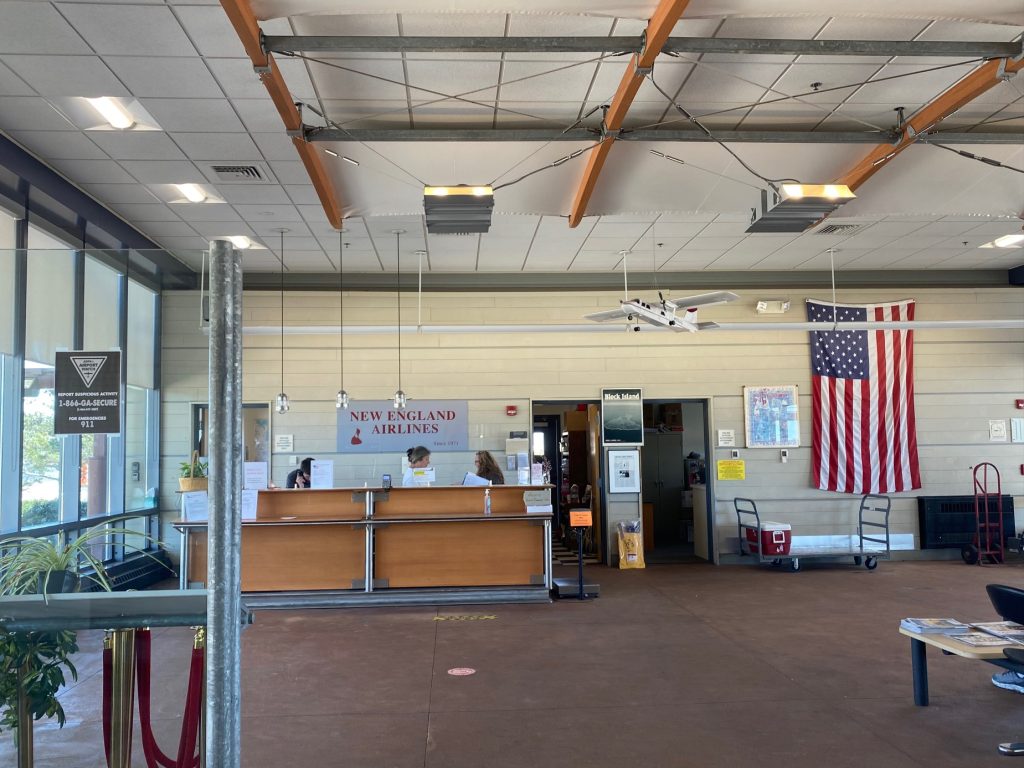
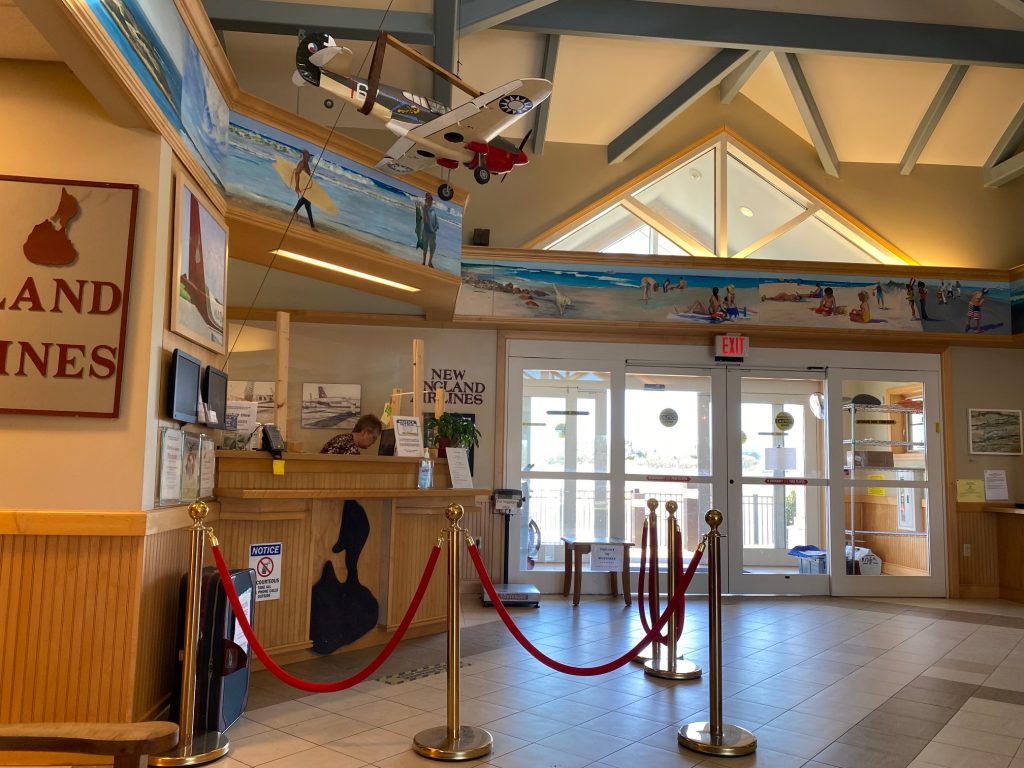
Since Westerly State Airport does not connect to the rest of the National Air Transporation System, passengers do not go through security checkpoints. While the airport does not have separate areas for arrivals and departures, it has an indoor waiting room and an outdoor waiting area.
New England Airline’s counter at Westerly State Airport. (Photo: AirlineGeeks | Fangzhong Guo)
Inside the terminal, you have the check-in counter and a few benches for people waiting for their flight or picking up their family and friends. It also houses a few vantage carts that hold the packages and food deliveries that would later join me on my flight.
The outdoor waiting area at Westerly State Airport. (Photo: AirlineGeeks | Fangzhong Guo)
The outside space lets you be within mere feet of the aircraft. Several BN-2s in New England Airlines livery were sitting on the ramp. Although the extra planes are mostly flying charters, it’s still reassuring to see their fleet out in the sun, ready to keep this vital link running.
The Flight
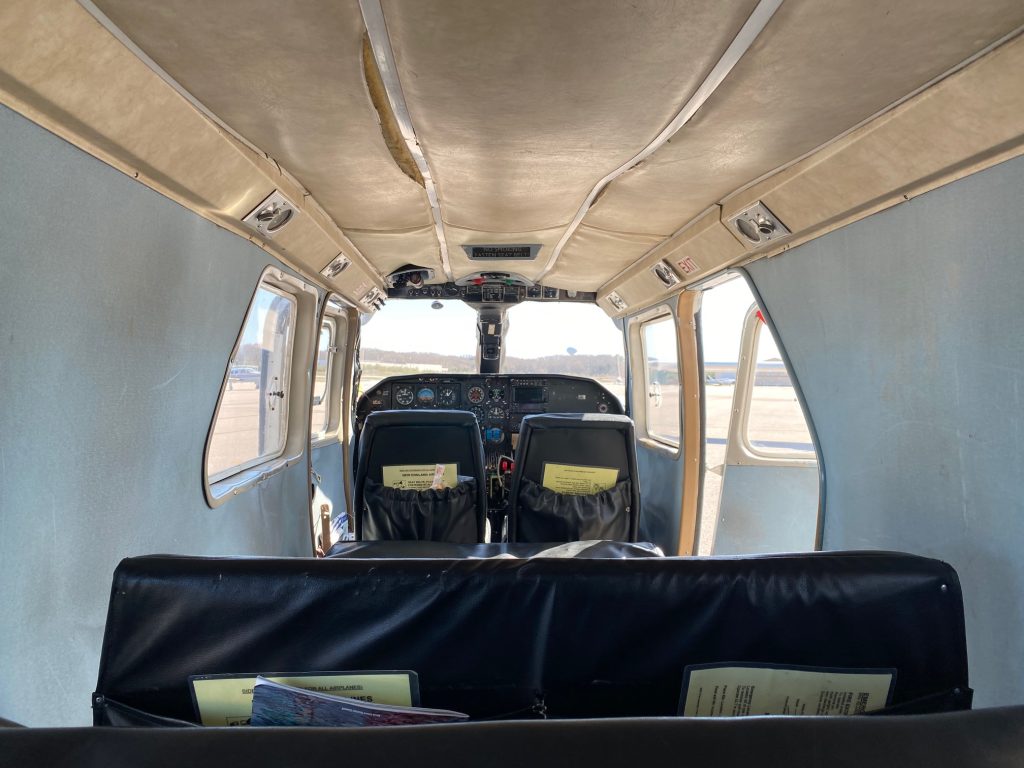
The Britten-Norman BN-2 Islander features bench style seating. (Photo: AirlineGeeks | Fangzhong Guo)
The Islander can carry up to nine passengers with four rows of bench seating and an individual seat beside the pilot. Rather than boarding everyone through the same door, we boarded through two separate entrances on both sides of the aircraft. The rear entry on the left side provides access to the back two rows, whereas the two rows behind the pilot board through a door on the airplane’s right side. The first passenger row folds down so others can reach the middle of the plane.
The interior is by no means comfortable, not even by general aviation airplane standards. Single passengers generally need to share a bench with a stranger in the tight fuselage. There was barely any padding or insulation on the wall, so the cabin was very noisy inflight. However, I found myself appreciating that intimacy with the machine.
Despite having an abysmal cabin, it does have one of the quirkiest features I’ve seen on a plane. In addition to the overhead air vents, the Islander also has a small opening in the window. Passengers can rotate the knob on the tab to allow more airflow from the outside. You can even use it when the plane is in the air.
Both my flights had an air time of 10 minutes, so bare minimal amenities won’t be a problem. The weather was fairly calm for my flights, but it’ll certainly be a bumpy ride when it is rougher.
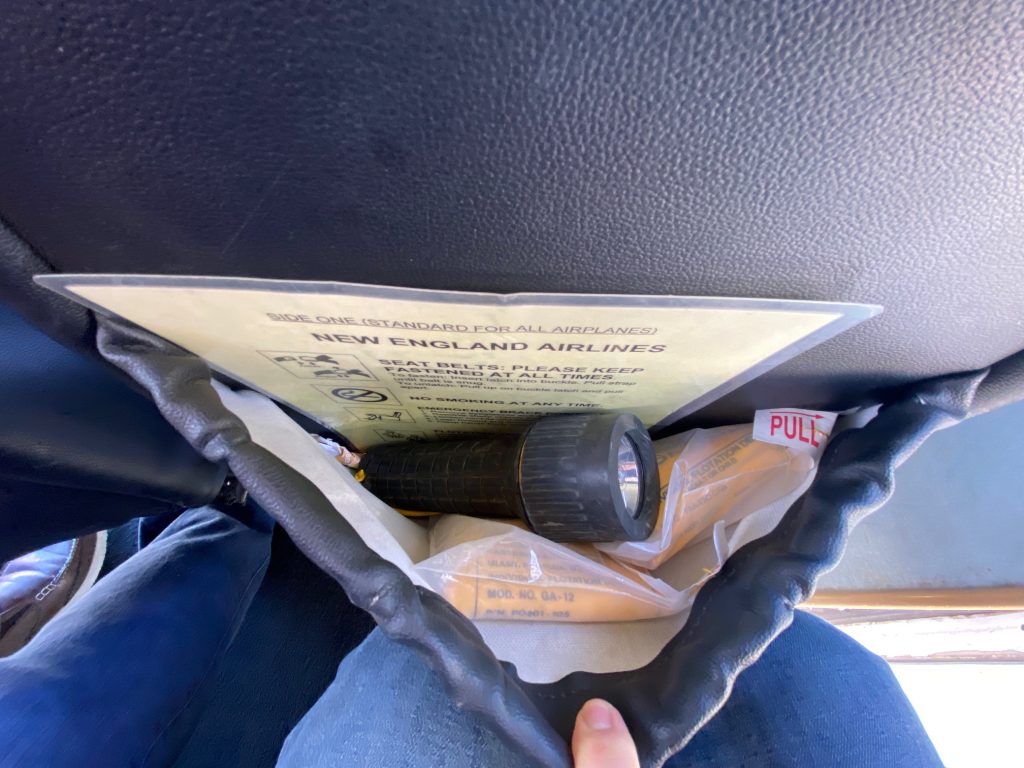
Seatback pocket contents include a safety card, a life vest, and a flashlight. (Photo: AirlineGeeks | Fangzhong Guo)Flying aboard the Britten-Norman BN-2 Islander. (Photo: AirlineGeeks | Fangzhong Guo)
Block Island
New England Airline’s counter at Block Island State Airport. (Photo: AirlineGeeks | Fangzhong Guo)
Block island is a popular summer vacation spot in the area. People can arrive on the island via ferry, which lands at the heart of the town. New England Airlines offers a much faster alternative, although passengers need to call a cab or walk a mile and a half to the center. Many people on my flights were coming to the island for work, including several builders.
After a quick stroll to and back from town, I enjoyed a sandwich at the airport diner while watching planes come and go. Eating right next to an active ramp is a treat you can only get at small general aviation airports.
Enjoying a sandwich next to the ramp is a rare treat only available at small airports. (Photo: AirlineGeeks | Fangzhong Guo)
What about single-pilot operation?
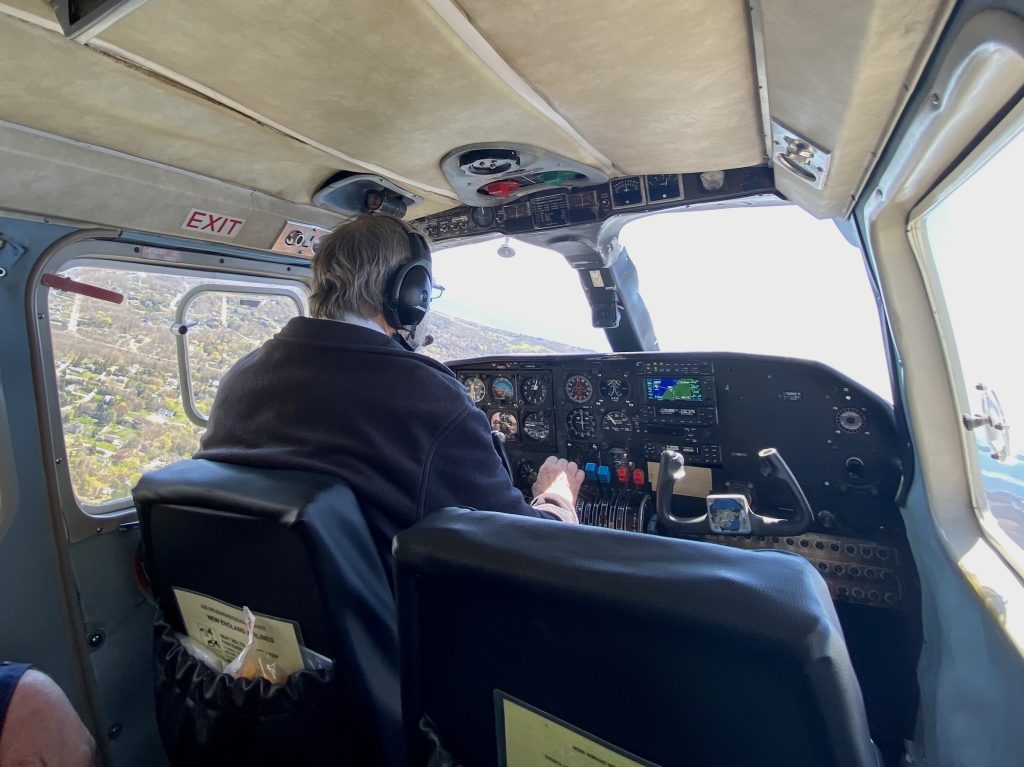
Many commuter flights are operated by a single pilot. (Photo: AirlineGeeks | Fangzhong Guo)
Like many other commuter flights in the country, this northeastern airline also flies their planes with a single pilot. Unlike many other flights flown by a lone pilot, the ‘cockpit’ of the BN-2 is more challenging to access by passengers sitting behind the pilot. It would seem that this would be concerning since we’ve all heard stories of passengers having to land a general aviation airplane when the pilot became incapacitated due to medical conditions. However, given how short this hop was, none of the passengers showed a remote sign of concern.
It’s always a balancing act ensuring air service safety and efficiency. In this case, a ten-minute hop over the waters has very few threatening factors which enabled the airline to continue providing service to the island. Single-pilot operation is a great way to provide important connectivity to communities that won’t otherwise have fast air transportation. It shouldn’t be just another thing the airlines do to lower their costs.
Fangzhong grew up near an OEM airport in northeastern China, where he developed his enthusiasm for aviation. Taking upon his passion, he's now working as an aircraft interior design engineer. Besides working in the aerospace industry, Fangzhong enjoys trying out different types of airplanes and seeing how airplane interiors have evolved. So far, he's flown on over 80 types of aircraft. He also planespots in his spare time. His rarest catches included the 747 Shuttle Carrier Aircraft and AN-225.
Ethiopian Airlines Announces Singapore, Copenhagen As Two Latest Destinations
An Ethiopian Airlines Boeing 787-9 Dreamliner landing in Brussels. (Photo: AirlineGeeks | Fabian Behr)
Ethiopian Airlines is resuming services to Copenhagen on May 22 after last serving the Danish capital in 2003. The carrier plans to offer five flights per week to the city, starting on May 22, 2023. The Addis Ababa-Copenhagen Kastrup route will operate via Austria’s capital Vienna using the Boeing 787-9 Dreamliner.
Copenhagen was last served by Ethiopian in October 2003, when the airline ended its one-stop routing via Frankfurt. Since joining Ethiopian’s network in 2014, Vienna has had flights continue to Stockholm; Brussels; Milan, Italy; Geneva and Marseille, France. In recent years, the carrier has served two destinations in Scandinavia, flying to Stockholm and Oslo.
At the present time, OAG data shows it operates a daily Addis Ababa-Stockholm-Oslo service using a mix of 787-9s and 777-200LRs.
The new route will also have an impact on the Vienna route as previous onward flights to the Belgian capital Brussels will no longer be used after stopping in Austria.
Ethiopian currently operates a route from Addis Ababa to Vienna to Brussels five times per week, in addition to operating twice-weekly nonstop flights from Addis Ababa to Brussels.
The addition of the Addis Ababa-to-Vienna-to-Copenhagen route will see Ethiopian end the Addis Ababa-Vienna-Brussels routing and instead operate daily nonstop flights between Addis Ababa and Brussels.
Return to Singapore
As well as making changes to its European network, Ethiopian has also confirmed plans to resume regular flights to Singapore after a three-year hiatus because of the pandemic.
From March 25, the carrier will offer a four times-weekly Addis Ababa-Singapore-Kuala Lumpur route a move that brings the Ethiopian national carrier back closer to restoring services to all pre pandemic destinations.
“The flight will further expand our network in Asia and create air connectivity for passengers travelling between Africa and Singapore,” Ethiopian Group CEO Mesfin Tasew said.
“The new flight will also facilitate trade, investment, and tourism ties between Africa and Singapore. In line with our plan for growing our network around the world, we will keep on opening new routes to enhance connectivity between Africa and the rest of the world via Addis Ababa.”
The last time the carrier operated its passenger services to Changi Airport was from June 2017 to March 2020 due to the pandemic and border closures. However, the Star Alliance airline continued to operate ad hoc cargo services using passenger aircraft.
Passenger traffic between Africa and Southeast Asia grew steadily between 2015 and 2019 pre-pandemic. More than 1.4 million passengers travelled between the Africa and South-east Asia in 2019, an increase of about 30% from 2015.
Flights from Addis Ababa to Singapore will take about ten and a half hours, while the return journey will take close to nine hours.
Victor Shalton's love for aviation can be traced to when he was 11-years-old. As a seasoned aviation writer, he takes pride in providing the best aviation coverage around the globe and is passionate about advancing his skills in the aviation space. In addition, he loves travelling, writing, arts and while his speaking engagements have taken him around the world, he is proud to call Nairobi home.
China Eastern's flagship Boeing 777-300ER at Shanghai's Pudong Airport (Photo: AirlineGeeks | Albert Kuan)
After being closed for three years, China will reopen its borders on January 8, 2023, and will eliminate the mandatory quarantine requirement for entry into the country, according to reports from the South China Morning Post.
The Asian giant was the first nation to be affected by the COVID-19 pandemic, because of which China closed entire cities, strict quarantines, and isolation of those infected.
Provincial health authorities are already prepared to meet the management plan for the reopening of the borders, as the country will only require a 48-hour PCR test for entry into the country.
A health official from the southern Guangdong province commented that they are already in preparations to open the border with Hong Kong. “It sets the direction for China’s Covid-19 control, which is more flexible and less disruptive to people’s lives,” the official said.
The airline industry in China was severely hit since January 2020 when airlines started canceling operations in the country, international passenger traffic dropped to record lows.
Major projects such as the Beijing-Daxing International Airport (PXK) stalled due to lack of foreign operators and low demand in the domestic market, and Chengdu-Tianfu International Airport (TFU) has been left without a date due to the pandemic situation.
With the opening of China’s borders, there’s a hope for foreign airlines to soon return to the country and for domestic operators to rebuild their international network.