









Stories

Emirates Takes Delivery of Final A380

An Emirates A380 in Dubai. (Photo: AirlineGeeks | Hisham Qadri)

Emirates took delivery of MSN272 on Thursday, 21 years after betting on the model as its launch customer during the 2000 Farnborough Air Show, when the aircraft was still being presented as A3XX, thus marking the end of the production line of the largest passenger aircraft in history. A total of 251 aircraft were produced, including three test aircraft.

This A380, registration A6-EVS, is the 123rd of the model delivered to Emirates by Airbus. The Dubai-based airline was key to the launch of the A380, and it was also a major contributor to the airline’s global expansion.

“The A380 is a special aircraft in many ways. For Emirates, it gave it the opportunity to redefine the travel experience, serve slot-scarce airports efficiently and enhance the growth of our network. It will continue to be Emirates’ flagship aircraft for years to come and an essential pillar in our plans,” said Sir Tim Clark, Emirates’ President in a statement.

Emirates take delivery of last superjumpo (Photo: Emirates)

The executive also highlighted that this A380 incorporates the latest enhancements to its passenger cabin, such as the new Premium Economy cabin, which confirms Emirates’ intention to continue to invest in the model. 52 of the 120 A380s remaining in its fleet will be refurbished.

Based on information gathered by Aviacionline through Cirium, by January 2022 Emirates will operate the A380 from Dubai to Amman, Amsterdam, Bangkok, Cairo, Guangzhou, Paris-CDG, Moscow-DME, Dusseldorf, Frankfurt, Sao Paulo-GRU, Hamburg, Istanbul, New York-JFK, Johannesburg, Los Angeles, London-LGW, London-LHR, Madrid, Manchester, Mauritius, Munich, Milan-MXP, Sydney, Vienna, Toronto, and Zurich.

This adds up to some 605 weekly flights with a supply of 296,181 seats, figures in both cases 52.5% lower than in the same month of 2020, prior to the pandemic outbreak.

This article was written by Edgardo Gimenez Mazó for Aviacionline.
Ryan Ewing

Ryan founded AirlineGeeks.com in February 2013 and has spent more than a decade covering the airline business. His work has been featured by CNN, WJLA, CNET, and Business Insider. His aviation experience spans airport operations, Part 135 regulatory compliance, and airline crew workforce planning, along with time behind the yoke of a Cessna 172 and interviews with airline executives. Ryan now serves as Group President of Firecrown Media’s Aviation Group. He holds a B.S. in Air Transportation Management and an MBA from Arizona State University and teaches Airline Management at Embry-Riddle Aeronautical University.

British Airways Parent Company Scraps Plans For Buyout

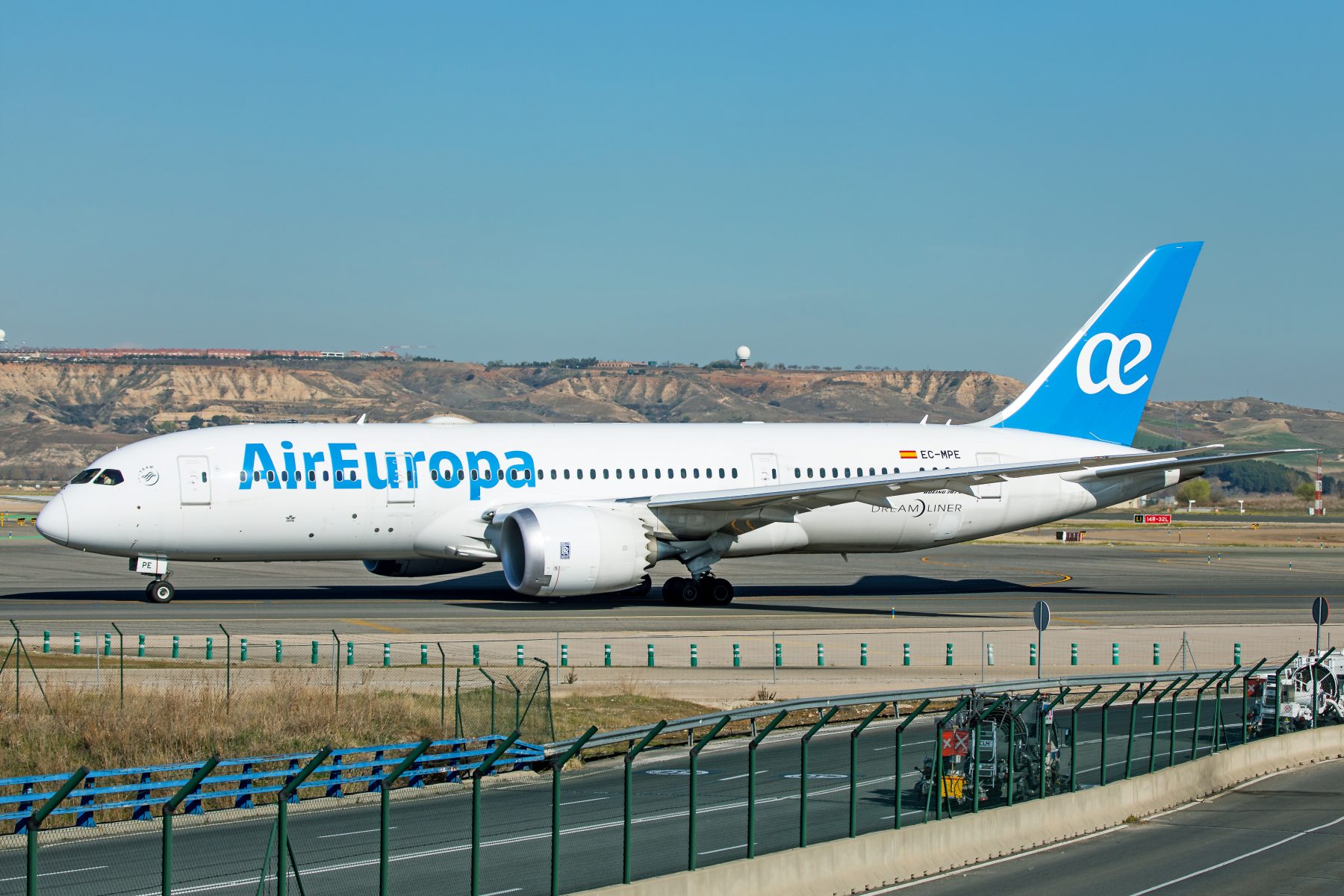
Air Europa 787
An Air Europa 787-8 in Madrid. (Photo: AirlineGeeks | William Derrickson)

International Airlines Group (IAG)  — the parent company of British Airways — is reportedly canceling plans to take over Spanish carrier Air Europa. Reuters reported that the deal to purchase Air Europa would have required IAG to make concessions to satisfy European regulators. The regulator had commenced an inquiry into the deal in June of this year. The consortium had reportedly offered to relinquish 13 short and medium-haul routes and two long-haul routes to Madrid and Barcelona, Spain.

The concession offered by IAG appears not to have been enough to satisfy the regulator’s concerns that such a takeover would result in a less competitive Spanish domestic air market.  Other concerns related to international routes into and out of Spain were also thought to have been a red flag for the regulator. Air Europa has operations to European destinations and to Latin America.

IAG planned to buy out Air Europa for a reported  €1 billion ($1.1 billion) and was first announced in November 2019 by then chief executive Willie Walsh. At the time of the initial announcement, Mr. Walsh said,  “Acquiring Air Europa would add a new competitive, cost-effective airline to IAG, consolidating Madrid as a leading European hub and resulting in IAG achieving South Atlantic leadership, therefore generating additional financial value for our shareholders.”

The U.K. Government had advised last month that the country’s Competition and Markets Authority (CMA) had opened an inquiry into the proposed acquisition. In a statement seeking comment, the government said, “The CMA is considering whether it is or may be the case that this transaction if carried into effect, will result in the creation of a relevant merger situation under the merger provisions of the Enterprise Act 2002 and, if so, whether the creation of that situation may be expected to result in a substantial lessening of competition within any market or markets in the United Kingdom for goods or services.”

In January 2021 IAG’s offer to Air Europa’s owners was cut to €500 million as a result of the effects of the pandemic.

Current IAG chief executive Luis Gallego said at the time, “Being part of a large group is the best guarantee to overcome current market challenges which will also benefit Air Europa once the transaction is completed. I am pleased that we have reached an agreement with Globalia to defer payment until well into the expected recovery in air travel following the end of the pandemic and when we expect to be realizing significant synergies resulting from the transaction.”

Aviation analysts have stated that withdrawing from the deal prior to a denouncement by regulators may place any future bid by IAG in a more favorable light.

John Flett

John has always had a passion for aviation and through a career with Air New Zealand has gained a strong understanding of aviation operations and the strategic nature of the industry. During his career with the airline, John held multiple leadership roles and was involved in projects such as the introduction of both the 777-200 and -300 type aircraft and the development of the IFE for the 777-300. He was also part of a small team who created and published the internal communications magazines for Air New Zealand’s pilots, cabin crew and ground staff balancing a mix of corporate and social content. John is educated to postgraduate level achieving a masters degree with Distinction in Airline and Airport Management. John has held the positions of course director of an undergraduate commercial pilot training programme at a leading London university. In addition he is contracted as an external instructor for IATA (International Air Transport Association) and has been a member of the Heathrow Community Fund’s ‘Communities for Tomorrow’ panel.

China: Evident Airport Expansions As Passenger Throughput Freezes

The new airport already has some tenants including Air China and China Eastern. (Photo: Hufton+Crow)

On Dec 16, Haikou, China’s Meilan Airport will officially open its Terminal 2. The terminal is part of the project for doubling the airport’s capacity. Amid the complicated Covid-19 situation still shadowing the public’s willingness to travel, Chinese airports are grasping this moment as a precious opportunity to expand their facilities without too much disturbance from ongoing operations.

Shiny Airports

Chengdu Tianfu International Airport
Departure hall of Chengdu Tianfu International Airport | Photo: Lei Yan

In 2021, the country welcomed 2 new mega airports, Chengdu, China’s Tianfu Airport, and Qingdao, China’s Jiaodong Airport. Both airports are designed to be future hubs of their regions. Existing airports are also building new gates and runways. Besides Meilan, China’s Airport, Shenzhen, China’s technology capital, opened a satellite concourse at its Bao’an Airport last week; Kunming, China’s Changshui Airport opened its satellite concourse in October 2021. Outside of China’s first and second-tier cities, smaller towns are also building moderately sized new airports, aiming to attract more travelers after the pandemic.

Departure hall of Beijing Daxing International Airport | (Photo: Lei Yan)

Many new terminals and new runways are under construction in China. Guangzhou, China’s Baiyun Airport, the world’s largest airport in 2020, is constructing multiple concourses and a new terminal aiming to expand its capacity to 120 million passengers; Hangzhou’s Xiaoshan airport is building a new terminal 4 to support the Asia Olympic games; Hong Kong Airport is also on track to have a new runway and a new terminal by 2024. Additionally, new capacities will facilitate the recovery and long-term growth of those regions.

Departure Hall of Qingdao, China’s Jiaodong Airport | (Photo: Lei Yan)

Struggling Industry

Due to the recent Covid-19 uptick in China, Reuters is warning of negative growth for the aviation market in China. After a weak third quarter, the final quarter of 2021 will likely be very moderate across all regions of China due to the pandemic. For instance, Air China plans to grow domestically as it continues to invest resources within its home country.  As China still adopts a zero-tolerance policy towards Covid-19, travels in-and-out of cities with cases is strongly discouraged with tests and even mandatory quarantine upon arrival.

Airlines are struggling during this trying time. Many major market players have to make the difficult decision to cut their fleets and reduce spending. On the other hand, many airports can withstand the headwinds, and even take on expensive renovation projects. Looking around the world, New York, Los Angeles, Denver, and Sydney are all carrying on with their massive constructions.

Strong Support For Airports

Unlike airlines, most Chinese airports are directly funded by local governments for their operation. Rather than being used as a tool to earn a profit, airports are considered a part of public services facilities. Governments will measure the return of their investments on airport expansions for the benefit of their district, instead of merely on profit directly earned by airports. Passenger throughput is an important measure for the healthiness of a region’s economy. According to multiple studies, the growth of passenger throughput of an airport is highly correlated with the region’s GDP growth.

As the vaccination rate of China reaches 80%, and the rest of the world slowly opening up, experts and officials are optimistic that China will loosen the zero-tolerance policy to better interact with the world. Airports are also taking action to prepare for the reopening, including setting up testing areas, and isolating international traffics with domestic traffics. Airports in China will be ready for the new age of travel.

Lei Yan

Lei is from Inner Mongolia, China, and now lives in Guangzhou. He grew up in an aviation family, where his passion began. During his time at Penn State University, he studied Industrial Engineering specializing in operations research, and he graduated with an honor’s thesis on airport gate assignment optimization. Now, he is a Purchasing Manager with Procter & Gamble. In his free time, he enjoys flying, reading, and wandering around the city.

Qantas Returns To Continental Europe

A Qantas 787 Dreamliner lifting out of Paine Field in Washington. (Photo: AirlineGeeks | Katie Zera)

In response to Australia’s reopening its borders after one of the lengthiest closures,  flag carrier Qantas has certainly been taking the reopening as more than just an opportunity to take the iconic kangaroo to international skies again, but also as an opportunity to try out new ideas.

Qantas Group CEO Alan Joyce said in a press release, “After the restrictions of the past few years, it’s the ideal time to reinvigorate our international network and we’ll continue to look for new opportunities.”

Although Qantas has been working hard on strengthening its cargo capacity while reinforcing its regional brand, the flag carrier also did not forget about its international network as well —making an exciting return to continental Europe.

Reigniting Service To Rome

Beginning June 22 through to October 6, Qantas will be returning to Italy with a direct seasonal service scheduled three-times-weekly via Sydney-Perth-Rome.

Operating under the flight number QF5, it will depart from Sydney at 17:55 on Mondays, Wednesdays and Saturdays for a short stopover in Perth, before arriving in Rome the next day at 08:45.

The returning QF6 departs Rome at 10:50 on Tuesdays, Thursdays and Sundays for a similar stopover in Perth, before arriving back in Sydney at 16:05 the following day.

This new service is routed in such a way to reduce more than three hours off the current fastest travel time to Rome and will be utilizing the Boeing 787-9 Dreamliner — one of Qantas’ long-haul specialists — that is configured with the Business Class, Premium Economy and Economy class cabins for a total of 236 passengers.

Strengthening Ties With Italy

While this route is a new addition to Qantas’ international network,  the airline once flew this route almost two decades ago until it was stopped in 2003.

Prior to this announcement, Qantas was only serving a singular European destination in London, which meant that its passengers would have to go through connecting flights either in Dubai or Singapore if they wanted to fly towards other parts of Europe.

It would definitely make sense for Qantas to reignite its services to Rome, as Joyce added, “Italy is the largest market for us in continental Europe for people visiting family and friends from Australia and we think customers will love flying direct to one of the world’s great cities to spend time with loved ones or enjoy Italy.”

The service to Rome will also provide opportunities for Qantas’ passengers to connect through onward destinations across the Mediterranean and southern Europe through Qantas’ network of partners.

Perth Is Back In Action

Besides providing a huge win for both Qantas and its passengers, the Rome service will also prove to be of huge help to Perth, Australia, which has since lost its stopover status to Darwin for Qantas’ London route.

Perth, Australia’s airport has not been considerably well, as the statistics show international numbers have declined over 95 percent since the start of the pandemic.

Thus,  the new route is expected to attract more visitors to Western Australia, as Qantas partners with Tourism Western Australia to further boost inbound tourism from Europe into Perth, and to also promote Perth as an ideal stopover for Australians traveling to Europe from the east coast — all of which will hopefully help put Perth back into proper action.

Charlotte Seet

Fascinated by aircraft from a very young age, Charlotte’s dream was to work alongside the big birds one day. Pursuing her dream, she went on to achieve her diploma in Aviation Management and is currently working on her degree in Aviation Business in Administration with a minor in Air Traffic Management. When she’s not busy with school assignments, you can find her aircraft spotting for long hours at the airport. In Charlotte’s heart, the Queen of the Skies will always be her favorite aircraft.

How Lufthansa Plans To Tackle 2022 From Key Hubs

Lufthansa
A Lufthansa A350 taxis in Munich. (Photo: AirlineGeeks | Fabian Behr)

Lufthansa has been having quite an exciting year with the miraculous returns of its Airbus A340-600s, Boeing B747-400s and Boeing 747-800s — its iconic quad-jets — as well as exciting services to popular destinations each season and not forgetting having paid off all financial aid from the German government.

As the new year quickly approaches, it would seem the Star Alliance member is prepared for yet another fruitful year, as it launched the 2022 summer flight schedule, which included an expanded network of brand-new destinations from Germany, paired with the increases of frequency and anticipated flight resumptions.

Services From Munich

From one of its major hubs in Munich, Lufthansa will be flying non-stop to Rio de Janeiro — the Brazilian metropolis — as well as to San Diego in the United States. Additionally, the airline’s nonstop service from Munich to Bangkok will also resume.

Commencing on March 27, these direct flights will be operated on the Lufthansa Group’s most modern and economical long-haul aircraft, the Airbus A350-900 – whose fleet in Munich is planned to be expanded from 17 to 21 aircraft, as a result of leasing agreements made earlier this year.

The vacation subsidiary of the Lufthansa Group Eurowings Discover will also be taking off from Munich as it connects with popular summer destinations such as Punta Cana, Dominican Republic; Cancún, Mexico and Las Vegas.

Frankfurt’s Operations

Connecting is the game for Lufthansa as it plans to fly to more destinations in the United States than ever before, starting with a new addition of a non-stop flight to St. Louis, Mo.  — making this service the first offered by an airline from continental Europe in nearly 20 years.

Eurowings Discover will follow the core Lufthansa brand’s lead by flying to Anchorage, Alaska; Fort Myers, Fla.; Las Vegas and Salt Lake City, all in addition to Tampa, Fla. The carrier will also operate flights to Halifax, Canada and Calgary, Canada.

In light of the 2022 Soccer World Cup hosted in Qatar, Lufthansa will be temporarily offering a total of 25 special fan flights from Frankfurt to Doha from November 14 and December 19, with up to five flights a week planned to be made available. Excited fans can start booking these flights from December 16, 2021 and will be seated on an Airbus A340-300 under the flight number LH 620.

Network In Europe

Besides its plan to connect outside of Europe, Lufthansa also plans to increase its intra-European connections from Frankfurt and Munich, allowing for the numbers to get close to the 2019 level of around 5,000 weekly flights.

To accomplish this, the German carrier will be offering six new services from Munich, such as Kalamata in Greece, the island of Menorca in Spain; Varna on the Black Sea; Billund, Denmark and Bergen, Norway. Starting in April, the Italian subsidiary Air Dolomiti will fly to Brindisi, Italy.

As for Eurowings Discover, the vacation airline is taking over from main-brand Lufthansa a total of 22 short-and-medium-haul tourist destinations such as the Canary Islands, cities in Turkey and twelve Greek islands, with newly added destinations including Samos and Skiathos in Greece.

From Frankfurt, Lufthansa will fly to Stavanger, Norway and Rennes, France. Furthermore, Lufthansa will also be offering non-stop flights to Liverpool, United Kingdom making the airline the first global network airline in Liverpool to have an extensive reach across various continents, allowing for passengers to connect through Frankfurt to over 160 destinations.

With 2021 coming to an end and with a new variant dampening on travel spirits, it would seem that Lufthansa remains unfazed and is preparing for a brighter 2022 ahead.

Charlotte Seet

Fascinated by aircraft from a very young age, Charlotte’s dream was to work alongside the big birds one day. Pursuing her dream, she went on to achieve her diploma in Aviation Management and is currently working on her degree in Aviation Business in Administration with a minor in Air Traffic Management. When she’s not busy with school assignments, you can find her aircraft spotting for long hours at the airport. In Charlotte’s heart, the Queen of the Skies will always be her favorite aircraft.

Opinion: Air Cargo Is Booming

A Cargolux 747 (Photo: Ian McMurtry)

Just over a century ago on November 7, 1910, the first-ever cargo flight took place between Dayton, Ohio and Columbus, Ohio with a package of 200 pounds of silk on a relatively small aircraft.

Fast forward to modern times, and we have much larger aircraft for cargo operations with numerous cargo airlines being founded. With the right aircraft and the right operational team, practically everything could be carried in the fuselage ranging from livestock, construction equipment, complete cars and even aircraft parts for assembly.

Air Cargo in Numbers

Before the pandemic rocked the entire world at its core, air cargo has already been a significant part of the aviation industry through the transportation of over 52 million metric tons of good per year, which represents more than 35 percent of global trade by value, but less than 1 percent of world trade by volume.

Whilst the 1 percent may seem quite a little, but the significance of air cargo within the industry is definitely bound to increase with the pandemic entering its third year, which in a way allows for air cargo to play a vital role in delivering much-needed medicines and medical equipment – basically keeping the global supply chains functioning for such time-sensitive materials.

And with the trend of e-commerce riding along with this high tide, retail stores worldwide are also frantically looking towards air cargo for quicker shipping times to improve their business and retain customer loyalty, as opposed to the then traditional method of shipping by sea.

Enjoying the Boom

Cargo airlines have certainly seen their business blossom even as the aviation industry as a whole crumpled during the initial pandemic, with the Cargolux Group reaching a record high in profits for the year 2020, and with bigger airlines managing to scrape through survival through cargo operations on empty passenger flights.

This would probably lead these airlines to wonder, perhaps it is time to invest a little more in air cargo as they used to on passengers?

Few airlines have taken upon such investments this year either through the purchasing of dedicated freighters, or even the freighter conversion of an older passenger aircraft like what Air Canada and Qantas recently did, with Air Canada’s first-ever freighter having entered service almost immediately after conversion as an effort to provide the additional cargo capacity needed.

Another likely airline seems to be Air Belgium when it posted a LinkedIn job posting for full-time pilots to fly the Boeing 747-8Fs for cargo operations set to commence in early 2022. Other airlines such as American and United have been considering bigger cargo operations, but have not taken any significant steps as of yet. Aircraft manufacturers like Airbus and Boeing have also been taking the booming hint, sketching up freighters in the works that can carry more whilst using lesser fuel for their airline customers.

What’s Next for Airlines?

It only takes one new Covid-19 variant to effectively shut down parts of the world again, just as it was having a grand re-opening and airlines were celebrating with network expansions and fleet additions.

Personally, I feel that it would be wise for airlines to focus a bit more on cargo considering how besides the time-sensitive materials like vaccines, e-commerce seems to be quite the driving force behind the boom of air cargo as well. if there’s one thing learned from this pandemic, it’s that airlines cannot simply rely on passenger numbers alone.

It would prove interesting to see which other airlines would slowly venture into either starting or expanding their cargo operations, because whilst it is easy to say and know about the boom of air cargo, but these airlines would also need the financials, aircraft and network for everything to work.

Charlotte Seet

Fascinated by aircraft from a very young age, Charlotte’s dream was to work alongside the big birds one day. Pursuing her dream, she went on to achieve her diploma in Aviation Management and is currently working on her degree in Aviation Business in Administration with a minor in Air Traffic Management. When she’s not busy with school assignments, you can find her aircraft spotting for long hours at the airport. In Charlotte’s heart, the Queen of the Skies will always be her favorite aircraft.

Emirates Suspends Flights To Nigeria Amid Slot Dispute

An Emirates Boeing 777-300
An Emirates Boeing 777-300. (Photo: AirlineGeeks.com | Greg Linton)

Last Friday, Emirates announced the suspension of flight operations between Nigeria and Dubai amid an intensifying slot allocation row between the Nigerian Ministry of Aviation and the United Arab Emirates’ General Civil Aviation Authority (GCAA), just a week after the country’s largest airline announced its flight resumption to Abuja, Nigeria and Lagos, Nigeria.

The Dubai, UAE-based airline is once again suspending flights in and out of Nigeria until both countries resolved “the ongoing issue,” with the suspension taking effect beginning Monday.

Slot Allocation

Abdullah Bin Touq Al Marri — the Chairman of GCAA Board and Minister of Economy — signed a letter from Dec. 10. In the letter, the GCAA requested that the federal government restore Emirates’ winter schedule.
The letter expressed sadness that the federal government withdrew the winter schedule because the United Arab Emirates refused to allow Air Peace’s request for three flights a week slot at Al Sharjah, UAE’s Sharjah Airport. The GCAA argued that Nigeria’s ministry of aviation to limit Emirates flights to once per week was unjustifiable while also accusing Nigeria’s Air Peace of abandoning Sharjah Airport noting that the Airport was currently operating at 140 percent slot capacity.
“We wish to kindly advise you that Sharjah Airport is currently operating at 140 percent slot capacity, but with goodwill and tremendous efforts on their side, this Airport was able to accommodate Air Peace with one of the three slots that this airline requested,” the letter said. “The GCAA wishes to stress that the action being taken by the NCAA is not in line with the spirit of the agreed air services arrangements between our two nations.”
“As we are both aware, the relations between our two brotherly countries are vintage, one hallmark being the recent visit of the President of Nigeria to the UAE, which certainly mirrored the status of the positive relations. Finally, we suggest that Air Peace should consider flying their two flights to any UAE airport at which there are available slots. As expected, the GCAA will support Air Peace in this activity, where required,” the letter adds.

Reciprocal Treatment

Air Peace Airlines — the only Nigerian airline that operates passenger flights to Sharjah International Airport in the United Arab Emirates — requested three weekly passenger flight frequencies and was granted only one weekly flight.

The chair of the GCAA attributed this action due to the non-availability of arrival slots at Sharjah International Airport.

On the other hand, Emirates Airline applied to Nigeria’s Federal Ministry of Aviation for approval of its winter flight schedule, with the requested schedule consisting of 21 weekly passenger flight frequencies to Nigeria, comprising of two daily flights to Lagos, Nigeria’s Murtala Mohammed Airport and one daily flight to Abuja, Nigeria’s Nnamdi Azikwe International Airport.

Captain Musa Nuhu — the Director-General of the Nigerian Civil Aviation Authority (NCAA) — explained that the reason why the government withdrew 20 flights from Emirates, leaving the Middle East carrier with one flight to Abuja, was because that was the same way the UAE treated Air Peace.

Air Peace had requested three flights a week but UAE authorities approved only one flight a week for the airline. The Director-General — in line with the principle of reciprocity — mentioned that the Nigerian government had to do the same for Emirates.

Victor Shalton

Victor Shalton's love for aviation can be traced to when he was 11-years-old. As a seasoned aviation writer, he takes pride in providing the best aviation coverage around the globe and is passionate about advancing his skills in the aviation space. In addition, he loves travelling, writing, arts and while his speaking engagements have taken him around the world, he is proud to call Nairobi home.

South Korea Invests in Poland’s New Airport

Boeing and LOT Polish Airlines celebrated the delivery of the carrier's 737 MAX. The airplane is seen here departing Boeing's delivery center in Seattle. (Photo: Paul Gordon / Boeing).

The global passenger volume has been significantly decreased since the start of the pandemic, but the aviation industry hasn’t ceased to its infrastructure. Polish government has announced that it will build a new airport in Warsaw, the capital of the country. In addition, Seoul, South Korea’s Incheon International Airport Corporation (IIAC) will invest in the new airport project in Poland.

The new airport is the part of Central Transportation Port (CPK) project. According to local media, CPK is the biggest infrastructure investment in the country. The CPK will consist of airport and railway facilities. The new airport will be located in central Poland, 45 kilometers southwest of Warsaw, Poland and will cost about 7.4 billion euros ($8.346 billion).

Mateusz Morawiecki, Prime Minister of Polish said, “the project is a combination of ambition, experience and potential.”

The new airport will cover 3,000 hectares and is expected to be completed by the end of 2027, handling 45 million passengers every year in the first phase, but its capacity could reach 100 million in the future.

Warsaw owns Chopin Airport, which already hit its maximum capacity and will be replaced by the new airport. The 87 years old airport is located 10 kilometers southwest of Warsaw, Poland and has handled almost 19 million passengers in 2019. As a result of the pandemic, the passenger capacity has dropped to 5.5 million in 2020. The top five destinations from Warsaw’s Chopin Airport are Kyiv, Ukraine; London, Paris, Frankfurt and Amsterdam.

Warsaw’s Chopin Airport is best known for the hub for LOT Polish Airlines. According to the airport, Wizz Air has expanded its route map at Chopin in recent years. The Polish government believed CPK will be a huge development boost for the country and benefit South Korea.

Marcin Horala, the commissioner for CPK, said, “The agreement is a very important milestone in this cooperation, which will ultimately lead to a strategic partnership, participation in the newly-built terminal and co-management of its air travel section, but first (investment – PAP) in its construction,” in a press conference for the agreement between two parties. The new hub could be “the Far East’s gateway to the European Union.”

Under the agreement, IIAC will invest the CPK project and participate to build and co-manage the air travel section. Since 2007, IIAC has started its Business Overseas Team to serve foreign airports, such as Russia, India, the Philippines, Indonesia and Turkey. Kuwait International Airport’s consignment operation is one of the IIAC ongoing projects.

The aviation industry in Poland has experienced turbulence during the pandemic. In 2019, LOT Polish Airlines made history to carry over 10 million passengers in a single year and post a profit of 15 million Euros. However, the flag carrier hasn’t done better than its competitors amid the pandemic, taking 3.1 million passengers to the skies in 2020 and posting a loss of 227 million euros. In the wake of the pandemic, the struggling airline needed to lay off its staff and received financial help from the government.

Looking to 2022, Heathrow Expects A Long Road To Recovery

Heathrow Airport's Check-In Area (Photo: AirlineGeeks)

With the effects of the Covid-19 pandemic still being felt around the world almost two years since the beginning of the emergency, air passenger numbers are still far from what they used to be in 2019, especially with regards to international services. London’s Heathrow Airport, the largest airport of the British capital and once the airport with the highest number of international passengers in the world, is still recovering from the collapse in demand caused by government restrictions and is bracing for the impact of the new limitations introduced to curb the spread of the new “omicron” variant.

Last week the airport announced that it expects to end 2021 with a total number of approximately 45 million passengers, just over half of what the airport recorded in 2019. During the last year of pre-pandemic operation, Heathrow recorded 80,890,031 passengers, over 76 million of which were international.

The figures are in line with the long-term forecast elaborated both by the U.K. Civil Aviation Authority and by the International Air Transport Association that were predicting international traffic to reach 60% of 2019 levels by the end of 2021. It is however a significant improvement over the numbers that had been recorded in 2020, when the many months during which operations had almost come to a halt had caused traffic to collapse to levels not seen since the 1970s, with just over 22 million passengers served.

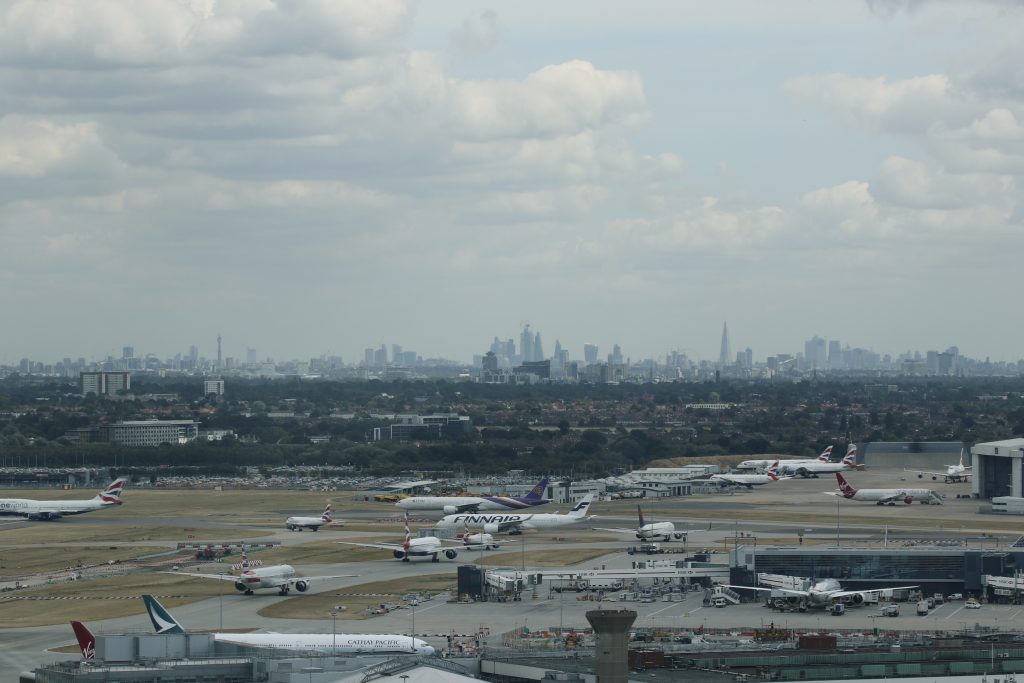
Aircraft lining up for departure out of London Heathrow Airport. (Photo: AirlineGeeks | James Dinsdale)

Heathrow is expecting a soft start of 2022, given the current uncertainty linked to the new measures recently put in place by the British government to contain the diffusion of the new Covid-19 variant. Passengers arriving in the U.K. from all countries are now required to present a pre-flight test and also to take a post-flight test once arrived at their destination. This has caused a high level of cancelation, especially among business passengers, who are reluctant to travel due to a higher risk of being trapped overseas.

“We do not expect that international travel will recover to 2019 levels until at least all travel restrictions (including testing) are removed from all the markets that we serve, at both ends of the route, and there is no risk of new restrictions, such as quarantine, being imposed,” the airport said in a note.

The management of the airport is encouraging Ministers to reduce restrictions as soon as possible to allow travelers coming from countries currently on the U.K. “red list” to isolate at home during the Christmas holidays.

“By allowing Brits to isolate at home, Ministers can make sure they are reunited with their loved ones this Christmas. It would send a strong signal that restrictions on travel will be removed as soon as safely possible to give passengers the confidence to book for 2022, opening up thousands of new jobs for local people at Heathrow. Let’s reunite families for Christmas,” said John Holland-Kaye, CEO of Heathrow Airport.

Vanni Gibertini

Vanni fell in love with commercial aviation during his undergraduate studies in Statistics at the University of Bologna, when he prepared his thesis on the effects of deregulation on the U.S. and European aviation markets. Then he pursued his passion further by obtaining a Master’s Degree in Air Transport Management at Cranfield University in the U.K. followed by holding several management positions at various start-up carriers in Europe (Jet2, SkyEurope, Silverjet). After moving to Canada, he was Business Development Manager for IATA for nine years before turning to his other passion: sports writing.

British Airways Schedules More A380 Destinations

A British Airways Airbus A380 taxis in Los Angeles. (Photo: AirlineGeeks | William Derrickson)

Coming just on the heels of British Airways resuming Airbus A380 service to LAX, according to theaeronetwork, the airline has announced the resumption of four A380 destinations in the U.S. that are slated to begin this coming spring and summer: Boston, San Francisco, Washington D.C., and Chicago. Dallas Ft. Worth is slated to receive the A380 as well but was already previously announced.

Neither Chicago’s O’Hare International Airport nor Boston Logan International Airport had seen a regularly scheduled A380 service since before the pandemic. The last time O’Hare saw any A380 service was from British Airways in the summer of 2019. Boston last saw a scheduled A380 service in January 2020 with Emirates operating to Dubai.

Emirates recently resumed A380 services to San Francisco and Washington D.C. Another airport that has recently been without the world’s largest passenger aircraft, Dallas hasn’t seen the A380 since Qantas served there before the pandemic.

A British Airways A380 landing at London’s Heathrow Airport (Photo: AirlineGeeks | William Derrickson)

While O’Hare hasn’t seen the A380 since 2019, Boston Logan did receive an unexpected visit from it on Nov. 13, when an Emirates A380 flying from Dubai to New York’s John F. Kennedy International Airport was diverted to Boston due to weather in the New York City area. Service on the A380 is slated to resume on May 15, 2022, and will operate on a daily basis from London Heathrow.

Chicago will have the first scheduled A380 flight return on British Airways on June 1, 2022. San Francisco service on the A380 will begin on May 1, 2022, and Washington Dulles International Airport — located just outside the District in Northern Virginia — will begin on March 27, 2022.

Before resuming long-haul routes, the British superjumbo spent roughly a month — from Nov. 8 until Dec. 2 — doing short-haul routes within Europe to refamiliarize crews with the aircraft as it was grounded for such a long time. During that time period, the airline was operating flights from its main base of Heathrow Airport in London to Madrid and Frankfurt.

These announcements come on as the final Airbus A380 ever built is in the process of performing test flights before being delivered to Emirates. While airlines like Malaysia Airlines and Lufthansa have permanently retired their superjumbo fleets during the pandemic, from the look of these routes, it is clear that British Airways will have these aircraft around for a while.

Joey Gerardi

Joey has always been interested in planes for as long as he can remember. He grew up in Central New York during the early 2000s when US Airways Express turboprops ruled the skies. Being from a non-aviation family made it harder for him to be around planes and would only spend about three hours a month at the airport. He was so excited when he could drive by himself, the first thing he did with his driver's license was get ice cream and go plane spotting for the entire day. He graduated from Western Michigan University in 2022 with a B.S. in Aviation Management & Operations and a Minor in Business, and currently works for a major airline in his hometown.
Sign-up for newsletters & special offers!

Get the latest stories & special offers delivered directly to your inbox

SUBSCRIBE